Archive for the Open Access Category

Elsevier is taking down papers from Academia.edu

Posted in Open Access with tags , on December 12, 2013 by telescoper

Yet another example of an academic publisher (Elsevier) acting in a manner clearly detrimental to research.

Mike Taylor's avatarSauropod Vertebra Picture of the Week

Lots of researchers post PDFs of their own papers on their own web-sites. It’s always been so, because even though technically it’s in breach of the copyright transfer agreements that we blithely sign, everyone knows it’s right and proper. Preventing people from making their own work available would be insane, and the publisher that did it would be committing a PR gaffe of huge proportions.

Enter Elsevier, stage left. Bioinformatician Guy Leonard is just one of several people to have mentioned on Twitter this morning that Academia.edu took down their papers in response to a notice from Elsevier. Here’s a screengrab of the notification:

oLI5n9w

And here is the text (largely so search-engines can index it):

Hi Guy

Unfortunately, we had to remove your paper, Resolving the question of trypanosome monophyly: a comparative genomics approach using whole genome data sets with low taxon sampling, due to a take-down notice from…

View original post 403 more words

Boycott Nature and Science!

Posted in Open Access, Science Politics with tags , , , , on December 11, 2013 by telescoper

On Tuesday Randy Schekman, joint winner of the 2013 Nobel Prize for Physiology or Medicine hit out at academic publishers for the way the most “prestigious” journals (specifically Cell, Nature and Science) publish only the “flashiest” research.  I see his announcement as part of a groundswell of opinion that scientists are being increasingly pressured to worry more about the impact factors of the journals they publish in than about the actual science that they do. Cynics have been quick to point out that his statements have emerged only after he received the Nobel Prize, and that it’s difficult for younger researchers who have to build their careers in a world to break free from the metrics that are strangling many disciplines. I feel, as do some of my colleagues (such as Garret Cotter of Oxford University), that it’s time for established researchers to make a stand and turn away from those publishers that we feel are having a negative impact on science and instead go for alternative modes of publication that are in better keeping with the spirit of open science.

In future, therefore, I’ll be boycotting Nature and Science (I don’t publish in Cell anyway) and I call upon my colleagues to do likewise. Here’s a nice logo (courtesy of Garrett Cotter) that you might find useful should you wish to support the boycott.

CNS

ps. For the record I should point out that during my career I have published four papers in Nature and one in Science.

The Open Journal for Astrophysics is Open for Test Submissions!

Posted in Open Access with tags , , , on November 17, 2013 by telescoper

Just a quick announcement that we’re stepping up the testing phase of the Open Journal for Astrophysics and would really appreciate it if astrophysicists and cosmologists out there would help us out by submitting papers for us to run through our swish new refereeing system.

Just to remind you The Open Journal for Astrophysics is completely free both for submission and for access; there are no Author Processing Charges and no subscription payments. All papers will be fully peer-reviewed using a system which is, as far as I’m concerned, far better than any professional astrophysical journal currently offers. All this is provided free by members of the astrophysics community as a service to the astrophysics community.

I know that many will be nervous about submitting the results of their research to such a new venture, but I hope there will be plenty among you who agree with me that the only way we can rid ourselves of the enormous and unnecessary financial burdens placed on us by the academic publishing industry is by proving that we can do the job better by ourselves without their intervention.

The project has changed a little since I suggest the idea last year, but the submission procedure is basically that which I originally envisaged. All you have to do is submit your paper to the arXiv and let us know its reference when this has been accomplished. Our software will then pick up the arXiv posting automatically and put it into our refereeing pipeline.

In future we will have our own latex template to produce a distinctive style for papers, but this is not needed for the testing phase so feel free to use any latex style you wish for your submission.

For the time being the OJFA website and associated repositories are not publicly available, but that’s just so we can test it thoroughly before it goes fully live, probably early in the new year; at that point all the papers passing peer review during the test phase will be published. I’m really excited about the forthcoming launch which will, I hope, generate quite a lot of publicity about the whole issue of open access publishing.

If anyone has any questions about this please feel free to ask via the comments box. Also please pass this on via twitter, etc. The more, and the more varied, papers we get to handle over the next couple of months the quicker we can get on with the revolution! So what are you waiting for? Let’s have your papers!

Open Access Repositories should be based on Subject, not Institution

Posted in Open Access with tags , , , , on September 18, 2013 by telescoper

Just when we thought that the powers that be might be starting to see the light on Open Access, round comes another circular from the Higher Education Funding Council for England (HEFCE) that shows that policymakers have an unlimited ability to get things wrong at the most basic level.

The document concerned opens a “Consultation on open access in the post-2014 Research Excellence Framework” by putting forward a number of proposals.

Now it’s depressing enough that the entire document is predicated on the assumption that there will be another Research Excellence Framework, perhaps in 2020. The current REF is such a disaster that one might have hoped somebody up there would have decided that enough is enough. But then we thought that about Research Assessment Exercise in 2008. Even the most pessimistic of us hope that the REF would have a “lighter touch” than the RAE, but as it has turned out it’s many times worse both in the time it has taken to prepare submissions and the ridiculous game-playing and dodgy employment practices that it has encouraged among participation institutions.

I hope there’s still time to drive a stake through the heart of the runaway bureaucracy that keeps imposing this idiocies on us. After all, a new Chief Executive about to take over at HEFCE. Perhaps a new broom will be wielded? I hope against hope.

However, setting all that to one side, I had a look at the proposals for Open Access after 2014 contained in the document. Here is the summary of the proposals:

HEFCE

Aarrgh!

Why on Earth should the proposals favour national institutional repositories over international subject-based ones? A shining example of the latter is the arXiv which has, for Physics and Astronomy, become the basic resource for researchers around the world; it’s a one-stop shop at which one can access research from all around the world. By contrast, having work in the same field stored over a plethora of institutional repositories will serve no useful purpose at all, because UK research will not  treated in the same way as work from other countries and in any case individual repositoes will lead to an absurd level of duplication of infrastructure and other resources. This requirement is particularly indefensible in Physics and Astronomy, as it would require us to duplicate in (probably inferior) institutional repositories what we already do with the arXiv.

The UK Funding Councils need realize that the solution to many of the challenges of Open Access has already been found. In fact, the European Research Council seems to have acknowledged this and is now directly funding the arXiv. The UK Research Councils should be required to construct similar archives for their disciplines. That shouldn’t be difficult, because all the hard work has already been done. There is a working model.

I’ll be responding to the consultation document in no uncertain terms. The Royal Astronomical Society is also collating responses for a collective submission. We have to resist these, and other proposals such as another REF, which are being foisted on us by people who have no idea what they’re doing and no idea what damage they’re causing.

Seeing Sense on Open Access

Posted in Open Access, Politics, Science Politics with tags , , on September 10, 2013 by telescoper

Just time for a quick post to pass on the news that the Parliamentary Select Committee on Open Access has published its report. A PDF file of the whole thing is available here. I was eagerly anticipating this publication for many reasons, including the fact that this blog (inadvertently) provided evidence to it:

A senior academic wrote on his blog that “the publisher was deliberately and disgracefully misleading the author about the RCUK policy on open access in order to take money from them”. I could go on, but can you convince us otherwise, because if that is the case, this is one of the less helpful pieces of the work that the Government has decided to do?

Anyway, the good news is that the Select Committee has seen sense and produced a report that is very critical of the government’s rush to Gold Open Access. Here are the main conclusions:

92. The Government’s committed and pro-active stance to increasing access to published research findings is admirable, as is its desire to achieve full open access. Gold open access, at scale, is a desirable ultimate goal, and we acknowledge that the recommendations of the Finch Report, and the Government and RCUK’s open access policies were formulated with this end in mind.

93. However, almost without exception, our evidence has pointed to gaps in both the qualitative and quantitative evidence underpinning the Finch Report’s conclusions and recommendations, most significantly a failure to examine the UK’s Green mandates and their efficacy. This has been replicated in the formulation of the Government and RCUK’s open access policies and their mistaken focus on the Gold solution as the primary route to achieving open access at scale in the UK. The major mechanism of transition must be Green open access, specifically through strong immediate self-archiving mandates set by funders and institutions, either as a funding condition or tied to research assessment as appropriate.

94. Given the emphasis the Government has placed on the benefits of open access, the Government should seek a derogation in relation to VAT on e-journals as a matter of urgency.

95. The Minister for Universities and Science and members of the Finch working group are due to meet in September 2013 to assess impact and progress of open access policy. RCUK has said it intends to review its policy in 2014, to assess how developments compare to their expectations, and to meet annually after that. As part of those reviews, both Government and RCUK must fully consider and address the conclusions and recommendations set out in this Report.

Item 93 is pretty strong stuff and I agree with every word of it! I have long believed that the Finch Report, which precipitated the Government’s present policy, was hijacked by vested interests in the academic publishing industry, greatly to the detriment of the academic community. The government needs to reverse its policy, and fast, before more money that should be spent on research and scholarship is wasted on subsidies for greedy publishers. It remains to be seen whether the government has the courage to change course.

UPDATE: See here for a more detailed and considered report by Stephen Curry

The Open Journal for Astrophysics – Update and Request

Posted in Open Access, The Universe and Stuff with tags , , , , , on August 22, 2013 by telescoper

I’ve been getting quite a few questions about my modest proposal The Open Journal for Astrophysics. I don’t want to give too much away before the site is revealed, but I can say that after a very positive meeting in London last week the project is right on track and will go live pretty soon for beta testing. We have an Editorial Board (names to be revealed in due course), a very nice website, a web team, and an excellent interface for editors and reviewers which, in my opinion, is far better than any offered by a “professional” journal. When the site does go live I’ll explain in more detail how it works and introduce all the people whose contributions enabled this project to get off the ground.

We are going to test everything extensively before the OJFA goes public, however, so please be patient. We will be testing the site initially using papers in a relatively restricted area of astrophysics (largely extragalactic astrophysics and cosmology), but hope to expand by the addition of other members to the Editorial Board. In anticipation of this future expansion, volunteers in areas of astrophysics outside this specialism are welcome!

That’s the update. Now time for the request. Although not essential for the initial testing phase of the project, we do think that it would benefit from a distinctive layout for the papers, which would be easily achieved by having our own Latex style. This came up in discussion some time ago when I first floated the idea of this project and somebody emailed me offering to design an appropriate Latex package. Unfortunately, however, in transit from Cardiff to here I appear to have lost the email and can’t remember who sent it. I’m therefore going to enlist the help of the blogosphere to remedy this act of incompetence. Is there anybody out there among the interwebs who is sufficiently keen and has the necessary expertise to construct a latex style for our new journal? If so please contact me, either through the comments or via email. I can’t do it myself because I have never had any sense of style…

Please pass this on via Twitter, etc.

Surplus Value, Exploitation and Scientific Publishing

Posted in Open Access, Politics with tags , , , , on August 11, 2013 by telescoper

The August edition of Physics World – house organ of the Institute of Physics – contains an article about Open Access Publishing which is available online here.  In fact, I get a mention in it:

Another vocal critic of the science-publishing industry has been astronomer Peter Coles from the University of Sussex. “Publishers want a much higher fee than [the real cost of publishing a paper on the Internet] because they want to maintain their eye-watering profit margins, despite the fact that the ‘service’ they provide has been rendered entirely obsolete by digital technologies,” Coles claimed on his blog In the Dark earlier this year. Yet publishers have been fighting back, pointing out that scientists often do not understand how the publishing industry operates and highlighting the many valuable – and expensive – functions they provide to the scientific community. In addition to the often complex process of managing peer review, these include everything from developing and maintaining IT systems to checking papers through plagiarism detection software – none of which comes cheap (see “The value publishers bring”).

Publishers have indeed been fighting back, but you’d expect that of vested interests.  You can read the rest of the article yourself to see if you’re convinced. I’m not. I think it’s a desperate piece of propaganda.

The last comment in the quoted paragraph (in parenthesis) points to a box purporting to explain why scientific journals should be so expensive. The explanations presented in that box  are so obviously  disingenuous that they don’t merit a detailed debunking because the argument can be refuted without any need to refer to the box: note the deliberate confusion between cost (“none of which comes cheap”) and “value” in the last paragraph quoted above.

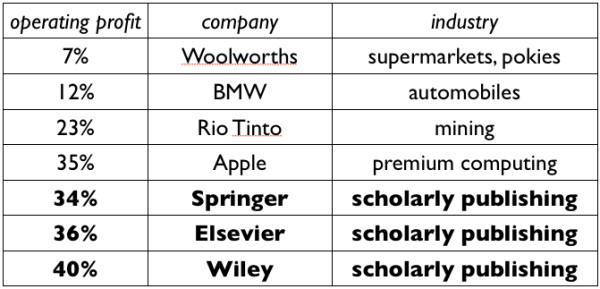
IOP Publishing (along with  other profiteering organizations of its type) insist that it brings value to scientific papers. It doesn’t. The authors and referees do all the things that add value. What the IOP does is take that value and turn it into its own profits. The fact that enormous profits are made out of this process in itself demonstrates that what the scientific community is being charged is nothing whatever to do with cost.

This reminds me of many discussions I had in my commie student days about surplus value, a concept that I believe was first discussed by Friedrich Engels, but which was explored in great detail by Karl Marx, in Das Kapital. According to the wikipedia page, the term “refers roughly to the new value created by workers that is in excess of their own labour-cost and which is therefore available to be appropriated by the capitalist, according to Marx; it allows then for profit and in so doing is the basis of capital accumulation.”

Engels is quoted there as follows:

Whence comes this surplus-value? It cannot come either from the buyer buying the commodities under their value, or from the seller selling them above their value. For in both cases the gains and the losses of each individual cancel each other, as each individual is in turn buyer and seller. Nor can it come from cheating, for though cheating can enrich one person at the expense of another, it cannot increase the total sum possessed by both, and therefore cannot augment the sum of the values in circulation. (…) This problem must be solved, and it must be solved in a purely economic way, excluding all cheating and the intervention of any force — the problem being: how is it possible constantly to sell dearer than one has bought, even on the hypothesis that equal values are always exchanged for equal values?

Marx’s solution of this economical conundrum was central to his theory of exploitation:

…living labour at an adequate level of productivity is able to create and conserve more value than it costs the employer to buy; which is exactly the economic reason why the employer buys it, i.e. to preserve and augment the value of the capital at his command. Thus, the surplus-labour is unpaid labour appropriated by employers in the form of work-time and outputs.

In this context of academic publishing, the workers are scientific researchers and the employers are the publishers. The workers  not only produce the science in the first place, but also carry out virtually all of the actions that the employers claim add value. The latter are simply appropriating the labour of the former, which is exploitation. It has to stop.

Open Journal of Astrophysics Revived

Posted in Open Access with tags , , , , , on July 8, 2013 by telescoper

Regular readers of this blog (Sid and Doris Bonkers) may recall that  while ago  I posted an item in which I suggested setting up The Open Journal of Astrophysics. The motivation behind this was to demonstrate that it is possible to run an academic journal which is freely available to anyone who wants to read it, as well as at minimal cost to authors. Basically, I want to show that it is possible to “cut out the middle man” in the process of publishing scientific research and that by doing it ourselves we can actually do it better. As people interested in this project will be aware, progress on this has been slower than I’d anticipated, largely because I changed job recently and have had so many administrative responsibilities that I haven’t had time to get too involved with it. The other folk who offered help have also been similarly preoccupied and some technical issues remain to be solved. However, the project has not been abandoned. Far from it. In fact, I’ve just received an update that strongly suggests we can get this idea off the ground over the course of the summer, so that it is in place in time for the new academic year.

We have a (good) website design with ample space and other resources to run it, and a significant number of persons of suitable eminence have agreed to serve on the Editorial Board. It will basically be a front-end for the Arxiv, but will have a number of interesting additional features which make it a lot  more than that.  I’d prefer to save further details to the official launch, which is now planned to take place in January (as it would probably get buried in the pre-Xmas rush if we tried to launch before then). I can also confirm that the service we will provide will be free at the start, although if the volume of submissions grows we may have to charge a small fee for refereeing. And when I say “small” I mean small, not the hundreds or thousands of pounds charged by the rip-off merchants.

There are, however, a couple of things I’d like to ask of my readers.

The first concerns the Editorial Board. I plan to contact those who offered help with this, but I’m still open to more volunteers. So, would anyone interested in getting involved – or at least thinking about getting involved please contact me via email. Also if you previously agreed please feel free to email to confirm your continued interest or, if you’ve changed your mind please let me know too.

The other thing  I would still like some ideas about is the name. I have asked about this before, but still haven’t settled on a compelling selection so I’m repeating the request here.

My working title for this project is The Open Journal of Astrophysics, which I think is OK but what I’d really like to do is break away from the old language of academic publishing as much as possible. I did think of the People’s Revolutionary Journal of Astrophysics, but feared that it might then split into Trotskyite and Marxist-Leninist factions. In any case the very name “journal” suggests something published periodically, whereas my idea is to have something that is updated continuously whenever papers are accepted. I’m therefore having second thoughts about having the word “Journal” in the title at all. Open Astrophysics might suffice, but I’m sure someone out there can come up with a better name. I know that Shakespeare said that a rose by any other name would smell as sweet, but I think a good title might make the difference between success and failure for this initiative…

That gives me the idea of enlisting the help of the denizens of the internet for some help in coming up with a better title; given the nature of the project, this seems an entirely appropriate way of proceeding. So please engage in collective or individual brainstorming sessions and let me have your suggestions through the comments box!

Desperate Publishers

Posted in Open Access with tags , , , , on April 28, 2013 by telescoper

I’m on campus to get some work done but before that I thought I do a quick postette as I eat my lunch. A good topic for a short contribution is a story I heard last week from one of my colleagues in the Department of Physics & Astronomy here at the University of Sussex. It seems he gave a talk at a conference a while ago.  As is far from unusual in such circumstances he was asked to write up his contribution for a special edition of a journal.

Before I go on I’ll just digress a bit to mention a less well-known aspect of the Academic Publishing Racket, the Conference Proceedings Volume. For a long time you couldn’t attend a conference in astrophysics without having to contribute an article to one of these books. Although usually produced on the cheap, using camera-ready copy, and with minimal editorial oversight, these were sold to participants and (more lucratively) to university libraries at enormously inflated prices, often over £100 a go. It wasn’t unusual for funding agencies to insist that a conference talk be followed up with a publication, so this racket flourished for a while. I’ve actually got a shelf full of such volumes accumulated over the years, although I don’t really know why I kept them as it is in their nature that they date very quickly.

Anyway, as time passed, and the internet expanded and improved, most conference organizers began to realize that it was much better just to keep their own record of the conference: putting summaries, and even full presentations, on the web for interested persons to download gratis. No doubt it is still de rigueur in some subjects to produce books of this type, but  most in astrophysics don’t bother any more.  Quite rightly, in my opinion. I think they’re a waste of time, money and shelf space.

The original thread of this post, however, isn’t about standalone books of conference proceedings but special editions of a regular academic journal; for an example of one such see here. Note the unsubtle and entirely gratuitous  link to one of my own papers! I’ve always thought this format was just as bad as putting them in a book, with the additional disadvantage that people might misinterpret the journal reference as meaning that the paper had been refereed. The paper I linked to above was not refereed, for instance. In any case they’re a bit of a chore to write, and are just as likely to be of ephemeral interest, but if one is invited to give a talk one generally feels obliged to play ball and deliver the article requested.

Which all brings me back to my colleague here at Sussex. He did his talk and wrote up the obligatory article for the special journal edition of the conference proceedings. But times have changed. When he tried to submit his article via the web upload facility he was directed to a screen asking whether his work was funded by the Science and Technology Facilities Council. When he answered “yes” he was told he was obliged to pay $3000 for the privilege of publishing his paper in Gold Open Access mode….

When he asked me if the School of Mathematical and Physical Sciences would pay the $3000 I nearly had a seizure. It’s bad enough getting landed with a hefty bill for writing an article as a favour to the conference organizers, but it’s even worse than that. The publisher was deliberately and disgracefully misleading the author about the RCUK policy on open access in order to take money from them. There is no requirement for researchers to pay for Gold OA in such a case. Sharp practice is too polite a phrase to describe the actions of this publisher. And of course nobody mentioned the $3000 fee when he signed up to give a talk at the conference.

Unfortunately, I think this sort of questionable business practice is bound to proliferate as publishers seek to maximize their revenue from Gold Open Access before the academic community rumbles the scam and cuts them out all together. So let this post be a warning. Do not trust academic publishers who try to charge you up front. Check the rules very carefully before committing yourself or, preferably, declining to publish with them. There are sharks out there and they’re after your funding.

Oh, and the name of the publisher involved in the scam I just described? I’m sure you can guess it before clicking this link to check.

Counting for the REF

Posted in Open Access, Science Politics with tags , , , , , , on April 20, 2013 by telescoper

It’s a lovely day in Brighton and I’m once again on campus for an Admissions Event at Sussex University, this time for the Mathematics Department in the School of Mathematical and Physical Sciences.  After all the terrible weather we’ve had since I arrived in February, it’s a delight and a relief to see the campus at its best for today’s crowds. Anyway, now that I’ve finished my talk and the subsequent chats with prospective students and their guests I thought I’d do a quick blogette before heading back home and preparing for this evenings Physics & Astronomy Ball. It’s all go around here.

What I want to do first of all is to draw attention to a very nice blog post by a certain Professor Moriarty who, in case you did not realise it, dragged himself away from his hiding place beneath the Reichenbach Falls and started a new life as Professor of Physics at Nottingham University.  Phil Moriarty’s piece basically argues that the only way to really judge the quality of a scientific publication is not by looking at where it is published, but by peer review (i.e. by getting knowledgeable people to read it). This isn’t a controversial point of view, but it does run counter to the current mania for dubious bibliometric indicators, such as journal impact factors and citation counts.

The forthcoming Research Excellence Framework involves an assessment of the research that has been carried out in UK universities over the past five years or so, and a major part of the REF will be the assessment of up to four “outputs” submitted by research-active members of staff over the relevant period (from 2008 to 2013). reading Phil’s piece might persuade you to be happy that the assessment of the research outputs involved in the REF will be primarily based on peer review. If you are then I suggest you read on because, as I have blogged about before, although peer review is fine in principle, the way that it will be implemented as part of the REF has me deeply worried.

The first problem arises from the scale of the task facing members of the panel undertaking this assessment. Each research active member of staff is requested to submit four research publications (“outputs”) to the panel, and we are told that each of these will be read by at least two panel members. The panel comprises 20 members.

As a rough guess let’s assume that the UK has about 40 Physics departments, and the average number of research-active staff in each is probably about 40. That gives about 1600 individuals for the REF. Actually the number of category A staff submitted to the 2008 RAE was 1,685.57 FTE (Full-Time Equivalent), pretty  close to this figure. At 4 outputs per person that gives 6400 papers to be read. We’re told that each will be read by at least two members of the panel, so that gives an overall job size of 12800 paper-readings. There is some uncertainty in these figures because (a) there is plenty of evidence that departments are going to be more selective in who is entered than was the case in 2008 and (b) some departments have increased their staff numbers significantly since 2008. These two factors work in opposite directions so not knowing the size of either it seems sensible to go with the numbers from the previous round for the purposes of my argument.

There are 20 members of the panel so 6400 papers submitted means that, between 29th November 2013 (the deadline for submissions) and the announcement of the results in December 2014 each member of the panel will have to have read 640 research papers. That’s an average of about two a day…

It is therefore blindingly obvious that whatever the panel does do will not be a thorough peer review of each paper, equivalent to refereeing it for publication in a journal. The panel members simply won’t have the time to do what the REF administrators claim they will do. We will be lucky if they manage a quick skim of each paper before moving on. In other words, it’s a sham.

Now we are also told the panel will use their expert judgment to decide which outputs belong to the following categories:

  • 4*  World Leading
  • 3* Internationally Excellent
  • 2* Internationally Recognized
  • 1* Nationally Recognized
  • U   Unclassified

There is an expectation that the so-called QR  funding allocated as a result of the 2013 REF will be heavily weighted towards 4*, with perhaps a small allocation to 3* and probably nothing at all for lower grades. The word on the street is that the weighting for 4* will be 9 and that for 3* only 1. “Internationally recognized”  will be regarded as worthless in the view of HEFCE. Will the papers belonging to the category “Not really understood by the panel member” suffer the same fate?

The panel members will apparently know enough about every single one of the papers they are going to read in order to place them  into one of the above categories, especially the crucial ones “world-leading” or “internationally excellent”, both of which are obviously defined in a completely transparent and objective manner. Not. The steep increase in weighting between 3* and 4* means that this judgment could mean a drop of funding that could spell closure for a department.

We are told that after forming this judgement based on their expertise the panel members will “check” the citation information for the papers. This will be done using the SCOPUS service provided (no doubt at considerable cost) by   Elsevier, which by sheer coincidence also happens to be a purveyor of ridiculously overpriced academic journals.  No doubt Elsevier are  on a nice little earner peddling meaningless data for the HECFE bean-counters, but I have no confidence that they will add any value to the assessment process.

There have been high-profile statements to the effect that the REF will take no account of where the relevant “outputs”  are published, including a pronouncement by David Willetts. On the face of it, that would suggest that a paper published in the spirit of Open Access in a free archive would not be disadvantaged. However, I very much doubt that will be the case.

I think if you look at the volume of work facing the REF panel members it’s pretty clear that citation statistics will be much more important for the Physics panel than we’ve been led to believe. The panel simply won’t have the time or the breadth of understanding to do an in-depth assessment of every paper, so will inevitably in many cases be led by bibliometric information. The fact that SCOPUS doesn’t cover the arXiv means that citation information will be entirely missing from papers just published there.

The involvement of  a company like Elsevier in this system just demonstrates the extent to which the machinery of research assessment is driven by the academic publishing industry. The REF is now pretty much the only reason why we have to use traditional journals. It would be better for research, better for public accountability and better economically if we all published our research free of charge in open archives. It wouldn’t be good for academic publishing houses, however, so they’re naturally very keen to keep things just the way they are. The saddest thing is that we’re all so cowed by the system that we see no alternative but to participate in this scam.

Incidentally we were told before the 2008 Research Assessment Exercise that citation data would emphatically not be used;  we were also told afterwards that citation data had been used by the Physics panel. That’s just one of the reasons why I’m very sceptical about the veracity of some of the pronouncements coming out from the REF establishment. Who knows what they actually do behind closed doors?  All the documentation is shredded after the results are published. Who can trust such a system?

To put it bluntly, the apparatus of research assessment has done what most bureaucracies eventually do; it has become  entirely self-serving. It is imposing increasingly  ridiculous administrative burdens on researchers, inventing increasingly  arbitrary assessment criteria and wasting increasing amounts of money on red tape which should actually be going to fund research.

And that’s all just about “outputs”. I haven’t even started on “impact”….