Archive for the Politics Category

Should students be (financially) compensated for strike action by lecturers?

Posted in Cardiff, Education, Politics with tags , , , , on May 22, 2019 by telescoper

Regular readers of this blog will know that last year I was still employed part of the time at Cardiff University and during that period I was participating in strike action called by the Universities and Colleges Union (UCU) over pensions. As a result of that action students on my module on Physics of the Early Universe missed quite a lot of lectures (and I was docked a large fraction of my pay).

I refused to do extra lectures after the strike was over to make up for those lost, as it seemed to me that defeated the point of the strike action, but I did make notes available for the students (which I do anyway). Students were also given access to recordings of the previous year’s lectures on the same module. I know some lecturers also adjusted their examinations and/or other assessments to exclude material that had not been covered.

It seems practice for dealing with this (admittedly difficult) situation has varied from institution to institution, and some students who feel that they missed out as a result of the strike have apparently asked to be compensated by their University. Institutions could of course pay compensation to students out of the money saved by not paying lecturers, but that wouldn’t go very far because only a small part of the £9000+ students pay in fees goes to the salaries of teaching staff. Another issue is that I recall one or two students didn’t come to lectures even before the strike started. Should they be compensated too?

Anyway I thought this might be an interesting topic for a poll, so here goes:

As always views are welcome through the comments box too!

Voting Matters in Ireland

Posted in Politics with tags , , , , on May 21, 2019 by telescoper

Arriving back in civilization last night I discovered that my polling card for Friday’s voting has arrived at last along with instructions on the Referendum to be held alongside the Local Council Elections and the European Parliament Elections, all held on 24th May.

I’m looking forward to casting my ballot. It is a new experience for me to vote here in Ireland. Both elections are held under Proportional Representation (Single Transferable Vote) which seems to me a very sensible system. One ranks the candidates in order of preference with votes progressively reallocated as the lowest-ranked candidates are eliminated. You can rank all the candidates or just some. In the system employed here one ranks the candidates in order of preference with votes progressively reallocated in various rounds until one ends up with the top n candidates to fill the n available seats. Surplus votes from the top candidates as well as those of eliminated candidates are reallocated to lower-preference candidates in this process.

The Local Elections involve filling 40 seats on Kildare County Council, with five councillors representing Maynooth. The nine candidates are listed here, in case you’re interested.

For the European Parliament Elections things are a bit more complicated. For the purposes of the EU elections Ireland is divided into three constituencies: Dublin, Ireland South and Midlands North West. I am in the latter, which elects four MEPs. There are 17 candidates for this constituency, listed here.

As a relative newcomer to Ireland I first sorted the candidates into three groups: (i) those that I would be happy to see elected, (ii) those that I don’t really like but could tolerate, and (iii) those that I wouldn’t like to see representing me under any circumstances. There are plenty in the latter category. There seems to be a law in Ireland that there has to be at least one deranged simpleton on every ballot paper, and there are several in this election. I will choose my lower-preference votes to ensure that none of these dickheads, especially racist gobshite Peter Casey, benefit from my vote in any way.

Although the STV system seems very sensible to me, it does lead to a rather lengthy counting process – especially if everyone does what I plan to do, i.e. rank all the candidates instead of just their favourites.

Fascism is coming..

Posted in History, Politics with tags , on May 19, 2019 by telescoper

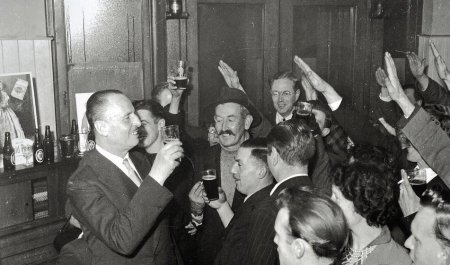
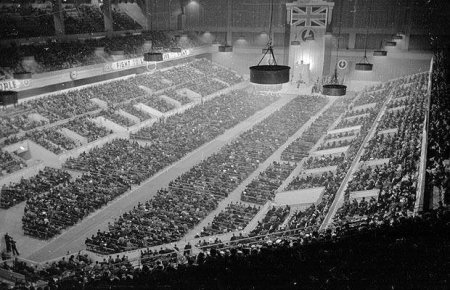
Rally for Oswald Mosley’s British Union of Fascists, Earl’s Court, London July 1939.

Beer-brandishing ‘Man of the People’, Oswald Mosley.

Fascism is coming; probably a slimy Anglicised form of Fascism, with cultured policemen instead of Nazi gorillas and the lion and the unicorn instead of the swastika.

George Orwell, from The Road to Wigan Pier, 1937.

Local Election News

Posted in Maynooth, Politics with tags , , , on May 3, 2019 by telescoper

As results come in from the local elections held in the Disunited Kingdom yesterday, I see that the results have been so bad for the Conservative Party that one Tory MP has been reduced to tears. You’d have to have a heart of stone not to burst out laughing. It’s also rather hilarious to see various factions (including the BBC news) spin the big gains of the Liberal Democrats as a message to `get on with Brexit’, but at the same time it’s also sad to see a country so gripped by madness that it is reduced to such a state.

UPDATE: With 218 out of 248 English Councils having been counted, the Conservative Party has lost an impressive 1072 councillors, but not to Labour who have lost 110. The big winners are the Liberal Democrats (+582), the Greens (+152) and Independents (+505). UKIP are also down by 99 to just 29 councillors. Both Labour and Tories are still claiming that this sends a message to get on with Brexit. Bizarre. I wonder what they think a message to stop Brexit would look like?

Anyway there were no local elections in Wales yesterday so I didn’t vote. I am still eligible to do so, of course, as I pay Council Tax on my house in Cardiff. I would have had a tricky problem deciding what to do if I had. As a lifelong Labour voter (and member until recently) I can no longer support them because of their `policy’ on Brexit, so probably would have voted for Plaid Cymru. That’s who I would vote for in the European Parliament elections.

I am eligible to vote in both the United Kingdom (Wales) and Ireland for the forthcoming European Parliament elections (assuming they go ahead), but one is supposed to vote in one or the other rather than both so I’ve decided to vote here as this is the country in which I am `normally resident’. The European Parliament elections take place here in Ireland on Friday 24th May (three weeks from today) at the same time as the local council elections here.

Kildare County Council will have 40 councillors of which five are elected in Maynooth. For the purpose of the European Parliament elections, Ireland is divided into three multi-member constituencies: Dublin, Ireland South and Midlands North-West. Maynooth is in the last of these, which stretches from Kildare across to Galway and up to Donegal. It will elect four MEPs. The same voting method is used in both elections: the single transferable vote.

(The UK has multi-member constituencies for the European Parliament elections too, but uses the D’Hondt system in which one votes for a party list rather than an individual.)

I’m a relative newcomer to Irish politics, and am yet to decide who to vote for in these elections. I certainly won’t vote for either of the two leading neoliberal/conservative parties, Fine Gael or Fianna Fáil. Sinn Féin will probably be top of my list of preferences in both ballots. On the other extreme, tax-dodger, racist gobshite and failed Presidential candidate Peter Casey is sure to be bottom of my list for the MEP elections: he’s unfit for any kind of public office, in my opinion.

Apart from the different voting system(s) and dates, there is another noticeable difference between the UK and Ireland at election time:

Posters like this pop up everywhere on lampposts during election (and referendum) campaigns in Ireland, as opposed to the larger billboard-type posters that seem to be favoured in Britain. At least these show you what your candidates look like, which is not the case if you vote for a party list. Such posters are specifically permitted by law but most be taken down within a certain time after the election, otherwise the party responsible is fined.

University News

Posted in Education, Politics with tags , , , , , , on April 28, 2019 by telescoper

As we stagger towards Week 11 of this twice-interrupted Semester I’m back in the office preparing stuff for another set of lectures. This term seems to have gone on forever, largely because of the two breaks (one at half-term around St Patrick’s Day, and other other for Easter). Now, though, the end is in sight. Or at least the examination period is: there are just two more weeks of lectures, ending on 10th May then a short break, then examinations start (on 17th May). Then, of course, there is marking, checking, conflating exam grades with coursework marks, examination boards, and all the other stuff that go on behind the scenes.

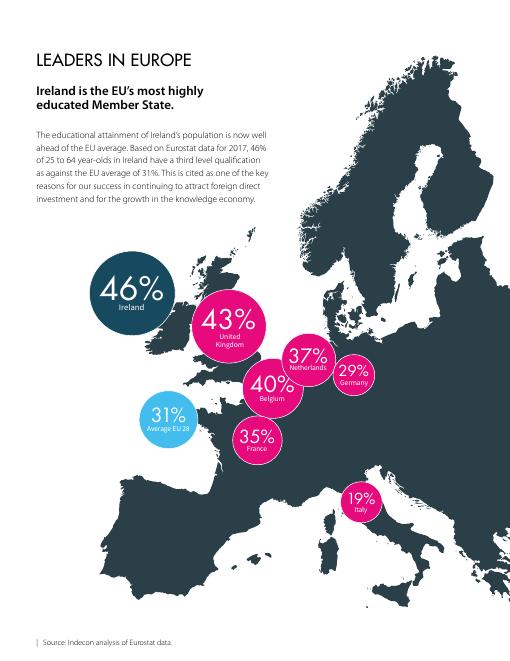
I noticed that this weekend’s edition of the Irish Times included a hard copy of a report called Delivering for Ireland: The Impact of Irish Universities which was produced by the Irish Universities Association. In fact the thing given away with the paper is just a summary report (you can download it in PDF format here). The full report (all 86 pages of it) can be downloaded here.

The report is full of interesting information, including this (which I didn’t know before):

The report was produced with the aim of making the case for further investment in Ireland’s universities. It remains to be seen whether the current Irish government will be persuaded. I’m not holding my breath. right-wing governments never seem to be interested in investing in the future. I think the best we can hope for is that Ireland does not continue its policy of slavishly copying English Higher Education policy, especially with the introduction of student loans and high tuition fees.

And talking of the idiocies of the English University system, there is a story going around that the UK Government is planning to make EU students pay full `Overseas’ fees after Brexit. Actually, Higher Education policy is a devolved matter so this can only be directly enforced on English universities. It will, however, be hard for Scottish Welsh and Northern Irish institutions to resist the consequences.

In fact I’ve long felt that the existing system – in which Home and EU students have to be treated the same way as a matter of law but non-EU students can be charged different (i.e. higher) fees is completely immoral. Once at university students are all taught the same way so why should some be charged more than others because they happen to come from China? What would you think of a shop that tried to charge people different prices for the same goods depending on the nationality of the customer?

This decision is of course an inevitable consequence of Theresa May’s interpretation of the EU referendum result as a mandate for policies of extreme xenophobia, as is the withdrawal from Erasmus. It is just another symptom of the UK’s descent into narrow-minded insularity. The message this decision sends out is that Britain hates foreigners but it likes their money so the rich ones who can pay extortionate fees will be graciously allowed to come here to get fleeced. Does the government really think that EU citizens are daft enough to come to a country that identifies itself in such a way? I don’t think they are. They’ll just find somewhere else to go, and the consequence for UK universities will be severe. I am confident this will push more than one UK higher education institution into bankruptcy.

Anyway, even if the the Irish university continues to be under-resourced, it will at least continue to welcome students from the EU on the same basis as before. So if you’re a European student who was thinking about studying in England, why not come to Ireland instead? It’s far cheaper, and we even have the same weather…

Der Englische Patient

Posted in Politics with tags , , on April 7, 2019 by telescoper

I couldn’t resist sharing this brilliant cartoon by Jürgen Tomicek

160 Years of the Irish Times

Posted in Biographical, Crosswords, Politics with tags , , on March 30, 2019 by telescoper

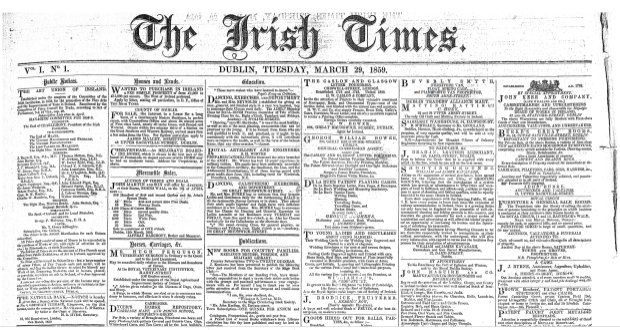
With all the shenanigans surrounding yesterday’s non-Brexit Day I quite missed the news that March 29th 2019 was an important for my newspaper of choice, The Irish Times, which was first published on March 29th 1859, the front page of which is reproduced above. Initially The Irish Times was only published on Tuesdays, Thursdays and Saturdays but it became a daily paper a few months after its launch, in June 1859.

The first edition promised to

make a first-rate Irish newspaper, complete in its details, sagacious and consistent in its policy and faithfully reflecting the opinions of the most independent, intelligent and truly progressive portion of Irish society.

That pretty much applies to it now, I’d say. Interestingly, though, it started out as a staunchly Unionist paper and every one of its editors until 1986 was a Protestant.

I don’t buy a paper every day but I do always get the Weekend Edition, which is full of excellent writing (even if often disagree with its take on various things).

It’s interesting to note that the front page of the first edition was dominated by goings-on in the House of Commons in Westminster, as is today’s edition. Plus ça change..

The only real drawback to the Irish Times is that it doesn’t have a very good cryptic crossword. Fortunately, the UK papers give theirs away for free so I now do the Financial Times, Guardian and Observer Prize Crosswords without buying them.

Brexit: What’s the Indicative Mood?

Posted in Pedantry, Politics with tags , , , , , on March 27, 2019 by telescoper

If you are confused about today’s `Indicative Votes’ in Parliament on Brexit let me provide some helpful information about the indicative mood, and how it relates to Brexit.

The English word “exit” is derived from the third person singular of the present tense in the indicative mood in the active voice of the Latin verb “exire” (“to go out”) i.e. it means “he/she/it leaves”, though the noun form it usually has in English derives from the supine form “exitus”. I feel it is important that we all get used to the grammar of Brexit, so here is a fairly complete list of the parts of the verb `Brexire’ in the active voice of the indicative mood, some or all of which may be relevant in the forthcoming debates, complete with accents to assist punctuation. At least these may prove useful in following any contributions from Jacob Rees-Mogg.

First let’s start with the basics:

Infinitive: Brexīre
Present participle: Brexiēns; Brexiéntis
Future participle: Brexītúrus
Gerund: Brexeúndum
Gerundive: Brexeúndus

And now here are representative examples of the conjugation of the verb Brexire in various tenses of the Indicative Mood in the order: first, second and third person singular followed by first, second and third person plural:

Present:

Brexeō,
Brexīs
Brexit
Brexīmus
Brexītis
Brexeunt

Past Imperfect

Brexībam
Brexībās
Brexībat
Brexībāmus
Brexībātis
Brexībant

Past Perfect

Brexiī
Brexīstī
Brexiit
Brexíimus
Brexīstis
Brexiḗrunt

Pluperfect

Brexíeram
Brexierās
Brexíerat
Brexierāmus
Brexierātis
Brexierant

Future Simple

Brexībō
Brexībis
Brexībit
Brexībimus
Brexībitis
Brexībunt

Future Perfect

Brexíerō
Brexíeris
Brexíerit
Brexiérimus
Brexieritis
Brexierint

The last tense here is not really relevant, but I’ve included it anyway.

No doubt when the Indicative votes are over, the House of Commons will proceed to the Subjunctive Mood – or even directly to the Imperative – but I shall leave these to a future post.

Changing Time

Posted in History, Politics with tags , , , , , , , , , on March 27, 2019 by telescoper

Among the many sensible decisions made yesterday by the European Parliament was to approve a directive that will abolish `Daylight Saving Time’. I’ve long felt that the annual ritual of putting the clocks forward in the Spring and back again in the Autumn was a waste of time effort, so I’ll be glad when this silly practice is terminated.
It would be better in my view to stick with a single Mean Time throughout the year. I’m only disappointed that this won’t happen until 2021 as EU countries have to enact the necessary legislation according to their constitutional processes.

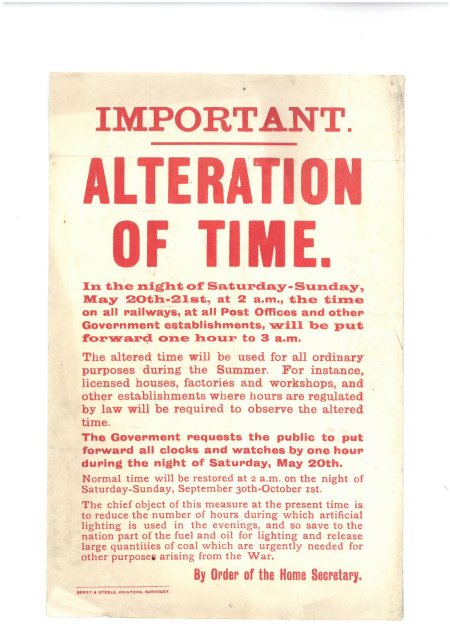
The marvellous poster above is from 1916, when British Summer Time was introduced. I was surprised to learn recently that the practice of changing clocks backwards and forwards is only about a hundred years old. in the United Kingdom. To be honest I’m also surprised that the practice persists to this day, as I can’t see any real advantage in it. Any institution or organisation that really wants to change its working hours in summer can easily do so, but the world of work is far more flexible nowadays than it was a hundred years ago and I think few would feel the need.

Anyway, while I am on about Mean Time, here is a another poster from 1916.

Until October 1916, clocks in Ireland were set to Dublin Mean Time, as defined at Dunsink Observatory rather than at Greenwich. The adoption of GMT in Ireland was driven largely by the fact that the British authorities found that the time difference between Dublin and London had confused telegraphic communications during the Easter Rising earlier in 1916. Its imposition was therefore, at least in part, intended to bring Ireland under closer control and this did not go down well with Irish nationalists.

Ireland had not moved to Summer Time with Britain in May 1916 because of the Easter Rising. Dublin Mean Time was 25 minutes 21 seconds behind GMT but the change was introduced at the same time as BST ended in the UK, hence the alteration by one hour minus 25 minutes 21 seconds, ie 34 minutes and 39 seconds as in the poster.

Britain will probably not scrap British Summer Time immediately as it will be out of the European Union by then. British xenophobia will resist this change on the grounds that anything to do with the EU must be bad. What happens to Northern Ireland when Ireland scraps Daylight Saving Time is yet to be seen.

Moreover the desire expressed by more than one Brexiter to return to the 18th Century may be behind the postponement of the Brexit deadline from 29th March to 12th April may be the result of an attempt to repeal the new-fangled Gregorian calendar (introduced in continental Europe in 1582 but not adopted by Britain until 1750). It’s not quite right though: 29th March in the Gregorian calendar would be 11th April in the Gregorian calendar…

I’ve no more … to give

Posted in Biographical, Music, Politics with tags , on March 26, 2019 by telescoper

And now here’s a vocal summation of my views on Brexit by Thomas Benjamin Wild Esq, a chap with a lovely beard…