Archive for the Politics Category

A Very British March

Posted in Biographical, Politics with tags , , , , on March 24, 2019 by telescoper

I’m back in Maynooth now after yesterday’s wonderful demonstration in London. Sources are claiming that about 1.4M people attended. I met filk from all round the country, many of whom had never been on a march before. It’s also worth saying according to the Metropolitan Police that there was not a single incident that they had to deal with.

I’m not very good in big crowds (to say the least) so I stood for a while a little distance from the main body of the demonstration as it assembled in Park Lane. I was astonished to see how many people were joining. It was certainly larger than the previous one, last year.

I eventually joined in when it started moving (very slowly). The people were very friendly and despite the numbers I didn’t get at all panicky. It struck me as being a quintessentially British demonstration, in that it was basically just some very nice polite people waiting politely in a very long queue..

The march was due to start at 12 noon but i didn’t get going until well after 2pm. I had to leave at 4pm, by which I had only got halfway along Piccadilly. Instead of going all the way to Parliament Square I headed back to my hotel, picked up the bag I had left there and took a packed tube to Heathrow. I made it just in time. The plane began boarding just as I ckeated the security checks.

I didn’t take many pictures of the march, but here are a few:

Hyde Park, the Statue of Achilles

Philosopher A. C. Grayling and I..

Beards against Brexit!

It was a wonderful experience to be in the company of so many extremely nice people and I was sad I couldn’t make it all the way to the end!

P. S. The petition on revoking Article 50 has reached almost reached 5 million signatures.
Put it to the People!

Posted in Politics with tags , , , on March 23, 2019 by telescoper

Well, that was a very enjoyable and informative couple of days in London celebrating the 60th Birthday of Alan Heavens, but my trip to London is not yet over. Before going to Heathrow Airport for the flight back to Dublin this evening, I am taking part in a demonstration in Central London demanding a referendum as a last chance to avert the calamity of Brexit, halt Britain’s descent into nationalistic xenophobia, and prevent the social and economic harm being done by the ongoing madness. I have a feeling that Theresa May’s toxic speech on Wednesday evening in which she blamed everyone but herself for the mess that she has created will have galvanized many more than me into action.

I’m not sure whether this march – even if it is huge – will make much difference or even that it will be properly reported in the media, but one has to do something. Despite the short delay to the Brexit date agreed by the EU, I still think the most likely outcome of this shambles is that the UK leaves without a proper withdrawal agreement and thus begins a new life as a pariah state run by incompetent deadheads who know nothing other than the empty slogans that they regurgitate instead of answering real questions.

The only sensible response to the present impasse is to `Put it to the People’, but there is no time to organize a new referendum – a proper one, informed by facts as we now know them and without the wholesale unlawful behavior of the Leave campaign in the last one. I dismiss entirely any argument that a new referendum would be undemocratic in any way. Only those terminally gripped by Brexit insanity would argue that voting can be anti-democratic, especially since there is strong evidence from opinion polls that having seen the mess the Government has created a clear majority wishes to remain. If there isn’t time for a new referendum before the deadline – and further extensions by the EU are unlikely – then the best plan is to revoke the Article 50 notification to stop the clock.

I know I’m not alone in thinking this. An official petition demanding the Government revoke Article 50 has passed 4,000,000 signatures in just a few days. I’ve signed it and encourage you to do likewise, which you can do here.

And if you’re tempted to agree with the Prime Minister’s claim that people are just tired of Brexit and just want it to be over, then please bear in mind that the Withdrawal Agreement – which has taken two years to get nowhere – is only the start of the process. The UK is set for years of further negotiations on the terms of its future relationship not only with the European Union but also all the other agreements that will be terminated by the UK’s self-imposed isolation.

If Brexit does go ahead, which I’m afraid I think will be the case, then my participation in today’s march will not have been a waste – it seems a fitting way to say goodbye to the land of my birth, a country to which I no longer belong.

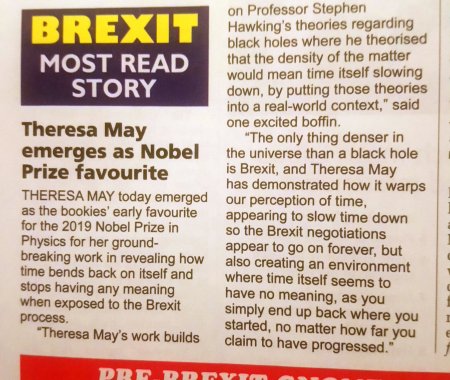
Anyway, I may be able to add a few pictures of the march in due course but, until then, here is an excerpt from Private Eye that made me laugh.

Beard of Ireland 2019 poll opens

Posted in Beards, Politics on March 4, 2019 by telescoper

Well, much to my surprise I find I am on the ballot paper for Beard of Ireland 2019. I don’t suppose I’ll feature among the front-runners as I don’t think my beard has had much impact on the Irish landscape. At the moment, however, the current leader is a DUP politician…

kmflett's avatarKmflett's Blog

Beard Liberation Front

Press release 3rd March

Contact Keith Flett 07803 167266

BEARD OF IRELAND 2019 POLL OPENS

The Beard Liberation Front, the informal network of beard wearers, has said that competition for the Irish Beard of the Year title is expected to see hairs split as the voting for the annual award opens

The 2017 winner was politician Colum Eastwood who bearded broadcaster William Crawley for the annual Award.

In 2018 the DUP’s Lee Reynolds shaved writer Dominic O’Reilly for the honour with Colum Eastwood in a steady third place.

The 2019 winner will be announced to mark St Patrick Day on 17th March

The BLF says that while traditionally a land of predominantly clean-shaven cultures, Ireland has in recent times become something of a centre for stylish and trendy beards.

Contenders for the title in 2019 include a diverse range of the hirsute- actors, comedians, political activists, journalists…

View original post 121 more words

Heroic Failure: Brexit and the Politics of Pain

Posted in Literature, Maynooth, Politics with tags , , on February 21, 2019 by telescoper

Before Christmas I attended a very enjoyable event here in Maynooth featuring journalist, historian and literary critic Fintan O’Toole talking his book Heroic Failure: Brexit and the Politics of Pain. I bought the book and had it signed by the author. Sadly, as I do far too often these days, I put the book on my shelf and promptly forgot about it as I got distracted by a myriad of other things.

This week I finally got round to reading it and very enjoyable it is too, though I expect people who voted Leave won’t like it, as it is probably a bit close to the bone for them.

The book deals with the Brexit referendum, the chaos it unleashed in British politics and the challenges posed to the island of Ireland by a ‘No Deal Brexit’. In particular the book examines how a country that once had colonies is redefining itself as an oppressed nation requiring liberation; the dreams of revolutionary deregulation and privatization that drive Arron Banks, Nigel Farage and Jacob Rees-Mogg; and the silent rise of English nationalism, the force that dare not speak its name. He also discusses the fatal attraction of heroic failure, once a self-deprecating cult in a hugely successful empire that could well afford the occasional disaster: the Charge of the Light Brigade, or Franklin lost in the Arctic. Now failure is no longer heroic – it is just failure, and its terrible costs will be paid by the most vulnerable of Brexit’s supporters, and by those who may suffer the consequences of a hard border in Ireland and the breakdown of a fragile peace.

It’s a very witty book which is at its best picking apart some of the some-contradictory rhetoric deployed by Leave campaigners, such as how the UK can be both grandiosely jingoistic and bullied by the EU at the same time, pulling in references from historical events and literature as well as contemporary culture (including Fifty Shades of Grey, the references to which were lost on me because I haven’t read it). It’s also very perceptive in its observation of how strongly the legacy of World War 2 pervades attitudes towards Brexit, especially the silly references to `Dunkirk Spirit’ and the rest that are the stock-in-trade of many Leavers.

Anyway, I heartily recommend this book to both Leavers and Remainers but it might induce a sense of humour failure in the former.


Slugs for Salt!

Posted in Politics on January 26, 2019 by telescoper

This little cartoon has been doing the rounds on social media recently. It appears to have caused some controversy, so naturally I decided to share it here.

I’m posting it without further comment, though of course any persons wishing to identify as slugs are free to do so.

What are we going to do now?

Posted in Politics, Television with tags , on January 16, 2019 by telescoper

After another tumultuous day in British politics, this blog is once again proud to be able to show exclusive behind-the-scenes footage of the Cabinet discussions at Number 10 Downing Street:

Meaningful Betting

Posted in Biographical, mathematics, Politics with tags , , , , on January 15, 2019 by telescoper

I’ve now finished my first batch of marking (Astrophysics & Cosmology) and I now have a few days to do other things until the next (larger) set of scripts arrives from Vector Calculus and Fourier Series which takes place on Saturday.

Before going home I turned my attention to the news of tonight’s “Meaningful Vote” in the House of Common’s about whether or not to accept the Withdrawal Agreement negotiated between PM Theresa May and the European Union. The Government is widely expected to lose the vote but it’s not clear by what margin. Interested to see what the betting markets think I had a look just now at the Betfair exchange and found this, on the basic question of whether the vote will pass or not:

(You might want to click on the image to make it clearer.) You can find the live odds here.

You will see that this is quite an active market – with over €700K being wagered. Odds of greater than 40 to 1 against a `yes’ vote but most of the action is on `no’. Note that quite a few punters are laying on this outcome, with odds of about 25-1 on. (The way odds are shown in the second row is that 1.04 means you with 4p for every £1 staked).

Clearly, therefore, the markets think the vote will fail. What is less clear is how many MPs will vote in favour of the Government. Here is the corresponding Betfair market:

The shortest odds are for the first option, i.e. for 199 or fewer voting with the Government, but there is activity across the whole range of possibilities. The press are talking about a defeat by 225 votes, but for what it’s worth I don’t think it will be such a large margin. I’m not going to bet on it, but I expect it to be defeated by less than 150 votes.

UPDATE: Not for the first time I was wrong. The vote was Ayes 202 Noes 432, a majority of 230 against. That means there were no abstentions.

Turning a Corner after Brexit

Posted in Politics on January 3, 2019 by telescoper

As I wait at Cardiff Airport for my flight back to Ireland, I see Theresa May has said that the UK ‘can turn a corner’ if MPs back her Brexit plan.

I’ve found a helpful graphic to show how that would work.

Turning a Blind Eye

Posted in History, Politics with tags , , on January 2, 2019 by telescoper

As my little festive sojourn in Wales draws to a close, there’s no sign of the Brexit Pantomime season doing likewise. The latest episode of this tragicomedy saw Transport Secretary Chris Grayling dishing out £14 million of taxpayers’ money to a ‘company’ called Seaborne Freight to operate ferries between Ramsgate and Ostend when, in less than 90 days, the UK leaves the EU.

As his name suggests, there’s something very fishy about Grayling’s decision to hand out a lucrative contract, without any proper procurement process, to a company that has only existed for a few months, has never operated a ferry, has no trained staff and, above all, has no ships!

Is this lawful? I doubt it. Is it ethical? Certainly not. Will Grayling get away with it? Almost certainly. Recent events have shown that illegality, fraud and corruption are all part of the job description for a Brexiter.

Perhaps Grayling is trying to channel Lord Nelson who, in legend anyway, at the Battle of Copenhagen in 1801, held a telescope to his blind eye when ordered to retreat, saying “I see no ships”. The difference here is of course that the ships can’t be seen because they don’t exist.

“I see no ships” is actually a misquote: what Nelson said was something like “I have a right to be blind sometimes. I really do not see the signal”. This event is not the origin of the phrase ‘to turn a blind eye’, either: the OED gives an example of its usage from 1698..

Anyway I think we can all see what the signal is in this case, a desperate government throwing public money down the drain without a shred of accountability. Get used to it. There will be a lot more of that in Brexit Britain. It’s what you voted for, isn’t it?

Sustainability and Irish Science

Posted in Politics, Science Politics, The Universe and Stuff with tags , , , , on December 19, 2018 by telescoper

There’s an interesting news item in the Education section of the Irish times about the appointment of Prof Séamus Davis to positions at both the University of Oxford and University College Cork, under a Science Foundation Ireland scheme intended to capitalize on Brexit (and the imminent loss of EU funding it implies) and the unhappy situation for science in the USA. This is the first appointment to one of the new Research Professorships, which allow the holders to be paid up to €250K.

While I support any investment in Irish science, and wish Prof. Davis every success in his new role, my reaction to the SFI scheme is very similar to my view of the Sêr Cymru (“Star Wales”) project which began a few years ago when I was working in Cardiff, with the aim of attracting `research leaders’ to Wales.

I am very skeptical about the likely success of `top-down’ moves like this. What Ireland really needs (and currently does not have) is a sustainable research base, so at very least I’d like to complementary  `bottom-up’ projects nurturing  researchers at PhD and PDRA level, perhaps through a greatly expanded system of national fellowships.  The trouble in Ireland is that there are so few opportunities for early career researchers that many have to go abroad to further their careers. There’s nothing wrong with Irish researchers choosing to work in another country, of course, but in an ideal world they would choose rather than be forced to do so by lack of opportunity and their loss would be offset by a other nationals choosing to come into Ireland. Unless this problem is fixed Ireland might end up with some leaders but nobody around to follow them.

The question I ask myself is, if one had to choose, what would be better in the long run for Irish science, one Professor on a salary of €250,000 or eight new postdoctoral fellowships (at roughly the same cost)?

Of course the idea of bringing in `research leaders’ is that they will manage to bring in funds from elsewhere, especially the European Union. This may indeed happen and indeed some may already have money in the bag when they move in. The problem with the strategy, though,  is that it’s not very easy to persuade such leaders to leave their current institutions, especially in experimental sciences, if they’ve already spend years acquiring the funding needed to equip their laboratories. This is not just a question of moving people, which is relatively easy, but can involve trying to replace lots of expensive and delicate equipment. The financial inducements needed to fund the relocation of a major research group and fight off counter-offers from its present host are likely to be so expensive that the benefit gained from doing this takes years to accrue, even they succeed. And EU grants are exceptionally competitive..

It’s a big shame that Ireland does not take research funding as seriously as it should, especially in fundamental science. Brexit could well turn out to be very damaging for the Irish economy, but science is one area where in which there are enormous opportunities if only there was the political will to seize them.