To summarise the report coming out of the meeting, here is a quotation from the draft communique, which states that they
…welcome open access to scientific publications as the option by default for publishing the results of publicly-funded research..
They also plan to
To remove financial and legal barriers, and to take the necessary steps for successful implementation in all scientific domains.
In a nutshell, the proposal is a move to abandon the traditional journal subscription model and embrace freely-available scientific research by 2020.
This is definitely a very good move. My only worry is that those involved seem not to have been able to make a decision on whether to go for the Green or Gold Open Access Model. The latter route has, in my opinion, been grossly abused by profiteering academic publishers who charge eye-watering “processing fees” for open access. I hope this initiative by the EU is not hijacked by vested interests as was the case with the UK’s Finch Report.
There’s clearly a lot more to be done before this proposal can be implemented, but it’s a very positive development the EU which will benefit science, both in the UK and across the continent, hugely. The European Union’s enthusiastic embrace of the principles of open access to scientific research is just one more to add to the list of reasons to remain.
About to embark on a weekend of examination marking, a desperate search for displacement activities reminded me of this important report by Sir William Wakeham (who happens to be the Chair of SEPNet, the South-East Physics Network, of which the University of Sussex is a member, so I get to call him Bill).
Apparently Bill’s report has been ready for some time but has been stuck on a shelf in Whitehall somewhere waiting to be released. Arcane rules about publishing government reports in the run-up to elections meant that it had to wait until after May 5th for publication.
Anyway, it was published this week (May 16th to be precise) and I encourage you all to read it. You can find the report and various annexes here. It has clearly been a complex task to make sense of some of the datasets used because they are incomplete and/or confusing, so inevitably some important questions remain unanswered. There are nevertheless clearly worrying signs for certain disciplines, as described in the Executive Summary:
Based on the accumulated evidence we have arrived at a list of degree disciplines where the graduate employment outcomes are sufficiently concerning for us to recommend additional targeted work. The STEM disciplines that the review has identified as being of particular concern are:
•Biological Sciences
•Earth, Marine and Environmental Sciences
•Agriculture, Animal Sciences and Food Sciences
I’m a little surprised that Biological Sciences appears in that list, because that is usually perceived as a burgeoning area, but it’s clear that some graduates in that area do find it more difficult to find employment than in other STEM areas. However, if you read the report in more detail you will see that there are many sub-disciplines involved in Biological Sciences and the picture isn’t the same for all of them. It does seem, however, that in some of the Biological Sciences, graduates do not have sufficient training in quantitative methods to suit the demands of potential employers.
In case you haven’t heard yet, news has just broken that Professor John Womersley (above), currently Chief Executive of the Science & Technology Facilities Council (STFC), has been appointed Director-General of the new European Spallation Source (ESS) in Lund, Sweden, and will therefore be stepping down from his post as Chief Executive of STFC in the autumn.
John has been Supreme Leader at STFC for five years now and, in my opinion, has done an excellent job in circumstances that have not always been easy. He will be a hard act to follow. I know he’s an occasional reader of this blog, so let me take this opportunity to wish him well in his new role.
Now, perhaps I should open a book on the likely contenders for the post of next Chief Executive of STFC?
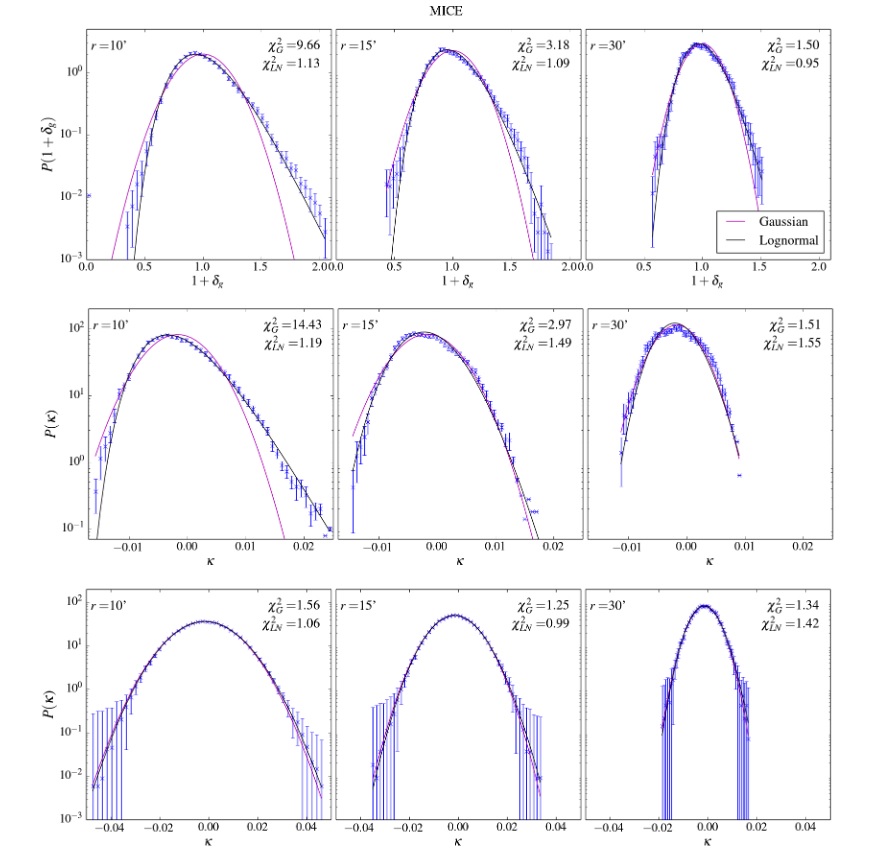
The points here are from MICE simulations. Not simulations of mice, of course, but simulations of MICE (Marenostrum Institut de Ciencies de l’Espai). Note how well the curves from a simple lognormal model fit the calculations that need a supercomputer to perform them!
The lognormal model used in the paper is basically the same as the one I developed in 1990 with Bernard Jones in what has turned out to be my most-cited paper. In fact the whole project was conceived, work done, written up and submitted in the space of a couple of months during a lovely visit to the fine city of Copenhagen. I’ve never been very good at grabbing citations – I’m more likely to fall off bandwagons rather than jump onto them – but this little paper seems to keep getting citations. It hasn’t got that many by the standards of some papers, but it’s carried on being referred to for almost twenty years, which I’m quite proud of; you can see the citations-per-year statistics even seen to be have increased recently. The model we proposed turned out to be extremely useful in a range of situations, which I suppose accounts for the citation longevity:
Citations die away for most papers, but this one is actually attracting more interest as time goes on! I don’t think this is my best paper, but it’s definitely the one I had most fun working on. I remember we had the idea of doing something with lognormal distributions over coffee one day, and just a few weeks later the paper was finished. In some ways it’s the most simple-minded paper I’ve ever written – and that’s up against some pretty stiff competition – but there you go.
The lognormal seemed an interesting idea to explore because it applies to non-linear processes in much the same way as the normal distribution does to linear ones. What I mean is that if you have a quantity Y which is the sum of n independent effects, Y=X1+X2+…+Xn, then the distribution of Y tends to be normal by virtue of the Central Limit Theorem regardless of what the distribution of the Xi is If, however, the process is multiplicative so Y=X1×X2×…×Xn then since log Y = log X1 + log X2 + …+log Xn then the Central Limit Theorem tends to make log Y normal, which is what the lognormal distribution means.
The lognormal is a good distribution for things produced by multiplicative processes, such as hierarchical fragmentation or coagulation processes: the distribution of sizes of the pebbles on Brighton beach is quite a good example. It also crops up quite often in the theory of turbulence.
I’ll mention one other thing about this distribution, just because it’s fun. The lognormal distribution is an example of a distribution that’s not completely determined by knowledge of its moments. Most people assume that if you know all the moments of a distribution then that has to specify the distribution uniquely, but it ain’t necessarily so.
If you’re wondering why I mentioned citations, it’s because they’re playing an increasing role in attempts to measure the quality of research done in UK universities. Citations definitely contain some information, but interpreting them isn’t at all straightforward. Different disciplines have hugely different citation rates, for one thing. Should one count self-citations?. Also how do you apportion citations to multi-author papers? Suppose a paper with a thousand citations has 25 authors. Does each of them get the thousand citations, or should each get 1000/25? Or, put it another way, how does a single-author paper with 100 citations compare to a 50 author paper with 101?
Or perhaps a better metric would be the logarithm of the number of citations?
Today is the 90th birthday of one of my biggest heroes, Sir David Attenborough, so let me start by wishing him many happy returns of the day!
There has been some controversy recently about the new Polar Research ship being called the Sir David Attenborough despite overwhelming support in a public poll for it to be called Boaty McBoatface. The latter name has been retained for one of the remote-controlled submersibles carried by the larger vessel, but I’ve seen a number of complaints that this was inappropriate. Actually, I disagree. For one thing the new vessel is undoubtedly a ship rather than a boat; its prefix ‘RRS’ means ‘Royal Research Ship’ after all. For another, submarines – even the very big ones – are always known as boats. This has been the practice since the earliest days of submersible craft, presumably because the earliest ones were small enough to be carried by other vessels. A submersible Boaty McBoatface is absolutely fine by me!
Anyway I thought I’d use the occasion of Sir David Attenborough’s birthday to post one of my favourite clips from one of his many TV programmes, and the piece I wrote about it a while ago…
I wonder what you felt as you watched it? What went through your mind? Amusement? Fascination? I’ll tell you how it was for me when I first saw it. I marvelled.
Seeing the extraordinary behaviour of this marvellous creature filled me with a sense of wonder. But I also began to wonder in another sense too. How did the Lyre Bird evolve its bizarre strategy? How does it learn to be such an accurate mimic? How does it produce such a fascinating variety of sounds? How can there be an evolutionary advantage in luring a potential mate to the sound of foresters and a chainsaw?
The Lyre Bird deploys its resources in such an elaborate and expensive way that you might be inclined to mock it, if all it does is draw females to “look at its plumes”. I can think of quite a few blokes who adopt not-too-dissimilar strategies, if truth be told. But if you could ask a Lyre Bird it would probably answer that it does this because that’s what it does. The song defines the bird. That’s its nature.
I was moved to post the clip in response to a characteristically snide and ill-informed piece by Simon Jenkins in the Guardian a while ago. Jenkins indulges in an anti-science rant every now and again. Sometimes he has a point, in fact. But this article was just puerile. Perhaps he had a bad experience of science at school and never got over it.
I suppose I can understand why some people are cynical about scientists stepping into the public eye to proselytise about science. After all, it’s also quite easy to come up with examples of scientists who have made mistakes. Sadly, there are also cases of outright dishonesty. Science is no good because scientists are fallible. But scientists are people, no better and no worse than the rest. To err is human and all that. We shouldn’t expect scientists to be superhuman any more than we should believe the occasional megalomaniac who says they are.
To many people fundamental physics is a just a load of incomprehensible gibberish, the Large Hadron Collider a monstrous waste of money, and astronomy of no greater value to the world than astrology. Any scientist trying to communicate science to the public must be trying to hoodwink them, to rob them of the schools and hospitals that their taxes should be building and sacrifice their hard-earned income on the altar of yet another phoney religion.
And now the BBC is participating in this con-trick by actually broadcasting popular programmes about science that have generated huge and appreciative audiences. Simon Jenkins obviously feels threatened by it. He’s probably not alone.
I don’t have anything like the public profile of the target of Jenkins’ vitriol, Lord Rees, but I try to do my share of science communication. I give public lectures from time to time and write popular articles, whenever I’m asked. I also answer science questions by email from the general public, and some of the pieces I post on here receive a reasonably wide distribution too.
Why do I (and most of my colleagues) do all this sort of stuff? Is it because we’re after your money? Actually, no it isn’t. Not directly, anyway.
I do all this stuff because, after 25 years as a scientist, I still have a sense of wonder about the universe. I want to share that as much as I can with others. Moreover, I’ve been lucky enough to find a career that allows me to get paid for indulging my scientific curiosity and I’m fully aware that it’s Joe Public that pays for me to do it. I’m happy they do so, and happier still that people will turn up on a rainy night to hear me talk about cosmology or astrophysics. I do this because I love doing science, and want other people to love it too.
Scientists are wont to play the utilitarian card when asked about why the public should fund fundamental research. Lord Rees did this in his Reith Lectures, in fact. Physics has given us countless spin-offs – TV sets, digital computers, the internet, you name it – that have created wealth for UK plc out of all proportion to the modest investment it has received. If you think the British government spends too much on science, then perhaps you could try to find the excessive sum on this picture.
Yes, the LHC is expensive but the cost was shared by a large number of countries and was spread over a long time. The financial burden to the UK now amounts to the cost of a cup of coffee per year for each taxpayer in the country. I’d compare this wonderful exercise in friendly international cooperation with the billions we’re about to waste on the Trident nuclear weapons programme which is being built on the assumption that international relations must involve mutual hatred.
This is the sort of argument that gets politicians interested, but scientists must be wary of it. If particle physics is good because it has spin-offs that can be applied in, e.g. medicine, then why not just give the money to medical research?
I’m not often put in situations where I have to answer questions like why we should spend money on astronomy or particle physics but, when I am, I always feel uncomfortable wheeling out the economic impact argument. Not because I don’t believe it’s true, but because I don’t think it’s the real reason for doing science. I know the following argument won’t cut any ice in the Treasury, but it’s what I really think as a scientist (and a human being).
What makes humans different from other animals? What defines us? I don’t know what the full answer to that is, or even if it has a single answer, but I’d say one of the things that we do is ask questions and try to answer them. Science isn’t the only way we do this. There are many complementary modes of enquiry of which the scientific method is just one. Generally speaking, though, we’re curious creatures.
I think the state should support science but I also think it should support the fine arts, literature, humanities and the rest, for their own sake. Because they’re things we do. They make us human. Without them we’re just like any other animal that consumes and reproduces.
So the real reason why the government should support science is the song of the Lyre Bird. No, I don’t mean as an elaborate mating ritual. I don’t think physics will help you pull the birds. What I mean is that even in this materialistic, money-obsessed world we still haven’t lost the need to wonder, for the joy it brings and for the way it stimulates our minds; science doesn’t inhibit wonder, as Jenkins argues, it sparks it.
Scary news. A government ban on state-funded scientists using their research question official policy is set to come into force on 1st May 2016. I knew about this before but was under the misleading impression that the effect on academic research had been clarified. It has not. I’ll leave it to others to decide whether this is just poorly-drafted legislation or a deliberate attack on academic freedom, but it will be very damaging not only to scientists but to academics in any field that might influence government policy. Indeed it runs counter to the logic of “impact” as defined in the Research Excellence Framework, which actually rewarded researchers who had ‘an effect on, change or benefit to the economy, society, culture, public policy or services, health, the environment or quality of life, beyond academia’.
I think this proposal is completely idiotic and more than a little sinister. If you agree, you can help stop it by signing the petition here. I have just done so.
Here are more details from the petition website:
The Cabinet Office has announced that a new ‘anti-lobbying’ clause will be included in all Government grants from May 2016. This is an attack on academic freedom as it would stop grants for university research being used to influence policy-makers. It is bad for the public interest and democracy.
The announcement by the Government on Saturday 6 February can be accessed here.
It does not mention that Government grants for research in universities and research institutes would be covered by the new clause.
The Government should ensure that grants from the higher education funding councils and research councils to support research are exempt from this new clause.
There are currently over 14,400 signatures on the petition so the Government is obliged to respond. If it reaches 100,000 signatures, which I hope it will, then the Government will have to consider a debate in the House of Commons.
UPDATE: 20th April. I don’t know if the petition (which is now over 28,000 signatures) played any part in this, but it appears that the government has (partially) backed down. There is supposed to be an exemption for researchers funded by HEFCE, at least, but I’m not sure exactly what the form of words will be.
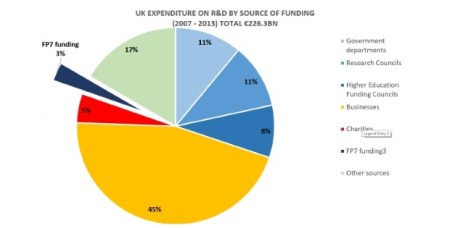
The figures are taken from a Royal Society report and are, as far as I’m aware, accurate. It’s worth noting however that the level of funding under the FP7 “Framework Programme” which funds research is much smaller than the current Horizon2020 programme.
However, as Stephen Curry has pointed out in a typically balanced and reasonable blog post, the impact of a BrExit on UK science is much more complex than this picture would suggest. I want to add just a few points from my specific perspective as a university-based researcher.
First, the 3% figure is arrived at by a tried-and-tested technique of finding the smallest possible numerator and dividing it by the lowest possible denominator. A fairer comparison, in my view, would just look at research funded by the taxpayer (either directly from the UK or via the EU). For one thing we don’t know how much of the research funded by businesses in the UK is funded by businesses which are only here in the UK because we’re part of the European Union. For another these figures are taken over the whole R&D effort and they hide huge differences from discipline to discipline.
From my perspective as an astrophysicist – and this is true of many researchers in “blue skies” areas – most of the pie chart is simply not relevant. The main sources of funding that we can attempt to tap are the UK Research Councils (chiefly STFC and EPSRC) and EU programmes; we also get a small amount of research income from charities, chiefly the Leverhulme Trust. The situation is different in other fields: medical research, for example, has much greater access to charitable funding.
As it happens I’ve just received the monthly research report of the School of Mathematical and Physics Sciences at the University of Sussex (of which I am currently Head) and I can tell you the EU counts not for 3% of our income but 21% (which is in line with the proportions) above; most of that comes from the European Research Council. The possibility of losing access to EU funding alarms me greatly as it would mean the loss of about one-fifth of our research base. I know that figure is much higher in some other institutions and departments.
But it’s not just the money that’s important, it’s also the kind of programmes that the EU funds. These are often to do with mobility of researchers, especially those early in their careers (including PhD students), grants that allow us to exploit facilities that we would otherwise not be able to access, and those that sustain large collaborations. It’s not just the level of cash that matters but the fact that what it funds is nicely complementary to the UK’s own programmes. The combination of UK and EU actually provides a much better form of “dual funding” than the UK can achieve on its own.
Some say that BrExit would not change our access to EU funding, but I maintain there’s a huge risk that this will be the case. The loss of the UK’s input into the overall EU budget will almost certainly lead to a revision of the ability of non-member states to access these programmes. The best that even BrExit campaigners argue for is that access to EU funding will not change. There is therefore, from a science perspective, there is no chance of a gain and a large risk of a loss. For me, that kind of a decision is a no-brainer. I’m not the only one who thinks that either: 150 Fellows of the Royal Society agree with me, as do the vast majority of scientists surveyed in a poll conducted by Nature magazine.
Of course there will be some who will argue that this “blue skies” academic research in universities isn’t important and we should be spending more money on stuff that leads to wealth creation. I can think of many arguments against that, but for the purposes of this post I’ll just remind you that 45% of UK research is done in industry and commercial businesses of various kinds. Where do you think the supply of science graduates come from, what kind of research draws students into science courses in the first place, and where do the teachers come from that educate the next generations?
As a scientist who cares passionately about the sustainability of Britain’s research base, I think we should definitely remain in the European Union.
I’ve been far too busy with work and other things to contribute as much as I’d like to the ongoing debate about the forthcoming referendum on Britain’s membership of the European Union. Hopefully I’ll get time for a few posts before June 23rd, which is when the United Kingdom goes to the polls.
For the time being, however, I’ll just make a quick comment about one phrase that is being bandied about in this context, namely Project Fear.As far as I am aware this expression first came up in the context of last year’s referendum on Scottish independence, but it’s now being used by the “leave” campaign to describe some of the arguments used by the “remain” campaign. I’ve met this phrase myself rather often on social media such as Twitter, usually in use by a BrExit campaigner accusing me of scaremongering because I think there’s a significant probability that leaving the EU will cause the UK serious economic problems.
Can I prove that this is the case? No, of course not. Nobody will know unless and until we try leaving the EU. But my point is that there’s definitely a risk. It seems to me grossly irresponsible to argue – as some clearly are doing – that there is no risk at all.
This is all very interesting for those of us who work in university science departments because “Risk Assessments” are one of the things we teach our students to do as a matter of routine, especially in advance of experimental projects. In case you weren’t aware, a risk assessment is
…. a systematic examination of a task, job or process that you carry out at work for the purpose of; Identifying the significant hazards that are present (a hazard is something that has the potential to cause someone harm or ill health).
Perhaps we should change the name of our “Project Risk Assessments” to “Project Fear”?
I think this all demonstrates how very bad most people are at thinking rationally about uncertainty, to such an extent that even thinking about potential hazards is verboten. I’ve actually written a book about uncertainty in the physical sciences , partly in an attempt to counter the myth that science deals with absolute certainties. And if physics doesn’t, economics definitely can’t.
In this context it is perhaps worth mentioning the definitions of “uncertainty” and “risk” suggested by Frank Hyneman Knight in a book on economics called Risk, Uncertainty and Profit which seem to be in standard use in the social sciences. The distinction made there is that “risk” is “randomness” with “knowable probabilities”, whereas “uncertainty” involves “randomness” with “unknowable probabilities”.
I don’t like these definitions at all. For one thing they both involve a reference to “randomness”, a word which I don’t know how to define anyway; I’d be much happier to use “unpredictability”.In the context of BrExit there is unpredictability because we don’t have any hard information on which to base a prediction. Even more importantly, perhaps, I find the distinction between “knowable” and “unknowable” probabilities very problematic. One always knows something about a probability distribution, even if that something means that the distribution has to be very broad. And in any case these definitions imply that the probabilities concerned are “out there”, rather being statements about a state of knowledge (or lack thereof). Sometimes we know what we know and sometimes we don’t, but there are more than two possibilities. As the great American philosopher and social scientist Donald Rumsfeld (Shurely Shome Mishtake? Ed) put it:
“…as we know, there are known knowns; there are things we know we know. We also know there are known unknowns; that is to say we know there are some things we do not know. But there are also unknown unknowns – the ones we don’t know we don’t know.”
There may be a proper Bayesian formulation of the distinction between “risk” and “uncertainty” that involves a transition between prior-dominated (uncertain) and posterior-dominated (risky), but basically I don’t see any qualititative difference between the two from such a perspective.
When it comes to the EU referendum is that probabilities of different outcomes are difficult to calculate because of the complexity of economics generally and the dynamics of trade within and beyond the European Union in particular. Moreover, probabilities need to be updated using quantitative evidence and we don’t actually have any of that. But it seems absurd to try to argue that there is neither any risk nor any uncertainty. Frankly, anyone who argues this is just being irrational.
Whether a risk is worth taking depends on the likely profit. Nobody has convinced me that the country as a whole will gain anything concrete if we leave the European Union, so the risk seems pointless. Cui Bono? I think you’ll find the answer to that among the hedge fund managers who are bankrolling the BrExit campaign…
Back in circulation after a short break I hope to write a few pieces about why I support the case for the United Kingdom to remain in the European Union, partly because it’s good for science, but also because it’s good for many other reasons.
But before I do that, I feel I have to do a quick post about the extremely unpleasant antics of an organization called “Scientists for Britain“, or rather the anonymous person or persons operating their Twitter feed.
Last Saturday I found myself in receipt of a message, apparently sent by this outfit, that explicitly threatened legal action on grounds of libel because of a comment I had made on one of their posts on Twitter which was alleged to be “disparaging”. I was refrained from referring the sender of this intentionally intimidatory message to the response given in Arkell versus Pressdram but it soon became clear that a number of other scientists on Twitter had received similar threats.Then, fortunately for us, in stepped renowned legal journalist David Allen Green, who blogs as Jack of Kent and is something of a specialist in libel law. He made it quite clear that the threats sent out by Scientists for Britain had no basis whatsoever in law, not least because you can’t libel an anonymous person. I hadn’t said anything even remotely actionable anyway.
Within hours, all the threatening messages had been deleted by Scientists for Britain, and they also blocked those of us to whom they had sent them in the first place, including myself. There are such things as screen grabs, however…
This social media car crash would be very funny were there not something very sinister behind it. I’m all for healthy robust and vigorous debate on the issue of the United Kingdom’s membership of the European Union ahead of the forthcoming referendum, but bullying those you disagree with by means of threats of legal action is no way to make your case. Also, for the record, I will point out that I have seen no evidence that the anonymous operator of the Scientists for Britain Twitter feed, who delights in issuing unwarranted libel threats, is a actually scientist at all. I very much doubt that is the case, in fact. Why else would Scientists for Britain be so obsessive about their anonymity? Even their response to a letter signed by 150 Fellows of the Royal Society is unsigned….
I am posting this information here in an attempt to find out how many other scientists Scientists for Britain have tried to silence through legal threats. If this has happened to you, please let me know via email, Twitter, or via the comments box of this blog (below).
If Scientists for Britain wish to comment they are welcome to do so below, although please note my comments policy: I do not accept postings from anonymous individuals.
I won’t pretend to be a historian but I can’t resist a comment from my perspective as a physicist. I am currently teaching a course module called Theoretical Physics which brings together some fairly advanced mathematical techniques and applies them to (mainly classical) physics problems. It’s not a course on the history of physics, but thenever I mention a new method or theorem I always try to say something about the person who gave it its name. In the course of teaching this module, therefore, I have compiled a set of short biographical notes about the people behind the rise of theoretical physics (mainly in the 19th Century). I won’t include them here – it would take too long – but a list makes the point well enough: Laplace, Poisson, Lagrange, Hamilton, Euler, Cauchy, Riemann, Biot, Savart, d’Alembert, Ampère, Einstein, Lorentz, Helmholtz, Gauss, etc etc.
There are a few British names too including the Englishmen Newton and Faraday and the Scot Maxwell. Hamilton, by the way, was Irish. Another Englishman, George Green, crops up quite prominently too, for reasons which I will expand upon below.
Sir Isaac Newton is undoubtedly one of the great figures in the History of Science, and it is hard to imagine how physics might have developed without him, but the fact of the matter is that for a hundred years after his death in 1727 the vast majority of significant developments in physics took place not in Britain but in Continental Europe. It’s no exaggeration to say that British physics was moribund during this period and it took the remarkable self-taught mathematician George Green to breath new life into it.
I quote from History of the Theories of the Aether and Electricity (Whittaker, 1951) :
The century which elapsed between the death of Newton and the scientific activity of Green was the darkest in the history of (Cambridge) University. It is true that (Henry) Cavendish and (Thomas) Young were educated at Cambridge; but they, after taking their undergraduate courses, removed to London. In the entire period the only natural philosopher of distinction was (John) Michell; and for some reason which at this distance of time it is difficult to understand fully, Michell’s researches seem to have attracted little or no attention among his collegiate contemporaries and successors, who silently acquiesced when his discoveries were attributed to others, and allowed his name to perish entirely from the Cambridge tradition.
I wasn’t aware of this analysis previously, but it re-iterates something I have posted about before. It stresses the enormous historical importance of British mathematician and physicist George Green, who lived from 1793 until 1841, and who left a substantial legacy for modern theoretical physicists, in Green’s theorems and Green’s functions; he is also credited as being the first person to use the word “potential” in electrostatics.
Green was the son of a Nottingham miller who, amazingly, taught himself mathematics and did most of his best work, especially his remarkable Essay on the Application of mathematical Analysis to the theories of Electricity and Magnetism (1828) before starting his studies as an undergraduate at the University of Cambridge ,which he did at the age of 30. Lacking independent finance, Green could not go to University until his father died, whereupon he leased out the mill he inherited to pay for his studies.
Extremely unusually for English mathematicians of his time, Green taught himself from books that were published in France. This gave him a huge advantage over his national contemporaries in that he learned the form of differential calculus that originated with Leibniz, which was far more elegant than that devised by Isaac Newton (which was called the method of fluxions). Whittaker remarks upon this:
Green undoubtedly received his own early inspiration from . . . (the great French analysts), chiefly from Poisson; but in clearness of physical insight and conciseness of exposition he far excelled his masters; and the slight volume of his collected papers has to this day a charm which is wanting in their voluminous writings.
Great scientist though he was, Newton’s influence on the development of physics in Britain was not entirely positive, as the above quote makes clear. Newton was held in such awe, especially in Cambridge, that his inferior mathematical approach was deemed to be the “right” way to do calculus and generations of scholars were forced to use it. This held back British science until the use of fluxions was phased out. Green himself was forced to learn fluxions when he went as an undergraduate to Cambridge despite having already learned the better method.
Unfortunately, Green’s great pre-Cambridge work on mathematical physics didn’t reach wide circulation in the United Kingdom until after his death. William Thomson, later Lord Kelvin, found a copy of Green’s Essay in 1845 and promoted it widely as a work of fundamental importance. This contributed to the eventual emergence of British theoretical physics from the shadow cast by Isaac Newton. This renaissance reached one of its heights just a few years later with the publication of a fully unified theory of electricity and magnetism by James Clerk Maxwell.
In a very real sense it was Green’s work that led to the resurgence of British physics during the later stages of the 19th Century, and it was the fact that he taught himself from French books that enabled him to bypass the insular attitudes of British physicists of the time. No physicist who has taken even a casual look at the history of their subject could possibly deny the immense importance of mainland Europe in providing its theoretical foundations.
Of course science has changed in the last two hundred years, but I believe that we can still learn an important lesson from this particular bit of history. Science moves forward when scientists engage with ideas and information from as wide a range of sources as possible, and it stagnates when it retreats into blinkered insularity. The European Union provides all scientific disciplines with a framework within which scientists can move freely and form transnational collaborations for the mutual benefit of all. We need more of this, not less. And not just in science.
The views presented here are personal and not necessarily those of my employer (or anyone else for that matter).
Feel free to comment on any of the posts on this blog but comments may be moderated; anonymous comments and any considered by me to be vexatious and/or abusive and/or defamatory will not be accepted. I do not necessarily endorse, support, sanction, encourage, verify or agree with the opinions or statements of any information or other content in the comments on this site and do not in any way guarantee their accuracy or reliability.




 In the Dark