Archive for the Science Politics Category

Controversy brewing at ESA?

Posted in Science Politics with tags , , , , on April 23, 2012 by telescoper

Interesting stuff over at the e-astronomer relating to ESA’s handling of the process of selecting its next L-class mission. The plot thickens.

andyxl's avatarThe e-Astronomer

So the Athena folk are somewhat miffed at being pipped by Juice. (This metaphor doesn’t seem quite right ? Ed.) But what about Horse Number Three ? Aren’t the NGO folk doing a Grand Petition ? Nope. It seems their tactic is a semi-formal complaint about inadeqacies in the process : an email letter direct to Gimenez. I am not sure how widely it has been circulated, but I understand it is stern stuff, bringing up issues of inappropriate revisions of costings and risk factors, and inadequately resolved conflicts of interest. Feel free to comment if you have clear knowledge, but please (a) do not leak things that are confidential, and (b) keep coments about process and not about individuals.

Its not really clear what competition means when a very small number of items is under consideration, and moreoever each item represents one community-segment, each of which ESA wishes to…

View original post 356 more words

Bad News for Astrophysics from ESA

Posted in Science Politics, The Universe and Stuff with tags , , , , , , , , on April 18, 2012 by telescoper

Just a quick post to pass on the news (which I got from Steinn Sigurdsson’s blog) that the ESA Executive (see correction in comments below) Space Science Advisory Committee (SSAC) of the European Space Agency (ESA) has made a recommendation as to the next large mission to be flown. The short list consisted of a mission to Jupiter’s moons (JUICE), an X-ray observatory (ATHENA), and a gravitational wave observatory (NGO). The last two of these are severely de-scoped versions of missions (IXO and LISA respectively) that had to be re-designed in the aftermath of decisions made in the US decadal review not to get involved in them.

Not unexpectedly, the winner is JUICE. Barring a rejection of this recommendation by the ESA Science Programme Committee (SPC) this will be the next big thing for ESA space science.

The School of Physics and Astronomy at Cardiff University has a considerable involvement in gravitational wave physics, so the decision is disappointing for us but not entirely surprising. It’s not such a big blow either, as we are mainly involved in ground-based searches such as LIGO.

The biggest local worry will be for the sizeable community of X-ray astronomers in the UK. With no big new facilities likely for well over a decade one wonders how the expertise in this area can be sustained into the future, even if LOFT is selected as one of the next medium-sized missions. Or, given that STFC funding is already spread extremely thin, perhaps this is time for the UK to organize a strategic withdrawal from X-ray astronomy?

Sêr Cymru

Posted in Science Politics with tags , , , on March 24, 2012 by telescoper

The Welsh Government’s vision for a world-leading science base in Wales was unveiled on Thursday 15 March during a keynote address by Wales’ Chief Scientific Officer, Professor John Harries, who delivered a public lecture at Cardiff University to reveal how he thinks this strategic agenda can steer Welsh science and engineering into the future.

Here is the lecture in its entirety

One the principal components this strategy is the Sêr Cymru (“Star Wales”) project which will involve expenditure of about £50 million over 5 years to attract research leaders to Wales. This announcement attracted quite a lot of local news coverage, e.g in the Western Mail, but it isn’t exactly a new proposal. In fact I blogged about it several months ago. Here is a summary of the points I made back then together with some new comments.

The basic point is that Welsh universities currently only attract about 3% of the UK’s total research funding whereas the famous Barnett formula allocates Wales about 5% of the total in other areas of public expenditure. Nobody involved in research would argue for funds to be allocated on any other basis than through quality, so there’s no clamour for having research funding allocated formulaically a là Barnett; the only way to improve the success rate is to improve the quality of applications. John Harries suggests that means poaching groups from elsewhere who’ve already got a big portfolio of research grants…

The problem with that strategy is that it’s not very easy to persuade such people to leave their current institutions, especially if they’ve already spend years acquiring the funding needed to equip their laboratories. It’s not just a question of moving people, which is relatively easy, but can involve trying to replace lots of expensive and delicate equipment. The financial inducements needed to fund the relocation of a major research group and fight off counter-offers from its present host are likely to be so expensive that the benefit gained from doing this takes years to accrue, even they are successful.

I agree with Prof. Harries that Welsh universities need to raise their game in research, but I don’t think this “transfer market” approach is likely to provide a solution on its own. I think Wales needs a radical restructuring of research, especially in science, across the whole sector, which I think is unacceptably complacent about the challenges ahead.

For a start, much more needs to be done to identify and nurture younger researchers, i.e. future research stars rather than present ones. Most football clubs nowadays have an “academy” dedicated to the development of promising youngsters, so why can’t we do a similar thing for research in Wales? Research groups in different Welsh universities also need to develop closer collaborations, and perhaps even full mergers, in order to compete with larger English institutions.

More controversially, I’d say that the problem is not being helped by Welsh universities continuing to be burdened by the monstrous bureaucracy and bizarre practices of the Research Excellent Framework, which allocates “QR” research funds according to priorities set by HEFCE in a way that reflects the thinking of the Westminster parliament. The distribution of QR funding in Wales, which is meant to supplement competitive grant income from UK funding bodies, should be decided by HEFCW in line with Welsh strategic priorities. Wales would be far better off withdrawing from the REF and doing its own thing under the auspices of the Welsh Assembly Government.

In fact there are dark rumours circulating that HEFCW will not have enough money to pay any QR funding anyway. If that’s true then the widening funding gap between Wales and England will do more damage than can possibly be remedied by importing a few big shots from elsewhere. The sum involved (£50 million) seems like a lot, but it won’t pay for more than a few groups around Wales if they are in experimental science or engineering technology, because the cost of setting up new labs and acquiring new equipment is considerable. Although buying in mercenaries might be of short-term benefit, what are the chances that they’ll take someone else’s dollar in the near future?

Wales needs a sustainable research base, so at very least I’d like to see a bottom-up project, encouraging younger researchers at PhD and PDRA level, perhaps through a system of national fellowships, to complement the “top-down” of the Star Wales project. Unless that happens, we might have leaders with no-one to follow them.

Worries for Science in Spain

Posted in Finance, Politics, Science Politics with tags , on March 10, 2012 by telescoper

I recently received the following email letter, concerning the state of science funding in Spain.  As well as passing it on to colleagues I thought I would post it on this blog where it might have wider impact:

Dear colleague,

You probably know very well how the global crisis is affecting southern Europe, and in particular Spain. Some of us are promoting a campaign among the worlwide scientific community to prevent our conservative government from straining even more the science system in Spain, that so many successes has obtained in the last decade, but whose future is now at stake.

In the next few weeks, and contravening recommendation from the European Commission stating that public deficit control measures should not affect Research and Development (R&D) and innovation, the Spanish Government and Parliament could approve a State Budget for 2012 that would cause considerable long-term damage to the already weakened Spanish research system, contributing to its collapse.

There is an open letter that we are sending to distinguished scientists all over the world, including many Nobel Prize Winners and Members of Academies of Science, asking them to sign, support the motion and spread the word:

http://www.investigaciondigna.es/wordpress/sign

Please do help us by signing the letter and passing it on to your colleagues.

Kind regards,

Alexander Knebe

The “open letter” you can read by clicking on the link contains some interesting – and alarming – information that has serious implications for our colleagues not only in Spain but elsewhere in Europe. Take a look, for example, at the following picture that shows the fraction of GDP being invested in science:

This isn’t just about Spain, although the situation is clearly especially serious for Spanish Science. It’s a timely reminder that the UK is also well below the EU average in terms of science spend. Is it a coincidence that the EU’s worst-performing economies are all on the right of this figure? Is that where we want the UK to be too?

STFC Team Selection

Posted in Football, Science Politics with tags , on February 27, 2012 by telescoper

It’s been such a busy day today I almost missed a seemingly unimportant message on Twitter from the Science and Technology Facilities Council about its new management structure. Only when I got home this evening did I read it carefully and discover that it’s not really as innocuous as I’d assumed. In fact it looks like the Chief Executive has been busy during the recent transfer window.

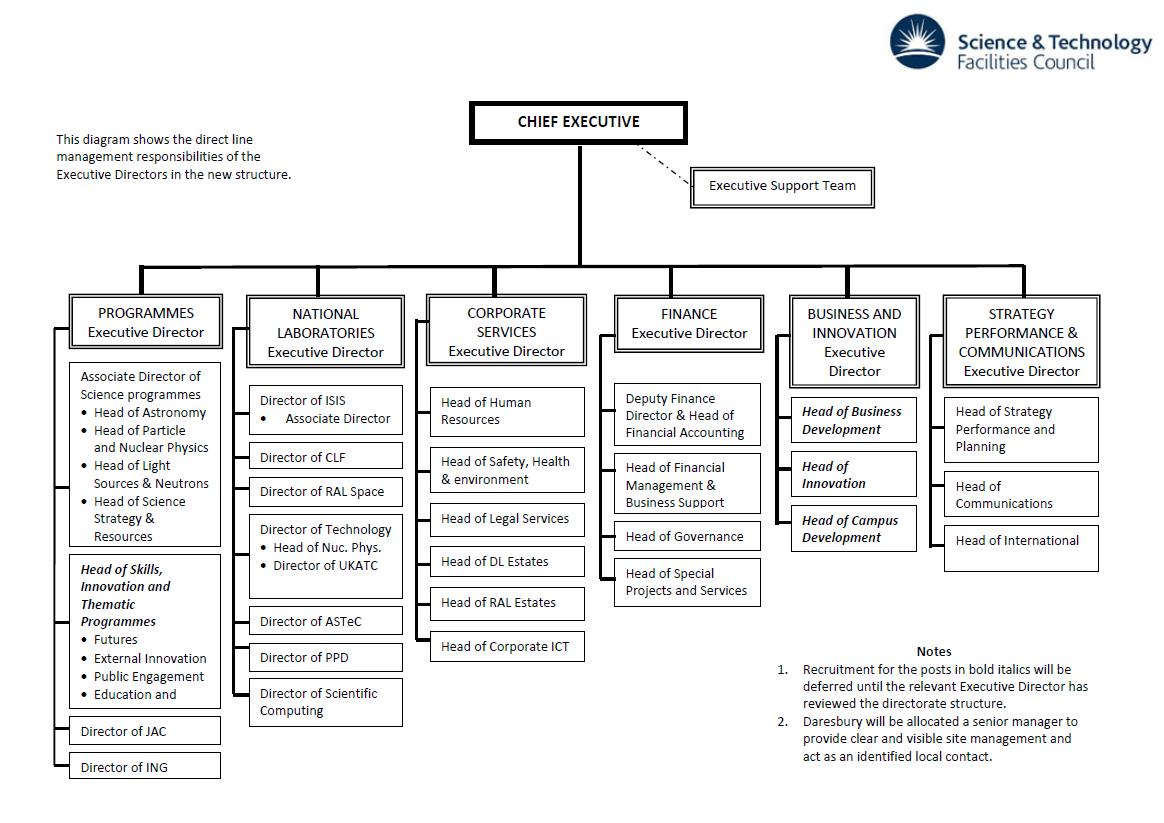
The new team at STFC will line up like this

It doesn’t look all that different from the old one, except it’s a slightly more compact  formation with less width in the wide areas, and perhaps fewer clichés in the final third.

The controversy however comes with ashen-faced manager Ron John Womersley’s team selection. As per the announcement:

Following staff input, and Council approval, I have conducted an internal selection process to fill the new senior positions in the structure and can now announce the following appointments from 1 April 2012:

    • Executive Director National Laboratories: Dr Andrew Taylor
    • Executive Director Business and Innovation: Dr Tim Bestwick
    • Executive Director Corporate Services: Mr Gordon Stewart
    • Executive Director Strategy, Performance and Communications: Dr Sharon Cosgrove

In addition, Mrs Jane Tirard will continue in her role with the new title of Executive Director Finance, and Dr Janet Seed will extend her acting stewardship of the programmes area as Acting Executive Director Programmes pending an open recruitment exercise for the position.

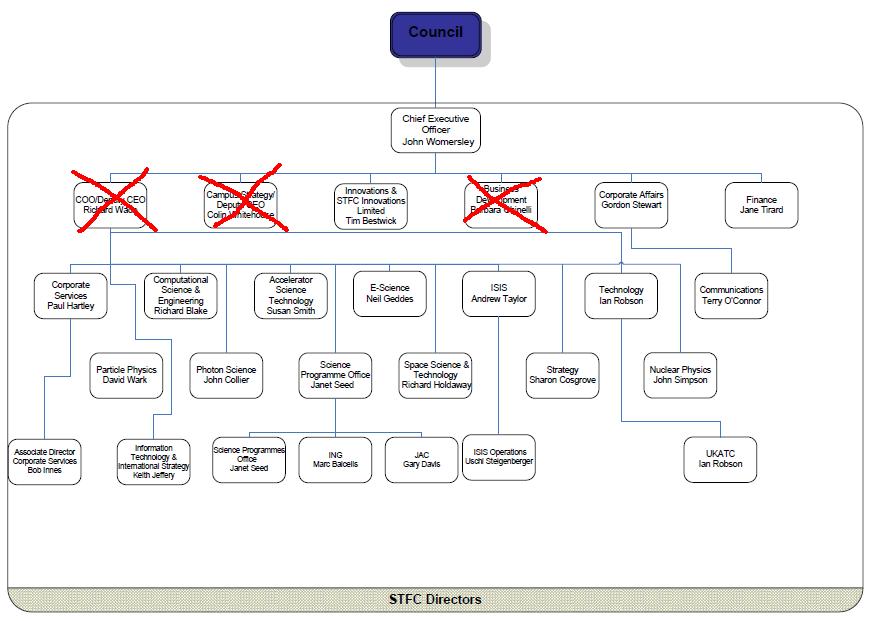
So three prominent members of the previous line-up are no longer part of the team:

For example, out goes hard-tackling wide man and own-goal specialist, Richard Wade, who apparently leaves on a free transfer. Or is he just on the subs’ bench for the time being?  According to the diagram, Tim Bestwick stays but will move from a central position to the right side, roughly changing position with Gordon Stewart who also keeps his place in the team. Andrew Taylor, formerly in midfield, moves to an inside forward role where, as Director of the National Laboratories, he will sometimes be “in the hole” (i.e. Didcot).

Most pundits reckon the new-look STFC will deploy a Diamond-Light Source shaped midfield aimed at closing down the opposition, as opposed to the old team which concentrated more on closing down its own facilities. It looks like the reorganization was made with  one eye on European challenges, but Womersley remains committed to the national game, as last week’s scouting trip to the University of Neasden makes clear.

The STFC supporters’ club  (Sid and Doris Bonkers) expressed delight with the team changes, but former manager Keith Mason remains bound and gagged in the basement of UKSA was unavailable for comment.

Harry Redknapp is 97.

P.S. The STFC statement describes the staff departures thus:

STFC has benefited from the very significant personal contributions of the existing senior management team. They have helped develop STFC into a successful workplace as recognised by the recent Investor in People accreditation (Silver status), and our positive Comprehensive Spending Round outcome. However, the changing dynamics of STFC mean that it is time for a change and not all senior managers will continue with the organisation.

Do I detect a note of insincerity?


The Quality of Physics

Posted in Science Politics with tags , , , on February 21, 2012 by telescoper

Just time for a quick post this lunchtime,  in between meetings and exercise classes. My eye was drawn this morning to an article about a lengthy report from the Institute of Physics that gives an international comparison of citation impact in physics and related fields.

According to the IOP website..

Although the UK is ranked seventh in a list of key competitor countries for the quantity of its physics research output – measured by the number of papers published – the UK is second only to Canada, and now higher than the US, when ranked on the average quality of the UK’s physics research output – measured by the average number of times research papers are cited around world.

The piece also goes on to note that the UK’s share of the total number of research papers written has decreased

For the UK, however, its proportionate decrease in output – from 7.1% of the world’s physics research in 2001 to 6.4% in 2010 – has been accompanied by a celebratory increase in overall, average quality – with the average number of citations of UK research papers rising from 1.24 in 2001 to 1.72 in 2010.

This, of course, assumes that citations measure “quality” but I’ve got no time to argue that point today. What I will do is put up a couple of interesting figures from the report.  This one shows that Space Science in the UK (including Astronomy and Astrophysics) holds a much bigger share of the total world output of papers than other disciplines (by a factor of about three):

While this one shows that the “citation impact” for Physics and Space Science roughly track each other…

..apart from the downturn right at the end of the window for space sciences, which, one imagines, might be a result of decisions taken by the management of the Science and Technology Facilities Council  over that period.

Our political leaders will be tempted to portray the steady increase of citation impact across fields as a sign of improved quality arising from the various research assessment exercises.  But I don’t think it’s as simple as that. It seems that many developing countries – especially China – are producing more and more scientific papers. This inevitably drives the UK’s share of world productivity down, because our capacity is not increasing. If anything it’s going down, in fact, owing to recent funding cuts. However, the more papers there are, the more reference lists there are, and the more citations there will be. The increase in citation rates may therefore just be a form of inflation.

Anyway, you can download the entire report here (PDF). I’m sure there will be other reactions to it so, as usual, please feel free to comment via the box below…

Innovations

Posted in Science Politics with tags , , on February 16, 2012 by telescoper

Moaning about science politics, especially with regard to funding, is one of the recurring themes on this blog. The UK government administers science policy through the Department for Business, Innovation and Skills (better known as BIS). Unfortunately I can’t think of that name without harking back to the good old days of the Innovations Catalogue (shown left). I was shocked to discover that this met its demise as long ago as 2003 but in its time it was comedy gold. Packed full of palpably useless gadgets – who could possibly forget the vibrating fur-lined golf club cover? – it was all the more hysterical for  that fact that it was clearly deadly serious. When I’m Sorry I Haven’t A Clue tried to lampoon the Innovations Catalogue,  the results struggled to be as funny as the real thing, although I do remember Willie Rushton’s combined cigarette lighter and nasal hair remover…

It seems that the Innovations people made one big mistake that cost them their business: the stuff they sold was dirt cheap. Subsequent experience has taught us that if you want to persuade people to buy useless gadgets, you have to make them expensive. No tat sells like expensive tat…

Anyway, having thus established the theme of Innovation, let me now explore a variation. Websites.

Over the past few weeks I’ve noticed a number of changes to websites I use. Last week I noticed that Twitter had been revamped. The first impression I got was that all my tweets were on the right hand side of the screen instead of the left. Not a drastic alteration, though as a man who is fully in touch with his inner Luddite I find even that level of change hard to cope with. More perturbingly I later saw that the button for searching for mentions of your username (for those of you who aren’t twits twats twerps tweeters, this was marked “@” because all twitter names begin with that character) is no longer labelled “mentions” but “connect”. Huh? Connect with what or whom? Likewise the “activity” tag is now called “discover”. Why it was decided to change the names from something descriptive to something non-descriptive is beyond me, but it’s probably what passes as “innovative” in the world of web designers.

I’ve got nothing against web designers in general, and I think some websites are absolutely wonderful in both content and style. This one, for example. However, there are some who seem to have been put together by people on a mission to the make the design so impenetrable that it’s impossible for anyone to find any content at all.

A major leap in this direction has recently been made by the BBC. A while ago they introduced a new home page, which has virtually no information on it, but lots of graphics. After vociferously negative responses from users of the BBC Website, i.e. the public, the person in charge responded by saying that the changes were needed in order to make the site more distinctive. I freely admit that it is distinctive, but its main distinction is that it is poor.

Now I’ll grant that page layout and style is a matter for personal taste so there will be others out there who like the new BBC Webshite. That’s fine. What’s less forgivable is that the quality of service has also deteriorated and that is an objective fact. Here’s an example.

On the old BBC website you could set your location, with the result that the homepage would give access to local news, local TV and radio listings, and so on. You also automatically got weather information for your chosen location. Now you can still set your location on the homepage, but if you click on the new “weather” page your location is automatically set to London. Every time you log on, and want to check the weather, you have to type in your location by hand. Unless you live in London, of course, which is presumably why the web hacks didn’t worry about this.

I’m no expert, but it shouldn’t have been beyond the wit of even the most lowly web designer to pass information about location from one page to another within the same site. But who cares about whether the service is better for the user, as long as it’s distinctive….

I suppose the point of this post – if there is one – is that we shouldn’t be too respectful towards innovation for innovation’s sake. Not all innovation is good.

You might think that adage applies also to what goes on in BIS, but I couldn’t possibly comment.

The SKA Propaganda Machine

Posted in Astrohype, Science Politics, The Universe and Stuff with tags , , , , on February 14, 2012 by telescoper

I’m a big fan of the Square Kilometre Array, a proposed new radio telescope that will revolutionize our understanding of many aspects of astrophysics.

I’m somewhat less keen on the intense lobbying being carried out on behalf of Australian astronomers in advance of the decision whether to site it in Australia or South Africa. The campaign is being orchestrated by a PR organization called Ogilvy and Mather who are making full use of social media to promote the Australian case.

Last week I was invited by email to attend a “webinar” (whatever that is) about the SKA, an invitation that I quietly ignored. Today I got a follow-up email from a person described as a “Digital Analyst” offering me the chance to “interview Dr Brian Boyle or Dr Lisa Harvey Smith”. They also sent me the following “infographic” (i.e. a picture) showing the case for siting the SKA in Australia, which they thought would be of interest to “my blog readers”.

Well, you can call me old-fashioned but I think there’s something a bit distasteful about engaging a glorified ad agency to lobby on behalf of one party in a discussion that should be resolved on purely scientific grounds. I wonder how much it cost, for a start, but I’d also have hoped scientists would be above that sort of thing anyway. Sign of the times, I suppose.

Anyway, even if the digital analysts at Ogilvy will be happy that I’ve shown their infographic, perhaps they might now realize that spin can work in two different ways…

Update on the Elsevier Affair…

Posted in Science Politics with tags , on February 11, 2012 by telescoper

No time for a post of my own this morning, as I’m off to the department to help with a UCAS admissions visit day. I’ll take the opportunity, therefore, to point you towards mathematician Tim Gowers’ excellent blog for an update on the Elsevier boycott (and related issues) that I posted about a while ago.

P.S. At times like this I’m so grateful WordPress brought the “reblog” option back, although I’m not sure I like the new format…

gowers's avatarGowers's Weblog

A group of mathematicians have been putting together a statement that explains some of the background to, and reasons for, the Elsevier boycott. This statement, which has been signed by 34 mathematicians (we are confident that many more would be happy to endorse it, but we had to stop somewhere), is now ready for release. If you are interested in reading it, then click here.

View original post 440 more words

A Shared Disservice

Posted in Biographical, Science Politics with tags , , , , , on February 5, 2012 by telescoper

If you’ve never heard of the Shared Services Centre then you’re a very lucky person. If you have heard of it, and especially if you’ve had any dealings with it, then the following excerpt  from the SSC website description of itself will make you either laugh or cry:

The UK’s seven Research Councils, working together as Research Councils UK (RCUK), set up a shared services centre to reduce spend on administration. Sharing and standardising processes simply frees more funds for keeping the UK at the forefront of research and innovation.

Each year the Research Councils invest around £2.8 billion in research into understanding and improving the world around us. They’re involved in everything from tackling superbugs or studying social trends to analysing the geo-climate of the Antarctic. So, operating efficiently benefits our whole society.

What is more, sharing services does not mean compromising quality. The RCUK Shared Services Centre Ltd (SSC) is dedicated to providing exceptional standards of service in Human Resources, Finance, Procurement, IT IS and Grants administration. Our people achieve this by sharing their skills, knowledge and our vision:

‘Professional people working together, delivering quality services for the benefit of the research community’

The italics are mine. I added them  to sections that made me laugh out loud.  In fact almost all the above description of the SSC is complete tripe. The organization is a  fiasco. It has cost more than twice its original budget to implement and since its inception the quality of research administration has deteriorated beyond all recognition. The only thing I’ll say about the statement quoted above is that George Orwell would have been very proud.

This has serious consequences for those dependent for funding on the Research Councils, including the Science and Technology Facilities Council (STFC), which has been forced to use the Shockingly Shambolic Catastrophe to administer the grants it issues.  The time taken to process and issue grants is now far longer than it was previously, when such tasks were done by people who actually knew (and cared about) what they were doing.

I’m told by reliable sources that the whole SSC debacle is such an embarrassment that staff employed by the Research Councils have been forbidden to say negative things about it and have instead to pretend everything is just hunky-dory lest the mess damages the reputations of their political masters in BIS.  The result of this strategy is that BIS now think the SSC is doing a fabulous job and are going to expand its activities across other departments. If nobody blows the whistle on it, the SSC behemoth will gradually take over the entire government and turn everything into crap. Or perhaps that has already happened?

Anyway, I’m far too old to play David versus Goliath in this particular battle. I’ll leave that to the continuing efforts of, e.g., Private Eye. But I will give you a tiny – and not particular important – illustration of how useless the SSC really is. I’m one of those people who has to fill in a self-assessment tax return every year. It’s not too difficult to do because I retain a chap to organize my accounts and in any case   income I receive on top of my main salary is usually documented in the various P60s I get at the end of each tax year. Except this year I didn’t get a P60 for the work I did for STFC on the Astronomy Grants Panel. Such payments are also administered by SSC, and it is their statutory responsibility to provide a P60, but despite repeated attempts to extract one, I didn’t get it  in time for the January 31st deadline. I therefore filed my return with estimated figures and an explanatory note.

Finally SSC replied. It seems they had decided to send my P60 to my old address in Nottingham, along with a number of other items of correspondence. Why they did so I have no idea, as I moved from there in 2008. I told STFC my new address at that time, and have been receiving various bits and bobs from them at my correct address since then. Moreover, SSC have been sending items here too, so they do have the right details. Only it seems I’ve been getting letters from Finance, whereas the tax stuff is dealt with by the dreaded Human Resources. As seems inevitable with large bureaucracies, the different parts clearly do not communicate with each other.

Anyway, to cut a very long story very short, after I filed my tax return I finally received an email from SSC explaining what had happened. It also said that it was not possible to issue a duplicate P60, but they were attaching a statement of earnings and tax paid. Only there was no attachment. I emailed back to ask what had happened to the attachment. Three days later I got a reply with the attachment. The email began “Dear Professor Collins…”.

Curiously the attachment – when it finally was sent – arrived in encrypted form “for security”. A bit of a waste of time, methinks, when they’ve been posting confidential documents to the wrong address for more than three years!

I’ve corrected my tax return in the light of the new information they sent, but I may still be liable for some sort of surcharge. It’s clearly the fault of the SSC, but there’s no symmetry in tax affairs. If Joe Bloggs is late or makes an error, he gets stamped on by the Inland Revenue. If a government agency messes up it probably gets away scot free.

This is all small potatoes of course, but the dire state of their record-keeping in a trivial case like mine makes me worry about what might be going wrong with more serious things…

I have the feeling that there might be one or two people out there with SSC stories of their own. Do feel free to share them via the comments box.