Archive for the Science Politics Category

The H-index is Redundant…

Posted in Bad Statistics, Science Politics with tags , , , , , on January 28, 2012 by telescoper

An interesting paper appeared on the arXiv last week by astrophysicist Henk Spruit on the subject of bibliometric indicators, and specifically the Hirsch index (or H-index) which has been the subject of a number of previous blog posts on here. The author’s surname is pronounced “sprout”, by the way.

The H-index is defined to be the largest number H such that the author has written at least H papers having H citations. It can easily be calculated by looking up all papers by a given author on a database such as NASA/ADS, sorting them by (decreasing) number of citations, and working down the list to the point where the number of citations of a paper falls below the number representing position in the list. Normalized quantities – obtained by dividing the number of citations a paper receives by the number of authors of that paper for each paper – can be used to form an alternative measure.

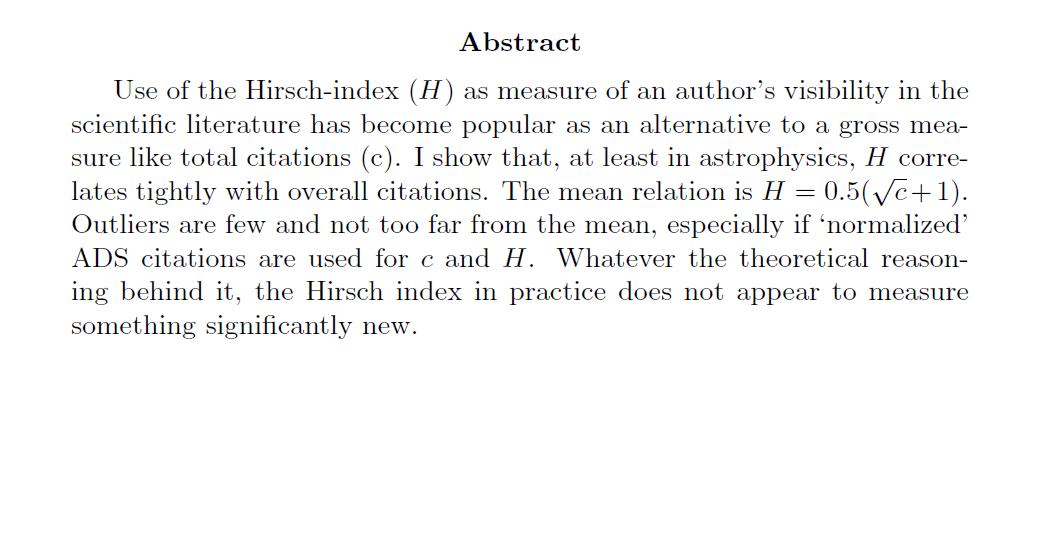
Here is the abstract of the paper:

Here are a couple of graphs which back up the claim of a near-perfect correlation between H-index and total citations:

The figure shows both total citations (right) and normalized citations (left); the latter, in my view, a much more sensible measure of individual contributions. The basic problem of course is that people don’t get citations, papers do. Apportioning appropriate credit for a multi-author paper is therefore extremely difficult. Does each author of a 100-author paper that gets 100 citations really deserve the same credit as a single author of a paper that also gets 100 citations? Clearly not, yet that’s what happens if you count total citations.

The correlation between H index and the square root of total citation numbers has been remarked upon before, but it is good to see it confirmed for the particular field of astrophysics.

Although I’m a bit unclear as to how the “sample” was selected I think this paper is a valuable contribution to the discussion, and I hope it helps counter the growing, and in my opinion already excessive, reliance on the H-index by grants panels and the like. Trying to condense all the available information about an applicant into a single number is clearly a futile task, and this paper shows that using H-index and total numbers doesn’t add anything as they are both measuring exactly the same thing.

A very interesting question emerges from this, however, which is why the relationship between total citation numbers and h-index has the form it does: the latter is always roughly half of the square-root of the former. This suggests to me that there might be some sort of scaling law describing onto which the distribution of cites-per-paper can be mapped for any individual. It would be interesting to construct a mathematical model of citation behaviour that could reproduce this apparently universal property….

Higgs-mania Day

Posted in Science Politics, The Universe and Stuff with tags , , , , , on December 13, 2011 by telescoper

I woke up this morning to the BBC Radio News at 7am announcing that scientists at CERN were going to report “hints” of the discovery of the Higgs Boson at the Large Hadron Collider;  you can find a longer discussion by the BBC here. This was later accompanied by articles tackling the important questions of the day such as whether the discovery of the Higgs would justify the enormous expense of Brian Cox the LHC.

Prize for the most  inaccurate science report goes to  the Daily Fail:

‘God’ particle found:

Atom smasher reveals Higgs boson, the key to the universe

Evidence soon emerged however that this particular squib might be of the damp variety. Consistent with previous blogospheric pronouncements, a paper on the arXiv this morning suggested no convincing detection of the Higgs had actually been made by the ATLAS experiment.

I then had to make an important choice between watching the live webcast of the CERN seminar at which detailed information on the Higgs searches was to be presented or to accept a free lunch with the examiners of a PhD candidate. I chose the latter.

Catching up on events after lunch confirmed the underwhelming nature of the Higgs “detection”, but with some intriguing evidence an excess signal at around 126 GeV at the 2.3 sigma level, in the frequentist parlance favoured by particle physicists and others who don’t know how to do statistics properly. In the words of the late John Bahcall:  “half of all three-sigma detections are false“. Of course if they used proper Bayesian language, scientists wouldn’t make so many nonsensical statements. Personally, I just don’t do sigmas.

My attention then switched to the CMS experiment. As a point of information you should be aware that CMS stands for Compact Muon Solenoid, where “compact” is a word used by particle physicists to mean “fucking enormous”. CMS makes  pictures like this:

Anyway, it seems from the CMS part of the presentation that they find a bit of a peak at a similar mass ~ 125 GeV but spread out over a larger range, this time at a level of – sigh – 2.6 sigma.

All in all, it’s a definite maybe. Putting the results together in the way only a frequentist can the result is a 2.4 sigma detection. In other words,  nothing any serious scientist would call convincing.

It’s interesting how certain these particle physicists are that the Higgs actually exists. It might, of course, and I think these results may be pointing the way to more convincing evidence based on more data. However,  I still think we should bear in mind the words of Alfred North Whitehead:

There is no more common error than to assume that, because prolonged and accurate mathematical calculations have been made, the application of the result to some fact of nature is absolutely certain.

If there is a Higgs boson with a mass of 125 GeV then that would of course be an exciting discovery, but if there isn’t one at all wouldn’t that be even more exciting?

Final word from the Director of CERN:

We have not found it yet, we have not excluded it yet, stay tuned for next year.

Thunder and hail descended on Cardiff just as the webcast finished, which is clearly not a coincidence although I couldn’t say how many sigmas were involved.

And a final, final word from the Chief Executive of the Science & Technology Facilities Council, John Womersley:

There is still some way to go before the existence of the Higgs boson can be confirmed or not, but excitement is mounting. UK physicists and engineers have played a significant role in securing today’s results, and will continue to be at the forefront of exploring the new frontiers of knowledge opened by the results coming from the LHC. This is an incredibly exciting time to be involved in physics!

Brian Cox is 43.

Planck Publications

Posted in Science Politics, The Universe and Stuff with tags , , , , on December 2, 2011 by telescoper

I just noticed that a Special Issue of Astronomy and Astrophysics which contains the early science papers from Planck has now finally appeared, swelling a considerable number of personal bibliographies just in time for the next round of grant and/or job applications!

The thing is, though, that these papers were all placed on the arXiv in January 2011, so it has taken almost 11 months for them to get officially published. Such a delay seems ridiculous to me in this digital age.  I wonder why it took A&A  so long to publish these papers? Were they all held up by refereeing delays? Are the final published versions significantly different from the arXiv version? I’ve only looked at a few, and can’t see any major changes.

Or maybe this is all normal for A&A?

If you know, please tell…

Of course the main science results from Planck won’t be out until 2013. I wonder how long they’ll take to referee?

Advice for the REF Panels

Posted in Finance, Science Politics with tags , , , , , on October 30, 2011 by telescoper

I thought I’d post a quick follow-up to last week’s item about the Research Excellence Framework (REF). You will recall that in that post I expressed serious doubts about the ability of the REF panel members to carry out a reliable assessment of the “ouputs” being submitted to this exercise, primarily because of the scale of the task in front of them. Each will have to read hundreds of papers, many of them far outside their own area of expertise. In the hope that it’s not too late to influence their approach, I thought I’d offer a few concrete suggestions as to how things might be improved. Most of my comments refer specifically to the Physics panel, but I have a feeling the themes I’ve addressed may apply in other disciplines.

The first area of  concern relates to citations, which we are told will be used during the assesment, although we’re not told precisely how this will be done. I’ve spent a few hours over the last few days looking at the accuracy and reliability various bibliometric databases and have come to the firm conclusion that Google Scholar is by far the best, certainly better than SCOPUS or Web of Knowledge. It’s also completely free. NASA/ADS is also free, and good for astronomy, but probably less complete for the rest of physics. I therefore urge the panel to ditch its commitment to use SCOPUS and adopt Google Scholar instead.

But choosing a sensible database is only part of the solution. Can citations be used sensibly at all for recently published papers? REF submissions must have been published no earlier than 2008 and the deadline is in 2013, so the longest time any paper can have had to garner citations will be five years. I think that’s OK for papers published early in the REF window, but obviously citations for those published in 2012 or 2013 won’t be as numerous.

However, the good thing about Google Scholar (and ADS) is that they include citations from the arXiv as well as from papers already published. Important papers get cited pretty much as soon as they appear on the arXiv, so including these citations will improve the process. That’s another strong argument for using Google Scholar.

The big problem with citation information is that citation rates vary significantly from field to field sit will be very difficult to use bibliometric data in a formulaic sense, but frankly it’s the only way the panel has to assess papers that lie far from their own expertise. Unless anyone else has a suggestion?

I suspect that what some panel members will do is to look beyond the four publications to guide their assessment. They might, for example, be tempted to look up the H-index of the author if they don’t know the area very well. “I don’t really understand the paper by Professor Poindexter but he has an H-index of 95 so is obviously a good chap and his work is probably therefore world-leading”. That sort of thing.

I think this approach would be very wrong indeed. For a start, it seriously disadvantages early career researchers who haven’t had time to build up a back catalogue of high-impact papers. Secondly, and more fundamentally still, it is contrary to the stated aim of the REF, which is to assess only the research carried out in the assessment period, i.e. 2008 to 2013. The H-index would include papers going back far further than 2008.

But as I pointed out in my previous post, it’s going to be impossible for the panel to perform accurate assessments of all the papers they are given: there will just be far too many and too diverse in content. They will obviously therefore have to do something other than what the rest of the community has been told they will do. It’s a sorry state of affairs that dishonesty is built into the system, but there you go. Given that the panel will be forced to cheat, let me suggest that they at least do so fairly. Better than using the H-index of each individual, use the H-index calculated over the REF period only. That will at least ensure that only research done in the REF period will count towards the REF assessment.

Another bone of contention is the assessment of the level of contribution authors have made to each paper, in other words the question of attribution. In astronomy and particle physics, many important papers have very long author lists and may be submitted to the REF by many different authors in different institutions. We are told that what the panel will do is judge whether a given individual has made a “significant” contribution to the paper. If so, that author will be accredited with the score given to the paper. If not, the grade assigned will be the lowest and that author will get no credit at all. Under this scheme one could be an author on a 4* paper but be graded “U”.

This is fair enough, in that it will penalise the “lurkers” who have made a career by attaching their names to papers on which they have made negligible contributions. We know that such people exist. But how will the panel decide what contribution is significant and what isn’t? What is the criterion?

Take the following example. Suppose the Higgs Boson is discovered at the LHC duringthe REF period. Just about every particle physics group in the UK will have authors on the ensuing paper, but the list is likely to be immensely long and include people who performed many different roles. Who decides where to draw the line on “significance”. I really don’t know the answer to this one, but a possibility might be to found in the use of the textual commentary that accompanies the submission of a research output. At present we are told that this should be used to explain what the author’s contribution to the paper was, but as far as I’m aware there is no mechanism to stop individuals hyping up their involvement.What I mean is I don’t think the panel will check for consistency between commentaries submitted by different people for the same institution.

I’d suggest that consortia  should be required to produce a standard form of words for the textual commentary, which will be used by every individual submitting the given paper and which lists all the other individuals in the UK submitting that paper as one of their four outputs. This will require co-authors to come to an agreement about their relative contributions in advance, which will no doubt lead to a lot of argument, but it seems to me the fairest way to do it. If the collaboration does not produce such an agreement then I suggest that paper be graded “U” throughout the exercise. This idea doesn’t answer the question “what does significant mean?”, but will at least put a stop to the worst of the game-playing that plagued the previous Research Assessment Exercise.

Another aspect of this relates to a question I asked several members of the Physics panel for the 2008 Research Assessment Exercise. Suppose Professor A at Oxbridge University and Dr B from The University of Neasden are co-authors on a paper and both choose to submit it as part of the REF return. Is there a mechanism to check that the grade given to the same piece of work is the same for both institutions? I never got a satisfactory answer in advance of the RAE but afterwards it became clear that the answer was “no”. I think that’s indefensible. I’d advise the panel to identify cases where the same paper is submitted by more than one institution and ensure that the grades they give are consistent.

Finally there’s the biggest problem. What on Earth does a grade like “4* (World Leading)” mean in the first place? This is clearly crucial because almost all the QR funding (in England at any rate) will be allocated to this grade. The percentage of outputs placed in this category varied enormously from field to field in the 2008 RAE and there is very strong evidence that the Physics panel judged much more harshly than the others. I don’t know what went on behind closed doors last time but whatever it was, it turned out to be very detrimental to the health of Physics as a discipline and the low fraction of 4* grades certainly did not present a fair reflection of the UK’s international standing in this area.

Ideally the REF panel could look at papers that were awarded 4* grades last time to see how the scoring went. Unfortunately, however, the previous panel shredded all this information, in order, one suspects, to avoid legal challenges. This more than any other individual act has led to deep suspicions amongs the Physics and Astronomy community about how the exercise was run. If I were in a position of influence I would urge the panel not to destroy the evidence. Most of us are mature enough to take disappointments in good grace as long as we trust the system.  After all, we’re used to unsuccessful grant applications nowadays.

That’s about twice as much as I was planning to write so I’ll end on that, but if anyone else has concrete suggestions on how to repair the REF  please file them through the comments box. They’ll probably be ignored, but you never know. Some members of the panel might take them on board.
Come off it, REF!

Posted in Science Politics with tags , , , , , , on October 27, 2011 by telescoper

Yesterday we all trooped off to the Millennium Stadium in Cardiff for a Staff Away Day. We didn’t actually get to play on the pitch of course, which wasn’t even there, as it had been removed to reveal a vast expanse of soil. Instead we were installed in the “Dragon Suite” for a discussion about our preparation for the forthcoming Research Excellence Framework.

Obviously I can’t post anything about our internal deliberations, but I’m sure departments up and down the United Kingdom are doing similar things so I thought I’d mention a few things which are already in the public domain and my personal reactions to them. I should also say that the opinions I express below are my own and not necessarily those of anyone else at Cardiff.

The first thing is the scale of the task facing members of the panel undertaking this assessment. Each research active member of staff is requested to submit four research publications (“outputs”) to the panel, and we are told that each of these will be read by at least two panel members. The panel comprises 20 members.

As a rough guess I’d say that the UK has about 40 Physics departments, and the average number of research-active staff in each is probably about 40. That gives about 1600 individuals for the REF. Actually the number of category A staff submitted to the 2008 RAE was 1,685.57 FTE (Full-Time Equivalent), pretty  close to this figure. At 4 outputs per person that gives 6400 papers to be read. We’re told that each will be read by at least two members of the panel, so that gives an overall job size of 12800 paper-readings. There are 20 members of the panel, so that means that between 29th November 2013 (the deadline for submissions) and the announcement of the results in December 2014 each member of the panel will have to have read 640 research papers. That’s an average of about two a day…

Incidentally, as I’ve mentioned before, the Physics REF panel includes representatives from institutions in England, Scotland and Northern Ireland, but not Wales. The decision to exclude representation from Welsh physics departments was a disgrace, in my view.

Now we are told the panel will use their expert judgment to decide which outputs belong to the following categories:

  • 4*  World Leading
  • 3* Internationally Excellent
  • 2* Internationally Recognized
  • 1* Nationally Recognized
  • U   Unclassified

There is an expectation that the so-called QR  funding allocated as a result of the 2013 REF will be heavily weighted towards 4*, with perhaps a small allocation to 3* and probably nothing at all for lower grades. “Internationally recognized” research is probably worthless in the view of HEFCE, in other words. Will the papers belonging to the category “Not really understood by the panel member” suffer the same fate?

The panel members will apparently know enough about every single one of the papers they are going to read in order to place them  into one of the above categories, especially the crucial ones “world-leading” or “internationally excellent”, both of which are obviously defined in a completely transparent and objective manner. Not.

We are told that after forming this judgement based on their expertise the panel members will “check” the citation information for the papers. This will be done using the SCOPUS service provided (no doubt at considerable cost) by   Elsevier, which by sheer coincidence also happens to be a purveyor of ridiculously overpriced academic journals. I’ve just checked the citation information for some of my papers on SCOPUS, and found an alarming number of errors. No doubt Elsevier are  on a nice little earner peddling meaningless data for the HECFE bean-counters, but I haven’t any confidence that it will add much value to the assessment process.

There have been high-profile statements to the effect that the REF will take no account of where the relevant “outputs”  are published, including a recent pronouncement by David Willetts. On the face of it, that would suggest that a paper published in the spirit of Open Access in a free archive would not be disadvantaged. However, I very much doubt that will be the case.

I think if you look at the volume of work facing the REF panel members it’s pretty clear that citation statistics will be much more important for the Physics panel than we’ve been led to believe. The panel simply won’t have the time or the breadth of understanding to do an in-depth assessment of every paper, so will inevitably in many cases be led by bibliometric information. The fact that SCOPUS doesn’t cover the arXiv means that citation information will be entirely missing from papers just published there.

The involvement of  a company like Elsevier in this system just demonstrates the extent to which the machinery of research assessment is driven by the academic publishing industry. The REF is now pretty much the only reason why we have to use traditional journals. It would be better for research, better for public accountability and better economically if we all published our research free of charge in open archives. It wouldn’t be good for academic publishing houses, however, so they’re naturally very keen to keep things just the way they are. The saddest thing is that we’re all so cowed by the system that we see no alternative but to participate in this scam.

Incidentally we were told before the 2008 Research Assessment Exercise that citation data would emphatically not be used;  we were also told afterwards that citation data had been used by the Physics panel. That’s just one of the reasons why I’m very sceptical about the veracity of some of the pronouncements coming out from the REF establishment. Who knows what they actually do behind closed doors?  All the documentation is shredded after the results are published. Who can trust such a system?

To put it bluntly, the apparatus of research assessment has done what most bureaucracies eventually do; it has become  entirely self-serving. It is imposing increasingly  ridiculous administrative burdens on researchers, inventing increasingly  arbitrary assessment criteria and wasting increasing amounts of money on red tape which should actually be going to fund research.

And that’s all just about “outputs”. I haven’t even started on “impact”….

Posted in Science Politics with tags , , , on October 26, 2011 by telescoper

No time for a post of my own today – it’s our “Staff Away Day” (which owing to budget cuts is only half a day and is being held in Cardiff, at the Millennium Stadium). Anyway, I was going to pass on the same rumours that Andy Lawrence is writing about, and he knows more about this than I do, so over to him for the ongoing ramifications of JWST…

News Flash from STFC

Posted in Science Politics with tags , , on October 18, 2011 by telescoper

At last!

The worst kept secret in science is now out. The new Chief Executive of the Science and Technology Facilities Council is Professor John Womersley. Here’s an official-looking picture of him, although I think it has been photo-shopped to stop him looking so much like Christopher Biggins:

The announcement of appointment of the new CEO has been expected for months now. It appears that the reason for the delay is tied up with the start date. John Womersley will in fact take up the reins at STFC on 1st November 2011, not when the current CEO retires (at the end of March next year) as originally planned. The current CEO, Professor Keith Mason, has been shunted across to kicked into touch at booted into the long grass in given the opportunity to take up a secondment at the UK Space Agency until he retires next year. Apparently he is moving there

to advise on steps needed to leverage the research base to maximise the economic growth of the space sector.

Don’t ask me what it means, but one guesses some form of negotiation must have been going on behind the scenes all this time (a) to persuade Keith Mason to go early and (b) to persuade UKSA to make room in the basement for him.

Anyway, heartiest congratulations to John Womersley (@JohnWomersley on Twitter)  on his new appointment. A change was long overdue, and I wish him well in what is going to be a difficult job.

The Astronomy Career Problem – it starts with the PhD

Posted in Science Politics with tags , , , , , on October 14, 2011 by telescoper

Just time for a quickie today, as I’ve got to run an examples class before dashing off on the train to London to attend the annual George Darwin Lecture which, this year, is to be given by Michael Turner with the title From Quarks to the Cosmos. I expect it to be very enjoyable and may well write a report at the weekend.

Yesterday evening there was a discussion on twitter (#astrojc) about the astronomy careers problem. I didn’t take part – in fact I didn’t realise it was happening – as I was slaving over the Private Eye crossword at the time.

Anyway, it gives me the excuse to rehash an argument I have presented before, which is that most analyses of the problems facing young postdoctoral researchers in astronomy are looking at the issue from the wrong end. I think the crisis is essentially caused by the overproduction of PhDs in this field. To understand the magnitude of the problem, consider the following.

Assume that the number of permanent academic positions in a given field (e.g. astronomy) remains constant over time. If that is the case, each retirement (or other form of departure) from a permanent position will be replaced by one, presumably junior, scientist.

This means that over an academic career, on average, each academic will produce just one PhD who will get a permanent job in academia. This of course doesn’t count students coming in from abroad, or those getting faculty positions abroad, but in the case of the UK these are probably relatively small corrections.

Under the present supply of PhD studentships an academic can expect to get a PhD student at least once every three years or so. At a minimum, therefore, over a 30 year career one can expect to have ten PhD students. A great many supervisors have more PhD students than this, but this just makes the odds worse. The expectation is that only one of these will get a permanent job in the UK. The others (nine out of ten, according to my conservative estimate) above must either leave the field or the country to find permanent employment.

The arithmetic of this situation is a simple fact of life, but I’m not sure how many prospective PhD students are aware of it. There is still a reasonable chance of getting a first postdoctoral position, but thereafter the odds are stacked against them.

The upshot of this is we have a field of understandably disgruntled young people with PhDs but no realistic prospect of ever earning a settled living working in the field they have prepared for. This problem has worsened considerably in recent  years as the number of postdoctoral positions has almost halved since 2006. New PhDs have to battle it out with existing postdoctoral researchers for the meagre supply of suitable jobs. It’s a terrible situation.

Now the powers that be – in this case the Science and Technology Facilities Council – have consistently argued that the excess PhDs go out into the wider world and contribute to the economy with the skills they have learned. That may be true in a few cases. However, my argument is that the PhD is not the right way to do this because it is ridiculously inefficient.

What we should have is a system wherein we produce more and better trained Masters level students  and fewer PhDs. This is the system that exists throughout most of Europe, in fact, and the UK is actually committed to adopt it through the Bologna process.  Not that this commitment seems to mean anything, as precisely nothing has been done to harmonize UK higher education with the 3+2+3 Bachelors+Masters+Doctorate system Bologna advocates.

The training provided in a proper two-year Masters programme will improve the skills pool for the world outside academia, and also better prepare the minority of students who go on to take a PhD. The quality of the  PhD will also improve, as only the very best and most highly motivated researchers will take that path. This used to be what happened, of course, but I don’t think it is any longer the case.

The main problem with this suggestion is that it requires big changes to the way both research and teaching are funded. The research councils turned away from funding Masters training many years ago, so I doubt if they can be persuaded to to a U-turn now.

This won’t solve the existing careers crisis, of course, but in order to make things better you first have to stop them getting worse.

A Poll about Peer Review

Posted in Science Politics with tags , , , on September 13, 2011 by telescoper

Anxious not to let the momentum dissipate about the discussion of scientific publishing, I thought I’d try a quick poll to see what people think about the issue of peer review. In my earlier posts I’ve advanced the view that, at least in the subject I work in (astrophysics), peer review achieves very little. Given that it is also extremely expensive when done by traditional journals, I think it could be replaced by a kind of crowd-sourcing, in which papers are put on an open-access archive or repository of some sort, and can then be commented upon by the community and from where they can be cited by other researchers. If you like, a sort of “arXiv plus”. Good papers will attract attention, poor ones will disappear. Such a system also has the advantage of guaranteeing open public access to research papers (although not necessarily to submission, which would have to be restricted to registered users only).

However, this is all just my view and I have no idea really how strongly others rate  the current system of peer review. The following poll is not very scientific, but ‘ve tried to include a reasonably representative range of views from “everything’s OK – let’s keep the current system” to the radical suggestion I make above.

Of course, if you have other views about peer review or academic publishing generally, please feel free to post them through the comments box.

Science Publishing: What is to be done?

Posted in Science Politics with tags , , , on September 10, 2011 by telescoper

The argument about academic publishing has been bubbling away nicely in the mainstream media and elsewhere in the blogosphere; see my recent post for links to some of the discussion elsewhere.

I’m not going to pretend that there’s a consensus amongst all scientists about this, but everything I’ve read has confirmed my rather hardline view, which is that in my field, astrophysics, academic journals are both unnecessary and unhealthy. I can certainly accept that in days gone by, perhaps up to around 1990, scientific journals provided the only means of disseminating research to the wider world. With the rise of the internet, that is no longer the case. Year after year we have been told that digital technologies would make scientific publishing cheaper. That has not happened. Journal subscriptions have risen faster than inflation for over a decade. Why is this happening? The answer is that we’re being ripped off. What began by providing a useful service has now become simply a parasite and, like most parasites, it is endangering the health of its subject.

The scale of the racket is revealed in an article I came across in Research Fortnight. Before I give you the figures let me explain that the UK Higher Education funding councils, such as HEFCE in England and HEFCW in Wales, award funding in a manner determined by the the quality of research going on in each department as judged by various research assessment exercises; this funding is called QR funding. Now listen to this. It is estimated that around 10 per cent of all QR funding in the UK goes into journal subscriptions. There is little enough money in science research these days for us to be paying a tithe of such proportions. This has to stop.

You might ask why such an obviously unsustainable situation carries on. I think there are two answers to this. One is the rise of the machinery of research assessment, which plays into the hands of the publishing industry. For submitted work to count in the Research Assessment Exercise (or its new incarnation, the Research Excellence Framework) it must be published in a refereed journal. Scientists who want to break the mould by publishing their papers some other way will be stamped on by our lords and masters who hold the purse strings. The whole system is invidious.

The second answer is even more discomforting. It is that many scientists actually like the current system. Each paper in a “prestigious” journal is another feather in your cap, another source of pride. It doesn’t matter if nobody reads any of them, ones published output is a measure of status. For far too many researchers gathering esteem by publishing in academic journals has become an end in itself. The system corrupts and has become corrupted. You can find similar comments in a piece in last week’s Guardian.

So what can be done? Well, I think that physics and astronomy can show the way forward. There is already a rudimentary yet highly effective prototype in place, called the arXiv. In many fields, including astronomy, all new papers are put on the arXiv, and these can be downloaded by anyone for free. Particle physics led the way towards the World Wide Web, an invention that has revolutionised so many things. It’s no coincidence that physicists are also ahead of the game on academic publishing too.

Of course it takes money to run the arXiv and that money is at the moment paid by contributions from universities that use it extensively. You might then argue that means the arXiv is just another journal, just one where the subscription cost is less obvious.

Perhaps that’s true, but then just take a look at the figures. The total running costs of the arXiv amount to just $400,000 per annum. That’s not just for astronomy but for a whole range of other branches of physics too, and not only new papers but a back catalogue going back at least 15 years.

There are about 40 UK universities doing physics research. If UK Physics had to sustain the costs of the arXiv on its own the cost would be an average of just $10,000 per department per annum. Spread the cost around the rest of the world, especially the USA, and the cost would be peanuts. Even $10,000 is less than most single physics journal subscriptions; indeed it’s not even 10 per cent of my departments annual budget for physics journals!

Whenever I’ve mentioned the arXiv to publishers they’ve generally dismissed it, arguing that it doesn’t have a “sustainable business plan”. Maybe not. But it is not the job of scientific researchers to support pointless commercial enterprises. We do the research. We write the papers. We assess their quality. Now we can publish them ourselves. Our research is funded by the taxpayer, so it should not be used to line the pockets of third parties.

I’m not saying the arXiv is perfect but, unlike traditional journals, it is, in my field anyway, indispensable. A little more investment, adding a comment facilities or a rating system along the lines of, e.g. reddit, and it would be better than anything we get academic publishers at a fraction of the cost. Reddit, in case you don’t know the site, allows readers to vote articles up or down according to their reaction to it. Restrict voting to registered users only and you have the core of a peer review system that involves en entire community rather than relying on the whim of one or two referees. Citations provide another measure in the longer term. Nowadays astronomical papers attract citations on the arXiv even before they appear in journals, but it still takes time for new research to incorporate older ideas.

Apparently, Research Libraries UK, a network of libraries of the Russell Group universities and national libraries, has already warned journal publishers Wiley and Elsevier that they will not renew subscriptions at current prices. If it were up to me I wouldn’t bother with a warning…