A “Mr Smith” from Portugal drew my attention to this post. I’ve posted from time to time about my scepticism about bibliometricism and this piece suggests some radical alternatives to the way citations are handled. I’m not sure I agree with it, but it’s well worth reading.
Archive for the Science Politics Category
Radical Research IV – rating researchers (via Cosmology at AIMS)
Posted in Science Politics with tags bibliometric, citations, Science on May 22, 2011 by telescoperIf it ain’t open, it ain’t science
Posted in Open Access, Science Politics, The Universe and Stuff with tags academic publishing, arXiv, LAMBDA, NASA/ADS, open science, Royal Society, Science on May 16, 2011 by telescoperLast Friday (13th March) the Royal Society launched a study into “openness in science”, as part of which they are inviting submisions from individuals and organizations. According to the Royal Society website
Science has always been about open debate. But incidents such as the UEA email leaks have prompted the Royal Society to look at how open science really is. With the advent of the Internet, the public now expect a greater degree of transparency. The impact of science on people’s lives, and the implications of scientific assessments for society and the economy are now so great that people won’t just believe scientists when they say “trust me, I’m an expert.” It is not just scientists who want to be able to see inside scientific datasets, to see how robust they are and ask difficult questions about their implications. Science has to adapt.”
I think this is a timely and important study which at the very least will reveal how different the attitude to this issue is between different science disciplines. On one extreme we have fields like astronomy, where the practice of making all data publically available is increasingly common and where most scientific publications are available free of charge through the arXiv. On the other there are fields where experimental data are generally regarded as the private property of the scientists involved in collecting the measurements or doing the experiments.
I have quite a simple view on this, which is that the default should be that data resulting from publically funded research should be in the public domain. I accept that this will not always be possible owing to ethical issues, such as when human subjects are involved, but that should be the default position.I have two reasons for thinking this way. One is that it’s public money that funds us, so we have a moral responsibility to be as open as possible with the public. The other is that the scientific method only works when analyses can be fully scrutinized and, if necessary, replicated by other researchers. In other words, to seek to prevent one’s data becoming freely available is profoundly unscientific.
I’m actually both surprised and depressed at the reluctance of some scientists to make their data available for scrutiny by other scientists, let alone members of the general public. I can give an example of my own experience of an encounter with a brick wall when trying to find out more about the statistics behind a study in the field of neuroscience. Other branches of physics are also way behind astronomy and cosmology in opening up their research.
If scientists are reluctant to share their data with other scientists it’s very difficult to believe they will be happy to put it all in the public domain. But I think they should. And I don’t mean just chucking terabytes of complicated unsorted data onto a website in such a way that it’s impossible in practice to make use of. I mean fully documented, carefully maintained databases with both raw data, analysis tools and data products. An exemplar is the excellent LAMBDA site which is a repository for data arising for research into the Cosmic Microwave Background.
I’ve ranted before (and will no doubt do so again) about the extremely negative effect the academic publishing industry has on the dissemination of results. At out latest Board of Studies meeting, the prospect of further cuts to our library budget was raised and the suggestion made that we might have to cancel some of our journal subscriptions. I, and most of my astronomy colleagues, frankly don’t really care if we cancel astronomy journals. All our relevant papers can be found on the arXiv and/or via the NASA/ADS system. My physics colleagues, on the other hand, are still in hock to the old-fashioned and ruinously expensive academic journal racket.
One of the questions the Royal Society study will ask is:
How do we make information more accessible and who will pay to do it?
I’m willing to hazard a guess that if we worked out how much universities and research laboratories are spending on pointless journal subscriptions, then we’d find that it’s more than enough to pay for the construction and maintenance of sufficient open access repositories. The current system of publishing could easily be scrapped, and replaced by something radically different, but it won’t be easy to change to a new approach more suited to the era of the internet. For example, at present we are forced to publish in “proper journals” for the purposes of research assessments, so that academic publishers wield immense power over university researchers. These vested interests will be difficult to overthrow, but I think there’s a growing realization that they are actively preventing science adjusting properly to the digital age.
Anyway, whether or not you agree with me, I hope you’ll agree that the Royal Society study is an important one so please take a look and contribute if you can.

Cutting Remarks
Posted in Finance, Politics, Science Politics with tags astronomy, cuts, funding, House of Commons, Particle Physics, STFC on May 13, 2011 by telescoperI know you’ve all been waiting with baited breath for news of the outcome of the House of Commons Science and Technology Committee‘s report into Astronomy and Particle Physics in the UK.
Well, it’s out now. You can find the web version of the report here and it’s also available as a PDF file there. There’s also a press release with the headline
MPs warn astronomy and particle physics budgets cuts will hit UK science hard
Journalists have obviously been busy overnight – the report was released at midnight, I believe – and there are stories all over the press this morning, including The Guardian, and the journal Science as well as the BBC. The Royal Astronomical Society and the Institute of Physics have also been quick to respond.
Apart from the savage cuts themselves – which the committee correctly suggest will reduce astronomy and particle physics spending by 2014/15 to about 50% of the level it was at in 2005 – the great tragedy of this story is that it has taken so long to recognize the scale of the disaster. Most of the damage was done way back in 2007 when the Science and Technology Facilities Council (STFC) was first set up. I’d suggest there is an error in the tense of the verb “to hit” in the headline above. It would be more accurate as
MPs warn astronomy and particle physics budgets cuts HAVE ALREADY hit UK science hard, and are getting worse all the time..
Last year’s Comprehensive Spending Review had relatively good news for STFC, with a settlement corresponding to level funding in cash terms. However, the Bank of England has recently stated that it expects inflation to reach 5% this year, which means that science will actually be getting 5% year-on-year real terms cuts on top of what it received in 2007. It’s a pretty dire situation.
The report also raises a doubt over whether the current Chief Executive, Keith Mason, has the “ability to command the confidence of the scientific community”. No shit.
I don’t have time to write much more on this right now as I have lectures to do, but perhaps others out there might feel the urge to start a discussion through the comments box…
Local Matters
Posted in Education, Finance, Politics, Science Politics with tags Campaign for Science and Engineering, Cardiff University, HEFCW, Physics, UCAS, Wales on May 12, 2011 by telescoperI think I’ve caught up with most of the signficant things that happened during my travels, so I thought I’d end this series of updates with some local news from Cardiff (and Wales generally).
First, I can pass on some information relating to the number of potential students applying to study Physics (and related subjects) this forthcoming academic year (2011/12) in the School of Physics & Astronomy at Cardiff University. I blogged about this a few months ago when it became obvious that we were having a bumper year. As it turns out, we finished with applications up by a whopping 53% on last year.
Second, and related to the first item, the detailed allocations of university funding in Wales have finally filtered down all the way from HEFCW, through the Cardiff University management, and onto individual schools. As it happens, this has also turned out not too badly for us here in Physics & Astronomy. For various reasons we’ve finally been given the increase in student numbers that we have been requesting for some time without success. In fact we’ve been given an extra 60 funded places, which is a significant uplift in our quota and a much-needed financial boost for the School. This has happened basically because of HECFW‘s desire to bolster STEM subjects as part of a range of measures related to the Welsh Assembly Government’s plans for the regions.
Unfortunately the admissions team have so far been proceeding on the basis that demand would exceed supply for this year so has set our undergraduate offers rather high. In order to fill the extra places that have been given to us late in the day, even with our vastly increased application numbers we may have to go into the clearing system to recruit some of the extra bodies. We’ll have to wait until the A-level results come out in August, however, before we know what the situation really is.
It would have been a lot easier if we’d known the rules at the start of the game, rather than near the end, but that’s the way it goes when politicians start tinkering with things…
We will have to lay on extra tutorials and laboratory sessions to cope with the anticipated increase in student numbers, which will be a bit of a struggle, but the extra money they bring in should keep the wolf from the door for a while.
Another thing worth mentioning concerns research in Wales. In the run-up to the Welsh Assembly elections, the Campaign for Science and Engineering (CASE) produced a couple of interesting documents. One was about science policy in the devolved nations and the other was a comparison of STEM subjects across the UK.
These documents make it clear that Wales lags far beyond England and (particularly) Scotland in terms of investment in, and productivity of, its scientific research. In its recommendations for Wales, CASE included
- The Higher Education Funding Council for Wales must increase its investment in research – as well as improving the research base directly, this investment should bring more success in winning competitive, UK-wide funding. The indirect costs of charitably funded research should continue to be covered.
- Policies should continue to build up the critical mass of research through collaboration, including with overseas researchers or businesses.
As I reported recently, we (Cardiff, Swansea and Aberystwyth) have tried to persuade HECFW to fund a Welsh physics initiative, intended to achieve precisely what CASE suggests. Unfortunately HECFW turned our bid down. At least for the short term, additional investment in physics research is clearly not on the agenda for HEFCW. There’s not much sign of it happening in the future either, but we will have to wait and see…
Public Attitudes to Science
Posted in Biographical, Science Politics with tags BIS, Ipsos/MORI, Outreach, Public Attitudes to Science, RCUK on May 10, 2011 by telescoperAnother quick bit of news to catch up on concerns the publication (on May 2nd) of a study by Ipsos MORI into Public Attitudes to Science. I have a special interest in this study because in fact I took part in it, in the role of a sort of science observer at the session held in Cardiff, which I blogged about in November 2010.
The study was not based on a particularly large sample – only 2103 people – but the results are quite interesting (and perhaps surprising). You can download the full report here, including a mention of yours truly on page 121, but it’s worth mentioning a few of the headline results for those of you who haven’t the energy to read the entire document. For example,
- 82% thought that “science is such a big part of our lives that we should all take an interest”
- 88% thought that scientists “make a valuable contribution to society”
- 82% thought that scientists “want to make life better for the average person”
On the other hand
- 51% thought they see and hear too little information about science
- 56% do not feel well informed about scientific research and developments
- 66% think that scientists should listen more to what ordinary people think.
These last three numbers compare unfavourably with corresponding figures from an earlier survey done in 2008. I’m not sure whether the results are surprising or not, but the results were considered sufficiently important for a Press Release from the Department for Business Industry and Skills (BIS) along with a response from RCUK which make interesting reading. Minister David Willetts is quoted as saying
Science, technology, engineering and maths are vital to economic growth. It’s encouraging that people are increasingly interested in research and new developments. However, more disappointingly, at the same time they feel less informed. People want more information and to engage with these subjects in a way that’s relevant to them. That’s a very clear message which Government has an important role in responding to.
The RCUK statement includes the following
RCUK is committed to working with researchers to encourage them to engage the public with their work. Along with the other UK funders of research, RCUK has underlined this commitment by putting in place the Concordat for Engaging the Public with Research. The Concordat aims to create a greater focus on and help embed public engagement with research across all disciplines in the higher education and research sectors. By establishing an ongoing dialogue between the research community and the public, society can benefit more fully from the outputs of research. A copy of the Concordat is available here.
While it’s good to see a high-level endorsement of the importance of outreach and public engagement, it remains to be seen how well this message propagates to individual departments and research groups, not all of which take these activities as seriously as they should in terms of rewarding staff taking part in them.
I also think that part of the difficulty lies not with scientists, but with the mass media who seem reluctant to accept that there is a significant demand for in-depth science coverage, e.g. on television.
Astronomy Grants: The Harsh Reality
Posted in Science Politics with tags Astronomy Grants, consolidated grants, funding, grant applications, STFC on May 8, 2011 by telescoperTime, I think, to return to my role as selfless servant of the astronomical community, with a bit of news about astronomy grants. I was prompted to do this by the following cartoon (from the excellent PhDComics) which I saw this morning:

It’s all completely untrue, of course. *Cough*.
Anyway, as you will probably know, the Science and Technology Facilities Council (STFC) is introducing a new system of grants this year and the deadline for the first set of applications for the new “consolidated grants” was 4th May, which passed last week while I was away on holiday. Just before leaving I attended a preliminary meeting in London of the Astronomy Grant Panel, of which I am a member. In fact, I delayed my departure specifically in order to attend the meeting. The things I do for science.
At the meeting we discussed a number of issues relating to the new system in order to be ready to get on with the business as quickly as possible when the applications are all in. The timetable is very tight if we’re going to be able to get our recommendations finalised in time for STFC to make announcements in October, as is planned. Thew new system is going to mean a huge amount of extra work over the summer for the panel members, doing what was always a thankless task in the first place.
Of course I’m not going to write anything on here about the actual process of assessing grants, and certainly not about individual proposals or outcomes. Anything that’s not confidential about the procedure is already explained quite clearly on the STFC website too, so there’s not much point going over that again here. It would also be inappropriate for me to give the impression that anything I put on here is in any way the official AGP (or STFC) line.
What I can do, though, is make a few comments about the current situation using information that is already in the public domain or is otherwise not a breach of confidentiality. The most important observation relates to the following figure, borrowed from the e-astronomer (who also happens to be Chair of the AGP):

The graph shows the number of astronomy postdoctoral research positions funded by STFC (or its forerunner PPARC) as a function of time. The steep decline in recent years has been widely discussed. My own view is that it will be disastrous in the long term if steps are not taken to rectify it soon. The STFC budget for astronomy grants is fixed for the next few years at a level corresponding to about 60 per year, similar to the number announced in 2010/11.
Now the new consolidated grants will incorporate existing roling grants (which were reviewed on a three-year cycle) and standard grants (which usually lasted three years). A large number of positions announced in 2008 will therefore be hoping for renewal this year. On top of those there will be proposals requesting new positions and other rolling grants coming into this round before their usual renewal date in order to merge with others from the same institution.
I don’t know the actual numbers applied for this year – and couldn’t tell you even if I did – but it’s not unreasonable based on the figures shown in the graph above to estimate that about 100 PDRA requests will be made, and possibly many more. A significant fraction of these (perhaps 2/3) will be people employed on existing rolling grants hoping to be continued in a new consolidated grant from 2011 onwards.
I probably don’t have to spell it out any further, but it’s clear from the graph that the arithmetic is very tough. Even without any new requests this year, only about 2/3 of the positions funded in 2008 can survive. In reality there may be more than 100 souls standing on deck, but the lifeboats can only hold 60….
When to believe new physics results (via Occasional Musings of a Particle Physicist)
Posted in Science Politics, The Universe and Stuff with tags Particle Physics, Science on April 23, 2011 by telescoperThis seems like a good day for reblogging, so try this for size. It gives instructions on when to believe stories about discoveries of exciting new physics by large consortia…
It’s an interesting piece, however it does seem to me that it gives necessary conditions for believing a result, but not sufficient ones. It’s not unknown for refereed articles to be wrong…
Community Matters
Posted in Education, Science Politics with tags Llandudno, National Astronomy Meeting, STFC on April 21, 2011 by telescoperWell, here I am back in sunny Cardiff after a pleasant journey back from Llandudno and a very enjoyable and productive National Astronomy Meeting. I’d like to take this opportunity to thank all those involved at the Royal Astronomical Society in putting the programme together and doing a huge amount of work behind the scenes. The staff at the Venue Cymru in Llandudno were very friendly as well as highly professional and well organised, and everything seems to run exceptionally smoothly.
Oh, and I shouldn’t forget the conference dinner on Tuesday night, which ended with a serenade from the magnificent Maelgwyn Male Voice Choir. It was fitting to have the chance to experience a fine Welsh tradition, and I thought they were wonderful to listen to.
Anyway, I might get a bit of time over the Easter break to comment on some things that struck me over the course of the past week but for today – because I’m quite tired after the journey (and several late nights at NAM) – I thought I’d just comment a bit further on the first session I attended, on Monday evening, attended by various representatives of STFC, at which John Womersley gave a presentation about the status of various projects in the existing astronomy programme and prospects for the future. It was clear from that presentation that there are many challenges ahead, but I was relieved that the atmosphere of the meeting wasn’t anything like as confrontational as on many previous occasions. This process of reconciliation will no doubt take futher steps forward when the new Chief Executive takes over next year.
Drinking in the bar much later in the evening with a number of senior figures from diverse branches of astronomy the issue arose of the now notorious petition that George Efstathiou blogged about in a guest post some time ago. Two things are now clear about this initiative. One is that it caused deep ructions within the astronomical community, with a number of senior figures vociferously both for and against it – even within the same department. When I revealed that I had signed it myself, a few of the assembled company expressed their views in forthright language about why I had been wrong, but I have to say without much coherence in the actual logic.
The other thing that emerged during the STFC session was an explicit acknowledgment that the petition had, in one particular respect, made a very big difference, namely that the criteria for the appointment of the next Chief Executive of STFC specifically took into account some of the comments made in it.
Anyway, the point of raising the dreaded petition is not to rake over this whole business but simply to try to put it to rest. We need to move on, and should be trying to heal any wounds that it may inadvertantly have caused. There are definitive signs that the STFC Executive is now really starting to listen, so now there’s a chance to really engage with them through the channels they are opening up rather than having to resort to extreme measures such as George’s petition.
Oh, and I’ll just remind anyone who is interested in the vacancy at the top of STFC that the deadline for applications is April 28th….
(Guest Post) Physics and Binary Creep
Posted in Education, Finance, Science Politics with tags chemistry, HEFCE, Paul Crowther, Physics, research, Research Assessment Exercise, university funding on April 15, 2011 by telescoperHis Excel-lence (geddit?) Paul Crowther has been at it again, using his favourite packages sophisticated graph-plotting facilities to produce the interesting figures that go with another guest post….
–0–
Last week’s Times Higher Ed included a news item headlined ‘binary creep’, in which HEFCE were considering restricting support for PhD research students to universities of the highest research quality. Concerns were expressed in the article about a two stream future for universities – research intensives in the fast lane and ‘the rest’ in the slow lane. This reminded me of a recent Times Higher Ed interview with the former Commons’ Science and Technology Committee chairman, Lord (Phil) Willis. Lord Willis argued that the UK could probably sustain “no more than 30” universities with the capacity to attract the best global researchers and carry out world-class research, a view no doubt shared by ministers and civil servants within BIS. I should qualify the following line of thought by emphasising that this is not Government policy, although both stories reflect moves by funding agencies to further concentrate increasingly scarce resources on the highest ranked research universities. For example, in England HEFCE is expected to withdraw all quality-related (QR) support from 2* RAE research from 2012 onwards.
Mindful of the fact that in such a vision for the future, there would be a comparatively few, research intensive universities (`winners’) where would that leave the remainder (‘losers’), especially for physics? Research quality can be quantified in all manner of ways, but for simplicity I have adopted the Quality Index (QI) from Research Fortnight which provides a single mark out of 100 based on RAE quality profiles (4*:3*:2*:1* weighted 8:4:2:1). The chart below shows the QI-ranked list of more-or-less all 120 UK universities who were rated in RAE 2008. It will come as no surprise to anyone that Oxbridge, LSE and Imperial top the rankings, closely followed by UCL and a few other high flyers, but beyond the top 10 perhaps more surprising there are no natural breaks in quality from Durham and QMUL in joint 11th place, to Bolton at 107th.
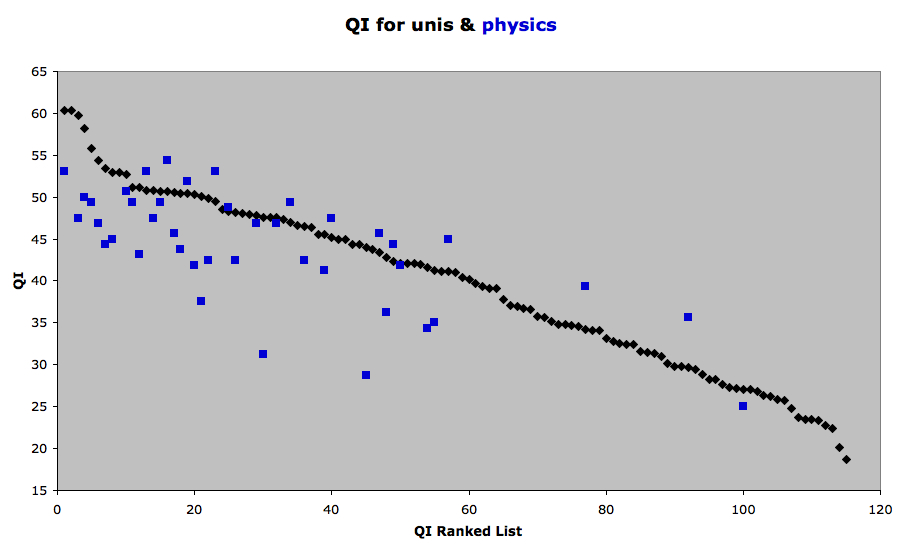

Thinking out loud about Willis’ assertion that the UK should not be spreading the jam more thinly than, say, the leading 30 universities, there would obviously be individual physics departments currently outside the top 30 which are ranked significantly higher than those within the top 30. To illustrate this, the chart also includes (in blue) physics QI scores for all teaching institutions that were assessed under the UOA 19 in RAE 2008. To blindly follow Lord Willis’ suggestion, 16 out of 42 institutions involved with physics research – comprising 37 per cent of all academic staff – would be clear losers. These would include one physics department raked within the top 10 (scoring 49) because its host institution is ranked 34th overall, while winners would include a department scoring 31, i.e. ranked 40th (out of 42) for physics, as a result of its university squeezing into the top 30. Chemistry – within the same RAE sub-panel as physics – reveals a broadly similar distribution, although there is perhaps a greater concentration of the highest research quality in the overall top 20, as the chart below illustrates.
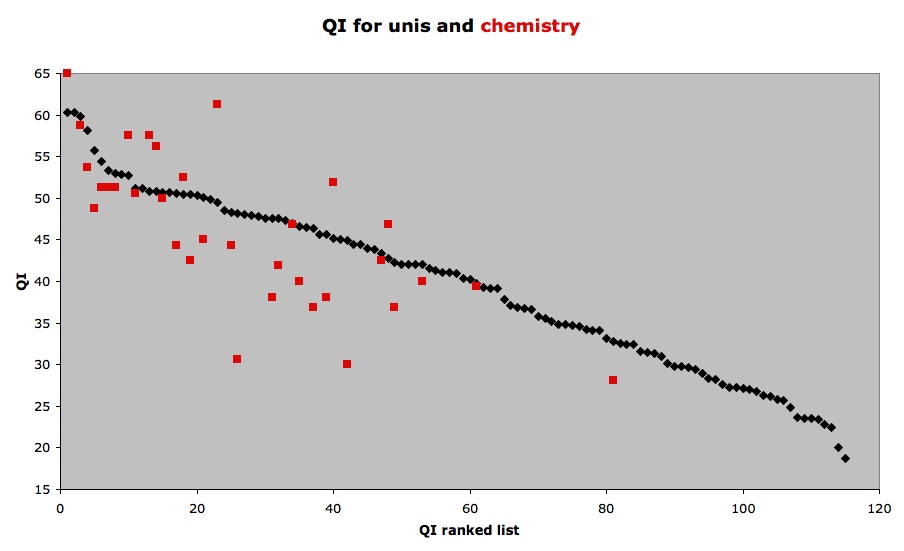

Alternatively, if there is to be further concentration, one could argue that research funding should focus on, say, the top 20 physics departments regardless of the performance of their host institution. Indeed, already 80 percent of STFC spending goes to only 16 universities. Still, as RAE grades indicate, a strength of UK physics is the breadth of high quality research, with no natural break points until beyond 30th place in the rankings, as the final chart shows. Of course, RAE scores aren’t the sole criterion being discussed, with “critical mass” the other main driver. Due in large part to the big four, 70 per cent of physics academic staff submitted for RAE 2008 are in departments that are currently ranked in the top 20. Chemistry has a similar story to tell in the chart, albeit displaying a somewhat steeper QI gradient.


What might be the long-term consequences of a divergence between a small number of “research-facing” universities and the rest? It is apparent that if the number of physics departments involved in research were reduced by a third, some high quality research groups would be lost, regardless of precisely where the cleaver ultimately fell. Let’s too not forget that astrophysics represents the largest sub-field of physics from the last IOP survey, as measured in numbers of academics.
If policy makers don’t see anything fundamentally wrong with A-level physics being taught by teachers qualified, say, in biology, then they might too wonder whether physics degrees could be taught by academics lacking a physics research background? This might work for first year undergraduate courses, but thereafter isn’t more specialist knowledge needed that a research background most readily provides? How would the third of physics academics outside the top 30 universities react to the prospects of a teaching-only future? Many surely would consider jumping ship either to one of the chosen few or overseas, further decreasing the pool of those with research experience in the remaining physics departments. This is further complicated by the expected political desire that physics departments should be appropriately distributed geographically across England, Scotland, Wales and Northern Ireland.
As a final thought experiment, the fate of physics departments facing the prospect of a teaching-only future might also be binary in nature, either (a) whither and die, decreasing the range of institutions offering degrees in physics (or physical sciences, natural sciences etc.); perversely at a time when the Government are anxious to maintain the number of students studying Science, Technology, Engineering and Mathematics (STEM) subjects, or (b) thriving – free from the distractions of chasing dwinding research grants – by adapting to offer shorter duration physics degrees, described as “cheap and cheerful” by Dr David Starkey during the discussion on student fees on last Thursday’s Newsnight. To reiterate, it is not explicit Government policy to actively reduce the number of physics departments that receive research allocations, but this seems to be the general “direction of travel” in policy-makers speak, so I fear a rocky path ahead..
Gravity waves goodbye to LISA?
Posted in Science Politics, The Universe and Stuff with tags ESA, gravitational waves, LISA, NASA on April 8, 2011 by telescoperIt seems that we’re not allowed to have any good news these days without a bit of bad to go with it. This week it has emerged here and there that the US National Aeronautics and Space Administration (better known as NASA) is pulling the plug on one of the most exciting space missions on its drawing board. Feeling the pressure of budget constraints and a ballooning overspend on the James Webb Space Telescope (JWST), NASA has decided not to participate further in the Laser Interferometric Space Antenna, a.k.a. LISA. The project teams working on LISA have been disbanded, and the shutters have been pulled down on a project which would have revolutionised astrophysics by opening up new possibilities of observing astronomical objects using gravitational waves, rather than electromagnetic radiation.
This does not mean that LISA is necessarily completely dead. For one thing, it was always planned to be a partnership between NASA and its European counterpart ESA (the European Space Agency); you can find ESA’s LISA page here. In fact a technological demonstrating mission LISA-Pathfinder, operated by ESA, is scheduled for launch in 2013.
It remains possible that ESA will proceed on its own with some version of LISA, although given its own financial constraints it is unlikely that it will be able to fund the full original mission concept. The best we can hope for, therefore, is probably some slimmed-down low-budget version and perhaps an even later launch date.
I still hold out some hope that LISA might come out of mothballs when gravitational waves are actually detected. This may well be accomplished by Advanced LIGO, a ground-based interferometric system based in the states, although it has to be said that gravitational waves have been “on the brink of detection” for at least 30 years and still haven’t actually been found. When detection does become a reality it might galvanise NASA into finding room in its budget again.
This news will be a particularly concern for the sizeable Gravitational Physics group here in the School of Physics & Astronomy at Cardiff University. However, LISA was very much in the planning and development stages so it won’t impact their current work. I haven’t had the chance to discuss the news about LISA with members of this group, so I’d be interested to receive comments from them, or indeed anyone else who knows more about what NASA’s decision may or not mean for the future of gravitational wave physics.

 In the Dark