Archive for the Science Politics Category

Number Crunching

Posted in Finance, Politics, Science Politics with tags , , on October 6, 2010 by telescoper

Only time for a (very) brief post this evening, as I’ve been in London all day and got back much later than expected.

In this morning’s Guardian there was a story about how the UK’s banks intend to pay out a whopping £7bn in bonuses this year. Banks. Remember them? They’re the organisations whose behaviour almost brought this country’s economy to its knees a few years ago and needed to be baled out by the taxpayer, at enormous cost to the public purse.

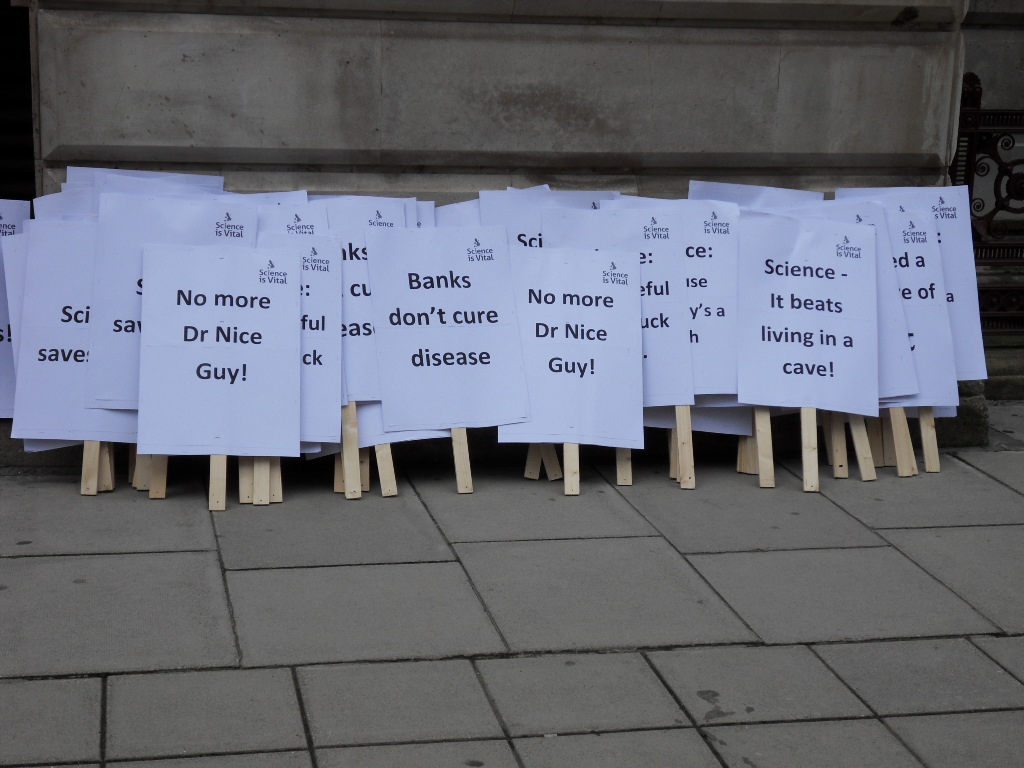
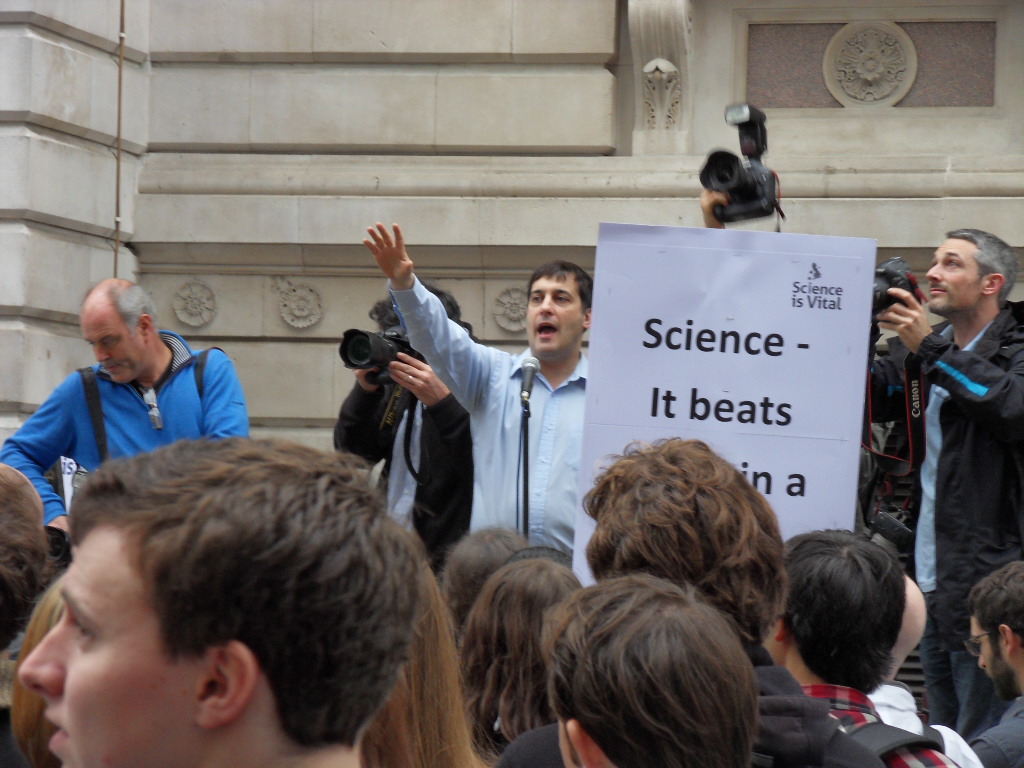
Meanwhile, the Science is Vital campaign is gearing up for Saturday’s rally. An article over on cosmic variance has raised the profile of this increasingly vocal campaign to stave off cuts which threaten to destroy Britain’s position as a leading scientific nation. The petition has now been signed by over 17,000 people (including the winners of this year’s Nobel Prize for Physics, announced yesterday).

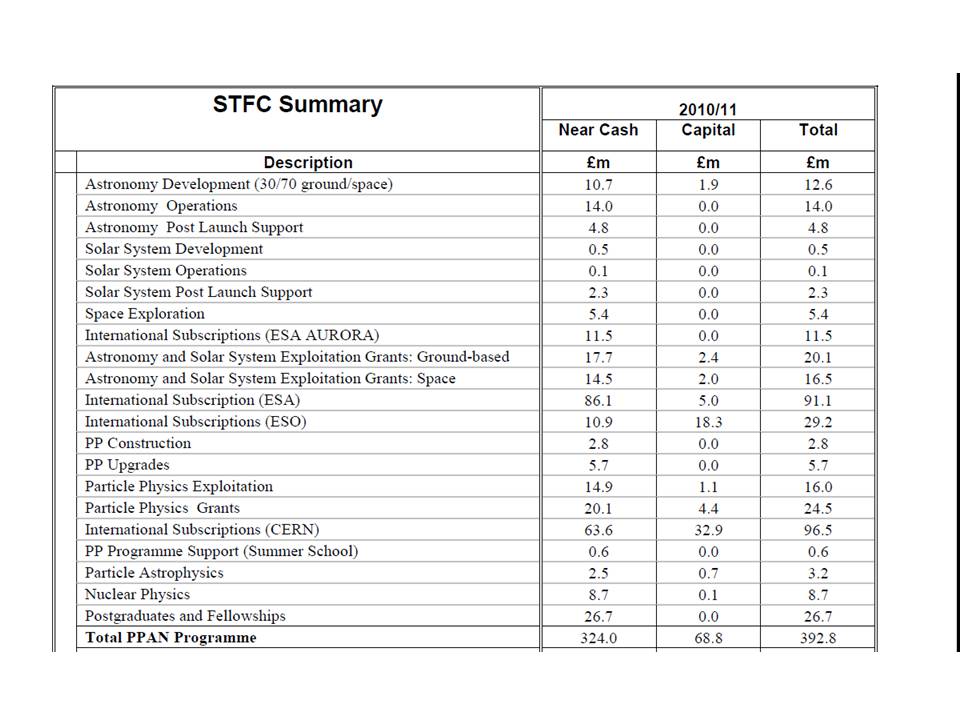
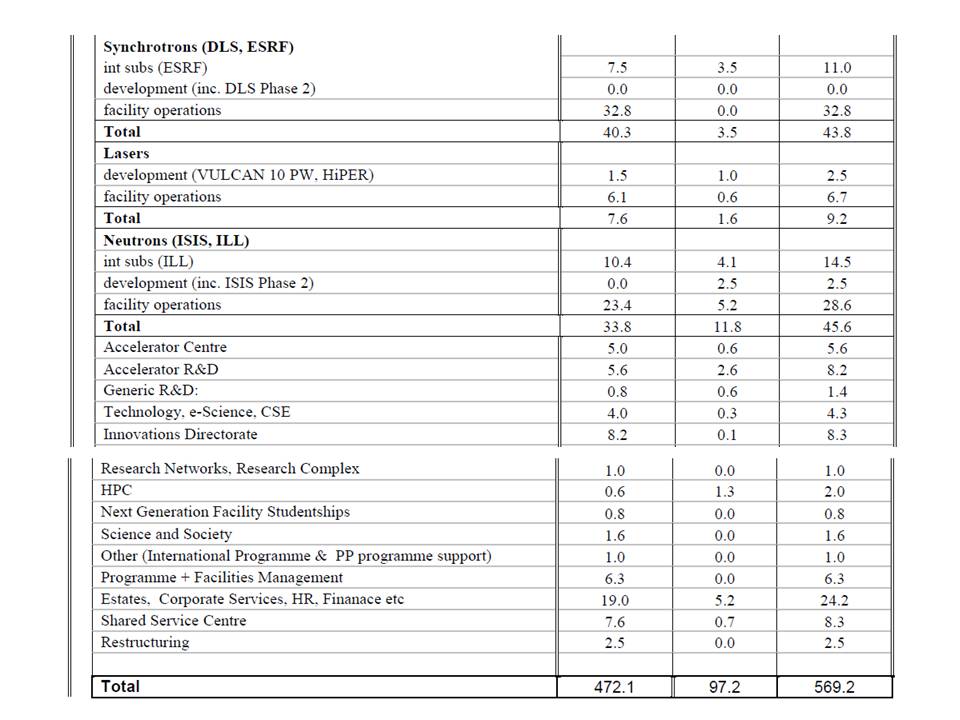
It’s worth emphasizing the numbers behind this story too.  The annual UK science budget, before the next round of cuts, stands at £3.2billion. That’s everything – particle physics, astronomy, chemistry, biosciences, and countless other things.

I need hardly point out the irony. The amount we’re waging an increasingly desperate fight to protect is less than half the amount to be spent on yachts and fancy cars by the people who got us into this mess in the first place. Some of us hoped the financial sector would show some contrition after the disaster of 2007. Fat chance!  Their rescue by the taxpayer has probably just convinced them that however they behave they can always rely on Joe Public to get them out of trouble. It seems they’ve reverted to type.

So let’s have no more of the specious arguments about having to cut science in order to avoid having to cut, say, the National Health Service. Science isn’t as expensive as some people would have us believe, and it’s not a luxury either. It’s vital to our economic and cultural well-being. Each pound spend on science is worth a lot more to this country than  two disappearing into a banker’s offshore tax haven.

In any case the government should just tax the greedy bankers’ bonus payments and use the money to increase the science budget. Better still, put pressure on the banks to themselves invest in science, alongside other areas of innovation, which we know will generate healthy profits for those brave enough to take a calculated risk, rather than going back to the old game of playing around with dodgy property-based financial speculations, which have a good chance of taking us down the plughole for good.

(Guest Post) STFC – It isn’t just about money

Posted in Science Politics with tags , , , , , , on October 4, 2010 by telescoper

The following piece was written by Professor George Efstathiou, FRS, who is Professor of Astrophysics at the University of Cambridge and Director of the Kavli Institute for Cosmology. The views expressed therein are George’s own, but I’m not saying that out of a desire to distance myself from his opinions. As a matter of fact, I was one of the people who signed the petition he describes in the article…

–o–

As Peter has reported on this site, physicists around the country are anxiously awaiting the results of the forthcoming Comprehensive Spending Review. Scientists whose research is supported by the Science and Technology Facilities Council (STFC)  are particularly anxious.  Since its creation, STFC has gone through two difficult scientific prioritisation exercises. Many excellent projects have been cancelled and grants supporting University groups have been cut savagely, by about 35%. STFC science has already descended into the Royal Society’s ‘game over‘ scenario. All of this has happened before the consequences of the economic crisis have hit the science budget. STFC has left itself uniquely poorly placed amongst the Research Councils to absorb further reductions following the CSR.

It is for this reason, that I and a few others organised a petition expressing a loss of confidence in the Chief Executive of STFC. The petition was signed by 916 researchers, including 162 Professors and 18 Fellows of the Royal Society. It was formally submitted to the STFC Chair (Michael Sterling) on 1st July together with an explicit request that STFC Council should review its role in this loss of confidence.

People will have had many different reasons for signing the petition. I made my views public well in advance (see my Letter to Lord Drayson). In all of my letters to ministers and others concerning the STFC ‘crisis’, I have never asked for more money. More money would help, of course, but this is utterly unrealistic in the current economic circumstances. No, over the last three years I have been lobbying for good governance. The strutural difficulties with STFC were easy to identify and I believe that with good governance the STFC programme could have been managed without such a catastrophic loss of science. Over three years, STFC have failed to establish a compelling narrative, strategy and constructive engagement with its science community. When one bears in mind that about 40 % of Physics staff work in areas for which STFC is the primary funding source, the consequences of the STFC crisis for University Departments, and the rest of the science base, are indeed serious.

So, whatever the outcome of the CSR, there are governance issues that we should be concerned about. There are three that I would like to raise here:

1. Fellowships and grants. Senior scientists from outside the UK point to the Fellowships and Rolling Grants as two of the most effective features of the UK funding system. Both are now under threat. I was responsible for making the case for the current 5 year system to PPARC Council. In addition to the evident benefits of continuity and reduction in peer review, Council need to understand that recruitment for postdocs involves a substantial lead time. If we are to compete for the best postdocs around the world (and not lose our best post docs), grant funds must be committed four years in advance. The 5 year rolling grant system, even with tapers, allows groups to advertise posts on an international timetable and to vire funds to maximise science output. Any move to responsive mode 3 year grants is guaranteed to deliver less science for a fixed amount of money. I would vigorously defend the Fellowships. Fellowships encourage scientific independence and provide a valuable “bottom-up” correction to the increasingly narrow “top-driven” science programme of STFC. Attacks on Fellowships and Rolling Grants will inevitably lead to a more introspective and less internationally competitive science programme.

2. The Composition of STFC Council. STFC Council, with a minority of leading research scientists, differs from other Research Councils. I have had several vigorous discussions with Michael Sterling concerning this issue and, in particular, the recent decision by BIS to appoint three new non-academic members to STFC. This led me to write a long letter to Adrian Smith (Director General of the Research Councils) reproduced here. Professor Smith replied that he approved of the present balance of Council and thought that it was compatible with the recommendations of previous reviews. I will leave readers to decide whether they agree. This is not a minor point. My experience on PPARC Council was that `lay members’ can often provide interesting perspectives on problems, but if they lack understanding of the science (sometimes alarmingly so) they will tend to accept the recommendations of the Executive. STFC needs a scientifically strong Council. Competent management is not enough. It is easy to keep within budget – you can be tough about cutting things. It is much harder to maximise the amount of science that you can do on a fixed budget. For that you need a scientific strategy and scientific judgement.

3. The New CEO. The search has begun for a new Chief Executive. There is one school of thought that a suitable candidate may be found from the corporate sector. Someone who may not understand the science, but would be a capable manager and communicator. I think that this would be a disaster. In my view, it is essential that a new CEO have an understanding of the science programme at STFC and should be prepared to act as an enthusiastic advocate for STFC science. We need a CEO who can engage constructively with the academic community and, when times are tough, articulate a strategy to limit the loss of science rather than gloat at our misfortune.

It would be great to have more money for STFC science. But money isn’t everything – we need to pay attention to governance issues as well. If we had been braver back in 2008 and openly challenged the Executive, we might not be in such a weak position now. We should not be so reticent in the future.


Share/Bookmark

“Game Over” for Science? Not yet, I hope..

Posted in Politics, Science Politics with tags , on September 28, 2010 by telescoper

Just a quick update on the Science is Vital campaign against proposed cuts in the UK research budget that I blogged about (briefly) last week. The impact of these cuts could be devastating, not just for scientists and their own careers but also for the economical (and, yes, cultural) health of this country. I saw an apt comment on Twitter yesterday to the effect that cutting the science budget to save money was like trying to lose weight by blowing your own brains out.

The petition has now attracted well over 5000 signatures, and I’m sure it will get still larger in the next few days. The march, planned for Saturday 9th October in London is going ahead. I’m hoping to take part, as there is an interesting meeting at the Royal Astronomical Society the day before, which will give me an excuse to stay over so I can attend this event. Perhaps I’ll even meet in real life some people I know only through the blogosphere!

However, at least one blogger has suggested that the campaign might already be too late. An article in the Financial Times (probably hidden by a paywall for most of you) suggested that a decision has been taken to cut research by £960 million per year, close to the 20% level that the Royal Society regards as meaning “game over” for British science.

It is thought that the Comprehensive Spending Review may announce its allocation to BIS (the Department for Business, Innovation and Skills) as early as next week (i.e. before the planned demonstration), but that doesn’t mean that it is too late. Only after the BIS budget is announced will it decide how much of the cut will be handed down to RCUK, the body that controls the Research Councils. However, RCUK’s budget is only a relatively small fraction of the BIS cake – £2.8 billion out of approximately £22 billion. Maintaining pressure may just convince BIS to go easy on research, so there’s still a lot to play for.

If that doesn’t work, and the research councils do receive a cut of 20% (or even more) then it won’t be at all pretty. It will then be left to individual councils to argue their case within RCUK, a situation likely to generate ever-decreasing circles of desperation as different disciplines are forced to battle it out for the scraps. Allocations to individual councils probably aren’t going to be known until December. Then, in STFC (for example), the particle physicists and astronomers may be put in a situation where they have to go head-to-head against each other, at which point there are unlikely to be any real winners.

I have to admit that three years’ experience of the STFC crisis haven’t left me feeling terribly confident about the next few months. However, unless we make some sort of a stand now, things will get unimagineably worse. The only way the go forward is to show some solidarity, and resist the forces that that would have us turn on each other.

These next few weeks could be crucial to the survival of British science. So stand up and be counted. Action is the antidote to despair.


Share/Bookmark

Science is Vital

Posted in Politics, Science Politics with tags , , , on September 24, 2010 by telescoper

Just a quick post to plug the Science is Vital campaign.

As you know, the government seems to be contemplating deep cuts to the UK science budget; see also this blog, passim. Cuts on the scale being discussed will devastate ongoing research, wreck the careers of hundreds of scientists and lead to an acceleration of the “brain drain” that has already started. Cutting science is short-sighted and counterproductive. The future is at stake.

If you agree, please visit the Science is Vital website and take part in the campaign. There is a petition, which currently has over 2000 signatures and a march is planned in London for Saturday 9th October. Please do your bit.

p.s. The Science Campaign blog is regularly updated with news of the fight to protect UK science.


Share/Bookmark

The Instinct of Hope

Posted in Biographical, Poetry, Science Politics with tags , , on September 23, 2010 by telescoper

A strenuous and stressful three days commuting to and from sunny Swindon for the STFC Astronomy Grants Panel are now over, just in time for the onset of teaching term next week. For reasons of confidentiality I can’t talk about the actual business of the grants panel, and it’s nowhere near finished anyway – there are several more meetings to come before any results come out. I would say, though, that it’s a curious job that manages to be both inspiring and depressing at the same time. The inspiring thing is that you get to read about so much really exciting science being done by all kinds of people in departments all over the country; the depressing thing is knowing that there isn’t anywhere near enough money to support all the things that one would like to in an ideal world. And our world is becoming less like an ideal one every day…

I decided for these three days not to stay in Swindon but to commute to and from from Cardiff. On balance, I think that was a good decision: I got to sleep in my own bed, didn’t have to arrange for someone to do Columbo’s jabs, and also saved STFC quite a bit of money – a day return from Cardiff to Swindon, a trip of almost exactly one hour each way, is only £26.80 at peak time. The downside was that I’ve been up at 5am each morning and have been in a vegetative state by the time I got home each evening, including this one!

Anyway, lacking the energy to put together a proper post, I’ll just put up this poem by John Clare which appeared in the  Guardian last saturday and which, for some reason, popped into my head during the train journey home. Somehow it seems apt.

Is there another world for this frail dust
To warm with life and be itself again?
Something about me daily speaks there must,
And why should instinct nourish hopes in vain?
‘Tis nature’s prophesy that such will be,
And everything seems struggling to explain
The close sealed volume of its mystery.
Time wandering onward keeps its usual pace
As seeming anxious of eternity,
To meet that calm and find a resting place.
E’en the small violet feels a future power
And waits each year renewing blooms to bring,
And surely man is no inferior flower
To die unworthy of a second spring?


Share/Bookmark

The Last Experiment (via In the Dark)

Posted in Science Politics, The Universe and Stuff on September 16, 2010 by telescoper

Today is this blog’s second birthday, so I thought I’d celebrate with a self-auto-reblog-type-of-thing of a post I wrote that memorable day in September 2008 when I started doing all this nonsense, which was just after the LHC had been switched on for the first time…

Actually, I really just wanted to see how this new reblog gizmo works.

I've launched myself into the blogosphere just a bit too late for the feeding frenzy surrounding the switching on of the Large Hadron Collider at CERN last week. Obviously the event itself was a bit of a non-event as it will take years for anything interesting to come out the other end of its multi-billion-dollar tunnel. There are a couple of things worth saying in retrospect, though, now that the dust has settled. The first is about all this non … Read More

via In the Dark

The Invisible Ma(so)n

Posted in Science Politics with tags , on September 12, 2010 by telescoper

I couldn’t resist sharing this little item I saw on the back page of the last issue of Research Fortnight:

WHERE’S KEITH? Once upon a time STFC chief executive
Keith Mason could be seen out and about, taking flak
in public for all manner of woes. But Research Fortnight
can’t help noticing that he has been remarkable only
by his absence recently. No site visits, no photo ops, no
community chit chats. He is due to stand down in March
2012, but how should we interpret his low profile in the
meantime? Surely no one can have built up that much
unused holiday?

On the other hand, the last time the Chief Executive of the Science and Technology Facilities Council (STFC) got involved in a Comprehensive Spending Review (in 2007), the outcome for his organization could hardly have been described as positive. Perhaps other members of the STFC Executive have decided to send him on a fact-finding mission to the Outer Hebrides in order to stop him messing up the negotations this time?


Share/Bookmark

Student Grants and/or Research Loans

Posted in Politics, Science Politics with tags , , , on September 9, 2010 by telescoper

I’m still a bit depressed after the events I blogged about yesterday. Some days you wonder why you bother, and this has been one of them. However, at least it’s got me rattled enough to stand back and think about the state of the UK university system in more general terms so I thought I’d jot down an idea which is probably barking mad, but has been at the back of my mind for some time.

The basic point is that universities essentially do two things, teaching and research. However, when you think about it, there’s a fundamental inconsistency in the way these are funded. It seems to me that correcting this anomaly could significantly improve  both the main benefits  universities contribute to the UK economy.

First, research. I wrote yesterday about using taxpayer’s money to fund research in universities:

If it’s going to pay off in the short term it should be funded by private investors or venture capitalists of some sort. Dragon’s Den, even. When the public purse is so heavily constrained, it should only be asked to fund those things that can’t in practice be funded any other way.

I’ve just remembered that a similar thing was said in in the Times Higher recently, in a piece about the new President of the Royal Astronomical Society:

Notwithstanding the Royal Academy of Engineering’s “very unfortunate” recent submission to the government spending review – which argued that the need to rebalance the UK economy required public spending to be concentrated on applied science – Professor Davies is confident he can make a good case for spending on astrophysics to be protected.

Research with market potential can already access funding from venture capitalists, he argued, while cautioning the government against attempting to predict the economic impact of different subjects.

This is pretty much the opposite of what the Treasury thinks. It wants to concentrate public funds in projects that  can demonstrate immediate commercial potential. Taxpayer’s money used in this way ends up in the pockets of entrepreneurs if the research succeeds and, if it doesn’t,  the grant has effectively been wasted. My proposal, therefore, is  to phase out research grants for groups that want to concentrate on commercially motivated research and replace them with research loans. If the claims they make to secure the advance are justified they should have no problem repaying it  from the profits they make from patent income or other forms of exploitation. If not, then they will have to pay back the loan from their own funds (as well as being exposed as bullshit merchants). In the current economic situation the loans could be made at very low interest rates and still save a huge amount of the current research budget for higher education. Indeed after a few years – suggest the loans should be repayable in 3-5 years, it would be self-financing. I think a large fraction of research in the Applied Sciences and Engineering should be funded in this way.

The money saved by replacing grants  to commercially driven research groups with loans could be re-invested in those areas where public investment is really needed, such as pure science and medicine. Here grants are needed because the motivation for the research is different. Much of it does, in fact, lead to commercial spin-offs, but that is accidental and likely to appear only in the very long term. The real motivation of doing this kind of research is to enrich the knowledge base of the UK and the world in general. In other words, it’s for the public good. Remember that?

Most of you probably think that this is a crazy idea, but if you do I’ll ask you to now think about how the government funds teaching in universities and ask yourself why research is handled in such a  different way.

Way back in the mists of time when I was a student, I didn’t have to pay fees and even got a maintenance grant from the government that was more-or-less sufficient to live on. That system changed so that students don’t get grants any more, but may qualify for loans. They also have to pay a contribution to their fees, but the government still pays an amount directly to the university on their behalf.

This change of policy happened because the (then) Labour government wanted to boost the rate of participation in universities, but didn’t think the taxpayer should pay the whole cost. The logic goes that the students benefit from their education, e.g. in terms of increased earnings over their working lifetime, so they should pay a contribution to it.

The problem with all this is that it has led to a huge increase in enrolment on degree courses in “vocational” areas such as Leisure & Tourism, Media Studies, and Business while traditional courses, such as those in STEM disciplines, providing the sort of rigorous intellectual training that is essential for many sectors of the economy, have struggled to keep up. This is partly because subjects like Mathematics and Physics are difficult, partly because they are expensive, and partly because the UK school system has ceased to function as preparation for such courses.

I’m by no means against universities supplying training in vocational subjects, but because these are the areas where the primary beneficiary is indeed the student, I don’t think the government should subsidise them as much as the more rigorous courses that we really need to encourage the brightest students to take up.

The fix I’d propose for this within the current tightly constrained budget is to cut government funding for vocational subjects and use the money to subsidise those courses contributing to the intellectual wealth of the country. I don’t mean just science, incidentally, I think we have a big problem with participation many other areas, such as modern languages. The best students – in chosen areas – should not only get their fees paid, they should also get maintenance grants as in the old days. Students should not be prevented from doing, e.g., a Business studies degree, or from doing anything without a state scholarship, but should understand that they have to pay for it.

If it’s fair to ask students to contribute to their teaching, it’s fair to ask commercial companies to pay for the research that they exploit. Just as student grants should be re-introduced for certain disciplines, so should research loans be introduced for others. You know it makes sense.

However, if you want to tell me why it doesn’t, via the comments box, please feel free!


Share/Bookmark

Unravelling Cable

Posted in Politics, Science Politics with tags , , , , , , , on September 8, 2010 by telescoper

I woke up this morning with the Vince Cable Blues, owing to an item on the BBC News concerning a speech by the Secretary of State for Business, Innovation and Skills that clearly signals that the forthcoming Comprehensive Spending Review will entail big cuts to the UK’s science budget.

It was a depressing way to start the day, but I for one wasn’t particularly surprised by the news. We all know big cuts are coming, the only remaining questions are “how big?” and “where?”. However, when the text of the speech was released, I was shocked by what it revealed about the Secretary of State’s grasp of his brief.  Read it for yourself and see if you agree with me.

Vince Cable: Out of his Depth

Of course there are the obligatory  platitudes about the quality of the UK’s scientific research, a lot of flannel about the importance of “blue skies” thinking, before he settles on the utilitarian line favoured by the Treasury mandarins who no doubt wrote his speech for him: greater concentration of research funding into areas that are “theoretically outstanding” (judged how?) or “commercially useful” (when?). In fact one wonders what the point of this speech was, as it said very little that was specific except that the government is going to cut science. We knew that already.

For what it’s worth I’ll repeat my own view that “commercially useful” research should not be funded by the taxpayer through research grants. If it’s going to pay off in the short term it should be funded by private investors or venture capitalists of some sort. Dragon’s Den, even. When the public purse is so heavily constrained, it should only be asked to fund those things that can’t in practice be funded any other way. That means long-term, speculative, curiosity driven research. You know, science.

So was Cable’s speech was feeble-minded, riddled with clichés, and totally lacking in depth or detail? Yes.  Was it surprising? No.

What was surprising, at least to me, is Cable’s deliberate use of spurious numbers to back up his argument. For example,

Its is worth noting in the last RAE 54 per cent of submitted work was defined as world class and that is the area where funding should be concentrated.

This appears to be what Cable  was referring to when he stated on the BBC Radio 4 Today Programme that  “45% of research grants were not of excellent standard”.

For one thing, there’s a difference between a research grant and the money allocated by HEFCE through the Research Assessment Exercise (RAE); more about that in a moment. Moreover, at least in England,  RAE funding is only allocated to grades 3* and 4* anyway, so the concentration he talks about is already happening. The comment is made all the more meaningless, however, because the 54% was actually imposed on the assessment panels anyway; they were told to match the outcome of their deliberations to a target profile. The figure quoted is therefore hardly an objective measure of the quality of scientific research in the UK.

When it comes to research grants – usually obtained from one of the Research Councils, such as the Science and Technology Facilities Council (STFC) scientists apply for funding and their proposals are assessed by panels. In the case of STFC I can assure every one that the only proposals funded are those graded excellent, and there isn’t anything like enough money to fund all the proposals graded that way. Further cuts will simply mean that  even more excellent research will have to be scrapped, and even more excellent scientists will  go abroad.

This basic misunderstanding convinces me that Vince Cable is completely out of his depth in this job. That’s very unfortunate because it means he will probably be susceptible to manipulation by the dark side (i.e. the anti-science lobby in Whitehall). Already  someone – most likely a Civil Service mandarin with an axe to grind – seems to have  duped him into thinking that 45% of  taxpayer’s money funds mediocre research. What with him already singing so enthusiastically from the Treasury hymn sheet, I fear they have got him exactly where they want him. Rarely has a new arrival in the Whitehall jungle gone native so quickly.

Another remark of his that was quoted today is that “the bar will have to be raised somewhat” in terms of  science funding.  At the next General Election I hope the British people, especially those foolish enough to opt for the Liberal Democrats last time, will “raise the bar” when it comes to deciding who is worthy of their vote. I’m sure of one thing, though. The fraction of British politicians who are “mediocre” is an awful lot higher than 45%.


Share/Bookmark

Hawking and the Mind of God

Posted in Books, Talks and Reviews, Science Politics, The Universe and Stuff with tags , , , , , on September 2, 2010 by telescoper

I woke up this morning to the news that, according to Stephen Hawking, God did not create the Universe but it was instead an “inevitable consequence of the Law of Physics”. By sheer coincidence this daft pronouncement has come out at the same time as the publication of Professor Hawking’s new book, an extract of which appears in todays Times.

It’s interesting that such a fatuous statement managed to become a lead item on the radio news and a headline in all the national newspapers despite being so obviously devoid of any meaning whatsoever. How can the Universe be  “a consequence” of the theories that we invented to describe it? To me that’s just like saying that the Lake District is a consequence of an Ordnance Survey map. And where did the Laws of Physics come from, if not from God?

Stephen Hawking is undoubtedly a very brilliant theoretical physicist. However, something I’ve noticed about theoretical physicists over the years is that if you get them talking on subjects outside physics they are generally likely to say things just as daft as some drunk bloke  down the pub. I’m afraid this is a case in point.

Part of me just wants to laugh this story off, but another part is alarmed at what must appear to many to be an example of an arrogant scientist presuming to pass judgement on subjects that are really none of his business. When scientists complain about the lack of enthusiasm shown by sections of the public towards their subject, perhaps they should take seriously the alienating effect that such statements can have. This kind of thing isn’t what I’d call public engagement. Quite the opposite, in fact.

In case anyone is interested, I am not religious but I do think that there are many things that science does not – and probably will never –  explain, such as why there is  something rather than nothing. I also believe that science and religious belief are not in principle incompatible – although whether there is a conflict in practice does depend of course on the form of religious belief and how it is observed. God and physics are in my view pretty much orthogonal. To put it another way,  if I were religious, there’s nothing in theoretical physics that would change make me want to change my mind. However, I’ll leave it to those many physicists who are learned in matters of theology to take up the (metaphorical) cudgels with Professor Hawking.

No doubt this bit of publicity will increase the sales of the new book, so I’ve decided  to point out that I have  written a book myself on precisely this question, which is available from all good airports bookshops. I’m sure you’ll understand that there isn’t a hint of opportunism in the way I’m drawing this to your attention. If you think this is a cynical attempt to cash in then all I can say is

BUY MY BOOK!

I also noticed that today’s Grauniad is offering a poll on the existence or non-existence of God. I noticed some time ago that there’s a poll facility on WordPress, so this gives me an excuse to try repeating it here. Anything dumb the Guardian can do, I can do dumber. However, owing to funding cuts I’ve decided to do a single poll encompassing several topical news stories at the same time.


Share/Bookmark