Archive for the Science Politics Category

Turning the Tables

Posted in Science Politics with tags , , , on May 30, 2010 by telescoper

In Andy Fabian‘s Presidential Address to the Royal Astronomical Society (published in the June 2010 issue of Astronomy and Geophysics) he discusses the impact of UK astronomy both on academic research and wider society. It’s a very interesting article that makes a number of good points, not the least of which is how difficult it is to measure “impact” for a fundamental science such as astronomy. I encourage you all to read the piece.

One of the fascinating things contained in that article is the following table, which shows the number of papers published in Space Sciences (including astronomy) in the period 1999-2009 (2nd column) with their citation counts (3rd Column) and citations per paper (4th column):

USA 53561 961779 17.96
UK(not NI) 18288 330311 18.06
Germany 16905 279586 16.54
England 15376 270290 17.58
France 13519 187830 13.89
Italy  11485 172642 15.03
Japan 8423 107886 12.81
Canada 5469 102326 18.71
Netherlands 5604 100220 17.88
Spain 6709 88979 13.26
Australia 4786 83264 17.40
Chile 3188 57732 18.11
Scotland 2219 48429 21.82
Switzerland 2821 46973 16.65
Poland 2563 32362 12.63
Sweden 2065 30374 14.71
Israel 1510 29335 19.43
Denmark 1448 26156 18.06
Hungary 761 16925 22.24
Portugal  780 13258 17.00
Wales 693 11592 16.73

I’m not sure why Northern Ireland isn’t included, but I suspect it’s because the original compilation (from the dreaded ISI Thompson database) lists England, Scotland, Wales and Northern Ireland separately and the latter didn’t make it into the top twenty; the entry for the United Kingdom is presumably constructed from the numbers for the other three. Of course many highly-cited papers involve international collaborations, so some of the papers will be in common to more than one country.

Based on citation counts alone you can see that the UK is comfortably in second place, with a similar count per paper to the USA.  However, the number that really caught my eye is Scotland’s citations per paper which, at 21.82, is significantly higher than most. In fact, if you sort by this figure rather than by the overall citation count then the table looks very different:


Hungary 761 16925 22.24
Scotland 2219 48429 21.82
Israel 1510 29335 19.43
Canada 5469 102326 18.71
Chile 3188 57732 18.11
UK (not NI) 18288 330311 18.06
Denmark 1448 26156 18.06
USA 53561 961779 17.96
Netherlands 5604 100220 17.88
England 15376 270290 17.58
Australia 4786 83264 17.40
Portugal  780 13258 17.00
Wales 693 11592 16.73
Switzerland 2821 46973 16.65
Germany 16905 279586 16.54
Italy  11485 172642 15.03
Sweden 2065 30374 14.71
France 13519 187830 13.89
Spain 6709 88979 13.26
Japan 8423 107886 12.81
Poland 2563 32362 12.63

Wales climbs to a creditable 13th place while the UK as a whole falls to 6th. Scotland is second only to Hungary. Hang on. Hungary? Why does Hungary have an average of  22.24 citations per paper? I’d love to know.  The overall number of papers is quite low so there must be some citation monsters among them. Any ideas?

Notice how some of the big spenders in this area – Japan, Germany, France and Italy – slide down the table when this metric is used. I think this just shows the limitations of trying to use a single figure of merit. It would be interesting to know – although extremely difficult to find out – how these counts relate to the number of people working in space sciences in each country. The UK, for example, is involved in about a third as many publications as the USA but the number of astronomers in the UK must be much less than a third of the corresponding figure for America. It would be interesting to see a proper comparison of all these countries’ investment in this area, both in terms of people and in money…

..which brings me to Andy Lawrence’s recent blog post which reports that the Italian Government is seriously considering closing down the INAF (Italy’s National Institute for Astrophysics). What this means for astronomy and astrophysics funding in Italy I don’t know. INAF has only existed since 2002 anyway, so it could just mean an expensive bureaucracy will be dismantled and things will go back to the way they were before then. On the other hand, it could be far worse than that and since Berlusconi is involved it probably will be.

Those in control of the astronomy budget in this country have also made it clear that they think there are too many astronomers in the UK, although the basis for this decision escapes me.  Recent deep cuts in grant funding have already convinced some British astronomers to go abroad. With more cuts probably on the way, this exodus is bound to accelerate. I suspect those that leave  won’t be going to Italy, but I agree with Andy Fabian that it’s very difficult to see how the UK will be able to hold  its excellent position in the world rankings for much longer.

Water and Energy

Posted in Biographical, Science Politics, The Universe and Stuff with tags , , , , , on May 25, 2010 by telescoper

I’ve refrained from blogging about the fraught history of my attempts to have a new  gas boiler installed in my house. Today, however, at last I have finally succeed in getting a state-of-the-art high-efficiency condensing contraption fit for the 21st Century, which will hopefully save me a few bob in gas bills over the winter but, more importantly, actually produce hot water for more than a minute or so without switching itself off.

The chaps that did the job for me actually had to test all the radiators too, which meant switching them all up to maximum. It wasn’t quite as hot today as it was yesterday but nevertheless the inside of the house was like a Turkish bath for a while. I therefore sat outside in the Sun for a bit waiting for them to get finished and tidy everything up.

While I was sitting there I got thinking about sustainable energy and so on, and was reminded of a comment Martin Rees made in his Reith Lecture not long ago. Wanting to sound positive about renewable energy he referred to the prospect of generating significant tidal power using a Severn Barrage. Given the local relevance to Cardiff – one of the main ideas is a barrage right across the Severn Estuary from Cardiff to Weston-super-Mare -so he presumably thought he was on safe ground mentioning it. In fact there was a lot of uneasy shuffling in seats at that point and the question session at the end generated some tersely sceptical comments. Many locals are not at all happy about the possible environmental impact of the Severn Barrage. That, and the cost – probably in excess of £20 billion – has to be set against the fact that such a barrage could in principle generate 2GW average power from an entirely renewable source. This would reduce our dependence on fossil fuels and increase our energy security too. The resources probably aren’t available right now given the parlous state of the public finances, but I’m glad that the Welsh Assembly Government is backing serious study of the various options. It may be that it won’t be long before we’re forced to think about it anyway. The Wikipedia page on the various proposals for a Severn Barrage is very comprehensive, so I won’t rehearse the arguments here. In any case, I’m no engineer and can’t comment on the specifics of the technology required to construct, e.g., a tidal-stream generator. However, I have to say that I find the idea pretty compelling, provided ways can be found to mitigate its environmental impact.

For a start it’s instructive to look at turbine-generated power. Wind turbines  are cropping up around the British isles, either individually or in wind farms. A  typical wind turbine can generate about 1MW in favourable weather conditions, but it needs an awful lot of them to produce anything like the power of a conventional power station. They’re also relatively unpredictable so can’t be relied upon on their own for continuous power generation. The power P available from a wind turbine is given roughly by

P \simeq \frac{1}{2} \epsilon \rho A v^3

where v is the wind speed, A is the area of the turbine, \rho is the density of air, which is about 1.2 kg per cubic metre, and \epsilon is the efficiency with which the turbine converts the kinetic energy of the air into useable electricity.
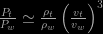
The same formula would apply to a turbine placed in water, immediately showing the advantage of tidal power.  For comparable efficiencies and sizes the ratio of power generated in a tidal-stream turbine to a wind turbine would be

\frac{P_{t}}{P_{w}}\simeq \frac{\rho_{t}}{\rho_{w}} \left( \frac{v_{t}}{v_{w}}\right)^{3}

The speed of the water in a tidal stream can be comparable to the airspeed in a moderate wind, in which case the term in brackets doesn’t matter and it’s just the ratio of the densities of water and air that counts, and that’s a large number! Of course wind speed can sometimes be larger than the fastest tidal current, but wind turbines don’t work efficiently in such conditions and in any case it isn’t the v which provides the killer factor. The density of sea water is about 1025 kg per cubic metre, a thousand times greater than that of air. To get the same energy output from air as from a tidal stream you would need to have winds blowing steadily ten times the velocity of the stream, which would be about 80 knots for the Severn. More than breezy!

Not all proposals for the Severn Barrage involve tidal stream turbines. Some exploit the gravitational potential energy rather than the kinetic energy of the water by exploiting the vertical rise and fall during a tidal cycle rather than the horizontal flow. The energy to be exploited in, for example, a tidal basin of area A  would go as

E \simeq \frac{1}{2} \epsilon A\rho gh^{2}

where h is the vertical tidal range, about 8 metres for the Severn Estuary, and g is the acceleration due to gravity. The average power generated would be found by dividing this amount of energy by 12 hours, the time between successive high tides. It remains to be seen whether tidal basin or lagoon based on this principle emerges as competitive.

Another thing that struck me doodling these things on the back of an envelope in the garden is that this sort of thing is what we should be getting physics students to think about. I’m quite ashamed to admit that we don’t…

The Graveyard of Ambition?

Posted in Education, Finance, Politics, Science Politics with tags , , , , , on May 23, 2010 by telescoper

The news today is full of speculation about the nature and extent of impending public spending cuts expected to be announced in the Queen’s Speech next Tuesday. Among the more specific figures being bandied about is a £700 million cut to the budget Department of Business, Innovation and Skills (BIS) which encompasses both scientific research and the university sector. It’s impossibly to say precisely where the axe will fall, but it’s very likely that university-based science groups in England will face a double-whammy, losing income both from HEFCE and from the Research Councils. The prospect looks particular dire for Physics & Astronomy, which rely for their research grants on the Science and Technology Facilities Council (STFC) which savagely cut back science research even before the credit crunch arrived. If STFC gets cut any further  then the result will be even worse carnage un universities than we’ve experienced over the last year or two, especially since it looks like there will be no changes in its Executive.

Here in Wales the situation is even more complicated, as is explained in a long article in this week’s Times Higher. Cuts to the Research Councils will, of course, affect university research groups in the Principality as their remit covers the whole of the United Kingdom. However, responsibility for Higher Education in Wales is devolved to the Welsh Assembly Government. This means that any cuts to the University budget announced next week will not apply here (nor indeed in Scotland or Northern Ireland).

However, as I’ve blogged about before, it’s not obvious that this is good news for fundamental science in Wales. The Welsh Assembly Government’s blueprint for the shape of Higher Education in Wales, For Our Future, signals what could be dramatic changes in the way university funding is allocated here. There’s a lot of nervousness about how things will pan out.

Currently, most university funding in Wales comes through HEFCW in the form of recurrent grants. However the WAG has recently set up a Strategic Implementation Fund which in future supply 80% of all university funding. The new(ish) Minister responsible for Higher Education, Leighton Andrews (who will be giving a public lecture in Cardiff about the changes next week) seems to be determined to take control of the sector. It’s good to have a Minister who shows some interest in Higher Education, but I’m wary of politicians with Big Ideas.

We’ll have to wait and see what happens over the next year or so, but I think there’s an opportunity for Wales to do something truly radical and break away from systems that simply copy those in place in England with a much lower level of resource. Given that HEFCW has already been told how 80% of its funding should be administered, why bother with HEFCW at all? Scrapping this quango will remove a buffer between the universities and the WAG, which might be a dangerous thing to do, but will also save money that could be spent on higher education rather than bureaucracy. And while we’re at it, why doesn’t the WAG take Welsh universities out of the Research Excellence Framework? In the new era why should Welsh universities be judged according to English priorities?

On the teaching side, the WAG wants to see more flexible study options, more part-time degrees (including PhDs), more lifelong learning, and so on. I think that’s a reasonable thing to aim for given the particular socio-economic circumstances that pertain in Wales, but I can’t really see scope for significant numbers of part-time degrees in physics, especially at the doctoral level.

A crucial issue that has to be addressed is the proliferation of small universities in Wales. England has a population of 49.1 million, and has  91 universities (a number that many consider to be way too high in any case). The population of Wales is just 2.98 million but has 12 universities which is about twice as many per capita as in England. I for one think this situation is unsustainable, but I’m not sure to what extent mergers would be politically acceptable.

The WAG also wants to focus funding on “priority areas” that it perceives to be important to future development of industry in Wales, including health and biosciences, the digital economy, low-carbon technologies, and advanced engineering and manufacturing.  Fair enough, I say, as long as “focus on” doesn’t mean “scrap everything else but”.  The big worry for me is that research doesn’t feature very strongly at all in the WAG’s document, and it isn’t in good shape in any case. According to the last Research Assessment Exercise (RAE), only around 14% of Welsh research is of world-leading quality and most of that (90%)  is concentrated in just four institutions (Aberystwyth, Bangor, Cardiff and Swansea).

Physics in Wales did particularly poorly in the RAE and in any case only involves three universities, Bangor having closed its Physics department many years ago. Indeed the RAE panel went out of its way to make unfavourable comments about the lack of coordination in Welsh  physics – comments, I might add, that went entirely beyond the panel’s remit and should have attracted censure. Physics is also an expensive subject so if we are to do better in future we need additional investment. Cardiff University is doing its best bring this about, but I think we should explore closer ties with Swansea and explicit encouragement from the WAG.

STEM areas are woefully under-represented in Wales. Some think the WAG should seize the chance to boost this area of activity, but others think it’s already too late. According to the Times Higher,

Julie Lydon, vice-chancellor of the University of Glamorgan and the first female head of a university in Wales, says expertise in STEM will have to be developed in “distinct areas”. Given its small size, Wales must be careful to set itself realistic aims, she says.

The country faces a complex challenge, Lydon adds. “We don’t have anywhere near the range and extent of research (that we should) for our size. We’ve got to move it up a gear, and we’ve got to raise aspirations. We’ll do that in niche areas, and we’ll do that by partnership, not on our own.

“We haven’t the scope and scale; Wales isn’t a large enough sector to be able to do that across the board, but it’s an agenda that is slightly wider than the narrow view of STEM.”

A focus on STEM would neglect some areas in which Wales is strong, Lydon says. Thanks to investment from major employers such the BBC, disciplines such as media are growth areas and critical to the economy, but they are not strictly defined as STEM subjects.

No, media studies isn’t a STEM subject. Nor do I think Wales can continue to rely on its economy being propped up by public bodies such as the BBC. The expected round of wider public spending cuts I mentioned at the start of this piece will effectively scupper that argument and I’m sure privatisation of the BBC is on the new government’s agenda anyway. The future requires more ambition than this kind of thinking exemplifies. Sadly, however, ambition doesn’t seem to be something that the Welsh are particularly good at.  Dylan Thomas’s phrase “The Graveyard of Ambition” was specifically aimed at his home town of Swansea, but it does sum up an attitude you can find throughout the country: a  resolute determination to be mediocre.

 Wales is indeed a small country. So is Scotland (population about 5 million), but the Scots have for a long time placed a much higher premium on science and university education generally than the Welsh (and even the English) and they have a thriving university sector that’s the envy of other nations (including England). I think it’s time for a change of mentality.

Into the Blue

Posted in Education, Finance, Politics, Science Politics with tags , , , on May 12, 2010 by telescoper

So there we are.  Britain has a new government. For the time being. Last night David Cameron became the Prime Minister of a coalition government involving the Conservative and Liberal Democrat parties (as I predicted). This is hardly a surprise given the arithmetic; Labour and the LibDems wouldn’t have had enough seats to command a majority anyway. It took five days from the election for the new Prime Minister to take over, much longer than the few hours it normally takes when there is a conclusive result, but nowhere near as long as it takes on the continent where coalition-building involves smaller and more diverse parties. In the UK the three main political parties are all centre-right, at least when it comes to economic policy,  and they share a great deal of common ground, so I never thought there would be much problem with the Conservatives and LibDems coming to a deal, which they have done.

Another prediction I got right was that Gordon Brown would resign as leader of the Labour Party, which he has also done. Who will lead the Labour Party now, and for how long, is anyone’s guess.

My third prediction was that the coalition government would fall within a year and there’ll be another general election. As for that, we’ll have to wait and see. It is, after all, a marriage of convenience. I think it won’t be long before a big row develops and the coalition unravels. There’s a lot of overlap between the two parties, but it’s a long way from the left of the LibDems to the right of the Tories. I give it 6 months to the first vote of confidence, assuming the Queen’s Speech passes.

Now that we have a government once more, the unreal business of electioneering is going to be set aside and all the facts that the media have kept quiet about during the election campaign will start to come out. For example, a story in the Financial Times of 11th May (yesterday), which has clearly been on the spike for the duration of the election campaign, reveals how huge cuts in university funding are set to fall hardest on science departments. Vice-chancellors have been making contingency plans for 25% cuts in recurrent funding for some time now, and there’s an obvious temptation to cut the more expensive subjects first.

I’ve already confessed my annoyance that the main parties connived to keep the details of the deep cuts they were all planning to implement out of the election campaign. Now we’re going to find out the true extent of what’s in store, and it’s too late to change.

Niels Bohr once said “Prediction is very difficult, especially about the future”, and I have no idea whether I’m being overly pessimistic here, but here are  some of  the things I think will affect my own life  as an astrophysicist working in a British university.

First, it’s now clear that there’s  no chance of a reversal in the fortunes of STFC. There never was much of a chance of that, to be honest. It’s more likely now that  STFC will now face further cuts on top of what it has endured already.  Fundamental science in the UK is in for a very lean time.

Second, university funding – the part that comes directly from central government – will be cut by at least 25%, probably more.  This could be achieved in a number of ways. The unit of resource (the payment made per student by the government to a university) could be cut. The number of students funded could be cut. Students could be charged higher fees or have less generous loan arrangements. These options are by no means exclusive, of course. They might all happen.

University V-Cs will have to make very difficult decisions  where to make savings:  some may tighten budgets across the board; others may shut entire departments to save the rest.

Another issue with university funding, however, is that it is not entirely the preserve of central government.  The Scottish Assembly runs higher education in Scotland, not the Westminster government. The Scottish Funding Council has generally funded universities more generously than HEFCE has in England. It’s also much less likely to implement higher tuition fees. More generally, with only one Scottish Tory MP in Westminster and a Scottish Nationalist-flavoured Assembly government, there’s no way of knowing what will happen in Scotland or, indeed, how much strain will be generated there by an English Tory government very few Scots voted for.

In Wales its a bit different. Here higher education is run by the Welsh Assembly government, which currently comprises a Labour-Plaid Cymru coalition. With the Westminster government consisting of an alliance between the other two major parties in Wales we have two levels of administration roughly orthogonal to each other. In principle, the WAG could decide to protect the university system in Wales against the level of cuts being imposed in England, but since we already get a lower unit of resource from HEFCW than HEFCE allocates to English universities, I doubt we’ll be any different in future.

So this is where we’re headed:  fewer science departments with fewer staff with increased teaching loads with less time to do research and with less funding to carry it out and vanishing career opportunities for the scientists they’re supposed to be training.

Still, at least the bankers will get their bonuses.

Experiments and Observations

Posted in Science Politics, The Universe and Stuff with tags , , , , , on May 8, 2010 by telescoper

It’s nice to be able to pass on some upbeat news for once.

The first thing is that, after a lot of delays and a bit of haggling, the School of Physics & Astronomy at Cardiff University has finally issued advertisements for a bunch of new Faculty positions in Experimental Physics. The positions, which are tenured,  involve both Chair and Lecturer/Reader levels and there are several positions available. The School and University  have  put together a handsome start-up package for a new group and there’s plenty of spanking new experimental laboratory space to set up shop. Coupled with the fact that Cardiff is a great city to live in, with low costs and great sporting and cultural infrastructure, this should prove a tempting opportunity for someone to set up their own group.

It’s also a welcome vote of confidence from Cardiff University which, despite cuts in its overall budget, has decided to invest heavily in the School’s strategic plan. I hope and believe we’ll attract a strong field for these appointments and look forward to seeing what develops. We need a shot in the arm and this might just deliver it.

What’s particularly interesting about this clutch of new appointments is that they are open to people working in any area of physics, with the exception of astrophysics. Given the massive cuts in STFC’s budget, this is no time to be expanding in areas covered by its remit. I say that as an astrophysicist, with considerable regret but pragmatism in the face of the changing landscape of British science funding. In times of risk you have to broaden your portfolio. However, that’s not to say that astrophysics at Cardiff is downbeat. Far from it, in fact.

ESA held an international press conference to present exciting new results from the Herschel Observatory at the European Space Research and Technology Centre, Noordwijk, The Netherlands, on Thursday 6 May. A webcast of the press conference with Cardiff’s Professors Matt Griffin and Steve Eales taking part, can be seen at from http://www.esa.int/SPECIALS/Herschel. At the conference Steve Eales talked about the latest results from the Herschel ATLAS survey: an ATLAS of the Universe. ATLAS will cover one eightieth of the sky, four times larger than all the other Herschel surveys combined and is led by Professor Eales and Dr Loretta Dunne at Nottingham University.

Herschel ATLAS has measured the infrared light from thousands of galaxies, spread across billions of light-years. Each galaxy appears as just a pinprick but its brightness allows astronomers to determine how quickly it is forming stars. Roughly speaking, the brighter the galaxy the more stars it is forming. The Herschel images show that in the past there were many more galaxies forming stars much faster than our own Galaxy. But what triggered this frantic activity is not completely understood. Steve Eales said

every time astronomers have observed the universe in a new waveband, they have discovered something new. So as well as our regular science programmes, I am hoping for the unexpected.

I am hoping to get involved with the ATLAS data myself at some point as I am formally a member of the consortium, but I’ve been too busy doing other things to get involved in these initial stages so am not on any of the preliminary science papers. I hope I can get properly involved in this project sooner rather than later…

The ATLAS survey, image courtesy of ESA and the ATLAS consortium

The full press release also includes surprises on how stars are formed including work carried out by Cardiff’s Professor Derek Ward-Thompson. Herschel’s star formation surveys are beginning to reveal the mysteries behind how massive stars are created.

To Mars or not to Mars?

Posted in Science Politics, The Universe and Stuff with tags , , , , , on April 17, 2010 by telescoper

Amongst  the news this week was President Obama’s announcement of a new space exploration policy for NASA. Out goes the Constellation program, including the Orion crewship, its Ares launch rocket, and the rest of the project’s Moon-bound architecture. Obama says NASA were on an unsustainable path, costing too much money and taking too long to develop. Instead he’s given them extra funds ($6 billion, modest by the standards of space exploration) and told them to find new ways of putting people into space. Obama’s particular goal is to send someone to Mars by the mid 2030s and return them safely to Earth. I think Obama’s plans have ruffled a few feathers, especially among those longing for a return to the Moon, but it seems to me to be both bold and intelligent. 

The European Space Agency also has a programme – called Aurora – which includes components involved with both robotic and human exploration. This programme is a kind of optional extra within the ESA budget and countries that wanted to join in were asked to pay an extra contribution. The UK opted in so now we pay a top-up on our subscription to ESA in order to participate. This will be one of the things that transfers to the new UK Space Agency, when it’s up and running properly, from the Science and Technology Facilities Council (STFC).

Thus far the UK policy has been not to get involved in human space exploration. There are a lot of reasons behind that, but one of the most important is sheer cost. Space exploration is expensive by its very nature, but involving human beings creates enormous extra costs connected with keeping them alive and keeping them safe while they are in space. Since our national expenditure on space exploration has largely been channelled through STFC (or its predecessor PPARC) where it has had to compete for funds with “pure” science activities in the areas of particle physics and astronomy (and, more recently, nuclear physics).

I think the scientific argument against funding human exploration has always been as follows. There aren’t many things that people could do on Mars that a robot couldn’t – here I’m talking just about scientific experiments and the like. Human space exploration is much more expensive than the robotic variety. The scientific value for money is consequently much higher for robotic missions ergo, since money is tight, we don’t do human space exploration. Plus, we couldn’t afford it anyway…

The other factor is that there aren’t many feasible targets for manned spaceflight in the first place. The Moon and Mars are basically it. Other objects in the solar system are either too distant or too inhospitable (or both) to be considered. Unmanned probes haven’t all been successful, but some certainly have paid off enormously in scientific terms. I give the Cassini-Huygens mission to Saturn (and its extraordinary moon Titan) as an example that has turned out, in my opinion, to be nothing short of sensational. The images of Titan’s surface sent back by Huygens were gobsmackingly amazing, for instance.

Before going on let me point out that I’m a cosmologist, not a planetary scientist. There’s a tendency among scientists to think that their own field is more important than the others with which it has to compete for funding. It’s perfectly natural that someone working on galaxy formation should find galaxies more interesting than planets, and vice-versa. We all pick what we want to work on, and obviously we pick what interests us most.  But any scientist worth his/her salt should have enough of a grasp of the big picture to recognize outstanding work in disciplines other than their own.  I don’t want anyone to think that the following comments are intended to suggest that there isn’t excellent work going on in the UK and rest of the world in the field of planetary exploration.

I do think, however, that there is a big difference in character between fundamental science (especially particle physics and cosmology) and planetary exploration. In fundamental physics we are attempting to uncover the nature of basic constituents of the universe and the general laws that govern the structure of matter and how it interacts and evolves – in other words, its scope is (or at least tries to be) universal. It’s certainly this aspect – trying to unravel an enormous cosmic puzzle – that drew me into cosmology. By contrast, the study of a particular planet – even a fascinating one, such as Saturn with all the beautiful orbital dynamics going on in its ring system – lacks this aspect of universality. That’s why cosmology interests me more than planetary exploration does. This is nothing more than a statement of personal interest.

Having said that – and pointing out  again that I’m no particular expert on the Solar System – I don’t find the Moon and Mars very  interesting from a scientific point of view compared with, say,  the outer planets which I find fascinating. Others – a great many others, in fact – obviously do see a lot of interest in Mars. I’m not at all convinced about the scientific merit of some other space probes either, especially the planned Mercury orbiter BepiColombo. But there we are. We can’t all expect to agree on everything. What I’m trying to say, though, is at the moment these different types of activity are funded from the same pot. In order to draw up an order of priority, STFC has to compare apples with oranges with predictably bizarre outcomes.

Moreover, space exploration – especially human space exploration – isn’t just about science. There are definite commercial opporunities in space, in both short and long term.  Space missions often  provide results that are fairly easily accessible to non-scientists, so has considerable popular appeal as well as inspiring young people to take up science and engineering subjects. It has immense cultural impact too, altering the way we think about ourselves and our place in the Universe. But these aren’t unique to space exploration. Particle physics and astronomy do this too.

 But the overriding factor is the politics. When NASA put a man on the Moon 40 years ago, it was never about science – it was a political statement made right at the height of the Cold War. We no longer have a Cold War, but nations still feel the need to show off to each other. It’s called national pride. Politicians know how this works, and how it can turn into votes…

So we shouldn’t think of the plan to put a man on Mars as being primarily a scientific thing anyway. I’m quite comfortable with that.  My worry – if the UK decides to take part in manned Mars exploration – is that the money will come from the already dwindling pot allocated to fundamental science. Particle physics and astronomy research in the UK is on the ropes after the recent devastating cuts. Any more blows like this and we’ll be on the floor. I’m deeply worried that far worse is already on the way – a combination of public spending cuts after the general election and political directives to devote more to space exploration.

The new UK Space Agency could be either a hero or a villain, and I don’t know how it will turn out. On the one hand, the creation of this organization may prevent the fundamental sciences from being squeezed further by expensive space projects. In this way it might represent a recognition of the different characteristics I talked about above. The industrial and commercial aspects of space exploration are present in the new outfit too.  On the other hand, the result of hiving off the “glamorous” space parts of STFC may lead to further cuts in what is left behind. I’m also nervous about the future relationship between UKSA and STFC, especially the extent to which the former can demand research grant funding from the latter.

I’m sorry this has been such a long and rambling post, but this has been on my mind for quite some time and I wanted at last to put something together about it. I could summarise what I’m saying as follows:

  •  I’m not convinced about the scientific case for Mars exploration – particularly if it involves manned missions
  • BUT it’s not my field so it’s not my decision to make
  • AND there’s more to Mars than science anyway
  • SO by all means do it if there’s a will
  • BUT for heavens sake don’t pay for it by killing off the rest of astronomy

This is something that I’d be genuinely interested in hearing other views on. What is stated above is my opinion and is not intended to be representative of anyone, but I’d be very interested in hearing other views through the comments box.

Ash Thursday

Posted in Science Politics with tags , , on April 15, 2010 by telescoper

I couldn’t resist putting up a quick post about the bizarre circumstances that have seen all airports closed and planes grounded all around Britain,  and the  skies emptied of aircraft.  The eruption of a volcano in a part of Iceland called Eyjafjallajoekull – there will be a pronunciation test at the end – has led to considerable plume of ash being thrown up into the atmosphere. Prevailing winds being roughly south-easterly in direction, part of this cloud has been heading towards mainland Britain.

You can see the cloud as the dark brown and black region on the following satellite image taken early this morning.

Apparently the ash contained in this cloud poses a significant danger to aircraft engines, so the UK Air Traffic Control system decided during the course of today to close UK airspace to all incoming and outgoing flights. Cue travel chaos.

It is anticipated that the ash will affect all of Britain by about 1800 GMT (i.e. 1900 British Summer Time) . It will dissipate as it spreads but of course as long as the eruption continues more ash will be pumped into the air.

One of the events disrupted by this display of vulcanism is the UK National Astronomy Meeting currently taking place in Glasgow. Many UK participants travelled to this meeting by plane and some of them are stuck there now because their return flights are not flying. NAM usually tends to be the sort of thing that senior academics tend to attend for only a day or two because the specialist sessions are quite brief and there are so many other things to do.

Today (Thursday) there was meant to be a Panel meeting organized by the Royal Astronomical Society at which members of the Science and Technology Facilities Council Executive, among others, were supposed to face questions from the assembled throng of astronomers. UK Astronomy has been under a dark threatening cloud for quite a while already, even before the Icelandic volcano did its thing.

However, the panel discussion was drastically curtailed by some not being able to make it to Glasgow and others having to leave early in order to get the train because their planes had been cancelled. In fact, according to what I’ve gleaned from the extensive Twitter traffic (from #NAM2010), John Womersley (Director of Science Programmes at STFC) was basically holding the fort in the absence of the other pundits. He seems to have come in for quite a lot of flak from younger scientists, particularly those whose careers have been wrecked by decisions made by the STFC Executive. I suspect those unable to make it are probably not ungrateful at being presented with an excuse for their absence.

Fellow blogger Andrew Jaffe was commendably prescient in deciding well in advance to return to London from Glasgow by train rather than plane. That’s the kind of  decision many people live to regret given the legendary unreliability of our train network, but this time it certainly paid off.

Not so many Cardiff astronomers went to NAM this year – the reason being that we are back to teaching while most other UK universities are still in their Easter break. However, those Cardiff staff and students who have gone there face more than a few problems getting back!

The meeting is scheduled to end tomorrow but it’s very unclear whether the skies will be open by then. We might have a few cancelled lectures if the situation doesn’t improve quickly…

Our New Chief Scientific Advisor …

Posted in Science Politics with tags , , , , on April 14, 2010 by telescoper

I just came across an interesting bit of news that I thought I’d share with those of you who haven’t heard it already. It came out some time ago, in fact, but I  missed it at the time.

Over a year ago I went to a meeting about Science Policy in Wales. One of the issues raised at that meeting was that the Welsh Assembly Government hadn’t yet managed to appoint a Chief Scientific Advisor, despite the results of a review in carried out in 2008 by Sir Christopher Pollock that argued strongly that this should be done. In June 2009, the (new) First Minister Carwyn Jones finally announced that he would proceed with an appointment to this new position but it’s still taken quite a while to get someone to fill the post.

Still, better late than never, and we now know who it is who will advise the WAG on matters scientific. It turns out that the first ever Chief Scientific Advisor for Wales will be John Harries (left), who is originally from Aberavon, and is the University of London Professor of Earth Observation at the Blackett Laboratory of Imperial College London, who has previously been a senior adviser to the UK Government in several roles. Professor Harries will take up his role on May 1, but I think he’ll carry on working at Imperial about 20% of his time.

The Chief Scientific Adviser’s role will be to provide scientific advice to the First Minister and the Welsh Assembly Government, to promote science, technology, engineering and mathematics and the role of science within the wider knowledge economy.

First Minister Carwyn Jones said:

The appointment of Professor Harries as our first Chief Scientific Adviser for Wales will ensure that we build on an impressive track record of achievement, and develop a more effective promotion of science and technology within the wider knowledge economy arena.

This will prove invaluable as we continue to encourage the knowledge, skills and enterprise to strengthen businesses in Wales ahead of the global economic upturn.

According to Professor Harries,

It is a huge honour to be asked to become the first Chief Scientific Adviser for Wales and I look forward with great enthusiasm to carrying out this new role on behalf of the government and people of Wales.

Wales is a small country, but is capable of the intelligent application of new science and engineering as a basis for greater commercial success in industry. The role includes acting as Head of Profession, providing a focus for good practice and the enhancement and encouragement of scientists and engineers in Wales. This is a job that encompasses two (along with my family and rugby) of my great passions – Science and Wales. I will give it my very best effort.

The appointment of a physicist as Chief Scientific Advisor for Wales could be very interesting with regard to the future development of the subject within the Principality. In particular, the recent devastating cuts in the UK’s  astronomy funding have led to some of our astronomers wondering whether they should work on space instruments that look down rather than up, and a move into Earth observation might now be even more timely.

In more general terms, it’s good to see the Welsh Assembly recognizing the importance of science, although whether they see its importance  being connected very narrowly with commerce remains to be seen. Anyway, I think it could turn out to be an excellent move, and I want to take this opportunity to wish Professor Harries the best of luck  in his new job!

Another Day, Another Panel..

Posted in Science Politics with tags , , , on April 13, 2010 by telescoper

I’m completely knackered, and my dinner’s warming up, so I’ll keep this relatively brief…

I got up at 5am this morning to take the train  to London  in order to attend the first meeting of the STFC Astronomy Grants Panel (AGP) for this year. The deadline passed in early April, and the applications have now all been received by Swindon Office so now the AGP has to swing into action, like a well-oiled machine, to rank the applications and make recommendations as to which ones should receive funding.

This meeting was chaired by the new Astronomy Grants Supremo,  the e-astronomer (although on STFC business he uses his pseudonym, Andy Lawrence). The real hard work comes in a succession of meetings later in the year, but this one was basically in order for us newbies to learn the ropes and to get a bit of background before we get going. Actually, I’ve been on such panels before – I chaired the Astronomy Theory Panel a few years ago, before moving to Cardiff – but it’s all changed quite a lot and I’m actually glad  I had the chance to learn about the new procedures. It was nice to see the other people involved too, some of whom I didn’t know before and some of whom I’ve known for years (often from other panels). When you get older as an academic, life turns into a Succession of  Panels. Sigh. I wonder if there are Panels in the Afterlife?

The backdrop to this round was provided by the deep cuts in Astronomy research that emerged from last year’s STFC  Prioritisation Exercise. We heard a summary of the Financial Position that was shocking in its magnitude as well as depressing in its likely long-term effects. In 2008, STFC funded “new” 92 postdoctoral research positions across the UK making the total number of astronomy PDRAs at that time about 295 (a PDRA usually lasts three years). In 2009 the number of new positions dropped to 69, and projections suggest a  number of about 60 this year. This will put the number of astronomy PDRAs at about 180, just short of a 40% cut with respect to the 2008 number. Moreover, last year saw a significant reduction in the number of rolling grants by about a third, although many of these carried on at a reduced level as standard (3-year) grants. Projections suggest that current funding levels will see 70% of the UK’s rolling grants unrolled in this way; this figure is higher than for this round because of  short-term injection of cash from RCUK – the famous £14 Million – that ameliorated the cuts this year and the fact that this year’s grant funding had slightly more money in it than other years of the three-year cycle for historical reasons. A full report of last year’s grants round should be available on the STFC website soon.

UPDATE: It is there now.

Of course it remains to be seen what happens in practice, and how this compares with projections of this sort. I won’t be able to say much on this blog about the process from now on – for reasons of confidentiality – but I can assure everyone reading this that everyone on the AGP wants to fund excellent science and will do everything they can to make the system work in a way that achieves this in the fairest possible manner. It’s inevitable, though, that in these tough times some excellent research will not be supported. That’s the thing that makes these Panels so stressful.

Anyway, apart from my growing apprehension of the scale of the task in front of us, the trip to London was otherwise pleasant. A lovely train journey in the sunshine through the beautiful spring greenery of Wales and England was very relaxing, and I even got tomorrow’s lecture written on the way. The meeting took place in a cramped and stuffy room at the Royal Institute of British Architects, a building of such poor design that you might think RIBA would disown it. Come to think of it, no. It probably won an award. Crap buildings so often do.

Oh, and the caterers forgot to supply our lunch on time too. Eventually we got a few measly sandwiches at about 2pm. Not impressive. Still, the main meetings will all be in Swindon. What a delight.

The way home wasn’t such fun. One of the engines of the train conked out shortly after leaving Paddington so we couldn’t go at proper speed and I got back to Cardiff 20 minutes late. It was still sunny, though, and I’d just put some lovely new music on my iPod so I wasn’t too bothered.

Now my dinner’s ready. And this has been 700 words. That’s not particularly brief, even by my standards…

Fears for the Future

Posted in Finance, Politics, Science Politics with tags , , on April 10, 2010 by telescoper

Just came back from a lovely cycle ride to find that my polling card arrived through my letterbox while I was out. Gordon Brown announced the election earlier this week, so it’s quite impressive how efficiently the electoral system swings into action.  It’s a pity so much else is screwed up.  Anyway, Parliament now goes into limbo and we have three weeks of heightened tedium to endure while the politicians try to convince us that, despite all the mess they’ve made of things so far, they do actually know what they’re doing.

I still don’t know how I’m going to cast my vote on May 6th (polling day). I can’t see myself voting for the incumbents – for more reasons than I have time to list. My experience of Thatcher’s Britain in the 1980s convinced me that I’ll never vote Conservative either. And the Lib Dems are just, well, a bit pathetic. I will vote. I just don’t know who I’ll vote for. I’ll have to look at my constituency’s history carefully to see if tactical voting might help. Perhaps more on that in due course…

Anyway, whatever the result of the election turns out to be, I’m pretty scared about what the next three or four years has in store.  The huge budget deficit that the government has built up saving the banks from collapse is going to have to be dealt with. The recent budget didn’t really do anything to tackle it, but everybody knows that was just a holding operation until the election is over. Whoever takes power afterwards will have to take serious measures to fix things. It won’t be pretty. Tax rises and public spending cuts are both inevitable as  the international bond markets threaten to downgrade Britains AAA credit rating. If that happens we will end up with runaway debts and increasingly expensive borrowing.  Don’t think we won’t go the way of Greece.

In the meantime our economy is carrying on as if it is in a trance. House prices continue to rise, the FTSE index is climbing, interest rates are at the astonishingly low level of 0.5%. It can’t possibly go on. Houses are clearly still overvalued, at immense social cost to people wanting to start a family. The stock market is gaining because investors are not getting any return from cash deposits, and companies are boosting their profits by sacking staff and cutting costs rather than generating new demand. As soon as interest rates go up again – which they surely must – I think there’s a good chance the stock market will fall again. If you don’t hold any shares yourself you may think that’s not important. However, it directly affects the pensions of millions of people, most of whom are not wealthy, because that’s where a lot of their pension schemes’ money is invested.

The most pressing issue is not who wins the election but whether there is a winner. If the election turns out indecisively – which at the moment seems quite likely – then we’re going to see turmoil on a scale that makes the banking nightmare of 2007 look like a tea party. And even if there is an outright winner, there’s no guarantee that they will have the gumption to even begin tackling the problem.

Of course, as a scientist working in a University, I’m also concerned about what’s going to happen to my own livelihood after the election. The recent mess this government has made of science funding has blotted its record on this, which was previously not bad. However, the true scale of this country’s economic problems seems to be too much for our political leaders, both present and future, to cope with. I don’t see any of the parties having the vision to manage the current crisis as well as putting together a coherent plan to build a better future. I’m not the only person to think so, in fact, as a letter in The Times today from a group of distinguished astronomers made clear. Other nations (especially the USA and France) are all investing heavily in science as a means to secure future economic growth. We’ve already started cutting back, and don’t see any strong political voice to reverse that policy.

Of course people don’t just vote for their immediate self-interest. Science is important to me, and I think it’s important for the country too, but there are other issues. There’s more to life than economics too. This country has been in a post-Imperial sleepwalk for too long and it needs to snap out of it. We need to renew our political system, which has grown distant and unaccountable. We need to deal with a looming energy crisis. We need to develop a proper education system that is fit for the 21st century. And we need to deal with the problems of a rapidly ageing population. For these reasons, and more, I hope the next Parliament will contain politicians with the vision necessary to see this country through the tough times ahead. Unfortunately, I don’t think it will.

I’m just glad I’m no longer young.