Archive for the Science Politics Category

Exploitation

Posted in Poetry, Science Politics with tags , , on October 27, 2009 by telescoper

At the last Meeting of the RAS Council on October 9th 2009, Professor Keith Mason, Chief Executive of the Science and Technology Facilities Council (STFC), made a presentation after which he claimed that STFC spends too much on “exploitation”, i.e. on doing science with the facilities it provides. This statement clearly signals an intention to cut grants to research groups still further and funnel a greater proportion of STFC’s budget into technology development rather than pure research.

Following on from Phillip Helbig’s challenge a couple of posts ago, I decided to commemorate the occasion with an appropriate sonnet, inspired by Shakespeare’s Sonnet 14.

TO.THE.ONLIE.BEGETTER.OF.THIS.INSU(LT)ING.SONNET.

Mr K.O.M.

It seems Keith Mason doesn’t give a fuck
About the future of Astronomy.
“The mess we’re in is down to rotten luck
And our country’s  ruin’d economy”;
Or that’s the tale our clueless leader tells
When oft by angry critics he’s assailed,
Undaunted he in Swindon’s office dwells
Refusing to accept it’s him that failed.
And now he tells us we must realise:
We spend “too much on science exploitation”.
Forget the dreams of research in blue skies
The new name of the game is wealth creation.
A truth his recent statement underlines
Is that we’re doomed unless this man resigns.

I Did Expect the Spanish Inquisition…

Posted in Biographical, Science Politics with tags , , , on October 14, 2009 by telescoper

So that was it. D-Day.

Our application to the Science and Technology Facilities Council (STFC) for a rolling grant to cover the next 5 years of astronomy research went in a  few months ago. Over the summer we got feedback from independent referees. But today was the crunch. The dreaded panel visit.

In the old days the grants panel used to visit the applicants at their own institute, chat to the postdocs and staff, help themselves to free food, and generally get a feel for the place over a period of a couple of days. Now, all that cosiness has gone. Nowadays the applicants visit the panel.  Mohammed and the Mountain and all that (except I’m not sure which is which).

A large group of astronomers are involved in this application, but STFC rules permit only three representatives to make the pilgrimage to Swindon in order to testify in front of the experts. I was among the chosen few, although I was not particularly grateful for this honour.

This would have been stressful enough, but there is grim talk of slashed budgets and looming financial disaster for UK astronomy. The successful launch of Planck and Herschel in May, followed by the exceptionally promising snippets of data that we’ve been getting, has strengthened what was already a very strong case. These events should have given us all the cards. The trouble is, it looks like the casino has gone bust.

We were all a bit nervous, I can tell you, as we travelled to Swindon on the early train from Cardiff. Steve Eales is Principal Investigator on the grant and he’s a self-confessed morning person so he went on a ludicrously early train in case something happened to delay him. Derek Ward-Thompson and I followed on a more sensible one, but we all got there safely and on time in the end.

We started with a presentation by Steve which he delivered in superb style, keeping exactly to time but also ticking all the boxes we were asked to cover in the instructions we got. The science updates from the last 6 months are really impressive, and it was all made even more dramatic when he told the panel that the new Herschel images they were seeing were not public and therefore that they shouldn’t look at them.

Then we were due for 45 minutes questioning by the panel. I thought it might be something like Blind Date because there were three of us to do the answering. Question Number One for Contestant Number Two, that sort of thing, except that we anticipated slightly more technical questions and we weren’t expecting Cilla Black to be there.

But there weren’t many questions at all. In fact, I had only one question (on the cosmology part). It was curiously anti-climactic after having had a near-sleepless night worrying about it. This could mean either that they’d already decided to close us down, that they’d already decided we were brilliant, or that they already knew there was no money so there wasn’t any point in asking anything.

So 25 minutes into the 45 allotted we were shown the door and headed back to Cardiff by train. It was like Monty Python in reverse: we did expect the Spanish Inquisition, but it never happened…

We jabbered nervously on the return journey because the adrenalin was still going, speculating about what it all meant but not coming to any real conclusions except that Steve had given a great presentation and that we had all answered the questions as well as we could have been expected to. It’s all out of our hands now.

The trouble is that we’re not likely to get a new grant announcement until April 2010, which is actually when the grant is supposed to start. The postdoctoral researchers we currently employ will have to wait until then to hear about possible extensions to their contracts. Perhaps by April  the management will have sorted out the current STFC crisis so we can get on and do some science with the wonderful new data.

On the other hand, perhaps not….

Darwin and After

Posted in Biographical, Science Politics with tags , , , , , , , , on October 10, 2009 by telescoper

Another sign that the academic year is back into full swing is that the monthly meetings of the Royal Astronomical Society have started up again after the usual summer hiatus. Since I’ve got a very heavy week coming up, I thought I’d take the advantage of a bit of breathing space in my timetable to attend yesterday’s meeting and catch up with the gossip at the Club afterwards.

The highlight of the day’s events was the annual George Darwin Lecture which was given this year by Neil Gehrels from the NASA Goddard Space Flight Center on the subject Gamma Ray Bursts and the Birth of Black Holes: Discoveries by SWIFT. This is a very hot topic (of course) and the lecture did full justice to it. The RAS has two other “prize” lectures – the Gerald Whitrow Lecture and the Harold Jeffreys Lecture – which are used to invite eminent speakers from around the world. They’re not always successful as lectures because the speakers sometimes try to make them too specialised and too detailed, but this one was exceptionally clear and well delivered. I enjoyed it, as well as learning a lot; that’s the essence of a good lecture I think.

The main task for visiting speakers when it comes to the George Darwin Lecture is to give their talk without revealing the fact that they hadn’t realised that Charles Darwin had a famous astronomical son!

Then to the Athenaeum, for drinks and dinner, where the current financial crisis at STFC was in the background of a lot of the conversation. Rumours abounded but I didn’t pick up any hard information about what is likely to happen to our funding next year. I suspect that’s because even STFC doesn’t know. After a bit of wine, though, conversation moved onto other,  less depressing, things including football, cheese and the Welsh landscape.

The colleague sitting next to me (an old friend from Queen Mary days, now at Imperial College) reminded me that in January last year Joao Magueijo invited me to give the vote of thanks at his inaugural lecture (as long as I promised to try to make my speech as short and as funny as possible). It turns out his lecture was only twenty minutes long, which didn’t give as much time as I’d hoped to think of something to say so I resorted to a couple of off-colour jokes and a facetious remark about how the brevity of Imperial’s lectures explained why their students never seemed to know anything. I got a very good laugh from the packed lecture theatre, but was told off afterwards by a senior physicist from the Imperial physics department. That particular episode is something I often think about, the pomposity of some of the staff reminding me that I’m not unhappy at not getting a job there I applied for a few years ago.

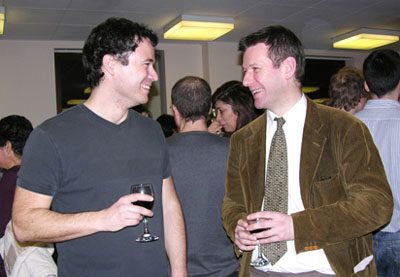
Actually, I just remembered that they took pictures at the party afterwards so here’s one of me and Joao having a chuckle afterwards. Notice I had put a tie on for the occasion, but Joao’s wardrobe is strictly T-shirts only.

37079699

After Friday’s dinner (roast partridge, if you want to know) I got the last train back to Cardiff from Paddington, snoozing comfortably for a large part of the journey. On time until just outside Cardiff Central, the train then sat motionless on the track almost within sight of the platform owing to the presence of a broken down goods train in front of us. We finally got into the station 50 (FIFTY) minutes late, and I didn’t get home until well after 2am.

Nobel Betting

Posted in Science Politics, The Universe and Stuff with tags , , , , on October 5, 2009 by telescoper

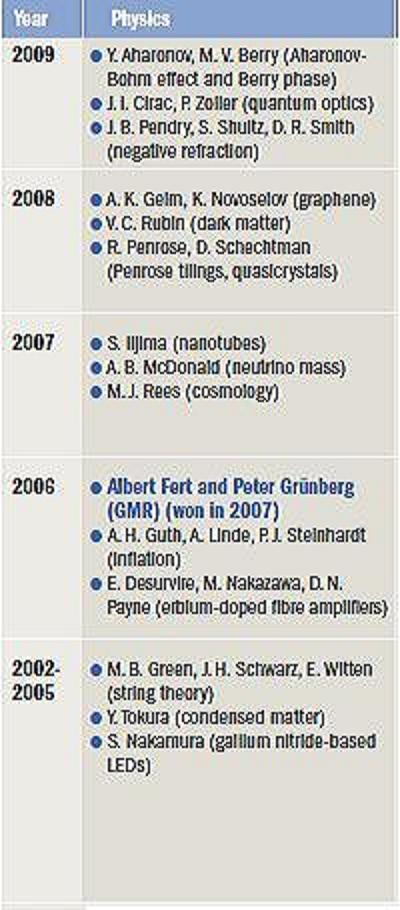
I’m reminded that the 2009 Nobel Prize for Physics will be announced tomorrow, on Tuesday 6th October. A recent article in the Times Higher suggested that British physicists might be in line for glory (based on a study of citation statistics). However, the Table they produced showed that their predictions haven’t really got a good track record so it might be unwise to bet too much on the outcome! This year’s predictions are at the top, with previous years underneath; the only successful prediction is highlighted in blue:

nobel

The problem I think is that it’s difficult to win the Nobel Prize for theoretical work unless confirmed by a definitive experiment, so much as I admire (Lord) Martin Rees – and would love to see a Nobel Prize going to astrophysics generally – I think I’d have to mark him down as an outsider. It would be absurd to give the prize to string theory, of course, as that makes no contact whatsoever with experiment or observation.

I think it would be particularly great if Sir Michael Berry won a share of the physics prize, but we’ll have to wait and see. The other British runner in the paddock is Sir John Pendry. While it would be excellent for British science to have a Nobel prize, what I think is best about the whole show is that it is one of the rare occasions that puts a spotlight on basic science, so it’s good for all of us (even us non-runners).

I think the panel made a bit of a bizarre decision last year and I hope there won’t be another steward’s enquiry this year to distract us from the chance to celebrate the achievements of the winner(s).

I’d be interested to hear any thoughts on other candidates through the comments box. No doubt there’ll be some reactions after the announcement too!

The Very Big Stupid

Posted in Science Politics with tags , , , on October 5, 2009 by telescoper

Sitting on the train yesterday coming back from a night at the Opera, I was reading The Observer. Last week’s edition had featured a superb piece by comedian David Mitchell on the topic of research funding. His argument, essentially, was that the government shouldn’t be directing its research funding at areas which will yield immediate economic benefit, but should instead be doing precisely the opposite. It is, he argues, the job of industry to invest in R&D that’s “relevant” to its immediate needs. It is the job of academia to do things driven by pure curiosity. If these happen to pay off it’s of course a good thing, but it’s a bonus and can only be expected to deliver a financial return in the long term.

Funding only that bit of science that can deliver immediate profits is a bit like diverting all the Arts Council grants into pop music or pantomimes when instead it should be funding things that are too experimental to  rely on revenue generated by paid customers, such as the Opera. I couldn’t agree more, but I am a bit biased in respect of that particular example. Although his piece was intended to be humorous, like a great deal of great comedy there is a great deal of truth in it.

This week’s edition of the Observer contained a number of letters about Mitchell’s piece. One called for him to be given a position in the government. Of course that would be inappropriate. He’s an intelligent and forward-thinking person, and would therefore be completely out of place in such a job. Another letter produced the following memorable quote from Frank Zappa which is exactly to the point.

The Very Big Stupid is a thing which breeds by eating The Future. Have you seen it? It sometimes disguises itself as a good-looking quarterly bottom line, derived by closing the R&D Department.

Meanwhile I attended a meeting this morning at which we were informed that all universities in England have been told to plan for cuts in their recurrent grants of about 15% next year. It is likely that Wales will follow suit. Since most of a University’s expenditure is on staff salaries, corresponding reductions will have to be made, either by cutting salaries or (more likely) by making redundancies.

Research Councils are also likely to feel the squeeze which will hit responsive mode grants too. For astronomy and particle physics, who rely on the Science & Technology Facilities Council for their funding, the situation is especially dire because even without the anticipated cuts, that particular organization has an enormous black hole in its  budget anyway.There is a strong likelihood that existing grant funding will be clawed back to plug the gap, with immediate consequences for postdoctoral researchers and a catastrophic long-term effect on morale.

Pure science in the UK faces a very grim period. All three main political parties have promised savage spending cuts after the next election. The Tories have promised a budget within a month of coming to power if they win; they certainly won’t increase  taxes to cover the budget deficit, especially not at the top end of the scale. A Conservative budget is very unlikely to contain any good news for science or higher education generally.

It’s time for us all to get lobbying about the importance of pure research, but the difficulty is that the Research Councils that are supposed to be distributing funds for this purpose are largely populated by politically appointed individuals who can’t or won’t fight the corner. The Chief Executive of STFC, for example, seems to be content to turn his organization into a channel through which government subsidy flows into technology and engineering companies with only a cursory nod in the direction of basic research. I suspect there are many within the higher levels of management of  other research council  who also see the current economic crisis as an opportunity to cut back “useless science” still further.

I’m sure  that in the long run people will look back on all this as a Very Big Example of The Very Big Stupid, but I’m also worried that for many research projects and for many scientific careers there may not actually be a long run.

Medawar on Johnson on Milton on Science

Posted in Science Politics with tags , , , , on October 1, 2009 by telescoper

Have recent events left you with a sinking feeling that science isn’t valued in today’s modern world? Are you aggrieved that the great and the good nowadays seem to be so unimpressed by research for research’s sake and require us instead to divert our energies into “useful things” (whatever they are)?

Looking for something to optimistic to say I turned to Peter Medawar‘s book Advice to a Young Scientist and found, to my disappointment, that actually there’s nothing new about this attitude. For example, Medawar explains, no less a character than Dr Samuel Johnson, in his Life of Milton  offered the following rant about Milton’s daft idea of setting up an academy in which the scholars should learn astronomy physics and chemistry as well as the usual school subjects:

But the truth is that the knowledge of external nature, and the sciences which that knowledge requires or includes, are not the great or the frequent business of the human mind. Whether we provide for action or conversation, whether we wish to be useful or pleasing, the first requisite is the religious and moral knowledge of right and wrong; the next is an acquaintance with the history of mankind, and with those examples which may be said to embody truth and prove by events the reasonableness of opinions. Prudence and Justice are virtues and excellences of all times and of all places; we are perpetually moralists, but we are geometricians only by chance. Our intercourse with intellectual nature is necessary; our speculations upon matter are voluntary and at leisure. Physiological learning is of such rare emergence that one man may know another half his life without being able to estimate his skill in hydrostaticks or astronomy, but his moral and prudential character immediately appears.

Medawar attempts to cheer up his readers  by responding with the following feeble platitude

Scientists whose work is prospering and who find themselves deeply absorbed in and transported by their research feel quite sorry for those who do not share the same sense of delight; many artists feel the same, and it makes them indifferent to – and is certainly a fully adequate compensation for –  any respect they think owed to them by the general public.

Tripe. Delight doesn’t put your dinner on the table. It’s not enough to feel smug about how clever you are: we need to convince people that science is worth doing because it’s worth doing for its own sake, and worth funding by the taxpayer for the same reason. Feeling sorry for people who don’t get the message is a sickeningly patronising attitude to take.

I should point out that the rest of the book isn’t all as bad as this, but  the mood I’m in today the best advice I could offer a young scientist at the moment wouldn’t require a whole book anyway:

Don’t!

Alarm Bells at STFC

Posted in Science Politics with tags , , on September 30, 2009 by telescoper

The  financial catastrophe engulfing the Science and Technology Facilities Council (STFC) has suddenly reared its (very ugly) head again.

Here is a statement posted yesterday on their webpage.

STFC Council policy on grants

STFC Council examined progress of its current science and technology prioritisation exercise at a strategy session on 21 and 22 September. Without prejudging the outcome of the prioritisation, Council agreed that prudent financial management required a re-examination of upcoming grants.

Council therefore agreed that new grants will be issued only to October 2010 in the first instance. This temporary policy is in place pending the outcome of the prioritisation exercise, expected in the New Year.

According to the e-astronomer the  STFC  has written to all Vice-chancellors and Principals of UK universities to tell them about this move. I gather the intention is that this measure will be temporary, but it looks deeply ominous to me. Those of us whose rolling grant requests for  5 years from April 2010 are currently being assessed face the possibility of receiving grants for only 6 months of funding. On the other hand, I’m told that what is more likely is that our grant won’t be announced until January or February, after the hitlist prioritisation exercise has been completed in the New Year. Hardest hit will be the particle physicists whose rolling grants start on 1st October 2009 (tomorrow), which will have only a year’s funding on them…

It seems that STFC has finally realised the scale of its budgetary problems and payback time is looming. I honestly think we could be doomed…

Index Rerum

Posted in Biographical, Science Politics with tags , , , , , , , , , on September 29, 2009 by telescoper

Following on from yesterday’s post about the forthcoming Research Excellence Framework that plans to use citations as a measure of research quality, I thought I would have a little rant on the subject of bibliometrics.

Recently one particular measure of scientific productivity has established itself as the norm for assessing job applications, grant proposals and for other related tasks. This is called the h-index, named after the physicist Jorge Hirsch, who introduced it in a paper in 2005. This is quite a simple index to define and to calculate (given an appropriately accurate bibliographic database). The definition  is that an individual has an h-index of  h if that individual has published h papers with at least h citations. If the author has published N papers in total then the other N-h must have no more than h citations. This is a bit like the Eddington number.  A citation, as if you didn’t know,  is basically an occurrence of that paper in the reference list of another paper.

To calculate it is easy. You just go to the appropriate database – such as the NASA ADS system – search for all papers with a given author and request the results to be returned sorted by decreasing citation count. You scan down the list until the number of citations falls below the position in the ordered list.

Incidentally, one of the issues here is whether to count only refereed journal publications or all articles (including books and conference proceedings). The argument in favour of the former is that the latter are often of lower quality. I think that is in illogical argument because good papers will get cited wherever they are published. Related to this is the fact that some people would like to count “high-impact” journals only, but if you’ve chosen citations as your measure of quality the choice of journal is irrelevant. Indeed a paper that is highly cited despite being in a lesser journal should if anything be given a higher weight than one with the same number of citations published  in, e.g., Nature. Of course it’s just a matter of time before the hideously overpriced academic journals run by the publishing mafia go out of business anyway so before long this question will simply vanish.

The h-index has some advantages over more obvious measures, such as the average number of citations, as it is not skewed by one or two publications with enormous numbers of hits. It also, at least to some extent, represents both quantity and quality in a single number. For whatever reasons in recent times h has undoubtedly become common currency (at least in physics and astronomy) as being a quick and easy measure of a person’s scientific oomph.

Incidentally, it has been claimed that this index can be fitted well by a formula h ~ sqrt(T)/2 where T is the total number of citations. This works in my case. If it works for everyone, doesn’t  it mean that h is actually of no more use than T in assessing research productivity?

Typical values of h vary enormously from field to field – even within each discipline – and vary a lot between observational and theoretical researchers. In extragalactic astronomy, for example, you might expect a good established observer to have an h-index around 40 or more whereas some other branches of astronomy have much lower citation rates. The top dogs in the field of cosmology are all theorists, though. People like Carlos Frenk, George Efstathiou, and Martin Rees all have very high h-indices.  At the extreme end of the scale, string theorist Ed Witten is in the citation stratosphere with an h-index well over a hundred.

I was tempted to put up examples of individuals’ h-numbers but decided instead just to illustrate things with my own. That way the only person to get embarrased is me. My own index value is modest – to say the least – at a meagre 27 (according to ADS).   Does that mean Ed Witten is four times the scientist I am? Of course not. He’s much better than that. So how exactly should one use h as an actual metric,  for allocating funds or prioritising job applications,  and what are the likely pitfalls? I don’t know the answer to the first one, but I have some suggestions for other metrics that avoid some of its shortcomings.

One of these addresses an obvious deficiency of h. Suppose we have an individual who writes one brilliant paper that gets 100 citations and another who is one author amongst 100 on another paper that has the same impact. In terms of total citations, both papers register the same value, but there’s no question in my mind that the first case deserves more credit. One remedy is to normalise the citations of each paper by the number of authors, essentially sharing citations equally between all those that contributed to the paper. This is quite easy to do on ADS also, and in my case it gives  a value of 19. Trying the same thing on various other astronomers, astrophysicists and cosmologists reveals that the h index of an observer is likely to reduce by a factor of 3-4 when calculated in this way – whereas theorists (who generally work in smaller groups) suffer less. I imagine Ed Witten’s index doesn’t change much when calculated on a normalized basis, although I haven’t calculated it myself.

Observers  complain that this normalized measure is unfair to them, but I’ve yet to hear a reasoned argument as to why this is so. I don’t see why 100 people should get the same credit for a single piece of work:  it seems  like obvious overcounting to me.

Another possibility – if you want to measure leadership too – is to calculate the h index using only those papers on which the individual concerned is the first author. This is  a bit more of a fiddle to do but mine comes out as 20 when done in this way.  This is considerably higher than most of my professorial colleagues even though my raw h value is smaller. Using first author papers only is also probably a good way of identifying lurkers: people who add themselves to any paper they can get their hands on but never take the lead. Mentioning no names of  course.  I propose using the ratio of  unnormalized to normalized h-indices as an appropriate lurker detector…

Finally in this list of bibliometrica is the so-called g-index. This is defined in a slightly more complicated way than h: given a set of articles ranked in decreasing order of citation numbers, g is defined to be the largest number such that the top g articles altogether received at least g2 citations. This is a bit like h but takes extra account of the average citations of the top papers. My own g-index is about 47. Obviously I like this one because my number looks bigger, but I’m pretty confident others go up even more than mine!

Of course you can play with these things to your heart’s content, combining ideas from each definition: the normalized g-factor, for example. The message is, though, that although h definitely contains some information, any attempt to condense such complicated information into a single number is never going to be entirely successful.

Comments, particularly with suggestions of alternative metrics are welcome via the box. Even from lurkers.

Reffing

Posted in Science Politics with tags , , , on September 28, 2009 by telescoper

No sooner has the dust settled on the  2008 Research Assessment Exercise (RAE) when the Higher Education Funding Council for England (HEFCE) has tabled its proposals for a new system called the Research Excellence Framework (REF) in a 56-page consultation document that you can download and peruse at your leisure.

I won’t try to give a complete account of the new system except to say that apart from the change of acronym there won’t be much different. Many of us hoped that the new framework would involve a lighter touch than the RAE, so we could actually get on with research instead of filling in forms all our lives. Fat chance. You can call me cynical if you like, but I think it’s obvious that once you set up a monstrous bureaucratical nightmare like the RAE it is almost impossible to kill it off. Things like this gather their own momentum and become completely self-serving. The apparatus of research assessment no longer exists to fulfil a particular purpose. It exists because it exists.

It might be useful however to summarise the main changes:

  1. The number of Units of Assessment and sub-panels is to be reduced from 67 to 30 and the number of main assessment panels from 15 to 4. This move is bound to prove controversial as it will clearly reduce the number of specialists involved in the quality appraisal side of things. However, the last RAE produced clear anomalies in the assessment carried out by different panels: physics overall did very poorly compared to other disciplines, for example. Having fewer panels might make it easier to calibrate different subjects. Might.
  2. In REF the overall assessments are going to be based on three elements: research output (60%); impact (25%); and environment (15%). In the last RAE each panel was free to vary the relative contribution of different components to the overall score. Although the “research output” category is similar to the last RAE, it is now proposed to include citation measures in the overall assessment. Officially, that is. It’s an open secret that panel members did look at citations last time anyway.  Citation impact will however be used only for certain science and engineering subjects.  “Impact” is a new element and its introduction is  in line with the government’s agenda to pump research funds into things which will generate wealth, so this measure will probably shaft fundamental physics. “Environment” includes things like postgraduate numbers, research funding and the like; this is also similar to the RAE.
  3. A roughly similar number of experts will be involved as in RAE 2008 – so it will be similarly expensive to run.
  4. The consultation document asks whether the number of outputs submitted per person should be reduced from four to three, and also whether “substantive outputs” (whatever they are) should be “double-weighted”.
  5. The results will be presented in terms of “profiles” as in 2008, with the percentage of activity at each level being given.
  6. The consultation also suggests honing the description of “world-leading” (4*) and “internationally excellent” (3*) to achieve greater discrimination at the top end of the scale. This is deeply worrying, as well as completely absurd. The last RAE applied a steeply rising funding formula to the scores so that 4*:3*:2*:1* was weighted 7:3:1:0. However the fraction of  work in each category is subject to considerable uncertainty, amplified by the strong weighting.  If the categories are divided further then I can see an even steeper weighting emerging, with the likely outcome that small variations in the (subjective) assessment will lead to drastic variations in funding. Among the inevitable consequences of this will be that  some excellent research will lose out.

No doubt university administrators across the United Kingdom will already be plotting how best to play the new system. I think we need to remember, though, that deep cuts in public spending have been promised by both major political parties and there is a general election due next year. I can see the overall  budget for university research being slashed so we’ll be fighting for shares of a shrinking pot. Killing off the bureaucracy would save money, but somehow I doubt that will be on the agenda.

Future Fees

Posted in Science Politics with tags , , , on September 21, 2009 by telescoper

There’s been a lot of news coverage today arising from a new report by the Confederation of British Industry (CBI) which argues that students should in future pay higher tuition fees to go to British universities. As you can probably imagine this has generated quite a lot of comment, but since some of the remarks I’ve heard are based on misunderstandings I thought I’d give my angle on  is happening and what the implications are.

For a start, the tuition fees paid by students at present are not the sole (or even the largest part) of the income paid to universities for undergraduate education. The way the funding councils work is to pay each university directly an amount for teaching each student (called the recurrent grant). This amount depends on the course. There is a basic level (which for 2009/10 is £3,947), but this is increased for subjects which require experimental work. The result is that there are four funding bands: A (which is clinical medicine, the most expensive); B (which includes science subjects such as physics); C (which includes subjects with laboratory or fieldwork element); and D (everything else).

The level of funding for an individual student in each price band in 2009/10 is

  • band A – £15,788
  • band B – £6,710
  • band C – £5,131
  • band D – £3,947

Physics (and Astronomy) is in band B, so the department receives £6,710 directly from the government for each student doing a course in these subjects.

Brought in in 2006, the “top-up” fee (currently £3225) is in addition to this, although it does not have to be paid immediately by the students. They can borrow the money at an advantageous interest rate and only have to pay it back when  they have left their University and started to earn money at a level sufficient to trigger the repayment. Here in Wales the situation is a little bit more complicated because the students don’t pay the full “top-up” fee payable in England. Instead they pay a lower rate (currently £1285) and the Welsh Assembly Government makes good the shortfall to the University. In Scotland there are no tuition fees payable by the students.

Anyway, for Physics at least, the tuition fee is only about one-third the total income for each student. It looks, then, like the government does actually pay the lion’s share of the cost of higher education, especially in science and medicine. However, it is worth remarking that if the UK devoted the same share of its GDP as the OECD mean (1.1%) then students would not have to pay top-up fees at all in order to fund the entire University system at an adequate level. Clearly a political decision was made that funding Trident, ID cards,  and wars in Iraq and Afghanistan was a much better use for taxpayers’ money than providing universal free higher education.

I don’t actually object to the principle that students should make a contribution to the cost of their university education but I think the fairest way to do that is via the taxation system. There are many problems with the system we have, which is an attempt at a British compromise that actually gives us the worst of all worlds. The Labour party was scared to allow fees to be set too high for fear of alienating its traditionalists by discouraging those from poorer background from going to university. On the other hand, it didn’t want to set them too low because that wouldn’t bring in sufficient extra money. In the end they settled at an in-between level, i.e. one that achieved very little and alienated people anyway.

For a start the level of top-up income is not really high enough to pay for the investment that is needed. Many leading universities are in fact making redundancies because the additional revenue  realised by top-up fees was not enough to meet the rising pay bill resulting from a generous salary settlement last year. Moreover, the idea that top-up fees would satisfy the right-wingers by introducing some kind of “market” was a complete delusion. All universities (big and small, old and new, good and less good) charged the same level of fee.

I went to university in the 1980s when the system was very different. There were no top-up fees and, because I wasn’t from a wealthy family, I received a full maintenance grant to cover the cost of living and studying during the three years of my degree. That’s the big difference nowadays: nobody gets a full maintenance grant. Universities do use some of their tuition fee money to provide contributions to poorer students but they generally amount to a few thousand pounds a year. That’s not enough to live on, so most students either rely on their parents to help them or have to work during term-time. I never had to do either of those.

Anyway the CBI report says that the level of tuition fees should increase to around £5000, the student loan interest rate should increase and there should be fewer bursaries. Even within its own terms I don’t think this makes much sense. In fact, I could understand them better if they had argued to remove the cap altogether. The posh places – Oxbridge and perhaps a few others – which can probably fill their places  charging whatever they like could actually afford a fairly generous bursary scheme that might encourage a few talented working class kinds to go there to ease these institutions’ consciences.  Other universities would be forced to set their own fee levels according to the demands of income and recruitment.  The system would be increasingly differentiated by cost and quality, but students from poorer backgrounds would  be excluded to an even greater extent than they are now. I wouldn’t like a university system built along those lines but it seems to me that it would suit the mentality of the CBI.

The big issue about today’s debate, however, is that neither the Labour nor the Conservative Party is going to say what they’re going to do about university funding until after the general election next year. Certainly  neither of them will say whether the fee will go up to £5000. For once, I agree with Sally Hunt  (general secretary of the Universities and Colleges Union) who has urged them both to come clean. Keeping silent about this when other public sector cuts are clearly on the table is both spineless and dishonest. Just what you’d expect from politicians, in fact.

For what it’s worth I predict that after the next election higher education will suffer a classic double-whammy. Whichever party takes power, the resulting government will be forced to make large-scale cuts in public spending to keep the country’s finances under control. I think what they’ll do is cut the unit of resource (probably by a large amount, say 25%) at the same time as increasing the tuition fee element. They can then claim that University funding has been protected while at the same time cutting the cost of the system to the public purse. Students will end up paying more for less. But, hey, at least it will keep the bankers happy and that’s what we’re here for after all.