Archive for the Science Politics Category

Returning to Lognormality

Posted in Biographical, Science Politics, The Universe and Stuff with tags , , , on June 7, 2009 by telescoper

I’m off later today for a short trip to Copenhagen, a place I always enjoy visiting. I particularly remember a very nice time I had there back in 1990 when I was invited by Bernard Jones, who used to work at the Niels Bohr Institute.  I stayed there several weeks over the May/June period which is the best time of year  for Denmark; it’s sufficiently far North that the summer days are very long, and when it’s light until almost midnight it’s very tempting to spend a lot of time out late at night.

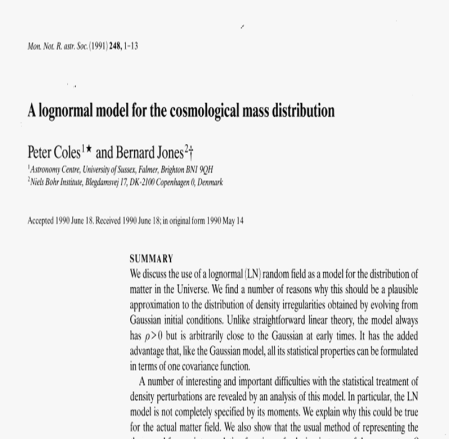
As well as being great fun, that little visit also produced my most-cited paper. I’ve never been very good at grabbing citations – I’m more likely to fall off bandwagons rather than jump onto them – but this little paper seems to keep getting citations. It hasn’t got that many by the standards of some papers, but it’s carried on being referred to for almost twenty years, which I’m quite proud of; you can see the citations per year statistics are fairly flat. The model we proposed turned out to be extremely useful in a range of situations, hence the long half-life.

nph-ref_history

I don’t think this is my best paper, but it’s definitely the one I had most fun working on. I remember we had the idea of doing something with lognormal distributions over coffee one day,  and just a few weeks later the paper was  finished. In some ways it’s the most simple-minded paper I’ve ever written – and that’s up against some pretty stiff competition – but there you go.

Picture1

The lognormal seemed an interesting idea to explore because it applies to non-linear processes in much the same way as the normal distribution does to linear ones. What I mean is that if you have a quantity Y which is the sum of n independent effects, Y=X1+X2+…+Xn, then the distribution of Y tends to be normal by virtue of the Central Limit Theorem regardless of what the distribution of the Xi is  If, however, the process is multiplicative so  Y=X1×X2×…×Xn then since log Y = log X1 + log X2 + …+log Xn then the Central Limit Theorem tends to make log Y normal, which is what the lognormal distribution means.

The lognormal is a good distribution for things produced by multiplicative processes, such as hierarchical fragmentation or coagulation processes: the distribution of sizes of the pebbles on Brighton beach  is quite a good example. It also crops up quite often in the theory of turbulence.

I;ll mention one other thing  about this distribution, just because it’s fun. The lognormal distribution is an example of a distribution that’s not completely determined by knowledge of its moments. Most people assume that if you know all the moments of a distribution then that has to specify the distribution uniquely, but it ain’t necessarily so.

If you’re wondering why I mentioned citations, it’s because it looks like they’re going to play a big part in the Research Excellence Framework, yet another new bureaucratical exercise to attempt to measure the quality of research done in UK universities. Unfortunately, using citations isn’t straightforward. Different disciplines have hugely different citation rates, for one thing. Should one count self-citations?. Also how do you aportion citations to multi-author papers? Suppose a paper with a thousand citations has 25 authors. Does each of them get the thousand citations, or should each get 1000/25? Or, put it another way, how does a single-author paper with 100 citations compare to a 50 author paper with 101?

Or perhaps the REF should use the logarithm of the number of citations instead?

Divided Loyalties

Posted in Biographical, Science Politics with tags , , , , on May 16, 2009 by telescoper

It’s easy to tell that summer is on the way. England are playing the West Indies at Cricket. It’s the penultimate weekend of the Premiership football season. The undergraduates are taking their exams. I’m sitting with a pile of projects to mark. And it’s raining.

I suppose I have to mention the football. My team, Newcastle United, gave themselves a chance of avoiding relegation on Monday night by beating local rivals, Middlesborough 3-1. A win today at home against Fulham would pretty much have guaranteed safety. They lost 1-0. It now looks inevitable that they will be relegated after 16 years in the top flight.

It’s a thankless task being a Newcastle supporter. I’ve followed them all my life and they have managed to avoid winning any competition of any significance since the Fairs cup in 1968 (now called the UEFA cup). They have loyal fans and a wonderful stadium, but somehow seem completely unable to convert that into success on the field. This season they were doomed as soon as the manager Kevin Keegan quit over the owner Mike Ashley’s refusal to allow him to be involved in signing any players. After a period without a manager, during which they lost game after game, the club appointed veteran relegation specialist Joe Kinnear, who did OK for a while then at Christmas had to go into hospital with heart problems. Another run of poor results followed until, in desperation, the club appointed the iconic former player Alan Shearer to his first managerial position. His lack of experience showed, though, and he’s only managed to win one game. In short, the season has been a shambles.

When my father died (about 18 months ago), I thought that my interest in Newcastle United would wane. Football and music were the only two things we had in common after my parents split when I was about 12 and I went to live with my mother. I saw him only rarely in later years,and much of the time we spent together involved talking about football. However, I still find myself getting nervous on match days and looking anxiously for the scores whenever they’ve been playing. It’s like there is an umbilical cord that still connects me to my home town and I can’t get rid of it.

That feeling was reinforced yesterday when, following a conversation at the RAS Club last week, Robert Smith sent me a booklet that he had received when he attended a conference in Newcastle in 1965. The Official Guide to Newcastle upon Tyne (priced 2/6) filled me with a mixture of nostalgia and amusement. Ironically, given the football team’s inadequacies the motto of the city is FORTITER DEFENDIT TRIUMPHANS, which was also the motto of my old school, the Royal Grammar School (also mentioned in the booklet).

The little picture on the left shows the armorial bearings of the City of Newcastle upon Tyne. The official blazon is: Arms:- Gules three Castles triple towered Argent. Crest on a Wreath of the Colours. A Castle as in the arms issuant therefrom from a demi Lion guardant supporting a Flagstaff Or, flying therefrom a forked Pennon of the Arms of Saint George.

Supporters: – on either side a Sea Horse proper crined and finned Or.

Obviously supporters don’t guarantee success, even if they’re proper crined and finned.

Of course, I shall be disappointed if and when Newcastle get relegated next week, but I don’t go along with all the guff in the newspapers about how it will have dire consequences for the city. They’ve been relegated twice before in my lifetime, and the world didn’t end then nor will it now. In any case, I’d reckon the Football Club has taken much more out of the economy of Newcastle in recent years than it has put back into it. Hard-earned cash from supporters has gone straight into the pockets of overpaid players and inept management staff. Maybe relegation will shake the Club up, which will be good in the long run.

Anyway, every cloud has at least one silver lining and this one has two. At the start of the season, I was prescient enough to place a large bet on Newcastle to get relegated at quite long odds. I expect to be handsomely compensated by Mr William Hill when they do go down. The other thing is that they will have to play Cardiff City in the Championship next year, which will give me the chance to see them play in Cardiff’s brand new stadium.

Incidentally, Cardiff City blew their promotion hopes in spectacular fashion. Needing only to avoid losing to Preston North End by 5 goals in order to secure a place in the play-offs, they lost 6-0.

Meanwhile we’ve been coming down slowly from the high that was Thursday’s launch of Herschel and Planck. I was surprised to see Matt Griffin in the department yesterday afternoon because he was actually at the launch in Kourou. He had left after the launch and flown directly back to Cardiff (via Paris). Our other representatives will return over this weekend, and things will start to get back to normal.

Matt told me that he was so impressed with the professionalism of Arianespace, that he wasn’t at all nervous about the launch. Matt’s instrument, SPIRE, will switch on during 22 May and testing will start. I’m sure that Matt and his team will be more than a little nervous about that!

Assuming both Planck and Herschel work satisfactorily, the next problem we will have to face is the deluge of data that will shortly be upon us. The astronomers at Cardiff University have submitted an application for rolling grant support from STFC (not Swindon Town Football Club) to enable us to extract scientific results from new data especially from Herschel. Unfortunately, though, the coffers are pretty bare and it seems very unlikely that we will get the substantial uplift in funding we need to carry out the work on a reasonable timescale.

A rolling grant is intended to support an ongoing research programme. Typically the grants cover 5 years’ funding, enabling the group to offer longer term contracts to staff than is allowed by the 3-year standard grant format. After 3 years of the rolling period, the group has to bid again for another 5 year period but the timing means there is always two years’ grace, meaning that if renewal is not recommended the group still has two years’ funding so the plug isn’t pulled immediately. If an extension is offered but at a reduced level of funding, a group might decide to refuse the new grant and carry on with its existing two years, perhaps to apply in the following round.

The problem with the current financial situation is that STFC barely has the funds needed to continue its existing rolling grants. In other words if all the groups applying for rolling support declined their new contracts and rolled on their existing grants, STFC would only just be able to pay them. In such a situation there would be no new grants or any kind of increase in existing rollers. The implications for successful exploitation of Herschel and Planck appear to be grim and there could well be a lot of difficult decisions within the department to be made if we have to operate within a much reduced budget.

It would be ridiculous if a billion-dollar mission like Herschel ends up stymied because of the relatively small sums needed to exploit the data, but that doesn’t mean it won’t happen. Football teams aren’t the only organizations to suffer from bad management.

Unravelling CERN

Posted in Science Politics, The Universe and Stuff with tags , , on May 13, 2009 by telescoper

A disturbing piece of news passed me by last week. One of the founder members, Austria, has decided to pull out of CERN, the home of the much-vaunted Large Hadron Collider. The announcement was made on 8th May 2009, but I missed it at the time owing to my trip to Berlin.

Austria, a founder member of CERN, has been a member of the 20-nation body since 1959, but its justification for leaving, according to Austria’s Minister for Science Johannes Hahn, is that the CERN subscription ties up about 70% of the nation’s budget for international research. To quote him

“In the meantime there have been diverse research projects in the European Union which offer a very large number of different scientists’ perspectives..”

Austria only contributes 2.2 percent of CERN’s budget, but it will be the first country to leave the organization since Spain’s departure in 1969. Spain rejoined in 1983. According to a statement,

“CERN would be sorry to lose Austria as one of its member states and sincerely believes that it would be in Austria’s best interests to remain a member..”

The immediate consequence of this will be a (small) increase in the subscriptions payable by other member nations in order to plug the funding gap left by Austria’s departure. However, particle physicists will probably see this as a very worrying precedent that might signal to other funding bodies that they could think the previously unthinkable and follow Austria’s example.

The CERN subscription payable by the United Kingdom comes from the budget of the Science and Technology Facilities Council (STFC). Although it amounts to about £82 million, this is about 16% of the STFC budget, which is a much smaller fraction than in the case of Austria. However, the consequences of one of the larger contributors like the UK pulling out of CERN would be extremely serious, because of the large increases in remaining subscriptions that would be needed to fill the gap that would be created.

All this puts even more pressure on the Large Hadron Collider to produce the goods and it also reinforces the view I expressed in one of my first ever blog posts that we may be nearing the time when nations decide that Big Science is just too expensive and  too esoteric to be worth investing in…

STOP PRESS:  New just in from Thomas (below) reveals that the Austrians have done a U-bahn U-turn and are not, after all, going to pull out of CERN.

For more information, see the story in Physics World.

Good News, Bad News

Posted in Science Politics with tags , , on May 1, 2009 by telescoper

Further to my gloomy prognosis about the implications of the Budget for astronomy research, I’ve managed to glean the following interpretation of the outcome for the Science & Technology Facilities Council (STFC).

Just to remind you that the situation before the budget settlement was announced last week was truly dire, with  falling exchange rates leading to rises in the cost of subscriptions putting pressure on an already overstretched STFC budget. In fact, STFC actually underspent last year but was not allowed to carry the underspend forward into the tax year beginning this April so that has done nothing to help the imminent financial meltdown. The overall  shortfall for 2009-10 was estimated pre-budget to be about £80 million, meaning that £80 million of current commitments would have to be ditched if nothing was done.

First, the good news. After the budget it has emerged that the Department for Innovation, Universities and Skills (DIUS)  has taken steps to “lend” STFC money to plug the shortfall arising from exchange rate fluctuations. This means the actual shortfall is not going to be as large as the previous estimate.

Now the bad news. There is no new money for STFC,  and there is consequently still a serious gap in the finances. There will have to be about £20 million savings this financial year (against current commitment) and about £30 million next year. Not as bad as £80 million, but still very tough.

At this moment the powers that be are dusting off the Programmatic Review which involved the prioritisation of missions and facilities within the STFC remit. There is also yet another review of ground-based astronomy which is meant to be a long-term thing, but will presumably inform the decision-making process in the short term too.

A line had previously drawn as far down the  list of priorities as funding would permit. Now the available funds are less the line will have to rise and some astronomical projects that thought they were safe will have to be ditched after all. This also depends on whether STFC saves money in other ways,  such as from the grants line or by internal savings within its own administration.

It will be a nervous wait for many of us to see where and the axe will fall next…

The Shape of Things to Come..

Posted in Science Politics with tags , , on April 24, 2009 by telescoper

The implications of this week’s budget for astronomy are gradually becoming clearer although a full picture is yet to emerge.

The following statement appeared on the webpages of the Science and Technology Facilities Council:

STFC’s budget of £491 million for 2009-10 is evidence of the Government’s commitment to investing in science in a period of severe national and global economic uncertainty.

STFC’s Chief Executive Officer, Professor Keith Mason, said: “Our budget represents a major investment in science at a time of increasing pressure on public spending, and will allow us to fund a wide array of world leading science delivering significant impact for the UK.”

“The budget confirms the Government’s commitment to, and acknowledgement of, investment in curiosity driven and application led research as essential elements to support the country’s economic growth in the short, medium and longer term.”

Professor Mason said the near cash* budget of £491 million was more than the Council’s allocation in the Comprehensice Spending Review (CSR07), thanks to assistance from the Department for Innovation, Universities and Skills (DIUS) in the form of a loan and compensation for foreign exchange exposure. This outcome follows extensive consultation between DIUS and the Research Councils to ameliorate the effect of the fall of the pound. However, it will unfortunately not allow STFC to fund the full science programme planned under its Programmatic Review.

Professor Mason said STFC would now consult on reprioritising its programme across the remainder of the CSR period. This consultation will cover both the short-term items required for 2009-10, and a longer term process to ensure stable platform for planning in the medium to longer term. Council will discuss options for 2009-10 at its meeting on the 28th April.

“For its part STFC has already imposed a series of internal savings, including on travel and severe restrictions on external recruitment. We will seek to identify further savings in order to concentrate resources on funding our core research programme,” Professor Mason said.

It appears, then, that there is to be short-term assistance from the effects of currency fluctuations but this will be in the form of a loan that will eventually have to be paid back from savings found within the programme. I suppose something’s better than nothing, despite the bland language, it is quite clear that we are heading for big cuts in the STFC programme and astronomy will not be immune.

The Times Higher has also covered the budget settlement for science and higher education generally in very downbeat terms. Echoing what I put in my previous post:

Although the Budget maintains an existing commitment to ring-fence the science budget, DIUS had reportedly sought a £1 billion increase in funding for scientific research as part of a stimulus package designed to use science to boost the economy.

Instead of this, research councils will be required to make £106 million in savings, which will then be reinvested elsewhere intheir portfolio “to support key areas of economic potential”.

We await details of where these “savings” will be made. My current understanding is that the STFC needs to find about £10 million immediately although whether this is on top of or including its share of the overall “efficiency savings”, I don’t know. In any case it is clear that this money will be taken from pure science programmes and spent instead on areas deemed to have “economic potential”. It looks like we’re all going to have to hone our bullshitting skills over the next few years.

Economic Impact

Posted in Science Politics with tags , , on April 22, 2009 by telescoper

Like many of my colleagues I’ve been looking nervously through the lengthy documents  produced by HM Treasury to fill in the details of the Chancellor’s Budget speech. I was hoping to find some evidence of a boost for science that might filter down as a rescue package for STFC and might dispel the rumours of savage cuts in the Astronomy programme. Unfortunately I didn’t find any.

No real details about the science programme are given in the lengthy budget report, at least not that I could find this afternoon. There are, however, a couple of worrying pointers that things might be going from bad to worse.

The Chancellor has decided to cut public spending overall by about £15 billion (largely by “efficiency savings”) in order to control the UK’s ballooning public debt. The Department of Innovation, Universities and Skills (DIUS) which sits above the Research Councils in the hierarchy of research management is mentioned twice in the document, in the following passages talking about savings:

£118 million through increasing the effectiveness of research activities funded by the Research Councils by reducing administration costs and refocusing spend on new research priorities;

and

An additional £106 million of savings delivered by the Research Councils within the science and research budget to be re-invested within that budget to support key areas of economic potential.

Both of these look to me like indications that money will be diverted from pure science into technology-driven areas. Far from there being a boost for astronomy, it looks like we face the opposite with money being squeezed from us and re-allocated to areas that can make a stronger case for economic potential.

Another indication of this phase change, which has been in the air for some time, appeared yesterday on the STFC website.  The whole item can be found here, but the salient points are included in the following excerpt

Applicants for STFC rolling and standard grants will now be required to produce an impact plan, identifying the potential economic impacts of their proposal. The change takes effect from 21 April 2009 and will affect grants rounds from autumn 2009 onward.

The change follows a 2006 Research Councils UK project, and subsequent Excellence with Impact report, into the efficiency and value for money of Research Council peer review processes. The report recommended the Research Councils improve guidance to applicants and peer reviewers to ensure a shared understanding about the value of identifying the potential economic impact of research, and that the new requirements be supported in electronic application systems and guidelines.

More details of the spending priorities of DIUS within its overall budget will no doubt emerge in due course and they may yet reveal a tonic of some sort for STFC. What seems more likely, however, is that any such funds will be aimed at space gadgetry rather than at science. I have a feeling that the impact of the economic downturn on UK Astronomy is going to turn out to be dire.

Budget Boost?

Posted in Science Politics with tags , , , , on April 19, 2009 by telescoper

This Wednesday (22nd April 2009) the Chancellor of the Exchequer, Alistair Darling, will deliver the UK government’s budget for this year. The background is of course the economic recession and the consequent collapse of our public finances. The government will have to borrow an estimated £175 billion over the next year, and it likely that taxes will eventually have to rise considerably to balance the books in the longer term.

Rumours are abounding about what will be in the budget and what won’t. According to today’s Observer, the centrepiece is likely to be a £50 billion scheme to revitalize the housing market.  If this is the case then I think it’s a mistake. Our economy has been run for too long on the basis of money raised from inflated property valuations, and we need to take this opportunity to change to a more sustainable way of running the country. Other schemes that may emerge include a £2 billion scheme to help unemployed young people which is a better idea, but much of it would probably be wasted in bureaucracy rather than doing real good.

My own attention will be focussed on whether there is anything in Alistair Darling’s speech that indicates some help for science, particularly fundamental science like physics and astronomy. In yesterday’s Guardian the Astronomer Royal and President of the Royal Society, Lord Martin Rees argued  for an injection of cash to stimulate science and innovation. About a month ago the BBC reported on efforts by Ministers to convince the treasury of the benefit of a £1 billion stimulus package for science along these lines. However, even if the powers that be listen to this argument (which is, in my view, unlikely), any increase in science funding would not necessarily be directed towards fundamental physics. I think if there isn’t anything for those of us working in astronomy in this budget, then we’re completely screwed.

I believe the funding crisis at the Science & Technology Facilities Council (STFC) was precipitated by a conscious government decision to move funds away from blue skies research and into more applied, technology driven areas.  The 2007 Comprehensive Spending Review was extremely tough on STFC but quite generous to some other agencies.  Moreover, within STFC itself there seems to be a shift from science-driven to technology-driven projects,  signalled by the cancellation of projects such as Clover to save a couple of million, and the allocation of funds to projects such as Moonlite which is devoid of any scientific interest and which could end up costing as much as £150 million over the next five years or so.

The true depth of the ongoing STFC crisis is only gradually becoming apparent. It was bad enough to start with, but has been exacerbated by the fall in value of sterling against the euro since 2007 which has meant that the cost of subscriptions to CERN, ESA and ESO have risen dramatically (by about 40%). These form such a large part of STFC’s expenditure – the CERN subscription alone is £70m out of a total budget of around £800m – that it cannot absorb the increased cost and it is now looking to make swingeing cuts on top of the 25% cut in research grants already implemented.

News emerged last week that STFC has abandoned plans to fund any R&D grants for ESA’s Cosmic Vision programme, and there are dark rumours circulating that it is considering cancelling all astronomy grants this year as well as clawing back money already given to universities in previous rounds. I hope these are not true, but I fear the worst.

Cuts on this scale would be devastating, demoralising, and I honestly think would destroy the United Kingdom as a place to do astronomy. They would also signal a complete breakdown of trust between scientists and the research council that is supposed to support them, if that hadn’t happened already.

Incidentally it is noticeable that STFC hasn’t bothered to report any of these matters publically through its website. Instead, the lead story on the STFC news page is about a visit by Prince Andrew to the Rutherford Appleton Lab. No sign yet, then, of the promised improvement in communication between the STFC Executive and its community.

The way I see it, the urgent issue is not whether we get a stimulus package , but whether we even get the bit of sticking plaster that is needed to  saves physics and astronomy from utter ruin. The cost would be a small fraction of the billions lavished on profligate bankers, but I’m not at all sure that the government either appreciates or cares about the scale of the problem.

Anyway, coincidentally, next week sees the Royal Astronomical Society’s National Astronomy Meeting (NAM), which is this year held jointly with the European Astronomical Society’s JENAM at the University of Hertfordshire. I won’t be going because it has unfortunately been organized in term time apparently because European astronomers refuse to attend meetings in the vacations, at least if they’re in places like Hatfield.  STFC representatives  have been invited; it remains to be seen what, if anything, they will have to say.

Full Blast

Posted in Science Politics, The Universe and Stuff with tags , , , , , on April 9, 2009 by telescoper

Yesterday, Paolo Calisse and I were paid a visit by a reporter (Martin Shipton) and a photographer from Welsh newspaper The Western Mail who wanted to cover the sad story of Clover.

Paolo is heavily involved with Clover, but I was a bit hesitant about doing this because I’m not really part of the Clover team. Paolo suggested it might be an advantage that I wasn’t so directly involved as I might be able to give a more balanced view of the importance of the experiment than him. Anyway, the story came out today in the newspaper and is available online too.

DrThis is the picture they took of me and Paolo in the Clover lab, fiddling with the cryostat. I’ve already had my leg pulled enough about pretending to be an instrumentalist for the photograph so no jokes please…


In the same issue of the paper there is another feature about Cardiff’s astronomy research, concerning BLAST (Balloon-borne Large Aperture Submillimetre Telescope). This is a much happier story, as it marks the release of results from a highly successful science run from 2006. In the print version of the Western Mail the two stories were run on the same page, one above the other, making very effectively the point that cutting the funding of the Astronomy Instrumentation Group jeopardizes a great deal of world-leading research besides Clover itself. And when I say “world-leading” I mean it, whatever the RAE panel might have thought.

A deluge of articles about BLAST appeared on the arXiv today, one of which is now published in Nature. I thought I’d put up the abstracts here in order to draw attention to these results. The author lists contain many Cardiff authors and, as you’ll see, the results are both fascinating and wide-ranging. I’ve put links to the arXiv after each abstract:

Title: BLAST: Correlations in the Cosmic Far-Infrared Background at 250, 350, and 500 microns Reveal Clustering of Star-Forming Galaxies

Authors: Marco P. Viero, Peter A. R. Ade, James J. Bock, Edward L. Chapin, Mark J. Devlin, Matthew Griffin, Joshua O. Gundersen, Mark Halpern, Peter C. Hargrave, David H. Hughes, Jeff Klein, Carrie J. MacTavish, Gaelen Marsden, Peter G. Martin, Philip Mauskopf, Lorenzo Moncelsi, Mattia Negrello, Calvin B. Netterfield, Luca Olmi, Enzo Pascale, Guillaume Patanchon, Marie Rex, Douglas Scott, Christopher Semisch, Nicholas Thomas, Matthew D. P. Truch, Carole Tucker, Gregory S. Tucker, Donald V. Wiebe

We detect correlations in the cosmic far-infrared background due to the clustering of star-forming galaxies, in observations made with the Balloon-borne Large Aperture Submillimeter Telescope (BLAST), at 250, 350, and 500 microns. Since the star-forming galaxies which make up the far-infrared background are expected to trace the underlying dark matter in a biased way, measuring clustering in the far infrared background provides a way to relate star formation directly to structure formation. We test the plausibility of the result by fitting a simple halo model to the data. We derive an effective bias b_eff = 2.2 +/- 0.2, effective mass log(M_eff/M_sun) = 13.2 (+0.3/-0.8), and minimum mass log(M_min/M_sun) = 9.9 (+1.5/-1.7). This is the first robust clustering measurement at submillimeter wavelengths.

http://arxiv.org/abs/0904.1200

Title: Over half of the far-infrared background light comes from galaxies at z >= 1.2

Authors: Mark J. Devlin, Peter A. R. Ade, Itziar Aretxaga, James J. Bock, Edward L. Chapin, Matthew Griffin, Joshua O. Gundersen, Mark Halpern, Peter C. Hargrave, David H. Hughes, Jeff Klein, Gaelen Marsden, Peter G. Martin, Philip Mauskopf, Lorenzo Moncelsi, Calvin B. Netterfield, Henry Ngo, Luca Olmi, Enzo Pascale, Guillaume Patanchon, Marie Rex, Douglas Scott, Christopher Semisch, Nicholas Thomas, Matthew D. P. Truch, Carole Tucker, Gregory S. Tucker, Marco P. Viero, Donald V. Wiebe

Journal-ref: Nature, vol. 458, 737-739 (2009) DOI: 10.1038/nature07918

Submillimetre surveys during the past decade have discovered a population of luminous, high-redshift, dusty starburst galaxies. In the redshift range 1 <= z <= 4, these massive submillimetre galaxies go through a phase characterized by optically obscured star formation at rates several hundred times that in the local Universe. Half of the starlight from this highly energetic process is absorbed and thermally re-radiated by clouds of dust at temperatures near 30 K with spectral energy distributions peaking at 100 microns in the rest frame. At 1 <= z <= 4, the peak is redshifted to wavelengths between 200 and 500 microns. The cumulative effect of these galaxies is to yield extragalactic optical and far-infrared backgrounds with approximately equal energy densities. Since the initial detection of the far-infrared background (FIRB), higher-resolution experiments have sought to decompose this integrated radiation into the contributions from individual galaxies. Here we report the results of an extragalactic survey at 250, 350 and 500 microns. Combining our results at 500 microns with those at 24 microns, we determine that all of the FIRB comes from individual galaxies, with galaxies at z >= 1.2 accounting for 70 per cent of it. As expected, at the longest wavelengths the signal is dominated by ultraluminous galaxies at z > 1.

http://arxiv.org/abs/0904.1201

Title: The Balloon-borne Large Aperture Submillimeter Telescope (BLAST) 2006:
Calibration and Flight Performance

Authors: Matthew D. P. Truch, Peter A. R. Ade, James J. Bock, Edward L. Chapin, Mark J. Devlin, Simon R. Dicker, Matthew Griffin, Joshua O. Gundersen, Mark Halpern, Peter C. Hargrave, David H. Hughes, Jeff Klein, Gaelen Marsden, Peter G. Martin, Philip Mauskopf, Lorenzo Moncelsi, Calvin B. Netterfield, Luca Olmi, Enzo Pascale, Guillaume Patanchon, Marie Rex, Douglas Scott, Christopher Semisch, Nicholas E. Thomas, Carole Tucker, Gregory S. Tucker, Marco P. Viero, Donald V. Wiebe

The Balloon-borne Large Aperture Submillimeter Telescope (BLAST) operated successfully during a 250-hour flight over Antarctica in December 2006 (BLAST06). As part of the calibration and pointing procedures, the red hypergiant star VY CMa was observed and used as the primary calibrator. Details of the overall BLAST06 calibration procedure are discussed. The 1-sigma absolute calibration is accurate to 10, 12, and 13% at the 250, 350, and 500 micron bands, respectively. The errors are highly correlated between bands
resulting in much lower error for the derived shape of the 250-500 micron continuum. The overall pointing error is <5″ rms for the 36, 42, and 60″ beams. The performance of the optics and pointing systems is discussed.

http://arxiv.org/abs/0904.1202

Title: A Bright Submillimeter Source in the Bullet Cluster (1E0657–56) Field Detected with BLAST

Authors: Marie Rex, Peter A. R. Ade, Itziar Aretxaga, James J. Bock, Edward L. Chapin, Mark J. Devlin, Simon R. Dicker, Matthew Griffin, Joshua O. Gundersen, Mark Halpern, Peter C. Hargrave, David H. Hughes, Jeff Klein, Gaelen Marsden, Peter G. Martin, Philip Mauskopf, Calvin B. Netterfield, Luca Olmi, Enzo Pascale, Guillaume Patanchon, Douglas Scott, Christopher Semisch, Nicholas Thomas, Matthew D. P. Truch, Carole Tucker, Gregory S. Tucker, Marco P. Viero, Donald V. Wiebe

We present the 250, 350, and 500 micron detection of bright submillimeter emission in the direction of the Bullet Cluster measured by the Balloon-borne Large-Aperture Submillimeter Telescope (BLAST). The 500 micron centroid is coincident with an AzTEC 1.1 millimeter detection at a position close to the peak lensing magnification produced by the cluster. However, the 250 micron and 350 micron emission is resolved and elongated, with centroid positions shifted toward the south of the AzTEC source and a differential shift between bands that cannot be explained by pointing uncertainties. We therefore conclude that the BLAST detection is contaminated by emission from foreground galaxies associated with the Bullet Cluster. The submillimeter redshift estimate based on 250-1100 micron photometry at the position of the AzTEC source is z_phot = 2.9 (+0.6/-0.3), consistent with the infrared color redshift estimation of the most likely Spitzer IRAC counterpart. These flux densities indicate an apparent far-infrared luminosity of L_FIR = 2E13 L_sun. When the amplification due to the gravitational lensing of the cluster is removed, the intrinsic far-infrared luminosity of the source is found to be L_FIR <= 1E12 L_sun, consistent with typical luminous infrared galaxies.

http://arxiv.org/abs/0904.1203

Title: Radio and mid-infrared identification of BLAST source counterparts in the Chandra Deep Field South

Authors: Simon Dye, Peter A. R. Ade, James J. Bock, Edward L. Chapin, Mark J. Devlin, James S. Dunlop, Stephen A. Eales, Matthew Griffin, Joshua O. Gundersen, Mark Halpern, Peter C. Hargrave, David H. Hughes, Jeff Klein, Gaelen Marsden, Philip Mauskopf, Lorenzo Moncelsi, Calvin B. Netterfield, Luca Olmi, Enzo Pascale, Guillaume Patanchon, Marie Rex, Douglas Scott, Christopher Semisch, Nicholas Thomas, Matthew D. P. Truch, Carole Tucker, Gregory S. Tucker, Marco P. Viero, Donald V. Wiebe

We have identified radio and/or mid-infrared counterparts to 198 out of 351 sources detected at >= 5 sigma over ~ 9 sq. degrees centered on the Chandra Deep Field South (CDFS) by the Balloon-borne Large Aperture Submillimeter Telescope (BLAST) at 250, 350, and 500 microns. We have matched 92 of these counterparts to optical sources with previously derived photometric redshifts and fitted SEDs to the BLAST fluxes and fluxes at 70 and 160 microns acquired with the Spitzer Space Telescope. In this way, we have constrained dust temperatures, total far-infrared/submillimeter luminosities and star formation rates for each source. Our findings show that the BLAST sources lie at significantly lower redshifts and have significantly lower rest-frame dust temperatures compared to submm sources detected in surveys conducted at 850 microns. We demonstrate that an apparent increase in dust temperature with redshift in our sample arises as a result of selection effects. This paper
constitutes the public release of the multi-wavelength catalog of >= 5 sigma BLAST sources contained within the full ~ 9 sq. degree survey area.

http://arxiv.org/abs/0904.1204

Title: BLAST: Resolving the Cosmic Submillimeter Background

Authors: Gaelen Marsden, Peter A. R. Ade, James J. Bock, Edward L. Chapin, Mark J. Devlin, Simon R. Dicker, Matthew Griffin, Joshua O. Gundersen, Mark Halpern, Peter C. Hargrave, David H. Hughes, Jeff Klein, Philip Mauskopf, Benjamin Magnelli, Lorenzo Moncelsi, Calvin B. Netterfield, Henry Ngo, Luca Olmi, Enzo Pascale, Guillaume Patanchon, Marie Rex, Douglas Scott, Christopher Semisch, Nicholas Thomas, Matthew D. P. Truch, Carole Tucker, Gregory S. Tucker, Marco P. Viero, Donald V. Wiebe

The Balloon-borne Large Aperture Submillimeter Telescope (BLAST) has made one square-degree, deep, confusion-limited maps at three different bands, centered on the Great Observatories Origins Deep Survey South field. By calculating the covariance of these maps with catalogs of 24 micron sources from the Far-Infrared Deep Extragalactic Legacy Survey (FIDEL), we have determined that the total submillimeter intensities are 8.60 +/- 0.59, 4.93 +/- 0.34, and 2.27 +/- 0.20 nW m^-2 sr^-1 at 250, 350, and 500 microns, respectively. These numbers are more precise than previous estimates of the cosmic infrared background (CIB) and are consistent with 24 micron-selected galaxies generating the full intensity of the CIB. We find that more than half of the CIB originates from sources at z >= 1.2. At all BLAST wavelengths, the relative intensity of high-z sources is higher for 24 micron-faint sources than it is for 24 micron-bright sources. Galaxies identified very broadly as AGN by their Spitzer Infrared Array Camera (IRAC) colors contribute 32-48% of the CIB, although X-ray-selected AGN contribute only 7%. BzK-selected galaxies are found to be brighter than typical 24 micron-selected galaxies in the BLAST bands, and contribute 32-42% of the CIB. These data provide high-precision constraints for models of the evolution of the number density and intensity of star-forming galaxies at high redshift.

http://arxiv.org/abs/0904.1205

Title: BLAST: A Far-Infrared Measurement of the History of Star Formation

Authors: Enzo Pascale, Peter A. R. Ade, James J. Bock, Edward L. Chapin, Mark J. Devlin, Simon Dye, Steve A. Eales, Matthew Griffin, Joshua O. Gundersen, Mark Halpern, Peter C. Hargrave, David H. Hughes, Jeff Klein, Gaelen Marsden, Philip Mauskopf, Lorenzo Moncelsi, Calvin B. Netterfield, Luca Olmi, Guillaume Patanchon, Marie Rex, Douglas Scott, Christopher Semisch, Nicholas Thomas, Matthew D. P. Truch, Carole Tucker, Gregory S. Tucker, Marco P. Viero, Donald V. Wiebe

We use measurements from the Balloon-borne Large Aperture Sub-millimeter Telescope (BLAST) at wavelengths spanning 250 to 500 microns, combined with data from the Spitzer Infrared telescope and ground-based optical surveys in GOODS-S, to determine the average star formation rate of the galaxies that comprise the cosmic infrared background (CIB) radiation from 70 to 500 microns, at redshifts 0 < z < 3. We find that different redshifts are preferentially probed at different wavelengths within this range, with most of the 70 micron background generated at z < ~1 and the 500 micron background generated at z >~1. The spectral coverage of BLAST and Spitzer in the region of the peak of the background at ~200 microns allows us to directly estimate the mean physical properties (temperature, bolometric luminosity and mass) of the dust in the galaxies responsible for contributing more than 80% of the CIB. By utilizing available redshift information we directly measure the evolution of the far infrared luminosity density and therefore the optically obscured star formation history up to redshift z ~3.

http://arxiv.org/abs/0904.1206

Title: BLAST: The Mass Function, Lifetimes, and Properties of Intermediate Mass Cores from a 50 Square Degree Submillimeter Galactic Survey in Vela (l = ~265)

Authors: Calvin. B. Netterfield, Peter A. R. Ade, James J. Bock, Edward L. Chapin, Mark J. Devlin, Matthew Griffin, Joshua O. Gundersen, Mark Halpern, Peter C. Hargrave, David H. Hughes, Jeff Klein, Gaelen Marsden, Peter G. Martin, Phillip Mauskopf, Luca Olmi, Enzo Pascale, Guillaume Patanchon, Marie Rex, Arabindo Roy, Douglas Scott, Christopher Semisch, Nicholas Thomas, Matthew D. P. Truch, Carole Tucker, Gregory S. Tucker, Marco P. Viero, Donald V. Wiebe

We present first results from an unbiased, 50 square degree submillimeter Galactic survey at 250, 350, and 500 microns from the 2006 flight of the Balloon-borne Large Aperture Submillimeter Telescope (BLAST). The map has resolution ranging from 36″ to 60″ in the three submillimeter bands spanning the thermal emission peak of cold starless cores. We determine the temperature, luminosity, and mass of more than a thousand compact sources in a range of evolutionary stages and an unbiased statistical characterization of the population. From comparison with C^18 O data, we find the dust opacity per gas mass, kappa/R = 0.16 cm^2/g at 250 microns, for cold clumps. We find that 2% of the mass of the molecular gas over this diverse region is in cores colder than 14 K, and that the mass function for these cold cores is consistent with a power law with index alpha = -3.22 +/- 0.14 over the mass range 14 M_sun < M < 80 M_sun, steeper than the Salpeter alpha = -2.35 initial massfunction for stars. Additionally, we infer a mass dependent cold core lifetime of tau(M) = 4E6 (M/20 M_sun)^-0.9 years — longer than what has been found in previous surveys of either low or high mass cores, and significantly longer than free fall or turbulent decay time scales. This implies some form of non-thermal support for cold cores during this early stage of star formation.

http://arxiv.org/abs/0904.1207

You can find a lot more detailed information on the dedicated BLAST website.

Statistics Matters, Science Matters

Posted in Science Politics with tags , , on April 7, 2009 by telescoper

I thought I’d say something about why I think statistics and statistical reasoning are so important. Of course they are important in science. In fact, I think they lie at the very core of the scientific method, although I am still surprised how few practising scientists are comfortable even with statistical language. A more important problem is the popular impression that science is about facts and absolute truths. It isn’t. It’s a process. In order to advance it has to question itself.

Statistical reasoning also applies to many facets of everyday life, including business, commerce, transport, the media, and politics. Probability even plays a role in personal relationships, though mostly at a subconscious level. It is a feature of everyday life that science and technology are deeply embedded in every aspect of what we do each day. Science has given us greater levels of comfort, better health care, and a plethora of labour-saving devices. It has also given us unprecedented ability to destroy the environment and each other, whether through accident or design.

Civilized societies face rigorous challenges in this century. We must confront the threat of climate change and forthcoming energy crises. We must find better ways of resolving conflicts peacefully lest nuclear or conventional weapons lead us to global catastrophe. We must stop large-scale pollution or systematic destruction of the biosphere that nurtures us. And we must do all of these things without abandoning the many positive things that science has brought us. Abandoning science and rationality by retreating into religious or political fundamentalism would be a catastrophe for humanity.

Unfortunately, recent decades have seen a wholesale breakdown of trust between scientists and the public at large. This is due partly to the deliberate abuse of science for immoral purposes, and partly to the sheer carelessness with which various agencies have exploited scientific discoveries without proper evaluation of the risks involved. The abuse of statistical arguments have undoubtedly contributed to the suspicion with which many individuals view science.

There is an increasing alienation between scientists and the general public. Many fewer students enrol for courses in physics and chemistry than a a few decades ago. Fewer graduates mean fewer qualified science teachers in schools. This is a vicious cycle that threatens our future. It must be broken.

The danger is that the decreasing level of understanding of science in society means that knowledge (as well as its consequent power) becomes concentrated in the minds of a few individuals. This could have dire consequences for the future of our democracy. Even as things stand now, very few Members of Parliament are scientifically literate. How can we expect to control the application of science when the necessary understanding rests with an unelected “priesthood” that is hardly understood by, or represented in, our democratic institutions?

Very few journalists or television producers know enough about science to report sensibly on the latest discoveries or controversies. As a result, important matters that the public needs to know about do not appear at all in the media, or if they do it is in such a garbled fashion that they do more harm than good.

Years ago I used to listen to radio interviews with scientists on the Today programme on BBC Radio 4. I even did such an interview once. It is a deeply frustrating experience. The scientist usually starts by explaining what the discovery is about in the way a scientist should, with careful statements of what is assumed, how the data is interpreted, and what other possible interpretations might be and the likely sources of error. The interviewer then loses patience and asks for a yes or no answer. The scientist tries to continue, but is badgered. Either the interview ends as a row, or the scientist ends up stating a grossly oversimplified version of the story.

Some scientists offer the oversimplified version at the outset, of course, and these are the ones that contribute to the image of scientists as priests. Such individuals often believe in their theories in exactly the same way that some people believe religiously. Not with the conditional and possibly temporary belief that characterizes the scientific method, but with the unquestioning fervour of an unthinking zealot. This approach may pay off for the individual in the short term, in popular esteem and media recognition – but when it goes wrong it is science as a whole that suffers. When a result that has been proclaimed certain is later shown to be false, the result is widespread disillusionment.

The worst example of this tendency that I can think of is the constant use of the phrase “Mind of God” by theoretical physicists to describe fundamental theories. This is not only meaningless but also damaging. As scientists we should know better than to use it. Our theories do not represent absolute truths: they are just the best we can do with the available data and the limited powers of the human mind. We believe in our theories, but only to the extent that we need to accept working hypotheses in order to make progress. Our approach is pragmatic rather than idealistic. We should be humble and avoid making extravagant claims that can’t be justified either theoretically or experimentally.

The more that people get used to the image of “scientist as priest” the more dissatisfied they are with real science. Most of the questions asked of scientists simply can’t be answered with “yes” or “no”. This leaves many with the impression that science is very vague and subjective. The public also tend to lose faith in science when it is unable to come up with quick answers. Science is a process, a way of looking at problems not a list of ready-made answers to impossible problems. Of course it is sometimes vague, but I think it is vague in a rational way and that’s what makes it worthwhile. It is also the reason why science has led to so many objectively measurable advances in our understanding of the World.

I don’t have any easy answers to the question of how to cure this malaise, but do have a few suggestions. It would be easy for a scientist such as myself to blame everything on the media and the education system, but in fact I think the responsibility lies mainly with ourselves. We are usually so obsessed with our own research, and the need to publish specialist papers by the lorry-load in order to advance our own careers that we usually spend very little time explaining what we do to the public or why.

I think every working scientist in the country should be required to spend at least 10% of their time working in schools or with the general media on “outreach”, including writing blogs like this. People in my field – astronomers and cosmologists – do this quite a lot, but these are areas where the public has some empathy with what we do. If only biologists, chemists, nuclear physicists and the rest were viewed in such a friendly light. Doing this sort of thing is not easy, especially when it comes to saying something on the radio that the interviewer does not want to hear. Media training for scientists has been a welcome recent innovation for some branches of science, but most of my colleagues have never had any help at all in this direction.

The second thing that must be done is to improve the dire state of science education in schools. Over the last two decades the national curriculum for British schools has been dumbed down to the point of absurdity. Pupils that leave school at 18 having taken “Advanced Level” physics do so with no useful knowledge of physics at all, even if they have obtained the highest grade. I do not at all blame the students for this; they can only do what they are asked to do. It’s all the fault of the educationalists, who have done the best they can for a long time to convince our young people that science is too hard for them. Science can be difficult, of course, and not everyone will be able to make a career out of it. But that doesn’t mean that it should not be taught properly to those that can take it in. If some students find it is not for them, then so be it. I always wanted to be a musician, but never had the talent for it.

I realise I must sound very gloomy about this, but I do think there are good prospects that the gap between science and society may gradually be healed. The fact that the public distrust scientists leads many of them to question us, which is a very good thing. They should question us and we should be prepared to answer them. If they ask us why, we should be prepared to give reasons. If enough scientists engage in this process then what will emerge is and understanding of the enduring value of science. I don’t just mean through the DVD players and computer games science has given us, but through its cultural impact. It is part of human nature to question our place in the Universe, so science is part of what we are. It gives us purpose. But it also shows us a way of living our lives. Except for a few individuals, the scientific community is tolerant, open, internationally-minded, and imbued with a philosophy of cooperation. It values reason and looks to the future rather than the past. Like anyone else, scientists will always make mistakes, but we can always learn from them. The logic of science may not be infallible, but it’s probably the best logic there is in a world so filled with uncertainty.

Post Mortem

Posted in Science Politics with tags , , , , on April 6, 2009 by telescoper

Finally the full details of the Physics panel’s deliberations during the 2008 Research Assessment Exercise have been published in the form of sub-profiles, showing the breakdown of the overall scores into various components, including the rating attached to “outputs” (i.e. papers), “environment” and “esteem”; for the jargon see the RAE guidelines for submissions.

 I’ve blogged about the RAE results before: here, there, elsewhere, et cetera and passim. Andy Lawrence (e-astronomer) has now written a blog post about the latest publications from HEFCE  (commenting on the Cardiff situation with a generosity that contrasts with the offensive attitude displayed by one of my former colleagues).  Andy has also produced a graph which makes for very interesting reading:

rae_21

I’ve used my meagre graphical skills to indicate the location of Cardiff on the figure between the thick solid lines. Note the enormous gap between the panel’s assessment of our outputs (2.22) compared to the score for esteem (2.74).

I’ve mentioned before that apparently not a single one of the papers submitted by Cardiff’s excellent Astronomy Instrumentation Group was graded as 4* (world leading). Among the papers submitted by this group were several highly cited ones relating to an important Cosmic Microwave Background experiment called BOOMERANG. The panel probably judged that Cardiff hadn’t played a sufficiently prominent role in this collaboration to merit a 4*, which seems to be a completely perverse conclusion. The experiment wouldn’t have been possible at all without the Cardiff group.

Notwithstanding my disgruntlement at the particularly and peculiarly harsh assessment of Cardiff’s physics submission, there is also an indication of a more general problem. Notice how at the top right, a large number of departments has an output score seriously lagging their other score (by about 0.4 or more).

The counterexample to this trend is Loughborough, which has a very small but clearly good research activity in physics, and which scored 2.66 on its outputs but only 1.1 on environment. They are easily identified on the graph as an extreme outlier below the general trend.

Although there is no reason to expect a perfect correlation between the different elements of the overall assessment, it looks to me like the Physics panel decided to let the output score for the strong departments saturate at a level of about 2.8 whereas other panels were much more generous.

Why did they do this?

Answers on a postcard (or, better, via the comments box), please.