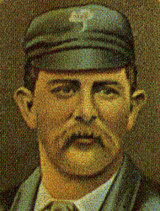
Too lazy to do a proper post today, I though I would try a little cricket quiz. This legendary cricketer featured in today’s Independent Prize Cryptic. Can you put a name to the face?
Answers through the comments box please!
Follow @telescoperToo lazy to do a proper post today, I though I would try a little cricket quiz. This legendary cricketer featured in today’s Independent Prize Cryptic. Can you put a name to the face?
Answers through the comments box please!
Follow @telescoperAmong the things I didn’t have time to blog about over a very busy Bank Holiday Weekend was the finish of the English Premiership season. I haven’t posted much about my own team, Newcastle United, this season because I haven’t been able to think of anything particularly positive to say. Since Alan Pardew quit in January to join Crystal Palace, Newcastle slumped to such an alarming extent that they went into their last game of the season (against West Ham) just two points above the drop zone. Had they lost their game, which did not seem unlikely on the basis of their recent form, and had Hull won against Manchester United, which did not seem unlikely on the grounds that Man Utd wwould finish in 4th place whatever happened in that game, then Newcastle would be relegated to the Championship. In the event, however, Newcastle won 2-0 which made them safe while Hull could only draw 0-0 which meant that Newcastle would have survived even if they had lost against West Ham. Moreover, Sunderland also lost their last game, which meant that the final Premier League Table looked like this:
(courtesy of the BBC Website). The important places are 15 and 16, obviously. The natural order of things has been restored….
Another League Table came out over the Bank Holiday. This was the annual Guardian University Guide. I’m deeply sceptical of the value of these league tables, but there’s no question that they’re very important to potential students so we have to take them seriously. This year was pretty good for Sussex as far as the Guardian Table is concerned: the University of Sussex rose to 19th place overall and the two departments of the School of Mathematical and Physical Sciences both improved: Physics & Astronomy is back in the top 10 (at number 9, up from 11th place last year) and Mathematics rose 22 places to take 21st place. Gratifyingly, both finished well above Sunderland.
While these results are good news in themselves, at least around my neck of the woods, as they will probably lead to increased applications to Sussex from students next year, it is important to look behind the simplistic narrative of “improvements”. Since last year there have been several substantial changes to the Guardian’s methodology. The weighting given to “spend-per-student” has been reduced from 15% to 10% of the overall score and the method of calculating “value added” has excluded specific predictions based on “non-tariff” students (i.e. those without UK entry qualifications, especially A-levels). What the Guardian consistently fails to do is explain the relative size of the effect of arbitrary methodological changes on its tables compared to actual changes in, e.g., cash spent per student.
Imagine the outrage there would be if football teams were not told until the end of a Premier League season how many points would be awarded for a win….
Follow @telescoperJust time for a quick post to record the fact that yesterday I made my annual pilgrimage to Lord’s Cricket Ground to watch the third day’s play of the First Test between England and New Zealand. On previous occasions I’ve had to make the trip from Cardiff to Paddington and back to take in a day at the Test, so had to get up at the crack of dawn, but this time I was travelling from Brighton which is a significantly shorter trip, so I only had to get up at 7 or so. Anyway, I got to the ground in time to have a bacon sandwich and a coffee before play started, with the added pleasure of listening to the jazz band as I consumed both items.
England had batted first in this game, and were on the brink of disaster at 30 for 4 at one stage, but recovered well to finish on 389 all out. Joe Root, Ben Stokes and Moeen Ali all made valuable runs in the middle order. Their performance was put into perspective by New Zealand, however, who had reached 303 for 2 at the end of the first day. It’s hard to say whether it was New Zealand’s strength in batting or England’s lacklustre bowling that was primarily responsible. I suspect it was a bit of both. Talk around the ground was if and when New Zealand might declare. I didn’t think I would declare on a score less than 600, even if tempted to have a go at the England batsman for 30 minutes in the evening, but that speculation turned out to be irrelevant.
Anyway on a cool and overcast morning, New Zealand resumed with Taylor and Williamson at the crease and England desperately needing to take quick wickets. The first breakthrough came after about 40 minutes, with Taylor well caught by wicketkeeper Buttler off the bowling of Stuart Broad. That served to bring in dangerman Brendan McCullum, who promptly hit his first ball for four through the covers. He continued to play his shots but never looked really convincing, eventually getting out to a wild shot off England’s debutant bowler Mark Wood, but not before he’d scored 42 runs at a brisk pace while Williamson at the other end continued to his century in much more sedate fashion.
Light drizzle had started to fall early on in the morning and shortly after McCullum was out it became much heavier. The players took an early lunch and play did not resume until 2.45pm, meaning that over an hour was lost. During the extended lunch interval I took a stroll around the ground, bought an expensive burger, and noted the large number of representatives of the Brigade of Gurkhas, who were collecting money for the Nepal Earthquake Appeal. Here are some of them making use of their vouchers in the Food Village:
When play resumed, England quickly took another wicket, that of Anderson, at which point New Zealand were 420 for 5. Wicketkeeper Watling (who had an injury from the first innings) came to the crease and look all at sea, frequently playing and missing and surviving two umpire reviews. He led a charmed life however and ended up 61 not out when the New Zealand innings closed at 523 all out.
One interesting fact about this innings was that “Extras” scored 67. Quite a lot of those were leg-byes, but the number of wides and byes was quite embarrassing. Wicket-keeper Buttler did take a couple of fine catches, but he wasn’t as tidy as one would expect at Test level. England also dropped three catches in the field. New Zealand only added 212 runs for their last 8 wickets, which wasn’t as bad as it could have been for England but it could have been better too. I wasn’t impressed with their bowling, either. Neither Anderson nor Broad looked particularly dangerous, although both took wickets. Wood was erratic too, straying down the legside far too often, but he did improve in his second spell and managed to take three wickets. I think Moeen was the steadiest and most impressive bowler, actually. He also took three, including that of Williamson whose excellent innings ended on 132.
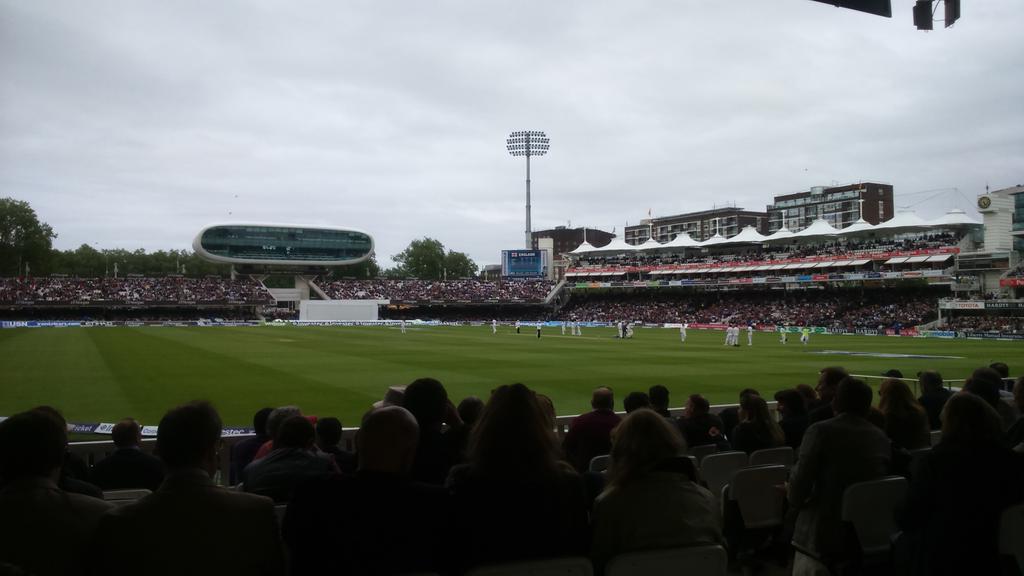
I took this picture from my vantage point in the Warner Stand just a few minutes before the last New Zealand wicket fell:
You can see it was still quite gloomy and dark. My mood was sombre, thinking about Donald Trump’s forthcoming victory in the 2016 United States Presidential Elections.
Incidentally, the Warner Stand is to be knocked down at the end of this season (in September 2015) and rebuilt much bigger and snazzier. I’ve got used to watching cricket from there during my occasional trips to Lord’s so I feel a little bit sad about its impending demise. On the other hand, it does need a bit of modernisation so perhaps it’s all for the best. The first phase of the rebuild should be ready for next season so I look forward to seeing what the new stand looks like in a year or so’s time.
England came out to bat with play extended until 7.30 to make up for the time lost for rain. Lyth faced the first ball, which was short. He played a hook shot which he mistimed. It went uppishly past the fielder at short midwicket for four, but it was a very risky shot to play at the very start of the innings given England’s situation and it made me worry about his temperament. He hit another couple of boundaries and then departed for 12, caught behind. Ballance came in, faced twelve deliveries and departed, clean bowled, without troubling the scorers. At that point England were in deep trouble at 25-2, still needing over a hundred runs to make New Zealand bat again. With the weather brightening up considerably, Bell and Cook steadied the ship a little and no more wickets were lost before the close of play. I had to leave before the close in order to get the train back to Brighton but the day ended with England on 75-2.
I think New Zealand will win this game, for the simple reason that their bowling, fielding and batting are all better than England’s. The biggest worry for England is their batting at the top of the order, which is far too fragile, but the bowling lacks penetration and the fielding is sloppy. It doesn’t bode well for the forthcoming Ashes series but more immediately it doesn’t bode well for Alastair Cook’s position as England captain. But who could replace him?
UPDATE, 7pm Sunday. Contrary to my pessimistic assessment, England played very well on Day 4. Cook batted all day, ending on 153 not out but the star of the show was Ben Stokes who scored the fastest century ever in a test at Lord’s (85 balls). With England on 429 for 6, a lead of 295, any result is possible. England need to bat until about lunch to make the game safe, and only then think about winning it.
UPDATE, 5.38pm Monday. The morning didn’t go entirely England’s way. They only reached 478 all out, a lead of 344. However, New Zealand were in deep trouble straight away, losing both openers without a run on the board. They were in even deeper trouble a bit later when they slumped to 12-3 but then staged a mini-recovery only for two quick wickets to fall taking them to 61-5. There then followed an excellent partnership of 107 between Anderson and Watling who at one point looked like wresting the initiative away from England. Then both fell in quick succession and were soon followed by Craig and Southee. As I write this, New Zealand are 200 for 9. England need one more wicket and have 15 overs left to get it, with two tailenders at the crease.
UPDATE, 6.03pm Monday. It seemed to take forever to come, but Moeen has just caught last man Boult off the bowling of Broad. New Zealand all out for 220 and England win by 124 runs, a victory I simply could not have imagined when I left Lord’s on Saturday. I’ve never been happier to be proved wrong!
This has been one of the great Test matches and I’m really happy I was there for part of it – even if it was only one day! Well played both teams for making such an excellent game of it. Long live Test cricket. There’s nothing like it!
Follow @telescoperInteresting proposal from Keith Flett for a new module for university students on uncovered pitches in cricket. My own view is that the syllabus on this fascinating subject should also discuss the physics behind the variable bounce and turn such pitches produced.
Uncovered pitches: the degree Syllabus
In its issue of 21st January 2015 the Times Higher reported that the University of the Highlands and Islands is to offer a degree in professional golf.
I responded that it was surely time to offer a degree in cricket too (28th January 2015).
Subjects covered could well include the Laws of Cricket, the history of the game (a very substantial subject in itself) Gentleman v Players and class in cricket, Race and Imperialism in cricket. There is also scope for modules on cricket management and coaching and like many degrees no doubt students would select those areas of most relevance to their interests and future careers.
One area that must certainly should be covered however is that of Uncovered Pitches. To mark the start of the English cricket season and indeed the start at nearly the same time of a West Indies…
View original post 201 more words
Just a short post to pay my respects to a great cricketing legend, Richie Benaud, who has died at the age of 84. It’s no surprise that the media are filled with tributes because he was admired by players and spectators alike. He retired as a player way back in 1964, so many would know him as a commentator, but he was a fine cricketer in his time. A shrewd tactician, he captained Australia with great distinction but was also an excellent leg-spinner, who took 248 wickets in Test matches, and a capable batsman. In fact he was the first cricketer in history to reach 2000 runs and 200 wickets at Test level, in an era when far fewer Test matches were played.
When he retired from the game as a player he turned to a career in broadcasting and soon established himself as a peerless comentator on the game. The deep knowledge of the game he acquired in his playing years helped of course, but he also had a natural feeling for when to comment and when to just let it happen. Too many commentators feel the urge to babble on during slower passages of play, but Richie Benaud understood the varying tempo of the game too much to spoil the experience with tittle-tattle. He was unfailingly courteous, generous and respectful, but never afraid to be critical when that was justified. His succinct and perceptive expert analyses during the intervals and after the close of play were especially good. I was going to describe him as a “class act” but I don’t think it was an act at all. I never met him in person, but I think he was as much of a gentleman in real life as he was in the commentary box or on the cricket field. His balanced, even-handed commentary won him as many admirers here as he had in his native Austrlia.
He was a regular commentator on English cricket during what passes for summer in the Northern hemisphere until the memorable Ashes series of 2005. He started his career in commentary in 1963, which was the year I was born, and he played a very big part Here are the last few moments of his last appearance as a commentator in England.
Rest in peace, Richie Benaud (1930-2015), and thank you for all you gave to the world of cricket.
Follow @telescoperThis is a particularly appropriate honour, as his beard is in the shape of a wooden spoon..
Beard Liberation Front
press release 21st March
Contact keith Flett 07803 167266
SCOTLAND’S GEOFF CROSS WINS BEARD OF SIX NATIONS POLL
The Beard Liberation Front, the informal network of beard wearers, has said that with the most hirsute Six Nations rugby Championship ever now concluded, a key contest, the Beard of the Six Nations, has also found a winner.
Scotland’s Geoff Cross beat Wales’s Leigh Halfpenny by several pitch lengths in the on-line poll.
Cross’s beard has been a significant hirsute presence throughout the Six Nations although according to the authoritative Sport BeardWatch, Cross is set to shave his beard for charity, prior to retiring from rugby to become a GP.
The impact of beards on the field has meant that even noted pogonophobes such as Clive Woodward who argued in 2013 on the BBC that he wouldn’t select players with beards, have remained silent on the matter this year.
View original post 59 more words
What a contest the Six Nations Rugby has given us today. I’ve just got my breath back after England’s extraordinary game against France. England won 55-35, a remarkable scoreline at this level, but just not quite enough to win the title.
Going into today’s final round of three games, Wales, Ireland and England were all level on six points, having won three games each. England were on top on points difference but Wales and Ireland had easier opponents, in Italy and Scotland respectively.
The day started with Wales demolishing Italy by 61-20 to give both Ireland and England a lot to do to catch up. Ireland responded by thrashing Scotland 40-10 which put them top with an even bigger points difference. To win the title England had to beat France by 26 points or more.
It was a tall order and, I thought, a shame that the competition was going to be decided by the scale of the whipping delivered to the weakest teams, rather than a head-to-head between the top ones. Of course the fixture list was compiled months ago before anybody knew the results of the earlier games, but it turned out that the script for this particular drama had been written perfectly!
England gave it everything in their match again France. The game contained great rugby, lots of errors, and breathless end-to-end excitement. They might have done it on another day but that last converted try just eluded them.
So congratulations to Ireland, who actually beat England earlier and are worthy champions. The lesson for England is clear from the table: they’re scoring enough points but need to concede fewer if they are to be serious contenders for the World Cup which takes place in the Autumn.
The last day of the Six Nations comes this year immediately after the Vernal Equinox, which happened last night at 22:45 GMT, both sporting and astronomical calendars telling us that spring is here. I hope England’s cricketers put up as much of a fight against the Aussies this summer!
Follow @telescoperToday marks the start of this season’s RBS Six Nations Rugby, which kicks off at 8.05pm at the Millennium Stadium in Cardiff with Wales versus England. The town will be buzzing in the evening, overrun with rugby fans in various states of drunkenness but with that extra special atmosphere that makes this such a fantastic place to be on such occasions, even if you’re not in the ground. It promises to be a bit chaotic, but it’s always an extra special day in Cardiff when the old adversaries meet. I’m heading off this afternoon in order to get there in time, and spending the weekend in Cardiff.
The Six Nations is a difficult competition to predict, but I think Wales must be strong favourites to win this particular match as England have had to cope with a number of injuries to key players. However, there is one battle whose outcome you can bet your bottom dollar on, and that’s the crowd singing. That one is always won by the Welsh.
Get a load of this example, from a few years ago which at least gives some idea what I’m talking about. This is the stirring Welsh National Anthem Hen Wlad Fy Nhadau (Land of My Fathers). And if you feel like singing along, here are the lyrics (in Welsh, of course):
Mae hen wlad fy nhadau yn annwyl i mi,
Gwlad beirdd a chantorion, enwogion o fri;
Ei gwrol ryfelwyr, gwladgarwyr tra mâd,
Tros ryddid gollasant eu gwaed.
Chorus:
Gwlad, Gwlad, pleidiol wyf i’m gwlad,
Tra môr yn fur i’r bur hoff bau,
O bydded i’r heniaith barhau.
Hen Gymru fynyddig, paradwys y bardd;
Pob dyffryn, pob clogwyn, i’m golwg sydd hardd
Trwy deimlad gwladgarol, mor swynol yw si
Ei nentydd, afonydd, i fi.
Chorus
Os treisiodd y gelyn fy ngwlad dan ei droed,
Mae hen iaith y Cymry mor fyw ag erioed,
Ni luddiwyd yr awen gan erchyll law brad,
Na thelyn berseiniol fy ngwlad.
Chorus
UPDATE: the Big Match didn’t turn out quite as I expected. Wales were all over England early on, taking a 10-0 lead. But once they had steadied themselves England began to claw their way back into contention. With the half-time score at 16-8 the game still looked to be heading for a Welsh victory. However in the 2nd half England’s more disciplined approach paid dividends. The English pack, compact and powerful, began to make deep inroads into the Welsh defence and gradually established a stranglehold on the game. Thirteen unanswered points in the second half gave England a memorable victory on a dramatic night. Wales 16 England 21.
Follow @telescoper
Like any cricket fan I was horrified to hear last week of the death at the age of 25 of the Australian cricketer Phillip Hughes, three days after he received a head injury on the field of play during a Sheffield Shield match in Australia on Tuesday. Let me start by expressing my deepest condolences to his family and friends at what must be a terrible time for them. My thoughts also go to the bowler, Sean Abbott, whose delivery ended up causing the fatal injury. He should not be blamed and I’m sure he feels as bad as anyone about the incident.

What happened to Phillip Hughes is a reminder that cricket is a dangerous game. A cricket ball is hard – it is made of solid cork wrapped in leather – and can travel at speeds in excess of 90 mph when delivered by a fast bowler. When you get hit by one it really hurts. Thankfully serious injuries are relatively rare, but it nevertheless takes considerable physical and mental courage as well as great skill for a batsman to face up to fast bowling.
In this case it was Sean Abbott who bowled a short-pitched delivery (a “bouncer”) at Hughes. There’s nothing unusual about that – it’s a standard part of a fast bowler’s repertoire. Hughes saw it coming and got into position to play a hook shot, a cross-batted stroke played to a ball over waist height with the intent of sending it to the boundary. This is one of the most spectacular attacking shots in cricket but also one of the most dangerous. Often it involves playing the ball directly in front of the face, and if the batsman misses an injury is inevitable. On this occasion, Hughes seems to have misjudged the pace of the ball and went through with the shot too quickly. His upper body having swung around during the course of his attempted hook, when the ball missed the bat it thudded into the back of his head, underneath his protective helmet. The impact ruptured an artery and caused a massive flow of blood into his brain. He subsequently collapsed and was carried off the field, where he needed mouth-to-mouth resuscitation. He was taken to hospital, and a procedure carried out to reduce the pressure on his brain. Sadly he never recovered, and died three days later.
Of course the death of Phillip Hughes has led to a great deal of soul-searching in the cricket world. I think it’s quite right that a heart-breaking event like the death of a cricketer so make us redouble efforts to keep the game as safe as possible. I think that means looking very seriously at the design of the modern cricket helmet. Only this summer, England’s Stuart Broad was badly injured when he was hit by a ball that smashed through the faceguard on his helmet, which suggests to me that the design of the front of the standard helmet is faulty. The same type of helmet offers no protection to the lower part of the back of the skull, either. On the other hand, a helmet that was too bulky might restrict the movement of a batsman so much that it makes it more, not less, likely that they will get hit. One also has to try to maintain a reasonable perspective. The type of injury that killed Hughes – a vertebral artery dissection – is extremely rare, with only about 100 cases ever having been recorded at all, none which were on the cricket field. Not that long ago, nobody wore a helmet anyway; see below for an example.
Australians cricketers learn to play the game on pitches that are fast and hard, but generally of even bounce. That’s why the hook shoot is favoured more by Aussie batsman than by their English counterparts; pitches in England are generally slower and variable bounce is much more likely. Until relatively recently many English batsman didn’t play the hook shot at all, preferring instead to simply get out of the way of a bouncer than attempt to play it. After all, the ball isn’t going to hit the stumps if it’s bouncing around head height. Getting out of the way isn’t as easy as it sounds, however, because one’s instinctive reaction is either to try to protect your head with bat or gloves, to flinch away or try to duck. The proper technique, which requires practice to ingrain, is to keep your eye on the ball, drop the hands to keep the bat out of the way, and sway out of the path of the ball at the last minute. That may sound easy, but it certainly isn’t. I tried to do it in a school game years against a bowler a fraction of the pace of Sean Abbott, and ended up with the ball smacking me right on bridge of my nose. I had taken the “keep your eyes on the ball” advice a bit too literally…
Some have argued that bouncers should be banned. I think that would be a mistake. Part of the unique appeal of cricket is that the spectactors are aware not only of the skill of the players, but also their courage. A bouncer is a severe test of the mettle of a batsman, whether they choose to fight fire with fire by trying to hook, or simply standing firm and letting it go by. Some of the most enthralling passages of play I remember watching involved a demon fast bowler hurling down terrifying thunderbolts at batsman who could do little but get everything into line and try soak up whatever was thrown at him. Heroic defence is as much a part of the game as dashing strokeplay.
Take this example. Brian Close had been brought into open the England batting earlier in the 1976 series against the West Indies in an attempt to stiffen their resistance to the West Indian attack. He wasn’t the greatest player in the world nor the cricketing world’s most agreeable character, and as you can tell he wasn’t in the first flush of youth in 1976 either, but there is no denying his courage and determination. Here he is enduring a vicious battering at the hands of Michael Holding. One short-pitched delivery in this sequence came within a whisker of hitting him on the head; had it done so the consequences would have been horrendous as he was not wearing a helmet. As it was, he “only” had to take a succession of blows to his body. He scored 20 runs at Old Trafford, off 108 balls in 162 minutes, and was dropped for the next Test as was his opening partner John Edrich, although both had stood their ground and defended their wickets (and themselves) manfully.
Note that Michael Holding did get a warning here for excessive use of short-pitched deliveries, but the situation was very different from that faced by Phillip Hughes who was well set and trying to score runs rather than clinging on against a barrage aimed at his head and body.
The element of danger is not unique to the sport of cricket. Contact sports (e.g. rugby) also carry a risk of serious injury. Boxing is another, perhaps more extreme, example. Of course we should do everything we can to minimize the danger to the participants, but we can never remove the risk entirely. I’m not in favour of banning bouncers or boxing or other “dangerous sports”: as long as all concerned know the risks then they should be allowed to make the decision whether to expose themselves to those risks. In fact, everything we do in life carries an element of risk. If we’re not free to take chances, we’re not free to live at all.
R.I.P. Phillip Hughes (1988-2014).
POSTSCRIPT. In a touching gesture, the record of Phillip Hughes’s last innings has been changed to from “Retired Hurt 63” to “Not Out 63”.
Follow @telescoperSince there’s a Test Match going on right now at the Oval and I’ve got a few minutes before my next task, I thought I’d just do a brief post to mark the anniversary of a very special cricketing moment. On this day in 1964, also at the Oval, Sir Fred Trueman became the first bowler to take 300 wickets in test matches. In his test career overall he took 307 wickets at an astonishingly low average of 21.57. He twice bowled spells in Test matches in which he took five wickets without conceding a run.
Here’s a short video to remind us all of what a superb action Fiery Fred Trueman had:
p.s. Fred Trueman was born in Yorkshire which, as you all know, is part of the Midlands.
Follow @telescoper