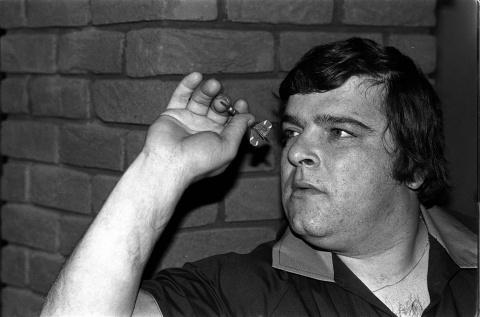
So. Farewell then
Jocky Wilson.
You finished
On Sixty-Two.
I would have gone
Triple Ten
Double Sixteen.
But it would be
More like you
To opt for
Twelve
Bull.
by P. Coles (aged 48¾)
Follow @telescoperSo. Farewell then
Jocky Wilson.
You finished
On Sixty-Two.
I would have gone
Triple Ten
Double Sixteen.
But it would be
More like you
To opt for
Twelve
Bull.
by P. Coles (aged 48¾)
Follow @telescoperIt’s a lovely morning in Cardiff. Later on, at 2.45pm, Wales will be playing their final match of the 2012 Six Nations Rugby against France here in Cardiff. Having won all four previous games they’re in line for a Grand Slam if they win. The atmosphere here is already electric with anticipation. Last night the city was filled with men in berets here to support France and today everything will be at a standstill for the match. I can’t describe what a wonderful feeling it is to be in Cardiff on match days, even if you don’t have a ticket!
People here seem to be taking it for granted that Wales will win this afternoon. I’d love a Welsh Grand Slam to happen, but I’m not sure it’s as much of cast-iron certainty the Welsh supporters seem to think it is. France are a dangerous side and their disappointing performances so far in the Six Nations don’t preclude the possibility that they’ll turn it on in the Millennium Stadium; they’re certainly not here just to make up the numbers. The Welsh team has its weaknesses and may yet meet their downfall…
Comparisons with the great Welsh teams of the 1970s are inevitable today. Although it may be tempting fate, I thought I’d post this video showing some of the great players of that era in action. Good though the current team is – and clearly the best of the six nations playing in the competition this year – I don’t think they’re in the same league as the side that included such wonderful players as Gerald Davies, Gareth Edwards, J.P.R. Williams, Barry John and, of course, Mervyn Davies who sadly died last week and in whose honour there will be a minute’s silence before this afternoon’s kick off. Here are some scintillating moments from that great team. We’ll never see their like again.
Even the commentators – especially the great Bill Maclaren – were so much better than the current generation!
But that was then and this is now. Good luck to Wales, and here’s to another Grand Slam this afternoon!
Follow @telescoperIt’s been such a busy day today I almost missed a seemingly unimportant message on Twitter from the Science and Technology Facilities Council about its new management structure. Only when I got home this evening did I read it carefully and discover that it’s not really as innocuous as I’d assumed. In fact it looks like the Chief Executive has been busy during the recent transfer window.
The new team at STFC will line up like this
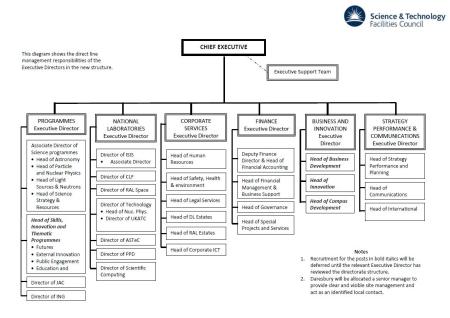
It doesn’t look all that different from the old one, except it’s a slightly more compact formation with less width in the wide areas, and perhaps fewer clichés in the final third.
The controversy however comes with ashen-faced manager Ron John Womersley’s team selection. As per the announcement:
Following staff input, and Council approval, I have conducted an internal selection process to fill the new senior positions in the structure and can now announce the following appointments from 1 April 2012:
In addition, Mrs Jane Tirard will continue in her role with the new title of Executive Director Finance, and Dr Janet Seed will extend her acting stewardship of the programmes area as Acting Executive Director Programmes pending an open recruitment exercise for the position.
So three prominent members of the previous line-up are no longer part of the team:
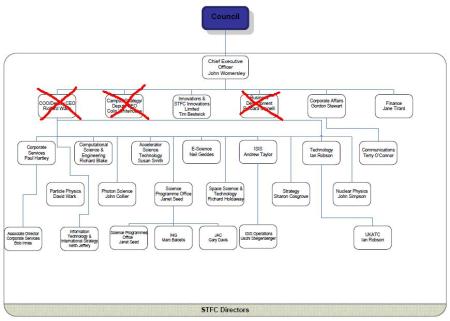
For example, out goes hard-tackling wide man and own-goal specialist, Richard Wade, who apparently leaves on a free transfer. Or is he just on the subs’ bench for the time being? According to the diagram, Tim Bestwick stays but will move from a central position to the right side, roughly changing position with Gordon Stewart who also keeps his place in the team. Andrew Taylor, formerly in midfield, moves to an inside forward role where, as Director of the National Laboratories, he will sometimes be “in the hole” (i.e. Didcot).
Most pundits reckon the new-look STFC will deploy a Diamond-Light Source shaped midfield aimed at closing down the opposition, as opposed to the old team which concentrated more on closing down its own facilities. It looks like the reorganization was made with one eye on European challenges, but Womersley remains committed to the national game, as last week’s scouting trip to the University of Neasden makes clear.
The STFC supporters’ club (Sid and Doris Bonkers) expressed delight with the team changes, but former manager Keith Mason remains bound and gagged in the basement of UKSA was unavailable for comment.
Harry Redknapp is 97.
P.S. The STFC statement describes the staff departures thus:
STFC has benefited from the very significant personal contributions of the existing senior management team. They have helped develop STFC into a successful workplace as recognised by the recent Investor in People accreditation (Silver status), and our positive Comprehensive Spending Round outcome. However, the changing dynamics of STFC mean that it is time for a change and not all senior managers will continue with the organisation.
Do I detect a note of insincerity?
Follow @telescoper
Today was the day for the first home game of the RBS Six Nations for Wales, so Cardiff was absolutely buzzing with that special atmosphere that only rugby and an influx of 80,000 people into a city with a population of 325,00 can bring. I was out and about earlier on but had to watch the game on TV as I lack the wherewithal to get tickets for occasions of such immensity. Wales were red-hot favourites for this game, and won comfortably enough in the end against Scotland although the game was closer than the 27-13 scoreline might suggest; Scotland had a try incorrectly disallowed, which might have made all the difference. The Scots fans also played their part, some of them camping out in the park near my house in the freezing cold for two nights before today’s game, and offered a fine rendition of Flower of Scotland before the kick-off. But there’s something special about the Welsh National Anthem on days like this. I’m glad they’ve dispensed with the professional pop singers that they’ve sometimes used to lead the singing. Wales is a nation that doesn’t need to pay people to sing for it…
Follow @telescoperI’ve posted a few times about science and sport, but here’s a bit of action that seems to defy the laws of physics. I remember watching this match, a group game at Guadalajara (Mexico) between England and Brazil from the 1970 World Cup, live on TV when I was seven years old. The Brazil team of 1970 was arguably the finest collection of players ever to grace a football field and the names of Jairzinho, Carlos Alberto, Rivelino and, of course, Pelé, were famous even in our school playground. The England team of 1970 was also very good, but they were made to look very ordinary that day – with one notable exception.
The only thing I remember well about the game itself was this save – the best of many excellent stops – by legendary goalkeeper Gordon Banks. I’ve seen it hundreds of times since, and still can’t understand how he managed to stop this header from Pelé. You can tell from Bobby Moore’s reaction (No. 6, on the line) that he also thought Brazil had scored…
Here’s the description of this action from wikipedia:
Playing at pace, Brazil were putting England under enormous pressure and an attack was begun by captain Carlos Alberto who sent a fizzing low ball down the right flank for the speedy Jairzinho to latch on to. The Brazilian winger sped past left back Terry Cooper and reached the byline. Stretching slightly, he managed to get his toes underneath the fast ball and deliver a high but dipping cross towards the far post. Banks, like all goalkeepers reliant on positional sensibility, had been at the near post and suddenly had to turn on his heels and follow the ball to its back post destination.
Waiting for the ball was Pelé, who had arrived at speed and with perfect timing. He leapt hard at the ball above England right back Tommy Wright and thundered a harsh, pacy downward header towards Banks’ near post corner. The striker shouted “Goal!” as he connected with the ball. Banks was still making his way across the line from Jairzinho’s cross and in the split-second of assessment the incident allowed, it seemed impossible for him to get to the ball. He also had to dive slightly backwards and down at the same time which is almost physically impossible. Yet he hurled himself downwards and backwards and got the base of his thumb to the ball, with the momentum sending him cascading to the ground. It was only when he heard the applause and praise of captain Bobby Moore and then looked up and saw the ball trundling towards the advertising hoardings at the far corner, that he realised he’d managed to divert the ball over the bar – he’d known he got a touch but still assumed the ball had gone in. England were not being well received by the locals after cutting comments made about Mexico prior to the tournament by Ramsey, but spontaneous applause rang around the Guadalajara, Jalisco stadium as Banks got back into position to defend the resulting corner. Pelé, who’d begun to celebrate a goal when he headed the ball, would later describe the save as the greatest he’d ever seen.
Here is Gordon Banks describing it in his own words.
Brazil deservedly went on to win the game, but only by a single goal. Without Gordon Banks, England would have been well and truly hammered.
Follow @telescoperI’m posting this cheery little poem in honour of England’s batting performance in the first innings against Pakistan this morning..
I’m overwhelmed with sadness at the news that Wales football manager Gary Speed has died at the age of only 42, having apparently taken his own life. This news is all the more devastating because it was so unexpected, at least to those of us who don’t know the circumstances of his private life. This is neither the time nor the place to speculate about what might have driven him to suicide, but it is time to pay tribute to an extremely talented player who, in the results of recent months, was beginning to show what great potential he had as a manager of the Welsh National Team. More importantly, and however feeble a gesture it must be at such a time, I’d like to express my deep condolences to his family and close friends. I can’t imagine what a terrible ordeal they must be going through. I only hope that time will bring them consolation, and some form of peace.
It is as a player for the club I follow, Newcastle United, that I will remember Gary Speed best. He joined the club in 1998 and was a mainstay of Bobby Robson’s team until he left in 2004. Rarely troubled by injury, he was a fine attacking midfielder, especially strong in the air, with a good goalscoring record, and was a firm favourite with the fans on Tyneside for his skill and commitment.

Rest in Peace, Gary Speed (1969-2011).
Follow @telescoperThis is turning out to be a sad month for cricket fans, for today saw the death of legendary all-rounder Basil D’Oliveira. “Dolly”, as he was affectionately known, was born in South Africa but was unable to play first-class cricket there because of the apartheid regime’s policy of racial segregation; as a “Cape Coloured” he wasn’t allowed to play what was basically a whites-only game. He emigrated to England in 1960 and was subsequently picked to play for England and quickly established himself as an excellent player at Test level. Selected basically as a batting all-rounder, and usually coming in between 5 and 7 in the order, his average was over 40, and he scored 5 centuries in 44 Test matches in a career that lasted from 1966 to 1972. These are impressive figures, especially considering that his Test career didn’t even start until he was in his mid-thirties.

His selection (as a late replacement) for the England side that was to tour South Africa in 1968 precipitated the D’Oliveira Affair, which led to South Africa being ostracised from international cricket until the end of apartheid in the 1990s. Although this episode must have been personally distressing for him, D’Oliveira behaved with great courage and dignity throughout and won many admirers on and off the field, and the warmth of the tributes being paid in today’s media demonstrate the high regard in which he was held by cricketers, fans of the sport, and by campaigners against racism.
Rest in peace, Basil D’Oliveira (1931-2011), one of the true gentlemen of cricket.
Follow @telescoper
Two things have come up recently that I’d like to mention here. They’re both, in their different ways, about heroes, but the remembrance that’s called for is different to that normally observed on this day.
First, I couldn’t resist passing on a link to a short but intensely moving piece by Alan Garner in yesterday’s Guardian about Alan Turing, in the My Hero series.

I suppose most readers of this blog will know of Turing’s pioneering work on computer science and his crucial contribution to the war effort in cracking the German Enigma codes. I also suppose most know about the circumstances of his death; he took is own life in 1954 after being forced to endure a form of chemical castration after being found guilty of homosexuality, in case you didn’t already know. Many of you will also have read some (or in my case many) of the various books about his life and work. (If not I recommend Andrew Hodges’ excellent The Enigma of Intelligence, which I read when I was an undergraduate, over 25 years ago.)
But what those of us who never met Alan Turing will never know is what he was really like as a man, and that is why pieces like the one by Alan Garner are so moving. Turing comes across as eccentric (I think we all know what was the case), but also as a very amusing character who was excellent company and a bit of a chatterbox, despite suffering from a stammer. The circumstances of his arrest and subsequent conviction for the “crime” of being gay also confirm the impression that he had an almost childlike innocence about the world outside academe. In other words, he was a very easy target. We like to think we live in more enlightened times nowadays – and I suppose in many ways we do – but I think Alan Turing would be as much, or even more of, a misfit in today’s world than he was in the 1950s. Although he was undoubtedly a genius, he rarely bothered to publish academic papers so I dread to think how he would fare in the present university system!
Anyway, I’d just like to say thank you to Alan Garner (who knew Turing well as a friend) for sharing his thoughts and experiences. I may have never met Alan Turing, but he’s my hero too…
And that brings me to another sad story. I only learned this morning that former cricketer Peter Roebuck died yesterday, at the age of 55, having taken his own life in a hotel room in Cape Town. Peter Roebuck always seemed to me an unlikely figure for a sportsman, with his spectacles, cerebral air, and rather stooped gait he looked more like an academic than an athlete, but he was a fine cricketer. I remember him very well from the time I was a schoolboy mad keen about cricket, and I liked him particularly because he wasn’t – or didn’t seem to be – someone blessed with prodigious natural skill. He made it in the professional game because he worked hard. People like that are always heroes to those, like me, who love sport but don’t have any innate talent for it.
After retiring from cricket Roebuck went to live in Australia and took up a career as writer and commentator on the sport, a role at which he excelled, as much for his lucid prose as for his deep technical knowledge. Although he mainly covered Australian cricket, I often read his articles and admired his writing enormously. I have no idea what caused him to commit suicide, and I wouldn’t wish to speculate about that, let alone presume to judge. All I can say is that it’s the saddest thing when someone takes their own life, whatever the circumstances.
UPDTATE: 14/11/2011 There’s a lot of traffic coming to this post via Google searches of “Was Peter Roebuck gay” or suchlike. I have no idea whether he was or wasn’t and I’m not going to indulge in gossip, so I’m afraid that if that’s the reason you’re here you’re going to be disappointed.
Rest in peace, Peter Roebuck.
Follow @telescoper
I promised yesterday to post a quick account of the Fifth (and final) One Day International between England and India at the SWALEC stadium in Sophia Gardens, Cardiff, so here goes…
As I feared, the weather in Cardiff yesterday wasn’t brilliant and, although it was quite warm during the morning, it was overcast and there were stacks of very dark clouds around by lunchtime. We got to the ground in time for the scheduled start, which was 2pm, but just as play was about to get under way the heavens opened and down came the rain.
This was the scene about five to two, just as the covers were being taken off; they dark clouds to the left were moving from left to right and covered the ground a few minutes later whereupon it stotted down.
Fortunately, although it came down in stair-rods for a while, the rain didn’t last long so play actually got under way about 2.40 and the authorities decided that the game would remain 50 overs a side (with a late finish).
England won the toss and decided to field. Openers Parthiv Patel and Ajinkya Rahane got the Indian innings off to a good start with a partnership of 52 runs, then Rahane was removed by Jade Dernbach when the batsman, after scoring just 26 runs off 47 deliveries, was caught by Steven Finn at third man, right down in front of us. In the 16th over, Patel also fell, for 9 runs off 39 deliveries, when he was caught by Tim Bresnan at mid-on off the bowling of spinner Graeme Swann. Rahul Dravid (playing his last ODI) and Virat Kohli then played a wonderful partnership which was not broken until the last delivery of the 42nd over. England finally managed to grab the wicket of Dravid who left the field to a standing ovation after scoring 69 runs. The Dravid/ Kohli partnership had brought 170 runs; by the time Dravid’s wicket fell, India were on 227-3. Meanwhile, Kholi had managed to score his sixth one-day hundred but he was out for 107 in the 44th over when he was given out hit-wicket while trying to play a delivery by Swann; his back foot had apparently slipped and struck the stumps, dislodging a bail. Unlucky.
The Indian skipper Mahendra Singh Dhoni then smashed 50 runs off 26 deliveries to help his side post a score of 304-6, leaving England a daunting target of 305 runs to win. India certainly batted well, but were helped a bit by poor bowling by some of the England players. Indeed the only bowler I thought was really impressive was Finn, who was consistetly over 90 mph in his opening spell and was clearly troubling the Indian batsmen. Jade Dernbach, by contrast, committed the unpardonable sin of bowling wides in the last over. Incidentally, I managed to catch the umpire signalling an England wide, but I can’t remember who was bowling at the time:
Just after they players went off for a (shortened) interval, the rain came back again and this time it was decided that there wouldn’t be time for another full 50 overs. The Duckworth–Lewis (D/L) method was wheeled out, with the initial outcome that England would have to score 270 to win off 40 overs. That seemed very tough – the ten overs lost only reducing England’s target by 35. Another rain delay then revised the target further to 241 runs from 34 overs, a very stiff challenge indeed.
The many Indian supporters in the ground were buoyed by their team’s strong batting performance and seemed confidedent of a first victory against England this tour. I thought India would win at this point too, as a matter of fact. Anyway, the rain finally cleared and as the sun came out a rather nice rainbow appeared over Sophia Gardens as the floodlights were switched on for the “night” part of this “day-night” game.
England came out to bat and, rightly, sought to take the attack to India right from the ouset. Openers Alastair Cook and Craig Kieswetter scored quickly against some frankly rather poor Indian bowling.
England suffered their first loss in the fifth over with the score on 27 when Kieswetter was given leg-before wicket off the bowling of Vinay Kumar. Cook was then joined by Jonathan Trott, often a rather slow scorer, but both batsmen scored quite freely building a partnership of 79 runs until Cook was dismissed in the 18th, bowled by Kohli. The England total was 106 at this point, with three wickets down but plenty of batting still to comeyet only 16 overs to score the remaining 135 needed to win.
Ian Bell departed after scoring 26 runs and then Trott fell to a catch, off an uncharacteristically poor shot, for 63 runs off 60 deliveries. With four wickets now down, India (and their fans) must have been feeling pretty confident that they could stop England’s run chase. The result was firmly in the balance.
Cue the 21-year-old debutant Jonathan Bairstow who looked a little nervous for his first two or three deliveries, but then proceeded to smash the Indian bowling all round the park (and out of it). I think at least two of his big straight hits may well have landed in the River Taff after clearing the stands at the Riverside end quite comfortably. The flurry of boundaries boosted England’s scoring rate so quickly that in no time the target started to look not just possible but comfortable. In the end Bairstow remained unbeaten on 41 runs while his partner Ravi Bopara was not out 37 as England won by 6 wickets with more than an over to spare.
It was an impressive performance by the England batsman and a crushing disappointment for India, who now return home without winning a single match in England this season.
Despite the showery weather it was a thoroughly enjoyable occasion. The ground was packed, the sizeable Indian contingent contributed a lot to the atmosphere, and the usual groups of daft blokes in bizarre fancy dress also added a measure of eccentricity to the event. It did look at one point that there might be an ugly scene between two groups of fans in our stand, but thankfully it didn’t turn out to be very serious. We don’t want any of that sort of thing at cricket matches, thank you very much.
So that’s that. A fine end to the summer of international cricket, though perhaps not for the Indian players and supporters….
Follow @telescoper