Archive for the Rugby Category

Leinster – 2025 United Rugby Champions!

Posted in Rugby with tags , , , on June 14, 2025 by telescoper

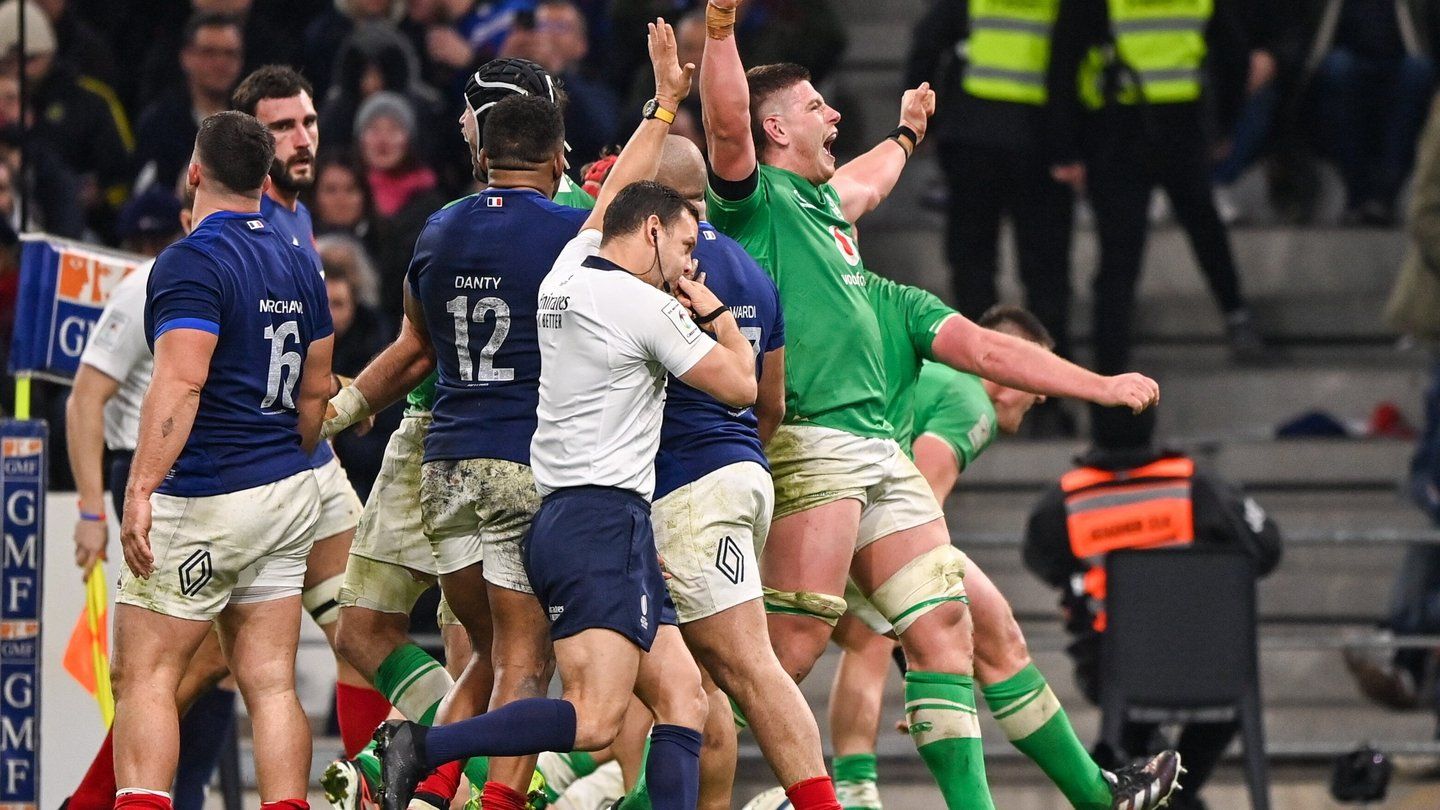
Photo Credit ©INPHO/Ben Brady

The 2024/5 United Rugby Championship ended today with a convincing win by Leinster over the South African team Vodacom Bulls (who are based in Pretoria). The game was played this evening in torrential rain at Croke Park; Leinster emerged victorious in the inclement conditions by 32-7.

Leinster have had a habit of being front-runners in the league part of this competition, only to fall in the knockout stages. I was a bit concerned that this year might follow the same pattern, as the Bulls have had considerable success agains Leinster over the years and Leinster failed to perform against Northampton in the European Champions Cup in a game they were expected to win. It was also a blow that one of their best players, scrum-half Jameson Gibson-Park was withdrawn from the squad this morning owing to injury. In the end, however, it wasn’t even a very close game, Leinster’s defence proving so solid that the Bulls could penetrate it only once.

The last time Leinster won the United Rugby Championship – way back in 2021 – it wasn’t even called the United Rugby Championship: it was called the Pro14, although two teams were not able to play that year because of Covid-19 restrictions so there were only 12 teams in it. The incorporation of four South African teams (Bulls, Stormers, Sharks and Lions) increased the number of teams to 16 and made it a much more difficult competition. I still think it is too long, though. The games featuring the Irish teams in this competition (Leinster, Munster, Connacht and Ulster) are broadcast free-to-air on television here and I watch quite a few of them. There are 16 teams in this competition, divided into four pools of four: each side plays the 15 others once, and an additional game against the other three in their pool, meaning 18 games per team. After 18 rounds, all that happens is that the bottom eight in the league table are eliminated and the top eight go into the knockout stage. Eighteen games is a long slog when all it does is eliminate half the teams, and it means that there’s much less at stake in individual matches. Still, now the Six Nations is over I’ll be watching the URC for the rest of the season, starting next weekend.

Six Nations Rugby

Posted in Rugby with tags , , , , , , , , on March 16, 2025 by telescoper

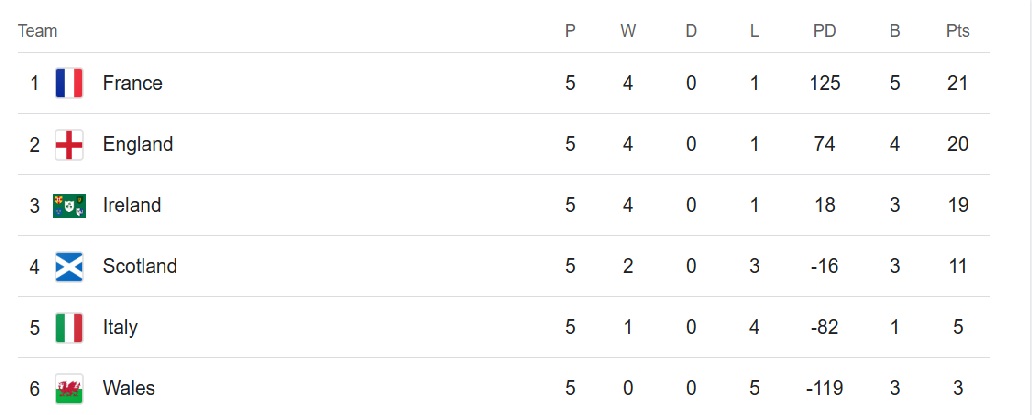
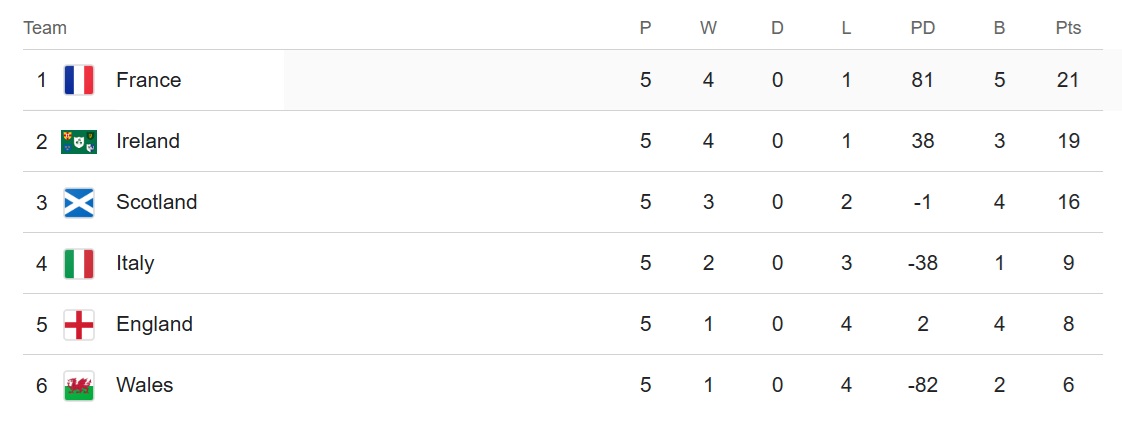
Yesterday I watched the last round of matches in this years Six Nations rugby Championship so, as I did last year, I thought I would do a quick summary of the games and the competition as a whole.

In the first game yesterday, thanks largely to their own errors, Ireland struggled to beat a spirited Italian side in Rome 17-22. That put them briefly top of the table, but with fewer bonus points and a worse points difference than either England or France so needed both those teams to lose in order to win the Championship. Hope of that happening vanished quickly when England scored a try about 2 minutes into their game against Wales in Cardiff, quickly followed by another. England thereafter ran riot and won 68-14 taking them to the top. England did play well, but Wales were very poor. To be honest, I found the game a bit painful to watch. If it had been boxing the referee would have stopped the fight. Memories of the great Welsh teams of the past are very distant nowadays. It’s hard to see where they go from here, with their second successive Wooden Spoon.

Then it was time for the finale, France versus Scotland. I did think that France would win easily but Scotland gave it a good go, and were unlucky not to take a lead into half-time. They wilted in the second half, however, and France duly picked up a bonus point win and the Championship. They are worthy winners, and all credit to them.

(The atmosphere at the Stade de France last night was so raucous that I had difficulty hearing the commentators over the crowd noise. I find commentators rarely add much to the experience, so this isn’t a complaint. In fact, I think it would be good if TV broadcasts allowed the viewer to turn off the commentary but keep the sounds from the stadium.)

The only game France lost was against England on a rainy day at Twickenham on 8th February, a game I watched. France should really have won that game but made a ludicrous number of mistakes and lost by a single point at the death. But for that Les Bleus would have had a Grand Slam. Fair play to England for hanging on and showing great resilience. After an unconvincing start as the competition went on they got better and better, though they needed a slice of luck to beat Scotland 16-15 as Finn Russell missed a conversion that would have won the game.

Up until last week the only team able to do a Grand Slam was Ireland, but they were outplayed in Dublin by France who won 42-27. Sports journalists have a habit of seeing everything as either a triumph or a disaster, and the Irish media portrayed that as the latter. The way I see it is that Ireland’s rugby team reached a high-water mark with their Grand Slam two years ago since when a number of important players have retired. It’s been a time for reconstruction and rebuilding. This is the way of things. I remember Ireland beating France comfortably last season, but France came back strongly this year. At least Ireland collected another Triple Crown, beating England, Wales and Scotland.

After last night’s game I was reflecting on why I enjoy the Six Nations so much. I think it’s mainly because there are relatively few games so each one takes on a significance, either in the context of the Championship or because it represents a longstanding rivalry (e.g. the Calcutta Cup). The point is that there is real jeopardy attached to many of the games. Contrast this with the United Rugby Championship. The games featuring the Irish teams in this competition (Leinster, Munster, Connacht and Ulster) are broadcast free-to-air on television here and I watch quite a few of them. There are 16 teams in this competition, divided into four pools of four: each side plays the 15 others once, and an additional game against the other three in their pool, meaning 18 games per team. After 18 rounds, all that happens is that the bottom eight in the league table are eliminated and the top eight go into the knockout stage. Eighteen games is a long slog when all it does is eliminate half the teams, and it means that there’s much less at stake in individual matches. Still, now the Six Nations is over I’ll be watching the URC for the rest of the season, starting next weekend.

Ravel 150 at the National Concert Hall

Posted in Music, Rugby with tags , , , , , , , , on March 8, 2025 by telescoper

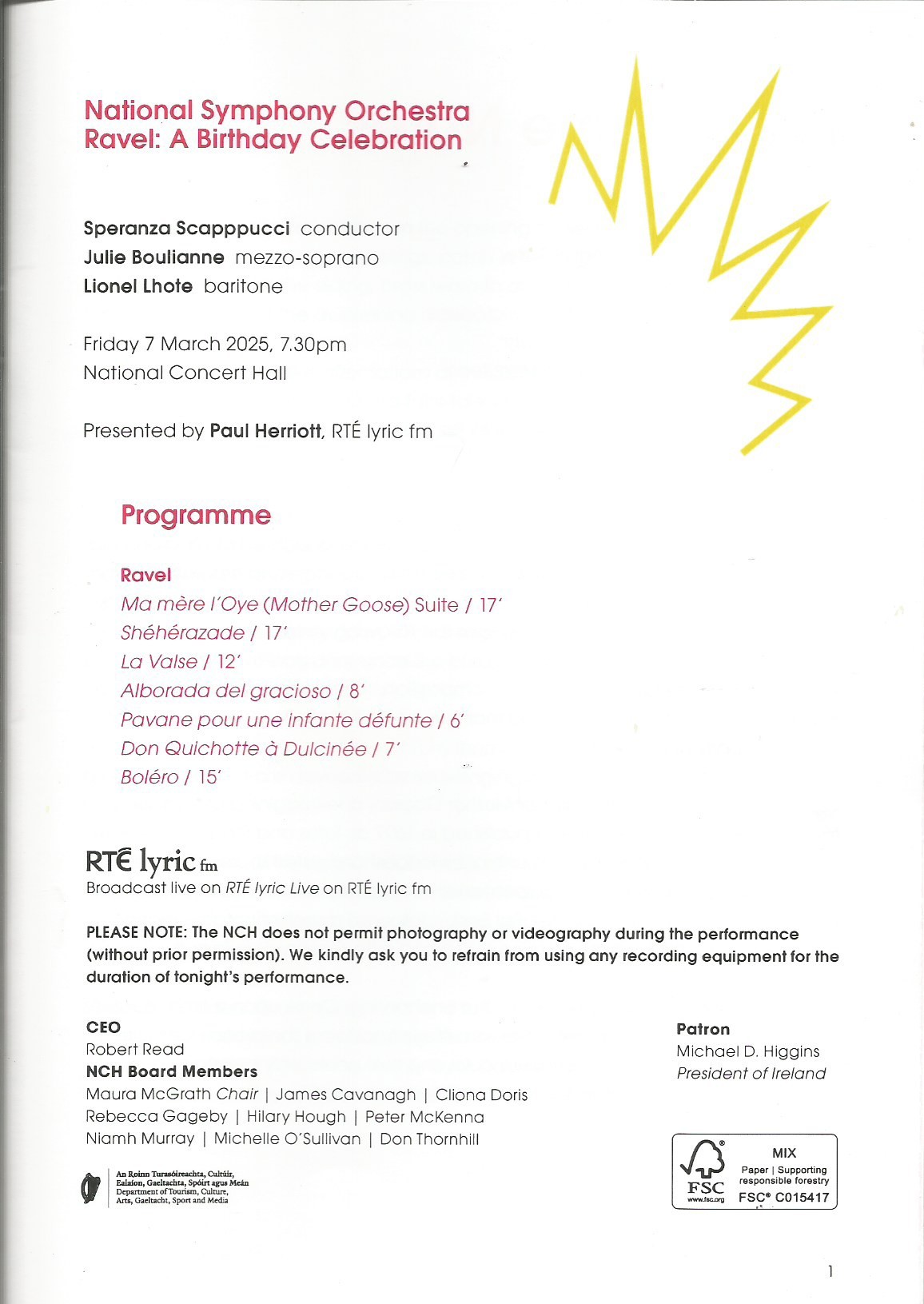
Yesterday (8th March 2025) was the 150th anniversary of the birth of Maurice Ravel and the National Symphony Orchestra celebrated it in fine fashion with all-Ravel programme for last night’s concert under the direction of guest conductor Speranza Scappucci (whose name aquired an extra p for the printed programme):

As you can see, it was basically a selection of Ravel’s greatest hits and there’s no surprise that the concert ended with a performance of Boléro, which is by no means the most interesting of Ravel’s compositions but is easily his most famous. Ravel himself said that `it has no music in it’, meaning that it doesn’t have any variation or thematic development or invention, but was written deliberately as an experiment to see how far he could get in writing a work that was entirely based on rhythm and repetition. The result was a smash hit and earned him a very great deal of money, but he grew to resent the fact that it was so much more popular than the other works he himself thought were much better. I know some people who hate this piece, but I think it’s great fun and always enjoy hearing it. Last night was no exception.

The composition of Boléro is so simple that even a non-musician like me can play it. It’s basically written in a slow 3/4 time signature on which is superimposed the following figure:

The second part is basically a repeat of the first, with the last two eighth notes replaced with triplet. The whole pattern consists of 24 notes. I once tried to count how many times it is repeated in a performance of Boléro, but gave up when I got to 100. I think it must be over 200 times.  This figure is introduced first on a single snare drum, which carries on playing it for the duration, i.e. for about 15 minutes in total. As the piece develops the same pattern is picked up by various other instruments, either alone in combination. A second snare drum joins in too. The key to the piece is to keep this all very strictly in tempo, as the piece gradually gets louder.

As I’ve mentioned before on this blog, my Father was a (jazz) drummer. I remember once borrowing his snare drum and attempting to play along with a recording of Boléro. The pattern shown above is not that hard to play in itself, but it’s not as easy as you probably think to keep in tempo as you play it louder and louder. At the start it’s fine: you begin by tapping the sticks on the skin of the drum very close to the rim. To increase the volume you gradually move the point of impact closer to the centre of the drum, which naturally makes it louder. However, to get louder still you have to increase the distance the sticks move, and that makes it tougher to keep to tempo. Playing along at home is one thing, but playing the percussionist playing this in an orchestra must leave the drummer feeling very exposed. One mistake, any speeding up or slowing down, and the whole performance will be ruined.  Percussionists very often have little to do for long passages in an orchestral work, but this takes it to the opposite extreme. It requires constant concentration, but no variation or embellishment is allowed.  I suppose professional musicians just get into the zone and don’t think about the possibility of screwing up. Last night the task fell to Section Leader Rebecca Celebuski, who performed it flawlessly.

The bolero rhythm is just one element of the composition, of course. There is a melody, in two parts. The first simple and catchy, the second bluesier and a bit syncopated. Each part is played twice, passed around the instruments of the orchestra, first individually and then in combinations. Sometimes the melodic line is doubled, but there are no complicated harmonies and the piece stays in C major throughout, apart from a sudden change of key near the very end. The second part of the melody allows the musicians to release their inner jazz a bit, playing behind or across the beat to generate the feeling that the tune is trying to escape the confines of the incessant rhythm. As is the case in jazz, this sense of tension only works if the basic rhythm is kept strictly in tempo as the crescendo builds

The third element of the composition is the simplest of all, but I feel that it is very important in determining whether a performance of Boléro really rocks. That is a rhythmic pulse based on the three beats of the underlying 3/4. When they’re not playing the melody or shadowing the bolero pattern, the orchestra play this figure and it ends up being boomed out by the timpani in tremendous style but also as the piece progresses the stress shifts between the three beats as different instruments contribute.

I know it’s a familiar piece but I really enjoyed last night’s performance. I’ll also reiterate that as well as making a great sound, a full symphony orchestra playing during a piece like this is also a tremendous thing to watch.

Anyway, it wasn’t all about Boléro. In the first half we had the orchestral suite Ma mère l’Oye (My Mother the Goose), the song cycle Shéhérazade with vocals by excellent mezzo-soprano Julie Boulianne, and La Valse. The last of these is a masterpiece, originally conceived as a tribute to the Viennese waltz, but not composed until after TheFirst World War, and turned into a kind of tragic parody, starting out sombre and brooding, gradually building into a garish intensity and then into a brutal, almost chaotic, ending.

After the wine break we heard Alborado del Gracioso, a beautifully atmospheric with a strong Spanish influence and the orchestral version of Pavane pour une infante défunte, played well but a little too slowly for my tastes, and the only piece of the evening that I’d never heard before, Don Quichotte à Dulcinée, a miniature song cycle lasting just 7 minutes, comprised of settings of three poems by Paul Morand. Soloist was baritone Lionel Lhote who not only sang very well but had a very engaging stage presence.

And then it was Boléro, received with great applause and a standing ovation, and then by train back to Maynooth. There were a lot of French people in Dublin last night, presumably not for the Ravel, but for this afternoon’s rugby. They will be enjoying themselves in the city right now, as France convincingly beat Ireland 27-42 in the Six Nations, to end the home team’s hopes of a grand slam. Disappointment for the Boys in Green, but France were excellent and thoroughly deserved to win. Losing to a side as good as that is no disgrace.

Congratulations to Spain!

Posted in Football, Rugby with tags , , , , , on July 14, 2024 by telescoper

And so it came to pass that Spain beat England 2-1 in the final of the 2024 European Championship. This is a result to add to the memories of Spain I’ve acquired by living there for much of the past year. I haven’t seen every match of the tournament but there’s no doubt in my mind that Spain played consistently the best football, and are worthy Champions. England ran them close in the final, though. Despite Spain having about 66% of the possession it took a very late goal to win it.

So football’s not coming home after all. Evidently it’s still on sabbatical…

I feel a bit sorry for the manager Gareth Southgate. He may not have won a trophy with England (yet) but he’s taken them further in more competitions than most of his predecessors. He attracted a great deal of criticism for his cautious approach in the earlier stages of this competition which he dealt with in a remarkably dignified way. All that eased off a bit when England got to the knockout stage, but I suspect it may come back. Will he put up with it for another two years until the 2026 World Cup?

As for Spain, this is the fourth time they have been European Champions; England have never won this competition. The Spanish squad is very youthful squad too, including the brilliant teenager Lamine Yamal. Nico Williams had a superb tournament too. 

P.S. This evening’s match was broadcast live on RTÉ so I watched it at home. By contrast, yesterday’s rugby between Ireland and the Springboks was not available on a free channel so I was forced against my will to watch it in a pub. I’m glad I did!

P.P.S the choice of schedule leading up to the Euros final is interesting:

Six Nations Summary

Posted in Rugby with tags , , , , , , , , , on March 17, 2024 by telescoper

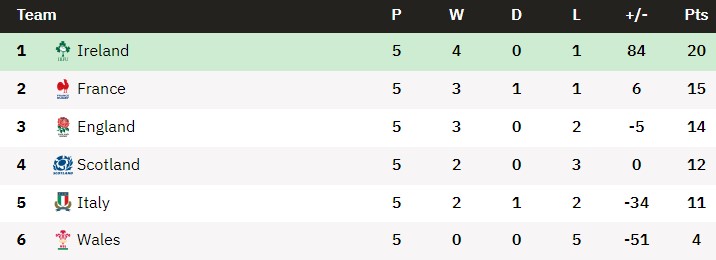
I didn’t see many of the games in this year’s Six Nations Rugby because I was abroad for most of it, but yesterday I saw the last round of matches. The last one, between France and England in Lyon, was probably the best game I’ve seen in this year’s tournament. After a fascinating ebb and flow, England thought they had snatched it with a converted try to make it 31-30 with just a couple of minutes to go, but then immediately conceded a penalty on the halfway line. Up stepped Thomas Ramos, who had scored from a similar distance earlier in the game, stepped up and scored. France won 33-31 in a game that could have gone either way. It was effectively a playoff for 2nd place.

Earlier in the day, Ireland held off a spirited challenge from Scotland in a tense and scrappy match to win 17-13 which guaranteed they would be Six Nations Champions. for the sixth time. I don’t think the team reached the heights of last year’s Grand Slam but it was a deserved victory. It was all a bit more comfortable than the scoreline suggests, though Scotland did score a try late on when Ireland lost concentration which made for a nervy few minutes. A defeat would have meant metaphorical rain on the St Patrick’s Day parades going on today, but in the end there was no rain, either metaphorical or literal.

Given the result in Lyon, Ireland would have been Champions by virtue of their bonus points, even if they had lost to Scotland. England (who beat Ireland last week in a game I didn’t see) had to win with a bonus point to catch them; they managed the bonus point for four tries, but lost the match. Some pundits have commented on whether it was fair for a team to have won having lost more games than the second place team. Of course all the teams know the rules before the competition starts, so there’s no point complaining after the fact. Ireland played attacking rugby knowing that the try count might be important. However, I do think there is a point. In the old Five Nations, and indeed in the World Cup Pools, each team played four games. A bonus point from each of those matches would add 4 to a team’s total, the same as a win. In the Six Nations each team places five matches, so the bonus points could add up to more than a win. A way to remedy this might be to award more points for a win: six for a win and three for a draw is my suggestion.

The first game of the last round yesterday was between Wales and Italy, a game which Italy won to finish 5th. They were unlucky not to beat France earlier in the competition and have played some excellent rugby this year. If they can deal with a marked tendency to fade in the last twenty minutes – as they did yesterday, but managed to hold on – then they will be genuine contenders. Wales had a terrible competition, losing all their games and finishing last. I am reliably informed that “wooden spoon” in Welsh is “llwy bren”. But nil desperandum: the last time Wales got the wooden spoon was in 2003; two years later they did the Grand Slam!

R.I.P. Barry John (1945-2024)

Posted in R.I.P., Rugby with tags , , , on February 6, 2024 by telescoper

I just read the terrible news of the death at the age of 79 of yet another icon of Welsh Rugby Union, the legendary standoff Barry John.

Five years ago I posted an item about Barry John inspired by this clip

The opening part of this clip had caught my attention because it was filmed near the bus stop just outside The Halfway, a pub on Cathedral Road just a few yards from the house in Cardiff in which I lived for many years; in the background you can see Llandaff Fields.

I had often wondered what became of Barry John. He was 74 when I wrote about him and no longer the slim young prodigy who was undoubtedly the best rugby player I ever saw. Since he played in a great era for Welsh rugby that included Gareth Edwards, J.P.R. Williams, Gerald Davies et al, that really says something. As the Guardian obituary aptly puts it, he “played Rugby from another world”.

As a sort of rugby equivalent of George Best, Barry John was incredibly famous during his career. Budding rugby players – even those not born in Wales – all wanted to play like Barry John. But suddenly, at the age of just 27, after playing just 25 internationals, he turned his back on all the publicity and adulation and retired from rugby. He found the pressure of being such a star in the amateur era too difficult to cope with.

So was Barry John really that good? Absolutely yes, he was. Slight of build but with superb balance, he had an extraordinary, almost magical, ability to find his way through a crowd of potential tacklers as if they weren’t there at all. In the memorable words of that great commentator Bill McLaren “he flits like a little phantom”. But you don’t need to take my word for it. Just look at him – and some other giants of the time – in these highlights of the classic Scotland-Wales tie in the Five Nations of 1971. Watch about 30 seconds in, where he wrong-foots half the Scottish three-quarter line before ghosting through three more and releasing the ball to his forwards. Will there ever be another Barry John? I doubt it..

I’m sure there are many of us who remember the excitement of watching Barry John play and feel enriched by what he gave us.

Rest in Peace, Barry John (1945-2024).

Six Nations Weekend

Posted in Rugby with tags , , , on February 3, 2024 by telescoper

I found out yesterday that some of my colleagues at Maynooth were planning to go to a pub to watch the first match of the new Six Nations competition last night. They were optimistic, but I thought it was going to be a very tough match for Ireland in Marseille. Despite the absence of Dupont and Ntamack I thought home advantage would prove decisive. I am very happy that I was proved wrong. It was a comprehensive victory for Ireland, 38-17. I bet the Maynooth contingent enjoyed the game! I never imagined a bonus point win for Ireland nor did I think I’d ever see a French side so unimaginative in attack and so porous in defence.

(In the interest of full disclosure, I should mention that last weekend I was confident that Australia would beat the West Indies and India would beat England in their respective test matches. I was wrong on both counts. Clearly my predictive powers are limited!)

The remaining two games of the first round were played today. England beat Italy by 27-24 in a game of much lower quality. Italy were OK in the first half, but offered very little in the second until with the game virtually over they scored a fine try that gave them a losing bonus point. I think the scoreline flattered Italy a bit, though I don’t think England were particularly impressive.

The last game, Wales versus Scotland in Cardiff, turned out to be very exciting. Wales were dreadful in the first half, and trailed 20-0 at half time. When Scotland scored another try to make it 27-0 Wales looked a beaten side and I feared they would be walloped by 50 points or more. Then Wales scored a try, Scotland had Turner sent to the sin bin and Wales ran riot, scoring three more tries. With ten minutes left to play, Wales were within a point and with the wind in their sails, and Scotland imploding, looked the likelier team to win. They had a good chance too, but messed up a lineout in a good position and lost the ball. Scotland almost scored at the death but it finished 26-27, Wales netting two bonus points after a stirring revival that almost brought them victory.

It’s dangerous to draw too many conclusions from the first round of matches, but I can make one prediction with some confidence: neither France nor Wales nor Italy will do a Grand Slam in 2024.

R.I.P. John Peter Rhys (“JPR”) Williams (1949-2024)

Posted in Biographical, Cardiff, R.I.P., Rugby with tags , , , , , , on January 9, 2024 by telescoper

A cold and miserable day in Cardiff yesterday got even sadder when news came out of the death of Welsh rugby legend John Peter Rhys Williams known universally as “JPR” after the winger John James Williams (another great player), joined the national team and became “JJ”. JPR was one of the superb players who dominated Welsh rugby in the 1970s; he stood out even in such exalted company. In my opinion JPR is was the greatest full-back ever.

JPR was instantly recognizable on the field: tall and craggy, with characteristic long hair, prominent sideburns, socks always rolled down around his ankles, he was an imposing figure whether patrolling the defensive lines or stepping up to join the attack. In the famous 1973 match in Cardiff between The Barbarians and New Zealand he was described by commentator Cliff Morgan as “a man who never shirks his responsibility”. Just watch the memorable opening try where you’ll see JPR in the thick of the action, twice shrugging off dangerous tackles around his neck, the second time receiving the ball from Phil Bennett to start the passing move from deep inside his own half.

Many people forget that the man himself scored a great try in that game too:

(Note the involvement of David Duckham in that move; he passed away just a year ago.)

As a full-back, JPR was often the last line of defence. Sometimes, tidying up after a kick from the opposition, he would clear his lines by kicking. More often, though, he would spot a weakness and go charging forward, ball in hand, not afraid to run straight at the opposition. He was quick to spot gaps in his own defence too, rushing to provide cover, often with last-ditch try-saving tackles.

As good as he was at turning defence into attack, he was even better when his side were already in control. Here are two tries he scored for Wales against England in 1976 that demonstrate his superb positional sense in attack as well as his sheer physical strength.

(Wales achieved a Grand Slam in 1976; England got the Wooden Spoon.)

JPR was a tough, aggressive and uncompromising man on the field – players certainly knew when he’d tackled them! – but a gentleman off it, and held in a very high regard throughout the rugby world and beyond. His loss is immeasurable. One by one the legends are leaving us. The world is poorer without them.

Rest in peace, J.P.R. Williams (1949-2024)

P.S. When living in Cardiff years ago I had the pleasure of meeting and talking with two Welsh rugby legends, Gerald Davies and Phil Bennett (the former at a function, the latter at a book-signing). Both were charmingly modest men. I never really met JPR properly but I remember vividly stepping out of my house in Pontcanna on a Six Nations match day and finding myself face-to-face with him in the street. He must have been around 60 then and was still the same imposing figure he was in the 1970s. I recognized him immediately. I wanted to say something and perhaps even shake his hand, but I was too star-struck.

P.P.S. JPR was a fully-qualified orthopaedic surgeon and a Fellow of the Royal College of Surgeons. This is a reminder that back in the 1970s, Rugby Union was still an amateur game.

The Rugby World Cup Final

Posted in Rugby with tags , , on October 28, 2023 by telescoper

So, after a tense, scrappy, and error-strewn final, South Africa have retained the Rugby World Cup by beating New Zealand 12-11, all the Springboks’ points coming from penalties kicked by Handré Pollard – shades of the 1995 final, when Joel Stransky kicked all the points for South Africa.

The game hinged on the sending-off of the New Zealand captain Sam Cane in the first half – a decision about which the All Blacks can have no complaints. Despite playing for over 50 minutes with only 14 men, New Zealand had chances to win, specifically the missed conversion of the game’s only try, which would have made it 13-12.

But you can’t blame anyone else if you don’t take your chances, so congratulations to South Africa!

It’s been a strange World Cup, with some cracking games, a fair share of heartbreak (especially for Ireland and France), and an absurdly unbalanced draw. Let’s hope the arrangements for 2027 are thought out better!

RWC: The Southern Hemisphere Strikes Back!

Posted in Barcelona, Rugby with tags , , on October 15, 2023 by telescoper

Sadly, Ireland’s Rugby World Cup dream came to an end last night with a narrow defeat (24-28) to the All Blacks. After being 13-0 down at one stage, Ireland clawed their way back into the match and at one stage trailed by only a point with New Zealand with a player in the sin bin. But the All Blacks defence held firm as wave after wave of Irish attacks broke on them. It just wasn’t to be. It was another titanic struggle between two excellent teams, which would have made a worthy final. Both teams looked exhausted at the end. For the record I have to say that, on the balance of play, I think the All Blacks deserved their win, just.

Unfortunately, the peculiarities of the draw meant that only two of the top four teams in the world rankings could make the semi-finals. Ireland won’t be one of them.

Earlier yesterday, in the other Quarter Final, there was an upset when Argentina beat Wales. That’s a great result for the Pumas, but Wales can justifiably argue that Argentina should have had a player sent off for a dangerous tackle. Inconsistencies in refereeing are a major issue in this tournament.

It’s interesting that the four teams who came top in their pools (Ireland, France, Wales and England) are all from the Northern Hemisphere. Now two of them are out. Today, France play South Africa and England play Fiji. It’s possible, though I would say not likely, not that all four semi-finalists will be from the Southern Hemisphere. I think if Fiji play their natural game they can give England a scare, and the game between France and South Africa is hard to call. I think the Springboks’ lack of a goal kicker may cost them dear.

At the start of the competition I thought that, with home advantage, France were clear favourites. I still think that’s the case, though I may have to revise that opinion after tonight’s match!

P.S. It’s raining today in Barcelona

UPDATE: England 30 Fiji 24. Fiji certainly made England work for that result! I can’t see England beating either France or South Africa in the semi-final though.

UPDATE: France 28 South Africa 29. Another pulsating match, with 6 tries in the first half, but South Africa just sneak it. Tight margins again, and especially one very dodgy penalty decision. Heartbreak for the hosts. I’m not often right but I was wrong again.

So the semi-finals will be New Zealand v Argentina and England v South Africa. The team that Ireland beat in their pool game goes through with New Zealand, the team that France beat in their pool.