R.I.P. Andrew Sachs (1930-2016)
Follow @telescoperArchive for the Television Category
I Know Nothing!
Posted in Television with tags Andrew Sachs, Fawlty Towers on December 2, 2016 by telescoperThe Byker Grove Connection
Posted in Biographical, History, Television with tags Benwell, Benwell Towers, Byker Grove, Newcastle upon Tyne on September 21, 2016 by telescoperOne of the interesting things about having a blog that has been running for some time is that old posts continue to attract comments even after many years. Some of the posts that have been getting comments recently are about my early childhood growing up in Benwell which is to the West of Newcastle upon Tyne; you can find a couple of examples here and here. The place has changed beyond all recognition since I was a kid, which I suppose accounts for the fact that people are googling about looking for memories of what it used to be like.
Here is a Google Earth rendition of the area I grew up in..

We used to live in one of the two cottages right next to Pendower School, which was just off Fox and Hounds Lane. You can see road that led to the front of our house, just between the text of “Benwell Village” and “Fox and Hounds Lane”. The cottages and school are now demolished, and a housing development stands where they were. That’s all in the middle of the top of the image.
My Dad used to run a shop which was was on the corner of Whickham View and Delaval Road, about halfway down the image to the left. The green strips to the East of Delaval Road and running parallel to it were all terraced when I lived there. Virtually everything has now gone, but it was a nice little community with old-fashioned little shops.
What drew my attention recently however, is that there is a location (to the top left of the image) marked Byker Grove., right next to where I used to live. When I was a lad that was Benwell Towers, which we were told was haunted – presumably to scare us off trying to get in. There was a rather scary and formidable fence separating the grounds of Benwell Towers from the School, but it was not unknown for kids to climb it…
There have been buildings on the site of Benwell Towers since the 13th Century. A tower house was built there in 1221 and stood until it was demolished to make way for the current, much larger, building which was constructed in 1831. The old building was for a time owned by a branch of the Shafto family, of Bobby Shafto fame. At the time of the construction of the new building, Benwell hadn’t been engulfed by the westward sprawl of Newcastle itself and was very much a separate village. “Benwell Village” still felt like a distinct, self-contained community, when I was growing up there in the Sixties.
The “new” Benwell Towers was, for a time, the residence of the Bishop of Newcastle, but when I lived there it was being used as a base for the National Coal Board and used primarily as the Headquarters of the Mine Rescue Service. There were some pits still open in those days. When the Coal Board didn’t need it any more, it became a tacky nightclub called The Mitre.
That’s all I knew about the place as I never really visited it again after going to University . But a chance comment on this blog followed by a Google Search revealed that when The Mitre closed the building was used to film the long-running TV series Byker Grove. I knew about the programme, but had always assumed it was filmed in Byker (which is in the East End of Newcastle) rather than Benwell (which is in the West End). It certainly never occurred to me that it was made just a hundred yards from where I grew up. You live and learn.
Follow @telescoper
Uccello and the Problem of Space
Posted in Art, Television, The Universe and Stuff with tags Flood and Waters Subsiding, Lewis, Paolo Uccello, The Hunt in the Forest, The Point of Vanishing on August 12, 2016 by telescoperThe other night I was watching an old episode of the detective series Lewis and it reminded me of something I wanted to blog about but never found the time. The episode in question, The Point of Vanishing, involves a discussion of a painting which can be found in the Ashmolean Museum in Oxford:

I won’t spoil the plot by explaining its role in the TV programme, but this work – called “The Hunt in the Forest” or “The Night Hunt” or some other variation on that title – is by one of the leading figures of the Early Renaissance, Paolo Uccello, who was born in Florence and lived from about 1396 until 1475. He was most notable for his explorations of the use of perspective in painting, and specifically in “The Problem of Space”, i.e. how to convey the presence of three dimensions when the paint is confined to only two. This picture accomplishes this not only by having a clear vanishing point in the centre of the composition, but also by the arrangement of the figures. Notice how the figures in the foreground are generally moving in the plane of the canvas, but towards the centre they are heading away from the observer. The composition thus acts like a funnel, drawing the viewer’s eye into the centre of the picture and then off into the distance, and the darkness.
Two other things are of interest here. One is that it’s not at all clear what is being hunted, or even whether there’s anything out there in the darkness at all. Is the hunt a metaphor for something else, perhaps the pursuit of something unattainable?
It’s also clear that Uccello wasn’t as interested in realism as he was in geometry and proportion. The horses, dogs and people are drawn in a rather primitive style reminiscent of mediaeval painting. I think that suggests a metaphorical interpretation of the subject matter.
I see this painting as a brilliant experiment in geometry rather than an attempt to depict a likeness of an actual event. Reading about Uccello reveals him to have been somewhat obsessive about perspective – his friend, the great artist Donatello, remarked that Uccello spent too much time studying and not enough painting – but his contribution to the development of painting techniques during the Renaissance period was immense.
Although Uccello may have taken it to an extreme, interest in the formal, geometric, aspects of art wasn’t at all unusual in this period. I blogged a while ago about another favourite Renaissance artist, Piero della Francesca (c. 1415-1492) whose life overlapped with Uccello. He combined his work as an artist with a distinguished career as a Mathematician. It would be surprising if Uccello and Piero della Francesca never met, but a quick search didn’t find any definitive evidence that they did.
Another great example of Uccello’s art is this:

It is one of the three panels of The Battle of San Romano. Again, the living figures are simply drawn – the bodies, weapons and bits of armour on the ground look like they might be toys on a nursery floor – but the way the painting gives the impression that everything is receding into the distance is remarkably effective.
But the best example of Uccello’s work that I’ve seen in the flesh (so to speak) is this:
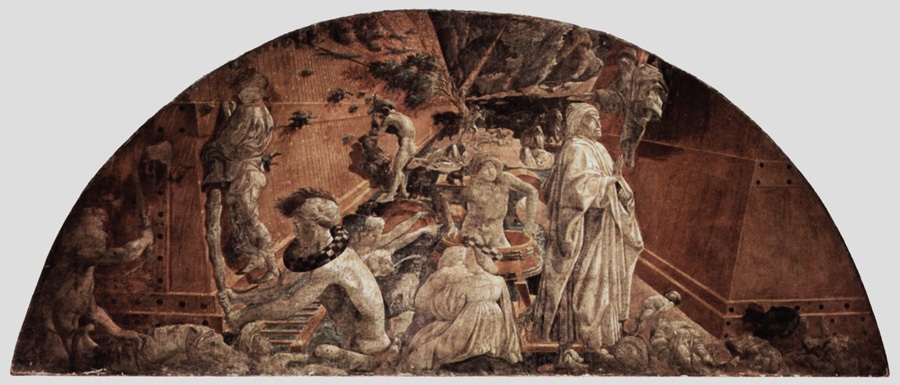
This – Flood and Waters Subsiding – is a fresco located in the Church of Santa Maria Novella in Florence. Unfortunately it’s quite badly damaged – not only have the colours faded badly but parts of the plaster have crumbled away entirely. Fresco is a notorious fragile medium and it’s sad that so many great Renaissance works of this type have been lost over the years. However, despite the disrepair, this is still an amazing piece. Perhaps helped by the semi-circular space into which it was designed to fit, this work manages to convey a sense of vorticity; There’s not so much a vanishing point as a point of origin and the action seems to swirl around it as well as to emerge from it. Note also that in contrast to the previous two paintings, the figures in this one are very lifelike, although the fading of the colours gives them a rather ghostly appearance. It’s also interesting that this work pre-dates The Hunt in the Forest by at least twenty years so the movement away from realism was something that happened in later life.
I’ve often wondered why I feel so intrigued by Early Renaissance Art. Of course these works are beautiful or exciting or in some other way pleasurable to look at, but there’s much more to it than that. They inspire curiosity. What is going on? Who are these figures? What is being hunted? Why is everything arranged in that particular way? And the act of looking at a painting like that , and being curious, perhaps reminds us that curiosity is so important for its own sake.
Follow @telescoper
Whither is fled the visionary gleam?
Posted in Poetry, Television with tags Ode: Intimations of Immortality from Recollections of Early Childhood, Penny Dreadful, William Wordsworth on June 26, 2016 by telescoperThe final scene of the final episode of Penny Dreadful, with excerpts from Ode: Intimations of Immortality from Recollections of Early Childhood by William Wordsworth.
Follow @telescoper
Next! – The Complete Animated Shakespeare
Posted in Literature, Television with tags Aardman Animations, Next, Shakespeare, William Shakespeare on April 23, 2016 by telescoperI’m sure most readers are aware that today is the 23rd April 2016, which is the 400th anniversary of the death of William Shakespeare. Despite the fact that most modern scholars agree that many of Shakespeare’s plays were not actually written by Shakespeare, but by someone else who had the same name, it’s still a good excuse to celebrate the life and work of a towering figure in the world of literature and drama. I was trying to think I suddenly remembered this marvellous animated film I saw when it was first released over 20 years ago. I couldn’t remember the name so it took me a bit of time to find it, but I got there in the end. It’s by Aardman Animations (best known for the later Wallace and Gromit films) and it was part of a splendid series of animated shorts called Lip-synch commissioned by Channel 4 and broadcast in 1990. It’s hard to imagine Channel 4 doing anything this good nowadays. This film, called Next, is only 5 minutes long yet it manages to refer to every single one of Shakespeare’s plays by having the immortal bard himself do them all as an audition. It’s not only clever and visually appealing but also a lot of fun…
Follow @telescoper
If Dick van Dyke tried a Geordie accent…
Posted in Television with tags Geordie Accent, Television, The Castle on March 8, 2016 by telescoper…it couldn’t be any less accurate than this effort from the US TV series The Castle:
Could this be the worst attempt at a regional accent ever recorded?
Follow @telescoper
Lines on the Death of Sir Terry Wogan
Posted in Poetry, Television with tags Terry Wogan on January 31, 2016 by telescoperSo, farewell then,
Sir Terry Wogan.
You were knighted
For services to
Blankety Blank.
Keith’s Mum
Thought you were
The Archbishop
Of Canterbury’s
Special Envoy
Who got
Kidnapped.
But it turns out
That was a
Different
Terry.
by Peter Coles (aged 52½)
Follow @telescoper
Forbrydelsen
Posted in Television with tags Detective Fiction, Film Noir, Forbrydelsen, Scandinavian Noir, The Killing on December 12, 2015 by telescoperOver the past week or so I’ve been watching the original TV series The Killing (in Danish with English subtitles). This was actually first broadcast in Denmark in 2007 but apparently achieved a bit of a cult following in the United Kingdom in 2011 when it was shown on BBC4. That was round about the time that I basically gave up watching television so I missed it then. However, I saw the DVD box set at a drastically reduced price a few weeks ago and decided to buy it. I’m very glad I did.

I’ve been to Copenhagen many times in my life but this is the first time I’ve seen some familiar locations on the small screen, which added a personal dimension for me, but my main reason for doing a blog about it is just to salute it for being exceptionally good. The Killing (in Danish Forbrydelsen: “The Crime”) is often quoted as an example of Nordic or Scandinavian Noir but that term is generally reserved for crime fiction novels rather than movies or television programmes. The Killing definitely retains some elements in common with classic Film Noir – a strong central female character and low-key visual style to name but two – but I’m not sure I would categorize it as “noir“. On the other hand some classic examples of film noir don’t display many of the characteristics associated with the genre either. Categories don’t really matter that much anyway, even when they are easily defined which is not the case with Noir.
The plot of The Killing revolves around the police investigation into a terrible crime: the brutal rape and murder of a young woman, Nanna Birk Larsen, who disappears after a Halloween party. Each of the twenty 50-minute long episodes depicts one day; the series has to be that long to accommodate all the twists, red herrings and false dawns, but it never loses pace or tension. That everything happens in a Nordic November means short days of grey skies and long wintry nights, establishing an appropriatelt sombre visual mood.
The complexity of the plot and the Copenhagen setting are not the most compelling things about this as a piece of TV drama, however. What stood out for me was the excellence of the acting not only from Sofie Gråbøl as lead investigator Sarah Lund but from the entire cast. The effect on the Birk Larsen family of the loss of their daughter in such cruel circumstances is portrayed most movingly, especially by Bjarne Henriksen as the father, Theis Birk Larsen.
I am so late writing about this that I don’t suppose I would spoil it for too many people if I revealed who did it, but I’ll refrain from doing it. What I will say, however, is that I was pretty confident that I knew who the perpetrator was right from Episode 1 and I proved to be right. That doesn’t mean that I’d make a great detective, just that I’ve had enough experience of detective stories to know some of the tricks writers use to throw the reader (or viewer) off the scent.
If you haven’t seen The Killing, I thoroughly recommend it. I gather there’s a second series too. I must watch that sometime…
Follow @telescoper
Pogles’ Wood
Posted in Biographical, Television with tags Pippin, Pogles Wood, Tog on October 19, 2015 by telescoperAnd now for something completely different: a piece of pure nostalgia. I remember watching Pogles’ Wood when I was a little boy. I wonder if any of my readers are old enough to remember Pippin, Tog and the Pogles? Here is an episode, called Honey Bees, which will bring it all back…
P.S. Should it be Pogles Wood, Pogle’s Wood or Pogles’ Wood?
Follow @pogles_wood
 In the Dark