Archive for the The Universe and Stuff Category

Making Better Sense of Quantum Mechanics

Posted in The Universe and Stuff with tags , , , on September 12, 2018 by telescoper

There is an interesting, pithy and polemical paper on the arXiv by David Mermin, with the abstract:

We still lack any consensus about what one is actually talking about as one uses quantum mechanics. There is a gap between the abstract terms in which the theory is couched and the phenomena the theory enables each of us to account for so well. Because it has no practical consequences for how we each use quantum mechanics to deal with physical problems, this cognitive dissonance has managed to coexist with the quantum theory from the very beginning. The absence of conceptual clarity for almost a century suggests that the problem might lie in some implicit misconceptions about the nature of scientific explanation that are deeply held by virtually all physicists, but are rarely explicitly acknowledged. I describe here such unvoiced but widely shared assumptions. Rejecting them clarifies and unifies a range of obscure remarks about quantum mechanics made almost from the beginning by some of the giants of physics, many of whom are held to be in deep disagreement. This new view of physics requires physicists to think about science in an unfamiliar way. My primary purpose is to explain the new perspective and urge that it be taken seriously. My secondary aims are to explain why this perspective differs significantly from what Bohr, Heisenberg, and Pauli had been saying from the very beginning, and why it is not solipsism, as some have maintained. To emphasize that this is a general view of science, and not just of quantum mechanics, I apply it to a long-standing puzzle in classical physics: the apparent inability of physics to give any meaning to “Now” — the present moment.

The `new perspective’ Mermin espouses is a form of `QBism (i.e. `Quantum Bayesianism’)‘. You can download the full article for free here.

Breakthrough Prize for Dame Jocelyn Bell Burnell

Posted in The Universe and Stuff with tags , , , , , on September 6, 2018 by telescoper

I awoke this morning to find my Twitter feed full of news about the award of a special Breakthrough Prize to Dame Jocelyn Bell Burnell. To quote the press release:

The Selection Committee of the Breakthrough Prize in Fundamental Physics today announced a Special Breakthrough Prize in Fundamental Physics recognizing the British astrophysicist Jocelyn Bell Burnell for her discovery of pulsars – a detection first announced in February 1968 – and her inspiring scientific leadership over the last five decades.

Bell Burnell receives the Prize “for fundamental contributions to the discovery of pulsars, and a lifetime of inspiring leadership in the scientific community.” Pulsars are a highly magnetized, rapidly spinning form of the super-dense stars known as neutron stars. Their discovery was one of the biggest surprises in the history of astronomy, transforming neutron stars from science fiction to reality in a most dramatic way. Among many later consequences, it led to several powerful tests of Einstein’s Theory of Relativity, and to a new understanding of the origin of the heavy elements in the universe.

For the full citation and background information, see here.

The prize is not only prestigious but also substantial in cash terms: $3M no less. Jocelyn has made it clear however that she intends to use the money to set up a fund to encourage greater diversity in physics, through the Institute of Physics. That is a wonderful gesture, but if you know Jocelyn at all then you will not be at all surprised by it, as she is a person of enormous integrity who has for many years demonstrated a huge commitment to the cause of increasing diversity. I look forward to hearing more about how this initiative works out.

In an interview with the Guardian, Jocelyn said “Increasing the diversity in physics could lead to all sorts of good things.” I agree, and not just because an open and inclusive environment is a good thing in itself (which it is) but also because the fewer barriers there are to entry for a particular field, the broader the pool of talent from which it can recruit.

P.S. What would you do if you won a prize of $3M?

P. P. S. If I had $3M to spend, I think I’d spend it on whatever would most annoy all the miserable twerps complaining on Twitter about what Jocelyn Bell Burnell is doing with her Breakthrough Prize money.

EDGES and Foregrounds

Posted in Astrohype, The Universe and Stuff with tags , , , on September 3, 2018 by telescoper

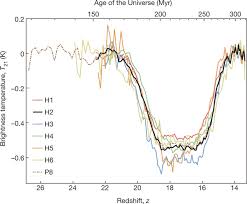
Earlier this year I wrote a brief post about paper by Bowman et al. from the EDGES experiment that had just come out in Nature reportining the detection of a flattened absorption profile in the sky-averaged radio spectrum, centred at a frequency of 78 megahertz, largely consistent with expectations for the 21-centimetre signal induced by early stars. It caused a lot of excitement at the time; see, e.g., here.
The key plot from the paper is this:

At the time I said that I wasn’t entirely convinced. Although the paper is very good at describing the EDGES experiment, it is far less convincing that all necessary foregrounds and systematics have been properly accounted for. There are many artefacts that could mimic the signal shown in the diagram.

I went on to say

If true, the signal is quite a lot larger than amplitude than standard models predict. That doesn’t mean that it must be wrong – I’ve never gone along with the saying `never trust an experimental result until it is confirmed by theory’ – but it’s way too early to claim that it proves that some new exotic physics is involved. The real explanation may be far more mundane.

There’s been a lot of media hype about this result – reminiscent of the BICEP bubble – and, while I agree that if it is true it is an extremely exciting result – I think it’s far too early to be certain of what it really represents. To my mind there’s a significant chance this could be a false cosmic dawn.

I gather the EDGES team is going to release its data publicly. That will be good, as independent checks of the data analysis would be very valuable.

Well, there’s a follow-up paper that I missed when it appeared on the arXiv in May the abstract of which reads:

We have re-analyzed the data in which Bowman et al. (2018) identified a feature that could be due to cosmological 21-cm line absorption in the intergalactic medium at redshift z~17. If we use exactly their procedures then we find almost identical results, but the fits imply either non-physical properties for the ionosphere or unexpected structure in the spectrum of foreground emission (or both). Furthermore we find that making reasonable changes to the analysis process, e.g., altering the description of the foregrounds or changing the range of frequencies included in the analysis, gives markedly different results for the properties of the absorption profile. We can in fact get what appears to be a satisfactory fit to the data without any absorption feature if there is a periodic feature with an amplitude of ~0.05 K present in the data. We believe that this calls into question the interpretation of these data as an unambiguous detection of the cosmological 21-cm absorption signature.

You can read the full paper here (PDF). I haven’t kept up with this particular story, so further comments/updates/references are welcome through the box below!

Sheila Tinney et al.

Posted in History, The Universe and Stuff with tags , on September 2, 2018 by telescoper

I came across the above picture via Twitter the other day. It was taken about 75 years ago, in 1943, the year that Erwin Schrödinger gave his famous lectures in Dublin on the topic What Is Life? Schrödinger is second from the right in the front row, next to Arthur Stanley Eddington (who is to his left as you look a the picture). Next but one to Eddington (to his left as you look at the picture)  is Éamon de Valera (who was Taioseach at the time; apparently he dragged all his cabinet along to Schrödinger’s lectures) and next to him (on the left as you look at the picture) is Paul Dirac. That’s quite a front row!

I’m afraid I don’t know the identity of most of the other people in the picture, apart from the lady on the far left who is Dr Sheila Tinney. She completed a PhD under the supervision of Max Born in just two years and was held in very high regard as a physicist, not least by Schrödinger himself. Sheila Tinney spent her academic career at University College Dublin and passed away in 2010 at the age of 92.

The gender balance in physics has improved a bit since 1943 but we still have a long way to go! Note also the numerous men in clerical garb.

There is a conference coming up in Dublin to mark the 75th anniversary of the What is Life lectures, and there has been quite a lot of interest in Schrödinger in the Irish media as a consequent, such as this piece in the Irish Times.

I guess most readers of this blog will know that Éamon de Valera set up the Dublin Institute for Advanced Studies (DIAS) in 1939 in order to create a position for Schrödinger, who was then basically a refugee from the Nazis. He had attempted to settle in Oxford but his unconventional domestic arrangements – he lived in the same house as his wife and his mistress – met with disapproval. Dublin was far more tolerant, and he took up the post of Director of Theoretical Physics at DIAS in 1940 and stayed in Ireland for 17 years.

If you ask me for a personal opinion about Schrödinger’s private life then I have to say two things. One is that all three members of his ménage à trois seemed quite happy with the arrangement as well as the affairs that Schrödinger had outside it. His wife also had numerous affairs, including one with physicist Hermann Weyl. Unconventional it may have been, but most conventions are pretty silly in my view.

On the other hand, there is a part of Schrödinger’s life that I do find entirely reprehensible, and that is the way he treated some of the women with whom he had affairs. As the Irish Times puts it

‘For Schrödinger, the mystical union of sexual love did not endure for long .. With Erwin it was never able to survive tidings of pregnancy.

The Schrödingers did (unofficially) adopt one of the children he fathered outside his marriage, but he strikes me as someone who wanted (or perhaps needed) the sexual and emotional fulfillment his lovers could give him, but wasn’t prepared to accept the responsibility that goes with human relationships. That strikes me as a very selfish attitude.

The Hubble Constant Tension Video!

Posted in The Universe and Stuff on August 31, 2018 by telescoper

The interwebs informed me yesterday that there’s a video out on Youtube about the Hubble Constant Tension I’ve blogged about a few times (e.g. here). The video features a number of distinguished cosmologists and Daniel Mortlock (;-). It’s well worth a look:

This also gives me the excuse to resurrect the poll I’ve been running on this issue for a few years now. Feel free to vote if you haven’t done so already…

[twittter-follow screen_name=’telescoper’]

The Simons Observatory: Science Goals and Forecasts

Posted in The Universe and Stuff with tags , , on August 27, 2018 by telescoper

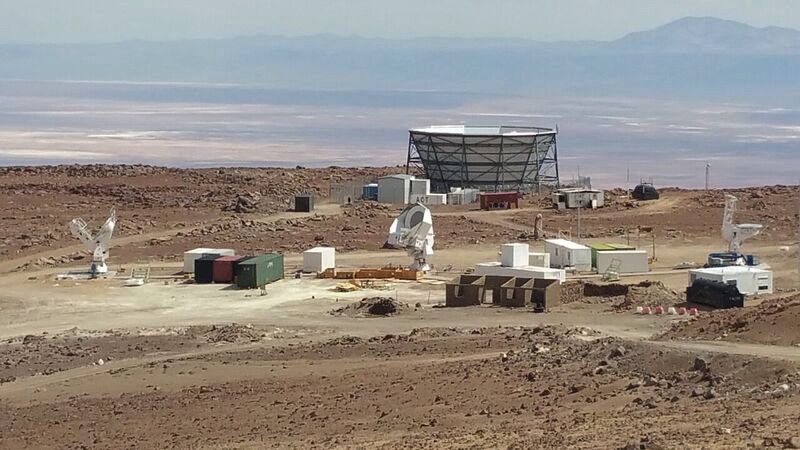
I haven’t been involved in this project, but several of my former colleagues at Cardiff have beenm and still are, so I know how much work has gone into this (especially by the amazing Erminia Calabrese), so I am happy to share this impressive work here. This long (54 pages) paper, which appeared on the arXiv last week, describes the latest step forward in ground-based cosmology using the cosmic microwave background. It shows just how rapid the onward march of instrumental technology continues to be.

The Simons Observatory Site, in Chile

It is likely that the Simons Observatory (based on a single 6m dish) will form part of the next generation CMB experiment known currently as CMB-S4.

You can download the paper in full from the arXiv here.

The Simons Observatory (SO) is a new cosmic microwave background experiment being built on Cerro Toco in Chile, due to begin observations in the early 2020s. We describe the scientific goals of the experiment, motivate the design, and forecast its performance. SO will measure the temperature and polarization anisotropy of the cosmic microwave background in six frequency bands: 27, 39, 93, 145, 225 and 280 GHz. The initial configuration of SO will have three small-aperture 0.5-m telescopes (SATs) and one large-aperture 6-m telescope (LAT), with a total of 60,000 cryogenic bolometers. Our key science goals are to characterize the primordial perturbations, measure the number of relativistic species and the mass of neutrinos, test for deviations from a cosmological constant, improve our understanding of galaxy evolution, and constrain the duration of reionization. The SATs will target the largest angular scales observable from Chile, mapping ~10% of the sky to a white noise level of 2 μK-arcmin in combined 93 and 145 GHz bands, to measure the primordial tensor-to-scalar ratio, r, at a target level of σ(r)=0.003. The LAT will map ~40% of the sky at arcminute angular resolution to an expected white noise level of 6 μK-arcmin in combined 93 and 145 GHz bands, overlapping with the majority of the LSST sky region and partially with DESI. With up to an order of magnitude lower polarization noise than maps from the Planck satellite, the high-resolution sky maps will constrain cosmological parameters derived from the damping tail, gravitational lensing of the microwave background, the primordial bispectrum, and the thermal and kinematic Sunyaev-Zel’dovich effects, and will aid in delensing the large-angle polarization signal to measure the tensor-to-scalar ratio. The survey will also provide a legacy catalog of 16,000 galaxy clusters and more than 20,000 extragalactic sources.

The merger of two neutron stars, one year on: GW170817

Posted in The Universe and Stuff with tags , on August 20, 2018 by telescoper

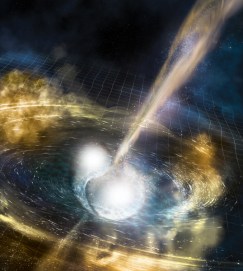
Can it really have been a year since GW170817, and the subsequent detection of electromagnetic radiation from its source? Read this very nice piece by my erstwhile Cardiff colleague Bernard Schutz, who gives an insider’s view of the story.

One of the things I remember about this was the fascinating way in which various `outsiders’ used a comments thread on this blog to piece together the clues to what going on!

bfschutz's avatarThe Rumbling Universe

Last Friday we celebrated the one-year anniversary of an event that those of us who were involved will never forget. The Virgo gravitational-wave detector had joined the two LIGO instruments on August 1, 2017, and the three detectors had since then been patiently listening out together for gravitational wave sounds coming from anywhere in the Universe. On August 17, the deep quiet was interrupted by a squeal, a chirp lasting much longer and going to a much higher pitch than the GW150914 chirp that had launched the field of gravitational wave observational astronomy two years earlier. We named it, prosaically, GW170817.

GW170817-rendition [Credit: NSF/LIGO/Sonoma State University/A. Simonnet] This one-minute-long squeal was followed by an incredible explosion that radiated intense gamma-rays, X-rays, light, radio waves — right across the whole electromagnetic spectrum. What came first was a burst of gamma-rays, just 2 seconds after the end of the squeal. Then…

View original post 2,237 more words

Cosmology Big Brother

Posted in Television, The Universe and Stuff with tags , , on August 17, 2018 by telescoper

I saw on Twitter today that the new series of Celebrity Big Brother has just started, though looking at the list of inmates housemates, I’m not sure whether the producers of this show understand the meaning of the word `celebrity’. At any rate, I’ve never heard of most of them.

I get the feeling that the Big Brother franchise may be getting a little tired, so I thought I’d pitch a new variant in order to boost the flagging ratings.

In Cosmology Big Brother a group of wannabe cosmologists live together in a specially-constructed house (with lots of whiteboards) isolated from the outside world (i.e. the arXiv). As the series progresses the furniture and rooms are gradually moved further apart, the temperature of the central heating is turned down, and the contents of the house become progressively more disordered.

Housemates are regularly voted out, at which point they have to enter the `real world’ (i.e. get a job in data science). Eventually only one person remains and whoever that is is awarded a research grant. They can then spend the rest of their life combining their study of cosmology with the usual activities of a Big Brother winner, e.g. opening supermarkets.

Quark Confinement and Excursion

Posted in Biographical, History, The Universe and Stuff with tags , , on July 31, 2018 by telescoper

Today’s the day that many folks here in Maynooth have been looking forward to for many months. It’s the start of the XIIIth Quark Confinement Conference. This is the latest in a series of biennial meetings:

Inaugurated in 1994 in Como, Italy, this series of conferences has become an important forum for scientists working on strong interactions, stimulating exchanges among theorists and experimentalists as well as across related fields.

The aim of the conference is to bring together people working on strong interactions from different approaches, ranging from lattice QCD to perturbative QCD, from models of the QCD vacuum to QCD phenomenology and experiments, from effective theories to physics beyond the Standard Model.

The scope of the conference also includes the interface between QCD, nuclear physics and astrophysics, and the wider landscape of strongly coupled physics. In particular, the conference will focus on the fruitful interactions and mutual benefits between QCD and the physics of condensed matter and strongly correlated systems·

A conference of over 300 people is a major undertaking for a small place like Maynooth and I hope it all goes well.The participants will start arriving today, and the conference will carry on over the weekend and into Monday (which is actually a Bank Holiday in Ireland, Lá Saoire i mí Lúnasa). Yesterday the organisers were putting the finishing touches to all the arrangements, including putting a team of elves PhD students to work in the Department of Theoretical Physics packing the conference goody bags:

I’m not really involved in this meeting, as it’s not really on my subject, though I plan to drop in on some of the talks. I have, however, volunteered to go along as a kind of escort (so to speak) with one of the excursions on Saturday. I’ll be going with group C, which is doing a tour of the Boyne Valley, taking in the prehistoric tomb complex at Knowth. I only found out yesterday that the local organisers were short of a `responsible adult’ to go with this group but I was delighted to be asked to step in, as the prehistory of this part of Ireland has become a fascination for me since I arrived here. The Knowth complex is probably not as ancient as the perhaps more famous Newgrange site, but the whole area of the Boyne valley is incredibly rich in neolithic remains that connect directly to Ireland’s mythic past. I hope that (a) I manage to shake off the cold I’ve been struggling with since last week before Saturday, (b) the weather’s reasonable and (c) I remember to take my good camera!

The Lunar Eclipse

Posted in Politics, The Universe and Stuff with tags , , on July 27, 2018 by telescoper

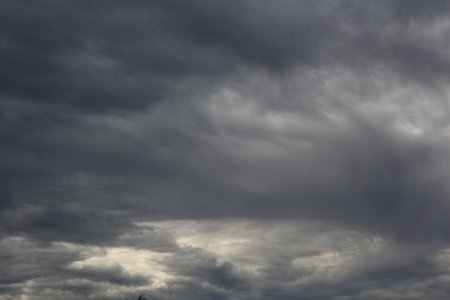
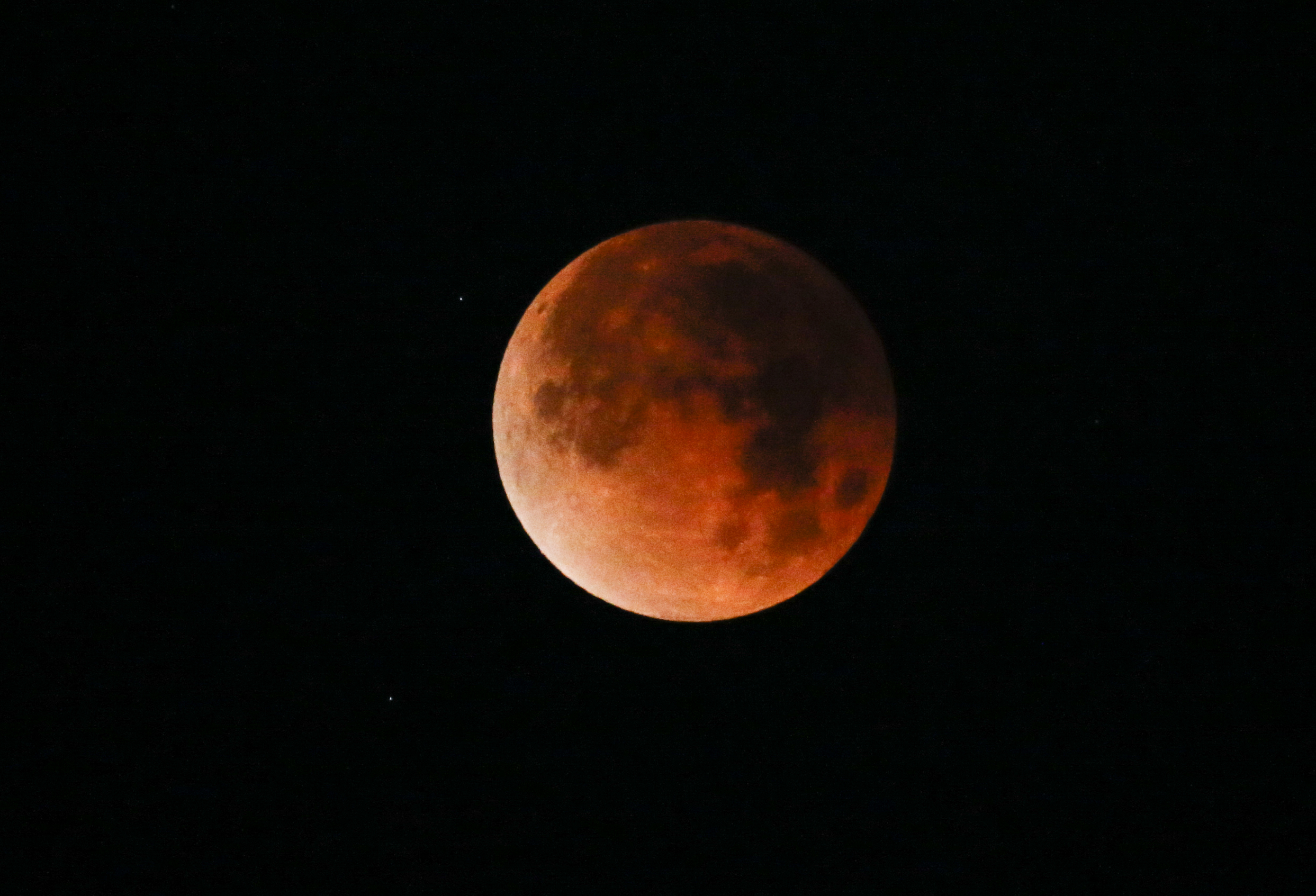
Just a reminder that there will be lunar eclipse tonight. The so-called `blood Moon’ will be visible across Ireland and the United Kingdom (as well as much of the rest of world tonight) although there is rain forecast, and its very overcast as I write this, so it’s possible that all I from Maynooth will see is clouds. That’s a shame as this will be the longest total lunar eclipse of the 21st century, lasting one hour, 42 minutes and 57 seconds.

Observers in Ireland will not be able to see the start of the eclipse as the moon will still be below the horizon when the Earth passes between the Sun and the Moon. However, in the Dublin area it will be seen (clouds permitting) from 9.30pm to 10.15pm low in the sky to the South East. Then from 10.15pm to 11.20pm, the moon will be seen coming out of Earth’s shadow. The partial eclipse will last around four hours. Oh, and you should be able to see Mars which will be very bright tonight, down a bit and to the left from the Moon.

The photograph above is of a lunar eclipse taken earlier this year, on 31st January. Lunar eclipses tend to be seen in pairs, like low comedians.

Update:

P.S. It’s worth also giving advanced notice that next year, on March 29th 2019, there will be a total eclipse of the United Kingdom visible from Ireland and all the rest of the world…