Archive for the The Universe and Stuff Category

A quantum proverb..

Posted in The Universe and Stuff on May 5, 2016 by telescoper

image

I’ve been busy in London all day so haven’t had time for a proper blog post today.

However, yesterday’s post reminded me of the above attempt at humour occasioned by the thought that classical proverbs may need to be modified to include quantum phenomena…

Can single-world interpretations of quantum theory be self-consistent?

Posted in The Universe and Stuff with tags , on May 4, 2016 by telescoper

I saw a provocative-looking paper on the arXiv the other day (by Daniela Frauchiger and Renato Renner)  with the title Single-world interpretations of quantum theory cannot be self-consistent. No doubting what the authors think!

Here’s the abstract:

 According to quantum theory, a measurement may have multiple possible outcomes. Single-world interpretations assert that, nevertheless, only one of them “really” occurs. Here we propose a gedankenexperiment where quantum theory is applied to model an experimenter who herself uses quantum theory. We find that, in such a scenario, no single-world interpretation can be logically consistent. This conclusion extends to deterministic hidden-variable theories, such as Bohmian mechanics, for they impose a single-world interpretation.

Since this is a subject we’ve had interesting debates about on this blog I thought I’d post a link to it here and see if anyone would like to respond through the comments. I haven’t had time to read it thoroughly yet, but I do have a bit of train travel to do tomorrow…


R.I.P. Harry Kroto (1939-2016)

Posted in Biographical, The Universe and Stuff with tags , , , , , , on May 1, 2016 by telescoper

image

I heard earlier this afternoon of the death at the age of 76 of the distinguished chemist Sir Harry Kroto.

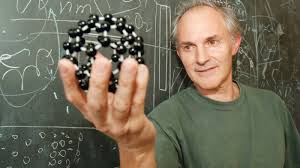
Along with Robert Curl and Richard Smalley,  Harry Kroto was awarded the Nobel Prize for Chemistry in 1996 for the discovery of the C60 structure that became known as Buckminsterfullerene (or the “Buckyball” for short).

Harry had a long association with the University of Sussex and was a regular visitor to the Falmer campus even after he moved to the USA.

I remember first meeting him in the 1988 when, as a new postdoc fresh out of my PhD, I had just taken over organising the Friday seminars for the Astronomy Centre. One speaker called off his talk just an hour before it was due to start so I asked if anyone could suggest someone on campus who might stand in. Someone suggested Harry, whose office was  nearby in the School of Molecular Sciences (now the Chichester Building). I was very nervous as I knocked on his door – Harry was already famous then – and held out very little hope that such a busy man would agree to give a talk with less than an hour’s notice. In fact he accepted immediately and with good grace gave a fine impromptu talk about the possibility that C60 might be a major component of interstellar dust. If only all distinguished people were so approachable and helpful!

I met him in campus more recently a couple of years ago when we met to talk about some work he had been doing on a range of things to do with widening participation in STEM subjects. I remember I had booked  an hour in my calendar but we talked for at least three. He was brimming with ideas and energy then. It’s hard to believe he is no more.

Harry Kroto was a man of very strong views  and he was not shy in expressing them. He cared passionately about science and was a powerful advocate for it. He will be greatly missed.

Rest in peace, Harry Kroto (1939-2016)

What’s the point of ResearchGate?

Posted in Biographical, The Universe and Stuff with tags on April 26, 2016 by telescoper

Some years ago, in a moment of weakness, I joined a website called ResearchGate. I’m not sure why, but it seemed a good idea at the time. I don’t visit the actual site very often, but it does send me large numbers of emails. Normally about things I’m not particularly interested in or asking me if I’m an author of a paper about biochemistry they’ve found somewhere on the net. Once a week I get one like this:

ResearchGate

I get a similar one every week without fail. It’s always flattering to be thought of as being in the spotlight, but the obvious inference to be made from the fact that I get such a message every week is that I am the only person in the Department silly enough to have joined ResearchGate.

Has anyone out there joined ResearchGate and found it worthwhile? Maybe there’s something worthwhile about it?

Do tell.

R.I.P. David Mackay (1967-2016)

Posted in R.I.P., The Universe and Stuff with tags , on April 15, 2016 by telescoper
Professor David Mackay , who died yesterday

Professor David Mackay , who died yesterday

Yesterday evening I heard from friends at Cambridge the devastating news that David Mackay has passed away. I knew this would happen eventually. About a year ago David was diagnosed with a particularly aggressive form of stomach cancer that was expected to be terminal. Since then he has fought for his life with great courage and posted regular updates on his blog. On Sunday, however, he posted a heartbreaking piece that made it clear that he was about to lose the battle. He died yesterday at the age of 48. Fuck you, cancer.

For those who didn’t know Professor Sir David John Cameron Mackay, he was an extremely distinguished scientist and engineer, a Fellow of the Royal Society and a former Chief Advisor to the UK Department of Energy and Climate Change. He is probably best known outside his own research for his book Sustainable Energy Without The Hot Air which has become a standard undergraduate textbook not only in the United Kingdom but across the world. He will be remembered for this work, and it is indeed a fitting memorial, but he also did many other things. In fact he was a primarily a physicist (he did the same Natural Sciences course at Cambridge that I did) but his interests were always interdisciplinary in nature. He got his PhD from Caltech for a thesis about Bayesian Methods for Adaptive Models and after returning to Cambridge he rose rapidly through the ranks and eventually found himself as Regius Professor of Engineering there. He devoted a great deal of his time and effort to outreach and science policy and was one of our finest public intellectuals. He was knighted in this year’s New Years Honours List.

I didn’t actually know David very well personally – we met only a few times – but on each occasion I was struck not only by his sheer intelligence, but also his energy and the force  of his personality. You meet few people who make such a lasting impression so quickly as David. He was forthright in his views, but always honest and engaging. The word “luminary” definitely applied to him. One time we met was at a meeting about Bayesian Cosmology about a decade ago. He asked a question during my talk, which triggered a lively discussion that carried on into the coffee break. I was impressed that he saw immediately how to tackle a problem that I had struggled with for months. I feel honoured to have made his acquaintance, however briefly, and can’t even begin to imagine what people who were closer to him must be feeling at his loss in such a cruel fashion. I send my deepest condolences go out to his family and friends. He was brilliant and amazing person, and will be greatly missed.

Rest in Peace David Mackay (1967-2016).

P.S. Shortly before he died, David set up a Just Giving page in favour of the Arthur Rank Hospice Charity. Please consider making a donation in his memory.


Blog Paper

Posted in Biographical, The Universe and Stuff with tags , , on April 12, 2016 by telescoper

I don’t often blog about my own research. To be honest that’s partly because I don’t get much time to do any. Fortunately, however, I have an excellent postdoctoral research assistant (Dipak) and some excellent collaborators. Anyway, I just heard yesterday that the following paper has been accepted for publication in the Journal of Cosmology and Astroparticle Physics (JCAP):

Munshi

It’s not exactly a light read – it’s 32 pages long – but at least it gives the non-cosmology readers of this blog an idea of my research interests. Hopefully it won’t be too long before we can apply techniques such as those described in the above paper to real data!

Hopefully also in future I’ll be able to persuade my co-authors to submit to the Open Journal of Astrophysics!

Fear, Risk, Uncertainty and the European Union

Posted in Politics, Science Politics, The Universe and Stuff with tags , , , , , , , , , on April 11, 2016 by telescoper

I’ve been far too busy with work and other things to contribute as much as I’d like to the ongoing debate about the forthcoming referendum on Britain’s membership of the European Union. Hopefully I’ll get time for a few posts before June 23rd, which is when the United Kingdom goes to the polls.

For the time being, however, I’ll just make a quick comment about one phrase that is being bandied about in this context, namely Project Fear.As far as I am aware this expression first came up in the context of last year’s referendum on Scottish independence, but it’s now being used by the “leave” campaign to describe some of the arguments used by the “remain” campaign. I’ve met this phrase myself rather often on social media such as Twitter, usually in use by a BrExit campaigner accusing me of scaremongering because I think there’s a significant probability that leaving the EU will cause the UK serious economic problems.

Can I prove that this is the case? No, of course not. Nobody will know unless and until we try leaving the EU. But my point is that there’s definitely a risk. It seems to me grossly irresponsible to argue – as some clearly are doing – that there is no risk at all.

This is all very interesting for those of us who work in university science departments because “Risk Assessments” are one of the things we teach our students to do as a matter of routine, especially in advance of experimental projects. In case you weren’t aware, a risk assessment is

…. a systematic examination of a task, job or process that you carry out at work for the purpose of; Identifying the significant hazards that are present (a hazard is something that has the potential to cause someone harm or ill health).

Perhaps we should change the name of our “Project Risk Assessments” to “Project Fear”?

I think this all demonstrates how very bad most people are at thinking rationally about uncertainty, to such an extent that even thinking about potential hazards is verboten. I’ve actually written a book about uncertainty in the physical sciences , partly in an attempt to counter the myth that science deals with absolute certainties. And if physics doesn’t, economics definitely can’t.

In this context it is perhaps worth mentioning the  definitions of “uncertainty” and “risk” suggested by Frank Hyneman Knight in a book on economics called Risk, Uncertainty and Profit which seem to be in standard use in the social sciences.  The distinction made there is that “risk” is “randomness” with “knowable probabilities”, whereas “uncertainty” involves “randomness” with “unknowable probabilities”.

I don’t like these definitions at all. For one thing they both involve a reference to “randomness”, a word which I don’t know how to define anyway; I’d be much happier to use “unpredictability”.In the context of BrExit there is unpredictability because we don’t have any hard information on which to base a prediction. Even more importantly, perhaps, I find the distinction between “knowable” and “unknowable” probabilities very problematic. One always knows something about a probability distribution, even if that something means that the distribution has to be very broad. And in any case these definitions imply that the probabilities concerned are “out there”, rather being statements about a state of knowledge (or lack thereof). Sometimes we know what we know and sometimes we don’t, but there are more than two possibilities. As the great American philosopher and social scientist Donald Rumsfeld (Shurely Shome Mishtake? Ed) put it:

“…as we know, there are known knowns; there are things we know we know. We also know there are known unknowns; that is to say we know there are some things we do not know. But there are also unknown unknowns – the ones we don’t know we don’t know.”

There may be a proper Bayesian formulation of the distinction between “risk” and “uncertainty” that involves a transition between prior-dominated (uncertain) and posterior-dominated (risky), but basically I don’t see any qualititative difference between the two from such a perspective.

When it comes to the EU referendum is that probabilities of different outcomes are difficult to calculate because of the complexity of economics generally and the dynamics of trade within and beyond the European Union in particular. Moreover, probabilities need to be updated using quantitative evidence and we don’t actually have any of that. But it seems absurd to try to argue that there is neither any risk nor any uncertainty. Frankly, anyone who argues this is just being irrational.

Whether a risk is worth taking depends on the likely profit. Nobody has convinced me that the country as a whole will gain anything concrete if we leave the European Union, so the risk seems pointless. Cui Bono? I think you’ll find the answer to that among the hedge fund managers who are bankrolling the BrExit campaign…



Constructed Universe

Posted in Art, The Universe and Stuff with tags , , on April 10, 2016 by telescoper

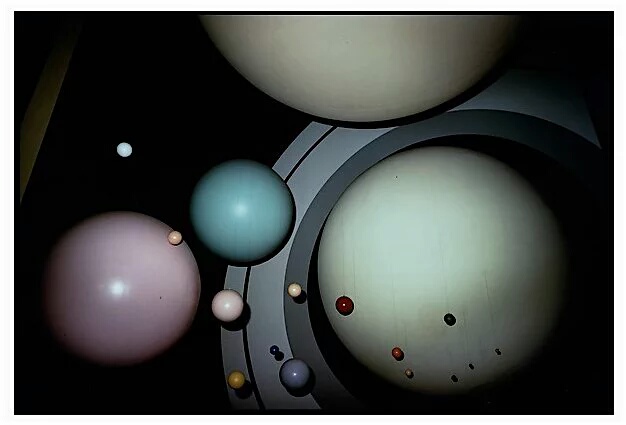
I saw this interesting piece “Constructed Universe” (1983) by Daniel Faust from the Metropolitan Museum of Art  via Twitter and it intrigued me enough to share it here, although some of you might think it’s just a load of balls.

image

What does “Big Data” mean to you?

Posted in The Universe and Stuff with tags , , , , on April 7, 2016 by telescoper

On several occasions recently I’ve had to talk about Big Data for one reason or another. I’m always at a disadvantage when I do that because I really dislike the term.Clearly I’m not the only one who feels this way:

say-big-data-one-more-time

For one thing the term “Big Data” seems to me like describing the Ocean as “Big Water”. For another it’s not really just the how big the data set is that matters. Size isn’t everything, after all. There is much truth in Stalin’s comment that “Quantity has a quality all its own” in that very large data sets allow you to do things you wouldn’t even try with smaller ones, but it can be complexity rather than sheer size that also requires new methods of analysis.

Planck_CMB_large

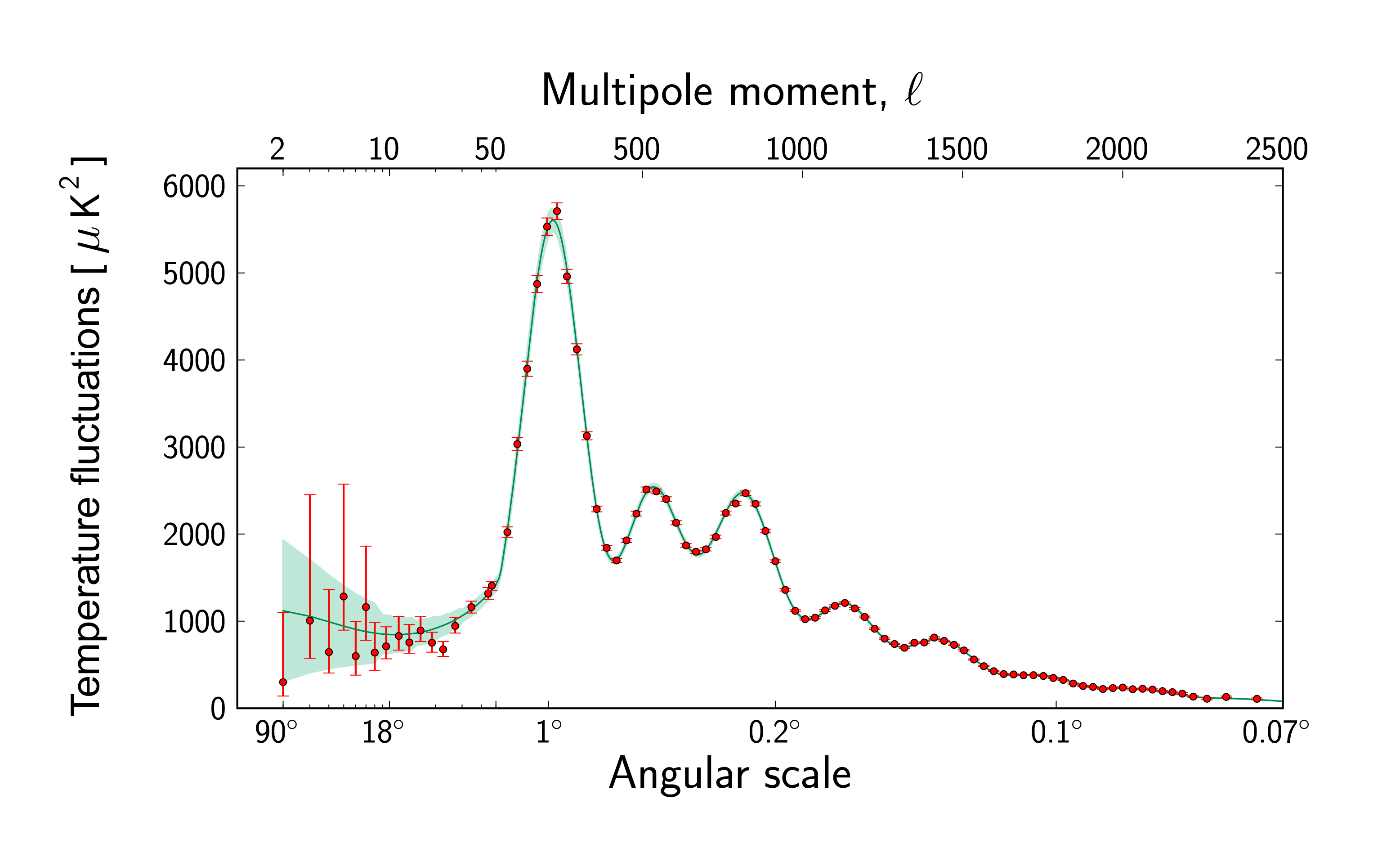
The biggest event in my own field of cosmology in the last few years has been the Planck mission. The data set is indeed huge: the above map of the temperature pattern in the cosmic microwave background has no fewer than 167 million pixels. That certainly caused some headaches in the analysis pipeline, but I think I would argue that this wasn’t really a Big Data project. I don’t mean that to be insulting to anyone, just that the main analysis of the Planck data was aimed at doing something very similar to what had been done (by WMAP), i.e. extracting the power spectrum of temperature fluctuations:

Planck_power_spectrum_origIt’s a wonderful result of course that extends the measurements that WMAP made up to much higher frequencies, but Planck’s goals were phrased in similar terms to those of WMAP – to pin down the parameters of the standard model to as high accuracy as possible. For me, a real “Big Data” approach to cosmic microwave background studies would involve doing something that couldn’t have been done at all with a smaller data set. An example that springs to mind is looking for indications of effects beyond the standard model.

Moreover what passes for Big Data in some fields would be just called “data” in others. For example, the Atlas Detector on the  Large Hadron Collider  represents about 150 million sensors delivering data 40 million times per second. There are about 600 million collisions per second, out of which perhaps one hundred per second are useful. The issue here is then one of dealing with an enormous rate of data in such a way as to be able to discard most of it very quickly. The same will be true of the Square Kilometre Array which will acquire exabytes of data every day out of which perhaps one petabyte will need to be stored. Both these projects involve data sets much bigger and more difficult to handle that what might pass for Big Data in other arenas.

Books you can buy at airports about Big Data generally list the following four or five characteristics:

  1. Volume
  2. Velocity
  3. Variety
  4. Veracity
  5. Variability

The first two are about the size and acquisition rate of the data mentioned above but the others are more about qualitatively different matters. For example, in cosmology nowadays we have to deal with data sets which are indeed quite large, but also very different in form.  We need to be able to do efficient joint analyses of heterogeneous data structures with very different sampling properties and systematic errors in such a way that we get the best science results we can. Now that’s a Big Data challenge!


The Distribution of Cauchy

Posted in Bad Statistics, The Universe and Stuff with tags , , , , , on April 6, 2016 by telescoper

Back into the swing of teaching after a short break, I have been doing some lectures this week about complex analysis to theoretical physics students. The name of a brilliant French mathematician called Augustin Louis Cauchy (1789-1857) crops up very regularly in this branch of mathematics, e.g. in the Cauchy integral formula and the Cauchy-Riemann conditions, which reminded me of some old jottings aI made about the Cauchy distribution, which I never used in the publication to which they related, so I thought I’d just quickly pop the main idea on here in the hope that some amongst you might find it interesting and/or amusing.

What sparked this off is that the simplest cosmological models (including the particular one we now call the standard model) assume that the primordial density fluctuations we see imprinted in the pattern of temperature fluctuations in the cosmic microwave background and which we think gave rise to the large-scale structure of the Universe through the action of gravitational instability, were distributed according to Gaussian statistics (as predicted by the simplest versions of the inflationary universe theory).  Departures from Gaussianity would therefore, if found, yield important clues about physics beyond the standard model.

Cosmology isn’t the only place where Gaussian (normal) statistics apply. In fact they arise  fairly generically,  in circumstances where variation results from the linear superposition of independent influences, by virtue of the Central Limit Theorem. Thermal noise in experimental detectors is often treated as following Gaussian statistics, for example.

The Gaussian distribution has some nice properties that make it possible to place meaningful bounds on the statistical accuracy of measurements made in the presence of Gaussian fluctuations. For example, we all know that the margin of error of the determination of the mean value of a quantity from a sample of size n independent Gaussian-dsitributed varies as 1/\sqrt{n}; the larger the sample, the more accurately the global mean can be known. In the cosmological context this is basically why mapping a larger volume of space can lead, for instance, to a more accurate determination of the overall mean density of matter in the Universe.

However, although the Gaussian assumption often applies it doesn’t always apply, so if we want to think about non-Gaussian effects we have to think also about how well we can do statistical inference if we don’t have Gaussianity to rely on.

That’s why I was playing around with the peculiarities of the Cauchy distribution. This distribution comes up in a variety of real physics problems so it isn’t an artificially pathological case. Imagine you have two independent variables X and Y each of which has a Gaussian distribution with zero mean and unit variance. The ratio Z=X/Y has a probability density function of the form

p(z)=\frac{1}{\pi(1+z^2)},

which is a Cauchy distribution. There’s nothing at all wrong with this as a distribution – it’s not singular anywhere and integrates to unity as a pdf should. However, it does have a peculiar property that none of its moments is finite, not even the mean value!

Following on from this property is the fact that Cauchy-distributed quantities violate the Central Limit Theorem. If we take n independent Gaussian variables then the distribution of sum X_1+X_2 + \ldots X_n has the normal form, but this is also true (for large enough n) for the sum of n independent variables having any distribution as long as it has finite variance.

The Cauchy distribution has infinite variance so the distribution of the sum of independent Cauchy-distributed quantities Z_1+Z_2 + \ldots Z_n doesn’t tend to a Gaussian. In fact the distribution of the sum of any number of  independent Cauchy variates is itself a Cauchy distribution. Moreover the distribution of the mean of a sample of size n does not depend on n for Cauchy variates. This means that making a larger sample doesn’t reduce the margin of error on the mean value!

This was essentially the point I made in a previous post about the dangers of using standard statistical techniques – which usually involve the Gaussian assumption – to distributions of quantities formed as ratios.

We cosmologists should be grateful that we don’t seem to live in a Universe whose fluctuations are governed by Cauchy, rather than (nearly) Gaussian, statistics. Measuring more of the Universe wouldn’t be any use in determining its global properties as we’d always be dominated by cosmic variance