Archive for the The Universe and Stuff Category

The End of Hitomi..

Posted in The Universe and Stuff with tags , , , on April 4, 2016 by telescoper

Time for a gloomy Monday update to my recent post about the Japanese X-ray satellite Hitomi.

First here’s a new plot of the debris (via Jonathan McDowell):

Hitomi

This shows more pieces of debris than the one I showed previously, and also demonstrates that some of the pieces are in rapidly-decaying orbits. A rough estimate suggests that some of these – those in the lower right of the diagram- will burn up in the atmosphere within a week or so. This behaviour is consistent with them being rather light fragments, on which the effect of drag is greater, and consequently possibly rather small.  Their behaviour does not therefore necessarily imply anything too catastrophic about the main spacecraft.

However, there is now strong evidence that the main spacecraft actually did break up fairly completely rather than shedding a few pieces of casing or whatever. Two of the brightest pieces are of roughly equal size and, ominously, the original identification of one of them with the main part of the spacecraft has been shown to be wrong. Furthermore, no signals have been received from the onboard beacon for six days now. It all sounds very terminal to me.

2-hitomispacec

So what happened? Of course I don’t know for sure, but the above picture suggests the possibility of an explosion (possibly violent outgassing of cryogens needed for the instruments near the rear of the main body of the vehicle). The structure to the rear of the vehicle is a deployable optical bench used to increase the focal length of the telescope for hard X-ray work. This could well have broken off during such an explosion, as could all or part of the solar panels used to supply power to the satellite.

The Japanese Space Agency JAXA has not officially given up on Hitomi (formerly known as ASTRO-H) but I think the hopes of most commenters I’m aware of have now faded away.

It’s all very sad.


The Trouble with Hitomi

Posted in The Universe and Stuff with tags , , on March 31, 2016 by telescoper

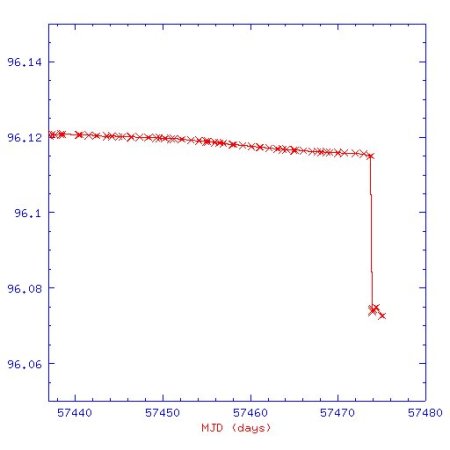
One of the stories I’ve been following a bit while taking a break from blogging has been that of the Japanese X-ray satellite Hitomi (formerly known as ASTRO-H), which was launched into a low-Earth orbit on February 17th 2016, experienced a “communication anomaly” on Saturday March 26th. It has now become clear that this was more than a simple communications glitch. Astronomer Jonathan McDowell posted this diagram on Twitter that showed a sudden decrease in the orbital period of the satellite:CekOyLxXEAAeNxF

Students of orbital dynamics will know that a decrease in orbital period corresponds to a decrease in the semi-major axis of the orbit, so Hitomi actually fell during this episode. It dropped only slightly – look at the % change on the graph – but by enough to be very worrying.

The plot thickened still further when radar detected five pieces of debris near the satellite and visual observations indicated the spacecraft to be tumbling rapidly. That suggested a very grim picture.

Putting the evidence together it seems that some kind of explosive event – possibly connected with out-gassing of cryogenic material from one of the on-board experiments – had damaged the satellite, changed its orbit and set it spinning uncontrollably.

Since then ground stations have picked up some signals from Hitomi, which is good news,  but these broadcasts are just from the on-board beacon. It has not yet proved possible to communicate with the attitude control system which is the only way to get it back into a stable state.

Obviously it’s touch and go as to whether the Japanese Space Agency JAXA will be able to regain control of Hitomi, but at least there’s more hope than on Saturday when many of us thought the vehicle had fallen apart. In fact the pieces of debris reported may be rather small (ten cm or so is detectable) and the main body of the telescoper may be intact. Maybe.

Update: April 1st. Tracking facilities are now reporting 11 pieces of debris, and also suggesting the object whose period is plotted in the above graph may not be the main part of the spacecraft. This does not sound good.

Update: April 2nd. The debris from Hitomi has now spread out due to different orbital speeds. The two largest pieces are both spinning out of control. I would say at this point that hope of a recovery has now disappeared. It’s very sad.

More fine structure silliness …

Posted in Bad Statistics, The Universe and Stuff with tags , on March 17, 2016 by telescoper

Wondering what had happened to claims of a spatial variation of the fine-structure constant?

Well, they’re still around but there’s still very little convincing evidence to support them, as this post explains…

The Great Photon Escape

Posted in The Universe and Stuff with tags , on March 14, 2016 by telescoper

Although it won’t be launched for a few years yet, the communications team behind the James Webb Space Telescope project, or JSWST for short, is already gearing up. Here’s a nice video they’ve made which I came across the other day and thought I would share on here..

“British physics” – A Lesson from History

Posted in History, Politics, Science Politics, The Universe and Stuff with tags , , , , , , , , , , , , , , , , on March 13, 2016 by telescoper

The other day I came across the following tweet

The link is to an excellent piece about the history of European science which I recommend reading; as I do with this one.

I won’t pretend to be a historian but I can’t resist a comment from my perspective as a physicist. I am currently teaching a course module called Theoretical Physics which brings together some fairly advanced mathematical techniques and applies them to (mainly classical) physics problems. It’s not a course on the history of physics, but thenever I mention a new method or theorem I always try to say something about the person who gave it its name. In the course of teaching this module, therefore, I have compiled a set of short biographical notes about the people behind the rise of theoretical physics (mainly in the 19th Century). I won’t include them here – it would take too long – but a list  makes the point well enough: Laplace, Poisson,  Lagrange, Hamilton, Euler, Cauchy, Riemann, Biot, Savart, d’Alembert, Ampère, Einstein, Lorentz, Helmholtz, Gauss, etc etc.

There are a few British names too  including the Englishmen Newton and Faraday and the Scot Maxwell. Hamilton, by the way, was Irish. Another Englishman, George Green, crops up quite prominently too, for reasons which I will expand upon below.

Sir Isaac Newton is undoubtedly one of the great figures in the History of Science, and it is hard to imagine how physics might have developed without him, but the fact of the matter is that for a hundred years after his death in 1727 the vast majority of significant developments in physics took place not in Britain but in Continental Europe. It’s no exaggeration to say that British physics was moribund during this period and it took the remarkable self-taught mathematician George Green to breath new life into it.
I quote from History of the Theories of the Aether and Electricity (Whittaker, 1951) :

The century which elapsed between the death of Newton and the scientific activity of Green was the darkest in the history of (Cambridge) University. It is true that (Henry) Cavendish and (Thomas) Young were educated at Cambridge; but they, after taking their undergraduate courses, removed to London. In the entire period the only natural philosopher of distinction was (John) Michell; and for some reason which at this distance of time it is difficult to understand fully, Michell’s researches seem to have attracted little or no attention among his collegiate contemporaries and successors, who silently acquiesced when his discoveries were attributed to others, and allowed his name to perish entirely from the Cambridge tradition.

I wasn’t aware of this analysis previously, but it re-iterates something I have posted about before. It stresses the enormous historical importance of British mathematician and physicist George Green, who lived from 1793 until 1841, and who left a substantial legacy for modern theoretical physicists, in Green’s theorems and Green’s functions; he is also credited as being the first person to use the word “potential” in electrostatics.

Green was the son of a Nottingham miller who, amazingly, taught himself mathematics and did most of his best work, especially his remarkable Essay on the Application of mathematical Analysis to the theories of Electricity and Magnetism (1828) before starting his studies as an undergraduate at the University of Cambridge ,which he did at the age of 30. Lacking independent finance, Green could not go to University until his father died, whereupon he leased out the mill he inherited to pay for his studies.

Extremely unusually for English mathematicians of his time, Green taught himself from books that were published in France. This gave him a huge advantage over his national contemporaries in that he learned the form of differential calculus that originated with Leibniz, which was far more elegant than that devised by Isaac Newton (which was called the method of fluxions). Whittaker remarks upon this:

Green undoubtedly received his own early inspiration from . . . (the great French analysts), chiefly from Poisson; but in clearness of physical insight and conciseness of exposition he far excelled his masters; and the slight volume of his collected papers has to this day a charm which is wanting in their voluminous writings.

Great scientist though he was, Newton’s influence on the development of physics in Britain was not entirely positive, as the above quote makes clear. Newton was held in such awe, especially in Cambridge, that his inferior mathematical approach was deemed to be the “right” way to do calculus and generations of scholars were forced to use it. This held back British science until the use of fluxions was phased out. Green himself was forced to learn fluxions when he went as an undergraduate to Cambridge despite having already learned the better method.

Unfortunately, Green’s great pre-Cambridge work on mathematical physics didn’t reach wide circulation in the United Kingdom until after his death. William Thomson, later Lord Kelvin, found a copy of Green’s Essay in 1845 and promoted it widely as a work of fundamental importance. This contributed to the eventual emergence of British theoretical physics from the shadow cast by Isaac Newton. This renaissance reached one of its heights just a few years later with the publication of a fully unified theory of electricity and magnetism by James Clerk Maxwell.

In a very real sense it was Green’s work that led to the resurgence of British physics during the later stages of the 19th Century, and it was the fact that he taught himself from French books that enabled him to bypass the insular attitudes of British physicists of the time. No physicist who has taken even a casual look at the history of their subject could possibly deny the immense importance of mainland Europe in providing its theoretical foundations.

Of course science has changed in the last two hundred years, but I believe that we can still learn an important lesson from this particular bit of history. Science moves forward when scientists engage with ideas and information from as wide a range of sources as possible, and it stagnates when it retreats into blinkered insularity. The European Union provides all scientific disciplines with a framework within which scientists can move freely and form transnational collaborations for the mutual benefit of all. We need more of this, not less. And not just in science.

A Galaxy at Redshift 11.1?

Posted in The Universe and Stuff with tags , , , on March 7, 2016 by telescoper

Back in the office after one Friday off and there’s the inevitable queue at my door and mountain of things that just have to be done immediately. Yeah, right..

Anyway, I couldn’t resit a short blogging break to mention a bit of news that made a splash last week. This is the claim that a galaxy has been observed at a redshift z=11.1 which, if true, would make it the most distant such object ever observed. When I was a lad, z=0.5 was considered high redshift!

If the current standard cosmological model is correct then the lookback time to this redshift is about 13.4 billion years, which means that the galaxy we are seeing formed just 400 million years after the Big Bang. If it is correctly identified then it has to be an object which is forming stars at a prodigious rate. You can find more details in the discovery paper (by Oesch et al.)  here.

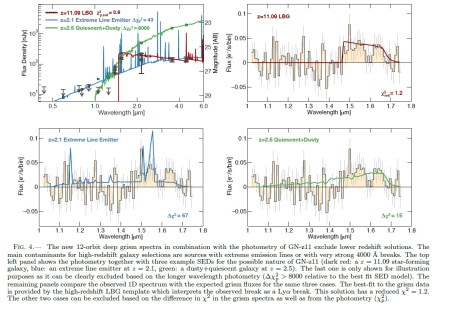
I have taken the liberty of extracting the following figure:

Grism

The claim is that the model spectrum on the top right is a much better fit to the data obtained using the Hubble Space Telescope Grism spectrograph than the two alternatives at much lower redshift. However, this depends a great deal on having a good model for the significant contamination from other sources. Moreover I’m sure the residuals are non-Gaussian and I’m not therefore convinced that a simple χ2 is the best way to assess the fit. Obviously I’d like to see a proper Bayesian model comparison!

So, as I have been on previous occasions (e.g. here), I remain not entirely convinced. But then I’m a theorist who is always excessively suspicious of data. Any experts out there want to tell me I’m wrong?


Cosmology at MaxEnt in Ghent

Posted in Talks and Reviews, The Universe and Stuff on March 3, 2016 by telescoper

It seems I am an invited speaker at MaxEnt 2016, the 36th Workshop on Bayesian Inference and Maximum Entropy Methods:

maxent

As well as talking about some of my own research I’ve been asked to include a bit of a review in my presentation. I haven’t quite decided what background stuff to include so thought a bit of crowdsourcing was called for. Anyone got any suggestions for important Bayesian/Maximum Entropy developments in cosmology?

If so, please offer them through the comments box!

P.S. Anyone know where Ghent is?

The Great Gravitational Wave Source Follow-Up

Posted in The Universe and Stuff with tags , , , on March 1, 2016 by telescoper

I recently noticed on the arXiv  an interesting paper with 1562 authors!

Here is the abstract:

A gravitational-wave transient was identified in data recorded by the Advanced LIGO detectors on 2015 September 14. The event candidate, initially designated G184098 and later given the name GW150914, is described in detail elsewhere. By prior arrangement, preliminary estimates of the time, significance, and sky location of the event were shared with 63 teams of observers covering radio, optical, near-infrared, X-ray, and gamma-ray wavelengths with ground- and space-based facilities. In this Letter we describe the low-latency analysis of the gravitational wave data and present the sky localization of the first observed compact binary merger. We summarize the follow-up observations reported by 25 teams via private Gamma-ray Coordinates Network Circulars, giving an overview of the participating facilities, the gravitational wave sky localization coverage, the timeline and depth of the observations. As this event turned out to be a binary black hole merger, there is little expectation of a detectable electromagnetic signature. Nevertheless, this first broadband campaign to search for a counterpart of an Advanced LIGO source represents a milestone and highlights the broad capabilities of the transient astronomy community and the observing strategies that have been developed to pursue neutron star binary merger events. Detailed investigations of the electromagnetic data and results of the electromagnetic follow-up campaign will be disseminated in the papers of the individual teams.

This is interesting not so much for the result – there wasn’t really any expectation of finding an electromagnetic counterpart of a binary black-hole merger – but that it’s the first example of the kind of mass mobilisation of astronomers that will be needed when gravitational-wave astronomy gets going in earnest. Astronomers working on transient sources such as gamma-ray bursts are already used to this kind of operation, but there’s going to be a lot more of it in the future!


Making Massive Black Hole Binaries Merge

Posted in The Universe and Stuff with tags , , , , , on February 16, 2016 by telescoper

Many fascinating questions remain unanswered by last week’s detection of gravitational waves produced by a coalescing binary black hole system (GW150914) by LIGO. One of these is whether the fact that the similarity of the component masses (29 and 36 times the mass of the Sun respectively) is significant.

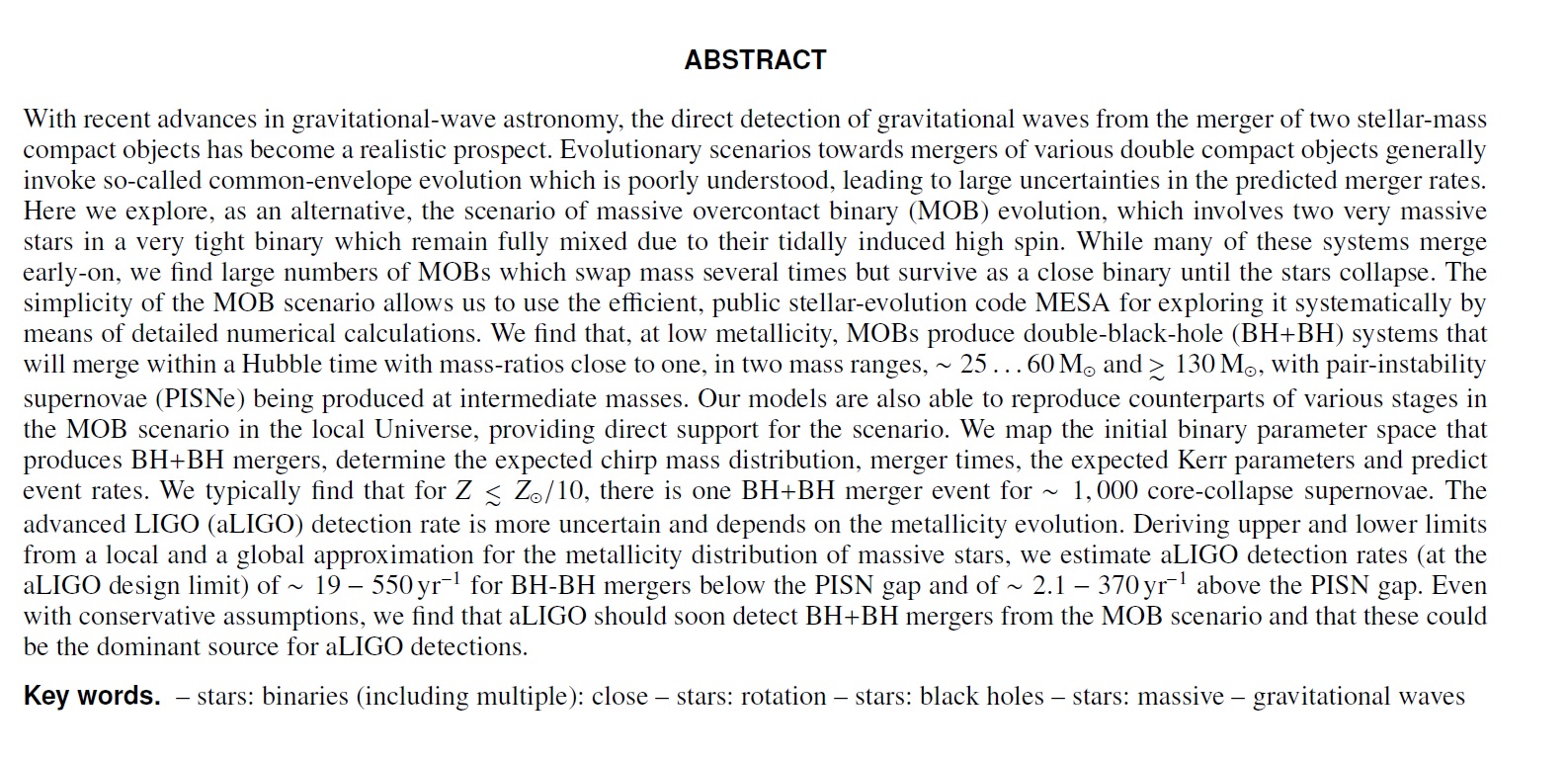
An interesting paper appeared on the arXiv last week by Marchant et al. that touches on this. Here is the abstract (you can click on it to make it larger):

BinaryBH


Although there is some technical jargon, the point is relatively clear. It appears that very masssive, very low metallicity binary stars can evolve into black hole binary systems via supernova explosions without disrupting their orbit. The term ‘low metallicity’ characteristises stars that form from primordial material (i.e. basically hydrogen and helium) early in the cycle of stellar evolution. Such material has very different opacity properties from material with significant quantities of heavier elements in it, which alters the dynamical evolution considerably.

(Remember that to an astrophysicist, chemistry is extremely simple. Hydrogen and helium make up most of the atomic matter in the Universe; all the rest is called “metals” including carbon, nitrogen, and oxygen…. )

Anyway, this theoretical paper is relevant because the mass ratios produced by this mechanism are expected to be of order unity, as is the case of GW150914.  One observation doesn’t prove much, but it’s definitely Quite Interesting…

Incidentally, it has been reported that another gravitational wave source may have been detected by LIGO, in October last year. This isn’t as clean a signal as the first, so it will require further analysis before a definitive result is claimed, but it too seems to be a black hole binary system with a mass ratio of order unity…

You wait forty years for a gravitational wave signal from a binary black hole merger and then two come along in quick succession…


Lessons from LIGO

Posted in The Universe and Stuff with tags , , , on February 13, 2016 by telescoper

At the end of a very exciting week I had the pleasure last night of toasting LIGO and the future of gravitational wave astronomy with champagne at the RAS Club in London. Two members of the LIGO collaboration were there, Alberto Vecchio and Mike Cruise (both from Birmingham); Alberto had delivered a very nice talk earlier in the day summarising the LIGO discovery while Mike made a short speech at the club.

This morning I found this interesting video produced by California Institute of Technology (CalTech) which discusses the history of the LIGO experiment:

It has taken over 40 years of determination and hard work to get this far. You can see pictures of some of the protagonists from Thursday’s press conference, such as Kip Thorne, when they were much younger. I bet there were times during the past four decades when they must have doubted that they would ever get there, but they kept the faith and now can enjoy the well-deserved celebrations. They certainly will all be glad they stuck with gravitational waves now, and all must be mighty proud!

Mike Cruise made two points in his speech that I think are worth repeating here. One is that we think of the LIGO discovery is a triumph of physics. It is that, of course. But the LIGO consortium of over a thousand people comprises not only physicists, but also various kinds of engineers, designers, technicians and software specialists. Moreover the membership of LIGO is international. It’s wonderful that people from all over the world can join forces, blend their skils and expertise, and achieve something remarkable. There’s a lesson right there for those who would seek to lead us into small-minded isolationism.

The other point was that the LIGO discovery provides a powerful testament for university research. LIGO was a high-risk experiment that took decades to yield a result. It’s impossible to imagine any commercial company undertaking such an endeavour, so this could only have happened in an institution (or, more correctly, a network of institutions) committed to “blue skies” science. This is research done for its own sake, not to create a short-term profit but to enrich our understanding of the Universe. Asking  profound questions and trying to answer them is one of the things that makes us human. It’s a pity we are so obsessed with wealth and property that we need to be reminded of this, but clearly we do.

The current system of Research Assessment in the UK requires university research to generate “impact” outside the world of academia in a relatively short timescale. That pressure is completely at odds with experiments like LIGO. Who would start a physics experiment now that would take 40 years to deliver?  I’ve said it time and time again to my bosses at the University of Sussex that if you’re serious about supporting physics you have to play a long game because it requires substantial initial investment and generates results only very slowly.  I worry what future lies in store for physics if the fixation on market-driven research continues much longer.

Finally, I couldn’t resist making a comment about another modern fixation – bibliometrics. The LIGO discovery paper in Physical Review Letters has 1,004 authors. By any standard this is an extraordinarily significant article, but because it has over a thousand authors it stands to be entirely excluded by the Times Higher when they compile the next World University Rankings.  Whatever the science community or the general public thinks about the discovery of gravitational waves, the bean-counters deem it worthless. We need to take a stand against this sort of nonsense.