It’s been an astronomical and meteorological rollercoaster of a morning. When I woke up at 6am this morning, the Sun was just rising. There was hazy cloud and there seemed to be every chance that it would break up to allowing viewing of today’s partial solar eclipse. Unfortunately, however, the cloud thickened rather than breaking up so I abandoned my plan to watch from the seafront and headed up to the University of Sussex campus at Falmer. Being higher up and a few miles inland, the weather is often clearer in Falmer than in Brighton. Unfortunately it was even murkier when I got here, so I assumed I was in for a disappointing morning.
Nevertheless I did join the large gathering in Library Square to experience the event. First contact between the Moon and the Sun happened at about 8.30, but the cloud cover was total at that point so nothing was visible. It did get gradually darker, but this happened slowly enough for eyes to adapt to the dark so it wasn’t all that noticeable to us humans. The birds on campus certainly noticed, however, and began to perform display roosting behaviour thinking it was evening. It also got really very cold.
Around 9.30 the coverage of the Sun by the Moon was about its maximum – 85% or so – but everything was still enshrouded in cloud. The crowd waited patiently in the gloom. It was a very British experience, a large group of people sharing their sense of collective disappointment in appropriately stoical fashion.
Gradually the wind seemed to increase, pushing the clouds over more quickly and causing them to break up. Then, suddenly, a small gap in the cloud opened up and there was the eclipse. For about a second. It may have been only a moment, but it generated a huge cheer which, I should add, wasn’t entirely ironic. The breaking up of the clouds continued and we were treated to several good views of the main event. It was definitely worth it.
Most of the pictures I took didn’t come out at all well, but here is one with the famous Meeting House in the foreground:
And here’s a rather nice picture from John Sander of the International Office at Sussex University, showing yours truly during the final stages of the eclipse..
I’ll add more pictures as I find them. Please feel free to share your comments and observations via the appropriate box!
As you will no doubt be aware, tomorrow there will be a Partial Eclipse of the Sun visible from the United Kingdom. Here’s a handy guide, courtesy of the Met Office, to the time and maximum fraction of the Sun’s disk that will be obscured.
Unfortunately the weather forecast for Brighton isn’t marvellous so it’s possible that the main event will be obscured by cloud and all we experience is that an already dark and gloomy morning gets even darker and gloomier.
However, in the event that the weather forecast turns out to be inaccurate, which is far from unheard of, please make sure you follow the official Royal Astronomical Society guidelines to make sure you observe it safely.
And while I’m at it, here is a video of a nice lecture by Ian Ridpath explaining all about Solar and Lunar Eclipses.
As a spectacle a partial solar eclipse is pretty exciting – as long as it’s not cloudy – but even a full view of one can’t really be compared with the awesome event that is a total eclipse. I’m lucky enough to have observed one and I can tell you it was truly awe-inspiring.
If you think about it, though, it’s rather odd that such a thing is possible at all. In a total eclipse, the Moon passes between the Earth and the Sun in such a way that it exactly covers the Solar disk. In order for this to happen the apparent angular size of the Moon (as seen from Earth) has to be almost exactly the same as that of the Sun (as seen from Earth). This involves a strange coincidence: the Moon is small (about 1740 km in radius) but very close to the Earth in astronomical terms (about 400,000 km away). The Sun, on the other hand, is both enormously large (radius 700,000 km) and enormously distant (approx. 150,000,000 km). The ratio of radius to distance from Earth of these objects is almost identical at the point of a a total eclipse, so the apparent disk of the Moon almost exactly fits over that of the Sun. Why is this so?
The simple answer is that it is just a coincidence. There seems no particular physical reason why the geometry of the Earth-Moon-Sun system should have turned out this way. Moreover, the system is not static. The tides raised by the Moon on the Earth lead to frictional heating and a loss of orbital energy. The Moon’s orbit is therefore moving slowly outwards from the Earth. I’m not going to tell you exactly how quickly this happens, as it is one of the questions I set my students in the module Astrophysical Concepts I’ll be starting in a few weeks, but eventually the Earth-Moon distance will be too large for total eclipses of the Sun by the Moon to be possible on Earth, although partial and annular eclipses may still be possible.
It seems therefore that we just happen to be living at the right place at the right time to see total eclipses. Perhaps there are other inhabited moonless planets whose inhabitants will never see one. Future inhabitants of Earth will have to content themselves with watching eclipse clips on Youtube.
Things may be more complicated than this though. I’ve heard it argued that the existence of a moon reasonably close to the Earth may have helped the evolution of terrestrial life. The argument – as far as I understand it – is that life presumably began in the oceans, then amphibious forms evolved in tidal margins of some sort wherein conditions favoured both aquatic and land-dwelling creatures. Only then did life fully emerge from the seas and begin to live on land. If it is the case that the existence of significant tides is necessary for life to complete the transition from oceans to solid ground, then maybe the Moon played a key role in the evolution of dinosaurs, mammals, and even ourselves.
I’m not sure I’m convinced of this argument because, although the Moon is the dominant source of the Earth’s tides, it is not overwhelmingly so. The effect of the Sun is also considerable, only a factor of three smaller than the Moon. So maybe the Sun could have done the job on its own. I don’t know.
That’s not really the point of this post, however. What I wanted to comment on is that astronomers generally don’t question the interpretation of the occurence of total eclipses as simply a coincidence. Eclipses just are. There are no doubt many other planets where they aren’t. We’re special in that we live somewhere where something apparently unlikely happens. But this isn’t important because eclipses aren’t really all that significant in cosmic terms, other than that the law of physics allow them.
On the other hand astronomers (and many other people) do make a big deal of the fact that life exists in the Universe. Given what we know about fundamental physics and biology – which admittedly isn’t very much – this also seems unlikely. Perhaps there are many other worlds without life, so the Earth is special once again. Others argue that the existence of life is so unlikely that special provision must have been made to make it possible.
Before I find myself falling into the black hole marked “Anthropic Principle” let me just say that I don’t see the existence of life (including human life) as being of any greater significance than that of a total eclipse. Both phenomena are (subjectively) interesting to humans, both are contingent on particular circumstances, and both will no doubt cease to occur at some point in perhaps not-too-distant the future. Neither tells us much about the true nature of the Universe.
Perhaps we should just face up to the fact that we’re just not very significant….
Just a quick post to advertise the fact that the BBC Television series Stargazing Live will be broadcast in the evenings this week from Wednesday 18th to Friday 20th March, 2015. The programme is hosted by Professor Brian Cox and Dara O Briain and will be beamed to you (or at least to those of you who have television sets) from Jodrell Bank, which is near Manchester (in the Midlands).
Closer to home, at least for those of you whose home is closer to mine than it is to Jodrell Bank, the Department of Physics & Astronomy at the University of Sussex will be running a series of astronomical activities (including planetarium shows, observing sessions and lectures) for all ages to coincide with the programme tonight (i.e. Wednesday 18th March). This also takes place within One World Week at the University of Sussex, which gives it added interest for both staff and students. There’s nothing like astronomy to make you aware of our shared existence on this little planet…
There are two sessions this evening. One is from 6pm to 7.30pm and the other from 8pm to 9.30pm. You can find full details of both sessions here, but here’s a taster of the menu for the earlier session:
It’s lovely and sunny on Sussex University campus as I write this, and the forecast is good for this evening too. Might we be able to get a glimpse of the Aurorae that lit up the skies over Britain last night? I can’t promise that, but there’s a chance! Sadly the forecast for Friday’s partial solar eclipse is not so good, but we live in hope.
Anyway, wherever you are and whatever you do this evening, here’s wishing you Happy Stargazing!
In that great journey of the stars through space About the mighty, all-directing Sun, The pallid, faithful Moon, has been the one Companion of the Earth. Her tender face, Pale with the swift, keen purpose of that race, Which at Time’s natal hour was first begun, Shines ever on her lover as they run And lights his orbit with her silvery smile.
Sometimes such passionate love doth in her rise, Down from her beaten path she softly slips, And with her mantle veils the Sun’s bold eyes, Then in the gloaming finds her lover’s lips. While far and near the men our world call wise See only that the Sun is in eclipse.
There’s been quite a lot going on recently to do with the Square Kilometre Array (SKA), some of it scientific and some of it political, some of it good and some of it bad. At least those seem to me to be the appropriate descriptions.
First the scientific good news is the the SKA Board has decided which of the planned components of SKA should be constructed during the first phase, which has a budget of around €650M. Details can be found here but, in a nutshell, it seems that the SKA Survey Telescope, which was to be built around the existing pathfinder project ASKAP located in Australia is not going to be built in the first phase. This implies the low-frequency bit of SKA will be in Australia while the higher-frequency activities will be concentrated in South Africa. That seems a pragmatic decision to me based on the budgetary constraints and should lead to a lot of good science being done. At the very least it’s a clear decision.
This positive news has however been overshadowed by an unseemly spat over the choice of headquarters over the location of the SKA Headquarters which has culminated in a rather unhelpful story in Nature. SKA HQ has been temporarily housed at Jodrell Bank Observatory (in the Midlands) since 2012 and there are clearly some who would like it to be located there permanently. There is however a rival bid, from the historic Italian city of Padova, at whose university Galileo Galilei once lectured, and which remains one of the top universities in Italy.
I should put my cards on the table and say that I’ve enjoyed many visits to Padova in my career, starting when I was a PhD student back in the 1980s and have many fond memories of the place. The late co-author of my cosmology textbook, Francesco Lucchin was Director of the Department of Astronomy in Padova at that time. For many years Padova has been home to a large concentration of astronomers and is undoubtedly a centre of excellence. Moreover it is a city that is very well served by transport links, just a short distance from Venice so easily reachable by air, and also on a major railway line offering fast national and international services. It’s also a considerably better place to dine out than Jodrell Bank!
Padova’s astronomers are housed in the Castello Carrese which adjoins the Specola (above), a tower which was once a working astronomical observatory but, being right in the city centre, has not been useful for such purposes for many moons. When I first started going to Padova the Department of Astronomy was located in the tower and in some nearby buildings but the rest of the Castello Carrese was used as a prison. Now it’s been renovated and all the astronomers have been located there. I remember the frequent walks across the little bridge over the canal to a coffee bar where we often did some of our best research!
Given its strategically important location, Padova was bombed by Allied planes on a number of occasions in 1944 and 1945. My Italian colleagues would regularly draw my attention to the plaque near the entrance to the Specola pointing out that it was hit and badly damaged by Allied bombs during one raid.
Anyway I can certainly see the merits of locating SKA HQ in Padova but it’s not my decision to make. Those responsible have not yet made a final decision, but what’s sad is that a number of stories have been flying around in the media that imply that the UK is trying to exert undue political interference to stop SKA HQ being moved to Italy. Whether this is true or not I don’t know. As far as I’m concerned the powers that be are following proper process and that process has not yet been brought to a conclusion. Whatever the outcome, though, there’s no question that the language being used in the press coverage is very damaging. Let’s hope it can all be resolved amicably.
Now for a spot of lunch and then up to the Royal Astronomical Society where the topic of the Discussion Meeting is, somewhat ironically, Building an Open UK SKA-Science Consortium…
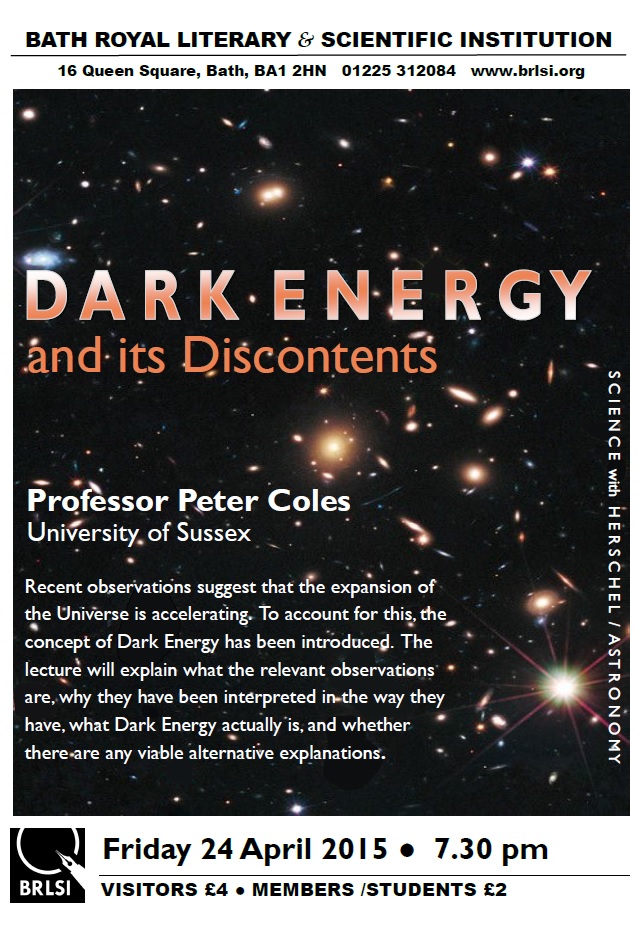
Busy again today, so just time for a spot of gratuitous self-promotion. I shall be giving a public lecture on Friday 24th April 2015 at the very posh-sounding Bath Royal Literary and Scientific Institution. Here is the poster, which explains all. Will I see any readers of this blog there?
It’s a small universe world. This lunchtime I turned up to the local Cosmology discussion group for a talk on reheating after inflation during which the topic of parametric resonance came up. To illustrate the concept the speaker showed this nice video, and there was my esteemed former University of Nottingham colleague and fellow jazz enthusiast Roger Bowley explaining all!
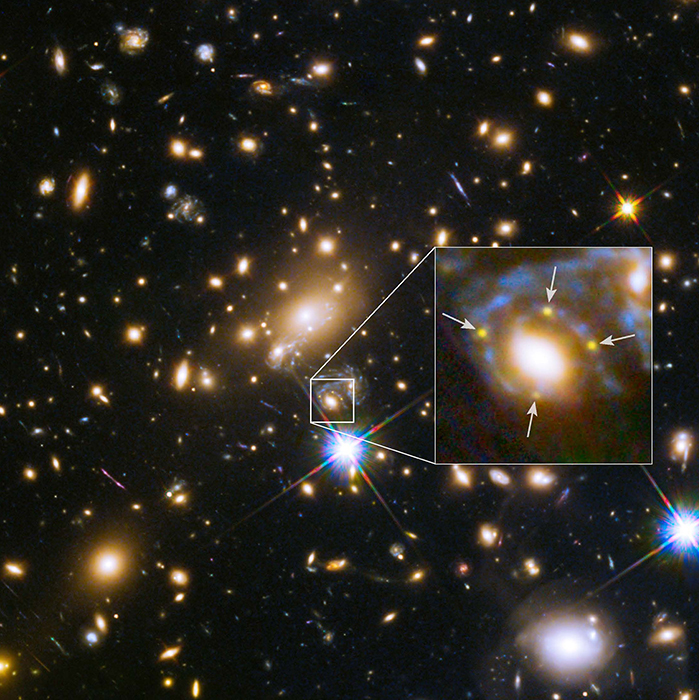
In 1964, Refsdal hypothesized that a supernova whose light traversed multiple paths around a strong gravitational lens could be used to measure the rate of cosmic expansion. We report the discovery of such a system. In Hubble Space Telescope imaging, we have found four images of a single supernova forming an Einstein cross configuration around a redshift z = 0.54 elliptical galaxy in the MACS J1149.6+2223 cluster. The cluster’s gravitational potential also creates multiple images of the z = 1.49 spiral supernova host galaxy, and a future appearance of the supernova elsewhere in the cluster field is expected. The magnifications and staggered arrivals of the supernova images probe the cosmic expansion rate, as well as the distribution of matter in the galaxy and cluster lenses.
And here’s a nice picture of the system which I ripped of from a nice report inPhysics World:
Multiple images of background objects caused by gravitational lensing have been observed before, but the key thing about this particular “Einstein Cross” is that the background object is a type of exploding star called a supernova. That means that the light it emits will decay over time. That light reaches us via four different paths around the intervening galaxy cluster so monitoring the different evolution in the four images will yield direct measurements of the physical scale of the cluster and hopefully answer a host of interesting cosmological questions.
A bit busy today so I just have time for another quick plug of this year’s Royal Astronomical SocietyNational Astronomy Meeting, which will be taking place at the splendid Venue Cymru conference centre, Llandudno, North Wales, from Sunday 5th July to Thursday 9th July 2015. I’ve posted most of this before, but I thought I’d post it again because today is the day that registration opened; you can sign up by following the link from here.
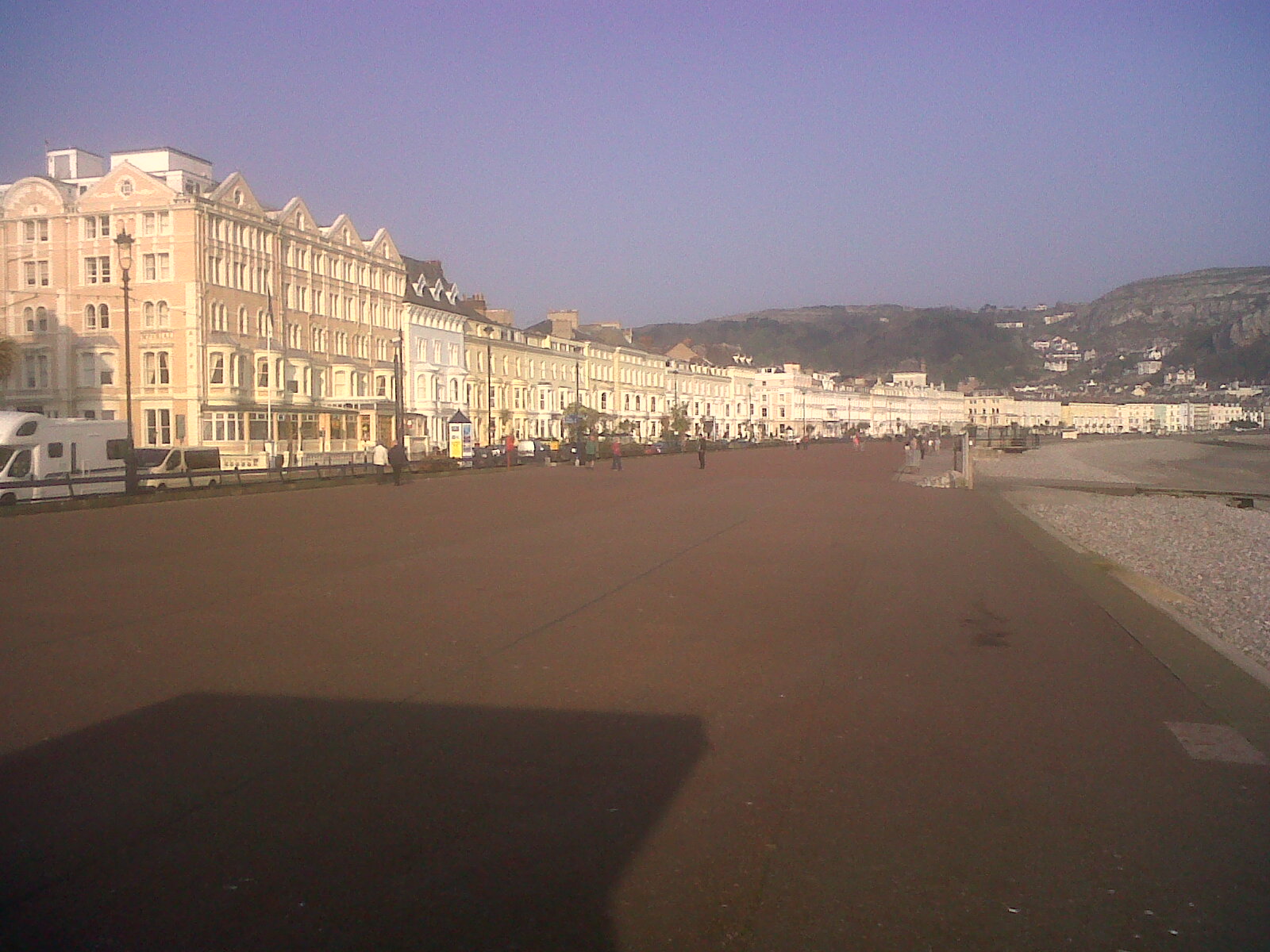
To whet your appetite, here are some pictures of lovely Llandudno I took at the last National Astronomy Meeting there, back in 2011.
The draft science programme is available and you can also find a full list of parallel sessions here. You can also submit proposals for contributed talks and posters for any of the sessions, including the one I’m organizing described below.
If you’re on Twitter you can keep up-to-date with developments by following their Twitter feed:
I’m actually on the Scientific Organizing Committee for NAM 2015 and as such I’ll be organizing a part of this meeting, namely a couple of sessions on Cosmology under the title Cosmology Beyond the Standard Model, with the following description.
Recent observations, particularly those from the Planck satellite, have provided strong empirical foundations for a standard cosmological model that is based on Einstein’s general theory of relativity and which describes a universe which is homogeneous and isotropic on large scales and which is dominated by dark energy and matter components. This session will explore theoretical and observational challenges to this standard picture, including modified gravity theories, models with large-scale inhomogeneity and/or anisotropy, and alternative forms of matter-energy. The aim will be to both take stock of the evidence for, and stimulate further investigation of, physics beyond the standard model.
It’s obviously quite a broad remit so I hope that there will be plenty of contributed talks and posters. NAM is a particularly good opportunity for younger researchers – PhD students and postdocs – to present their work to a big audience so I particularly encourage such persons to submit abstracts. Would more senior readers please pass this message on to anyone they think might want to give a talk?
If you have any questions please feel free to use the comments box (or contact me privately).
There’s been a lot of news coverage this week about a very big black hole, so I thought I’d post a little bit of background. The paper describing the discovery of the object concerned appeared in Nature this week, but basically it’s a quasar at a redshift z=6.30. That’s not the record for such an object. Not long ago I posted an item about the discovery of a quasar at redshift 7.085, for example. But what’s interesting about this beastie is that it’s a very big beastie, with a central black hole estimated to have a mass of around 12 billion times the mass of the Sun, which is a factor of ten or more larger than other objects found at high redshift.
Anyway, I thought perhaps it might be useful to explain a little bit about what difficulties this observation might pose for the standard “Big Bang” cosmological model. Our general understanding of galaxies form is that gravity gathers cold non-baryonic matter into clumps into which “ordinary” baryonic material subsequently falls, eventually forming a luminous galaxy forms surrounded by a “halo” of (invisible) dark matter. Quasars are galaxies in which enough baryonic matter has collected in the centre of the halo to build a supermassive black hole, which powers a short-lived phase of extremely high luminosity.
The key idea behind this picture is that the haloes form by hierarchical clustering: the first to form are small but merge rapidly into objects of increasing mass as time goes on. We have a fairly well-established theory of what happens with these haloes – called the Press-Schechter formalism – which allows us to calculate the number-density of objects of a given mass as a function of redshift . As an aside, it’s interesting to remark that the paper largely responsible for establishing the efficacy of this theory was written by George Efstathiou and Martin Rees in 1988, on the topic of high redshift quasars.
Anyway, this is how the mass function of haloes is predicted to evolve in the standard cosmological model; the different lines show the distribution as a function of redshift for redshifts from 0 (red) to 9 (violet):
Note that the typical size of a halo increases with decreasing redshift, but it’s only at really high masses where you see a really dramatic effect. The plot is logarithmic, so the number density large mass haloes falls off by several orders of magnitude over the range of redshifts shown. The mass of the black hole responsible for the recently-detected high-redshift quasar is estimated to be about . But how does that relate to the mass of the halo within which it resides? Clearly the dark matter halo has to be more massive than the baryonic material it collects, and therefore more massive than the central black hole, but by how much?
This question is very difficult to answer, as it depends on how luminous the quasar is, how long it lives, what fraction of the baryons in the halo fall into the centre, what efficiency is involved in generating the quasar luminosity, etc. Efstathiou and Rees argued that to power a quasar with luminosity of order for a time order years requires a parent halo of mass about . Generally, i’s a reasonable back-of-an-envelope estimate that the halo mass would be about a hundred times larger than that of the central black hole so the halo housing this one could be around .
You can see from the abundance of such haloes is down by quite a factor at redshift 7 compared to redshift 0 (the present epoch), but the fall-off is even more precipitous for haloes of larger mass than this. We really need to know how abundant such objects are before drawing definitive conclusions, and one object isn’t enough to put a reliable estimate on the general abundance, but with the discovery of this object it’s certainly getting interesting. Haloes the size of a galaxy cluster, i.e. , are rarer by many orders of magnitude at redshift 7 than at redshift 0 so if anyone ever finds one at this redshift that would really be a shock to many a cosmologist’s system, as would be the discovery of quasars with such a high mass at redshifts significantly higher than seven.
Another thing worth mentioning is that, although there might be a sufficient number of potential haloes to serve as hosts for a quasar, there remains the difficult issue of understanding precisely how the black hole forms and especially how long it takes to do so. This aspect of the process of quasar formation is much more complicated than the halo distribution, so it’s probably on detailed models of black-hole growth that this discovery will have the greatest impact in the short term.
The views presented here are personal and not necessarily those of my employer (or anyone else for that matter).
Feel free to comment on any of the posts on this blog but comments may be moderated; anonymous comments and any considered by me to be vexatious and/or abusive and/or defamatory will not be accepted. I do not necessarily endorse, support, sanction, encourage, verify or agree with the opinions or statements of any information or other content in the comments on this site and do not in any way guarantee their accuracy or reliability.
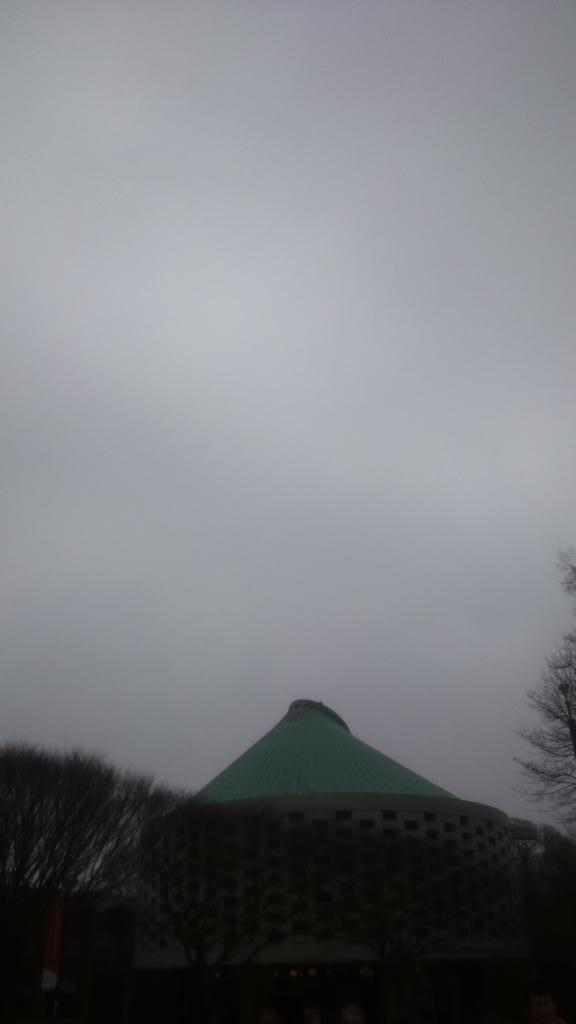 less I did join the large gathering in Library Square to experience the event. First contact between the Moon and the Sun happened at about 8.30, but the cloud cover was total at that point so nothing was visible. It did get gradually darker, but this happened slowly enough for eyes to adapt to the dark so it wasn’t all that noticeable to us humans. The birds on campus certainly noticed, however, and began to perform display roosting behaviour thinking it was evening. It also got really very cold.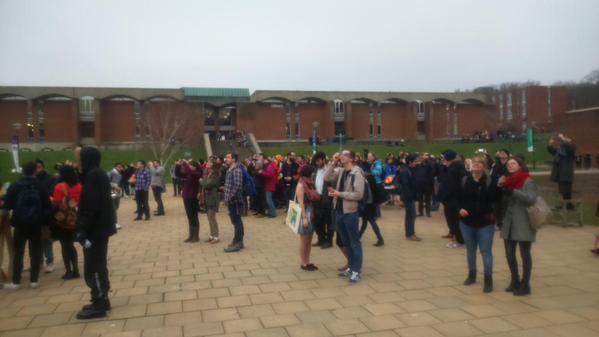
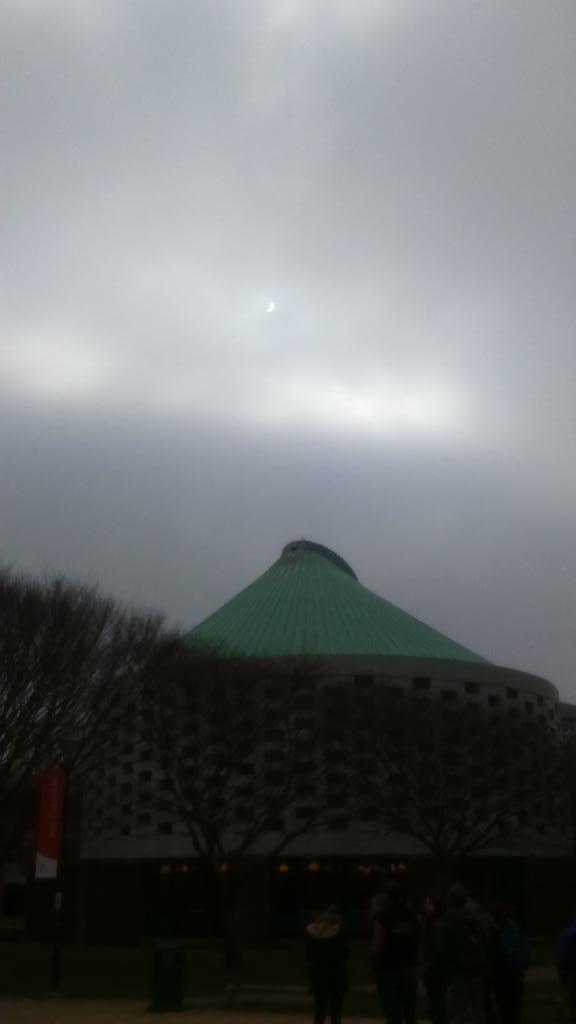 And here’s a rather nice picture from John Sander of the International Office at Sussex University, showing yours truly during the final stages of the eclipse..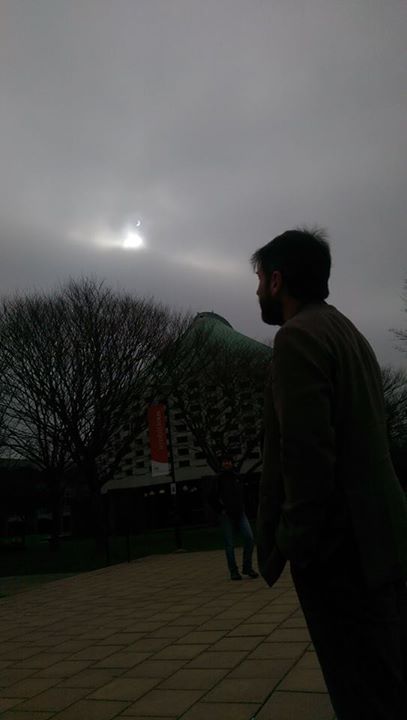




 of objects of a given mass
  as a function of redshift
  . As an aside, it’s interesting to remark that the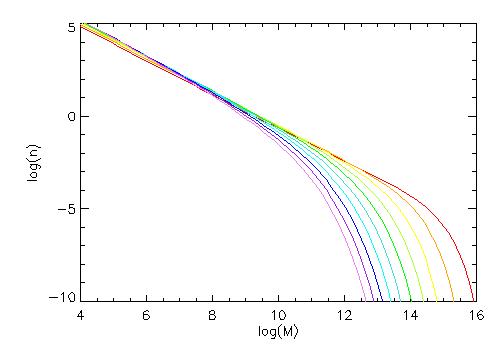
 . But how does that relate to the mass of the halo within which it resides? Clearly the dark matter halo has to be more massive than the baryonic material it collects, and therefore more massive than the central black hole, but by how much?
 for a time order
  years requires a parent halo of mass about
  . Generally, i’s a reasonable back-of-an-envelope estimate that the halo mass would be about a hundred times larger than that of the central black hole so the halo housing this one could be around
  .
. , are rarer by many orders of magnitude at redshift 7 than at redshift 0 so if anyone ever finds one at this redshift that would really be a shock to many a cosmologist’s system, as would be the discovery of quasars with such a high mass at redshifts significantly higher than seven.

