Archive for the The Universe and Stuff Category

Ode to SnarXiv

Posted in The Universe and Stuff with tags , , , , on April 30, 2014 by telescoper

So many things pass me by these days that I’m not usually surprised when I have no idea what people around me are talking about. I am however quite surprised that, until yesterday, never heard of the snarXiv. As its author explains:

The snarXiv is a ran­dom high-energy the­ory paper gen­er­a­tor incor­po­rat­ing all the lat­est trends, entropic rea­son­ing, and excit­ing mod­uli spaces. The arXiv is sim­i­lar, but occa­sion­ally less ran­dom.

The snarXiv uses “Context Free Grammar” together with a database of stock words and phrases to generate its content, which is actually just limited to titles and abstracts rather than entire papers. It’s just a matter of time, though. The results are variable, with some making no sense at all even by the standards of theoretical particle physics, but the best are almost good enough to pass off as real abstracts.

Here’s an example in the form of the abstract of a paper called (P,q) Brane Probe Predicted From Conformal Blocks:

Recently, work on new inflation has opened up a perturbative class of braneworld matrix models. We make contact with observables, moreover investigating trivial Beckenstein-Boltzmann equations. Next, using the behavior of a left-right reduction of models of WIMPs, we reformulate instanton liquids at the LHC. After discussing positrons, we check that worldsheet symmetric central charges are equivalent to electric-duality in gravity. Finally, we make contact with a special lagrangian brane, surprisingly obtaining models of inertial fluctuations.

Why not have a go at arXiv versus SnarXiv to see if you can spot the genuine article titles?

I’m tempted, with a nod in the light of the Sokal Affair, to suggest that a similar approach used in the social sciences, but the thing that really struck me is that someone should do a snarXiv for astronomy and astrophysics. Or is someone going to tell me it already exists?

Come to think of it, judging by some of the proposals I’ve read while serving on the Astronomy Grants Panel over the years, a similar generator may already exist for writing grant applications…

Promoting Women in Physics at Sussex

Posted in Education, The Universe and Stuff with tags , , , , , on April 28, 2014 by telescoper

At the end of a very busy day of meetings I suddenly remembered that I forgot to pass on a nice bit of news about the Department of Physics & Astronomy at the University of Sussex.

It doesn’t seem very long ago at all that I announced the promotion of its first ever female Professor of Physics in the Department, Prof. Antonella de Santo. In fact it was in July last year. Well, just before the Easter break I was delighted at the promotion panel’s decision  to appoint the second female Professor in the Department. The successful candidate this time was Clauda Eberlein, who has been promoted to a Chair in Theoretical Physics with immediate effect.

I’ve already posted about how the proportion of female undergraduates studying physics as been stuck at around the 20% mark for a decade despite strenuous efforts to widen participation. A recent (2012) study by the Institute of Physics contains a wealth of statistical information about staff in Physics departments, which I encourage people to read if they’re interested in the overall issue with equality and diversity in physics. Here I’ll just pull out the figure (based on a 2010 survey) that out of a total of 650 Professors of Physics (and/or Astronomy) in the UK, just 5.5% were female. At that date about 20 physics departments had no female professors at all; that would have included Sussex, of course.

The first ever female Professor of Physics in the United Kingdom was Daphne Jackson, a nuclear physicist, who took up her Chair at the University of Surrey way back in 1971. It’s interesting to note that when Daphne Jackson studied physics as an undergraduate at Imperial College she was one of only two women among the 88 undergraduates in her year.

Congratulations to Claudia on her promotion, but the news doesn’t end there. Claudia will actually be taking over as Head of the Department of Physics & Astronomy in January 2015. She is currently Director of Teaching and Learning for the School of Mathematical and Physical Sciences and will take up her new role when the current Head of Physics & Astronomy, Philip Harris, stands down, having served his term in admirable fashion. Anyway, when Claudia takes up her post as Head of Department she will join an elite band of female physicists to have been appointed to such a role. Does anyone out there know how many other women have headed a Physics department?


Magnetic River

Posted in Education, The Universe and Stuff with tags , , on April 15, 2014 by telescoper

I stumbled across this yesterday as a result of an email from a friend who shall remain nameless (i.e. Anton). I remember seeing Prof. Eric Laithwaite on the television quite a few times when I was a kid. What I found so interesting about watching this so many years later is that it’s still so watchable and compelling. No frills, no gimmicks, just very clear explanation and demonstrations, reinforced by an aura of authoritativeness that makes you want to listen to him. If only more modern science communication were as direct as this.  I suppose part of the appeal is that he speaks with an immediately identifiable no-nonsense accent, from the part of the Midlands known as Lancashire….


Awards and Rewards

Posted in Beards, Biographical, Education, The Universe and Stuff with tags , , on April 14, 2014 by telescoper

A surge in the polls for footballer John Brayford of Sheffield United (in the Midlands) has left my dreams of the coveted title of Beard of Spring in ruins. I’m still in second place, but with the leader on 83.7% I think I’ll shortly be writing my concession speech…

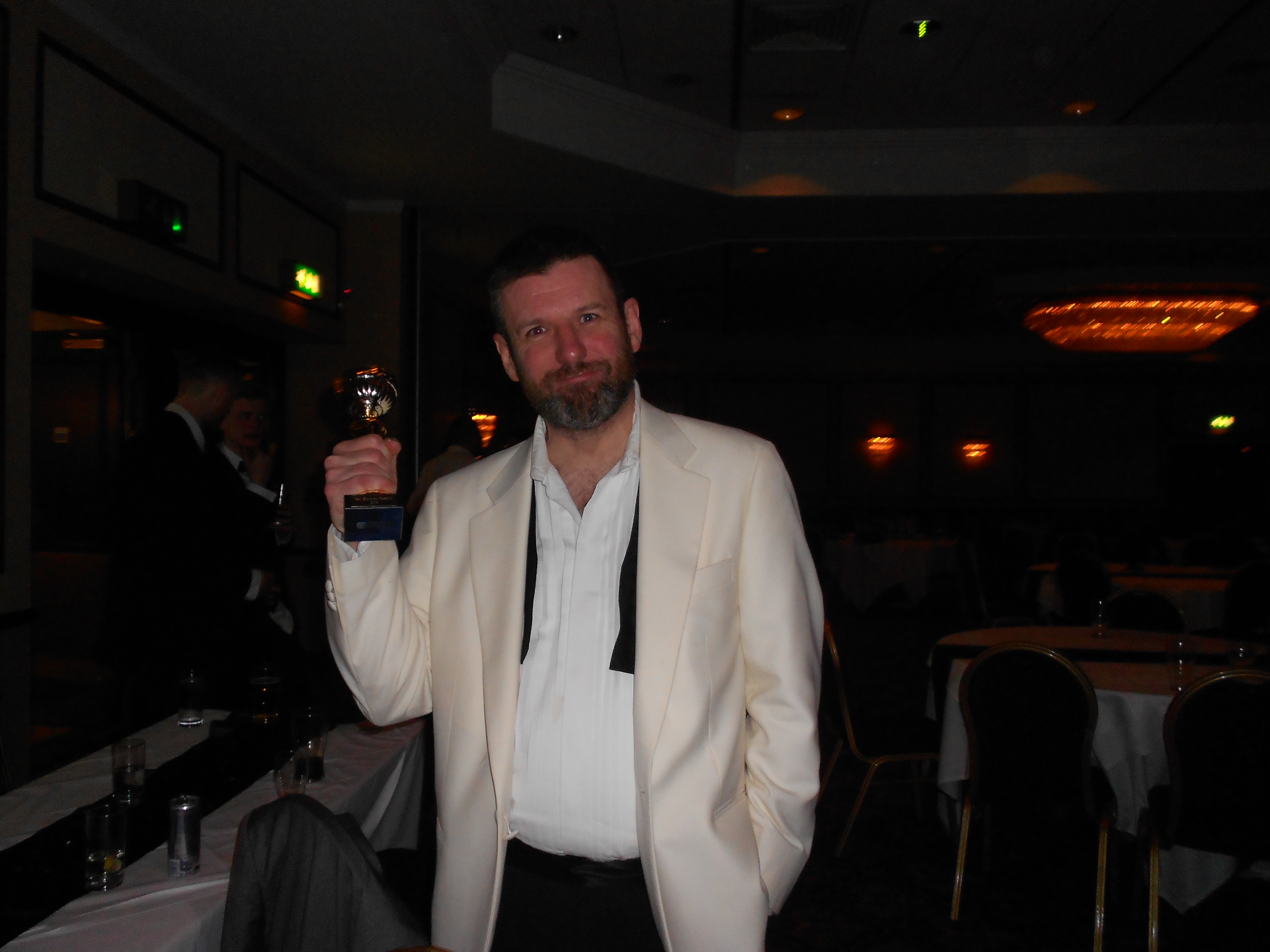
Fortunately, however my disappointment at fading into oblivion in one competition has been more than adequately offset by joy at being awarded a Prize by students from the Department of Physics & Astronomy at the University of Sussex. You could have knocked me down with a feather (had I not been seated) when they announced my name as winner of the award for Best Expressed Research. Here’s the trophy:

award

I’m assuming that it’s solid gold, although it’s surprisingly light to carry. I’m not sure where I should store it until next year when presumably it will be handed onto someone else. It did occur to me to send it up to Newcastle United. At least that way they will have something to put in their trophy cabinet…

DSCN1446

Anyway, I’d like to thank everyone who voted for me, although I’m still not at all sure what “Best Expressed Research” actually means nor do I know what I did in particular to deserve the award. Not that any of that really matters. It’s honour enough to be working in a Department that’s part of a School where there’s such a wonderful friendly and cooperative atmosphere between staff and students. I’ve worked in some good physics departments in my time, but the Department of Sussex is completely unique both for the level of support it offers students and the fact that so many of the undergraduates are so highly motivated. Maybe that’s at least partly because there is such a close link between our teaching and research across the Department. Some people think – and some universities would have them think – that research-led teaching only happens in Russell Group institutions. In reality there’s plenty of evidence that, at least in Physics, Sussex does research-led teaching better than any of the Russell group.

Amid all the administrative jobs I have to do these days the opportunity to do a bit of teaching every now and then is the only chance I have of staying even approximately sane. I’m not sure how many other Heads of School at Sussex University do teaching – I’m told my predecessor in the School of Mathematical and Physical Sciences didn’t do any – but the day I have to stop teaching is the day I’ll retire. Teaching students who want to learn is much more than mere waged labour – it’s one of the most rewarding ways there is of spending your time.

Who was the Bringer of the Lines from Pauli?

Posted in History, The Universe and Stuff with tags , , , , on April 13, 2014 by telescoper

Part of the entertainment at last night’s Physics & Astronomy Ball was a marvellously entertaining and informative after-dinner speech by particle physicist David Wark. David had to leave before the evening ended in order to get a taxi to Heathrow and thence a flight to Japan, so he missed out on the dancing and general merriment. I may get time tomorrow to write a bit more about the Ball itself, including the fact that I received an award from the students! For the time being, though, I’ll just pass on a fascinating snippet that David Wark, an expert on neutrinos, mentioned in his speech.

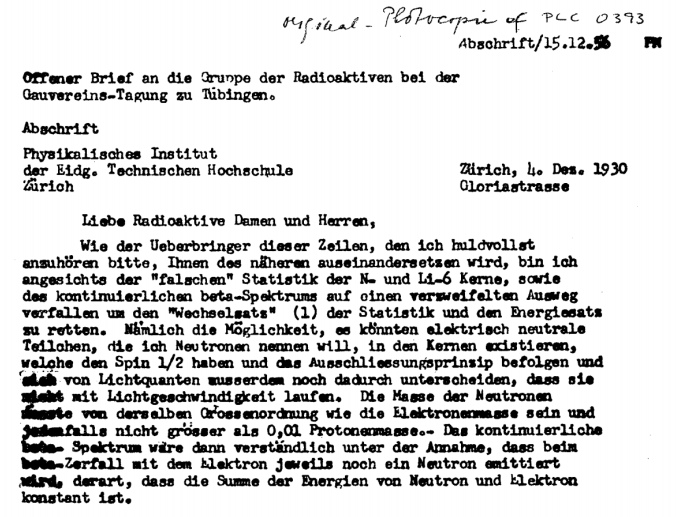
It is well known that the neutrino was first postulated by Wolfgang Pauli in 1930 to account measurements that suggested that energy and momentum were not conserved in beta decay. What is perhaps less well known – it was certainly new to me until I heard about it last night – is that Pauli’s proposal is described in famous letter, addressed rather charmingly to “Radioactive Ladies and Gentlemen” of Tübingen from his base the ETH in Zürich. Part of the letter is reproduced here:

pauli_1930_neutrino_letter_head_smaller

The opening phrases of the letter “Wie der überbringer dieser Zeilen den ich huldvollst anzuhören bitte…” is a polite request that the recipient(s) listen to the “bearer of these lines”. Presumably, Pauli being unable to visit Tübingen himself, he sent someone else along with the letter and that person gave some sort of seminar or informal presentation of the idea.

The mystery is that despite the obvious importance of this episode for the history of physics, nobody seems to know who the “bearer of the lines” from Pauli actually was. In his speech David Wark said he had been trying for 15 years to identify the individual, without success.

Anyone out there in Internetshire got any ideas?

Galactic Loops as Sources of Polarized Emission

Posted in The Universe and Stuff with tags , , , , , on April 8, 2014 by telescoper

Since I seem to have established myself as an arch-sceptic concerning the cosmological interpretation of the the BICEP2 measurement of the polarization of the cosmic microwave background (CMB), I couldn’t resist posting a link to an interesting paper by Liu et al. that has just appeared on the arXiv.

The abstract is:

We investigate possible imprints of galactic foreground structures such as the `radio loops’ in the derived maps of the cosmic microwave background. Surprisingly there is evidence for these not only at radio frequencies through their synchrotron radiation, but also at microwave frequencies where emission by dust dominates. This suggests the mechanism is magnetic dipole radiation from dust grains enriched by metallic iron, or ferrimagnetic molecules. This new foreground we have identified is present at high galactic latitudes, and potentially dominates over the expected B-mode polarisation signal due to primordial gravitational waves from inflation.

The authors argue that foreground emission from our own Galaxy has not been fully subtracted from maps of the cosmic microwave background. This emission could result in significant contamination of the CMB polarization if it is associated with dust grains aligned with the Galaxy’s magnetic field.

I’m grateful to one of the authors of the paper, Philip Mertsch, for sending me this map of the Galactic Loops with the BICEP2 region superimposed on it, demonstrating that there is potential for a contribution…

bicep2_loops


This paper is likely to provoke quite a discussion, so I thought I’d suggest one possible way of testing it, namely by updating the analysis presented by myself and Patrick Dineen in 2003 with new data. Here’s the abstract of our old paper:

We present a diagnostic test of possible Galactic contamination of cosmic microwave background sky maps designed to provide an independent check on the methods used to compile these maps. The method involves a non-parametric measurement of cross-correlation between the Faraday rotation measure (RM) of extragalactic sources and the measured microwave signal at the same angular position. We argue that statistical properties of the observed distribution of rotation measures are consistent with a Galactic origin, an argument reinforced by a direct measurement of cross-correlation between dust, free-free and synchrotron foreground maps and RM values with the strongest correlation being for dust and free-free. We do not find any statistically compelling evidence for correlations between the RM values and the COBE DMR maps at any frequency, so there is no evidence of residual contamination in these CMB maps. On the other hand, there is a statistically significant correlation of RM with the preliminary WMAP individual frequency maps which remains significant in the Tegmark et al. Wiener-filtered map but not in the Internal Linear Combination map produced by the WMAP team.

The idea is that cross-correlating the CMB pattern with Faraday rotation measures should provide an independent diagnostic of the effect of magnetic fields. Our analysis was based on old CMB data, so there’s an interesting project to be done updating it with, e.g., Planck CMB data and a larger set of rotation measures. See the comment below for a reference to more recent work along these lines, but still not including Planck.

Anyway, this all goes to show that there’s one question you can always ask about an astrophysics result: have you considered the possible role of magnetic fields?

A Problem of Capacitors

Posted in Cute Problems, The Universe and Stuff with tags , , on April 3, 2014 by telescoper

Time for another entry in the Cute Problems  category. I’ve been teaching a course module  in theoretical physics this term so here’s one that my students should find a doddle…

A spherical capacitor consists of an outer conducting sphere of fixed radius b and a concentric inner conducting sphere whose radius a can be varied. The space between the spheres is filled with air which has a breakdown electric field strength E0. What are the greatest achievable values for (i) the potential difference between the spheres, and (ii) the electrostatic energy stored in the capacitor?

Answers via the comments box please.

AAA Day in the LIfE of the 137 SS Mystic – August 3, 2013 – N, SHE, and NUN … where Egypt hid the swastika

Posted in The Universe and Stuff with tags on March 26, 2014 by telescoper

Oh my…

raphael's avatarAlternative Thinking 37

August 3, 2013

So where did Egypt hide the swastika?

How was it vEILed?

UPDATE March 24, 2014

The Smoking Gun and the Gravity of the Situation

Jesus positioned between the two thieves RED and BLUE
a.k.a. the two B-mode gravitational waves

polarized RED and BLUE gravitational waves

On March 17th, 2014 an announcement was made that confirms what I AM now sharing.
The announcement apparently confirms Einstein’s musings about gravitational waves, an expanding universe and an early ‘imprinting’ that took place.
There are rumors of a big bang Nobel prize.

But inflation came with a very specific prediction – that it would be associated with waves of gravitational energy, and that these ripples in the fabric of space would leave an indelible mark on the oldest light in the sky – the famous Cosmic Microwave Background.

The BICEP2 team says it has now identified that signal.

Scientists call…

View original post 1,196 more words

Responding to the Mail

Posted in The Universe and Stuff with tags , , , , on March 24, 2014 by telescoper

What was that quotation by Oscar Wilde, “We are all in the gutter, but some of us aren’t reading the Daily Mail“? Last week that particular element of the gutter press took the opportunity to display its aptitude for racism and sexism in a snide piece about the appearance of two female (shock!) and non-white (horror!) scientists on Newsnight. It’s not really a surprise that the Daily Mail would publish such a scummy article, but it’s still depressing to see how the minds of some people work.

For the record I’ll say that I only know one of the scientists concerned personally (Hiranya Peiris of University College, London). Speaking as a cosmologist, I’m sure I’m not alone in saying that if someone from the press had phoned me up and asked me to suggest an expert to invite onto a television show to explain the BICEP2 results then Hiranya would have been right at the top of my list – because  she’s a brilliant scientist (in exactly the relevant area) and a gifted communicator to boot. Is it really so hard to grasp the idea that a brilliant scientist can be female? Or born in Sri Lanka?

Anyway, University College was quick to criticize the Daily Fail in an open letter from Professor David Price, Vice-Provost for Research. Meanwhile a flurry of enraged emails was going around the Council of the Royal Astronomical Society (of which I am a member) that led to a collective response being issued on Friday.

Here follows the RAS statement on the matter which I reproduce here in full, apart from the link to the offensive Daily Mail “article” which I have removed because I don’t want them to profit from traffic sent by this blog.

The statement was written by RAS President David Southwood and RAS Press Officer Robert Massey who are to be congratulated for their measured yet forceful riposte. The last two paragraphs are particularly good.

I’m glad the task of responding to the Daily Mail wasn’t left to me. I would have been far less diplomatic.

–0–

The Council and President of the Royal Astronomical Society (RAS) have offered unequivocal support to astronomers Dr Hiranya Peiris and Dr Maggie Aderin-Pocock. An article in the Daily Mail suggested that they were selected to appear on an episode of theBBC Newsnight programme on the basis of their ethnic background, nationality and gender.

The two astronomers discussed results from the BICEP-2 experiment announced earlier this week, which offered evidence of gravitational waves in the early universe and for a rapid expansion of the cosmos (known as inflation) shortly after the Big Bang. If confirmed, this discovery is of huge significance and was rightly covered by news media all over the world.

Dr Peiris is a world-leading cosmologist now based at University College London (UCL), with degrees from Cambridge and Princeton. In 2012 she received the RAS Fowler Award in recognition of her immense contribution to her field at an early stage of her research career.

Dr Aderin-Pocock has a background in space engineering and science communication and is now co-presenter of theBBC’s The Sky at Night, a role which demands the ability to convey complex ideas to the public at large.

Both scientists are thus exceptionally well qualified to discuss the BICEP-2 results and were natural choices for the Newsnight piece.

In the Daily Mail article, columnist ‘Ephraim Hardcastle’ (the nom de plume of Peter Mackay) not only ignored their expertise entirely but incorrectly suggested that the BICEP-2 team consisted only of white, male, American astronomers.

Astronomy world-wide has long ceased to be a closed male world and the backgrounds of astronomers have long been culturally diverse. Specifically in Britain, women now make up 27% of UK university lecturers in astronomy [see e.g. the pdfRAS Demographic Survey (2011)] and lead space- and ground-based research projects alike.

RAS President Prof. David Southwood commented: “Astronomy did not begin in Western Europe and has always been an international science. Today researchers from many nations and many cultures routinely work together to achieve shared goals. In the UK, our field is enriched by some of the most talented people from all over the world who choose to join teams in this country.

“It is deeply regrettable that the Daily Mail column chose to overlook the scientific achievements of the BICEP-2 team and the expertise of Hiranya and Maggie and instead concentrate on their skin colour and gender. The implied and deplorable message  that astronomy is the exclusive business of people who are white and male  completely ignores the successful efforts made by the RAS and other scientific bodies to create an environment where science can be done by those best suited to do it, irrespective of background culture, nationality or gender.”

Clover: What Might Have Been

Posted in Science Politics, The Universe and Stuff with tags , , , on March 23, 2014 by telescoper

Quite a few people have been asking me whether the UK’s cancelled B-mode experiment, Clover, could have detected what BICEP2 may  have found; I’m still not convinced, by the way. It therefore seemed apt to do a quick post in order to direct you to relevant sources of information. If you’re interested in Clover’s capabilities you can find a nice summary on the ArXiv here. The abstract reads:

We describe the objectives, design and predicted performance of Clover, which is a ground-based experiment to measure the faint “B-mode” polarisation pattern in the cosmic microwave background (CMB). To achieve this goal, clover will make polarimetric observations of approximately 1000 deg^2 of the sky in spectral bands centred on 97, 150 and 225 GHz. The observations will be made with a two-mirror compact range antenna fed by profiled corrugated horns. The telescope beam sizes for each band are 7.5, 5.5 and 5.5 arcmin, respectively. The polarisation of the sky will be measured with a rotating half-wave plate and stationary analyser, which will be an orthomode transducer. The sky coverage combined with the angular resolution will allow us to measure the angular power spectra between 20 < l < 1000. Each frequency band will employ 192 single polarisation, photon noise limited TES bolometers cooled to 100 mK. The background-limited sensitivity of these detector arrays will allow us to constrain the tensor-to-scalar ratio to 0.026 at 3sigma, assuming any polarised foreground signals can be subtracted with minimal degradation to the 150 GHz sensitivity. Systematic errors will be mitigated by modulating the polarisation of the sky signals with the rotating half-wave plate, fast azimuth scans and periodic telescope rotations about its boresight. The three spectral bands will be divided into two separate but nearly identical instruments – one for 97 GHz and another for 150 and 225 GHz. The two instruments will be sited on identical three-axis mounts in the Atacama Desert in Chile near Pampa la Bola. Observations are expected to begin in late 2009.

The following points, gleaned from a very quick skimming of the above paper, are worth noting (but please note the important corrections and clarifications in the comments below from the first author of the above paper and also bear in mind that the Clover numbers are estimated rather than based on actual measurements):

  1. The sky coverage of Clover would have been 1000 square degrees, compared with 380 square degrees of BICEP2
  2. Clover measurements would have been made at three frequencies, 97 GHz, 150 GHz and 225 GHz. This would have enabled the possibility of foreground contamination to be rejected with much greater confidence than in BICEP2 (which only operates at 150 GHz)
  3. The sensitivity of Clover at 150 GHz (the frequency at which BICEP2 operates) would have been about 1.4 times better than BICEP2
  4. Had it gone ahead, Clover would have started taking data at around the same time as BICEP2 (perhaps even a bit earlier).
  5. Clover was originally intended to be positioned at the South Pole, where observing conditions are better than in Chile and where BICEP2 is placed, but this was in the middle of STFC’s financial crisis and running costs would have been much higher than the alternative location in Chile. This might have had a negative impact on its sensitivity.

Here’s a plot from the above paper showing a the anticipated measurement if the tensor scalar ratio had been 0.1; BICEP2 detection (if real) corresponds to a signal twice this amplitude:

Clover_sensitivity

In other words, we don’t know whether Clover would have hit its target sensitivity and there are many other imponderables, but  it’s a very great shame it never got the chance to try…