Archive for the The Universe and Stuff Category

Research Hive on Open Access

Posted in Open Access, The Universe and Stuff with tags , , , , on March 21, 2014 by telescoper

Near the end of a week that has been both exciting and exhausting, I had the opportunity to take part in a seminar on Open Access publishing. I agreed to do this last year sometime, and only remembered that it was today because I got an email reminder a couple of days ago! Anyway it was nice to have an excuse to visit the iconic Library of the University of Sussex for this event.

Fortunately, as things turned out, I had plenty of topical material to draw on for inspiration and spent some time discussion the possibilities of community peer review with reference with what’s been happening with BICEP2. Here’s me in the middle of the talk on that very subject showing the Live Discussion Facebook page:

Hive

I shared the bill with Rupert Gatti from Open House Press which publishes mainly in the Arts and Humanities area; generally speaking these disciplines are a long way behind astrophysics in terms of their readiness for the age of Open Access but I think change across all academia is inevitable.

For those of you interested I realize that an update on the Open Journal For Astrophysics is long overdue. I’ve just been too busy with other things to devote much time to it. I do hope to have further news very soon…

BICEP2, Social Media and Open Science

Posted in Open Access, The Universe and Stuff with tags , , , on March 20, 2014 by telescoper

I’ve been finding it a bit difficult to keep up with all the BICEP2 excitement in between all the other things I’ve had to do this week but at least the blog has been generating some interest and there’s no sign of that abating yet.  In fact, according to the wordpress elves, today is the busiest day I’ve ever had on In the Dark – and it’s not even 6pm yet!

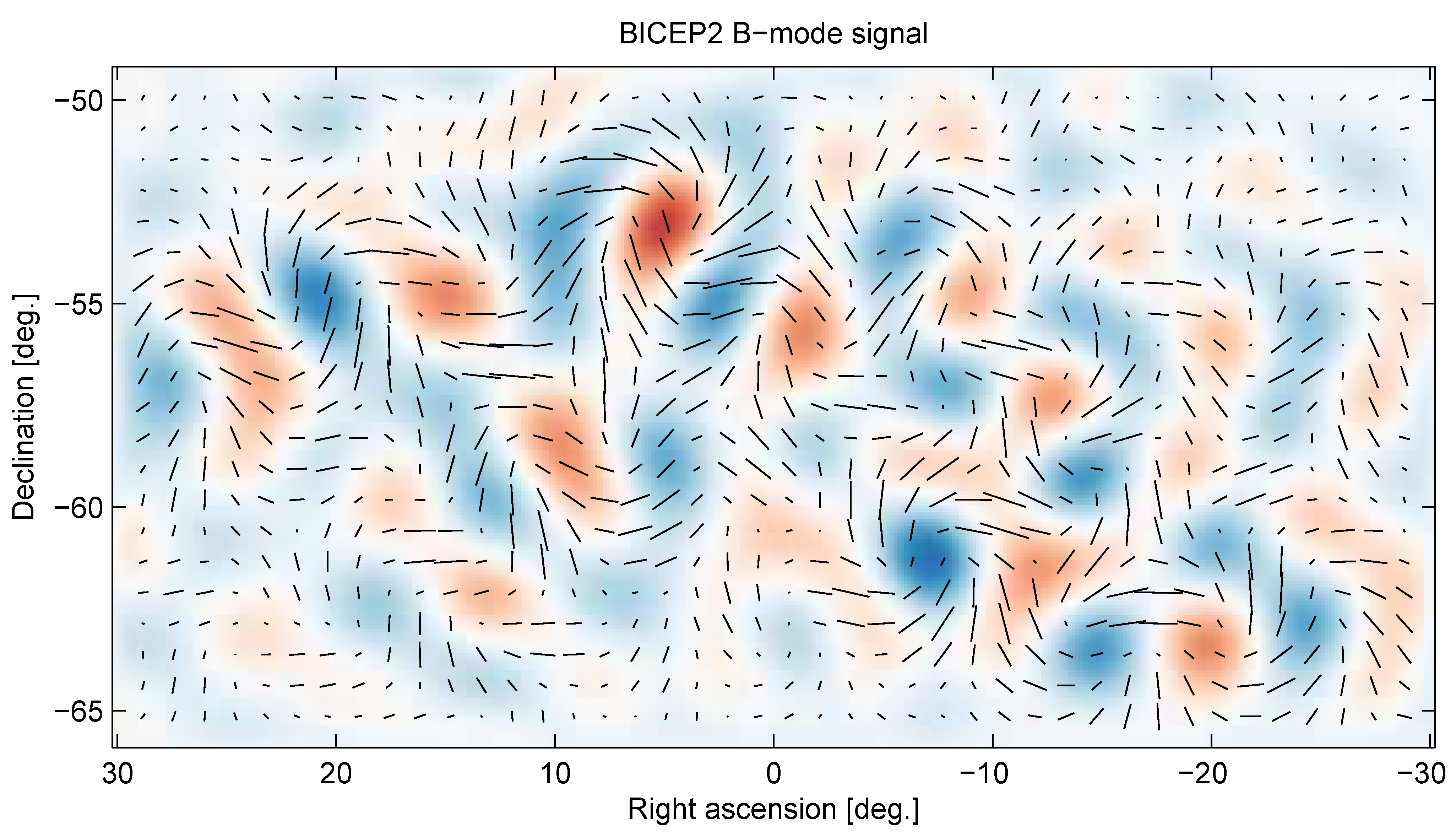
I realize that I’ve posted several items on B-modes without ever showing a picture of what they look like, so here you go, an image of the B-mode polarization seen by the BICEP2 experiment:

b_over_b_rect_BICEP2

When the BICEP2 team announced that  a “major astrophysics discovery” would be announced this Monday I have to admit that I was quite a bit uncomfortable about the way things were being done. I’ve never been keen on “Science by Press Release” and when it became clear that the press conference would be announcing results that hadn’t yet been peer-reviewed my concerns deepened.

However, the BICEP2 team immediately made available not only the “discovery” paper but also the data products, so people with sufficient expertise (and time) could try to unpick the content. This is fully in the spirit of open science and I applaud them for it. Indeed one could argue that putting everything out in the open the way they have is ensuring that that their work is being peer-reviewed in the open by the entire cosmological community not secretly and by one or two anonymous individuals. The more I think about it the more convinced I am becoming that this is a better way of doing peer review than the traditional method, although before I decide that for sure I’d like to know whether the BICEP2 actually does stand up!

One of the particularly interesting developments in this case is the role social media are playing in the BICEP2 story. A Facebook Group was set up in advance of Monday’s announcement and live discussion started immediately the press conference started. The group now has well over 700 members, including many eminent cosmologists. And me. There’s a very healthy scientific discussion going on there which may well prove to be a model of how such things happen in the future. Is this a sign of a major change in the way science is done, the use of digital technology allowing science to break free from the shackles placed on it by traditional publication processes? Maybe.

Anyway, no time to write any more. I just remembered I have to participate in a seminar on Open Access publishing and I have to start thinking about what I’m going to say!

P.S. The Vernal Equinox happened at 16.:57 GMT today, so welcome to Spring!

BICEP2: Is the Signal Cosmological?

Posted in The Universe and Stuff with tags , , , , , on March 19, 2014 by telescoper

I have a short gap in my schedule today so I thought I would use it to post a short note about the BICEP2 results announced to great excitement on Monday.

There has been a great deal of coverage in the popular media about a “Spectacular Cosmic Discovery” and this is mirrored by excitement at a more technical level about the theoretical implications of the BICEP2 results. Having taken a bit of time out last night to go through the discovery paper, I think I should say that I think all this excitement is very premature. In that respect I agree with the result of my straw poll.

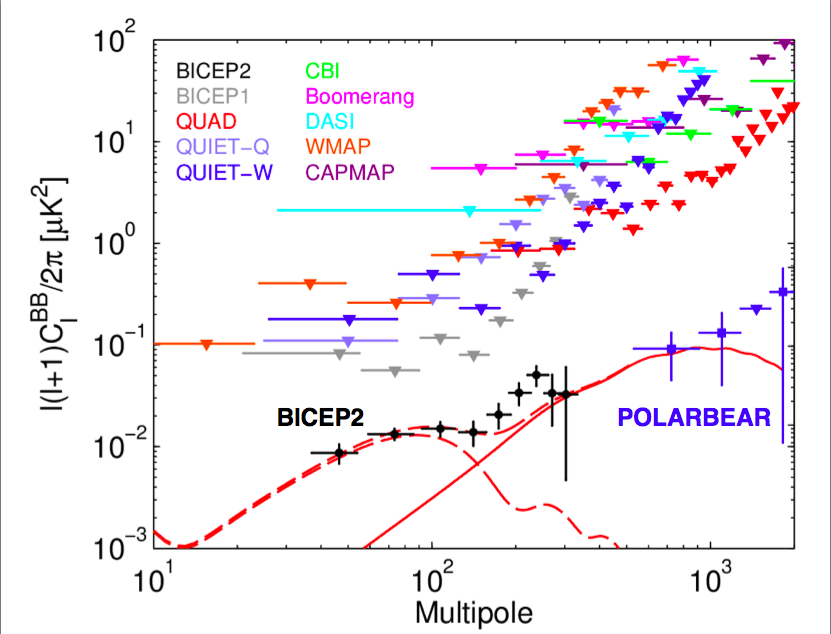
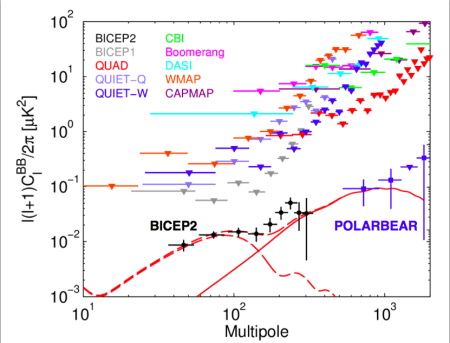
First of all let me make it clear that the BICEP2 experiment is absolutely superb. It was designed and built by top-class scientists and has clearly functioned brilliantly to improve its sensitivity so much that it has gone so far ahead of so many rivals:
Polarization detections

Notice that the only other detection of the elusive B-mode signal is by POLARBEAR, but that is actually accounted for by gravitational lensing effects rather than being evidence of a primordial gravitational wave contribution.

The B-mode signal is so weak that it is to mind absolutely amazing that an experiment can get anywhere near measuring it. There’s no denying the fact that BICEP2 team have done heroic work.

But – and it’s a big “but” – we have to ask the question “How confident can we be that the signal detected by BICEP2 is, in fact, the imprint of primordial gravitational waves on the cosmic microwave background that cosmologists were hoping for?”

The answer to this question will depend on the individual, but I would say that to convince me the absolute minimum would be a detection of the signal in more than one frequency band. A primordial signal should not vary as a function of frequency, whereas foreground emission (likely to be from dust) would be frequency dependent.

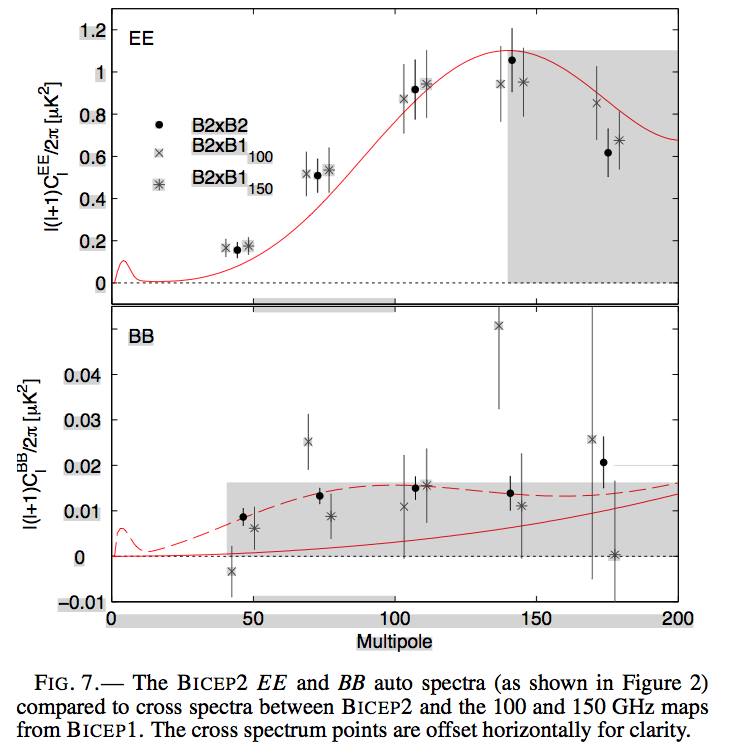
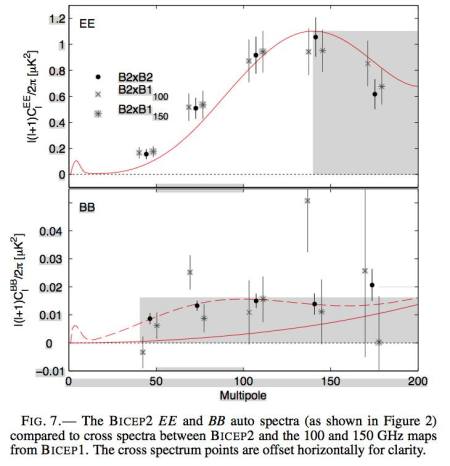
Now BICEP2 only operates at one frequency, 150GHz, so the experiment on its own can’t satisfy this criterion but it could through cross-correlation with the original BICEP1 instrument which worked at 100 GHz and 150 GHz. In the discovery paper we find the

Additionally, cross-correlating BICEP2 against 100GHz maps from the BICEP1 experiment, the excess signal is confirmed with 3sigma significance and its spectral index is found to be consistent with that of the CMB.

Here is the relevant plot, Figure 7 from the paper,
Xcor_BICEP

Well, the correct though the statement in the paper might be,  it is clear from this (rather ratty) cross-correlation that there is actually no firm detection of the B-modes at all at 100GHz. In other words, the 100 GHz BICEP1 data may be consistent with BICEP2 but they are also consistent with zero. (NOTE ADDED: I am ready to rescind this statement when I see a full analysis of these cross-correlations; at face value the scatter looks strange and certainly consistent with a null detection). In any case a positive cross-correlation does not exclude the possibility that the signal in common across the two channels is dust. If we only have a detection at one frequency we have no compelling evidence at all that the signal is cosmological.

When asked on Tuesday about this by Physics World I stated that I wasn’t convinced:

It seems to me though that there’s a significant possibility of some of the polarization signal in E and B [modes] not being cosmological. This is a very interesting result, but I’d prefer to reserve judgement until it is confirmed by other experiments. If it is genuine, then the spectrum is a bit strange and may indicate something added to the normal inflationary recipe.

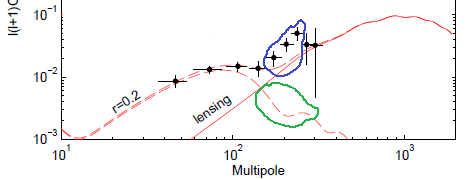
My scepticism was then derived primarily from the distribution of the points around l=200 in the first figure: they look too high compared to the expected gravitational lensing contribution (which seems to have been pinned down by the POLARBEAR measurements to the right of the plot):
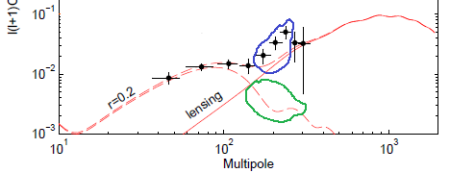
My concern: the three data points circles in blue are all higher than they should be, by about 0.01, which is the same height as the points to their left.  But the prediction of gravitational waves from inflation, circles in green, is that there should be very little contribution here --- which is why these points should lie closer to the solid red "lensing" prediction.  So the model of lensing for the right-hand part of the data + gravitational waves from inflation for the left-hand part of the data does not seem to be a very convincing fit.

I’ve taken this plot from the post I reblogged yesterday. The errors in the measurements ringed in blue are probably correlated so the fact that all three lie well above the red curve may not be as significant as it first seems, but note that the vertical scale is logarithmic. If some sort of systematic error has indeed bumped these points up then the amount of power involved could easily account for all the signal in the points to the left; the fit to the primordial B-mode (red dashed) part of the curve could then be fortuitous.

One possible systematic, apart from foreground contamination by dust, is leakage between E and B modes in the spherical harmonic decomposition. This arises because the spherical harmonic modes are only orthogonal over a complete sphere; BICEP2 does not map the whole sky, so the modes get mixed and separating them becomes extremely messy. Since the E-mode signal is so much larger, the worry is that some of it might leak into the B-mode.

UPDATE: 20/3/2014

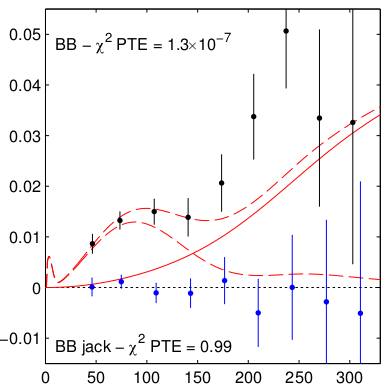
I noticed a post on the BICEP2 Facebook Page from Hans Kristian Eriksen pointing another oddity:
PTE

The above plot is one of many showing jackknife estimates relating to various aspects of the polarization signal. What is strange is that all the blue dots lie so close to zero. Statistically speaking this is extremely unlikely and it may suggest that the noise levels have been over-estimated underestimated; roughly one in three data points should be further away than one sigma from zero if sigma is estimated correctly.

Taking all this together I have to say that I stick to the point of view I took when I first saw the results. They are very  interesting, but it is far too earlier to even claim that they are cosmological, let alone to start talking about providing evidence for or against particular models of the early Universe. No doubt I’ll be criticized for trying to put a wet blanket over the whole affair, but this is a measurement of such potential importance that I think we have to set the bar very high indeed when it comes to evidence. If I were running a book on this, I would put it at no better than even money that this is a cosmological signal.

Of course the rush to embrace these results as “definitive proof” of something is a product of human nature and the general level of excitement this amazing experiment has generated. That’s entirely understandable and basically a very good thing. It reminds those of us working in cosmology how lucky we are that we work in a field in which such momentous discoveries do actually happen. This is no doubt why so many budding scientists are drawn into cosmology in the first place. Let’s not forget, however, that there is a thing called the scientific method and often after years of hard work there remain more questions than answers. For the time being, that’s where we are with gravitational waves.

How solid is the BICEP2 B-mode result?

Posted in The Universe and Stuff with tags , , on March 18, 2014 by telescoper

Another wordpress post about BICEP2 – by astrophysicist Phil Bull – with some comments on possible issues with the data…

Phil Bull's avatarLumps 'n' Bumps

Phew! An exciting day indeed, so I’ll jot down a few notes to recap what happened.

The BICEP2/Keck experiments detected B-modes at large angular scales in the polarisation of the CMB. They released two papers and some data online just as the announcement was made, which you can find here. Not all of the data mind, but it’s plenty to go on for now.

Their interpretation of the data is that they detect a bump at low-ell that is characteristic of primordial B-modes generated by inflation. If true, this is super exciting, as it gives us a (sort of, but not really) direct detection of gravitational waves, and opens up a new window on the very early Universe (and hence extremely high energy scales). People are even saying it’s a probe of quantum gravity, which I guess is sort of true. Furthermore, they find a best-fit value of the…

View original post 1,413 more words

BICEP2: New Evidence Of Cosmic Inflation!

Posted in The Universe and Stuff with tags , , on March 18, 2014 by telescoper

Following on from yesterday’s news, here’s a more detailed analysis of the implications of the BICEP2 result from Matt Straessler’s blog. I certainly agree with the statement highlighted in red in his post:

Until this measurement/discovery is confirmed by another experiment, you should consider it provisional. Although this is too large a signal to be likely to be due to a pure statistical fluke, it could still be due to a mistake or problem, or due to something other than gravitational waves from inflation.

Matt Strassler's avatarOf Particular Significance

[For your reference if you can’t follow this post: My History of the Universe, and a primer to help you understand what’s going on today.]

I’m still updating this post as more information comes in and as I understand more of what’s in the BICEP2 paper and data. Talking to and listening to experts, I’d describe the mood as cautiously optimistic; some people are worried about certain weird features of the data, while others seem less concerned about them… typical when a new discovery is claimed.  I’m disturbed that the media is declaring victory before the scientific community is ready to.  That didn’t happen with the Higgs discovery, where the media was, wisely, far more patient.

The Main Data

Here’s BICEP2’s data!  The black dots at the bottom of this figure, showing evidence of B-mode polarization both at small scales (“Multipole” >> 100, where it is due to gravitational…

View original post 1,769 more words

BICEP2 – A Straw Poll

Posted in The Universe and Stuff with tags , on March 17, 2014 by telescoper

I’m not sure whether my scepticism about the BICEP2 results is just a sign of my old age, so it’s time for a quick (and, it goes without saying, totally unscientific)  straw poll to see what people think. Feel free to add comments through the box as well!

BICEP2DAY

Posted in Astrohype, The Universe and Stuff with tags , , , , on March 17, 2014 by telescoper

Well, it’s official that this afternoon’s announcement of a “major discovery” is going to be from the BICEP team, and it specifically concerns the BICEP2 CMB telescope experiment. I’ve just got back to Sussex (after a weekend in Cardiff) and will be following the events in among other things I have to do before going off to give a lecture at 5pm GMT.

The schedule of events is as follows: there will be a special webcast presenting the first results from the BICEP2 CMB telescope. The webcast will begin with a presentation for scientists 10:45-11:30 EDT, followed by a news conference 12:00-1:00 EDT.

You can join the webcast from the link at http://www.cfa.harvard.edu/news/news_conferences.html

Papers and data products will be available at 10:45 EDT from http://bicepkeck.org/

EDT is four hours behind Greenwich Mean Time so the webcast will begin at 14:45 GMT, i.e. in about half an hour.

In the mean time, for those of you wondering what these BICEPS are all about, here is a useful graphic in which a Harvard astrophysicist demonstrates the possibilities:

biceps

LIVE BLOG:

14:36 The press conference server has gone down. There’s no truth in the rumour that ex-members of the Clover collaboration have sabotaged it.

14:42 There’s a grave danger that this press conference will run into tea time.

14:45 The BICEP2 papers are now live at http://bicepkeck.org/

14:48 Straight to the headline: R=0.2 (+0.07, -0.05) with R=0 rejected at about 7 sigma, if you like things stated in such terms…

14:53 Here’s the crucial graph. Results a bit higher than the expected  signal at l in range 200-300?

Bi7-IpDCEAA7frU

15:06 The news avalanche has started, e.g. here at the BBC, but there is some concern about the shape of the spectrum.

15:10 I’m not getting anything from the press conference, so may have missed important details. It seems to me though that there’s a significant possibility of some of the polarization signal in E and B not being cosmological. This is a very interesting result, but I’d prefer to reserve judgement until it is confirmed by other experiments.

15:35 Despite the press hype there’s still some scepticism among cosmologists arising from the strange-looking shape of the spectrum. I’m not convinced myself. Anyway, I have to sign off now in order to prepare a lecture..

16:20 Back-of-the-envelope time: if the result is correct then the inflationary energy scale is about 2×10¹⁶ GeV. That’s just two orders of magnitude below the Planck scale…

18:19 Returned from my 5pm Theoretical Physics lecture. Couldn’t resist spending 30 minutes talking about BICEP2, though I did tell them it’s not in the examination.

18:25 Main points of controversy:

  1. there seems to be evidence of leakage of temperature into polarization (lines in Fig. 5);
  2. there’s an excess in the B-B spectrum at l~250 shown above;
  3. there’s an excess at low l in the E-E spectrum
  4. there’s a deficit at low l in the cross-correlation with Keck

There may be a connection between 1. and 2.-4. If 2.-4 are real then they may be evidence of something interesting that requires more than a straightforward modification of inflation (such as might include just a running of the spectral index).

18:35 Other controversy: why has this result been announced before the paper has been published or even peer-reviewed?

Some B-Mode Background

Posted in Astrohype, Science Politics, The Universe and Stuff with tags , , , , , , , , , , , on March 15, 2014 by telescoper

Well, in case you hadn’t noticed, the cosmology rumour mill has gone into overdrive this weekend primarily concerning the possibility that an experiment known as BICEP (an acronym formed from Background Imaging of Cosmic Extragalactic Polarization). These rumours have been circulating since it was announced last week that the Harvard-Smithsonian Center for Astrophysics (CfA) will host a press conference  on Monday, March 17th, to announce “a major discovery”. The grapevine is full of possibilities, but it seems fairly clear that the “major discovery” is related to one of the most exciting challenges facing the current generation of cosmologists, namely to locate in the pattern of fluctuations in the cosmic microwave background evidence for the primordial gravitational waves predicted by models of the Universe that involve inflation.

Anyway, I thought I’d add a bit of background on here to help those interested make sense of whatever is announced on Monday evening.

Looking only at the temperature variation across the sky, it is not possible to distinguish between tensor  (gravitational wave) and scalar (density wave) contributions  (both of which are predicted to be excited during the inflationary epoch).  However, scattering of photons off electrons is expected to leave the radiation slightly polarized (at the level of a few percent). This gives us additional information in the form of the  polarization angle at each point on the sky and this extra clue should, in principle, enable us to disentangle the tensor and scalar components.

The polarization signal can be decomposed into two basic types depending on whether the pattern has  odd or even parity, as shown in the nice diagram (from a paper by James Bartlett)

The top row shows the E-mode (which look the same when reflected in a mirror and can be produced by either scalar or tensor modes) and the bottom shows the B-mode (which have a definite handedness that changes when mirror-reflected and which can’t be generated by scalar modes because they can’t have odd parity).

The B-mode is therefore (at least in principle)  a clean diagnostic of the presence of gravitational waves in the early Universe. Unfortunately, however, the B-mode is predicted to be very small, about 100 times smaller than the E-mode, and foreground contamination is likely to be a very serious issue for any experiment trying to detect it. To be convinced that what is being measured is cosmological rather than some sort of contaminant one would have to see the signal repeated across a range of different wavelengths.

Moreover, primordial gravitational waves are not the only way that a cosmological B-mode signal could be generated. Less than a year ago, a paper appeared on the arXiv by Hanson et al. from SPTpol, an experiment which aims to measure the polarization of the cosmic microwave background using the South Pole Telescope. The principal result of this paper was to demonstrate a convincing detection of the so-called “B-mode” of polarization from gravitational lensing of the microwave background photons as they pass through the gravitational field generated by the matter distributed through the Universe. Gravitational lensing can produce the same kind of shearing effect that gravitational waves generate, so it’s important to separate this “line-of-sight” effect from truly primordial signals.

So we wait with bated breath to see exactly what is announced on Monday. In particular, it will be extremely interesting to see whether the new results from BICEP are consistent with the recently published conclusions from Planck. Although Planck has not yet released the analysis of its own polarization data, analysis of the temperature fluctuations yields a (somewhat model-dependent) conclusion that the ratio of tensor to scalar contributions to the CMB pattern is no more than about 11 per cent, usually phrased in the terms, i.e. R<0.11. A quick (and possibly inaccurate) back-of-the-envelope calculation using the published expected sensitivity of BICEP suggests that if they have made a detection it might be above that limit. That would be really interesting because it might indicate that something is going on which is not consistent with the standard framework. The limits on R arising from temperature studies alone assume that both scalar and tensor perturbations are generated by a relatively simple inflationary model belonging to a class in which there is a direct relationship between the relative amplitudes of the two modes (and the shape of the perturbation spectrum). So far everything we have learned from CMB analysis is broadly consistent with this simplifying assumption being correct. Are we about to see evidence that the early Universe was more complex than we thought? We'll just have to wait and see…

Incidentally, once upon a time there was a British experiment called Clover (involving the Universities of  Cardiff, Oxford, Cambridge and Manchester) which was designed to detect the primordial B-mode signal from its vantage point in Chile. I won’t describe it in more detail here, for reasons which will become obvious.

The chance to get involved in a high-profile cosmological experiment was one of the reasons I moved to Cardiff in 2007, and I was looking forward to seeing the data arriving for analysis. Although I’m primarily a theorist, I have some experience in advanced statistical methods that might have been useful in analysing the output.  Unfortunately, however, none of that actually happened. Because of its budget crisis, and despite the fact that it had spent a large amount (£4.5M) on it already,  STFC decided to withdraw the funding needed to complete it (£2.5M)  and cancelled the Clover experiment. Had it gone ahead it would probably have had two years’ data in the bag by now.

It wasn’t clear that Clover would have won the race to detect the B-mode cosmological polarization, but it’s a real shame it was withdrawn as a non-starter. C’est la vie.

Charlotte Church and Physics

Posted in Music, The Universe and Stuff with tags , , , , on March 14, 2014 by telescoper

I just noticed an interesting news item about popular vocal artiste Charlotte Church. Apparently she is thinking about doing a degree in physics. She is quoted on the BBC Website as saying

“I just think it’s important to keep the brain active and keep educating yourself.

“I have an interest in it and I should try to follow it. It’s something I’ve been interested in for the last year or two.”

I hope she does it, as it will set an excellent example. In the article, however, she also says “I will have to do an A-level in physics and maths first though”. That’s not necessarily the case, actually. It is possible instead to opt for a physics degree programme with a Foundation year. Many universities run such programmes. We have one here at the University of Sussex but there is also one at Cardiff University, which happens to be in Charlotte Church’s home town.

These courses are specifically designed for people who didn’t do the traditional mix of A-level subjects for a Physics degree and I always recommend that students who are coming to the subject late in life give them serious consideration rather than assuming they should go via the usual A-level route. Widening participation in higher education by offering such access courses is something many universities work very hard at and do very well.

In fact, as I’ve pointed out before, that the current A-level Physics courses are part of the reason why we have so few female physics students; the fraction is a meagre 20%. That might start to change if high-profile women like Charlotte Church lead the way, but in the mean time it’s definitely worth thinking about alternatives to A-level such as those I’ve described.

In any case, and whatever Charlotte Church does decide to do in the future, I’m sure I speak on behalf of the vast majority of physicists when I express thanks to her for putting such a nice story about physics into the news!

POSTRSCRIPT: I wasn’t aware of this when I wrote the above piece, but it seems a former colleague of mine from Cardiff University, Edward Gomez helped get Charlotte Church interested in physics.

Fly through of the GAMA Galaxy Catalogue

Posted in The Universe and Stuff with tags , , , , , , , , on March 13, 2014 by telescoper

When I’m struggling to find time to do a proper blog post I’m always grateful that I work in cosmology because nearly every day there’s something interest to post. I’m indebted to Andy Lawrence for bring the following wonderful video to my attention. It comes from the Galaxy And Mass Assembly Survey (or GAMA Survey for short), a spectroscopic survey of around 300,000 galaxies in a region of the sky comprising about 300 square degrees;  the measured redshifts of the galaxies enable their three-dimensional positions to be plotted. The video shows the shape of the survey volume before showing what the distribution of galaxies in space looks like as you fly through. Note that the galaxy distances are to scale, but the image of each galaxy is magnified to make it easier to see; the real Universe is quite a lot emptier than this in that the separation between galaxies is larger relative to their size.