Archive for the The Universe and Stuff Category

From Real Time to Imaginary Time

Posted in Brighton, Education, The Universe and Stuff with tags , , , , , , , , , , , on February 24, 2014 by telescoper

Yesterday, after yet another Sunday afternoon in my office on the University of Sussex campus, I once again encountered the baffling nature of the “real time boards” at the bus-stop at Falmer Station (just over the road from the University). These boards are meant to show the expected arrival times of buses; an example can be seen on the left of the picture below, taken at Churchill Square (in the City Centre).

???????????????????????????????

The real-time board system works pretty well in central Brighton, but it’s a very different story at Falmer, especially for the Number 23 which is my preferred bus home. Yesterday provided a typical illustration of the problem: the time of the first bus on the list, a No. 23, was shown as “1 min” when I arrived at the stop. It then quickly moved to “due” (a word which I’ll comment about later). It then moved back to “2 mins” for about 5 minutes and then back to “due” again. It stayed like that for over 10 minutes at which point the bus that was second on the list (a No. 28 from Lewes) appeared. Rather than risk waiting any longer for the 23 I got on the 28 and had a slightly longer walk home from the stop at the other end. Just as well I did because the 23 vanished entirely from the screen as soon as I boarded the other bus. This apparent time-travel isn’t unusual at Falmer, although I’ve never really understood why.

By sheer coincidence when I got to the bus stop to catch a bus to campus this morning there was a chap from Brighton and Hove buses there. He was explaining what sometimes goes wrong with the real time boards to a lady, so I joined in the conversation and asked him if he knew why Falmer is so unreliable. He was happy to oblige. It turns out that the way the real-time boards work depends on each bus having a GPS system that communicates to a central computer via a radio link. If the radio link drops out for some reason – as it apparently does quite often up at Falmer (mobile phone connectivity is poor here also) – the system looks up the expected time of the bus after the one that it has lost contact with. Thus it is that a bus can apparently be “due” and then apparently go back in time. Also, if a bus has to divert from the route programmed into the GPS tracker then it is also removed from the real-time boards.

However, there is another system in operation alongside the GPS tracker. When a bus actually stops at a stop and opens its doors the onboard computer communicates this to the central system at the same time as the location signs inside the bus are updated. At this point the real-time boards are reset.

The unreliability I’ve observed at Falmer is in fact caused by two problems: (i) the patchy radio coverage as the bus wanders around the hilly environs of Falmer campus; and (ii) the No. 23 is on a new route around the back of campus which means that it vanishes from the system entirely when it wanders off the old route, as would happen if the bus were to break down.

Mystery solved then, in a sense, but it means there’s a systematic problem that isn’t going to be fixed in the short-term. Would it be better to switch off the boards than have them show inaccurate information? Perhaps, but only if it were always wrong. In fact the boards seem to work OK for the more frequent bus, the No. 25. My strategy is therefore never to rely on the information provided concerning the No. 23 and just get the first bus that comes. It’s not a problem anyway during the week because there’s a bus every few minutes, but on a Sunday evening it is quite irksome to see apparently random times on the screens.

All this talk about real-time boards reminds me of a question I was asked in a lecture last week. I was starting a new section of my Theoretical Physics module for 2nd Year students on Complex Analysis: the Cauchy-Riemann equations, Conformal Transformations, Contour Integrals and all that Jazz. To start the section I went on a bit of a ramble about the ubiquity of complex numbers in physics and whether this means that imaginary numbers are, in some sense, real. You can find an enjoyable polemic on this subject, given the answer “no” to the question here.

Anyway, I got the class to suggest examples of the use of complex numbers in physics. The things you’d expect came up such as circuit theory, wave propagation etc. Then somebody mentioned that somewhere they had heard of imaginary time. The context had probably been provided Stephen Hawking who mentioned this in his book A Brief History of Time. In fact the trick of introducing imaginary time is called a Wick Rotation and the basic idea is simple. In special relativity we deal with four-dimensional space-time intervals of the form

ds^2 = -c^2dt^2 + dx^2 + dy^2 +dz^2,

i.e. the metric describing Minkowski space. The minus sign in front of the time bit is essential to the causal structure of space-time but it causes quite a few mathematical difficulties. However if we make the substitution

\tau \rightarrow i c t

then the metric becomes

ds^2 = d\tau^2 + dx^2 + dy^2 +dz^2,

which corresponds to a four-dimensional Euclidean space which is in many situations much easier to handle mathematically.

Complex variables and complex functions provide the theoretical physicist with a host of extremely elegant techniques for solving tricky problems. But does that mean they are somehow “built in” to nature? I don’t think so. I don’t think the Brighton & Hove Bus company uses imaginary time on its display boards either, although it does sometimes seem that way.


POSTSCRIPT. I forgot to include my planned rant about the use of the word “due”. The boards displaying train times at railway stations usually give the destination and planned departure time of the train, e.g. “Brighton 11.15”. If things are running to schedule this information is supplemented by the phrase “On Time”. If not, which is sadly a more likely contingency in the UK, this changes to “due 11.37” or some such. This really annoys me.: the train is due at 11.15. If it doesn’t come until after then, it’s overdue or, in other words, late.

It’s Official, it’s PLATO!

Posted in Science Politics, The Universe and Stuff with tags , , , , on February 19, 2014 by telescoper

Just a quick post to pass on the news that the European Space Agency has officially selected the third M-Class mission to form part of its Cosmic Vision Programme (which covers the period 2015-2025). The lucky winner is PLATO (PLAnetary Transits and  Oscillations of stars) and it will detect extra-solar planets by monitoring relatively nearby stars, searching for tiny, regular dips in brightness as planets transit in front of them. It will also study astroseismological activity, enabling a precise characterisation of the host star of each planet discovered, including its mass, radius and age.

plato_satelliteIt is expected that PLATO will find and analyse thousands of  such exoplanetary systems in this way, with an emphasis on discovering and characterizing Earth-sized planets and super-Earths in the habitable zone of their parent star. PLATO will be launched on a Soyuz rocket from Europe’s Spaceport in Kourou by 2024 for an initial six-year mission. It will operate from the Second Lagrange Point, or L2 for short. It’s an intriguing design consisting of 34 small telescopes (left).

PLATO joins Solar Orbiter and Euclid, which were chosen in 2011 as ESA’s first two M-class missions. Solar Orbiter will be launched in 2017 to study the Sun and solar wind from a distance of less than 50 million km, while Euclid, to be launched in 2020, will focus on dark energy, dark matter and the structure of the Universe.

The decision to select PLATO wasn’t exactly a surprise as it was singled out as the leading candidate by an expert panel last month, but there was nevertheless some nervousness among certain senior astronomers at the Royal Astronomical Society on Friday in advance of the formal decision. I suspect they’ll all be out celebrating tonight!

Coming out as a scientist

Posted in Education, LGBTQ+, The Universe and Stuff with tags , on February 14, 2014 by telescoper

So here I am sitting in the library at Burlington House, the Royal Astronomical Society Council meeting I was attending having just finished slightly ahead of schedule.

I only have time for a brief post, so I’ll take the opportunity to direct your attention to an interesting piece in the Grauniad by Tom Welton. Tom is Professor of Sustainable Chemistry at Imperial College. He was also a contemporary of mine in old Sussex days. He was doing a PhD in Chemistry in MOLS while I was doing mine in Astrophysics in MAPS. Come to think of it we both did DPhils actually.

Anyway, Tom’s piece is related to something I blogged about a while ago (being a gay scientist) but he turns it the other way round and writes about how the difficulties of coming out as a scientist to your gay friends..

The most beautiful equation?

Posted in The Universe and Stuff with tags , , , , on February 13, 2014 by telescoper

There’s an interesting article on the BBC website today that discusses the way mathematicians’ brains appear to perceive “beauty”. A (slightly) more technical version of the story can be found here. According to functional magnetic resonance imaging studies, it seems that beautiful equations excite the same sort of brain activity as beautiful music or art.

The question of why we think equations are beautiful is one that has come up a number of times on this blog. I suspect the answer is a slightly different one for theoretical physicists compared with pure mathematicians. Anyway, I thought it might be fun to invite people offer suggestions through the comments box as to the most beautiful equation along with a brief description of why.

I should set the ball rolling myself, and I will do so with this, the Dirac Equation:

dirac_equation

This equation is certainly the most beautiful thing I’ve ever come across in theoretical physics, though I don’t find it easy to articulate precisely why. I think it’s partly because it is such a wonderfully compact fusion of two historic achievements in physics – special relativity and quantum mechanics – but also partly because of the great leaps of the imagination that were needed along the journey to derive it and my consequent admiration for the intellectual struggle involved. I feel it is therefore as much an emotional response to the achievement of another human being – such as one feels when hearing great music or looking at great art – as it is a rational response to the mathematical structure involved. But it’s not just that, of course. The Dirac Equation paved the way to many further developments in particle physics. It seems to encapsulate so much about the behaviour of elementary particles in so few symbols. Some of its beauty also derives from its compactness.

Anyway, feel free to suggest formulae or equations through the comments box, preferably with a brief explanation of why you think they’re so beautiful.

Happy Birthday, Harry Nyquist!

Posted in History, The Universe and Stuff with tags , on February 7, 2014 by telescoper

Harry_NyquistThis morning I learned via Twitter that today is the 125th anniversary of the birth of Harry Nyquist, a physicist and electrical engineer, who was a prolific inventor who made fundamental theoretical and practical contributions to the field of telecommunications. He also gave his name to the Nyquist frequency and the Nyquist sampling theorem, now usually known as the Nyquist-Shannon sampling theorem.

Harry Nyquist (left) was born on February  7, 1889, in Nilsby, Sweden but moved to the United States in 1907. In 1917, after earning a Ph.D. in physics from Yale University, he joined the American Telephone and Telegraph Company (AT&T). There he remained until his retirement in 1954, working in the research department and then (from 1934) at Bell Laboratories.  Apparently he didn’t have a beard, but he seems to have overcome this obstacle and had an illustrious career in research.

In my opinion, Harry Nyquist’s achievements are not sufficiently appreciated either by physicists or by the wider world, so here’s a quick summary of some of his greatest hits:

Some of Nyquist’s best-known work was done in the 1920s and was inspired by telegraph communication problems of the time. Because of the elegance and generality of his writings, much of it continues to be cited and used. For example, his 1928 paper Certain Topics in Telegraph Transmission Theory refined his earlier results and established the principles of sampling continuous signals to convert them to digital signals. The Nyquist sampling theorem showed that the sampling rate must be at least twice the highest frequency present in the sample in order to reconstruct the original signal. These two papers by Nyquist, along with one by R.V.L. Hartley, are cited in the first paragraph of Claude Shannon’s classic essay The Mathematical Theory of Communication (1948), where their seminal role in the development of information theory is acknowledged.

In 1927 Nyquist provided a mathematical explanation of the unexpectedly strong thermal noise studied by J.B. Johnson. The understanding of noise is of critical importance for communications systems. Thermal noise is sometimes called Johnson noise or Nyquist noise because of their pioneering work in this field.

In 1932 Nyquist discovered how to determine when negative feedback amplifiers are stable. His criterion, generally called the Nyquist stability theorem, is of great practical importance. During World War II it helped control artillery employing electromechanical feedback systems.

I think that demonstrates the tremendous debt the modern world of telecommunications owes to Harry Nyquist, and why we should remember him on his 125th birthday..

Did Hawking Say “There Are No Black Holes”?

Posted in Astrohype, The Universe and Stuff with tags , , , on February 5, 2014 by telescoper

Last week there was a rather tedious flurry of media activity about Stephen Hawking’s alleged claim that there are no black holes after all. Here’s a nice blog post explaining what Hawking actually said. Also, check out the link at the start of this article to a very nice layperson’s guide to the Black Hole Information Paradox.

Matt Strassler's avatarOf Particular Significance

Media absurdity has reached new levels of darkness with the announcement that Stephen Hawking has a new theory in which black holes do not exist after all.

No, he doesn’t.

[Note added: click here for my new introduction to the black hole information paradox.]

First, Hawking does not have a new theory… at least not one he’s presented. You can look at his paper here — two pages (pdf), a short commentary that he gave to experts in August 2013 and wrote up as a little document — and you can see it has no equations at all. That means it doesn’t qualify as a theory. “Theory”, in physics, means: a set of equations that can be used to make predictions for physical processes in a real or imaginary world. When we talk about Einstein’s theory of relativity, we’re talking about equations. Compare just the look and…

View original post 979 more words

Big Trouble with Big G

Posted in The Universe and Stuff with tags , , on February 4, 2014 by telescoper

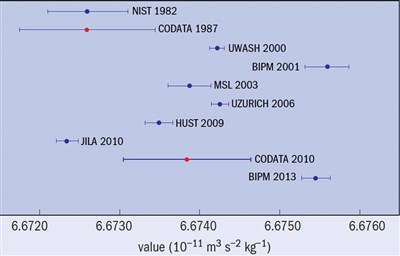
An Antonymous email correspondent this morning drew my attention to an interesting article in the latest Physics World about the trials and tribulations of groups of physicists trying to measure Newton’s Gravitational Constant,  G. This is probably the first physical constant that most of us encounter when we’re learning the subject so it might seem strange that it’s the one which is known to the lowest accuracy. That’s not for want of trying to make the measurements more precise, just that gravity is such a very weak force that it’s very difficult to eliminate systematic effects down to the necessary level.

Just how difficult it is to measure Big G is demonstrated by the following graphic which shows the latest measurements:

Big_G

Here’s the caption, so you can identify the various groups responsible for the various measurements:

Disagreeing over “big G” This chart shows wildly differing values of the gravitational constant, G, as measured by various high-profile research groups (blue). The values do not agree even within their error bars. Also shown are two values of G adopted by the Committee on Data for Science and Technology (CODATA) as international standards (red). The groups are based at the National Institute of Standards and Technology (NIST), the University of Washington (UWASH), the International Bureau of Weights and Measures (BIPM), the Measurement Standards Laboratory of New Zealand (MSL), the University of Zurich (UZURICH), the Huazhong University of Science and Technology (HUST) and the Joint Institute for Astrophysics (JILA).

Clearly there’s quite a lot of disagreement between recent results, with some a long way outside each other’s error bars. They can’t all be right, but who’s most likely to be wrong? Answers on a postcard.

I’m by no means an expert on experimental gravity so I won’t attempt to suggest who is right and who is wrong. What I will say is that although this kind of research is clearly extremely important it is clearly also fiendishly difficult. I’m not really surprised that the pieces of the puzzle haven’t fallen into place yet. The dedicated teams who have been tackling this problem for many decades deserve the deep admiration as well as the continued support of the physics community. Theoretical physics is generally perceived to be more glamorous and exciting than its experimental counterpart, but the subject as a whole is nothing without its empirical foundations. That said, I’m glad it’s not my job to measure Big G. I have neither the practical skill nor the patience to cope with so many frustrations!

The super-compressible Cosmic Microwave Background

Posted in The Universe and Stuff with tags , , on February 3, 2014 by telescoper

I just came across this blog post, one of a series on cosmology from the African Institute for Mathematical Sciences, which is in Muizenberg near Cape Town, South Africa. I thought I’d reblog it, partly because it’s on a topic I often discuss in talks and partly because I wanted to draw your attention the site and the other interesting posts on it.

In this article Bruce Bassett explains just how much of the information we get from measurements of the Cosmic Microwave Background can be squeezed into precise estimates of just a few parameters. The only point I would add is that this does assume at the outset that all relevant information is contained within the angular power spectrum; that’s not necessarily the case, but we don’t have any compelling evidence that it’s a wrong assumption for the CMB; see here for a previous discussion of this.

Bruce Bassett's avatarCosmology at AIMS

One of the most striking features about the Cosmic Microwave Background (CMB) is that it is incredibly compressible from an information content point of view. The Planck satellite produced maps with of order a billion pixels whose information could be compressed almost perfectly into a power spectrum of order one thousand real numbers.

This already is a massive compression. But in addition, most of this information can be compressed further into just six of the parameters of the standard model, yielding a total compression of about one billion to one. This is both remarkable and annoying because we want to be surprised and find things that we can’t explain. And if there are things we can’t explain we want to have clear signals data about them, not just vague hints of their existence.

Anyway, to illustrate just how efficient the compression is, I took the binned WMAP 9 TT power spectrum…

View original post 520 more words

Scott Tremaine on “Astrohype”

Posted in Astrohype, The Universe and Stuff with tags on February 2, 2014 by telescoper

I recently came across a post by distinguished astrophysicist Scott Tremaine who works at the Institute for Advanced Study in Princeton. The piece is entitled “Overblown Statements in Press Releases Undermine Science”, something that exercised me so much that I invented the category Astrohype so I could post particularly egregious examples on this blog.

Soctt Tremaine’s piece is on the American Astronomical Society website, but I’m reposting the text here to give it wider circulation as I think it makes some very important points that we’d all do well to heed. And of course in the interest of full disclosure I should point out that I am a theoretical astrophysicist myself, so may be a bit biased…

–o–

In a recent column, AAS President David Helfand argued correctly that negative public messages about subfields within our own discipline, or even about other disciplines — “shooting inward at each other” — damage all of us.

Consider, then, the following public messages:

  • from a major research university, a press release titled “Astronomers Discover Planet that Shouldn’t Be There,”
  • from the European Southern Observatory, a press release titled “Turning Planetary Theory Upside Down,”
  • from the National Radio Astronomy Observatory, a press release containing the quote, “Much of what we thought we understood about the physics of pulsars and neutron stars may be wrong,”
  • from the Space Telescope Science Institute, a press release stating, “New observations from NASA’s Hubble Space Telescope challenge 30 years of scientific theory about quasars,” and
  • from a respected news organization, an interview with a prominent exoplanet researcher containing the quote, “Theory has struck out.”

The point is not whether these messages provide accurate characterizations of the state of theoretical understanding in their respective subject areas (though in most cases they do not). The point is that by belittling and trivializing the efforts of theoretical astrophysicists — who try to understand extremely complex processes in exotic environments, with limited clues from observations — they damage the public perception of the entire astronomy community. As just one example, statements from press releases such as those above are often repeated on creationist websites, where they carry extra weight because they have the imprimatur of NASA or a major observatory or university.

Advances in observational astronomy are spectacular enough to appeal to the public on their own merits, without “shooting inward” at efforts to understand these observations. Astronomers and press officers can provide a more realistic picture of the synergy between observation and theory, and in so doing would improve the public perception of astronomy research in particular and of the scientific enterprise more generally.

How to Address Gender Inequality in Physics

Posted in Education, The Universe and Stuff with tags , , , , on January 26, 2014 by telescoper

Last night I was drinking a glass or several of wine while listening to the radio and thinking about a brainwave I’d had on Friday. Naturally I decided to wait until I reconsidered it in the cold light and sobriety of day before posting it, which I have now done, so here it is.

The idea that came to me simply joins two threads of discussion that have appeared on this blog before. The first is that, despite strenuous efforts by many parties, the fraction of female students taking A-level Physics has flat-lined at 20% for over a decade. This is the reason why the proportion of female physics students at university is the same, i.e. 20%. In short, the problem lies within our school system.

The second line of argument is that A-level Physics is not a useful preparation for a Physics degree because it does not develop the sort of problem-solving skills or the ability to express physical concepts in mathematical language on which university physics depends. Most physics admissions tutors that I know care much more about the performance of students at A-level Mathematics than Physics.

Hitherto, most of the effort that has been expended on the first problem has been directed at persuading more girls to do Physics A-level. Since all universities require a Physics A-level for entry into a degree programme, this makes sense but it has not been successful.

I now believe that the only practical way to improve the gender balance on university physics course is to drop the requirement that applicants have A-level Physics entirely and only insist on Mathematics (which has a much more even gender mix). I do not believe that this would require many changes to course content but I do believe it would circumvent the barriers that our current school system places in the way of aspiring female physicists.

Not all UK universities seem very interested in widening participation, but those that are should seriously consider this approach.