Archive for the The Universe and Stuff Category

A Perihelion Poser

Posted in Cute Problems, The Universe and Stuff with tags , , , on January 4, 2014 by telescoper

Today (January 4th) the Earth is at perihelion, ie its closest approach to the Sun. This may surprise folk in the Northern hemisphere who think that winter and summer are determined the Earth’s distance from the Sun…

Anyway, here’s an easy little question. The eccentricity of the Earth’s orbit is 0.017. Estimate the percentage difference in the flux of energy arriving at Earth from the Sun at the extremes of its orbit (ie at perihelion and aphelion). Is this difference likely to have any significant effect?

Answers through the comment box please..

An Astronomical Teaser

Posted in Cute Problems, The Universe and Stuff with tags , , , , on January 1, 2014 by telescoper

For those of you who feel up to a little brain-teaser after last night’s revels, try this little problem which involves the use of everybody’s favourite type of astronomical measurement, the magnitude system. Answers through the comment box please!

A binary star at a distance of 100 pc has such a small separation between its component stars that it is unresolved by a telescope. If the apparent visual magnitude of the combined image of the system is 10.5, and one star is known to have an absolute visual magnitude of 9.0, what is the absolute visual magnitude of the other star?

Top Ten Gaia Facts

Posted in Astrohype, The Universe and Stuff with tags , , , on December 20, 2013 by telescoper
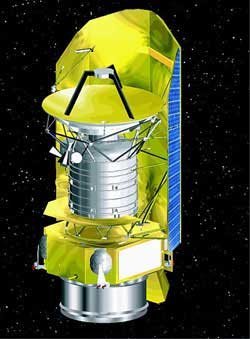
Gaia looks nothing like the Herschel Space Observatory shown here.

Gaia looks nothing like the Herschel Space Observatory shown here.

Since yesterday’s successful launch of the European Space Agency’s Gaia mission I have been inundated with requests for more information about this impressive satellite and the science behind it. As a service to the community, and for the edification of the public at large, I therefore thought I’d share my list of top ten Gaia facts via the medium of this blog:

  1. The correct pronunciation of GAIA is as in “gayer”. Please bear this in mind when reading any press articles about the mission.
  2. The GAIA spacecraft will orbit the Sun at the Second Lagrange Point, the only place in the Solar System where the  effects of cuts in the UK science budget can not be felt.
  3. The data processing challenges posed by GAIA are immense; the billions of astrometric measurements resulting from the mission will be analysed using the world’s biggest Excel Spreadsheet.
  4. To provide secure backup storage of the complete GAIA data set, the European Space Agency has commandeered the world’s entire stock of 3½ inch floppy disks.
  5. As well as measuring billions of star positions and velocities, GAIA is expected to discover thousands of new asteroids and the hiding place of Lord Lucan.
  6. GAIA can measure star positions to an accuracy of a few microarcseconds. That’s the angle subtended by a single pubic hair at a distance of 1000km.
  7. The precursor to GAIA was a satellite called Hipparcos, which is not how you spell Hipparchus.
  8. The BBC will be shortly be broadcasting a new 26-part TV series about GAIA. Entitled WOW! Gaia! That’s Soo Amaazing… it will be presented by Britain’s leading expert on astrometry, Professor Brian Cox.
  9. Er…
  10. That’s it.

Countdown to GAIA

Posted in The Universe and Stuff with tags , , , on December 18, 2013 by telescoper

Just a quick post to point out that tomorrow morning at 9.12am GMT will see the launch of the European Space Agency’s Gaia mission.  You can watch the launch live here from about 8.50 GMT. I’ll be in a meeting at 9am tomorrow morning, so I’m probably going to miss it.

Gaia arrives on the Launchpad at Kourou, French Guyana, on 13th December

Gaia arrives on the Launchpad at Kourou, French Guyana, on 13th December

I remember first hearing about Gaia about 15 years ago when I was on a PPARC advisory panel and was simultaneously amazed  by the ambition of its objectives and sceptical that it would ever get off the ground. Now its almost ready to go, so fingers crossed for a successful launch tomorrow.

Coincidentally, Gaia is among the various telescopes and observatories featured in the STFC Roadshow we put on  viewfor an Astronomy Master Class we have been putting on for local schools over the last couple of days here at the University of Sussex:

IMG-20131218-00248

Gaia is a global space astrometry mission, which will make the largest, most precise three-dimensional map of our Galaxy by surveying more than a thousand million stars. In some sense it is the descendant of the Hipparcos mission launched in 1989, but it’s very much more than that. Gaia will monitor each of its target stars about 70 times over a five-year period. It is expected to discover hundreds of thousands of new celestial objects, such as extra-solar planets and brown dwarfs, and observe hundreds of thousands of asteroids within our own Solar System. The mission is also expected to yield a wide variety of other benefits, including new tests of the  General Theory of Relativity.

Gaia will create an extraordinarily precise three-dimensional map of more than a thousand million stars throughout our Galaxy (The Milky Way) and beyond, mapping their motion, luminosity, temperature and chemical composition as well as any changes in such properties. This huge stellar census will provide the data needed to tackle an enormous range of important problems related to the origin, structure and evolutionary history of our Galaxy. Gaia will do all this by repeatedly measuring the positions of all objects down to an apparent magnitude of 20. A thousand million stars is about 1% of the entire stellar population of the Milky Way.

For the brighter objects, i.e. those brighter than magnitude 15, Gaia will measure their positions to an accuracy of 24 microarcseconds, comparable to measuring the diameter of a human hair at a distance of 1000 km. Distances of relatively nearby stars will be measured to an accuracy of 0.001%. Even stars near the Galactic Centre, some 30 000 light-years away, will have their distances measured to within an accuracy of 20%.

It’s an astonishing mission that will leave an unbelievably rich legacy not only for the astronomers working on the front-line operations of Gaia but for generations to come. I have a feeling that there might be  a few sleepless nights tonight waiting for the launch, but I suppose astronomers should be used to that!

UPDATE: 19/12/2013 Success! Launch went smoothly, separation of the Gaia spacecraft achieved. Now we have to wait for a month or so for it to get to L2, settle itself down, and then start doing science. The first data release isn’t due for 22 months…Bon Voyage!

The Cosmic Web at Sussex

Posted in Books, Talks and Reviews, The Universe and Stuff with tags , on December 10, 2013 by telescoper

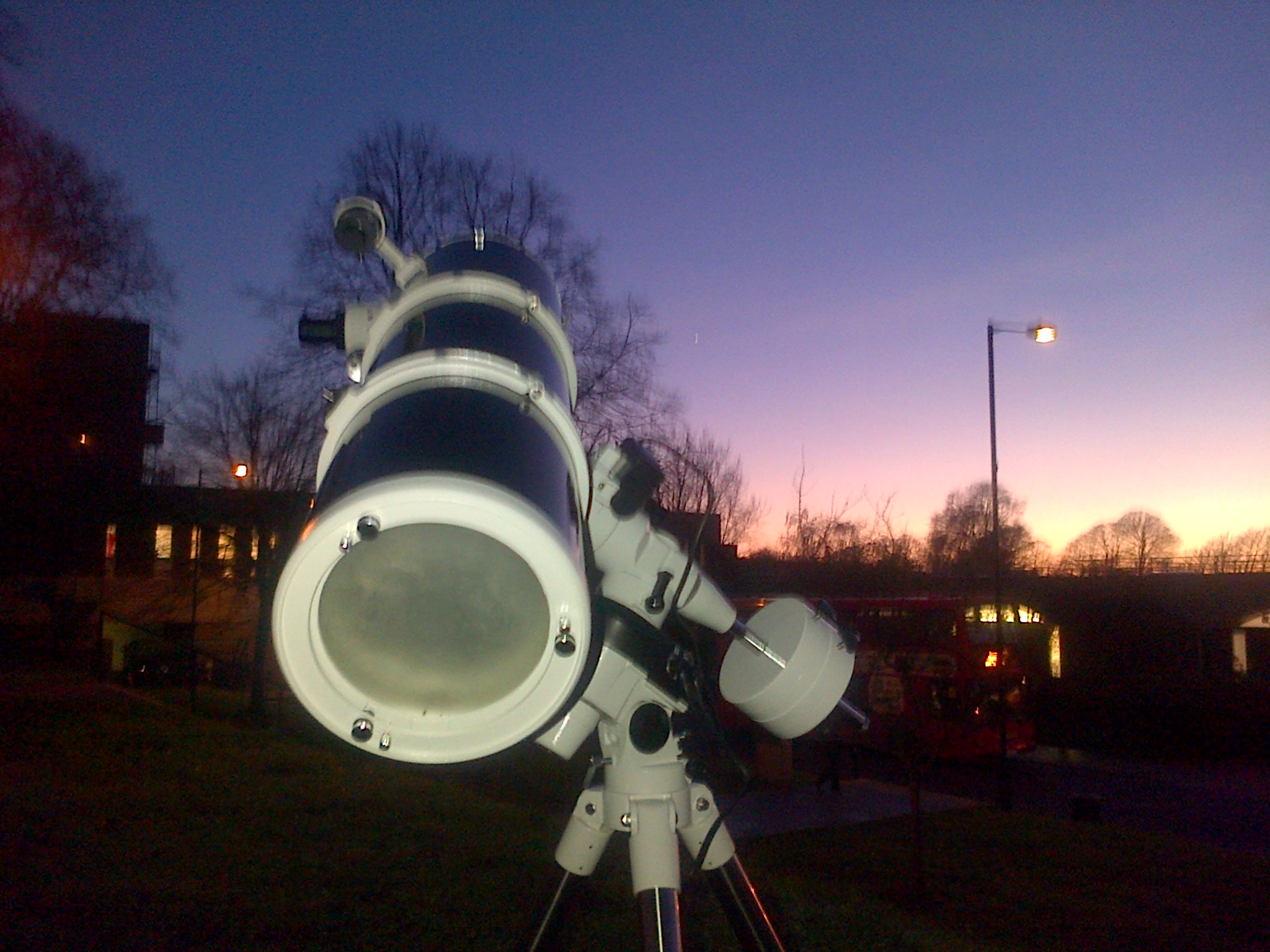
Yesterday I had the honour of giving an evening lecture for staff and students at the School of Mathematical and Physical Sciences at the University of Sussex. The event was preceded by a bit of impromptu twilight stargazing with the new telescope our students have just purchased:

IMG-20131209-00241 IMG-20131209-00243

You can just about see Venus in the second picture, just to the left of the street light.

Anyway, after briefly pretending to be a proper astronomer it was down to my regular business as a cosmologist and my talk entitled The Cosmic Web. Here is the abstract:

The lecture will focus on the large-scale structure of the Universe and the ideas that physicists are weaving together to explain how it came to be the way it is. Over the last few decades, astronomers have revealed that our cosmos is not only vast in scale – at least 14 billion light years in radius – but also exceedingly complex, with galaxies and clusters of galaxies linked together in immense chains and sheets, surrounding giant voids of (apparently) empty space. Cosmologists have developed theoretical explanations for its origin that involve such exotic concepts as ‘dark matter’ and ‘cosmic inflation’, producing a cosmic web of ideas that is, in some ways, as rich and fascinating as the Universe itself.

And for those of you interested, here are the slides I used for your perusal:

It was quite a large (and  very mixed) audience; it’s always difficult to pitch a talk at the right level in those circumstances so that it’s not too boring for the people who know something already but not too challenging for those who don’t know anything at all. A couple of people walked out about five minutes into the talk, which doesn’t exactly inspire a speaker with confidence, but overall it seemed to go down quite well.

Most of all, thank you to the organizers for the very nice reward of a bottle of wine!

Quantum Technology – a Sussex Strength

Posted in Finance, Politics, Science Politics, The Universe and Stuff with tags , , on December 9, 2013 by telescoper

Amid all the doom and gloom in the Chancellor’s Autumn Statement delivered last week there’s a ray of sunshine for research in Physics in the form of an injection of around £270 million in Quantum Technology. According to the Financial Times,

The money will support a national network of five research centres, covering quantum computing, secure communications, sensors, measurement and simulation.

Details of the scheme are yet to be released, but it seems the network will consist of “regional centres” although how evenly it will be spread across the regions remains to be seen. How many will be in the Midlands, for example?

We’re very happy here with this announcement here in the School of Physics & Astronomy at the University of Sussex as we have a well-established and expanding major research activity in Quantum Technology and an MSc Course called Frontiers of Quantum Technology. Moreover, as members of the South East Physics Network (SEPNet) we seem to be in a good position to be for funds as a truly regional centre. Assuming, that is, that the scheme hasn’t already been divvied up behind closed doors before it was even announced!

The investment announced by the government mirrors a growing realization of the potential for economic exploitation of, e.g., quantum computing which is bound to lead to a new range of career opportunities for budding physics graduates.

I’d welcome any comments from people who know any more information about the details of the new investment, as I’m too lazy to search for it myself…

Bohmian Mechanics Explained

Posted in The Universe and Stuff with tags , , on December 4, 2013 by telescoper

Here’s a nice set of short videos about the de Broglie-Bohm theory which is a causal, deterministic, interpretation of Quantum Mechanics that can be thought of as a hidden variable theory. It’s a common misconception that hidden-variable theories are ruled out by experimental evidence (which is probably why they tend not to be discussed very much at undergraduate level) but this is not the case. What is true is that hidden variables have to be non-local, which many physicists consider too weird for comfort – but who’s to say that the Universe isn’t even weirder than we thought?

Statistical Challenges in 21st Century Cosmology

Posted in The Universe and Stuff with tags , , on December 2, 2013 by telescoper

I received the following email about a forthcoming conference which is probably of interest to a (statistically) significant number of readers of this blog so I thought I’d share it here with an encouragement to attend:

–o–

IAUS306 – Statistical Challenges in 21st Century Cosmology

We are pleased to announce the IAU Symposium 306 on Statistical Challenges in 21st Century Cosmology, which will take place in Lisbon, Portugal from 26-29 May 2014, with a tutorial day on 25 May.  Apologies if you receive this more than once.

Full exploitation of the very large surveys of the Cosmic Microwave Background, Large-Scale Structure, weak gravitational lensing and future 21cm surveys will require use of the best statistical techniques to answer the major cosmological questions of the 21st century, such as the nature of Dark Energy and gravity.

Thus it is timely to emphasise the importance of inference in cosmology, and to promote dialogue between astronomers and statisticians. This has been recognized by the creation of the IAU Working Group in Astrostatistics and Astroinformatics in 2012.

IAU Symposium 306 will be devoted to problems of inference in cosmology, from data processing to methods and model selection, and will have an important element of cross-disciplinary involvement from the statistics communities.

Keynote speakers

• Cosmic Microwave Background :: Graca Rocha (USA / Portugal)

• Weak Gravitational Lensing :: Masahiro Takada (Japan)

• Combining probes :: Anais Rassat (Switzerland)

• Statistics of Fields :: Sabino Matarrese (Italy)

• Large-scale structure :: Licia Verde (Spain)

• Bayesian methods :: David van Dyk (UK)

• 21cm cosmology :: Mario Santos (South Africa / Portugal)

• Massive parameter estimation :: Ben Wandelt (France)

• Overwhelmingly large datasets :: Alex Szalay (USA)

• Errors and nonparametric estimation :: Aurore Delaigle (Australia)

You are invited to submit an abstract for a contributed talk or poster for the meeting, via the meeting website. The deadline for abstract submission is 21st March 2014. Full information on the scientific rationale, programme, proceedings, critical dates, and local arrangements will be on the symposium web site here.

Deadlines

13 January 2014 – Grant requests

21 March 2014 – Abstract submission

4 April 2014 – Notification of abstract acceptance

11 April 2014 – Close of registration

30 June 2014 – Manuscript submission
Night Sky

Posted in Poetry, The Universe and Stuff with tags , on November 29, 2013 by telescoper


What they are saying is
that there is life there, too:
that the universe is the size it is
to enable us to catch up.

They have gone on from the human:
that shining is a reflection
of their intelligence. Godhead
is the colonisation by mind

of untenanted space. It is its own
light, a statement beyond language
of conceptual truth. Every night
is a rinsing myself of the darkness

that is in my veins. I let the stars inject me
with fire, silent as it is far,
but certain in its cauterising
of my despair. I am a slow

traveller, but there is more than time
to arrive. Resting in the intervals
of my breathing, I pick up the signals
relayed to me from a periphery I comprehend.

by Ronald Stuart Thomas (1913-2000)

Doctor Who at 50

Posted in Biographical, Music, Television, The Universe and Stuff with tags , , , , , on November 23, 2013 by telescoper

Today is the official 50th birthday celebration of Doctor Who and, since The Doctor and myself are of the same vintage, I thought I’d repeat an old post about the show. I just listened to the original theme music again before posting this and I still think it sounds amazingly fresh.

–0–

As a Professor of Astrophysics I am often asked “Why on Earth did you decide to make a career out of such a crazy subject?”

I guess many astronomers, physicists and other scientists have to answer this sort of question. For many of them there is probably a romantic reason, such as seeing the rings of Saturn or the majesty of the Milky Way on a dark night. Others will probably have been inspired by TV documentary series such as The Sky at Night, Carl Sagan’s Cosmos or even Horizon which, believe it or not, actually used to be quite good but which is nowadays uniformly dire. Or it could have been something a bit more mundane but no less stimulating such as a very good science teacher at school.

When I’m asked this question I’d love to be able to put my hand on my heart and give an answer of that sort but the truth is really quite a long way from those possibilities. The thing that probably did more than anything else to get me interested in science was a Science Fiction TV series or rather not exactly the series but the opening titles.

The first episode of Doctor Who was broadcast in the year of my birth, so I don’t remember it at all, but I do remember the astonishing effect the credits had on my imagination when I saw later episodes as a small child. Here is the  opening title sequence as it appeared in the very first series featuring William Hartnell as the first Doctor.

To a younger audience it probably all seems quite tame, but I think there’s a haunting, unearthly beauty to the shapes conjured up by Bernard Lodge. Having virtually no budget for graphics, he experimented in a darkened studio with an old-fashioned TV camera and a piece of black card with Doctor Who written on it in white. He created the spooky kaleidoscopic patterns you see by simply pointing the camera so it could see into its own monitor, thus producing a sort of electronic hall of mirrors.

What is so fascinating to me is how a relatively simple underlying concept could produce a rich assortment of patterns, particularly how they seem to take on an almost organic aspect as they merge and transform. I’ve continued to be struck by the idea that complexity could be produced by relatively simple natural laws which is one of the essential features of astrophysics and cosmology. As a practical demonstration of the universality of physics this sequence takes some beating.

As well as these strange and wonderful images, the titles also featured a pioneering piece of electronic music. Officially the composer was Ron Grainer, but he wasn’t very interested in the commission and simply scribbled the theme down and left it to the BBC to turn it into something useable. In stepped the wonderful Delia Derbyshire, unsung heroine of the BBC Radiophonic Workshop who, with only the crudest electronic equipment available, turned it into a little masterpiece. Ethereal yet propulsive, the original theme from Doctor Who is definitely one of my absolute favourite pieces of music and I’m glad to see that Delia Derbyshire is now receiving the acclaim she deserves from serious music critics.

It’s ironic that until earlier this year I used to live  in Cardiff, where the newer episodes of Doctor Who and its spin-off, the anagrammatic Torchwood, are made. One of the great things about the early episodes of Doctor Who was that the technology simply didn’t exist to do very good special effects. The scripts were consequently very careful to let the viewers’ imagination do all the work. That’s what made it so good. I’m pleased that the more recent incarnations of this show also don’t go overboard on the visuals. Perhaps that’s a conscious attempt to appeal to people who saw the old ones as well as those too young to have done so. It’s just a pity the modern opening title music is so bad…

Anyway, I still love Doctor Who after all these years. It must sound daft to say that it inspired me to take up astrophysics, but it’s truer than any other explanation I can think of. Of course the career path is slightly different from a Timelord, but only slightly.

At any rate I think The Doctor is overdue for promotion. How about Professor Who?