Archive for the The Universe and Stuff Category

Fracking Confusion

Posted in Politics, Science Politics, The Universe and Stuff with tags , , , , , , on August 12, 2013 by telescoper

The news on the radio this morning featured a story about the Prime Minister wanting the UK to “get behind” hydraulic fracturing (or “fracking” as it is known for short) , a means of  liberating shale gas that offers the prospect of boosting the UK’s energy supply.

There’s not much sign any “getting behind” happening up the road from here in Balcombe, where a sizable anti-fracking protest has been going on for some time. There’s actually no fracking going on in Balcombe at the moment; the company involved, Cuadrilla Resources, is doing exploratory drilling to look for oil but may apply for a licence to pursue hydraulic fracturing if that is unsuccessful.

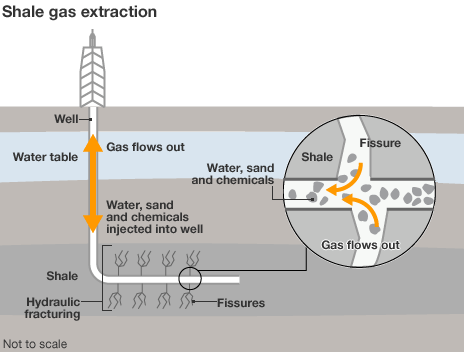
There’s a simple graphic on the BBC website that illustrates how fracking works:
_65309507_shale_gas_extraction464

In simple terms it involves pumping a mixture of water, sand and chemicals into a deposit of shale ato fracture the solid material contained therein and thus liberate the gas. Environmentalists argue that this technique might cause earth tremors and/or contamination of the water supply; advocates of fracking dispute these claims. I’m not sufficiently expert to be able to comment usefully on the arguments about the possible environmental dangers associated with it, so I’d be glad to receive comments via the box below.

One thing I will comment on, though, is the very poor quality of the media reporting on this issue. I’ve yet to see any meaningful attempt to comment on the science involved when surely that’s the key to whether we should “get behind” fracking or not? It struck me that quite a few readers might also be interested but ill-informed about this issue to, so for them I’d recommend reading the Beddington Report, the key findings of which were:

  • The health, safety and environmental risks can be managed effectively in the UK. Operational best practices must be implemented and enforced through strong regulation. Fracture propagation is an unlikely cause of contamination.
  • The risk of fractures propagating to reach overlying aquifers is very low provided that shale gas extraction takes place at depths of many hundreds of metres or several kilometres. Even if fractures reached overlying aquifers, the necessary pressure conditions for contaminants to flow are very unlikely to be met given the UK’s shale gas hydrogeological environments.
  • Well integrity is the highest priority. More likely causes of possible contamination include faulty wells. The UK’s unique well examination scheme was set up so that independent, specialist experts could review the design of every offshore well. This scheme must be made fit for purpose for onshore activities.
  • Robust monitoring is vital. Monitoring should be carried out before, during and after shale gas operations to detect methane and other contaminants in groundwater and potential leakages of methane and other gases into the atmosphere.
  • An Environmental Risk Assessment (ERA) should be mandatory. Every shale gas operation should assess risks across the entire lifecycle of operations, from water use through to the disposal of wastes and the abandonment of wells.
  • Seismic risks are low. Seismicity should be included in the ERA.Seismicity induced by hydraulic fracturing is likely to be of smaller magnitude than the UK’s largest natural seismic events and those induced by coal mining.
  • Water requirements can be managed sustainably. Water use is already regulated by the Environment Agency. Integrated operational practices, such as recycling and reusing wastewaters where possible, would help to minimise water requirements further. Options for disposing of wastes should be planned from the outset. Should any onshore disposal wells be necessary in the UK, their construction, regulation and siting would need further consideration.
  • Regulation must be fit for purpose. Attention must be paid to the way in which risks scale up should a future shale gas industry develop nationwide. Regulatory co-ordination and capacity must be maintained.
  • Policymaking would benefit from further research. The carbon footprint of shale gas extraction needs further research. Further benefit would also be derived from research into the public acceptability of shale gas extraction and use in the context of the UK’s energy, climate and economic policies.

I’m not sure how many anti-fracking activists, or others involved in the Balcombe protest, have read this report.

Anyway, in an attempt to gauge the mood of my totally unrepresentative readership, I thought I’d try a little poll:

And if you have strong opinions, please feel free to use the comments box.

The Expanding University

Posted in Biographical, Education, The Universe and Stuff with tags , , , on August 10, 2013 by telescoper

Well, I’m a bit busy today – despite the fact that it’s a weekend – so I’m just going to take the opportunity post here  a news item from my employer which has already been posted on the University of Sussex website. 

–o–

The School of Mathematical and Physical Sciences (MPS) will have 63 academics at the start of the 2013-14 academic year – an increase of 58 per cent from February, when only 40 were in post.

The expansion follows a very successful few years for the School, during which the number of students starting degrees in Physics and Astronomy at Sussex has grown almost threefold.

The department has also climbed to 5th in The Times Good University Guide 2013 and Mathematics was ranked in the top 10 for academic support in the 2012 National Student Survey (NSS).

From September, Physics and Astronomy will have 40 academics, up from 25 in February. There are 12 new posts as well as three replacements, including the arrival in February of Professor Peter Coles, who replaced the late Professor David Axon as Head of School.

Mathematics is increasing from 15 academics to 23, with five of these arrivals being new positions. In particular, three new professors will join the Department this year.

Professor Coles says that overseeing this expansion has been his main focus since returning to Sussex. He says: “When I arrived, plans were already under way to get new people in and I knew this had to be my priority in my first few months as Head of MPS.

“We had an incredibly high calibre of applicants for all the posts and, in many cases, have been able to appoint more than one person. For one of the posts in Astronomy, the shortlist was so strong that we have actually appointed four excellent academics in that area. We couldn’t miss that opportunity.

“Our three  new chairs in Mathematics are joining us from Denmark, Greece and Italy, bolstering the School’s international outlook.

“We have been strategic in our appointments to encourage growth into new areas for us, such as probability and stochastic modelling on the Mathematics side, and materials-based experimental research on the Physics side. We anticipate further strategic expansion in these areas in the near future.

“These appointments also represent a step towards more interdisciplinarity and better crossover between the two departments within the School, and indeed with other schools such as Life Sciences, developing still further the University’s traditional strength in interdisciplinary research.

“And, most importantly of all, students in MPS will benefit from more study choices and smaller class sizes.”

A Sussex Alumna

Posted in Biographical, Television, The Universe and Stuff with tags , , , , on August 9, 2013 by telescoper

I had a very nice meeting this morning with Sir Harry Kroto, who is back in the UK for the summer. We chatted about a number of exciting things going on at Sussex University and beyond, in the middle of which I remembered a film featuring my former  PhD Student from Nottingham days, Emma King. The film was part of a series about young scientists made by the Vega Science Trust (which Harry set up) and it was originally broadcast on BBC 2 as part of The Learning Zone.

Emma is a graduate of the Department of Physics & Astronomy at Sussex University. As an undergraduate at the University of Sussex she made history when she became the first woman to win the top prize at the Science, Engineering and Technology Student of the Year award despite tests at school which showed that Emma was not only slightly dyslexic, but that also had very poor arithmetic skills and she says “a nearly non-existent visual memory.” None of that stopped her completing her PhD thesis (on magnetic fields in cosmology) in 2006.

p.s. After completing her PhD, Emma changed career and now runs this outdoor event venue.

Duet for Violin and Subatomic Particles

Posted in Music, The Universe and Stuff with tags , , , on August 8, 2013 by telescoper

I received an email this morning about this video and thought I’d post the clip here. This short documentary is about the performance of the composition Cloud Chamber (“Duet for violin and subatomic particles”) in San Francisco at the California Academy of Sciences in Golden Gate Park. The video was produced by Patrick Haynes, Adam Behrmann and Chris Whitmore, and features commentaries from , e.g., Hitoshi Murayama, Professor of Physics at Berkeley and Director of the Institute of Physics and Mathematics of the Universe at the University of Tokyo (the commentaries start at 16:10). It is introduced by Professor JoAnne L. Hewitt, Head of Theoretical Physics at SLAC National Accelerator Laboratory, Stanford University. There’s a longer description on the Youtube page if you’re interested in learning more about this interesting project.

An Integral Appendix

Posted in Biographical, Cute Problems, The Universe and Stuff with tags , , , , , , on August 7, 2013 by telescoper

After the conference dinner at the Ripples in the Cosmos meeting in Durham I attended recently, a group of us adjourned to the Castle bar for a drink or several. I ended up chatting to one of the locals, Richard Bower, mainly on the subject of beards. I suppose you could call it a chinwag. Only later on did  we get onto the subject of a paper we had both worked on a while ago. It was with some alarm that I later realized that the paper concerned was actually published twenty years ago. Sigh. Where did all that time go?

Anyway, Richard and I both remembered having a great time working on that paper which turned out to be a nice one, although it didn’t exactly set the world on fire in terms of citations. This paper was written before the standard “concordance” (LCDM) cosmology was firmly established and theorists were groping around for ways of reconciling observations of the CMB from the COBE satellite with large-scale structure in the galaxy distribution as well as the properties of individual galaxies. The (then) standard model (CDM with no Lambda) struggled to satisfy the observational constraints, so in typical theorists fashion we tried to think of a way to rescue it. The idea we came up with was “cooperative galaxy formation”, as explained in the abstract:

We consider a model in which galaxy formation occurs at high peaks of the mass density field, as in the standard picture for biased galaxy formation, but is further enhanced by the presence of nearby galaxies. This modification is accomplished by assuming the threshold for galaxy formation to be modulated by large-scale density fluctuations rather than to be spatially invariant. We show that even a weak modulation can produce significant large-scale clustering. In a universe dominated by cold dark matter, a 2 percent – 3 percent modulation on a scale exceeding 10/h Mpc produces enough additional clustering to fit the angular correlation function of the APM galaxy survey. We discuss several astrophysical mechanisms for which there are observational indications that cooperative effects could occur on the scale required.

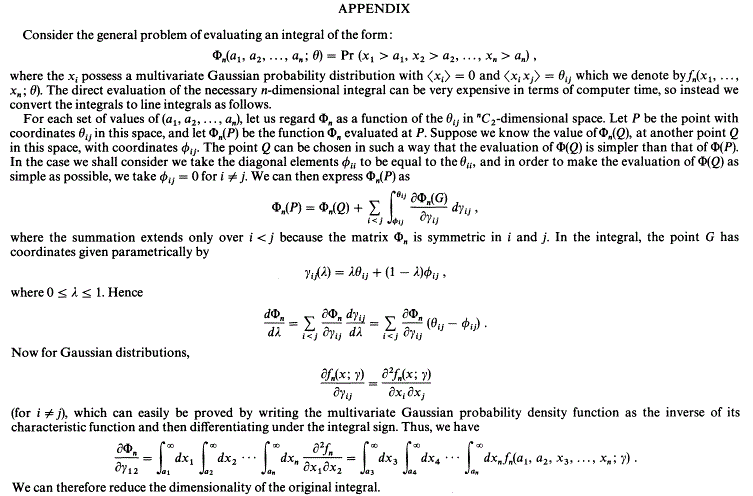
I have to say that Richard did most of the actual work on this paper, though all four authors did spend a lot of time discussing whether the idea was viable in principle and, if so, how we should implement it mathematically. In the end, my contribution was pretty much limited to the Appendix, which you can click to make it larger if you’re interested.

t2png

As is often the case in work of this kind, everything boiled down to evaluating numerically a rather nasty integral. Coincidentally, I’d come across a similar problem in a totally different context a few years previously when I was working on my thesis and therefore just happened to know the neat trick described in the paper.

Two things struck me looking back on this after being reminded of it over that beer. One is that a typical modern laptop is powerful enough to evaluate the original integral without undue difficulty, so if this paper had been written nowadays we wouldn’t have bothered trying anything clever; my Appendix would probably not have been written. The other thing is that I sometimes hear colleagues bemoaning physics students’ lack of mathematical “problem-solving” ability, claiming that if students haven’t seen the problem before they don’t know what to do. The problem with that complaint is that it ignores the fact that many problems are the same as things you’ve solved before, if only you look at them in the right way. Problem solving is never going to be entirely about “pattern-matching” – some imagination and/or initiative is going to required sometimes- but you’d be surprised how many apparently intractable problems can be teased into a form to which standard methods can be applied. Don’t take this advice too far, though. There’s an old saying that goes “To a man who’s only got a hammer, everything looks like a nail”. But the first rule for solving “unseen” problems has to be to check whether you might in fact already have seen them…

Just a minute! Is space really expanding?

Posted in Astrohype, The Universe and Stuff with tags , , , on August 2, 2013 by telescoper

Now then. I’m sure this little video will get a few cosmologists’ hackles rising:

The video was produced by minutephysics, so presumably the expansion of time accounts for the fact that lasts more than two minutes. More importantly, though, is the content. Here’s an old  discussion of mine on this question. Let me know what you think via the comments box!

Building Blocks and Blueprints in Cosmology

Posted in The Universe and Stuff with tags , , , on August 1, 2013 by telescoper

Still playing catch-up from my recent travels, so to provide a blog post for today I’ve decided shamelessly to rip off an interesting comment on a blog post by Sean Caroll which picked up on the theme I posted about a few days ago, namely my perception that the current generation of cosmologists seems rather reluctant to question the standard paradigm. Please bear with me if that all sounds a bit incestuous…

Anyway, Peter Edmonds commented in order to draw attention to a series of papers on related matters by Avi Loeb (of Harvard University) which can be found on the arXiv here, here, here and there.
I’d encourage you to read the four interesting papers I’ve linked to above as I think they are extremely thought-provoking. The last of these begins with this paragraph, so you can see why it’s relevant to the aforementioned topic.

Too few theoretical astrophysicists are engaged in tasks that go beyond the refinement of details in a commonly accepted paradigm. It is far more straightforward today to work on these details than to review whether the paradigm itself is valid. While there is much work to be done in the analysis and interpretation of experimental data, the unfortunate by-product of the current state of affairs is that popular, mainstream paradigms within which data is interpreted are rarely challenged. Most cosmologists, for example, lay one brick of phenomenology at a time in support of the standard (inflation+Λ+Cold-Dark-Matter) cosmological model, resembling engineers that follow the blueprint of a global construction project, without pausing to question whether the architecture of the project makes sense when discrepancies between expectations and data are revealed.

To put this another way, a great deal of modern astrophysics and cosmology is rather incremental. I don’t mean that in a derogatory way, just that such research often involves large-scale observational projects that have to proceed slowly and painstakingly. Working at the coal face in large consortia like this makes it difficult to take the time to step back and consider the bigger picture. We ask a lot of early career researchers nowadays when we expect them to cope with detailed analytic work as well as assimilating and synthesizing a coherent view of the overall landscape. Producing a stream of research papers doesn’t in itself make an excellent research. Productivity needs to be balanced by a proper appreciation of which questions are the most important ones to ask, which often requires (and I apologize for using such an awful cliché) thinking outside the box.

Article of the Day!

Posted in The Universe and Stuff with tags , , , , , , on July 31, 2013 by telescoper

Back in the office today, the heatwave having given way to grey drizzle and cool breezes (at least for the time being). I’ve got stacks of paperwork to catch up on, but fortunately I’ve got time to post a quick congratulatory message to Ian Harrison, who is author of today’s NASA ADS Article of the Day! Ian is a PhD student in the School of Physics & Astronomy at Cardiff University and was supervised by me until I abandoned ship to come here to Sussex earlier this year; he’s got a postdoctoral research position lined up in the Midlands (Manchester) when he finishes his thesis. The other author, Shaun Hotchkiss, is coming to Sussex as a postdoctoral researcher in October.

Anyway, the paper is a nice one, called A consistent approach to falsifying ΛCDM with rare galaxy clusters. Here’s the abstract:

We consider methods with which to answer the question “is any observed galaxy cluster too unusual for ΛCDM?” After emphasising that many previous attempts to answer this question will overestimate the confidence level at which ΛCDM can be ruled out, we outline a consistent approach to these rare clusters, which allows the question to be answered. We define three statistical measures, each of which are sensitive to changes in cluster populations arising from different modifications to the cosmological model. We also use these properties to define the “equivalent mass at redshift zero” for a cluster — the mass of an equally unusual cluster today. This quantity is independent of the observational survey in which the cluster was found, which makes it an ideal proxy for ranking the relative unusualness of clusters detected by different surveys. These methods are then used on a comprehensive sample of observed galaxy clusters and we confirm that all are less than 2σ deviations from the ΛCDM expectation. Whereas we have only applied our method to galaxy clusters, it is applicable to any isolated, collapsed, halo. As motivation for future surveys, we also calculate where in the mass redshift plane the rarest halo is most likely to be found, giving information as to which objects might be the most fruitful in the search for new physics.

In case you’re wondering, the rather Popperian nature of the title is not the reason why I’m not among the authors. I’m just not the sort of supervisor who feels he should always be an author of papers done by his research students even when they had the idea and did all the work themselves. From what I’ve heard talking to others, we’re a dying breed!

No more ripples?

Posted in Biographical, The Universe and Stuff with tags , , , on July 27, 2013 by telescoper

Well, that’s the Ripples in the Cosmos meeting in Durham over and done with, and I’m back in Newcastle for a few days before moving on to Edinburgh next week. I’m not sure I’ll be able to blog much over the next few days because my internet connectivity will be a bit limited.

Anyway, the meeting was very exciting, as you can tell from the picture showing me (with the beard) and Brian Schmidt (with the Nobel Prize):

IMG_20130725_144131

Yesterday it was my job to round off the meeting with some concluding remarks leading into a panel discussion. I have to admit that although the programme for the conference was clearly designed in order to generate provoke discussion, I was a little disappointed that so few people said anything controversial. I’ve long held that there are too many cosmologists willing to believe too much, and this was further evidence that the scepticism that is a necessary part of a healthy science has been replaced by widespread conformity, especially among the young; when I was a lad the students and postdocs were a lot more vocal at meetings than they are now. Perhaps this is characteristic of a change in culture of cosmology? To get a job nowadays it’s virtually essential to climb onto one of the big bandwagon projects, and to keep your place you have to toe the party line, refrain from rocking the boat, not speak out of turn, and avoid making ripples (That’s enough metaphors. Ed).

Anyway, I think there are still a great many things in modern cosmology we don’t understand at all, and I think a few more of the older generation should show the way by questioning things in public. In fact only got asked to do the concluding remarks because Jim Peebles was unable to come to the meeting. Jim’s an immensely distinguished physicist who has probably done more than any other living person to develop the standard cosmology, but he’s also never been afraid to play devil’s advocate. We need more like him, willing to articulate the doubts that too many of us feel the need to suppress.

It’s amazing how much progress we have made in cosmology over the last few decades, but we shouldn’t use that as an excuse to get complacent. Cosmology is about the biggest questions in science. That alone makes it an exciting subject to work in. It’s an adventure. And the last thing you want on an adventure is for the journey to be too comfortable.

The Mysterious Mr Ripples

Posted in Biographical, The Universe and Stuff with tags , , on July 24, 2013 by telescoper

So here I am in the fine city of Durham, in the North Midlands, for a meeting entitled Ripples in the Cosmos. I travelled by plane from Gatwick to Newcastle on Sunday afternoon, and got there eventually – after a two-hour delay caused by the aircraft we were meant to fly on having a technical problem and needing to be replaced by another. Anyway, I spent Sunday with my folks. Thinking it was only going to be a half-hour drive to Durham, we left early on Monday morning so I’d be in time to chair the first session.

Unfortunately, major roadworks on A1 intervened and we got stuck in traffic near the Metro Centre in Gateshead. Fortunately, various people at the conference caught my Twitter updates and a deputy was arranged. I got there about 30 minutes late and I took over after the coffee break.

300px-Yard2
After the day’s conference I wandered up to Durham Caste (left), where I had a room booked for the week. However, when I got there they had no record of my reservation. The porter was very helpful and let me connect to my email to check, and I retrieved the confirmation of my booking. In exasperation, I looked through the papers he had relating to room bookings, and found one in the name of “Mr Ripples”. Not even “Professor Ripples”, mark you.


The mysterious Mr Ripples not having appeared to claim his room I surmised that the similarity of his name to the title of the conference might indicate that perhaps some administrative error might have been made. The porter agreed, changed the name from Mr Ripples to Professor Coles and gave me a key.

Anyway, Durham Castle is a rather splendid place to stay.  Breakfast is to be had in grand surroundings complete with walls decorated with suits of armour, swords and other historical weapons. This environment, together with the continuing warm weather, as well of course as the excellent conference talks, has made this very enjoyable week so far.  Apart from the nagging doubt that Mr Ripples could suddenly turn up and demand his room, the only problem is the ringing of bells all through the night.

The conference dinner is this evening, and it’s in the Great Hall of Durham Castle so I won’t have far to stagger home to bed…