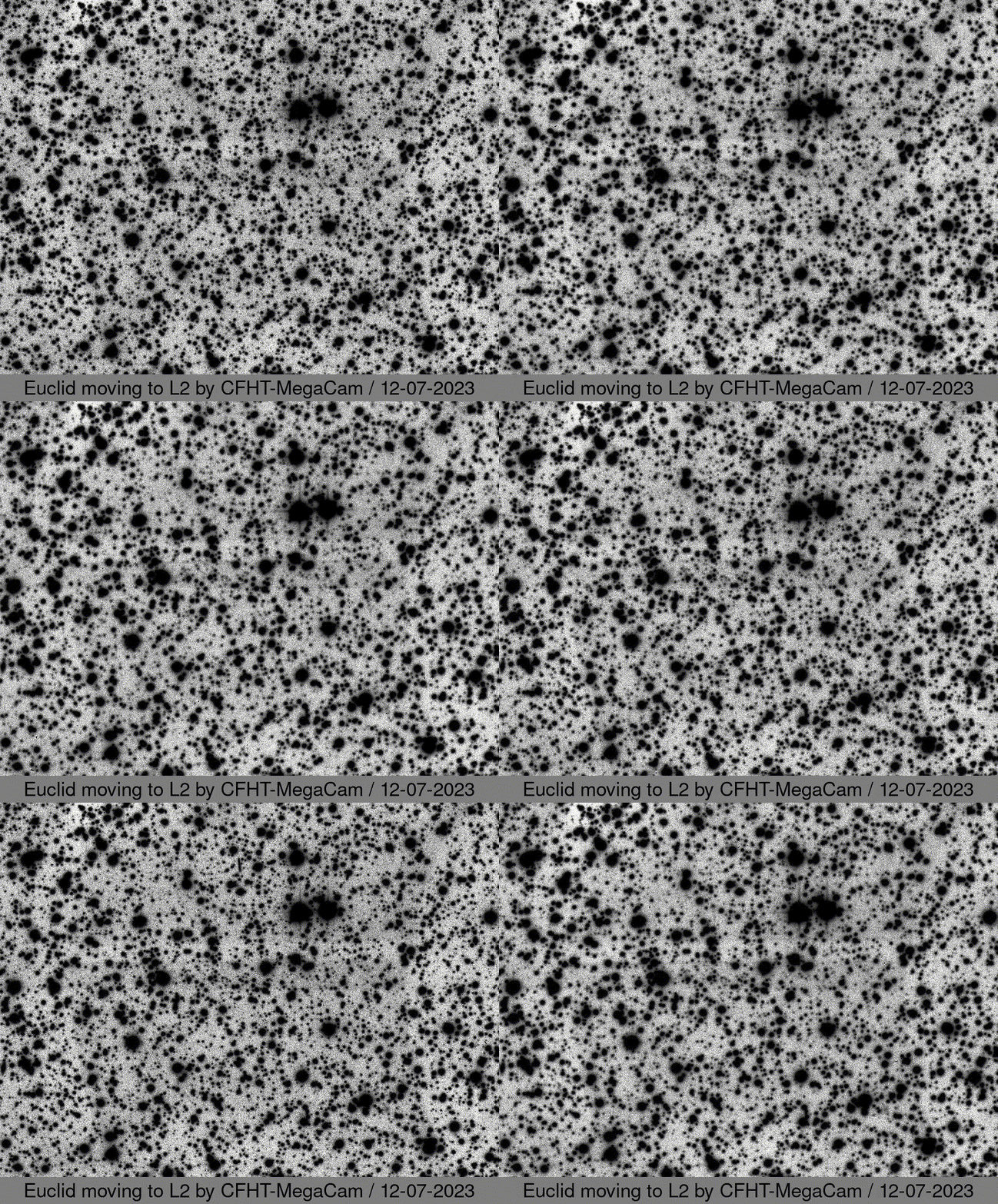
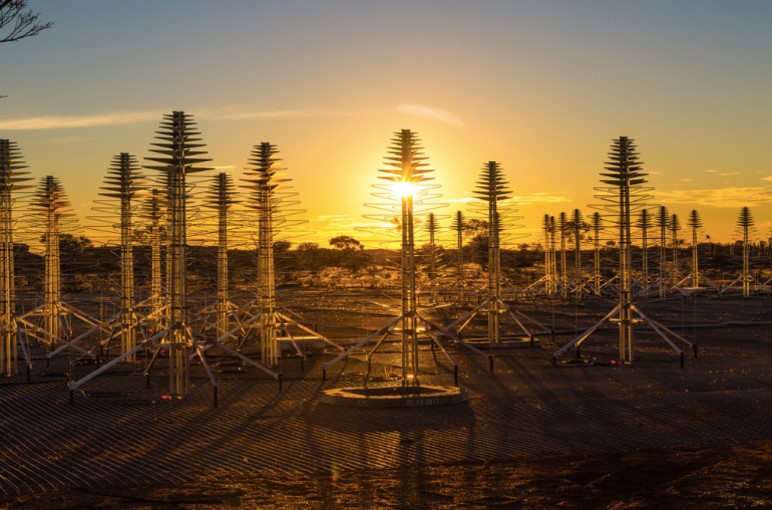
With just three days to go before the scheduled launch of the Euclid spacecraft on Saturday 1st July 2023, at 1612 Irish Time (GMT+1), the Education and Public Outreach (EPO) team have been continuing to ramp up its social media activity and the second YouTube video has now “dropped” (as you young people say).
This was filmed at Thales Alenia Space in Cannes, France, as members of the Euclid consortium from around the world gathered in anticipation to see the fully-assembled Euclid telescope for the first time as it underwent final tests before its journey to the launch site in Florida.
The first paper was published on Friday 23rd June. It is the 21st in Volume 6 (2023) and the 86th in all.
The primary classification for this paper is Cosmology and Nongalactic Astrophysics and its title is “CosmoPower-JAX: high-dimensional Bayesian inference with differentiable cosmological emulators”. The paper is about a new method, based on machine learning, to construct emulators for cosmological power spectra for the purpose of speeding up inference procedures. The software described in the paper is available here.
The authors are Davide Piras (of the University of Geneva, Switzerland) and Alessio Spurio Mancini (of the Mullard Space Sciences Laboratory, University College, London, UK)
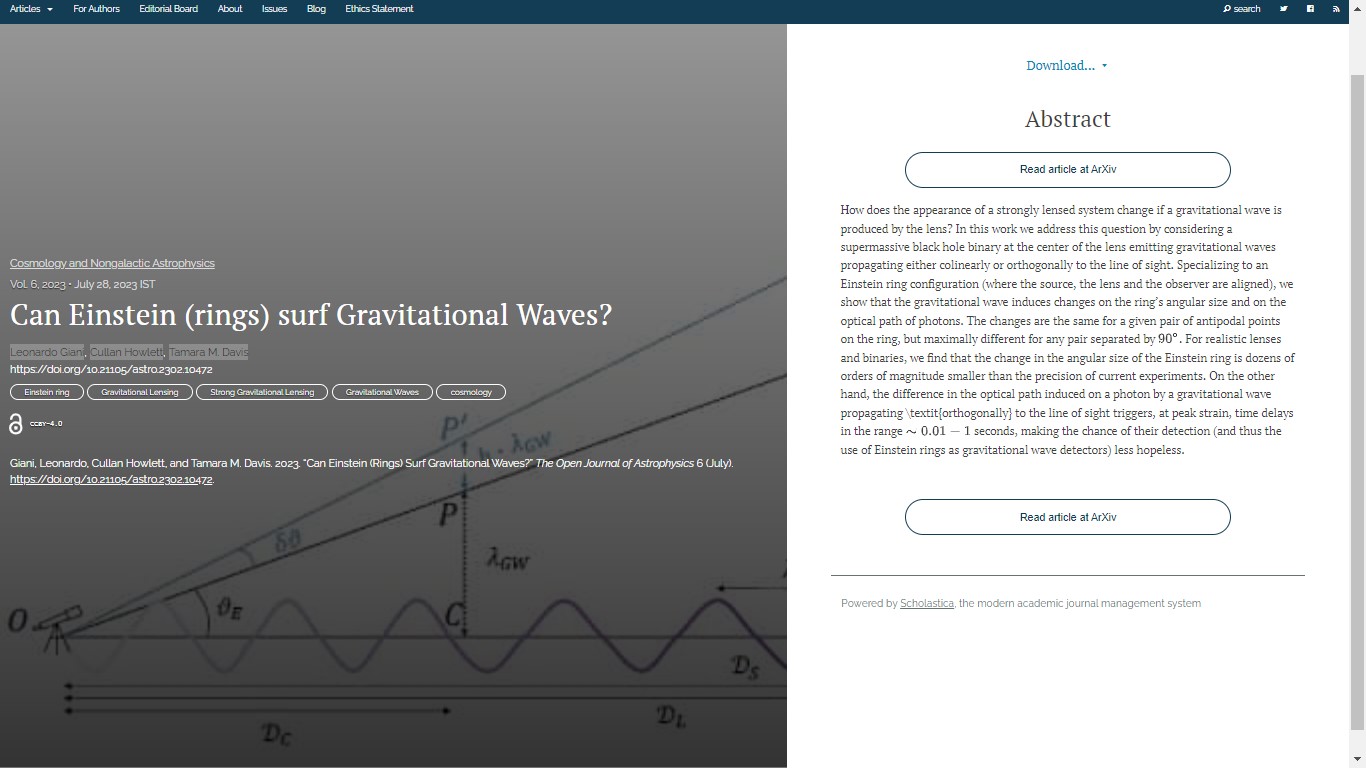
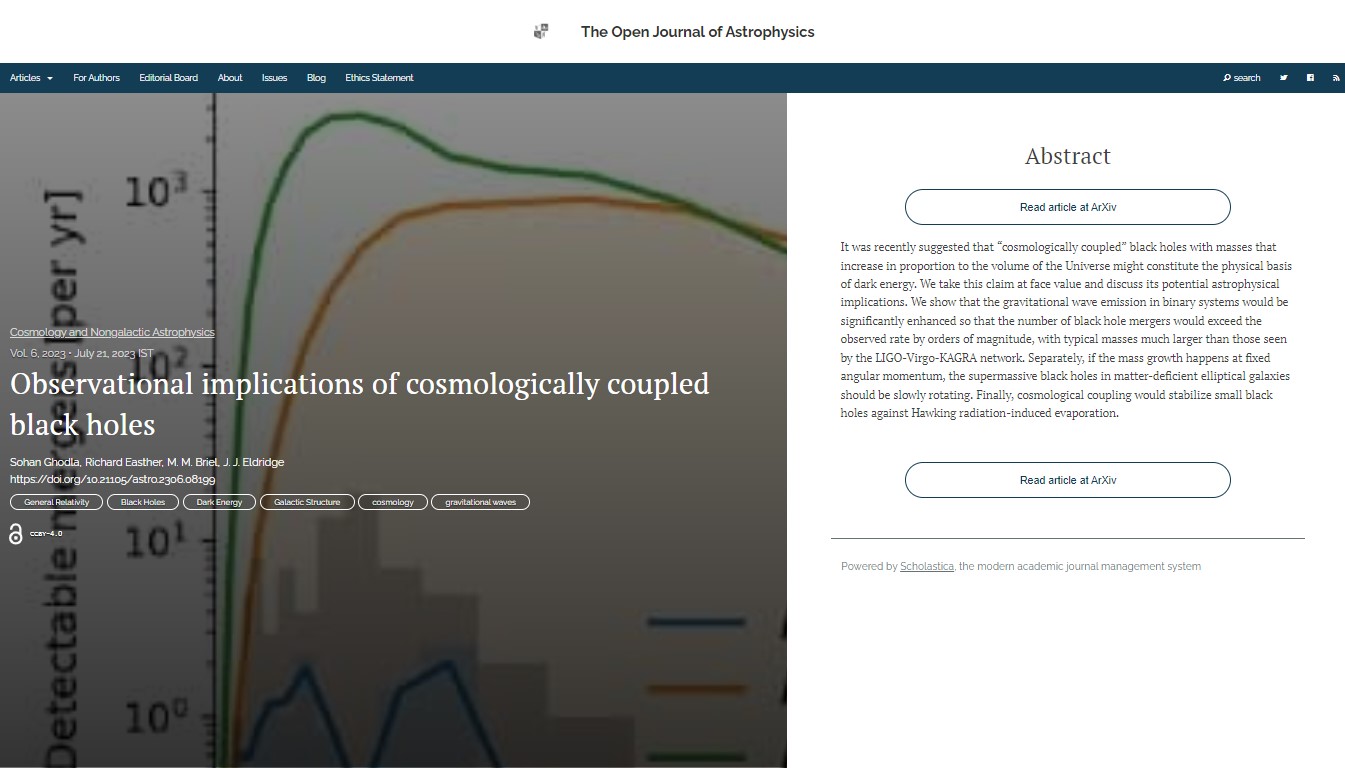
Here is a screen grab of the overlay which includes the abstract:
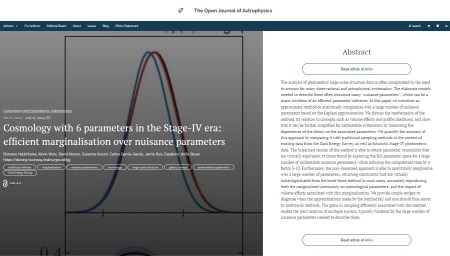
You can click on the image of the overlay to make it larger should you wish to do so. You can find the officially accepted version of the paper on the arXiv here.
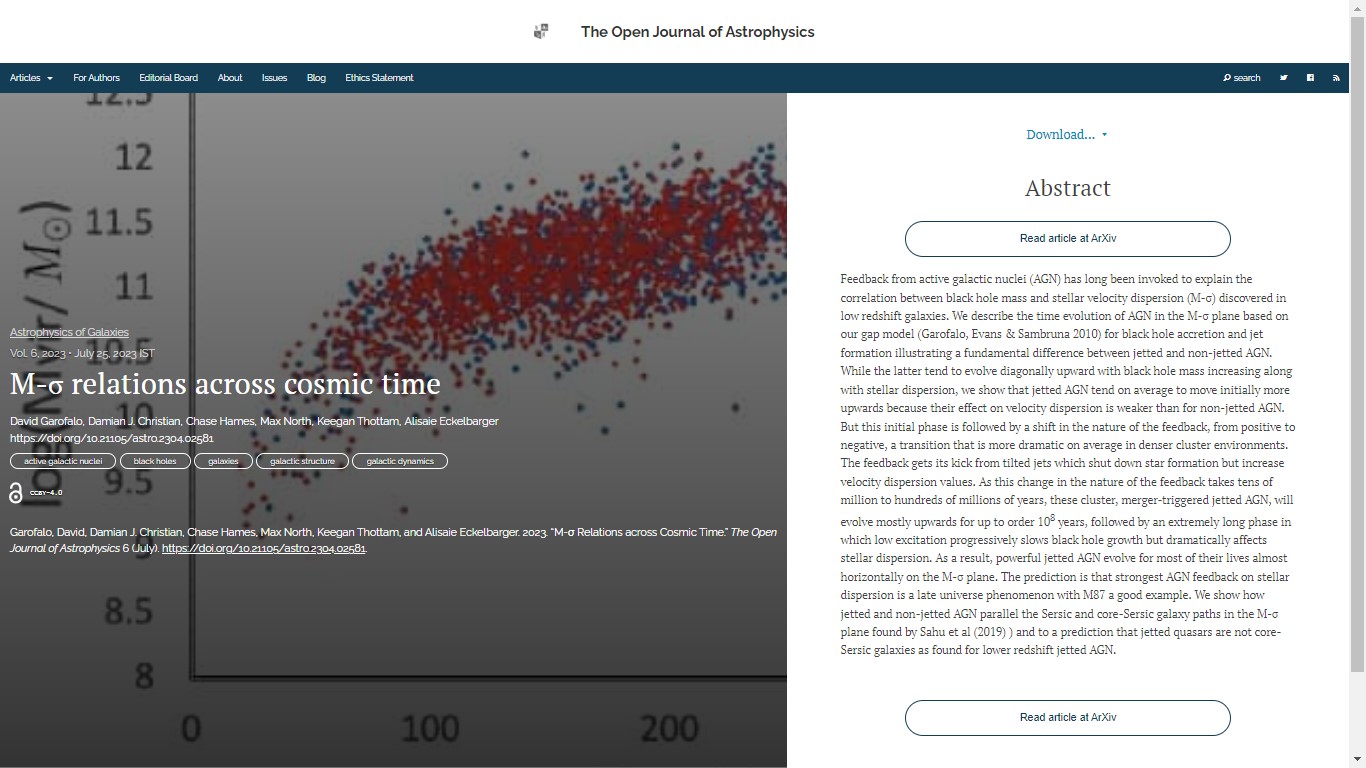
The second paper was published yesterday. It is the 22nd in Volume 6 (2023) and the 87th in all. Although 87 is an unlucky number for Australian cricketers – 13 short of a century – we’re still well on track to reach 100 papers by the end of the year.
Once again the primary classification for this paper is Cosmology and Nongalactic Astrophysics. The title of this one is “The alignment of galaxies at the Baryon Acoustic Oscillation scale” by Dennis van Dompseler, Christos Georgiou & Nora Elisa Chisari all of Utrecht University, in The Netherlands.
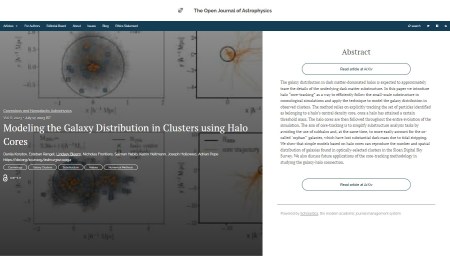
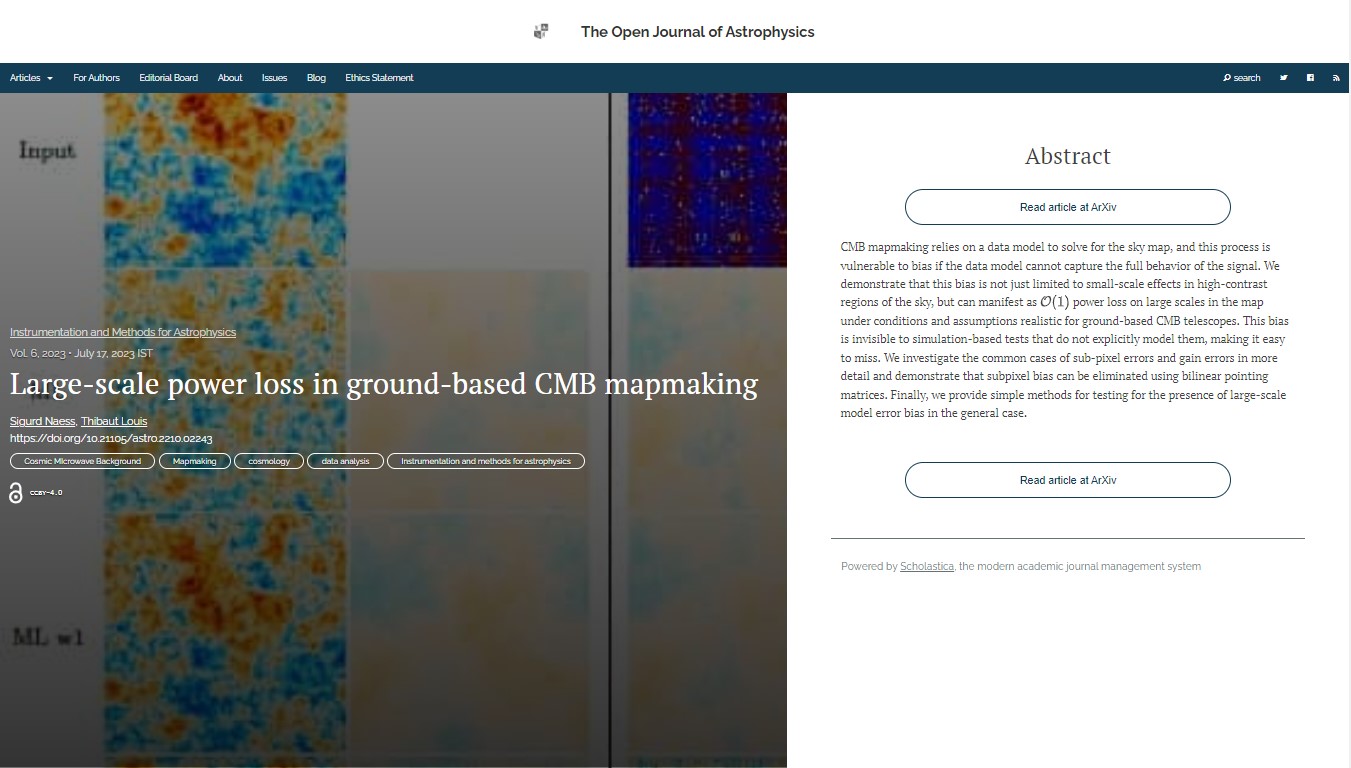
Here is a screen grab of the overlay which includes the abstract:
You can click on the image of the overlay to make it larger should you wish to do so. You can find the officially accepted version of the paper on the arXiv here.
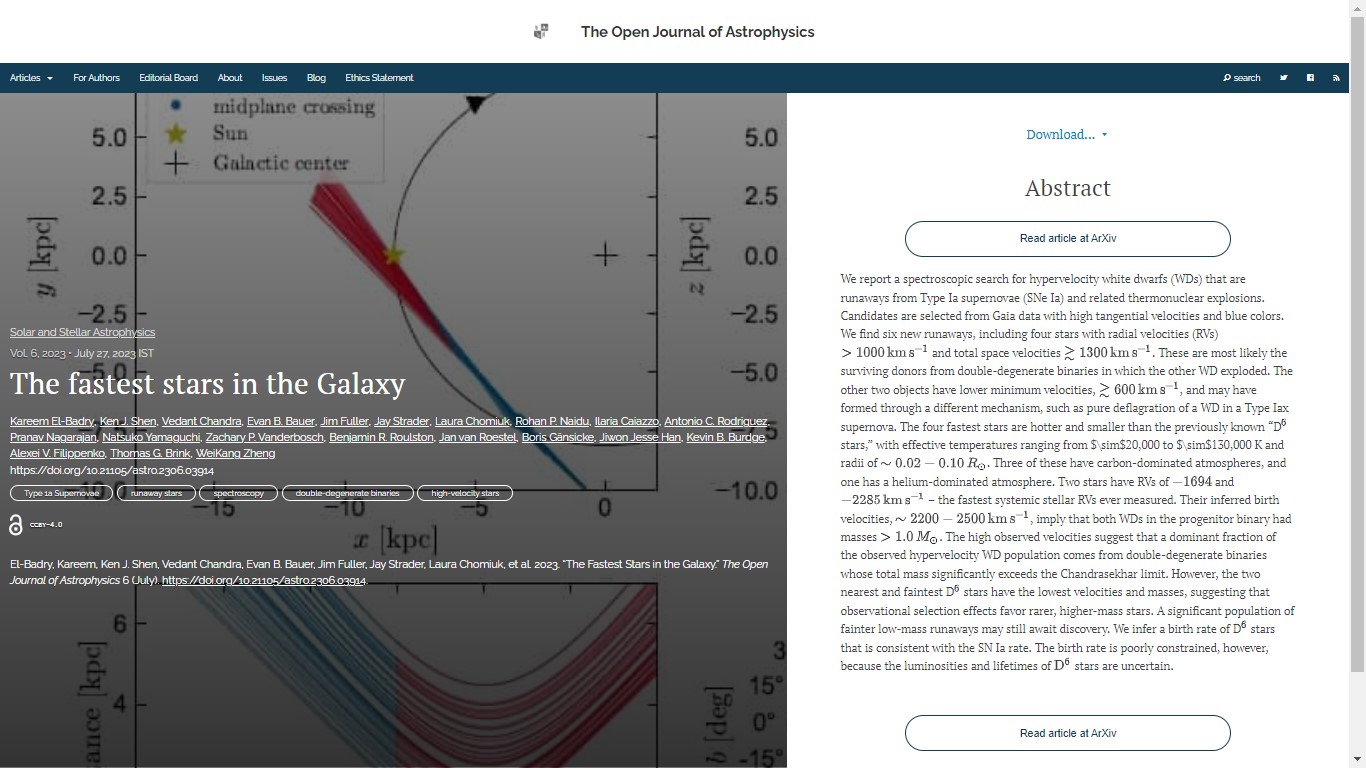
With the scheduled launch of ESA’s Euclid mission coming up this weekend, it is perhaps topical to share the document written almost 12 years ago that outlines the design concepts and describes the detailed scientific case. It’s a compendious piece, running to well over 100 pages but, as with virtually everything in astrophysics, the full Euclid Definition Study Report can be found on arXiv.
Here is the abstract:
Euclid is a space-based survey mission from the European Space Agency designed to understand the origin of the Universe’s accelerating expansion. It will use cosmological probes to investigate the nature of dark energy, dark matter and gravity by tracking their observational signatures on the geometry of the universe and on the cosmic history of structure formation. The mission is optimised for two independent primary cosmological probes: Weak gravitational Lensing (WL) and Baryonic Acoustic Oscillations (BAO). The Euclid payload consists of a 1.2 m Korsch telescope designed to provide a large field of view. It carries two instruments with a common field-of-view of ~0.54 deg2: the visual imager (VIS) and the near infrared instrument (NISP) which contains a slitless spectrometer and a three bands photometer. The Euclid wide survey will cover 15,000 deg2 of the extragalactic sky and is complemented by two 20 deg2 deep fields. For WL, Euclid measures the shapes of 30-40 resolved galaxies per arcmin2 in one broad visible R+I+Z band (550-920 nm). The photometric redshifts for these galaxies reach a precision of dz/(1+z) < 0.05. They are derived from three additional Euclid NIR bands (Y, J, H in the range 0.92-2.0 micron), complemented by ground based photometry in visible bands derived from public data or through engaged collaborations. The BAO are determined from a spectroscopic survey with a redshift accuracy dz/(1+z) =0.001. The slitless spectrometer, with spectral resolution ~250, predominantly detects Ha emission line galaxies. Euclid is a Medium Class mission of the ESA Cosmic Vision 2015-2025 programme, with a foreseen launch date in 2019. This report (also known as the Euclid Red Book) describes the outcome of the Phase A study.
arXiv:1110.3193
Euclid was formally adopted as an ESA M Class mission in June 2012. I’ve added the emphasis to the penultimate sentence to draw your attention to the fact that the launch of Euclid is about four years late.
With less than a week to go before the scheduled launch of the Euclid spacecraft on Saturday 1st July 2023, at 1612 Irish Time (GMT+1), the Education and Public Outreach (EPO) team has been ramping up its social media activity. They’ve even got a blog! Anyway here is a nice video featuring many members of the Euclid Consortium – some of whom gave presentations at last week’s conference – talking about Euclid. The sense of enthusiasm shines through, I think. I will be sharing further videos when they appear.
So here I am then, back in Maynooth. I had a relatively stress-free trip back, although my plane was a bit late and I had to run through Dublin Airport to catch the Hopper Bus I was booked on. Made it though.
The first thing I want to do is to thank the organizers for what was a wonderful event. I wasn’t able to attend the Euclid Consortium meeting in Oslo last year, largely because it was earlier in the year, in April (i.e. term-time) and I had teaching responsibilities. I gather it was a rather gloomy occasion because there was no concrete plan for the launch of Euclid thanks to the Russian war against Ukraine. I guess few would have predicted then that the 2023 meeting would be just a week or so before a launch on SpaceX!
I have to say the atmosphere was also helped by the excellent weather and very fine catering. The conference dinner was held in the Banqueting Hall, on the first floor of the Hans Christian Anderson Castle which stands at one of the entrances to the famous Tivoli Gardens, a few minutes from the conference venue.
Finally, one other memory that will stay with me for a while. It turned out that the week of the conference coincided with high-school graduation celebrations in Copenhagen, so every day we encountered lots of exuberant and largely inebriated teenagers around wearing funny hats and generally going a bit berserk. They made quite a lot of noise in the evenings, but it was all harmless. You’re only young once!
Having not been at an in-person conference for over four years, it was great to see some new faces and catch up with some people I haven’t seen for a long time. It was especially nice to talk to a couple of members of the Editorial Board of the Open Journal of Astrophysics. It was also nice to talk to some authors. Talking of which, here is Nicolas Tessore delivering a plenary presentation featuring work from one of the papers he has published with OJAp:
Anyway, I was up a stupid o’clock to catch my flight this morning so I think I’ll have a bit of rest and hope for the rain to stop so I can do some shopping.
I may be away at a conference, but it’s still time to announce yet another new paper at the Open Journal of Astrophysics. This one was published on Monday 19th June.
The latest paper is the 20th so far in Volume 6 (2023) and the 85th in all, so with still more than half of 2023 remaining and many papers still in the pipeline, we’re on track to reach a total of 100 papers by the end of 2023!
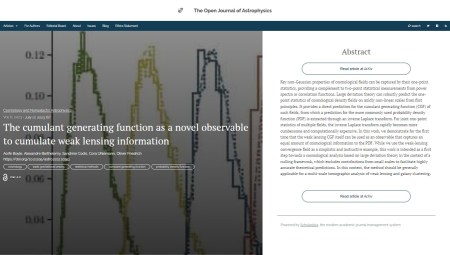
The primary classification for this paper is Cosmology and Nongalactic Astrophysics and its title is “Sparse Bayesian mass-mapping using trans-dimensional MCMC”. The paper describes a new trans-dimensional Markov Chain Monte Carlo sampler for mass-mapping, using wavelets, for the construction of mass maps from weak gravitational lensing which, as I’ve previously mentioned on this blog, is what the cool kids do these days.
The authors are: Augustin Marignier, Thomas D. Kitching & Jason D. McEwen (MSSL, Mullard Space Science Laboratory), Ana M. G. Ferreira (Department of Earth Sciences), all at University College London.
Here is a screen grab of the overlay which includes the abstract:
You can click on the image of the overlay to make it larger should you wish to do so. You can find the officially accepted version of the paper on the arXiv here.
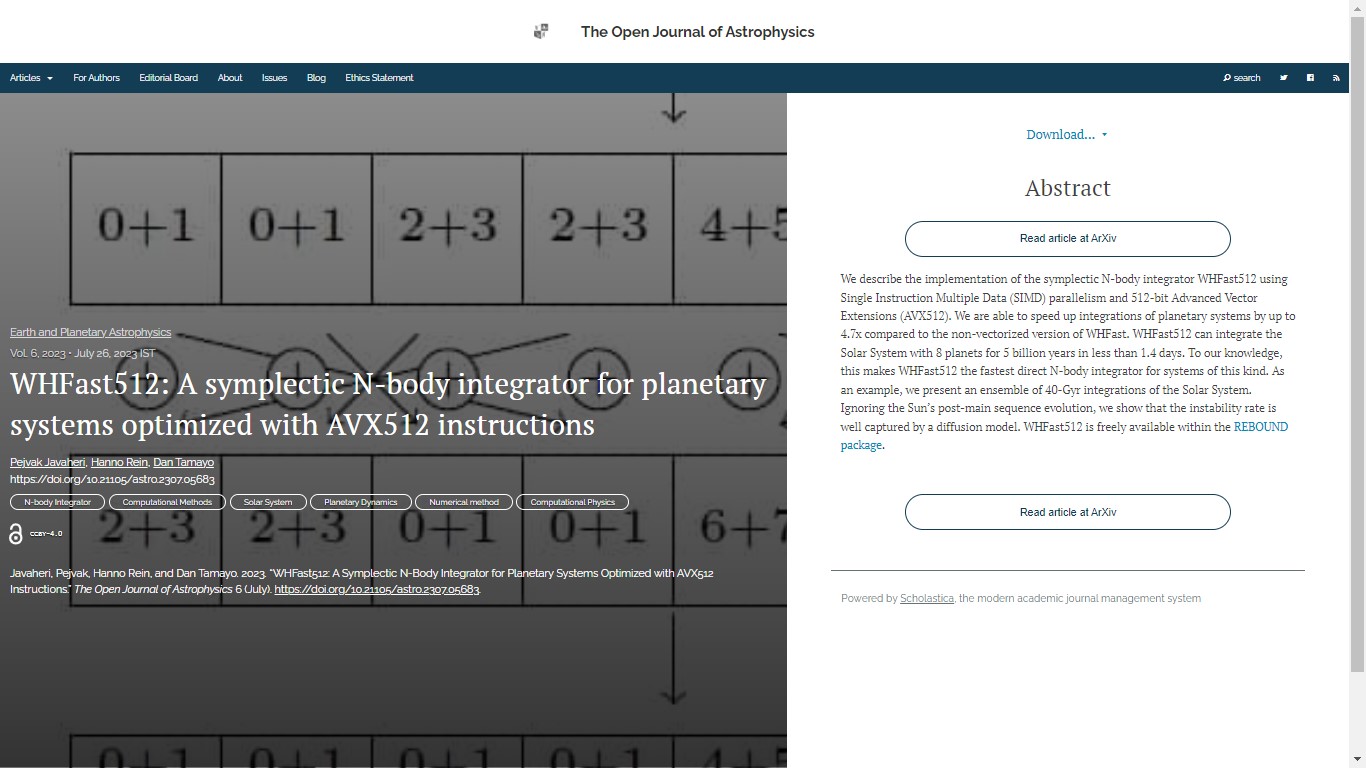
Quick update from the Euclid Consortium confirming that the launch will take place on Saturday 1st July 2023, at 1612 Irish Time (GMT+1):
If for some reason (such as weather) the launch cannot take place at 11.12 precisely it will be delayed for 24 hours and then launched the next day, 2nd July, at the same time. I’m told that thunderstorms are quite common at Cape Canaveral at this time of year so there may well be such a delay.
P.S. When the Euclid mission was accepted by ESA, over a decade ago, the launch date was envisaged to be in 2020, so it is about three years late.
I made it to the conference venue (CPH Conference) for this year’s Euclid Consortium Meeting, which is 5 minutes walk from my hotel.
One thing that confused me when I looked at the programme last night was that all the rooms in the conference centre are named after locations in and around the city, e.g. Kastrup, Amager, Vesterbro, etc. For a while I thought the delegates would be running around Copenhagen to find their parallel sessions! Then I realized these were just names of meeting rooms…
The full programme doesn’t start until tomorrow but today I attended a couple of sessions aimed at early career researchers, not because I identify myself as such but because I wanted to listen to questions they asked and the advice given to them, much of which was very sound.
I’m looking forward to tomorrow, especially the plenaries, but first: dinner.
It was with a sense of shock that I heard this afternoon of the death of the age of 68 of cosmologist Nick Kaiser. It seems like only yesterday that we were celebrating the award of the Gruber Prize to Nick, but that was back in 2019. In a field filled with very clever people, Nick was one of the cleverest and also one of the nicest.
I have never worked directly with Nick Kaiser but he had an enormous influence on me, especially early on in my career. When I was doing my PhD, Nick was based in Cambridge and if I remember correctly he was the first person ever to ask me a question during a conference talk when I gave one there in 1987. Nick was never shy about making such interventions, sometimes somewhat mischievously. At first he terrified me because I didn’t know him except by scientific reputation, and didn’t realize what a nice guy he was. His question was actually very helpful, as it allowed me explain something that I’d skipped because I was under time pressure. His response to my explanation was very complimentary and supportive, which encouraged me a lot, and we chatted for quite a while after the session (in a pub). He was very friendly and approachable, and very far from the intimidating character I’d expected. Anyway, his 1984 paper on cluster correlations was the direct motivation for my very first publication (in 1986).
I mentioned yesterday that many of the papers published by the Open Journal of Astrophysics over the last few years have been in the field of weak gravitational lensing. It is safe to say that is a field that was basically created by Nick; see the paper by Kaiser & Squires (1993) that kicked it all off. You could also say the same about the use of redshift-space distortions, concerning which he wrote a seminal paper in 1987. These are two techniques that will be applied in the analysis of data from the Euclid spacecraft, to be launched next month.
These are just a few of things that Nick did. He did many others, always original and always interesting. In recognition of his achievements he was made a Fellow of the Royal Society in 2008, won the Gold Medal of the Royal Astronomical Society in 2017, the Daniel Chalonge and Hector de Vega Medals in 2018, and the Gruber Prize for Astronomy in 2019.
It’s hard to characterize someone of such intellectual breadth, but it always seemed to me that his approach was driven by a very deep physical insight. He was often able to identify what were the fundamental aspects of apparently complicated phenomena and build simple models that captured most of the physics. Using this approach he could penetrate the thickets in which others might get lost. He was perfectly capable of undertaking more complicated calculations to elaborate the details, but he always started by focussing on the basics.
I met Nick many times here and there, usually at conferences. He was always enthusiastic and energetic and entertaining, and was great company to talk to over a drink or several. You always had a good laugh talking to Nick, but you always learnt something too. His son studied in Cardiff some years ago, while I was working there, and Nick sometimes came to visit on the pretext of giving a seminar. I remember once he almost missed his own talk because we were sitting in a pub chatting.
Nick spent recent years in Paris; I remember his presence when I did an online colloquium for the Daniel Chalonge – Hector de Vega School in 2021. He certainly seemed in fine health and good spirits then. Indeed, he gave a talk in the same series that year which you can download here.
Nick’s untimely death is particularly shocking because he was ultra-fit. I think he got hooked on ultra-endurance events while living in Hawaii, as the first Ironman events were held there. Mere marathons were not enough for him. I think I last saw him in person in 2016 during a meeting in Italy. While most of us laboured on the “easy” hiking trails, Nick found them uninteresting and went running off looking for greater challenges.
It still hasn’t really sunk in that Nick has gone. I know I’m not the only one who feels that way. I think the sense of loss will pervade the cosmological community for a considerable time. I send deepest condolences to his family, friends, colleagues and co-workers. He’ll be hugely missed by a huge number of people.
I was just thinking this morning that it’s been a while since I posted anything in my Bad Statistics folder when suddenly I come across this gem from a paper in Nature Astronomy entitled Could quantum gravity slow down neutrinos?
The paper itself is behind a paywall (though a preprint version is on the arXiv here). The results in the paper were deemed so important that Nature Astronomy tweeted about them, including this remarkable graph:
Understandably there has been quite a lot of reaction from scientists on Twitter to this plot, questioning how the blue line is obtained from the dots (as only one point to the right appears to be responsible for the trend), remarking on the complete absence of any error bars on either axis for any of the points, and above all wondering how this managed to get past a referee, never mind one for a “prestigious” journal such as Nature Astronomy. It wouldn’t have passed muster as an undergraduate exercise.
Of course this is how a proper astronomer would do it:
Joking aside, if you look at the paper (or the preprint if you can’t afford it) you will see another graph, which shows two other points at higher energy (red triangles):
The extra two points don’t have any error-bars either, and according to the preprint these appear to be unconfirmed candidate GRB events.
The abstract of the paper is:
In addition to its implications for astrophysics, the hunt for neutrinos originating from gamma-ray bursts could also be significant in quantum-gravity research, as they are excellent probes of the microscopic fabric of spacetime. Some previous studies based on neutrinos observed by the IceCube observatory found intriguing preliminary evidence that some of them might be gamma-ray burst neutrinos whose travel times are affected by quantum properties of spacetime that would slow down some of the neutrinos while speeding up others. The IceCube collaboration recently significantly revised the estimates of the direction of observation of their neutrinos, and we here investigate how the corrected directional information affects the results of the previous quantum-spacetime-inspired analyses. We find that there is now little evidence for neutrinos being sped up by quantum spacetime properties, whereas the evidence for neutrinos being slowed down by quantum spacetime is even stronger than previously determined. Our most conservative estimates find a false-alarm probability of less than 1% for these ‘slow neutrinos’, providing motivation for future studies on larger data samples.
I agree with the last sentence where it says larger data samples are needed in future, but also I’d suggest higher standards of data analysis are also called for. Not to mention refereeing. After all, it’s the quality of the reviewing that you pay for, isn’t it?
P.S. For those of you wondering, this paper would not have been published by the Open Journal of Astrophysics even if passed review, as it is not on the astro-ph section of arXiv (it’s on gr-qc).
The views presented here are personal and not necessarily those of my employer (or anyone else for that matter).
Feel free to comment on any of the posts on this blog but comments may be moderated; anonymous comments and any considered by me to be vexatious and/or abusive and/or defamatory will not be accepted. I do not necessarily endorse, support, sanction, encourage, verify or agree with the opinions or statements of any information or other content in the comments on this site and do not in any way guarantee their accuracy or reliability.