Five minutes to go!
Update: it all seemed to go very well, but the timing of the launch was badly planned by the EuropeanSpaceAgency, as it clashed with the semi-final between Spain and France in the European Championship.
Five minutes to go!
Update: it all seemed to go very well, but the timing of the launch was badly planned by the EuropeanSpaceAgency, as it clashed with the semi-final between Spain and France in the European Championship.
I finally decided to take my ailing laptop to the computer hospital where I hope it can be restored to health reasonably soon (or put out of its misery and replaced with a new one). In the meantime, however, I will be taking a break from blogging.
Normal services will be resumed as soon as possible but, for the time being, there will now follow a short intermission.
Some time ago I wrote a post asking why universities are still using X, the social media platform that used to be called Twitter. In the same vein I thought I would repost the article below, which I saw this morning.
It seems to be widely believed (by those responsible for research assessment) that what is important about research papers and their authors is not the research they describe but how many citations they attract. Thinking about this recently yet another anomaly in this attitude struck me arising from the fact that papers continue to attract citations long after the authors are dead. It seems surprising therefore institutions have not tried harder to use the citations of deceased researchers to boost their research profile. The last Research Excellence Framework in the UK allowed institutions to claim some credit for work by researchers who had moved on to another institution. Why then not allow institutions to claim credit for researchers who passed away?
The obvious problem with this idea is that it might encourage University managers to do even more than they do already to work their staff into an early grave. It seems to me the answer to that is obvious. Researchers should be allowed to stipulate in their last will and testament whom they would like to benefit from post-mortem citations. Or indeed carry some form of donor card…
The free market solution would of course be to set up a market to allow the citations accrued after death of a researcher to be traded.
Another anomaly is that the deceased are generally – though see here for an exception – not allowed to be authors on new papers. I think this is highly discriminatory. You might argue that a dead person can contribute neither to the writing of a paper nor contribute to the scientific discussions that led to it, nor even read a draft of the text, yet I have first-hand experience of many living people who do none of those things yet still manage to appear in the author lists of many papers…
Finally, let me remark that a researcher’s H-index, a quantity often used by institutions to inform decisions about promotion, also continues to increase after the researcher has kicked the bucket. Why, then, should the dead be barred from promotion? Perhaps there should be a new job category of PHR (PostHumous Researcher)? The departed could even take up senior management positions where they could do just as good a job as those in such positions already without incurring any salary costs. This approach could address many of the grave problems facing modern universities.
It is high time institutions adopted a much more inclusive approach to their late researchers who, instead of merely pushing up the daises, could be used to push up the citations.
Still trying to use the spare time during my sabbatical to catch up on long-neglected reading, this Easter weekend – helped by the rainy weather – I finished Wolf Hall by Hilary Mantel, the first of her novels that I’ve read. This “historical novel” won the Booker Prize in 2009 and I understand was made into a play and a TV series, neither of which I have seen.
The novel is set in Tudor England in the reign of Henry VIII and revolves around Thomas Cromwell, who rose from lowly beginnings in Putney to be one of the powerful men in the country. Cromwell gets a surprisingly sympathetic treatment, at odds with most of the historical record which treats him largely as a cruel and unscrupulous character, undoubtedly clever but given to threats and torture if appeals to reason failed. From a 21st century perspective, it’s hard to find redeeming features in Cromwell. Or anyone else in this story, to be honest.
The historical events of the period covered by the book are dominated by Henry’s attempts to have his marriage of 24 years to Catherine of Aragon annulled so he could marry Anne Boleyn, along the way having himself declared the Supreme Governor of the Church in England, causing a split with Rome. Henry does marry Anne, and she bears him a daughter, destined to become Elizabeth I, though her second pregnancy ends in a miscarriage. The book ends in 1535 just after the execution of Thomas More, beheaded for refusing to swear the Oath of Supremacy.
(More was portrayed sympathetically in the play and film A Man For All Seasons though he was much disposed to persecution of alleged heretics, many of whom he caused to be burned at the stake for such terrible crimes as distributing copies of the Bible printed in English. Significant chunks of the penultimate chapter are lifted from the script of A Man For All Seasons but given a very different spin.)
Henry VIII is also portrayed in a somewhat flattering light; Anne Boleyn rather less so. Mary Tudor, Henry’s eldest daughter by Catherine of Aragon, cuts an unsurprisingly forlorn and intransigent. There are also significant appearances from other figures familiar from schoolboy history: Hugh Latimer, Cardinal Wolsey, and Thomas Cranmer; as well as those whose story is not often told, such as Mary Boleyn (Anne’s older sister). I have a feeling that Hilary Mantel was being deliberately courting controversy with her heterodox approach to characterization. She probably succeeded, as many professional historians are on record as hating Wolf Hall as much of it is of questionable accuracy and some is outright fiction.
Incidentally, one of the most negative reactions to this book that I’ve seen is from Eamon Duffy who is on record as detesting the historical figure of Thomas Cromwell and was “mystified by his makeover in Hilary Mantel’s Wolf Hall from a thuggish ruthless commoner to a thoughtful sensitive figure”. I mention this particularly because Eamon Duffy, an ecclesiastical historian, was my tutor when I was an undergraduate at Magdalene College, Cambridge.
On the other hand, Wolf Hall not meant to be a work of scholarly history: it is a novel and I think you have to judge it by the standards of whether it succeeds as a work of fiction. I would say that it does. Although rather long-winded in places – it’s about 640 pages long – it is vividly written and does bring this period to life with colour and energy, and a great deal of humour, while not shying away from the brutality of the time; the execution scenes are unflinchingly gruesome. The book may not be accurate in terms of actual history, but it certainly creates a credible alternative vision of the time.
It’s interesting that the title of this book is Wolf Hall when that particular place – the seat of the Seymour family – hardly figures in the book. However, one character does make a few appearances, Jane Seymour, who just a year after the ending of this book would become the third wife of Henry VIII. It also happened that Thomas Cromwell’s son, Gregory, married Jane’s sister, Elizabeth. I suppose I will have to read the next book in the trilogy, Bring Up The Bodies, to hear Mantel’s version of those events…
At a press conference earlier today, scientists from the Event Horizon Telescope revealed an exciting new picture of the environs of Sgr A* the black hole at the centre of the Milky Way that shows structures associated with a powerful magnetic field:


You can see immediately the enormous advantage of using a paintbrush (left) rather than a crayon (right) to make such images. For more details, see the press release here or the two papers about this work, here and here.
There’s an interesting preprint on arXiv by Andrew Gray entitled ChatGPT “contamination”: estimating the prevalence of LLMs in the scholarly literature that tries to estimate how many research articles there are out there that have been written with the help of Large Language Models (LLMs) such as ChatGPT. The abstract of the paper is:
The use of ChatGPT and similar Large Language Model (LLM) tools in scholarly communication and academic publishing has been widely discussed since they became easily accessible to a general audience in late 2022. This study uses keywords known to be disproportionately present in LLM-generated text to provide an overall estimate for the prevalence of LLM-assisted writing in the scholarly literature. For the publishing year 2023, it is found that several of those keywords show a distinctive and disproportionate increase in their prevalence, individually and in combination. It is estimated that at least 60,000 papers (slightly over 1% of all articles) were LLM-assisted, though this number could be extended and refined by analysis of other characteristics of the papers or by identification of further indicative keywords.
Andrew Gray, arXiv:2403.16887
The method employed to make the estimate involves identifying certain words that LLMs seem to love, of which usage has increased substantially since last year. For example, twice as many papers call something “intricate” nowadays compared to the past; there are also increases in the use of the words “commendable” and “meticulous”.
I found this a commendable paper, which is both meticulous and intricate. I encourage you to read it.
P.S. I did not use ChatGPT to write this blog post.
(Based on an idea stolen from here.)
So here I am after a very busy day in a very cold Cardiff, about to have a pizza for dinner having accomplished quite a few of the things I’d planned, despite having to return to base for a couple of telecons: Euclid business has resumed in earnest after the break.
It has just started snowing.
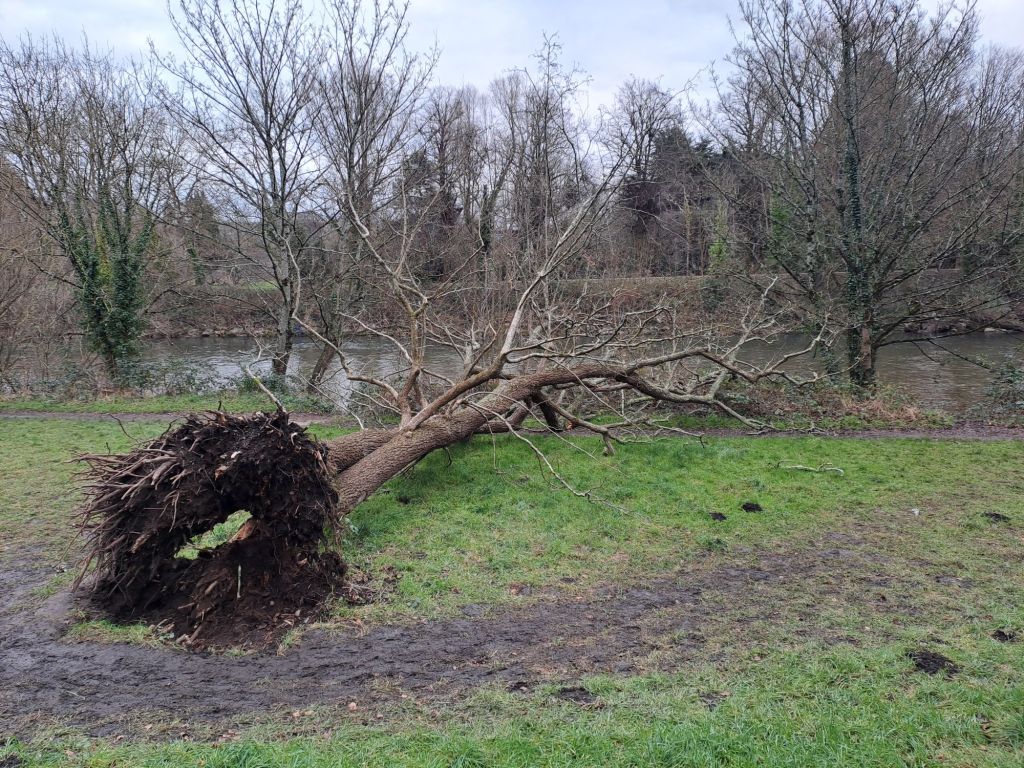
Earlier today, my perambulations took me through Bute Park, where there was quite a lot of evidence of storm damage, including this:

The snow is now falling steadily.

I hope it doesn’t go on too long as I have to get a train later in the week, and even a light dusting seems to bring the rail network to a standstill!