Archive for the Uncategorized Category

Nollaig Shona Daoibh Go Léir!

Posted in Uncategorized on December 25, 2023 by telescoper

Here we are then, Christmas Day. I thought I’d do a quick yule blog before (late) breakfast. I can’t possibly compete with my post of yesterday featuring Miggledy Higgins, so I’ll keep it brief. Let me just wish you all a Merry Christmas, Nadolig Llawen, Nollaig Shona, Fröhliche Weihnachten, Joyeux Noël, Buon Natale, Feliz Navidad, Feliç Nadal, etc.

I’m not in Barcelona at the moment but I thought you might enjoy this old traditional carol from Catalonia called Fum, fum, fum.


And in the words of a traditional Irish toast:

Go mbeirimid beo ag an am seo arís!

(“May we all live to see this time next year”)

Return to Barcelona

Posted in Uncategorized on November 29, 2023 by telescoper

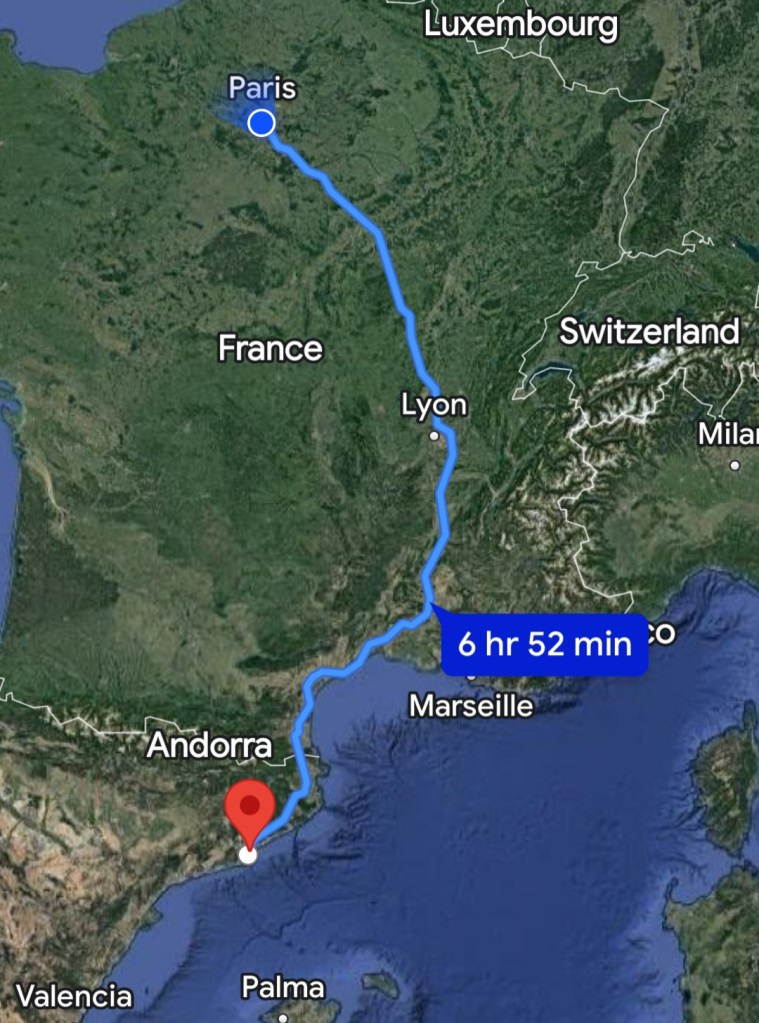
So here I am, packed and ready to travel across Paris to Gare De Lyon for the train back to Barcelona. It’s rather cold in Paris this morning, about 2°C in fact.

It’s quite a long trip, back the way I came  without the stopover in Montpellier, but I have a window seat and plenty of things to do, so it shouldn’t be too bad.

Au revoir, Paris!

Update: I arrived exactly on time in Barcelona after a pleasantly uneventful journey back. It’s almost 15° warmer in Barcelona than in grey Paris! Now I need to stretch my legs and do some shopping!

The Harvard Astronomer’s Songbook

Posted in Uncategorized with tags , on November 16, 2023 by telescoper

I’ve just finished a major task I’ve been struggling over for ages but before I head home early to celebrate, inspired this wonderfully snarky article on arXiv, I thought I’d indulge in a list of my Top Ten entries from the Harvard Astronomer’s Songbook. Feel free to add your own contributions through the Comments Box!

  1. Careless Loeb
  2. What’s Loeb got to do with it?
  3. All you need is Loeb
  4. How deep is your Loeb?
  5. Crazy little thing called Loeb
  6. Endless Loeb
  7. Loeb is in the Air
  8. The Power of Loeb
  9. Tainted Loeb
  10. I’m in the Mood for Loeb

and a bonus track, Bye Bye Loeb

Book Marking

Posted in Uncategorized on August 5, 2023 by telescoper

Following on from the fogeydom displayed in my previous post, I wonder how many of my readers ever use bookmarks? I do. In fact, I have a collection that goes back at least 20 years (part of which is shown above).

(I don’t remember how I got the Harry Potter one, as I haven’t read any of those books…)

Update Update

Posted in Uncategorized on August 5, 2023 by telescoper

I can’t believe that some people still haven’t updated to Windows 11. I’m already on Windows 95!

(I bought that laptop about 30 years ago, and it still works!)

R.I.P. Charles W. Misner (1932-2023)

Posted in R.I.P., Uncategorized with tags , , , on July 26, 2023 by telescoper
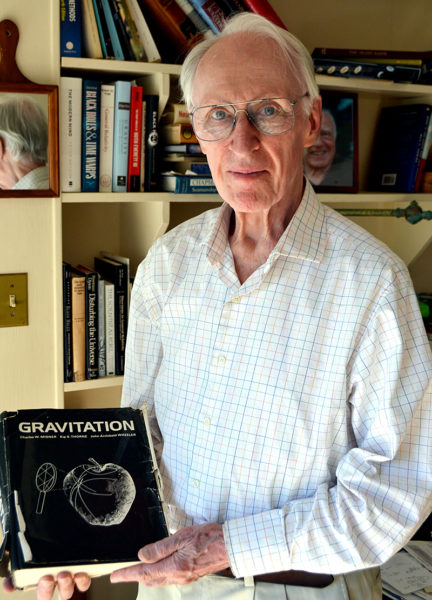
Charles Misner, pictured in 2016. (Picture credit: Maia Zewert)

Earlier this year I wrote a blog post pointing out that the classic textbook Gravitation by Misner, Thorne and Wheeler (above) is 50 years old this year. MTW (as it is usually known) was first published in 1973, and has has now been reprinted 24 times.

I was therefore saddened to learn that the eminent theoretical physicist Charles W. Misner, the first author of this famous tome, passed away a couple of days ago, on 24th July 2023, at the age of 91. A full obituary of Prof. Misner can be found here.

Rest in peace, Charles W. Misner (1932-2023)

Summer Solstice 2023

Posted in Uncategorized on June 21, 2023 by telescoper

The Summer Solstice in the Northern hemisphere takes place later today, Wednesday 21st June 2022, at 15.58 Irish Time (14.58 UTC) or 16.58 local time here in Copenhagen.

Among other things, this means that today is the longest day of the year around these parts. Incidentally, the latitude of Copenhagen is 55.6761° N, which is a little bit South of Edinburgh. I had thought it was further North, but I was wrong.

According to this website, the interval between sunrise and sunset in Copenhagen today will be 17 hours 32  minutes and 18 seconds. which is 5 seconds longer than yesterday while tomorrow will be two whole seconds shorter than that.

It’s all downhill from now on.

In the Northern hemisphere, days will get shorter from tomorrow until the Winter Solstice in December, although this does not mean that sunset will necessarily happen earlier on 22nd than it does tomorrow. In fact it is a little later. Nor does it mean that sunrise will happen later tomorrow; in fact it is a little earlier.

This arises because there is a difference between mean solar time (measured by clocks) and apparent solar time (defined by the position of the Sun in the sky), so that a solar day does not always last exactly 24 hours. A description of apparent and mean time was given by Nevil Maskelyne in the Nautical Almanac for 1767:

Apparent Time is that deduced immediately from the Sun, whether from the Observation of his passing the Meridian, or from his observed Rising or Setting. This Time is different from that shewn by Clocks and Watches well regulated at Land, which is called equated or mean Time.

The discrepancy between mean time and apparent time arises because of the Earth’s axial tilt and the fact that it travels around the Sun in an elliptical orbit in which its orbital speed varies with time of year (being faster at perihelion than at aphelion).

Anyway, here’s a  picture of four sixty-somethings – myself, John Peacock, Per Lilje and Ofer Lahav – on our way to dinner last night (including a toast to the memory of Nick Kaiser)

Picture courtesy of Ofer Lahav

The building in the background is Københavns Domhus (the Copenhagen Court House). The restaurant we went to, Puk, is highly recommended.

Travel Blog

Posted in Uncategorized on June 18, 2023 by telescoper

It’s Sunday morning, I’ve just had breakfast, and shortly I’ll be throwing a few things into a bag and heading off to Dublin Airport on the Hopper Bus which is back running after being suspended for a considerable time owing to the pandemic. It’s by far the most convenient way to get to the Airport from Maynooth. I’m all checked in and ready to go, although my flight is not until this evening and it takes less than an hour to get to the airport. You can put this down to nerves!

I realized last night that this will be the first trip I’ve taken outside the UK/Ireland Common Travel Area since I went to the Euclid Consortium Meeting in Helsinki in June 2019, just over four year ago. I was made Head of Department in 2019 and the pandemic descended on us in March 2020, so I couldn’t have travelled even if I’d had the time (which I didn’t).

After such a big gap I’m very out of practice with all this travelling malarkey so am actually quite nervous, which is ridiculous, especially since I’m going to a familiar destination, Copenhagen, and will only be there for a few days. I had a short panic this morning because I’d forgotten where I’d put my passport after all this time. On the other hand, it’s good to be getting back into the swing of things with a little trip before a much bigger one later in the year.

Anyway, the reason for this trip is this year’s Euclid Consortium Meeting which will be the last before Euclid is launched next month. It promises to be a very exciting event which I can enjoy without the tension of having to do a talk.

There’s a good chance that the actual launch date for Euclid will be announced during this meeting. At the moment, all we know is that it’s between July 1st and July 15th. The announcement of the date will be made 10 days in advance so if it’s early in that two-week window, we will be told next week.

UPDATE: I took an earlier Airport Hopper than I really needed to, in case of traffic delays and/or queues at security, but the bus arrived dead on time at Maynooth and slightly ahead of schedule at the Airport. Then it only took 15 minutes to get through security. Then I found it my flight was delayed on its inbound journey so I ended up having to wait about three hours. I arrived in Copenhagen about an hour later than I’d expected but that’s not too bad really. I was a bit disappointed that I didn’t get full value from my EU passport at arrivals, however, as the “All Passports” booths were a lot less busy than the EU/EEA/ETC ones so I went through one of them as I would have done if I’d been travelling on my British passport. Anyway, the public transport here is very good so I got to my hotel not far from the Central Railway Station very easily. Now I just have to settle in and find out where I have to be tomorrow and when I need to get there!

Do “high-quality journals” always publish “high-quality papers”?

Posted in Uncategorized with tags , , , , on May 23, 2023 by telescoper

After a busy morning correcting examination scripts, I have now reached the lunch interval and thought I’d use the opportunity to share a paper I found via Stephen Curry on Twitter with the title In which fields do higher impact journals publish higher quality articles?. It’s quite telling that anyone should ask the question. It’s also telling that the paper, in a Springer journal called Scientometrics is behind a paywall. I can at least share the abstract:

The Journal Impact Factor and other indicators that assess the average citation rate of articles in a journal are consulted by many academics and research evaluators, despite initiatives against overreliance on them. Undermining both practices, there is limited evidence about the extent to which journal impact indicators in any field relate to human judgements about the quality of the articles published in the field’s journals. In response, we compared average citation rates of journals against expert judgements of their articles in all fields of science. We used preliminary quality scores for 96,031 articles published 2014–18 from the UK Research Excellence Framework 2021. Unexpectedly, there was a positive correlation between expert judgements of article quality and average journal citation impact in all fields of science, although very weak in many fields and never strong. The strength of the correlation varied from 0.11 to 0.43 for the 27 broad fields of Scopus. The highest correlation for the 94 Scopus narrow fields with at least 750 articles was only 0.54, for Infectious Diseases, and there was only one negative correlation, for the mixed category Computer Science (all), probably due to the mixing. The average citation impact of a Scopus-indexed journal is therefore never completely irrelevant to the quality of an article but is also never a strong indicator of article quality. Since journal citation impact can at best moderately suggest article quality it should never be relied on for this, supporting the San Francisco Declaration on Research Assessment.

There is some follow-up discussion on this paper and its conclusions here.

The big problem of course is how you define “high-quality papers” and “high-quality journals”. As in the above discussion this usually resolves itself into something to do with citation impact, which is problematic to start with but if that’s the route you want to go down then there is sufficient readily available article-level information for each paper nowadays that you don’t need any journal metrics at all. The academic journal industry won’t agree of course, as it’s in their interest to perpetuate the falsehood that such rankings matter. The fact that correlation between article “quality” measures and journal “quality” measures is weak does not surprise me. I think there are many weak papers that have passed peer review and appeared in high-profile journals. This is another reason for disregarding the journal entirely. Don’t judge the quality of an item by the wrapping, but by what’s inside it!

There is quite a lot of discussion in my own field of astrophysics about what the “leading journals” are. Different ranking methods produce different lists, not surprisingly given the arbitrariness of the methods used. According to this site, The Open Journal of Astrophysics ranks 4th out of 48 journals., but it doesn’t appear on some other lists because the academic publication industry, which acts as gate-keeper via Clarivate, does not seem not to like its unconventional approach. According to Exaly, Monthly Notices of the Royal Astronomical Society (MNRAS) is ranked in 13th place, while according to this list, it is 14th. No disrespect to MNRAS, but I don’t see any objective justification for calling it “the leading journal in the field”.

The top ranked journals in astronomy and astrophysics are generally review journals, which have always attract lots of citations through references like “see Bloggs 2015 and references therein”. Many of these review articles are really excellent and contribute a great deal to their discipline, but it’s not obvious they can be compared with actual research papers. At OJAp we decided to allow review articles of sufficiently high quality because we see the journal primarily as a service to the community rather than a service to the bean-counters who make the rankings.

Now, back to the exams…