Archive for the Uncategorized Category

My private IDAHO

Posted in Uncategorized with tags , , , on May 17, 2012 by telescoper

Today, 17th May, is International day Against Homophobia and Transphobia (IDAHO). There are events going on all round the world, including the UK (for which you can find a list here).

As an oldie, I find it quite amazing how much attitudes have changed in the general population, and even within the police force, but sadly that doesn’t mean that homophobic hate crimes no longer happen. In fact, they are still depressingly commonplace. The path that leads to violence (and even murder) starts with verbal abuse, and this will only stop when all fair-minded people (straight, gay, bisexual, transexual and undecided) are prepared to confront the bigots. Maybe one day IDAHO will not be needed, but that day remains a long way off.

Here is the official IDAHO video

And here is a special message from these parts made by Stonewall Cymru and the Welsh Assembly

Wales Coastal Path

Posted in Uncategorized with tags , on May 5, 2012 by telescoper

And now for something completely different.

I just found out this morning that this weekend sees the official opening of the Wales Coastal Path. This means that it’s now possible – if you have the time, the energy and sensible shoes – to walk the entire length of the Welsh coast. There’s a nice article here that picks out five particularly interesting stretches. One,  around the Llyn Peninsula, is of particular interest to me because it includes this picture of ancient church of Saint Hywyn, which is  almost on the beach in Aberdaron. The great Welsh poet R.S. Thomas was vicar here for a number of years.

Anyway, here’s a promotional video about the Wales Coastal Path, which gives an idea of some of the stunning views at various points around this beautiful country.

Godzilla versus the Olympics

Posted in Uncategorized with tags , on April 30, 2012 by telescoper

Breaking News. Alarming footage just released by MI5 reveals the true nature of the threat to the forthcoming 2012 Olympic games and explains why it is necessary to station missile batteries in London’s East End.

Homecoming

Posted in Uncategorized with tags on April 25, 2012 by telescoper

Normal service will be resumed as soon as possible…

Posted in Uncategorized on April 3, 2012 by telescoper

Well, after a 12 hour flight I finally made it to my destination – the fine city of Cape Town, in the Republic of South Africa. Uncannily I’m staying in the same flat on the UCT Campus that I lived in when I came here in 1995 to finish writing a book with George Ellis. I’ll just mention that it’s a sunny 25 degrees at the moment!

Unfortunately I haven’t yet got any proper internet access sorted out, so I’m just posting this brief update via my Blackberry.

I hope to get connected soon and will add reports and pics of this lovely city, if and when it’s possible.


The Name of Love

Posted in Uncategorized with tags , on April 1, 2012 by telescoper

A comment on a recent post pointed out that the ancient Greeks had four distinct name for different aspects of what in English is called, simply, “love”.

Here’s what wikipedia says on the matter:

There are several Greek words for love, as the Greek language distinguishes how the word is used. Ancient Greek has four distinct words for loveagápeérosphilía, and storgē. However, as with other languages, it has been historically difficult to separate the meanings of these words. Nonetheless, the senses in which these words were generally used are given below.

  • Agápe (ἀγάπη agápē[1]) means “love” (unconditional love) in modern day Greek, such as in the term s’agapo (Σ’αγαπώ), which means “I love you”. In Ancient Greek, it often refers to a general affection or deeper sense of “true love” rather than the attraction suggested by “eros“. Agape is used in the biblical passage known as the “love chapter”, 1 Corinthians 13, and is described there and throughout the New Testament as sacrificial love. Agape is also used in ancient texts to denote feelings for one’s children and the feelings for a spouse, and it was also used to refer to a love feast. It can also be described as the feeling of being content or holding one in high regard. Agape was appropriated by Christians for use to express the unconditional love of God.[citation needed] Before agape love there was no other word to express such great love.[citation needed]
  • Éros (ἔρως érōs[2]) is passionate love, with sensual desire and longing. The Modern Greek word “erotas” means “intimate love;” however, eros does not have to be sexual in nature.Eros can be interpreted as a love for someone whom you love more than the philia, love of friendship. It can also apply to dating relationships as well as marriage. Plato refined his own definition: Although eros is initially felt for a person, with contemplation it becomes an appreciation of the beauty within that person, or even becomes appreciation of beauty itself. Plato does not talk of physical attraction as a necessary part of love, hence the use of the word platonic to mean, “without physical attraction.” In the Symposium, the most famous ancient work on the subject, Plato has the middle-aged Athenian philosopher, Socrates argue to aristocratic intellectuals and a young male acolyte in sexual pursuit of him, that eroshelps the soul recall knowledge of beauty, and contributes to an understanding of spiritual truth, the ideal “Form” of youthful beauty that leads us humans to feel erotic desire — thus suggesting that even that sensually-based love aspires to the non-corporeal, spiritual plane of existence; that is, finding its truth, just like finding any truth, leads to transcendence. Lovers and philosophers are all inspired to seek truth through the means of eros.”
  • Philia (φιλία philía[3]) means friendship or affectionate love in modern Greek. It is a dispassionate virtuous love, a concept developed by Aristotle. It includes loyalty to friends, family, and community, and requires virtue, equality and familiarity. In ancient texts, philos denoted a general type of love, used for love between family, between friends, a desire or enjoyment of an activity, as well as between lovers.
  • Storge (στοργή storgē[4]) means “affection” in ancient and modern Greek. It is natural affection, like that felt by parents for offspring. Rarely used in ancient works, and then almost exclusively as a descriptor of relationships within the family. It is also known to express mere acceptance or putting up with situations, as in “loving” the tyrant.

I’m by no means an expert on love, but it seems to me that even with this expanded set of basis states it’s still the case that one’s emotions aren’t described fully by just one. Perhaps love is like quantum mechanics, in which the general state is a superposition?

Anyway, this all reminded me of “the love that dare not speak its name” which most take to refer to homosexual desire. In fact it’s not as simple as that. The phrase was coined by Oscar Wilde in the following excerpt taken from the transcript of his criminal trial for gross indecency in 1895:

‘The love that dare not speak its name’, in this century, is such a great affection of an elder for a younger man as there was between David and Johnathan. Such as Plato made the very basis of his philosophy, and such as you may find in the sonnets of Michelangelo or Shakespeare. It is, in this century, misunderstood. So much misunderstood that it may be described as ‘the love that dare not speak its name’, and on account of it I am placed where I am now. It is beautiful. It is fine. It is the noblest form of affection. There is nothing unnatural about it. It is intellectual. And it repeatedly exists between an elder and a younger man when the elder has intellect and the younger man has all the joy, hope and glamour of life before him. That it should be so, the world does not understand. The world mocks at it and sometimes puts someone in the pillory for it.

This looks to me like it fits in the wider definition of Eros, not necessarily of a sexual nature. It’s a very moving speech, or at least I think so,  but it didn’t do him much good. He was eventually convicted and sentenced to two years’ hard labour. And, over a century later, it’s still “misunderstood”…
 

Behind the Scenes at the School Management Group

Posted in Uncategorized on March 29, 2012 by telescoper

At a Staff Meeting yesterday it was officially announced that I’ve been “promoted” to Deputy Head of School, with responsibility for Teaching and Learning. Actually,  it’s not so much a promotion as a battlefield commission, as the current holder of this prestigious position is shortly moving to pastures new. People have asking me if anything is going to be re-organized in the new regime. I’m going to suggest quite a few things, in fact, but the main idea I’ve come up with is to separate the administration of the “Teaching” part entirely from that of the “Learning” in order to reflect the fact that there’s absolutely no connection between the two activities. If we then appoint a Director of Teaching and a Director of Learning, I can leave them to do everything while I go down the pub.

As Deputy Head of School, I will be joining the all-powerful Management Group, the School’s elite Politburo which has only four members. One of my aims is to make this organization less secretive and more open. In this spirit, I can reveal this exclusive behind-the-scenes footage taken at the last Management Group meeting. I’m sure the members of the School will sleep more easily in their offices knowing that they’re managed by four such capable individuals.

A Walk in Bute Park

Posted in Uncategorized with tags , on March 28, 2012 by telescoper

Yesterday evening as I walked home through Bute Park I thought I’d take a few pictures with my phone to remind myself at a future date what beautiful weather we’re having and how splendid the trees and flowers are looking. It’s great to see so many people enjoying this beautiful park these days; fortunately the Council seems to have suspended the regular traffic of heavy vehicles along the paths, at least for the time being.

Unfortunately at around the time I took these pictures, something much less pleasant was happening a few hundred yards away near Cardiff Station. I’ve no idea what went on, but thankfully it looks like nobody received life-threatening injuries…

Anyway, neither Cherry nor May Blossom lasts very long – the Magnolias are already dropping their flowers – so let’s make the most of them while we can!

Cardiff Castle behind the trees

Even the Weeping Willow looks happy...although it's a bit of a concern that the water level in the Taff is so low...

Now here’s a question. Is it just me, or is the May Blossom appearing earlier nowadays than it used to? It’s definitely out now and it’s not even April yet…

If you don’t approve of same-sex marriage, don’t marry someone of the same sex

Posted in Uncategorized with tags , , , , on March 27, 2012 by telescoper

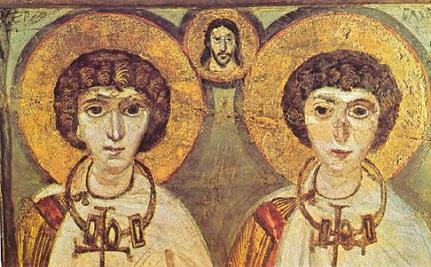
I found this image while reading an interesting piece about same-sex marriages in the early Christian era. Here’s an excerpt:

In the famous St. Catherine’s monastery on Mount Sinai, there is an icon which shows two robed Christian saints getting married. Their ‘pronubus’ (official witness, or “best man”) is none other than Jesus Christ.

The happy couple are 4th Century Christian martyrs, Saint Serge and Saint Bacchus — both men.

Severus of Antioch in the sixth century explained that “we should not separate in speech [Serge and Bacchus] who were joined in life.” More bluntly, in the definitive 10th century Greek account of their lives, Saint Serge is described as the “sweet companion and lover (erastai)” of St. Bacchus.

It’s interesting how religious conservatives keep going on about how legal recognition of same-sex relationships would destroy the “traditional” view of marriage. What tradition would that be, then? The tradition that gave us the Spanish Inquisition? Clearly not the tradition of the early Christian church.

I’m not a Christian and wouldn’t dream of telling Christians what they should think about same-sex marriage. I actually don’t mind if heterosexual people – Christian or otherwise – disapprove. They’re welcome to, in fact. They don’t have to marry a person of the same sex if they don’t want to. That’s not the same as allowing them to deny that right to others who feel differently.

And what’s this tripe about same-sex marriage “threatening” of “devaluing” traditional marriage? Is the function of marriage simply to make married people feel superior to those who aren’t allowed to be married? That’s what that argument sounds like to me. If that’s what it’s for I think the state should withdraw legal recognition from all forms of marriage and let us all be treated equally by the law, as individuals.

Posted in Uncategorized on March 21, 2012 by telescoper

Elsevier redefines the meaning of “free”…their open access articles in fact cost over £10 each to download.

Mike Taylor's avatarSauropod Vertebra Picture of the Week

Well, I’ve spent a lot of time on this blog trying to determine what the terms are for Elsevier’s elective open-access articles — what they term “Sponsored Articles“.  [For anyone who needs to catch up: part 1, part 2, part 3, unofficial part 3-and-a-bit, part 4.]

We are as far as ever from getting a good, clear, explicit statement like the one Springer provide on their “Open Choice” page (“all Open Choice articles are published under the Creative Commons Attribution (CC BY) license”.  There — that wasn’t so hard, was it?)  But we do have an important new nugget of information, thanks to a pair of tweets from Erin McKiernan (@emckiernan13).

We start at this page, the table of contents for Neuron 73(5).  Neuron is published by Cell Press, which is an imprint of Elsevier.  As you…

View original post 375 more words