Archive for the Uncategorized Category

R.I.P. Tom Marsh (1961-2022)

Posted in R.I.P., Uncategorized on November 19, 2022 by telescoper

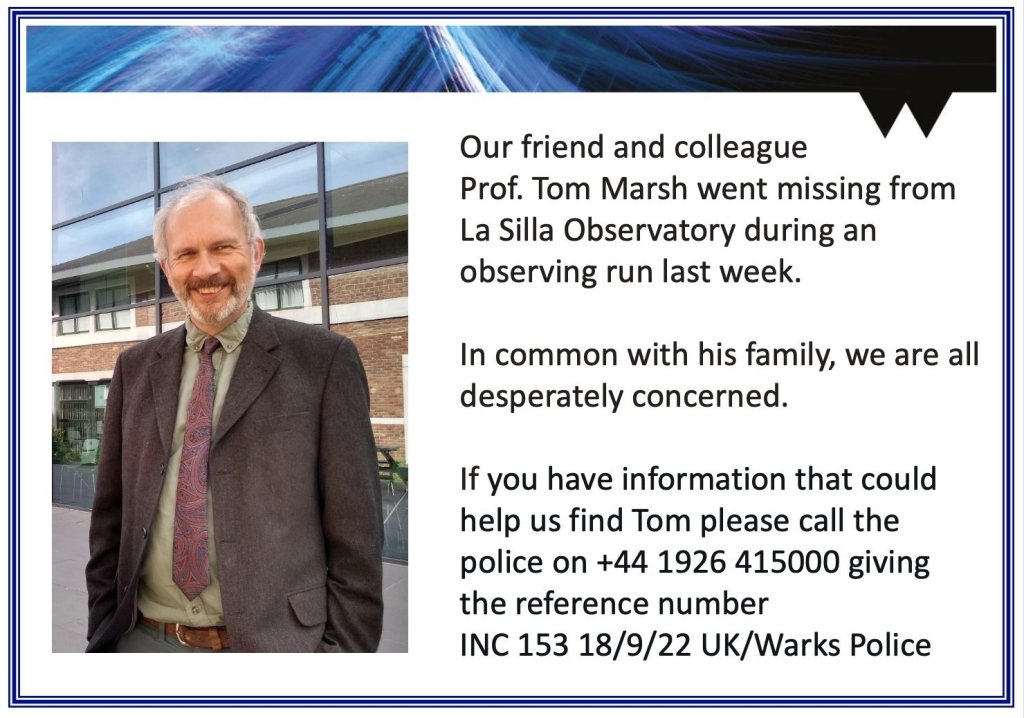
About two months ago I posted an urgent appeal for information about the whereabouts of Prof. Tom Marsh, who had gone missing while on an observing trip in La Silla, Chile. The longer the time he was missing the less likely it seemed that he would be found safe and well and sadly there wasn’t to be a happy ending.

Last week a body was found about 5km from the Observatory and has now been formally identified as that of Tom Marsh. This brings to an end an awful period of uncertainty, but it isn’t the kind of closure that anyone hoped for.

A fitting tribute to the life and astronomical achievements of Tom Marsh, who was 60 years old, has been posted by Warwick University I send my own condolences to his family, friends and colleagues at what must be a very difficult time.

Rest in peace, Tom Marsh (1961-2022).

R.I.P. Carolina Ödman-Govender

Posted in Uncategorized on November 15, 2022 by telescoper

Just got back from a lecture to hear the heartbreaking news that Carolina Ödman-Govender has passed away after a long battle with cancer. I first met Carolina when she was a PhD student at the University of Cambridge about 20 years ago. I think that was at a conference in Erice. She was a lovely human being who was held in the highest esteem by everyone who met her. It is devastating that such an inspirational figure is no longer with us. I send heartfelt condolences to husband Kevin, her family, friends and colleagues at this terrible time.

Five Million Views in the Dark

Posted in Uncategorized on September 25, 2022 by telescoper

I just finished writing my notes for next week’s lectures and checked the blog statistics to discover that there have now been over 5,000,000 visits to this website. It’s been just over 14 years since I started blogging so that is about 360,000 hits per year on average, or just under 1000 a day. The actual daily figure varies considerably of course. It’s also worth mentioning that the number of distinct visitors is somewhat lower (just under 2 million). That means on average visitors come here about 2.5 times. On the other hand the visitor statistic probably overcounts because people may use different devices to access this site. Such details may matter to people who want to sell advertising, etc, but not to me.

I’m sure there are many blogs that get much more traffic than this one but I’m glad so many people have found things of interest here over the years, so thank you all for coming!

Can you help find Tom Marsh?

Posted in Uncategorized with tags , , on September 23, 2022 by telescoper

Yesterday I heard the worrying news that astronomer Professor Tom Marsh of Warwick University (UK) went missing on 16th September 2022 while on an observing trip at the European Southern Observatory facility in La Silla, Chile. Despite extensive searches over the last week he has not yet been found.

I know it’s a long shot but I’m posting this here in the hope that somebody somewhere might have information about his whereabouts.

There is also a statement from ESO here with further details

Marsh is described as white, about 192 cm in height, with balding grey hair and a beard. He is likely to be wearing a blue rain jacket, walking boots and a grey woollen hat. 

Please forward this as widely as possible!

UPDATE: 11/11/2022. Sadly, almost two months after being reported missing, the body of Tom Marsh has now been found. The cause of death has not yet been announced.

Conference Badge

Posted in Uncategorized on September 5, 2022 by telescoper

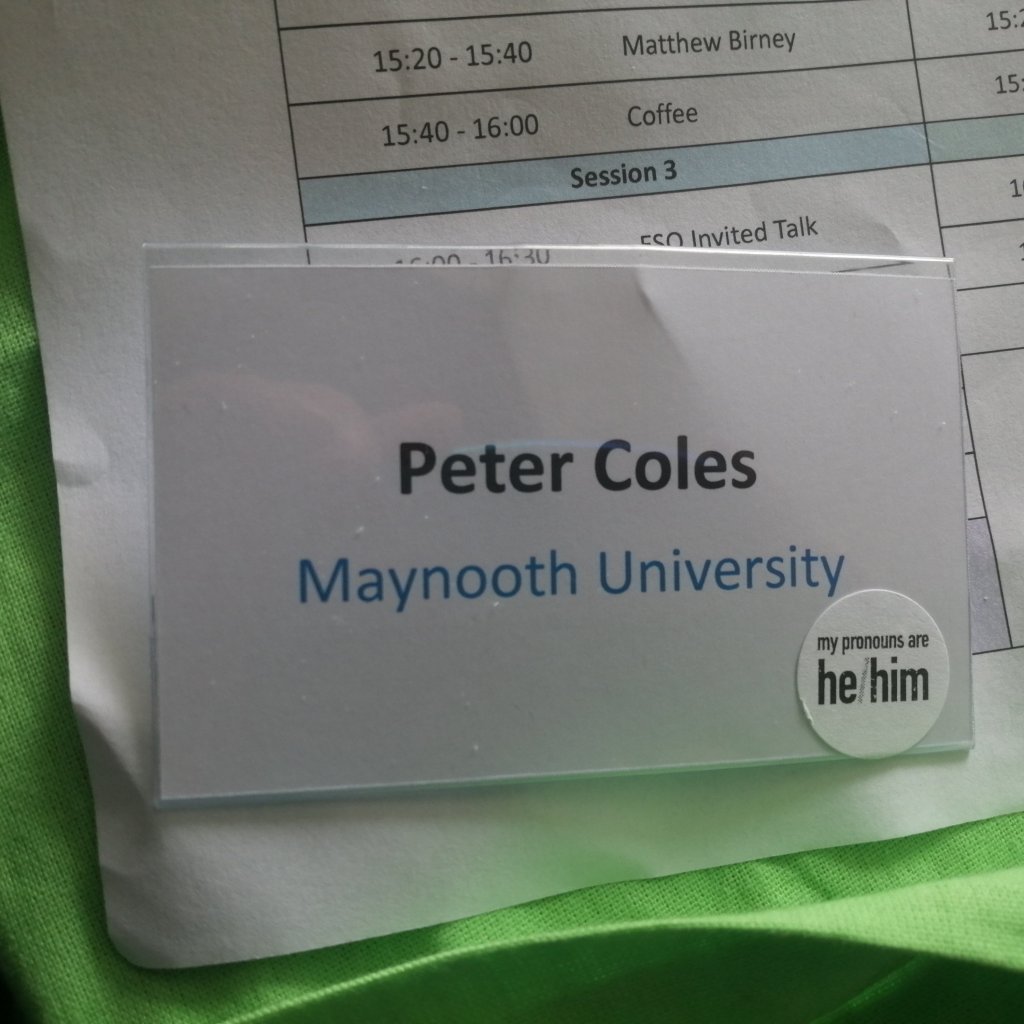
I thought I’d share a picture of my conference badge from INAM 2022, complete with pronouns, for the benefit of those who are triggered by such things.

If you are one of those people triggered by pronouns, just wait until you find out about adjectives!

La Même Chose

Posted in Uncategorized with tags , , on August 19, 2022 by telescoper
What is she saying?

You can’t move on Twitter these days without seeing the above photograph which seems to have become the latest viral meme. The game as always is to tweet the picture with a suggestion of what the girl is saying. Here is my effort:

You can play the game yourself at home by suggesting your own version of what she’s saying. There are quite a lot of astronomy-related attempts circulating already. The Hubble Tension is an obvious example topic.

Interestingly, just like ChorizoGate, the picture in question was first circulated a few years ago (in 2019) and was also apparently created in Spain. Perhaps there’s some kind of law that states that these things circulate on a 3-4 year cycle?

Talking of ChorizoGate, especially the French Dimension thereof, I wondered whether the French word for “Meme” is the same as it is in English. The French word however turns out to be “Mème”. So the English word “Meme” is not quite the same in French; the French word for Meme is “Mème” which is also not quite the same in French (“Même”). To put it another way, “Même” is the same in French but it’s not the same as either “Mème” or “Meme” neither of which are the same in French (nor in English).

I hope this clarifies the situation.

P.S. I chose the title from the well-known French saying “plus ça change, plus c’est la même chose”.

A Second in Azed!

Posted in Biographical, Crosswords, Uncategorized with tags , on June 26, 2022 by telescoper

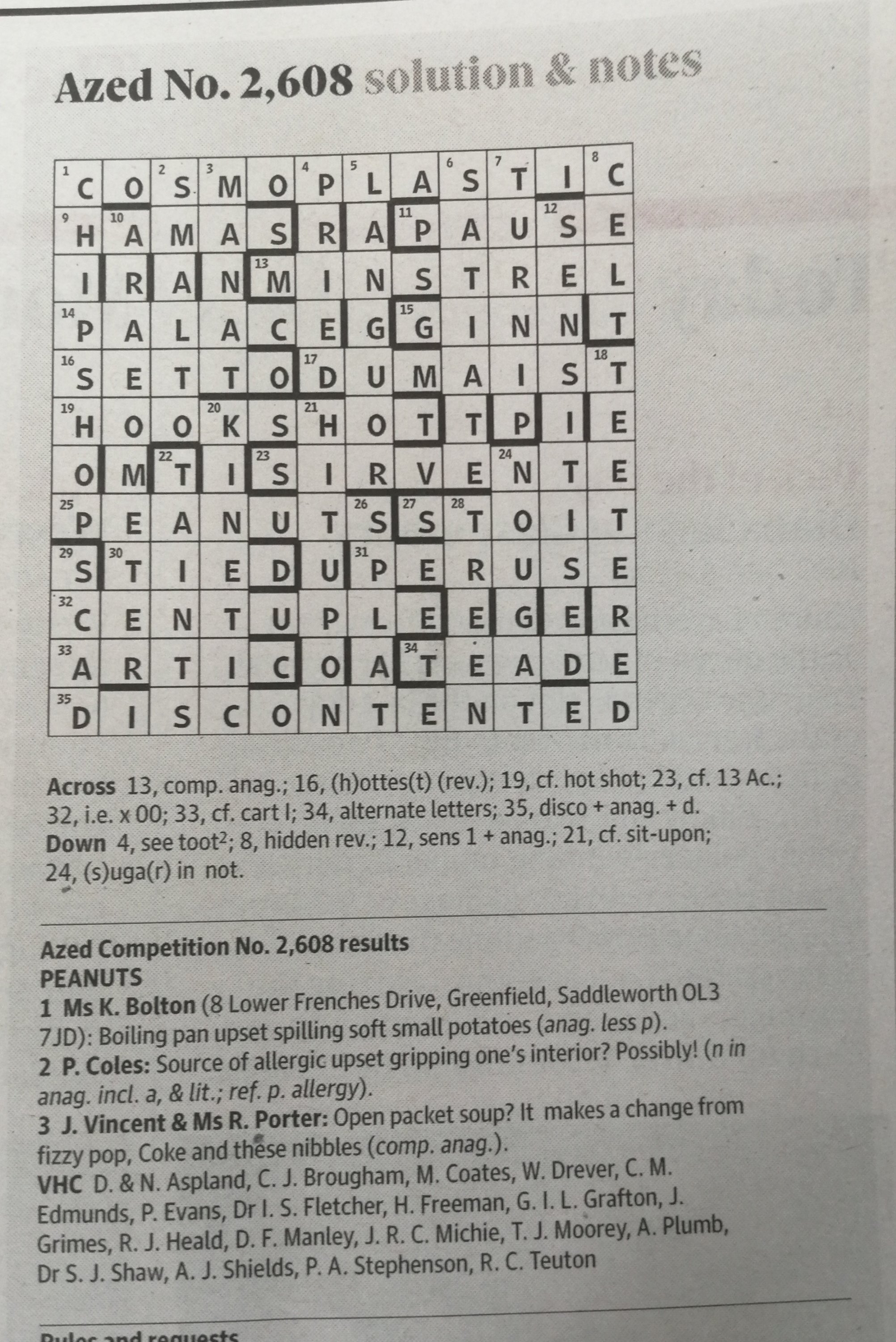
I was more than a little surprised this morning to find that I had won Second Prize in the latest Azed Crossword Competition in the Observer newspaper. This only the third time I’ve been among the medals (so to speak); I got a First Prize last year and a Third Prize exactly 11 years ago today.

As I’ve mentioned before, the monthly Azed Competition puzzle involves not only solving the Azed crossword but also supplying a cryptic clue for a word or phrase given only as a definition in the crossword. This competition is tough, partly because Azed is a stickler for syntactical soundness in submitted clues, and partly because many of the competitors are professional crossword setters. I’ve struggled recently to find the time and the energy to make a decent attempt at the Azed competition, but this competition puzzle was published on the last Bank Holiday Weekend so I had more time than usual to think about it. The target word was PEANUTS and my clue was

Source of allergic upset gripping one’s interior? Possibly!

Usually in a cryptic crossword clue one part of the clue provides a definition of the answer and the other a cryptic allusion to it; the solver has to identify each part. This clue is of a slightly different type called “&lit” which means that two different readings of the clue give you the definition and the cryptic allusion. The cryptic reading gives A (source of Allergic) in an anagram of UPSET containing N (oNe’s interior) indicated by the word “possibly”. UPSET is often used as a anagram indicator but not in this case. The surface reading of the clue also suggests PEANUTS.

P.S. I think the First Prize clue was very good indeed so congratulations to K. Bolton!


Royal Society SFI University Research Fellowships

Posted in Uncategorized on June 23, 2022 by telescoper

It is now time for a quick public information broadcast, to give advanced notice of an important scheme run jointly between the  Royal Society and Science Foundation Ireland that gives early career researchers in Ireland access to University Research Fellowships. I thought I’d mention it now before the summer vacations (which apparently some people have):

This scheme provides eight years of research funding (with the possibility of renewal) and has proved to be a stepping stone to their first permanent academic position for a great many scientists. Here are a couple of items about the eligibility and duration.

Eligibility:  The scheme is open to early career Post Doctoral Researchers with between 3-8 years of actual research experience since their PhD (date on which the degree was approved by board of graduate studies) by the closing date.  You cannot apply if you hold a permanent post in the university or have held (or currently hold) an equivalent fellowship that provides the opportunity to establish independence.

Funding and Duration:  In previous years this scheme provided funding of the research fellow’s salary and research expenses for an initial period of 5 years with the possibility to apply for a further 3 years.  This time, though, applicants are asked to provide a proposal for a project lasting eight years which is subject to a mid-term review.

Key Dates: The scheme opens on 12th July 2022 and applications need to be in by 6th September 2022 at 3pm UK time. Last year the application deadline for Irish institutions was a bit later than for the UK but I don’t know if that will be the case this year as the call has not yet opened.

For further details and further developments see here.

The scheme covers a wide range of disciplines. including physics and astronomy. Of course if you want to do cosmology, the best place  to do it in Ireland is here in Maynooth but we also do, e.g. condensed matter theory and particle physics.

The deadline is not far off,  so please get cracking!

P.S. Five years residency in Ireland qualifies you for Irish citizenship. Just saying…

Picture Joke

Posted in Uncategorized on June 19, 2022 by telescoper

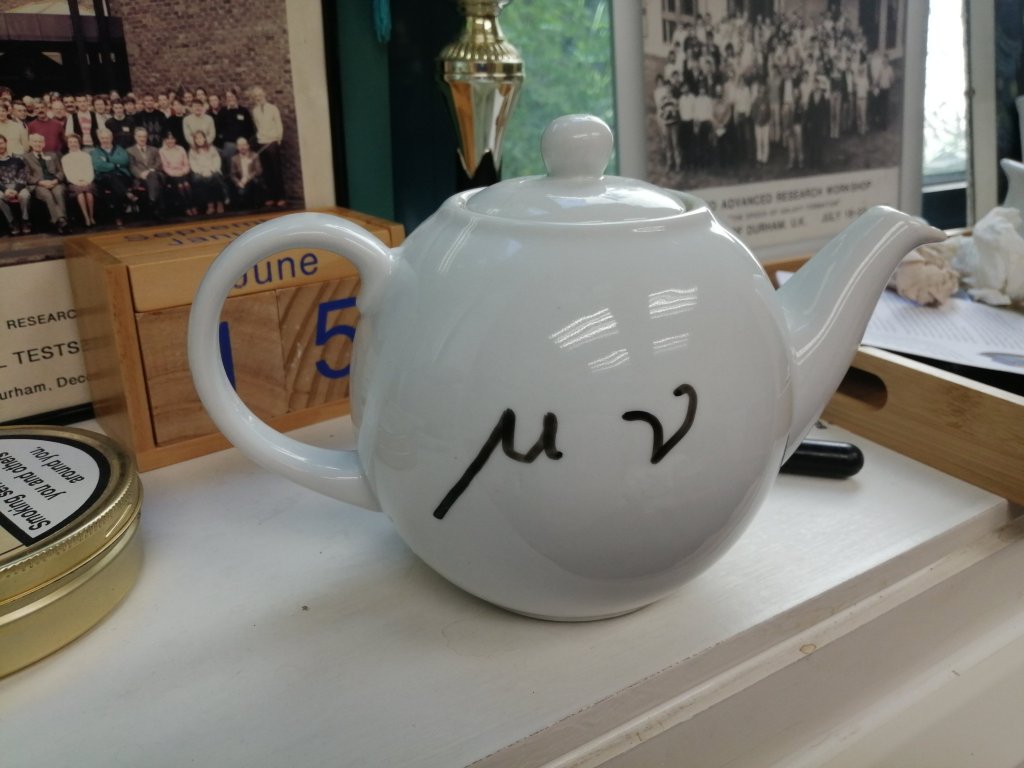
I put this picture up on Twitter last week with the caption Geddit? and it got as close to going viral as anything I’ve ever tweeted. Since I’m too lazy to post anything substantial today I thought I’d put it up here.

In the words of Roy Walker: “Say what you see..” though you will probably have to be a physicist who’s studied general relativity.

Some of those who did get the joke asked me where they could buy such an item. In fact I just wrote the Greek letters on with a whiteboard marker…

A Chara

Posted in Irish Language, Uncategorized on May 11, 2022 by telescoper

Having spent a great deal of time recently writing reference letters I thought about how at least to start a letter in the Irish language (though I’m nowhere near fluent enough to continue).

It turns out the correct formal way to begin a letter in Irish to someone you don’t know is “A chara” which means literally “O friend” to be compared with the opening you might write in English “Dear Sir/Madam”. The plural version is A chairde.

The Irish form is interesting for a number of reasons. For one thing it is ungendered so there’s no need for the clumsy “Sir/Madam”. For another it presupposes that the person you are writing to is a friend, which is far less frosty than the English alternative.

The Irish word cara is related to many similar words in other European languages, especially the Italian caro and the French cher and like them can be used as an adjective meaning “dear”. If you want to address a letter to someone you know you can write, for example, A Phádraig, a chara which would mean “Dear Patrick”.

A chara is also interesting from a grammatical point of view because the nominative case of the word for friend is cara but in the vocative case (introduced by the particle “a”) it is modified in a manner called a séimhiú which involves lenition of the initial consonant, hence a chara. The plural form of cara is cairde, which also attracts a séimhiú in the same way as the singular form, becoming chairde. In older forms of written Irish this would have been denoted by a dot over the consonant, but in modern script the modification is indicated by inserting an h.

One of the pronunciational things I struggled with when I was attempting to learn Irish last year was the difference between the c in cara and the ch in chara. The c in Irish is usually pronounced like a k in English but in its weakened form ch it only changes slightly: it’s not like the c in census nor the ch in cheese.

If you try saying the letter k out loud as a child would – “kuh” – you will find it involves contact between your tongue and the roof of your mouth. Move the point of contact back to the rear of your mouth and it becomes deeper and thicker; move it towards your front teeth and it becomes narrower and slightly higher in pitch. That’s the difference between the broad and narrow “c”. It’s very hard to spot in spoken Irish, particularly for a beginner!

There is a vocative case in other European languages ancient and modern, e.g. Latin, but that involves changes at the end of a noun rather than the beginning. The particle “a” which introduces it in Irish plays the same role as “o” in archaic and/or poetic English usage but is part of everyday usage in Irish. It is not a preposition because it doesn’t have any particular meaning other than to introduce the vocative case.