Archive for the Uncategorized Category

The True Origin of CERN

Posted in Uncategorized with tags , , on February 27, 2010 by telescoper

During my fascinating visit to CERN to see the Large Hadron Collider yesterday it occurred to me that many of my readers might be unaware of the true historical origin of that organization. I have to say the general misunderstanding of the background to CERN is not helped by the information produced locally which insists that CERN is an acronym for Conseil Européen pour la Recherche Nucléaire and that it came into being in the 1950s. This is false.

CERN is in fact named after the Dorset village of Cerne Abbas, most famous for a prehistoric hill figure called the Cerne Abbas Giant. The following aerial photograph of this outstanding local landmark proves that the ancient Brits had the idea of erecting a large hardon facility thousands of years ago…

PC and the PCC (by PC)

Posted in Uncategorized with tags , , on February 21, 2010 by telescoper

Another bit of news to emerge last week was the decision by the Press Complaints Commission (PCC) not to censure the Daily Mail journalist Jan Moir for the truly odious article she wrote after the death of Stephen Gately. Even by the standards of the Daily Mail, this piece was so horrendous that it led to a Twitter storm and provoked no less than 25,000 complaints from the public in addition to a direct complaint from Stephen’s partner, Andrew Cowles. I even blogged about it here.

The PCC, however, decided not to uphold these complaints. I can’t say that I’m at all surprised at their decision and not surprised either that it has also led to many expressions of outrage via Twitter and elsewhere. In among all the noise there have also been some thoughtful blog posts giving more reasoned discussions of the outcome. If you’re interested, I recommend Unspeak,  The Free Speech Blog and Enemies of Reason for a range of different takes on the affair. I’m sure you will all have your own views on whether the PCC was right or wrong to let Jan Moir off the hook. My own opinion – for what it’s worth – is that they were partly right and partly wrong.

If you read the PCC announcement you will see that the complaints were made under three clauses of their code: 1 (which stipulates that articles must distinguish fact from conjecture), 5 (that reporting should be handled sensitively at a time of grief) and 12 (that articles must avoid pejorative references to an individual’s sexual orientation).

The overriding issue is, of course,  the freedom of the press. I quote

The price of freedom of expression is that often commentators and columnists say things with which other people may not agree, may find offensive or may consider to be inappropriate.

In other words, the price we have to pay for freedom of speech is that we have to allow people to say things we don’t like. I agree.

However, the PCC is a body formed by the press in order to regulate the press. This is tacit acceptance that freedom of speech has its limits. We  all know that there are things we shouldn’t say even though we have the right to say them. In private life our outbursts are controlled by social conventions or by guidelines issued by our employers governing conduct in the workplace. Political Correctness is sometimes taken to ridiculous extremes, but its primary aim is, in my opinion, laudable – to be aware of the possibly pejorative interpretation of certain words and avoid using them in a way that could cause offence. The PCC plays a similar role for the press.  Conscious of the harm that can be caused by extremely prejudicial articles, the press has subjected itself to voluntary regulation.

I think that’s a good thing, in principle. The alternative would be official censorship and the further intrusion of the criminal law into matters of individual expression. However, self-regulation must not be mere window-dressing. Any organization can publish codes of conduct and the like, but unless they are applied rigorously and in good faith they are nothing other than exercises in hypocrisy.

It’s clear that the PCC found much of Moir’s article extremely distasteful but did not feel that she had offended sufficiently in respect of any of the clauses to warrant censure. I think they were right on Clause 1 – the piece was clearly identifiable as comment rather than fact – and I’m not sure about Clause 5. I’m convinced, however, that they got it wrong with respect to Clause 12. You can make your own mind up, of course, but if that is their decision in this case I’d like to know what sort of article they would censure.

In particular, the adjudication on Clause 12 states

While many complainants considered that there was an underlying tone of negativity towards Mr Gately and the complainant on account of the fact that they were gay, it was not possible to identify any direct uses of pejorative or prejudicial language in the article. The columnist had not used pejorative synonyms for the word “homosexual” at any point.

The Commission made clear that this part of the Code was not designed to prevent discussion of certain lifestyles or broad issues relating to race, religion or sexuality. There was a distinction between critical innuendo – which, though perhaps distasteful, was permissible in a free society – and discriminatory description of individuals, and the Code was designed to constrain the latter rather than the former.

Jan Moir’s article mocked Stephen Gately’s relationship with his partner as “unnatural”, implied that all gay relationships are tainted with sleaze, and suggested that gay people are all promiscuous drug-users. However, a panel of (presumably heterosexual) press pundits decided that it was not sufficiently homophobic to warrant censure, since they didn’t actually call Stephen Gately a faggot. I wonder what might have happened if a young black pop singer had died suddenly and Jan Moir had written an article suggesting that all black people were promiscuous drug-users living unnatural and debauched lives?

This is why I’m not surprised at the PCC conclusion. Guidelines and codes of conduct are just words. They only actually mean anything if they are enforced, and when it’s a matter of sexual orientation they rarely are. The PCC has given carte blanche to Jan Moir’s bigotry but since 99% of what’s in the Daily Mail is horrendous anyway, nothing much has changed.

What is more interesting, I think, is that this episode contains fascinating glimpses of the future. This morning I bought my regular Sunday newspaper, The Observer. Like all print media, newspapers are struggling to survive in a period of rapid technological change. The Observer has this week been re-launched, in a condensed form, because it is losing money hand-over-fist. Digital media, social networking and blogs are taking over from traditional formats as ways of communicating news and opinion about current events. Newspapers are dying, and the PCC will die with them. I doubt if it will be mourned.

The point is that although the press regularly make noises about freedom of speech, the freedoms most newspapers really care about are the freedom to make money and the freedom to promote the political views of the barons that control them. There are exceptions of course. I’m sure some journalists are motivated by democratics ideals and a desire for public good, atlhough I doubt if many of them work for the Daily Mail.  But the traditional press is in any case losing its grip. News websites may continue to exist, but the ability of large media conglomerates to control what we can read about is vanishing. I don’t think that’s a bad thing.

The New Media  sector has only minimal regulation and is consequently more diverse than the popular press. It’s anarchistic, I suppose, but is accessible and  democratic as a result. I don’t see any way that the blogosphere will ever be policed, voluntarily or otherwise. Nor do I think that’s desirable. There are dark corners where horrible creatures lurk. Nasty stuff will emerge. However, if somebody publishes something obnoxious it will be greeted with the same sort of reaction as Jan Moir’s article. There’ll be no PCC to hide behind. As the PCC itself made clear

Indeed, the reaction to the article, and the publicity which had ensued as a result of its publication, was a testament to freedom of expression, and was indicative of a broader process at work demonstrating the widespread opportunity that exists to respond to an article and make voices of complaint heard.

Twitter mobs aren’t always pretty, and they don’t always get it right,  but they’re the future. Get used to them.

Truth, Lies and Wikipedia

Posted in Uncategorized with tags , , , on February 19, 2010 by telescoper

I think it’s time to post a brief update on the story of Mark Brake, a Professor at the University of Glamorgan who falsely claimed to have a PhD from Cardiff University when applying for a grant in 2006. After this came to light through a story in the Western Mail, it was covered in the Times Higher, and I also blogged about it here.

There’s relatively little I can say about what’s been going more recently on in connection with this story, for reasons of confidentiality. However, one thing I am allowed say in public that Professor Mark Brake is no longer a Fellow of the Institute of Physics, a status he acquired in 2008.  I’m not allowed to discuss the events leading up to, or the reasons behind, his decision to resign from the IOP, but he did so in January 2010.

That little bit of news hardly merits an entire blog post, but what’s interesting is the subsequent behaviour of the wikipedia editors. Mark Brake’s wikipedia page currently states:

He was elected as a Fellow of the Institute of Physics in 2008[1] and is presently Director of the Science Communication Research Unit at Glamorgan.

As soon as Brake creased to be a FInstP, the IOP Director of Membership and Business, John Brindley, edited the page to make it clear that he no longer held the Fellowship. Bizarrely, however, a wikipedia editor overruled the change and the text reverted to the above form. The editor says that this “leaves open the possibility that this may no longer be the case”.

Well, it may leave open that possibility but the implication of the above form is definitely that Brake remains a Fellow. As John Brindley himself wrote on the corresponding wikipedia discussion page

there is a well established and understood convention that memebrships of professional institutions is considered as continuous from the date of election unless or untl a date of resignation or removal is given.

However, the editor has refused to budge on the grounds that

Other than your comments here, which unfortunately can’t be considered to be a reliable source according to wikipedia rules, I can find nothing to indicate that he has, in fact, resigned.

Short of putting an announcement on their webpages that Brake has resigned his Fellowship – something that is contrary to their usual practice – there doesn’t seem to be anything the IOP can do to convince wikipedia to amend this page so it says the whole truth, rather than just a partial and potentially misleading version.

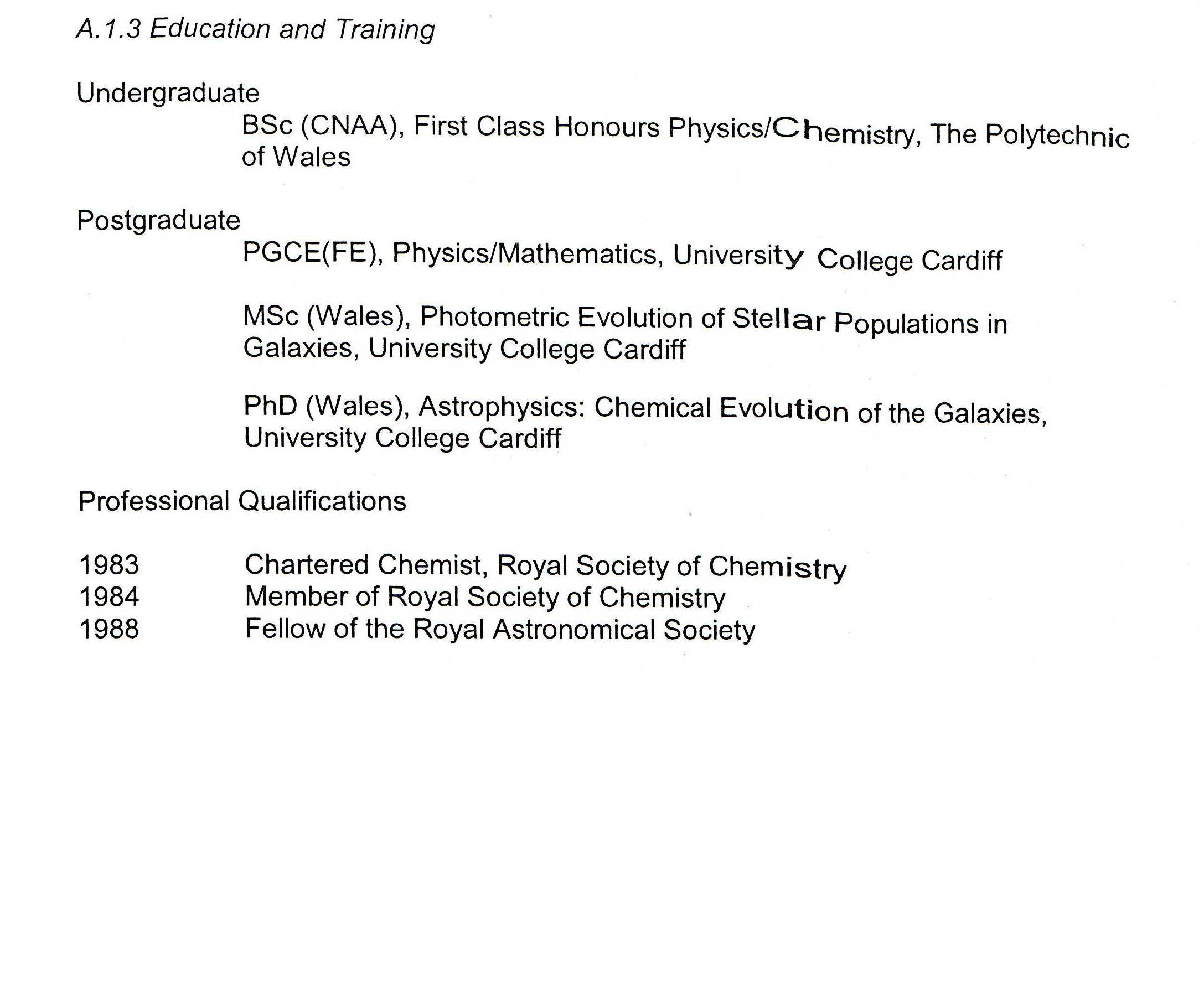
And while I’m on the subject of potentially misleading statements, it is perhaps worth going back to the original grant application that started this whole affair off. I showed part of this in a previous post, but here is the whole page showing the false claim of a PhD:

Under Professional Qualifications you will see Brake lists professional connections with the Royal Society of Chemistry as well as a Fellowship of the Royal Astronomical Society. This was written in 2006. In fact Brake disappeared from the membership register for the Royal Society of Chemistry in 1993 and ceased to be a Fellow of the Royal Astronomical Society in 1994. Hmmm…

You might argue – as the editor seems to be doing in the case of the wikipedia page – that these aren’t factually incorrect in that they give the year of election but say nothing about whether his tenure may or may not have ended.  I think most academics would agree with John Brindley, however, that the convention is to give a date of termination if the qualification no longer applies, otherwise the implication is that the status is unchanged.

Seeing further pieces of misleading information on the grant application doesn’t really surprise me, but I find it strange that somebody seems to want wikipedia’s pages  to misrepresent the truth in a similar fashion.

Results and Transfer Gossip

Posted in Finance, Football, Science Politics, Uncategorized with tags , , on February 6, 2010 by telescoper

I had to skip the usual trip to the Poet’s Corner last night and go home early because the general state of fatigue I’ve been in suddenly morphed into a fever. I went home at 5, went straight to bed, and it was only Columbo’s frantic pawing that woke me up several hours later. I had not only missed a leaving party for Kate Isaak, who is now off to work for the European Space Agency, but also slept all the way through Newcastle United’s splendid 5-1 hammering of Cardiff City in last night’s Coca Cola Championship match at St James’ Park.

Despite home advantage, and the fact that Newcastle won the corresponding away fixture here in Cardiff, I thought this tie would be pretty difficult for Newcastle so I was overjoyed to see the result when I finally roused myself from feverish slumbers. It seems that Newcastle’s recent signings in the January transfer window actually came good, especially Wayne Routledge who gives the side a much-needed injection of pace down the wing. Cardiff City, on the other hand, didn’t buy any players at all because they need all the cash they’ve got to pay off an outstanding tax bill and thwart various winding-up orders that have been served on them. The turbulence behind the scenes seems to have worked its way onto the pitch: the blues are definitely the most erratic team in the division, winning 6-0 only a week or so ago and then getting thrashed 5-1 yesterday.

And just to make  my allegiances clear, I do have a soft spot for Cardiff City and do want to see them do well – except when they’re playing Newcastle. Once a Geordie, always a Geordie…

Results of a different kind were the topic of discussion around the School of Physics & Astronomy yesterday, as it was the official day for tutors to hand the results of the 1st semester exams to their tutees. It’s always great to see students leaving their tutor’s office with a big smile on their face, which happened rather a lot yesterday.  Some, of course, got more disappointing news, but to them I’d just say that it’s only half way through the year so there’s plenty of time to recover. Stick at it, and don’t let setbacks get you down.  I hope to see even more happy faces in June than I did yesterday….

Football teams like Cardiff City aren’t the only things to be enduring financial uncertainty these days, either. Even the Premiership clubs of the university sector are feeling the pinch. Many institutions around the country are planning departmental closures and redundancies, but you know it’s serious when it hits the big colleges in London. Last week University College (UCL) and Imperial both announced plans for large-scale layoffs, and this week they were joined by King’s College which plans to sack 205 academics, including 30 in the School of Physical Sciences and Engineering.

The background to all this is that the cuts announced by Lord Mandelson in December have now been officially passed on to English universities by HEFCE, but one suspects also that in some cases this is being used as a cover for other management decisions. Imperial, for example, is going ahead with the purchase of new property in Wood Lane for a cool £28 million at the same time as cutting academic positions costing a fraction of that.

Amid all the gloom, however, it is nice to be able to report some good news. Cardiff University was almost declared bankrupt in the 1980s when it failed to get to grips with the cuts imposed by Margaret Thatcher’s Conservative  government which were similar in scale to those being implemented by New Labour. It was brought back from the brink, however, and since then has managed its finances with almost excessive caution. Other universities have scored spectacular successes in the League tables by spending money freely on fancy research initiatives and overseas campuses, but in the new reality of austerity Britain these may turn out to have been risky ventures.

By contrast, “Safe and Steady” has long been the motto in Cardiff. We might not have done brilliantly in the RAE but the insitution has an extremely sound financial base that should put it in as good position as any to withstand these difficult times. Moreover, we’ve just heard that the University management has agreed that the School of Physics & Astronomy can go ahead and make  four new academic appointments, and that these will be accompanied by substantial startup packages with which the new appointees can begin to equip their own laboratories. This involves a considerable investment in the School from the University’s central coffers and I think it’s fantastic news. I doubt if many UK universities are going to be investing so heavily in physics at this time, so this is an extremely welcome development. It’s always nice to buck the trend.

The adverts will be going out pretty soon, so the transfer window is about to open.  I look forward to meeting our new signings in due course, and I’m confident that they’ll help us climb up the League.

If only I could say the same for Cardiff City…

Stormy Weather

Posted in Uncategorized with tags , , on January 29, 2010 by telescoper

Tough day, for various reasons. Perhaps more about that tomorrow. However, I thought I’d end it with  a flashbackto my youth. I went to see Derek Jarman‘s brilliant screen adaptation of The Tempest by William Shakespeare when it came out around 30 years ago, roughly the same time that I did. Critics were divided, especially about the ending, although I loved it all, especially the ending. The cast of the film included Christopher Biggins and Toyah Wilcox, so it was never going to be a straightforward Shakespeare adaptation but even if you don’t like it you have to admit that it’s beautifully photographed. Jarman decided to change the usual ending of the play, which is Prospero’s Epilogue:

Now my charms are all o’erthrown,
And what strength I have’s mine own,
Which is most faint: now, ’tis true,
I must be here confined by you,
Or sent to Naples. Let me not,
Since I have my dukedom got
And pardon’d the deceiver, dwell
In this bare island by your spell;
But release me from my bands
With the help of your good hands:
Gentle breath of yours my sails
Must fill, or else my project fails,
Which was to please. Now I want
Spirits to enforce, art to enchant,
And my ending is despair,
Unless I be relieved by prayer,
Which pierces so that it assaults
Mercy itself and frees all faults.
As youth from crimes would pardon’d be,
Let your indulgence set me free .

Instead the sublime Elizabeth Welch (who was 75 at the time, and died in 2003 at the age of 99) sings the wonderful song Stormy Weather, to a bevy of handsome sailors. A bit camp? Yes. But I think it’s sheer genius. In fact, I think  it’s one of the most fabulous-est endings to a film ever.

Blue Moon

Posted in Uncategorized with tags , , on December 31, 2009 by telescoper

Tonight’s a blue moon, and it’s also New Year’s Eve (obviously), so just before I head out for a booze up,  here’s an appropriate celebratory track!

Happy New Year Everyone!

Bring me Sunshine

Posted in Uncategorized with tags , on December 24, 2009 by telescoper

If all goes to plan I’ll be in Newcastle with my folks when this  post hits the wordpress. This one comes to you courtesy of the autoschedule feature which I’ve never used before. I hope it works!

It’s been a pretty grim year for many people I know  for many reasons but, although I’m very angry about the mess being made by people in authority, I’m still determined to have a good time during this holiday. If you let them get to you then the bastards have won. That’s a lesson I learned earlier this year, in fact.

So I’m going to wish you all the merriest possible Christmas and the happiest imagineable New Year by putting up a clip that’s associated in my memory with this season even more strongly than Handel’s Messiah. The event on Christmas Day for me when I was younger was always the Morecambe & Wise Christmas Special, which in 1977 attracted 27 million viewers (half the UK population of the time).This is their signature tune, which I hope will bring a smile to your face along with the happy memories.

Merry Christmas!

Commented out

Posted in Uncategorized with tags , , , on December 3, 2009 by telescoper

Interesting. Very interesting.

You may recall that a few days ago, the Times Higher closed the comments section on their story about Mark Brake, the University of Glamorgan Professor who falsely represented his credentials on a grant application in 2006 by claiming to have a PhD. This is an ongoing story on this blog – see previous posts here, here and here – and I had been logging the comments for future reference. I was worried that the comments might be lost when the Times Higher closed them so I posted them on this blog. I took them offline a bit later because I was worried about possible copyright infringement, but also made several copies which I have lodged in various places for safekeeping.

When I got back home yesterday I spent a bit of time catching up on blog administration and found that the page of Times Higher comments (which was still on my wordpress space, but not available to the public) had been marked “DO NOT REPOST – CONTACT SUPPORT”. I did so, and it was explained to me that they had received a complaint containing the following

.. this post is actually a repost of an entire conversation held on the Times Higher Education Supplement website, which was removed earlier today after the editor there decided that the contents had become too abusive, and was in breach of not only their own sites rules against defamation and liable, but also in breach of several telecommunications acts here in the UK as well as consituting an invasion of privacy into the lives of several people.

Since the Times Higher hadn’t given a reason for deleting the comments thread on its own site, I asked them whether these indeed were the reasons they had removed them and whether they had made this complaint. I suspected not, as for one thing I was sure that employees of  said organ would be able to spell “libel” correctly. Had they – or anyone else – approached me directly with a  good reason I would have been happy to remove them. As it happens nobody contacted me personally about this, and I was a bit annoyed at the underhand way that it was done. Not the only underhand thing that has happened recently in connection with this story.

I received a reply from Phil Baty, one of the editors of the THES, who confirmed that they had decided to close the thread after “complaints” but had not made any approach about my use of the THES comments on this site. He also  stated that

the decision to close the thread should not be taken as any judgement on our part on the behaviour of any individual who posted.

The anonymous complainant thus seems to have deliberately misrepresented the situation to WordPress in order to suppress the contents of my blog page. Sneaky.

Neither WordPress nor the Times Higher would reveal the identity of the complainant, but I can guess. I surmise this was done by an individual anxious to hush up this story and to conceal his identity. I wonder who that might be?

Anyway, the main point of this post is to reassure those at the University of Glamorgan responsible for disciplinary matters that the abusive comments posted on the THES  have not been lost so there’s no reason to give up their investigation into the ongoing serious misconduct of its employees. I’d be delighted to hand over the information if they request it as part of their no doubt strenuous efforts to root out those responsible for bringing their name into disrepute.

I’m sure the University of Glamorgan would have been very upset if  such important evidence of ongoing wrongdoing had been lost so I am happy to be able to allay their fears.

Perhaps the University of Glamorgan might also like to establish whether any of its employees used a deliberate falsehood to persuade WordPress to suppress this evidence? Shouldn’t be too difficult.

PS. I note the recent news that the University of Glamorgan is to get a new Vice-chancellor.

Interlude

Posted in Uncategorized on November 30, 2009 by telescoper

Owing to foreseen circumstances I’m going to be spending the next few days enjoying the hospitality (geddit?) of our wonderful National Health Service which is the envy of the civilised world (and America).

Normal services will be resumed as soon as possible but, for the time being, there will now follow a short intermission.

Brake Thread

Posted in Uncategorized with tags , , , on November 26, 2009 by telescoper

Following my post yesterday, the thread of comments relating to the Mark Brake/University of Glamorgan fraud scandal has been removed from the Times Higher story. However, I was logging the thread until very near the end (in fact, until my own  last comment this morning shortly before the comments were closed). I have posted them on a permanent page here to preserve them, but the page is currently offline pending clarification of copyright issues.

I have no idea why the comments were deleted, but I hope it is a sign that the University of Glamorgan is finally investigating this matter. If they are, I expect this matter to reach a speedy conclusion. If not, I will keep you posted on further developments with this and other matters in due course.

I’ve decided to reduce the amout of blogging I do over the next few days to catch up on paper-writing and a few other things, but I don’t think it’s a bad thing if story stays at the top of the page for now.