Archive for the Uncategorized Category

Christmas Closure

Posted in Uncategorized with tags , , on December 23, 2008 by telescoper

Dear Readers (and Associate Professors),

I’m shortly going to be climbing aboard the Deadwood Stage (with some other faggots) in order to spend Christmas with my friends in the  North.

That means that I’ll be offline for a few days but as soon as I’ve sobered up I’ll be back with more of the random drivel that this blog is famous for.

In the meantime, I’d just like you wish anyone who reads this a very Merry Christmas and a Happy New Year or, failing that, a felicitous non-denominational yuletide.

Set ’em up, Joe!

Peter

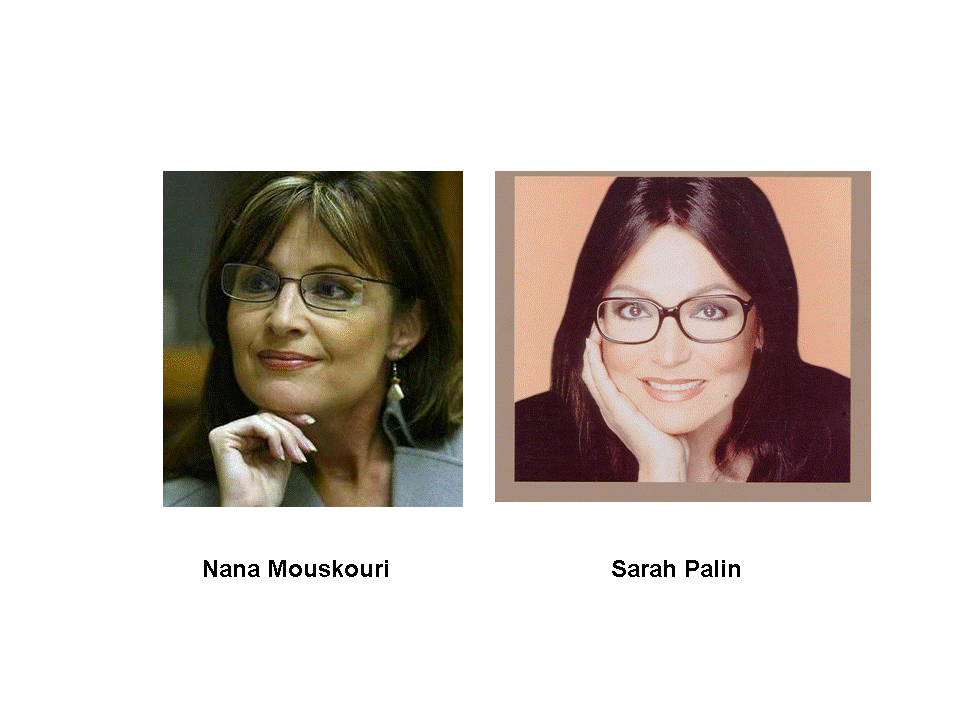
The Facebook of the Future

Posted in Uncategorized on November 17, 2008 by telescoper

If you’re not on facebook this won’t make any sense!

But thanks to Ed Gomez for sending it.

A Blast from the Past

Posted in Uncategorized on October 29, 2008 by telescoper

Trawling the web today for something completely different, I accidentally stumbled upon a film featuring my former Nottingham PhD Student, Emma King. It is part of a series about young scientists made by the Vega Science Trust and originally broadcast on BBC 2 as part of The Learning Zone. I had completely forgotten about it. How could I have failed to remember my one and only appearance on the Emma King Show? You can watch the film here.

Emma successfully completed her PhD in 2006 and now runs her own science communication business from her home in the Isle of Man.

News Roundup

Posted in Uncategorized with tags , on October 24, 2008 by telescoper

It’s not often that your own department gets onto the BBC News, but to do it twice in a few days with different stories has to be worth a mention!

Earlier this week was an item about the Einstein Telescope project, which has just received 3M euros in funding for design studies. Unlike familiar telescopes, this one is planned to exploit gravitational waves rather than the usual optical, radio or X-ray radiation (which are all varieties of electromagnetic waves). Gravitational radiation hasn’t actually been detected yet, but there are good reasons to believe that it will soon be measured for the first time. The next challenge will be to use gravitational waves from distant sources to study the processes that generate them, such as collisions between black holes. That’s what the new project is intended to do. In principle, gravitational waves will allow us to look much farther into the distant Universe (and therefore farther back in time) than we can do with even the largest optical or radio telescopes so this could be the dawn of a new era of observational astronomy.

But that doesn’t mean that optical telescopes will be defunct, especially when it comes to inspiring the young to take up an interest in astronomy. The other news item on the BBC this week about this department is our own new (optical) telescope which is now fully installed and will shortly to be opened. This is situated on the roof of the building that houses the School of Physics & Astronomy and it will be used primarily for undergraduate teaching, but it will also be available to be used by the general public and school visits on open nights. It should be put to particularly good use in 2009, which is the International Year of Astronomy.

It’s a small telescope by professional standards, about half a metre in diameter, but large compared with what’s available at other Universities in the UK and it promises to be a valuable addition to our already large range of astronomical facilities which is one of the reasons Cardiff is such a good place to work and study.

On the grounds that all publicity is good publicity, I was very pleased to see these things get a full airing on the local media, although I have to admit that the news that really caught my eye this week was the discovery of a headless corpse on the track at Llandaff railway station.

Powers and the Playhouse

Posted in Books, Talks and Reviews, Uncategorized with tags on October 21, 2008 by telescoper


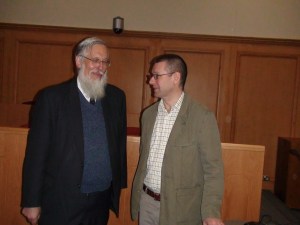
I got this picture this morning from the University of Derby. It was taken at the end of my lecture there last week. The chap on the left of the picture is Jonathan Powers, who is a former pro-vice chancellor of the University of Derby and who introduced my lecture as well as generally acting as master of ceremonies. He’s a very knowledgeable and genial fellow with a huge range of interests.

Over drinks after the talk he told me how he had recently become involved with a campaign to save the historic Derby Playhouse which was recently put into administration and is in danger of demolition if the current rescue package doesn’t work out.

I promised to put in a plug for the campaign, but forgot to do so until the photograph reminded me. You can keep in touch with the campaign and hopefully get involved by visiting their website here.

The meaning of e

Posted in Uncategorized on October 11, 2008 by telescoper

I found Andy Lawrence‘s blog (“the e-astronomer“) on wordpress this morning. He’s been at this lark for much longer than me and seems to have generated quite a lot of discussion about various things to do with astronomy.

His pseudonym, though, got me thinking about the prevalence of the prefix “e-” these days. Of course we’ve had e-mail for a long time. I have published an e-book but, as far as I know, nobody has ever e-read it. We have e-banking and e-commerce (although these may e-disintegrate the way things are going). You can get on a plane  using an e-ticket, and the police make e-fits to help solve crimes, although apparently only those that have been committed by cartoon characters. And then there’s also e-coli which is presumably some form of electronic medical treatment, judging by its ubiquity in news stories about British hospitals.

Universities now have “e-learning”, which may or may not be correlated with “e-teaching”, research councils do “e-science” or “e-technology” (and even sometimes even “e-research”).   But I’ve always been confused about what it means in these later manifestations.

And then there is the potential confusion with older terms involving “e”, as exemplified by the term Emeritus Professor. The meaning in this particular case is clearly explained by Stephen Leacock in his book Here are my Lectures:

“I am what is called a professor emeritus – from the Latin e meaning “out”, and meritus meaning “ought to be”.

But I think this gives  a clue as to how to interpret e-science and the rest. In these uses, e is roughly a combination of the two previous examples, conveying both its electronic nature and the association with “emeritus”, i.e. very expensive in terms of resources needed, very unlikely to produce anything interesting, but superficially impressive to those who don’t know any better and therefore occasionally useful to wheel out whenever you want to convince someone to give your department money.

The phrase “e-science” illustrates this nicely, especially in terms of its expense, its apparent appeal to politicians,  and the total lack of any impact on real science. Likewise “e-learning” is electronic gimmickry that doesn’t actually have much to do with learning, and so on.

But of course this interpretation doesn’t apply in any way shape or form to the name “e-astronomer”. Andy Lawrence is a very distinguished scientist. That’s why his real working title is Egregious Professor of Astronomy.

At least I think that’s what it says.

Crash! There goes another one..

Posted in Uncategorized with tags on October 9, 2008 by telescoper

Another day, another bank failure.

Further to my post about the crisis in the Icelandic banking system, it now appears the third major private Icelandic bank, Kaupthing, has also been taken into admininistration over concerns about its liquidity (or lack of it). The UK-based online subsidiary Kaupthing Edge has, however, been taken over by ING Direct, another direct savings bank. ING claims that all the deposits it has acquired are now safe, but something tells me this crisis is far from over and I interpret “safe” as meaning “for the time being”. This is all coming very close to home, as I have savings in Kaupthing Edge.

At least I’m in a better position than someone who had savings in Icesave which was the second Icelandic bank to fail. The scary thing about this one was that the Icelandic government had given guarantees to protect depositors, but has now thrown away those guarantees leaving the UK government to step in to compensate those who have lost their savings. For once, I actually agree with Prime Minister Gordon Brown’s reaction to this. I hope Britain seizes any Icelandic assets it can to compensate the UK taxpayer. That is if Iceland actually has any assets left at all.

Iceland has also today suspended all dealings in its shares as its economy rapidly melts down.  Apparently the country now has debts totalling 12 times its Gross Domestic Product which makes it as near as dammit to being bankrupt.

Meanwhile despite massive intervention from central banks around the world, stocks and shares have continued to lurch around violently above and below a steady downward trend. All this seems totally irrational to me. And they have the nerve to award a Nobel prize to economists!

If only everything in life were as simple as the Cabibbo-Kobayashi-Maskawa theory.

American Excess

Posted in Biographical, Uncategorized with tags , on October 4, 2008 by telescoper

I posted an item last week about my encounter with the Kansas Police Force, primarily because looking back it is pretty funny. A few people contacted me to apologize for what had happened, perhaps surprised about how over-zealous law enforcement officers can be. I guess it’s pretty boring being a cop in Kansas, so if something unusual happens they tend to get a bit excited.

But if anyone in the States is in a mood for apologizing about something, they should read this item. Three years on  it still makes me seethe whenever I think about it, unlike the Kansas City tale which I look back on with amusement rather than animus.

When I was working at the University of Nottingham, I was given a sabbatical for one semester for the Autumn of 2005. I had already received an informal invitation from George Smoot at the University of California at Berkeley to visit, specifically from 1st August to 10th December that year. I had visited him the previous year while I was on holiday in California and enjoyed it very much, especially the good food and stupid jokes.

All I had to do was to get my visa and travel arrangements sorted out. The period of the visit was longer than the 90 days for which visa-free travel was allowed, and also the restrictions brought in after 9/11 involved stricter monitoring of scientific visitors. It was therefore necessary to apply for a J-1 visa.

For a J-1 visa for the USA you need first of all a form called a DS-2109 which, in the case of visiting scholars like me, is a kind of formal invitation issued by the host institution. I applied for this using a special form on March 10th 2005. My first problem was that Berkeley did not send the papers back to me until 12th July 2005. However, once I had it I was in a position to get the visa.

Nowadays nobody is issued a US visa without an “interview” at a US Embassy consular division. You are not allowed to book an interview until you have your DS-2109. I called the Embassy visa line (cost £1.30 per minute) and made an appointment. Unbelievably, the first available appointment was a month later, on 11th August 2005, 10 days after my sabbatical visit was supposed to start. Worse still, the instructions I received indicated a minimum of a further 5 working days should be allowed after the interview for the return of the passport with the visa.

You also have to surrender your passport at the interview with no promise of when it will be returned. They don’t even guarantee 5 days. As a matter of fact they don’t guarantee anything at all, as we shall see.

The next thing you have to do is to pay a fee called a SEVIS fee. In my case that was $100. You can do this online, so it was no problem. I paid the fee by credit card and printed out the receipt as instructed. There are then several forms to be filled in. DS-156 is the basic application form. I also needed to fill in a DS-157 and DS-158, which contain detailed information about my work history, qualifications and family circumstances. I was also told I would need to take with me to the interview evidence of my employment, bank statements, mortgage statements, and so on, presumably to prove I was not planning to gain entry to the US to work there; obviously everyone in Britain, even a University professor, really wants to leave their home and work as a waiter in America.

Finally you have to go to a bank and pay the visa application fee (£60) and get a formal receipt. Oh, and you need a photograph. Armed with all this paperwork, and my passport, I went to the Embassy in London on the morning of 11th August 2005. My appointment was scheduled at 12.45, but it’s a two-hour train journey from Nottingham to London. Incidentally, that cost me £94. I got there in good time, and actually entered the Embassy through its extensive security checks around 12.15.

The Embassy operates a take-a-ticket-and-wait system like the deli counter at a supermarket. I took a number and waited. After about an hour, my number was called. I went to a window and a lady who could hardly speak English asked for my documents. I passed them through the window. I then had my fingerprints scanned. And that was that. Except it turns out that is only Stage 1. I returned to my seat and waited for Stage 2, the interview

Three hours later I was finally called for my interview. The consular official was quite polite. He asked me some questions about my job, and work. I thought it was all going fine. It took about 15 minutes. Then he picked up my passport. It was a perfectly valid passport that I had used for a trip to Belgium a few weeks previously without any problems and it still had about two years left to run before a new one was required. He turned to the back page where the photograph was. He picked up a paper knife and stuffed it into the edge of back cover of the passport, between the plastic covering the photograph and the actual back cover, and started to waggle the knife about. He did this so violently that the photograph came loose, which it was not when I entered the Embassy.

Oh dear”, he said. “Looks like someone has tampered with your passport.” He showed me the damaged page through the glass.

I couldn’t believe my eyes. “Yes..you just did.”

Oh, anyone could have done that”, was the response. “Someone could replace your photograph with theirs, so I can’t accept this.”

I was actually shaking with anger and confusion at this point. He continued to the effect that he couldn’t issue a visa until I got a new passport. He gave me a form for the re-application and instructions on how to send everything back to the Embassy by courier. He told me if I did re-apply it would take at least 5 working days to process, but I wouldn’t need to pay another fee or have another interview. Finally, as an added bonus he stamped my ruined passport to indicate a visa had been refused.

Have a nice day”. He actually said that as I left.

Walking back from the Embassy to St Pancras station to get the train back to Nottingham my head was spinning. Had this really happened? Does the US Embassy actually think it has the right to destroy someone’s passport?

I came back to Nottingham that evening half-convinced I had dreamt the whole thing. Why would anyone do that? The passport was fairly old, but had another year or two to run. It was also a machine-readable passport, as is now required. It did not have a digital photograph printed directly on the information page, but the regulations did not actually require that to be the case. My passport was perfectly valid when I entered the Embassy, but it was now useless.

I can only guess that Consular staff had been issued with instructions not to accept passports with old-fashioned photographs in them, even if they were otherwise acceptable. However, rather than print updated guidelines the individual in charge of my application chose to mutilate my passport in order to give him an “official” reason for rejecting it.

Whatever the reason, my passport was ruined and if I was to go anywhere at all I would need a new one. I went to the Post Office the very next day, on Friday 12th August, and applied for a replacement passport. I received a shiny new one (with a digital photograph in it) the following week. As a bonus, the Passports office had noted the fact that my previous one had two years left to run so had given me a passport that wouldn’t expire until 2017.

Now I had to decide what to do. Partly because I had invested so much time and money already, and partly because I was worried about the fact that the immigration records for the US would contain information that I had been refused a visa, I decided to continue with the re-application. After all, if my record showed a refused visa it would be very unlikely I could travel to the USA without extreme difficulty at any time in the future. So I filled in all the forms again, got another photograph, got some more copies of bank statements and all the rest. I rang the Courier (SMS) and arranged for them to pick up the re-application (together with new passport) on 25th August. I paid for the return trip of my documents too. Total cost £19. The courier came and picked up the package to take to the Embassy as arranged.

Fine, I thought. Only 5 days and it will all be sorted. What a fool I was. By September 9th I still hadn’t received anything back. Without my passport I wasn’t able to travel abroad at all. I called the embassy to demand the immediate return of my passport whether it had a visa or not. I no longer cared about visiting the USA. I just wanted my papers back. The Embassy staff said that I would have to wait until it had been processed and, if I read the conditions of application, the five day processing time was never guaranteed.

I contacted the Member of Parliament for my constituency, Nick Palmer, who informed me that I should lodge a formal complaint to the Foreign & Commonwealth Office about the damage to my passport. Since UK passports remain Crown Property at all times, this is the appropriate channel for such matters. I even asked the Foreign Office to attempt the retrieval of my passport from the Embassy.

I was in such a rage I sent a few emails out to friends and colleagues who I thought might be interested in the story, some of whom forward them on. I got a number of nice replies from people all around the world with their own stories. I realized that although I was angry and frustrated, at least I wasn’t having my life torn apart, which is exactly what this kind of petty officialdom can do in different circumstances.

I don’t know which, if any, of these routes actually achieved anything but a few days later my passport arrived back by Courier. It even had a J-1 Visa in it.

Finally! Success!

But wait, there was a covering letter included with my documents. It said that although I had been given a J-1 visa , it wouldn’t be sufficient to achieve entry to the United States. I would have to take with me to the airport all the documents I had taken to the Embassy for my interview. Helpfully, they also pointed out that my DS-2109 had now expired because I should have entered the states on August 1st 2005 and it was now the middle of September. before I travelled I would therefore need to acquire a new DS-2109. Effectively I was back at square one.

Given how long it had taken to get this in the first place, I gave up. I abandoned all hope of ever taking my sabbatical in Berkeley or indeed anywhere in the USA. I had lost six weeks of my allotted time in any case.

I had to find a plan B. I contacted Dick Bond at the Canadian Institute for Theoretical Astrophysics in Toronto and asked if I could go there instead. I didn’t expect him to agree because it was very short notice, but he said yes. Next day I received a formal letter of invitation by FedEx and I booked my ticket to Canada. No visa needed.

I arrived in Toronto at the end of September and spent about three months there. It was an extremely enjoyable time, during which I managed to finish my book From Cosmos to Chaos, as well as a few other things. Of course the climate was a bit different from what I would have experience at Berkeley. It got quite cold in Toronto towards Christmas, but I didn’t mind at all. My only regret is that I wasted so much time and money before deciding to go there when I could have had another six weeks in Toronto without the hassle.

Nothing ever came of any of the formal protests. I’m not surprised about that. The chap who wrecked my passport has diplomatic immunity so can’t be prosecuted. I doubt that the British Government ever even approached the US Ambassador with this matter. Given the collusion of the British in the illegal rendition and torture of prisoners by US agents, it seems unlikely that they give a toss about international law anyway.

I passed the details onto Berkeley who contacted the US Visa Department in Washington, but I never heard anything back from them either. Even less surprising.

So I now have a passport with a J-1 visa in it, but no US entry stamp. I sometimes wonder what would happen if I turned up in the States and showed it to an immigration officer, but then I doubt if I’ll be going to the USA in the foreseeable future. I’ve also been asked about this unusual state of affairs a few times on entering other countries, which gives me the chance to tell the story I’ve just posted or at leas the gyst of it. The best response was from a Canadian Immigration Officer, when I arrived in Toronto in Autumn 2005.

That’s America for you. But you’re in a civilized country now.”

I am sorry I didn’t get the chance to visit George Smoot, though I did manage to meet up with him a year later in Sweden. But that’s another story…
Nana for Vice-President!

Posted in Uncategorized with tags , on September 26, 2008 by telescoper

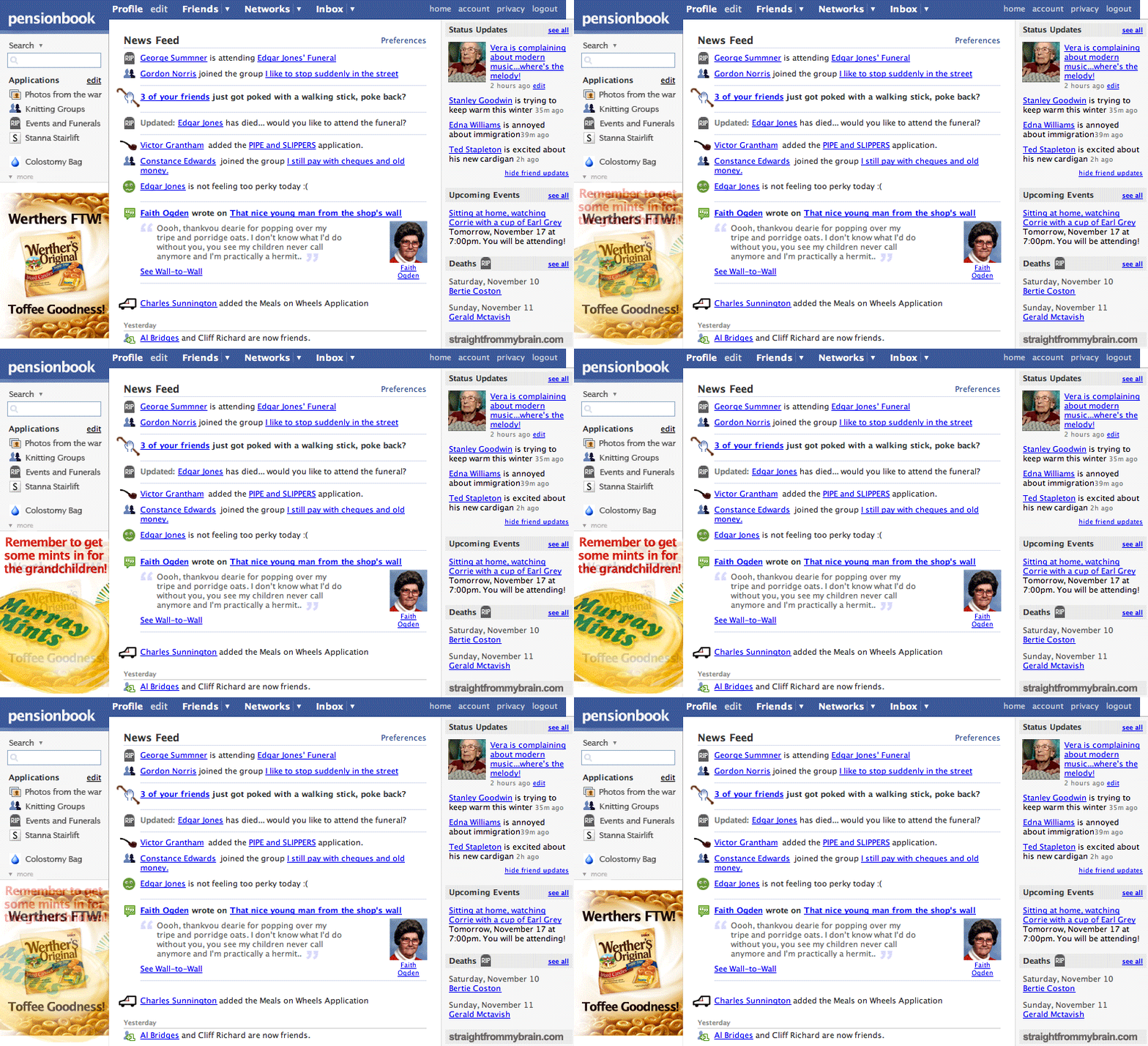
Despite the change in hairstyle, there is no concealing the fact that John McCain’s running mate for the forthcoming US Presidential Elections is none other than Greek cantatrice and 1970s eurovision icon, Nana Mouskouri. Perhaps we should have been told.

Death and Conkers

Posted in Uncategorized with tags , , on September 24, 2008 by telescoper

Strange connections. No sooner do I post a meandering item about the autumn weather bringing about flashbacks when I get two – quite different echoes – from today’s Guardian.

The first came from the obituary pages, where I read of the death on September 21st 2008 of Professor Sir Brian Pippard, aged 88.

I never knew him personally. In fact he retired from his post as Cavendish Professor of Physics in 1982, which was the year I started my undergraduate degree at Cambridge, so I was never taught by him. His research was predominantly in the area of superconductivity, which is far from my own speciality, so I never knew him through that route either.  But I did develop a kind of respect for him through a little book he compiled, called Cavendish Problems in Classical Physics.

This was on the list of required textbooks I got before I started my time as a student and I still have it today. As its name suggests, this contains all manner of problems about very mainstream topics in physics: electricity, magnetism, mechanics, and so on. Some of them are short, some long, but all have interesting little twists in them and each is instructive in its own way. 

I tried some of these problems on first year physics students at Cardiff last academic year and they turned out to be excessively challenging. In other words, the students couldn’t do them. I don’t want to go into a rant about declining standards of school science teaching, but it is a fact that A-level physics nowadays provides absolutely no preparation for tackling the likes of the  Cavendish Problems because it does not cultivate the kind of lateral thinking needed even to formulate these problems. Instead the students tend to be taken through standard exercises that they learn by rote and regurgitate in examinations. Anything different to what they’ve been led through completely throws them. I’m generalizing horribly, I know, but there’s a lot of truth in there.

It’s not so much that students can’t complete the Cavendish problems, but that they don’t even know how to start. It’s a shame that the art of genuine problem solving is so badly neglected in today’s schools, especially because its the bit that’s the most fun .  The brain can be so much more than a memory device, if only we could free up future generations of young minds by abandoning the obsession with modularised, factoid based teaching.

I think Brian Pippard would have agreed.

The other of today’s autumnal flashbacks was triggered by a short piece about the humble horse chestnut tree.  At this time of year the ground underneath these trees is covered with conkers which are collected by schoolboys and used in the game of the same name.  Or at least that’s what used to happen.

Apparently, for several years now horse chestnut trees have been struggling with adverse weather and attacks from moths. Now they have an even tougher enemy, a virulent disease called bleeding canker. This causes a sticky ooze to emanate from the trunk and branches of the trees, the leaves to die much earlier than usual and, worst of all,  the conkers to be very small or even non-existent. The bacterium that causes this disease  now infects about half the horse chestnut trees in the United Kingdom, and there is no known cure.

The death of high school physics is bad enough, but how can we ever cope without conkers?