Archive for the Uncategorized Category

Taking down their Particulars and Examining their Testimonials

Posted in Uncategorized with tags , , , on January 21, 2009 by telescoper

If you’ve looked at Cosmic Variance recently you will know that has almost gone up in flames (metaphorically speaking) . The incendiary item was what I thought was a gently humorous post on the subject of recommendation letters for entry into graduate schools, which evolved to include postdoctoral positions too. This item has generated nearly a hundred comments so far, some of which are quite sensible and interesting but others worryingly vitriolic. One correspondent in particular got hold of the wrong end of the stick and proceeded to beat wildly about the bush with it,  accusing academics of everything from intellectual snobbery to the Whitechapel Murders.

I’m actually quite pleased that the more extremist comments are there, as they make mine look quite sensible which they perhaps wouldn’t if they were on their own. I’ve therefore collected my thoughts here to see if they generate any reaction.

A follow-up post attempted to defuse the issue with an injection of common sense, but it remains to be seen whether this will indeed steady the ship. (I’m proud of that multiply mixed metaphor.)

The principal bone of contention is the matter of “recommendation letters” and whether a Professor should ever write negative comments when asked to recommend a student for a place on a graduate course.

In the UK we generally don’t have “recommendations” but “references” or “testimonials” which are supposed to describe the candidate’s character and abilities in a manner that is useful to those doing the recruitment. They are not meant to be written in absurdly hyperbolic terms and they are not meant to ignore any demonstrable shortcomings of the applicant. They are supposed to advise the people doing the recruitment of the suitability of the candidate in a sober, balanced and objective way. Fortunately, most students applying to graduate schools are actually rather good so there are many more positives than negatives, but if there are weaknesses in my view these  must be mentioned, even this turns out to be the kiss of death to their application.

Another objection is to recommendation letters that include statements of the form Aaron is better than Brenda but not as good as Charlie. I don’t object at all to the idea of a reference that includes some form of  ordering like this. Since there are inevitably more applicants than places the panel will have to make a ranking, so why not help them by giving your input? After all, you know the candidates better than the panel does.

The point is that the referee is not only providing a service for the student but also for the recruiting school. On this basis, it is, I think, perfectly valid to include negative points as long as they can be justified objectively.

British professors are often criticized by our colleagues over the pond for writing very reserved recommendation letters, but having one year received references from a US institution on behalf of 4 different students who were all apparently the best student that institution had ever had in physics, I think I prefer the old-fashioned British understatement.

However, references transcripts and other paperwork can only establish whether a student has reached the threshold level of technical competence that is needed to commence a research degree. That’s a necessary but not sufficient condition for their success as a scientist. The other factors – drive, imagination, commitment, and diligence (which apparently is a term of abuse in the USA) are much harder to assess. I think this part has to be done at interview. You can’t just rely on examination results because it’s by no means true that the best students at passing examinations turn into the best graduate students. Research is a whole different ball game.

I also think there’s a difference between how references are used for making a job appointment versus a place at graduate school. Where I come from, in the UK, graduate study is funded by a studentship which pays a stipend rather than a salary and the successful applicants are not formally employed by the university. It is rather different in the case of a postdoc where the successful candidate is an employee of the institution.

Owing to recent changes in employment legislation in the UK, best practice for the process of appointing staff is now considered to not even ask for references until after short-listing or even after interview. The purpose of references is simply to verify that the information the applicant has given in the application is complete and correct; they are not to be used in deciding on quality. Shortlisting is done on the basis of whether the applicant can show in the application that they have skills that match the requirement of the post. The final decisions is made after interview of shortlisted candidates.

Many academics hate this new-fangled way of doing things partly because its a new-fangled way of doing things but also because they tend to rely heavily on references in judging the relative quality of candidates for PDRA appointments. Personally, however, I don’t find references particularly helpful in this context – especially those from America where the language is so inflated as to be laughable – so, unlike most of my colleagues, I’m quite happy to embrace the “new” approach. I think relying too much on references is a tantamount to wanting other people to make difficult decisions for you rather than making them yourself.

On top of this, modern protocol requires the use of a standard application form rather than just a CV and list of research interests. That way the relative merits of all candidates can be judged on the basis of the same pieces of information and answers to the  same questions. Whatever you think about this process, it certainly does make things more transparent.

I’m currently advertising a postdoc job and will be shortlisting for this position on the basis I have described, i.e. without asking for references uprfront. I’ll only look at references later on, after shortlisting.  This is the first time I will have done it this way, so I am interested to see how it works.

But I can’t see at all how one could possibly make decisions concerning entry of an undergraduate student onto a graduate programme without using references earlier on in the process.
Crimes and Misdemeanours

Posted in Uncategorized with tags , , on January 16, 2009 by telescoper

I’m indebted to Frazer Pearce for sending me a very interesting item about Susan Crawford, a former judge who served in a legal capacity for the US Army. She recently went on record to state without equivocation that the treatment meted out to detainee Mohammed al-Qahtani at Guantanamo Bay was “torture”. Not “coercive interrogation”. Not “enhanced interrogation”. Not any other “nontorturous form of interrogation”. Just plain torture.

The implications of this conclusion could be very profound. I would like to think that every single member of the Bush administration who sanctioned this should now be prosecuted under international law. I would also prosecute anyone who knew about it but failed to stop it, as their behaviour means that they were still party to a conspiracy to commit torture. It would, however, take someone with extraordinary courage (and financial backing) to force such an action through the legal system.

I’m not holding my breath.

Coincidentally, another George was in the news today although this one was O’Dowd rather than Bush. `Boy George’ was today sentenced to 15 months in jail for “falsely imprisoning” a male escort at his London flat. I’ll spare my delicate readers the more salacious details of the offence, but it seems the 47-year old former Culture Club singer was buzzing with cocaine at the time and suffering from paranoid delusions that his paid guest had tampered with his computer. He therefore tied him up and assaulted him. Having been found guilty by the jury he was sentenced today.

Initially I thought 15 months sounded very harsh, but then I didn’t know the extent of what had happened until I read the account in today’s newspaper. The violent and degrading treatment he inflicted on the 29-year old escort clearly merited a stern response so, on reflection, I’m glad in many respects that the judge was severe. Whatever you may think of the morality of the escort business, workers in that trade (whether straight or gay) are still human beings and deserve to be treated with respect.

I say “in some respects” because I’m very pessimistic about the criminal justice system generally. We lock up a staggering number of people in jail, many more than any other Western European country. The police spend their time trying to catch offenders, some of them get sent to jail and they see their job done. But I’ve yet to see any evidence of anything good coming out the other end of this depressing pipeline. I’m not convinced a jail sentence is going to cure Boy George of the drug problems that clearly led to this situation.

On the other hand, I’m by no means arguing that celebrities should be treated differently from others. I’m just saying that there has to be a better way, if only someone could think of it. Until they do, I think Boy George should do his time. At least he won’t have to pay for male company.

But isn’t it ironic that the other George – the one guilty of mass murder as well as torture – will probably get away scot free?

Sad News

Posted in Uncategorized with tags on January 13, 2009 by telescoper

You may recall a previous blog item of mine about Operation Skyphoto, which was an attempt to raise funds for a new medical treatment for Alexander Thatte, the young son of two Oxford physicists, by selling old sky survey plates.

I was reading through some items on the e-astronomer this morning, and found a comment by Steve Warren conveying the sad news that Alexander lost his battle against leucaemia and passed away on January 4th 2009.

Vitae Summa Brevis Spem Nos Vetat Incohare Longam.

Christmas Closure

Posted in Uncategorized with tags , , on December 23, 2008 by telescoper

Dear Readers (and Associate Professors),

I’m shortly going to be climbing aboard the Deadwood Stage (with some other faggots) in order to spend Christmas with my friends in the  North.

That means that I’ll be offline for a few days but as soon as I’ve sobered up I’ll be back with more of the random drivel that this blog is famous for.

In the meantime, I’d just like you wish anyone who reads this a very Merry Christmas and a Happy New Year or, failing that, a felicitous non-denominational yuletide.

Set ’em up, Joe!

Peter

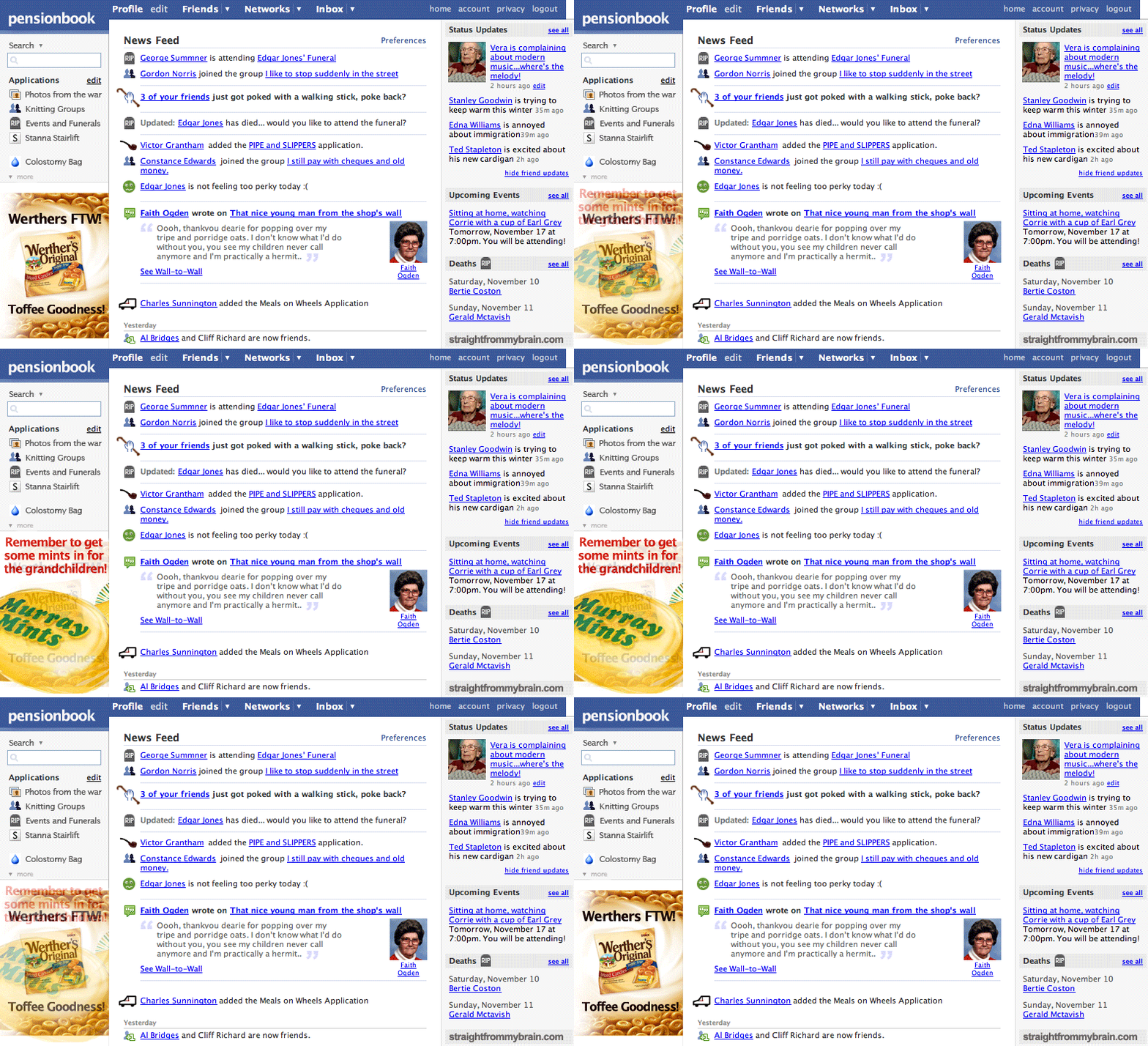
The Facebook of the Future

Posted in Uncategorized on November 17, 2008 by telescoper

If you’re not on facebook this won’t make any sense!

But thanks to Ed Gomez for sending it.

A Blast from the Past

Posted in Uncategorized on October 29, 2008 by telescoper

Trawling the web today for something completely different, I accidentally stumbled upon a film featuring my former Nottingham PhD Student, Emma King. It is part of a series about young scientists made by the Vega Science Trust and originally broadcast on BBC 2 as part of The Learning Zone. I had completely forgotten about it. How could I have failed to remember my one and only appearance on the Emma King Show? You can watch the film here.

Emma successfully completed her PhD in 2006 and now runs her own science communication business from her home in the Isle of Man.

News Roundup

Posted in Uncategorized with tags , on October 24, 2008 by telescoper

It’s not often that your own department gets onto the BBC News, but to do it twice in a few days with different stories has to be worth a mention!

Earlier this week was an item about the Einstein Telescope project, which has just received 3M euros in funding for design studies. Unlike familiar telescopes, this one is planned to exploit gravitational waves rather than the usual optical, radio or X-ray radiation (which are all varieties of electromagnetic waves). Gravitational radiation hasn’t actually been detected yet, but there are good reasons to believe that it will soon be measured for the first time. The next challenge will be to use gravitational waves from distant sources to study the processes that generate them, such as collisions between black holes. That’s what the new project is intended to do. In principle, gravitational waves will allow us to look much farther into the distant Universe (and therefore farther back in time) than we can do with even the largest optical or radio telescopes so this could be the dawn of a new era of observational astronomy.

But that doesn’t mean that optical telescopes will be defunct, especially when it comes to inspiring the young to take up an interest in astronomy. The other news item on the BBC this week about this department is our own new (optical) telescope which is now fully installed and will shortly to be opened. This is situated on the roof of the building that houses the School of Physics & Astronomy and it will be used primarily for undergraduate teaching, but it will also be available to be used by the general public and school visits on open nights. It should be put to particularly good use in 2009, which is the International Year of Astronomy.

It’s a small telescope by professional standards, about half a metre in diameter, but large compared with what’s available at other Universities in the UK and it promises to be a valuable addition to our already large range of astronomical facilities which is one of the reasons Cardiff is such a good place to work and study.

On the grounds that all publicity is good publicity, I was very pleased to see these things get a full airing on the local media, although I have to admit that the news that really caught my eye this week was the discovery of a headless corpse on the track at Llandaff railway station.

Powers and the Playhouse

Posted in Books, Talks and Reviews, Uncategorized with tags on October 21, 2008 by telescoper


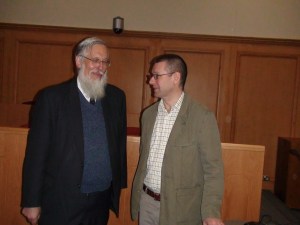
I got this picture this morning from the University of Derby. It was taken at the end of my lecture there last week. The chap on the left of the picture is Jonathan Powers, who is a former pro-vice chancellor of the University of Derby and who introduced my lecture as well as generally acting as master of ceremonies. He’s a very knowledgeable and genial fellow with a huge range of interests.

Over drinks after the talk he told me how he had recently become involved with a campaign to save the historic Derby Playhouse which was recently put into administration and is in danger of demolition if the current rescue package doesn’t work out.

I promised to put in a plug for the campaign, but forgot to do so until the photograph reminded me. You can keep in touch with the campaign and hopefully get involved by visiting their website here.

The meaning of e

Posted in Uncategorized on October 11, 2008 by telescoper

I found Andy Lawrence‘s blog (“the e-astronomer“) on wordpress this morning. He’s been at this lark for much longer than me and seems to have generated quite a lot of discussion about various things to do with astronomy.

His pseudonym, though, got me thinking about the prevalence of the prefix “e-” these days. Of course we’ve had e-mail for a long time. I have published an e-book but, as far as I know, nobody has ever e-read it. We have e-banking and e-commerce (although these may e-disintegrate the way things are going). You can get on a plane  using an e-ticket, and the police make e-fits to help solve crimes, although apparently only those that have been committed by cartoon characters. And then there’s also e-coli which is presumably some form of electronic medical treatment, judging by its ubiquity in news stories about British hospitals.

Universities now have “e-learning”, which may or may not be correlated with “e-teaching”, research councils do “e-science” or “e-technology” (and even sometimes even “e-research”).   But I’ve always been confused about what it means in these later manifestations.

And then there is the potential confusion with older terms involving “e”, as exemplified by the term Emeritus Professor. The meaning in this particular case is clearly explained by Stephen Leacock in his book Here are my Lectures:

“I am what is called a professor emeritus – from the Latin e meaning “out”, and meritus meaning “ought to be”.

But I think this gives  a clue as to how to interpret e-science and the rest. In these uses, e is roughly a combination of the two previous examples, conveying both its electronic nature and the association with “emeritus”, i.e. very expensive in terms of resources needed, very unlikely to produce anything interesting, but superficially impressive to those who don’t know any better and therefore occasionally useful to wheel out whenever you want to convince someone to give your department money.

The phrase “e-science” illustrates this nicely, especially in terms of its expense, its apparent appeal to politicians,  and the total lack of any impact on real science. Likewise “e-learning” is electronic gimmickry that doesn’t actually have much to do with learning, and so on.

But of course this interpretation doesn’t apply in any way shape or form to the name “e-astronomer”. Andy Lawrence is a very distinguished scientist. That’s why his real working title is Egregious Professor of Astronomy.

At least I think that’s what it says.

Crash! There goes another one..

Posted in Uncategorized with tags on October 9, 2008 by telescoper

Another day, another bank failure.

Further to my post about the crisis in the Icelandic banking system, it now appears the third major private Icelandic bank, Kaupthing, has also been taken into admininistration over concerns about its liquidity (or lack of it). The UK-based online subsidiary Kaupthing Edge has, however, been taken over by ING Direct, another direct savings bank. ING claims that all the deposits it has acquired are now safe, but something tells me this crisis is far from over and I interpret “safe” as meaning “for the time being”. This is all coming very close to home, as I have savings in Kaupthing Edge.

At least I’m in a better position than someone who had savings in Icesave which was the second Icelandic bank to fail. The scary thing about this one was that the Icelandic government had given guarantees to protect depositors, but has now thrown away those guarantees leaving the UK government to step in to compensate those who have lost their savings. For once, I actually agree with Prime Minister Gordon Brown’s reaction to this. I hope Britain seizes any Icelandic assets it can to compensate the UK taxpayer. That is if Iceland actually has any assets left at all.

Iceland has also today suspended all dealings in its shares as its economy rapidly melts down.  Apparently the country now has debts totalling 12 times its Gross Domestic Product which makes it as near as dammit to being bankrupt.

Meanwhile despite massive intervention from central banks around the world, stocks and shares have continued to lurch around violently above and below a steady downward trend. All this seems totally irrational to me. And they have the nerve to award a Nobel prize to economists!

If only everything in life were as simple as the Cabibbo-Kobayashi-Maskawa theory.