Una Grande Vociaccia – 100 Years of Maria Callas

Posted in History, Opera with tags , , on December 2, 2023 by telescoper
Maria Callas (1923-1977)

Today, 2nd December 2023, is the centenary of the birth of the most renowned opera singer of her time, Maria Callas. I couldn’t let this occasion pass without posting a tribute, Tonight I’ll be sipping wine and listening to some historic recordings of her. I think every classical radio station in the world will tonight be paying tribute to this remarkable artist.

Maria Callas was born on December 2nd 1923 in New York city, of Greek parents who had moved there the previous year, and christened Maria Anna Sofia Cecilia Kalogeropoulou. Her mother, disenchanted with her deteriorating marriage, abandoned her husband (Maria’s father) and took Maria and her sister back to Athens in 1937. Maria enrolled at the National Conservatoire of Greece the same year after winning a scholarship with the quality of her voice, which

was warm, lyrical, intense; it swirled and flared like a flame and filled the air with melodious reverberations.

At this age, Maria was a rather plump young lady with a rather deep singing voice. Initially, she aspired to be a contralto but at the Conservatoire she was encouraged instead to become a dramatic soprano. Accordingly, she underwent special training to raise her natural pitch (or tessitura) and learned how to control her remarkable voice more accurately so she could sing in a sufficiently disciplined fashion that she could take on the dazzling coloratura passages that she would perform in later years with such success. She also worked on her chest tones to broaden the scope of her voice in the mezzo region. Although she became more technically refined as a singer during this period, there were some things that didn’t change. One was the sheer power of her voice, which is something that we tend to notice less in these days of microphones and studio recordings. People who heard her sing live confess to being shocked at the sheer scale of sound she could deliver without amplification. Perhaps more tellingly, she eschewed many of the devices sopranos tended to use to control the highest notes (usually involving some alteration of the throat to produce accuracy at the expense of a thinner and more constricted tone). When Callas went for a high note, she always did so in a full-throated manner. This often produced a piercing sound that could be intensely dramatic, even to the extent of almost knocking you out of your seat, but it was a very risky approach for a live performance. Audiences simply weren’t used to hearing a coloratura sing with such volume and in such a whole-hearted way. It wasn’t always pretty, but it was certainly remarkable and often very moving. It was this aspect of her voice that led her friend Tito Gobbi (who sang with her in Tosca) to call it una grande vociaccia, which I translate in my schoolboy Italian as meaning something like “a big ugly voice”. That isn’t meant to be as disparaging as it sounds (Gobbi was a great admirer of Callas’ singing).

Having listened to lots of recordings of Maria Callas I have to admit that they are certainly not all good. Sometimes the voice didn’t come off at all. Unkindly, one colleague said that she “sang with her ovaries”. When she talked about her own voice, Callas herself often referred to it as if it were some independent creature over which she had very little control. Anyway, whatever the reason, when she was bad she was definitely bad. But I adopt the philosophy that one should judge artists (and scientists, for that matter) by their best work rather than their worst, and when Callas was good she was simply phenomenal, like a sublime and irresistible force of nature. Nobody else could bring characters to life in the same way. That’s why they called her La Divina.

Although her talent was very raw in the beginning there was no question that she always had a voice of exceptional power and dramatic intensity. When she started singing professionally she immediately attracted lavish praise from the critics not just for her voice but also for her acting. As a young soprano she sang in an astonishing variety of operas, including Wagner‘s Tristan und Isoldeand Die Walküre, neither of which one would now associate with Callas.

It was in the late 1940s that Callas began to take an interest in the type of opera that would really make her name. Bel canto opera was rather unfashionable at that time, probably because audiences preferred the grittier and more realistic verismo style. Virtually single-handed, Callas resurrected the bel canto canon by injecting a true sense of drama into works which had previously just been seen as vehicles for the singers to demonstrate their art. Callas brought an entirely new dimension to the great operas by Bellini (Norma, I Puritani, La Somnambula…) and Donizetti (Lucia di Lammermoor, Anna Bolena), although she was sufficiently versatile to also perform brilliantly in the verismo syle of Verdi and Puccini as well as lesser known composers such as Giordano (Andrea Chenier). Recordings of many of these performances are available, but it is sad that this glorious period of her singing career happened just a bit before high quality equipment was available so the true glory of her voice isn’t always evident.

In 1953, Callas decided that she wanted to change her appearance, perhaps so she would look more appropriate for the parts she was playing on stage. At the time she weighed almost 200lbs. In order to lose weight as quickly as possible, she followed the barbarous but highly effective expedient of swallowing a tapeworm. She lost 80lbs in a matter of months. The dramatic loss of weight changed her body and her face, emphasizing her high angular cheekbones and giving her a striking look very well suited to the opera stage. But it also affected her voice somewhat, especially at the upper end where she seems to have found it more difficult to avoid the dreaded “wobble” which was one of the alleged imperfections that critics tended to dwell upon.

Callas also had very poor eyesight which required her to wear very thick spectacles in order to see at all, a thing she refused to do onstage with the result that she was virtually blind during performances. In fact, during a performance of Tosca at Covent Garden she leant too far over a candle and her hair caught fire. Improvising magnificently, Tito Gobbi, as the loathsome Scarpia, extinguished the fire by throwing water at her before the audience had noticed. Although they weren’t much use for seeing with, her eyes were a great asset for her acting, in turns flashing like a demon then shining like an angel.

After her weight loss, Callas was suddenly no longer just a wonderful singer but also a strikingly beautiful woman. Her career took a back seat as she started to revel in the glamorous lifestyle that opened up in front of her. Her voice deteriorated and she performed rather less frequently. Eventually she embarked on a love affair with Aristotle Onassis, a notorious serial collector of trophy women. She hoped to marry him but he abandoned her to marry Jackie Kennedy, widow of John F. Kennedy.

She never really recovered from the failure of this affair, retired from singing and lived out the last years of her life as a virtual recluse in her apartment in Paris. She died in 1977.

I had heard a lot about Maria Callas when I was younger, but the recordings that I listened to (generally from the 1960s) were really not very good, as her voice was undoubtedly much diminished by then. I just assumed that, as is the case with many artists, the legend of Callas was all mere hype. Then, about 20 years ago, I was listening to BBC Radio 3 and they played the final scenes of the great 1954 recording of Norma with Callas in the title role, conducted by Tullio Serafin. I was completely overwhelmed by the emotion of it and tears flowed freely from my eyes. I’ve always had a tendency to blub when I hear really beautiful music, but as I’ve got older I’ve learned not to be embarrassed by it.

In England, Callas is probably best remembered for her performances in Tosca in Covent Garden. I have recordings of her in that role and they are really wonderful. But there are many fine recordings of Tosca by other singers, some of which are almost as good. In the case of Norma, though, there isn’t any other performance that comes within a mile of the Callas version. Or if there is, I’ve yet to hear it.

Now I know that there are some people, even opera lovers, who just don’t get Callas at all (just look at the comment boards on Youtube, etc). I grant that she wasn’t always the most accurate singer, and I don’t think you could say her voice had a purely classical beauty. But even if you don’t like her voice you have to admit that she revitalized the opera stage and brought a new public into the theatres. I can’t imagine what the state of opera would be now, if there hadn’t been a Callas, and you can’t argue that she is now an iconic figure. What I admire most about her is that, like it or loath it, her voice is instantly recognizable. In this sense, she always puts me in mind of a kind of operatic version of Billie Holliday. She’s a far cry from the many bland mediocrities that pass themselves off as opera singers nowadays.

I’m going to end with the obligatory clips from Youtube. There’s a lot of Callas on there, not all of it good. I’ve chosen a couple of items, although neither of them has a proper video. The first was performed live in 1955 in front of the notoriously difficult audience at La Scala in Milan and recorded from a radio broadcast so that the sound quality is very poor. A studio recording of this aria, from Andrea Chenier, features most movingly in the film Philadelphia. This live version, however, is notable for a number of reasons. One is that you get some idea of the power of the Callas voice in the way she pushes aside the entire orchestra and is even able to cut through the distortions introduced by the rather primitive recording technology. The second thing is that she sings it so beautifully, with such feeling, lovely phrasing, and so much colour and vitality. Listen to the way the texture of her voice matches perfectly her changing emotions as she tells her story. The shattering, climactic high C that occurs near the end is a perfect example of what I was saying above. She stabs this note out like her life depended on it. It sends shivers down my spine and clearly had the same effect on the audience. The thunderous applause that follows the end of this aria is quite frightening in its intensity, but gives a good idea how much her public adored her. If you can put up with the lo-fi recording, this is certainly a better performance than the studio version.

The final piece has to be from Norma. I think Bellini is a wonderful composer of opera, but he doesn’t make life easy for the singers. There’s never any doubling of the vocal line by the orchestra so the singer is very exposed. This doesn’t bother Maria Callas. This is the famous aria Casta Diva, which has become a kind of signature tune for her and it’s one of the pieces that she always seemed to perform beautifully. It might be a bit hackneyed but I love it and, after all, it’s my blog. There’s also a nice compilation of pictures.

I wonder how many times and in how many places, Casta Diva is being played today?

New Publication at the Open Journal of Astrophysics

Posted in OJAp Papers, Open Access, The Universe and Stuff with tags , , , , , , on December 1, 2023 by telescoper

It’s Friday and I thought I’d take  the opportunity before the weekend to announce yet another new paper at the Open Journal of Astrophysics.

The latest paper is the 46th so far in Volume 6 (2023) – just four to go for a half-century – and it’s the 111th altogether. This one was actually published on Wednesday November 29th.

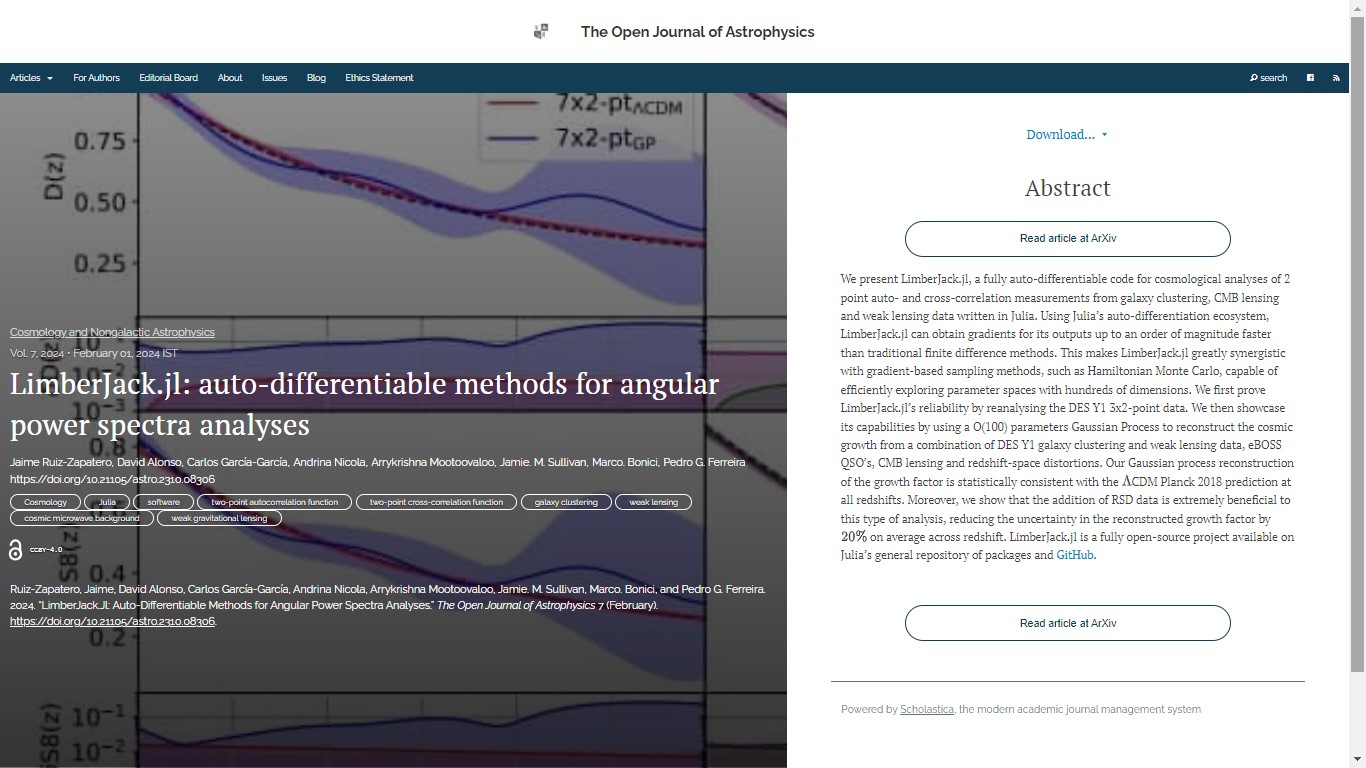
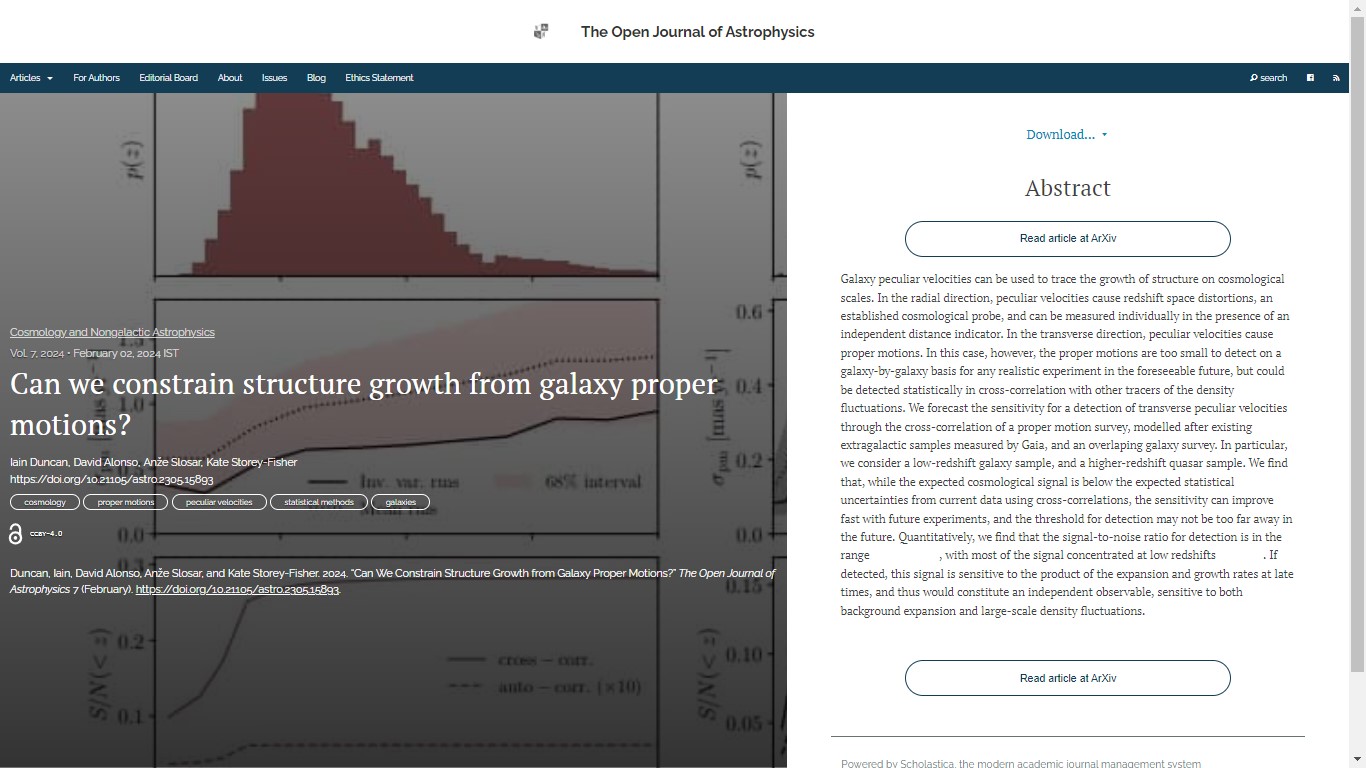
The title is “Optimization and Quality Assessment of Baryon Pasting for Intracluster Gas using the Borg Cube Simulation” and it presents an algorithm for adding baryons to gravity-only simulations via a “pasting” approach. It is in the folder marked Cosmology and Nongalactic Astrophysics.

There are 8 authors: F. Kéruzoré;  L. Bleem; M. Buehlmann;  J.D. Emberson; N. Frontiere; S. Habib; K. Heitmann; and P. Larsen;  all of them based at the Argonne National Laboratory, in Illinois (USA).

Here is the overlay of the paper containing the abstract:


You can click on the image of the overlay to make it larger should you wish to do so. You can find the officially accepted version of the paper on the arXiv here.

Six Years in Maynooth!

Posted in Biographical, Education, Maynooth with tags on December 1, 2023 by telescoper
Maynooth University Library, home of the famous cat

It is 1st December 2023, which means that it’s six years to the day since I started work at Maynooth University. (Obviously, I’m not there now, but you get the point.) So much has happened in that period it seems very much longer since I first arrived. Still, it does mean that I’ve now spent 10% of my life living in Ireland. I’m very happy that I made the move all those years ago.

I won’t deny that the past six years have had their frustrations. The major one is something I haven’t mentioned this on the blog before, but when I joined the University I was promised – in writing – that the Department of Theoretical Physics would be allocated part-time computer support. Despite many reminders, that has never happened. That’s a breach of contract. A less patient employee would have sued his employer already. It’s absurd that the Department is still having to run its own computer cluster without any professional technical support. I’m writing this now to make it clear that I haven’t forgotten. I hope that this issue is remedied by the time I return to Maynooth. Six years is long enough.

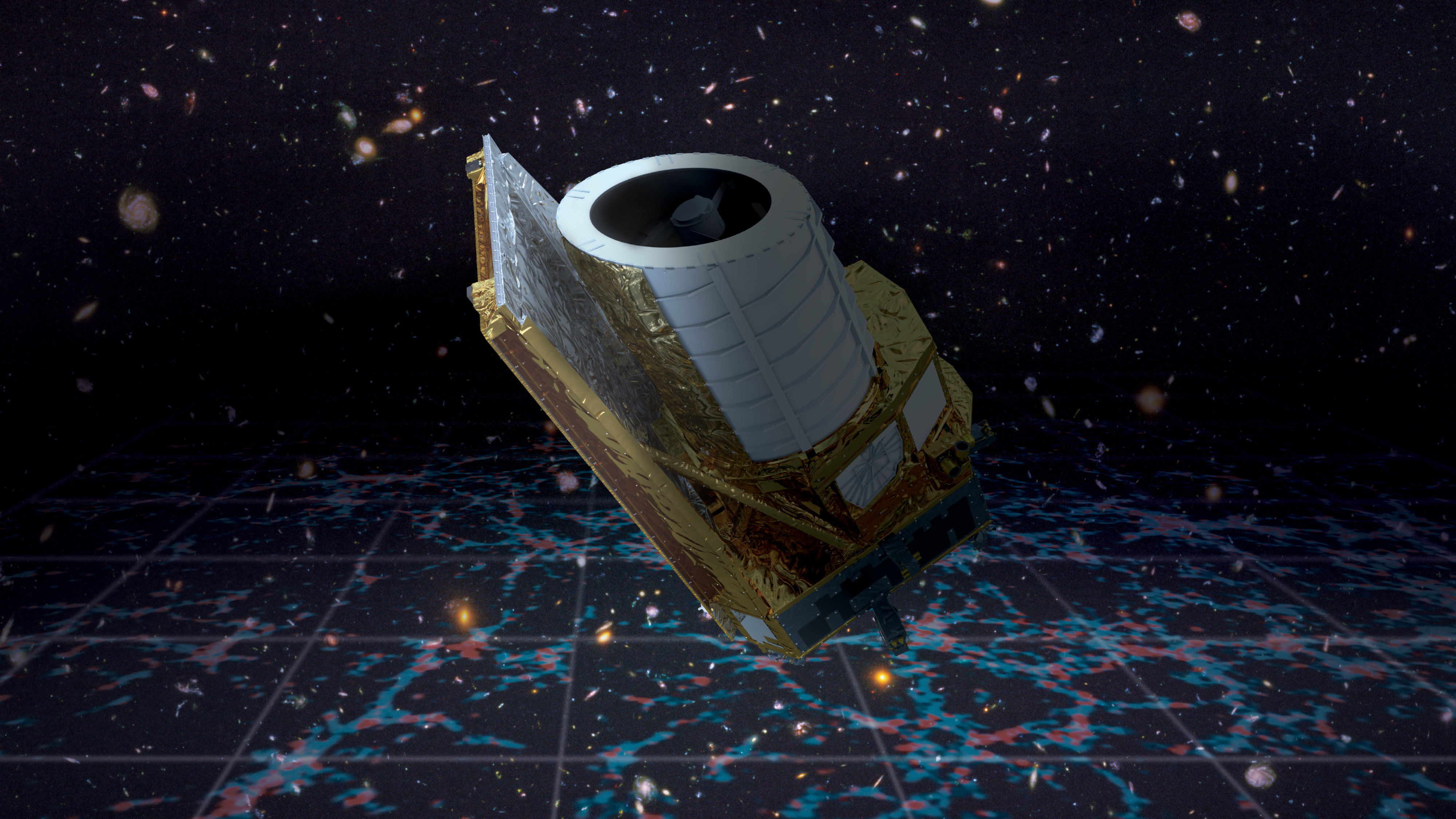
On top of that, the teaching and administrative workload, especially for the three years I was Head of Department, mostly during the Covid-19 pandemic with very little support from the University, was very heavy and has made it difficult to be very active in research. Fortunately, now I’m on sabbatical so am able to do a bit of catching up with projects. Obviously the big event this year was the launch of the European Space Agency’s Euclid mission. Performance verification is still under way and the Euclid survey proper won’t start until the new year, but things so far look very promising.

I took over as Chair of the Euclid Consortium Diversity Committee in July. That has been a lot of work, actually, with very frequent telecons. You might argue that this is a distraction from actual research, and there’s some truth in that. But the most important thing is that the Euclid mission is a success, and I think that making the Euclid Consortium as inclusive and supportive a working environment as possible is one way of contributing to that.


The thing I’m probably most proud of over the past six years is, with the huge help of staff at Maynooth University Library, getting the Open Journal of Astrophysics off the ground and attracting some excellent papers. This year has seen significant growth, with submissions and publications increasing by about a factor three since last year. We’re still smaller than many of the mainstream astrophysics journals, but we’re still growing.

So, after a few years of hard and at times dispiriting slog, things are now going pretty well from a personal point of view. I do still worry about the future, though. My biggest fear for the Irish Higher Education system is that it follows the “business model” of soulless teaching factories with courses delivered by demoralized staff on casual teaching contracts. Things are definitely going that way in Maynooth and this trend must be resisted, as must the never-ending diversion of resources away from teaching and research into useless layers of management. Every time I see a job advertisement for a new management post, I think how much less it would cost to fund the technical support I was promised six years ago. What drives the University’s policies is not lack of resources but ridiculously warped priorities.

Connections and Submissions

Posted in Biographical, Open Access on November 30, 2023 by telescoper

If I have one gripe to make about the otherwise excellent train service between Barcelona and Paris (and back) , it’s that the Wi-Fi connection was very unreliable and at times unusable. That mean that I couldn’t do some of the fairly complicated things I needed to do online because of frequent disconnections. The upside of being disconnected is that I have a good excuse for not attending telecons!

I did manage to publish one paper at the Open Journal of Astrophysics yesterday, because I did the necessary before leaving my hotel in Paris. Unfortunately, I had to wait until I got back to Barcelona to check that everything had been correctly registered with Crossref. Only then could I promote the paper on social media. I’ll probably do a post here tomorrow about it.

These connectivity problems yesterday resulted in me spending most of my first day back in Barcelona catching up with such things as writing Google Docs and editing things via Overleaf but mainly dealing with new OJAp submissions.

There have been three four new submissions today alone, adding to the little backlog that developed over the short periods I was offline. These days we’re getting an average of one paper per day so if I can’t afford to miss many days as then it is difficult to catch up.

The two talks I gave while I was away were both about Open Access publishing in general, and the Open Journal of Astrophysics in particular, but I don’t think today’s little surge in submissions is a direct consequence of me touting for trade as I don’t think any of the authors concerned attended either talk even virtually.

It’s gratifying to see the number of submissions steadily increasing. I am sometimes frustrated – as I’m sure the authors are – by the slowness of the refereeing process but at least that’s no different from other journals I suppose.

Anyway, that’s enough reflections. Hopefully I’ll be able to spend this evening and tomorrow doing some writing of my own. Apart from tomorrow afternoon, when I’ll have yet another telecon…

Return to Barcelona

Posted in Uncategorized on November 29, 2023 by telescoper

So here I am, packed and ready to travel across Paris to Gare De Lyon for the train back to Barcelona. It’s rather cold in Paris this morning, about 2°C in fact.

It’s quite a long trip, back the way I came  without the stopover in Montpellier, but I have a window seat and plenty of things to do, so it shouldn’t be too bad.

Au revoir, Paris!

Update: I arrived exactly on time in Barcelona after a pleasantly uneventful journey back. It’s almost 15° warmer in Barcelona than in grey Paris! Now I need to stretch my legs and do some shopping!

To Saclay

Posted in Biographical, Open Access, Talks and Reviews with tags , on November 28, 2023 by telescoper

I am up early this morning ahead of a trip to Saclay, best known for CEA Saclay and the relatively new Paris-Saclay University, which involves an approximately 30-minute trip on an RER to Le Guichet, followed by road transport. It’s anomalous that Saclay itself is not served by either train or Metro, though I am told there are plans.

The only significant annoyance about yesterday’s journey was that the WIFI was hopeless, so I had to catch up with a lot of things last night and have more to do today. Still, my talk is this morning so I should have plenty time this afternoon and evening before heading back to Barcelona tomorrow.

Here are the slides I used for my talk, which was virtually identical to the one given at Montpellier last week.

Update: It has been a long day. I’m now back in the hotel in Port-Royal. The new Paris-Saclay campus is very impressive. The IPhT is a bit older and of a different style but is a nice working environment. Thanks to everyone there for their hospitality and especially for the splendid lunch after my talk!

Tour de France – Deuxième Étape

Posted in Biographical with tags , on November 26, 2023 by telescoper

So here I am, then, in my room in Montpellier, about to have breakfast and then to depart for the train to Paris. Hopefully, I’ll get to my hotel there in time for the three consecutive hours of Zoom calls I have scheduled for this evening. I’ll be spending tomorrow at the Institut de Physique Théorique in Saclay, which will require a combination of trains and buses, but for today I just have to get the TGV from Montpellier Saint-Roch to Paris Gare De Lyon and an RER train from there to my hotel. What could possibly go wrong?

Thank you to everyone in Montpellier for their hospitality during this short visit. Au revoir!

Update: On my way on time. Momentary panic as I tried to embark because the OUIGO app refused to display my ticket so I couldn’t find out which seat I was supposed to sit in, but it worked eventually. This train isn’t as fancy as the one I got from Barcelona and is rather full but nevertheless comfortable enough.

Update to the Update: arrived in a very grey and misty Paris on schedule and managed to find my way to the hotel and even managed the whole check-in experience in French! Now I have three hours of telecons to complete before thinking about dinner…

Art at the Musée Fabre 

Posted in Art, History with tags , , , on November 26, 2023 by telescoper

I spent several hours today wandering around the excellent Musée Fabre; for a little flavour of the place, see the little video I took in one of the rooms here. The largest part of the collection is French art, particularly from the 16th to 19th century, although there are also quite a few rooms dedicated to “northern” paintings, principally of Flemish origin. The gallery was founded by François-Xavier Fabre (1766-1837) who was born and died in Montpellier but spent most of his productive life as an artist in Italy (especially Florence). Fabre gave most of his own paintings to start the gallery, and there are many of examples of his work here, but many of his contemporaries are represented too, as well as earlier French artists such as Nicolas Poussin, and later ones such as Henri Matisse. Among the non-French artists are Peter-Paul Rubens, Joshua Reynolds and Thomas Wright of Derby, to name but a few.

The permanent collection is accompanied by an exhibition of modern art by Pierre Soulages, who passed away last year, and who specialized in sombre abstracts which make quite a contrast with the permanent collection.

Anyway, here is a gallery of random pictures I took. If you click on the image it will tell you who the artist was: the one by Soulages is obvious; the very fine bronze sculpture is Le Coureur (1955) by Germaine Richier, an retrospective of her work finished earlier this month (as you can see from the banner in the first picture). Check out the little boy in the very sepulchral scene depicting a vigil for the dead, who is looking at the viewer as if to say “What are you doing here?”

Musée Fabre, Montpellier

Posted in Art with tags , on November 26, 2023 by telescoper

Random Shots of Montpellier

Posted in Biographical, History with tags , , , , on November 25, 2023 by telescoper

Having a few hours to spare this morning, I took a walk around Montpellier in the sunshine. I can tell you that the layout of the old part of the city, which hasn’t changed since mediaeval times, is a labyrinth in which it is very easy to get lost but if you’re not going anywhere in particular it’s fun wandering around. At night it’s very atmospheric too. Anyway, here are some random pics I took on the way. As you can see, the weather was lovely and you always get interesting shadows from the winter sun…

While I am on the blog, I thought I would mention one of Montpellier’s famous historical connections, Michel de Nostredame (1503-1566), more usually known as Nostradamus, who studied medicine at the University here for a while before he was expelled. I searched the Prophecies of Nostradamus which you can find online, and found no reference to my visit to Montpellier. Incidentally, the University of Montpellier was founded in 1220 so is one of the oldest universities in the world. La Tour de la Babotte was part of the fortifications of the old city and was later used for a time as an astronomical observatory.

P.S. the oldest remains in Montpellier are medieval. The Romans never settled here; the main settlement in the area was Maguelone, on the coast. The administrative centre of the region was moved to Montpellier, which is 10km inland, to avoid raids from pirates.