Simons Observatory News

Posted in Cardiff, Science Politics, The Universe and Stuff with tags , , , on October 18, 2022 by telescoper

It seems a lot longer than four years ago that I drew the attention of readers of this blog to the science case for the Simons Observatory, the next big thing in ground-based studies of the cosmic microwave background.

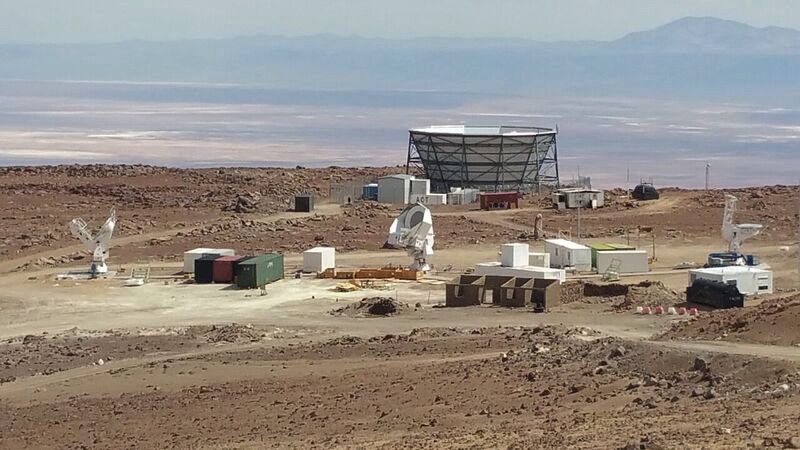
The Simons Observatory Site in Chile, as it appeared four years ago

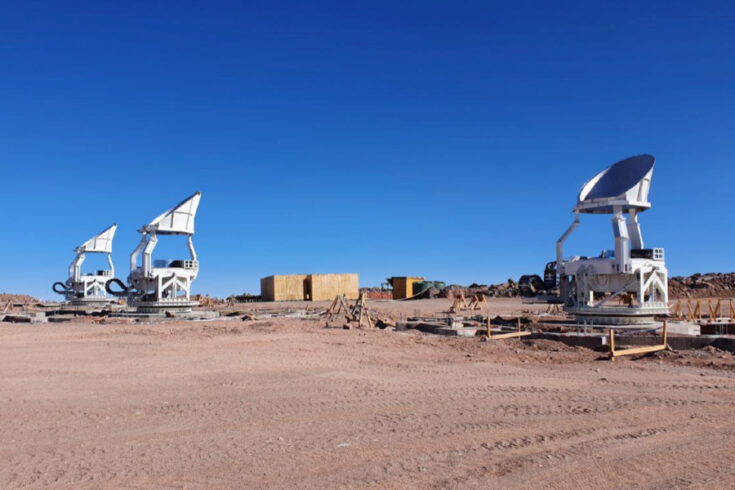
Obviously a couple of years of pandemic have intervened, amongst other things, but I was delighted to read yesterday that the UK has invested £18M in the Simons Observatory, which will enable further development of the facility at Cerro Toco, high above the Atacama Desert in Chile.

Simons Observatory in May 2022

The project was already a large international collaboration led from the USA, but the new funds from UKRI mean that six UK institutions will now join. These are (in alphabetical order): Cambridge; Cardiff; Imperial College London; Manchester; Oxford; and Sussex. Although I’m not involved in this project myself I know many people at these institutions (two of which I have worked at) and elsewhere who will be absolutely thrilled to be able to participate in this exciting project. Congratulations to them!

It would have been great if Ireland had been able to get involved in the Simons Observatory, but sadly fundamental science of this type is not a priority for the powers that be in Irish science funding. This is unfortunate because I think membership of international consortia like this would enable a small country to punch above its weight in science. Still, at least the UK PI, Prof. Michael Brown (Manchester), is an Irishman…

Open Access Week and the arXiv

Posted in Open Access with tags , , on October 17, 2022 by telescoper

Just time for a quick post to advertise the fact that next week (commencing October 24th 2022) is International Open Access Week.

I’ll be participating in one of the events – a panel discussion – organized by arXiv as part of Open Access Week. This event is entitled Trends in Peer Review of Open Access Preprints and the description is:

Speed of research is a major feature of open access preprint platforms like arXiv – formal peer review can follow later after rapid distribution of results. However, as submissions to arXiv and other preprint servers have grown, many researchers are seeking new avenues for community feedback and peer review. At this panel discussion, leaders in preprints and peer review will discuss current trends in virtual overlay journals, open peer reviews, and more. (Video recording will be available to registrants after the event)

Panelists:

  • Peter Coles, PhD, Theoretical Cosmologist at Maynooth University in Ireland and Managing Editor of The Open Journal of Astrophysics
  • Jessica Polka, PhD, Executive Director of ASAPbio
  • Antti Mikael Rousi, PhD, Senior Advisor, Research Services at Aalto University, Finland
  • Steinn Sigurdsson, PhD, Professor of Astronomy at Penn State University and arXiv Scientific Director

The event is at on Wednesday, October 26, 2022 at 15:00 UTC /11:00 EDT; that’s 16:00 Irish Time. It’s on Zoom (unless you are at Cornell and can attend in person). You need to register here.

The Autumn Leaves

Posted in Biographical, Maynooth with tags , , on October 16, 2022 by telescoper

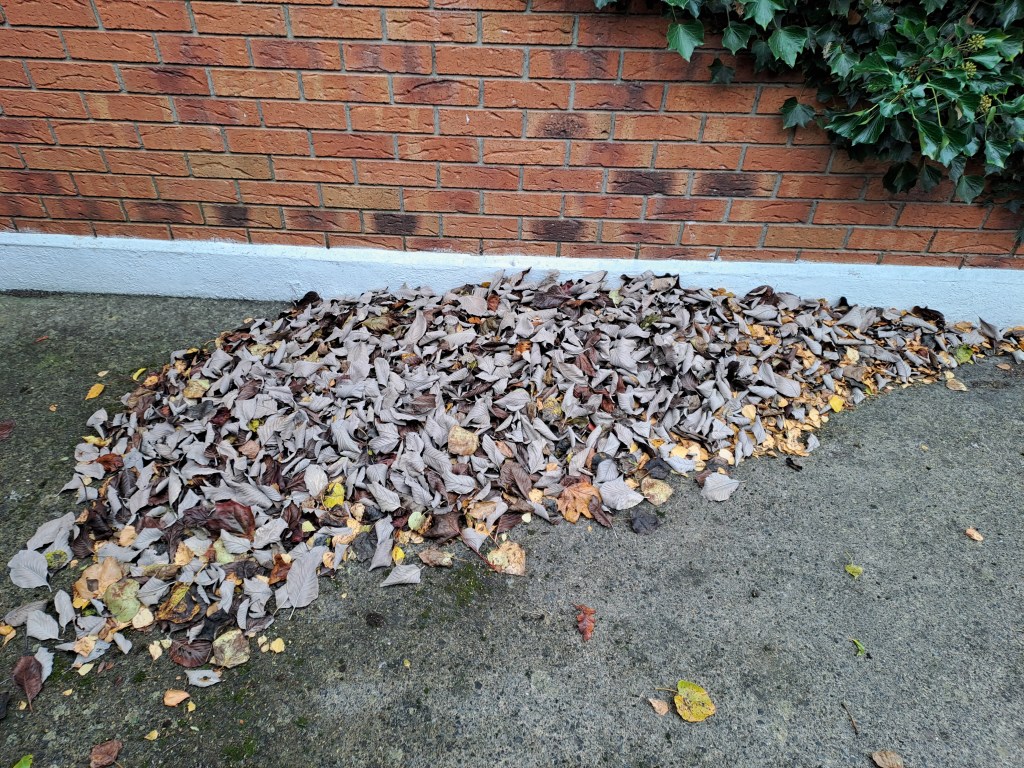
Autumn is definitely here. It’s very nice to live in a tree-lined street but the consequence of that at this time of year is that there are leaves everywhere. They don’t call it “fall” for nothing. Actually I let the leaves lie until they compost down on the actual garden but unfortunately the side of my house is a bit of wind trap and they tend to accumulate there in large quantities. When they do start to break down it makes a slippery hazard for anyone visiting, especially if it rains.

So this lunchtime I cleared away most of the leaves from the path leading up to my front door, in which task I was joined by a little robin who was no doubt hoping I would disturb some bugs or at any rate something edible when I swept up the leaves. I’m not sure this is the same robin that came in my house earlier this year, but it wasn’t afraid to come very close.

Reading a little about robins I discovered that many don’t live to reach their first birthday, but those that do have a good chance of living quite a while longer. The record is 19 years! Today’s robin could be the same one I’ve seen before, but I can’t be certain.

That reminded me that it was about time to start putting the bird feeders out again so I went out and bought some seed and peanuts and fat balls, although I think I’ll keep those for when it’s a bit colder.

At some point soon I’ll have to get the ladders out and trim back the ivy which is once again reaching the top of the wall. That will have to wait a few days, though, as my garden refuse bin is now full and won’t be empty again until Wednesday.

Angela Gheorghiu at the National Concert Hall

Posted in Music with tags , , , on October 15, 2022 by telescoper

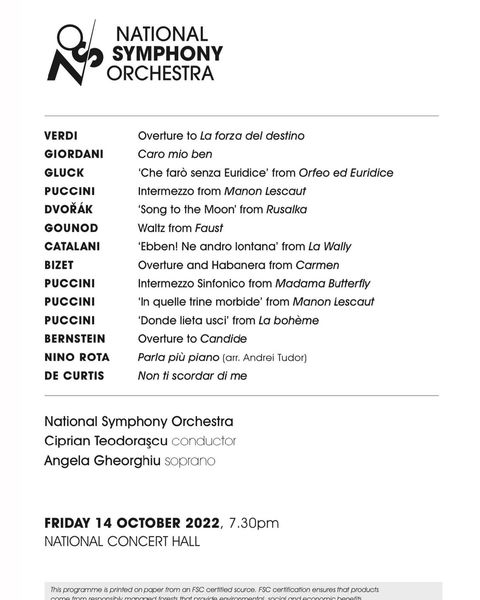
I almost missed out on last night’s performance at the National Concert Hall in Dublin. I saw the details in the brochure when it arrived at the start of the season and marked the date in my diary but dithered about buying a ticket and when I did get round to trying a few weeks ago the concert was sold out. I kept checking on the website though and was fortunate enough to find that there were some returns, so I managed to get there after all.

Angela Gheorghiu is of course a celebrated Diva with a huge following around the world, so I should have known tickets would sell quickly. The foyers and bars of the National Concert Hall were as busy as I’ve ever seen them before a performance, and there was a bit of delay getting everyone into their seats at the start as it was so full.

Last night’s concert wasn’t the normal Friday night affair at the NCH. There were no microphones and no Paul Herriott on stage so I presume it wasn’t broadcast on RTÉ Lyric FM as the weekly concerts usually are, or even recorded. I guess there were contractual reasons for that. The National Symphony Orchestra was conducted by Ciprian Teodorașcu from Romania, as of course is the star of the show herself.

I thought Angela Gheorghiu took a little while to get into her stride, not helped by the tempo for the second number Che farò senza Euridice? which I thought was far too slow. By the time we got to Song to the Moon from Rusalka, however, she was in full flow; thereafter the concert just got better and better, especially after the wine break (which was after the Habanera from Carmen). Gheorghiu’s voice seems well suited to Puccini, and the two of his arias in the second half were particularly fine.

Angela Gheorghiu was not only in excellent voice but also looked every inch the glamorous operatic superstar we expected. In the first half she was dressed in a black dress with a plunging neckline and in the second in a blazing red gown. She established a huge rapport with the audience, making a point of turning around from time to time and singing to the folk in the choir stalls.

Picture Credit: National Symphony Orchestra.

The concert was of standard operatic repertoire but I didn’t know what Parla più piano was until I read the programme notes: it’s the love them from The Godfather, usually sung in English as Speak Softly Love. The last time I heard that was at my Mother’s funeral. Can that really have been three years ago?

The performance was received very warmly indeed, with loud cheers and standing ovations. There were encores too, of course. I just knew the first would be an Irish song, and so it was – The Last Rose of Summer. The next was Puccini’s O mio babbino caro from Gianni Schicchi and the one after that was Granada, another standard component of the concert repertoire.

There may have been more encores, but I had to leave after three to get the train home after an unforgettable evening which was a much needed tonic after an exhausting week.

Cosmic Ignorance Today

Posted in The Universe and Stuff with tags , , , on October 14, 2022 by telescoper

Sorry to be so late advertising this but it’s been a busy week. This year’s Royal Astronomical Society Gerald Whitrow lecture will be given this afternoon by Prof. Pedro Ferreira of Oxford University, as a hybrid event. You have until 3pm to register. Among many other things, Pedro is a member of the Editorial Board of the Open Journal of Astrophysics…

The abstract of the lecture is:

Observations of the large scale structure of the Universe have allowed us to validate a powerful mathematical model of the Universe. We can now measure with remarkable precision, a number of properties such as its geometry, its matter content and the morphology of the initial conditions. This model is firmly rooted in physics that we know yet also reliant on speculative assumptions: inflation, dark matter and dark energy. As our understanding of the cosmological model has developed, and with ever improving data, we have been confronted with anomalies and inconsistencies. There is hope that, with new observations, more powerful simulations and the new developments in machine learning and data science, we will be able to fully resolve any inconsistencies. But there is a real risk that, if we don’t start to think differently, we will never completely understand our mathematical model. Ultimately we may never know how our Universe really works.

It should be an interesting talk and there’s still a bit of time to register. Alternatively you can wait until the recording appears on YouTube. I’ll add a link here when it does.

The Christopher Backhouse Case

Posted in Harassment Bullying etc with tags , , on October 13, 2022 by telescoper

I want to thank everyone who has contacted me about the Christopher Backhouse harassment case I blogged about yesterday. Based on what I’ve been told, the details revealed in the Guardian article – which are bad enough – are just the tip of the iceberg. I can’t say any more in case there are further legal developments.

I saw this reaction from Erica Smith yesterday.

This experience must have been absolutely dreadful for her and I sincerely hope yesterday’s announcement allows her to bring some closure to the matter. Many would have given up given the lack of action from the police, but Erica Smith had the courage to pursue a civil action getting a sub poena that led to the identity of her harasser being revealed.

Some of the people who have contacted me are people involved with DUNE. Although the harassment went on for years, none of them knew anything about the case until very recently. They are all very disturbed that this was going on in their midst for so long.

I am not a lawyer but it remains a mystery to me why Dr Backhouse has not faced a criminal prosecution. This seems to have enabled him to simply walk away from all the trouble he has caused?

I have been told that because the online harassment was anonymous – because Backhouse used proxy servers – the US Police could not pursue the matter. However, now Backhouse’s cover has been blown and the evidence is clear, shouldn’t the matter now be referred to the UK Police for him to be prosecuted there, or even extradicted to the USA to stand trial there?

In England & Wales Some crimes of harassment are dealt with summarily (i.e. by a Magistrates’ Court) which means the maximum custodial sentence on conviction is six months. However, more serious offences can be tried in the High Court and according to the Sentencing Council guidelines much longer sentences are possible for more serious offences. I’m no in favour of sending people to prison unless it’s absolutely necessary, but the harassment alone seems to me to warrant it in this case.

Anyway, my purpose in writing this post was really to point out that however strongly I feel about this there is little I myself can do of a practical nature, except encourage people who have further information on this case to take it to the proper authorities and urge others in similar situations to be inspired by the example of Erica Smith.

Update: some further information clarifying some matters related to this case is available on this Twitter thread

The Christopher Backhouse Harassment Case

Posted in Harassment Bullying etc with tags , , , , on October 12, 2022 by telescoper

I hardly know what to say about the harassment case involving Christopher Backhouse, a former researcher at University College London covered in today’s Guardian, except that everyone should be aware of just what a shocking case it is. The opening paragraph of the Guardian story gives a taste:

A former academic at University College London must pay almost £50,000 in damages to a former colleague after falsely portraying her as a sex worker on social media as part of a months-long campaign of harassment.

I don’t know Backhouse personally, but he is (or was) apparently a Royal Society Research Fellow working on the DUNE experiment, an underground neutrino physics experiment.

The whole story is very disturbing, not least because the harassment went on for so long. One strange aspect of this case is that the victim of Backhouse’s campaign of harassment, Erica Smith, had to pursue a civil action against him to put an end to his behaviour. One would have imagined that a criminal case would have been more appropriate. I for one think he should be in prison; the description presented in the Guardian article seems to constitute harassment as defined under the Public Order Act 1986 and the Protection from Harassment Act 1997. If such an offence is committed with intent to cause harassment, alarm or distress, the offender can be given 6 months’ imprisonment or a hefty fine. Why has Backhouse not been prosecuted?

The article ends with

A UCL spokesperson said Backhouse was no longer employed by the university.

I’m glad at least of that, but I wonder what UCL did during the “campaign of harassment” carried out by Christopher Backhouse and whether he left voluntarily or was sacked. I wonder what they have done to help Erica Smith put her life back together after this horrific episode. Does UCL have a vicarious liability?

This case on its own raises grave questions about the way harassment cases are handled in the Department of Physics & Astronomy at UCL but this is far from the first such case there that has gone public; see e.g. here.

UCL clearly has a lot of work to do to put its house in order.

In more general terms, I’ll repeat what I have said in earlier posts on this issue:

Failure to act strongly when such behaviour is proven just sends out the message that the institution doesn’t take sexual harassment seriously. In my view, confidentiality is needed during an investigation – to protect both sides and indeed the person doing the investigation – but if the conclusion is that misconduct has taken place, it should be acknowledged publicly. Justice has to be seen to be done. Sexual assault, of course, is another matter entirely – that should go straight to the police to deal with.

I’ve talked about protocols and procedures, but these can only ever apply a sticking-plaster solution to a problem which is extremely deeply rooted in the culture of many science departments and research teams across the world. These tend to be very hierarchical, with power and influence concentrated in the hands of relatively few, usually male, individuals. A complaint about harassment generally has to go up through the management structure and therefore risks being blocked at a number of stages for a number of reasons. This sort of structure reinforces the idea that students and postdocs are at the bottom of the heap and discourages them from even attempting to pursue a case against someone at the top.

We are obviously very far indeed from eliminating harassment or the conditions that allow it to continue but although cases like this are very painful, I think they at least demonstrate that we are beginning to see the extent of the problem, and how the measures taken to deal with it are inadequate. We have to work much harder to stop this sort of thing from happening in the first place.

Cosmological Dipole Controversy

Posted in Astrohype, Bad Statistics, The Universe and Stuff with tags , , on October 11, 2022 by telescoper

I’ve just finished reading an interesting paper by Secrest et al. which has attracted some attention recently. It’s published in the Astrophysical Journal Letters but is also available on the arXiv here. I blogged about earlier work by some of these authors here.

The abstract of the current paper is:

We present the first joint analysis of catalogs of radio galaxies and quasars to determine if their sky distribution is consistent with the standard ΛCDM model of cosmology. This model is based on the cosmological principle, which asserts that the universe is statistically isotropic and homogeneous on large scales, so the observed dipole anisotropy in the cosmic microwave background (CMB) must be attributed to our local peculiar motion. We test the null hypothesis that there is a dipole anisotropy in the sky distribution of radio galaxies and quasars consistent with the motion inferred from the CMB, as is expected for cosmologically distant sources. Our two samples, constructed respectively from the NRAO VLA Sky Survey and the Wide-field Infrared Survey Explorer, are systematically independent and have no shared objects. Using a completely general statistic that accounts for correlation between the found dipole amplitude and its directional offset from the CMB dipole, the null hypothesis is independently rejected by the radio galaxy and quasar samples with p-value of 8.9×10⁻³ and 1.2×10⁻⁵, respectively, corresponding to 2.6σ and 4.4σ significance. The joint significance, using sample size-weighted Z-scores, is 5.1σ. We show that the radio galaxy and quasar dipoles are consistent with each other and find no evidence for any frequency dependence of the amplitude. The consistency of the two dipoles improves if we boost to the CMB frame assuming its dipole to be fully kinematic, suggesting that cosmologically distant radio galaxies and quasars may have an intrinsic anisotropy in this frame.

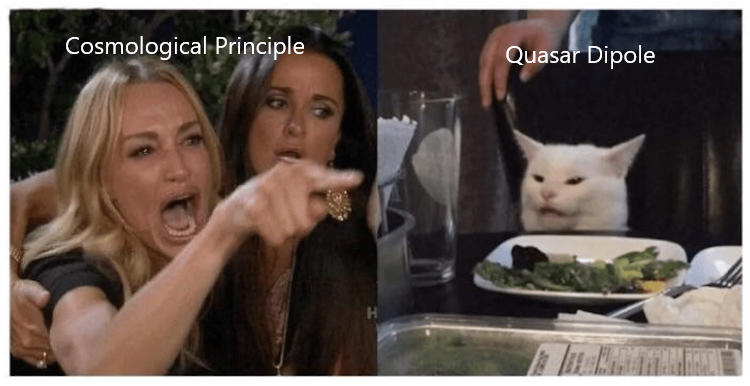
I can summarize the paper in the form of this well-worn meme:

My main reaction to the paper – apart from finding it interesting – is that if I were doing this I wouldn’t take the frequentist approach used by the authors as this doesn’t address the real question of whether the data prefer some alternative model over the standard cosmological model.

As was the case with a Nature piece I blogged about some time ago, this article focuses on the p-value, a frequentist concept that corresponds to the probability of obtaining a value at least as large as that obtained for a test statistic under a particular null hypothesis. To give an example, the null hypothesis might be that two variates are uncorrelated; the test statistic might be the sample correlation coefficient r obtained from a set of bivariate data. If the data were uncorrelated then r would have a known probability distribution, and if the value measured from the sample were such that its numerical value would be exceeded with a probability of 0.05 then the p-value (or significance level) is 0.05. This is usually called a ‘2σ’ result because for Gaussian statistics a variable has a probability of 95% of lying within 2σ of the mean value.

Anyway, whatever the null hypothesis happens to be, you can see that the way a frequentist would proceed would be to calculate what the distribution of measurements would be if it were true. If the actual measurement is deemed to be unlikely (say that it is so high that only 1% of measurements would turn out that large under the null hypothesis) then you reject the null, in this case with a “level of significance” of 1%. If you don’t reject it then you tacitly accept it unless and until another experiment does persuade you to shift your allegiance.

But the p-value merely specifies the probability that you would reject the null-hypothesis if it were correct. This is what you would call making a Type I error. It says nothing at all about the probability that the null hypothesis is actually a correct description of the data. To make that sort of statement you would need to specify an alternative distribution, calculate the distribution based on it, and hence determine the statistical power of the test, i.e. the probability that you would actually reject the null hypothesis when it is incorrect. To fail to reject the null hypothesis when it’s actually incorrect is to make a Type II error.

If all this stuff about p-values, significance, power and Type I and Type II errors seems a bit bizarre, I think that’s because it is. In fact I feel so strongly about this that if I had my way I’d ban p-values altogether…

This is not an objection to the value of the p-value chosen, and whether this is 0.005 rather than 0.05 or, , a 5σ standard (which translates to about 0.000001!  While it is true that this would throw out a lot of flaky ‘two-sigma’ results, it doesn’t alter the basic problem which is that the frequentist approach to hypothesis testing is intrinsically confusing compared to the logically clearer Bayesian approach. In particular, most of the time the p-value is an answer to a question which is quite different from that which a scientist would actually want to ask, which is what the data have to say about the probability of a specific hypothesis being true or sometimes whether the data imply one hypothesis more strongly than another. I’ve banged on about Bayesian methods quite enough on this blog so I won’t repeat the arguments here, except that such approaches focus on the probability of a hypothesis being right given the data, rather than on properties that the data might have given the hypothesis.

Not that it’s always easy to implement the (better) Bayesian approach. It’s especially difficult when the data are affected by complicated noise statistics and selection effects, and/or when it is difficult to formulate a hypothesis test rigorously because one does not have a clear alternative hypothesis in mind. That’s probably why many scientists prefer to accept the limitations of the frequentist approach than tackle the admittedly very challenging problems of going Bayesian.

But having indulged in that methodological rant, I certainly have an open mind about departures from isotropy on large scales. The correct scientific approach is now to reanalyze the data used in this paper to see if the result presented stands up, which it very well might.
How well-intentioned white male physicists maintain ignorance of inequity and justify inaction

Posted in Science Politics with tags , , , , , on October 10, 2022 by telescoper

I just noticed a paper on arXiv by Melissa Dancy and Apriel Hodari, which will probably annoy many people who deserve to be annoyed. Here is the abstract:

Background: We present an analysis of interviews with 27 self-identified progressive white-male physics faculty and graduate students discussing race and gender in physics. White men dominate most STEM fields and are particularly overrepresented in positions of status and influence (i.e. full professors, chairs, deans, etc.), positioning them as a potentially powerful demographic for enacting systemic reform. Despite their proclaimed outrage at and interest in addressing inequity, they frequently engage in patterns of belief, speech and (in)action that ultimately support the status quo of white male privilege in opposition to their intentions.


Results: The white male physicists we interviewed used numerous discourses which support racist and sexist norms and position them as powerless to disrupt their own privilege. We present and discuss three overarching themes, seen in our data, demonstrating how highly intelligent, well-intentioned people of privilege maintain their power and privilege despite their own intentions: 1) Denying inequity is physically near them, 2) Locating causes of inequity in large societal systems over which they have little influence and 3) Justifying inaction.


Conclusions: Despite being progressively minded, well-meaning, and highly intelligent, these men are frequently complicit in racism and sexism in physics. We end with recommendations for helping these men to engage the power they hold to better work with women and people of color in disrupting inequity in physics.

(I added the spacing and underlining.)

The paper does not mention the additional issue that not all white male professors are even well-intentioned…

The Scales of Things

Posted in Maynooth, The Universe and Stuff with tags , , , , , on October 9, 2022 by telescoper

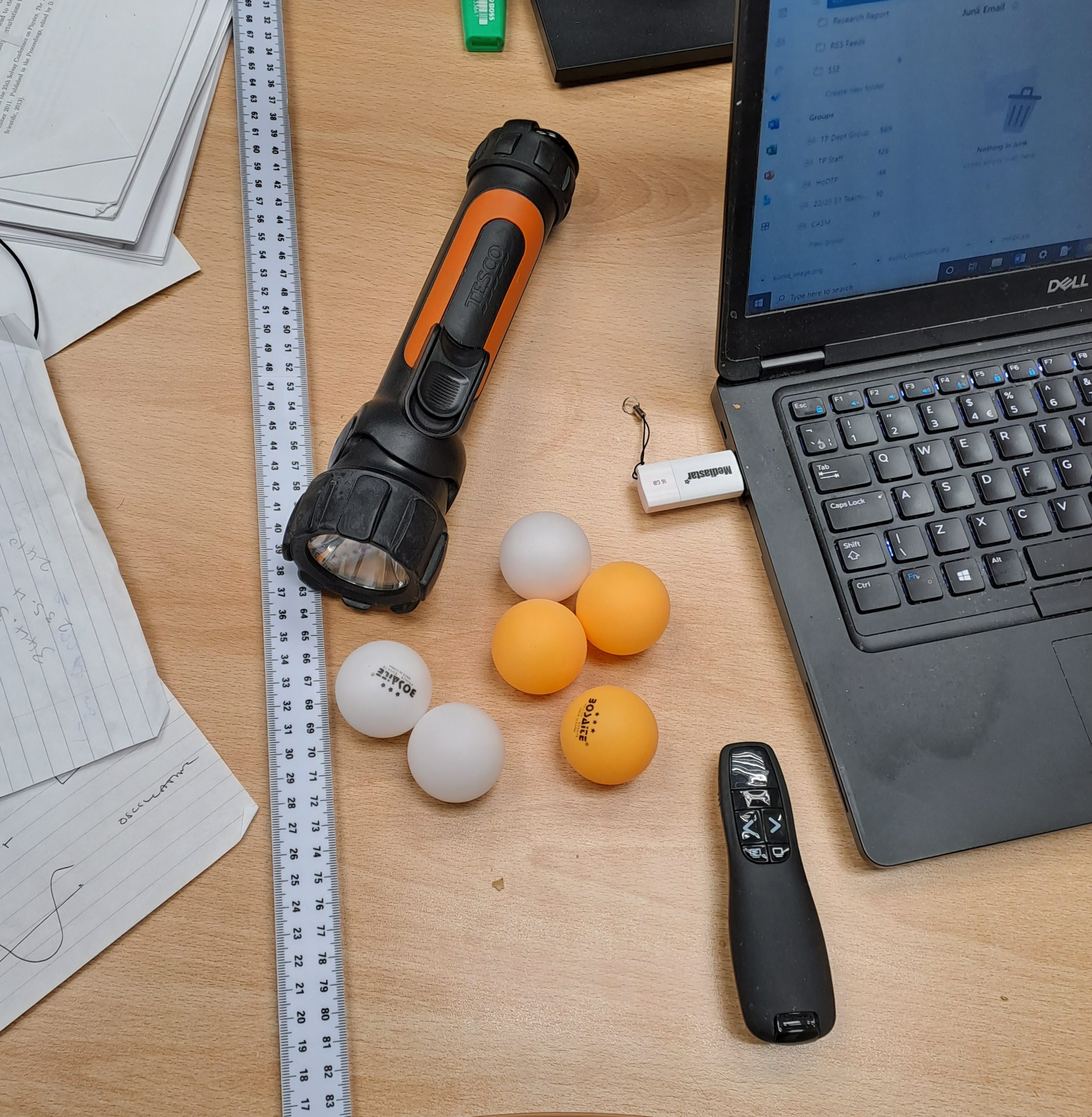
A few people have asked me why I needed such extravagant equipment (ping-pong balls, a torch and a metre-ruler) in my lecture on Thursday night.

I did only use one ping pong ball in the talk but I found the local budget shop Eurosaver only sells them in packs of twelve (for the princely sum of €3) so I now have plenty of spares. The metre ruler was borrowed from the Department of Experimental Physics (who have expertise using sophisticated measurement devices) and returned on Friday morning. The torch was procured from Tesco along with two batteries.

One of the things I wanted to do in my lecture was to explain some of the difficulties about measuring cosmological distances. I started by holding up a ping pong ball (radius 2cm) and asking if the ping pong ball were the Sun (radius 7 × 10⁸ m), on the same scale how far away would be the nearest other star (Proxima Centauri)?

To cut a long story short – and you can do the arithmetic yourself – the answer surprises most people who haven’t seen this demonstration before. It’s not the back of the lecture theatre, nor is it the town centre, nor the next town. It’s 1200 km away. That’s as far from Maynooth as, say, Geneva, or Copenhagen. The distances between stars is huge, even in the relatively dense part of a Galaxy, such as where the Sun is situated. The Universe is very big and very empty, even in the places that look crowded.

The torch and the metre rule were used to demonstrate two ways of possibly measuring astronomically large distances. I had a student stand up at the back of the theatre holding the metre rule. I explained that I could measure the distance to the student using geometry by measuring the angle subtended by the ruler if I knew its length (which I do). This is the principle behind the angular diameter distance; the metre rule is called a “standard rod”.

The torch is used to illustrate the luminosity distance. If I knew its power output I could measure the intensity of light using a lightmeter and infer the distance from that using the fact that it follows an inverse-square law. The torch is thus a “standard candle”.

Of course in cosmology we don’t have perfectly standard rods or candles but we can apply the principle of the angular diameter distance to features in the galaxy distribution or the cosmic microwave background or gravitational lenses and supernovae can provide us with accurate luminosity distances.

There are additional complications. Objects at large distances are receding with the Hubble expansion so light from them is redshifted, affecting their apparent luminosity. Einstein’s theory of general relativity allows for the possibility that light rays don’t travel in straight lines either (because space is curved), affecting the angular diameters. That means the two methods don’t necessarily give the same distance unless these factors are taken into account.