I’ve long been a fan of Art Hodes, a brilliant jazz and blues pianist, whose self-taught style reminds me quite a lot of Thelonious Monk, although Monk was a modernist and Hodes a traditionalist. It was only tonight however that I was reminded that he was actually born in Mykolaiv (Ukraine), in 1904, although he moved to America when he was only a few months old. He’s probably best remembered for some of the great early records of the Blue Note label, including some with Sidney Bechet, made in New York in the late 30s and early 40s, but he spent much of his later life playing and recording and living in and around Chicago. He died in 1993.
Anyway, here’s a record that wasn’t released until 1994, after his death, which is typical of his relaxed yet slightly quirky take on the blues and which I couldn’t resist sharing today because of the Ukrainian connection.
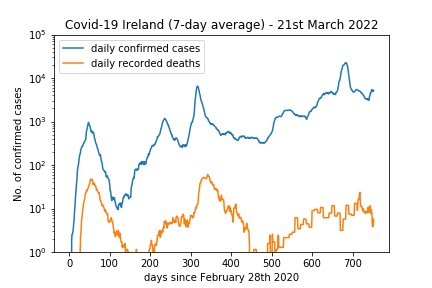
As well as returning to the Department for the first time after the Study Week break, I’ve also had the chance to update my Covid-19 data page with five days’ worth of numbers after the Bank Holiday and Weekend hiatus. A total of 63,954 positive tests (either antigen or PCR) were reported today.
The latest 7-day rolling average is around 5200 new PCR-confirmed cases per day, but that number is a considerable underestimate because much less PCR testing is being done compared with earlier in the pandemic. Over 10,000 positive antigen tests were logged today (21st March) but not included in the figure below:
The surge expected after the St Patrick’s Day festivities won’t have registered in this plot yet either. Anecdotal evidence is that lots of undergraduate students have been absent from lectures and tutorials on the first day back from the break citing Covid-19 as the reason, and some tutors are also off sick. My first lecture and first laboratory session aren’t until tomorrow though.
As of this morning, 1308 people are in hospital in Ireland with Covid-19, over double the number at the start of the month. Fortunately the number in ICU and the number of deaths remain reasonably low.
It seems there is no intention at Government level to reintroduce public health restrictions so we have to continue teaching as if nothing is wrong. The fact of the matter remains, however, that the much-vaunted “return to campus” hasn’t really been achieved this Semester, with many students staying away from classes either through choice or necessity.
As Head of a small Department that is already short-staffed I am worried about what I’m supposed to do if we suffer absences among those who are teaching. We’ve got six weeks until the end of the Semester. I just hope we get through it without a crisis caused by the high case numbers.
Just a quick note to say that the Vernal Equinox, or Spring Equinox, (in the Northern hemisphere) takes place this afternoon at 15.33 UTC (which is 3.33 pm local Irish Time). Many people regard this as the first day of spring. The weather in Maynooth is certainly spring-like. Of course in the Southern hemisphere this is the Autumnal Equinox.
The date of the Vernal Equinox is usually given as 21st March, but in fact it has only been on 21st March twice this century so far (2003 and 2007); it was on 20th March in 2008, has been on 20th March every spring from then until now, and will be until 2044 (when it will be on March 19th).
People sometimes ask me how one can define the `equinox’ so precisely when surely it just refers to a day on which day and night are of equal length, implying that it’s a day not a specific time?
The answer is that the equinox is defined by a specific event, the event in question being when the plane defined by Earth’s equator passes through the centre of the Sun’s disk (or, if you prefer, when the centre of the Sun passes through the plane defined by Earth’s equator). Day and night are not necessarily exactly equal on the equinox, but they’re the closest they get. From now until the Autumnal Equinox days in the Northern hemisphere will be longer than nights, and they’ll get longer until the Summer Solstice before beginning to shorten again.
Loughcrew (County Meath), near Newgrange, an ancient burial site and a traditional place to observe the sunrise at the Equinox
Here in Ireland we celebrated Saint Patrick’s day on March 17th, the reputed date of his death in 461 AD. Although he may have been born in Wales, nobody really knows for sure precisely where St Patrick was born, though, so it would be surprising if the when were any better known.
In any case, it wasn’t until the 17th Century that Saint Patrick’s feast day was placed on the universal liturgical calendar in the Catholic Church. In the thousand years that passed any memory of the actual date was probably lost, so the Equinox was perhaps rebranded for the purpose.
The early Christian church in Ireland incorporated many pre-Christian traditions that survived until roughly the 12th century, including the ancient festival of Ēostre (or Ostara), the goddess of spring associated with the spring equinox after whom Easter is named. During this festival, eggs were used a symbol of rebirth and the beginning of new life and a hare or rabbit was the symbol of the goddess and fertility. In turn the Celtic people of Ireland probably adapted their own beliefs to absorb much older influences dating back to the stone age. St Patrick’s Day and Easter therefore probably both have their roots in prehistoric traditions around the Spring Equinox, although the direct connection has long been lost.
One of the things I definitely don’t miss about working in the UK university system is the dreaded Researchfish. If you’ve never heard of this bit of software, it’s intended to collect data relating to the outputs of research grants funded by the various Research Councils. That’s not an unreasonable thing to want to do, of course, but the interface is – or at least was when I last used it several years ago – extremely clunky and user-unfriendly. That meant that once a year along with other academics with research grants (in my case STFC) I had to waste hours uploading bibliometric and other data by hand. A sensible system would have harvested this automatically as it is mostly available online at various locations or allowed users simply to upload their own publication list as a file; most of us keep an up-to-date list of publications for various reasons (including vanity!) anyway. Institutions also keep track of all this stuff independently. All this duplication seems utterly pointless.
I always wondered what happened to the information I uploaded every year, which seemed to disappear without trace into the bowels of RCUK. I assume it was used for something, but mere researchers were never told to what purpose.
When I left the UK in 2018 to work full-time in Ireland, I took great pleasure in ignoring the multiple emails demanding that I do yet another Researchfish upload. The automated reminders turned into individual emails threatening that I would never again be eligible for funding if I didn’t do it, to which I eventually replied that I wouldn’t be applying for UK research grants anymore anyway so there. Eventually the emails stopped.
Now, four years later, it seems the software is no better. That’s not surprising as since everyone has to use it on threat of excommunication there is no incentive to improve it.
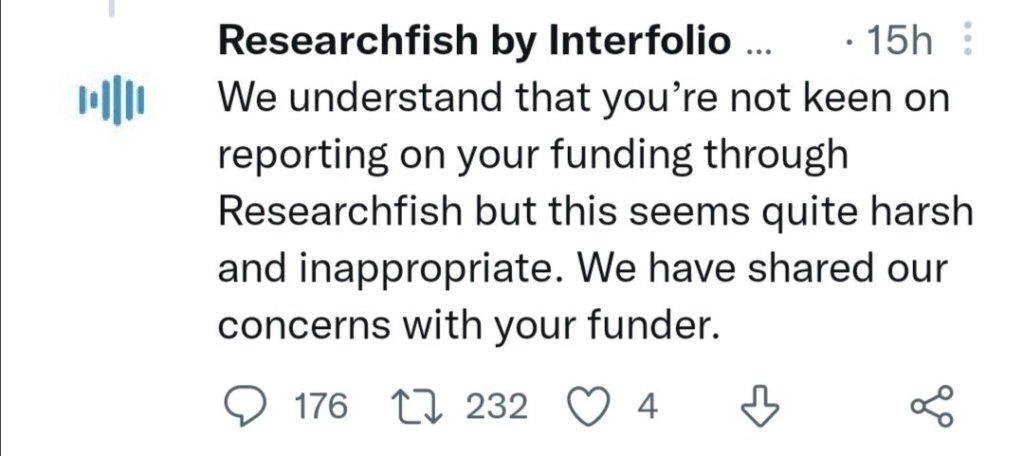
Yesterday I noticed on Twitter – not for the first time – an academic complaining about Researchfish. It was however the first time I saw this sinister reply from the company that runs the system:
I’m out of the UK system for good, so I can say what I think. To put it mildly I don’t think this response is at all appropriate. Researchfish would be better off trying to engage with the research community to improve its system, especially the awful user interface, than threatening the people who criticize it.
(And there are other software providers, you know…)
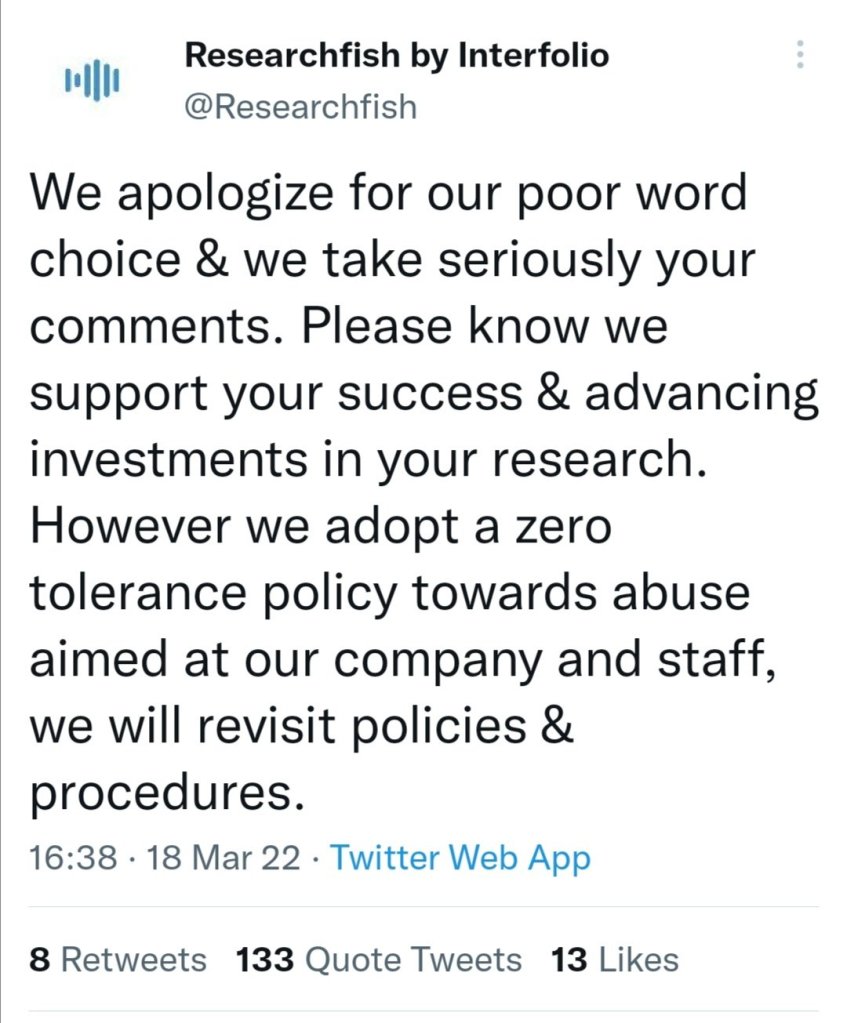
Update; unbelievably, with this crass “apology” they’ve made matters even worse!
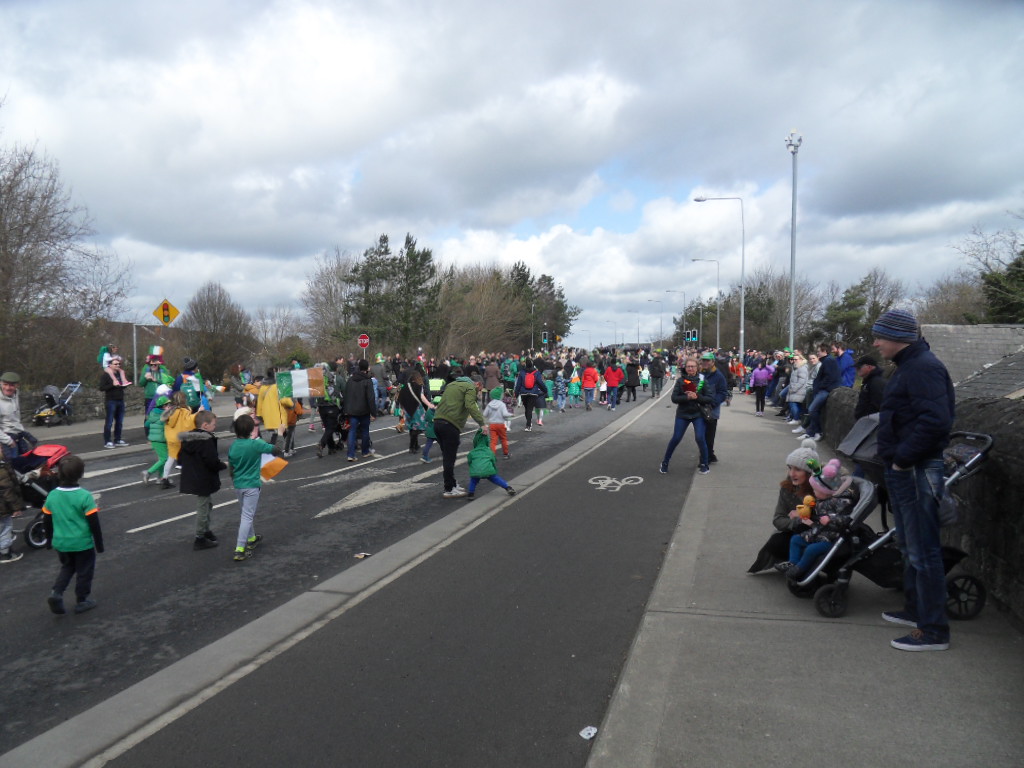
Today being 17th March it is St Patrick’s Day, and there not having been a St Patrick’s Day Parade for the last two years in Maynooth, I decided to make the most of my morning off and go watch the festivities. Here are some snaps I took on Straffan Road as the Parade made its way into town. As you can see it was a bit overcast, and it was also a bit breezy, but it wasn’t cold and everyone seemed to be enjoying themselves!
The front of the parade
Irish Dancing SchoolIt must be hard to walk in those shoesMaynooth GAA ClubView towards MaynoothTractors!Tractor on Tractor ActionNot sure what this isBridge?More Dancing
Professor Gene Parker, May 18, 2017. (Photo by Jean Lachat)
I was very sad to hear via the NASA website of the death, yesterday at the age of 94, of Professor Eugene N. Parker (known to all as “Gene”). He was best known for his work on solar magnetism and the solar wind, but he made important contributions across a wide range of astrophysics; he wrote an excellent book entitledCosmical Magnetic Fields: Their Origin and Activity which I bought many years ago. Most recently NASA’s Parker Solar Probe was named in his honour.
I only met Gene Parker once, many years ago, and was a bit in awe of him because of his intellectual reputation but he came across as a very likeable and friendly man.
We have lost a giant in the field of astrophysics who leaves a huge legacy and will be greatly missed. I send my condolences to his family, friends and colleagues at the University of Chicago where he worked since 1955.
Yesterday afternoon it was my turn to present a paper at our bi-weekly cosmology journal club. Because this is Study Week – that’s my excuse anyway – I forgot about it until I was reminded in late morning. I decided on a paper to present but it was only when I started that I was reminded that I had done that paper before, last year.
I had no recollection at all of having done that paper before. I didn’t have time to do another one, so I went through the paper again. Perhaps I’ll end up doing that paper once a year, like Groundhog Day! The last two years of pandemic have played havoc with my memory, so ‘ll put this lapse down to that. I’ve had to do so many things that maybe my old brain can’t cope with it all.
Maybe I’m just getting too old. I’ll be 60 next summer.
On the other hand, this morning I was chatting some colleagues before forming the academic procession for a conferring ceremony. One of the people there was Italian and he complained that the robe hire company couldn’t find appropriate academic dress for the University of Padova, where he graduated, so he had just been given a random set of robes. I visited Padova many times in the past, until my colleague and co-author Francesco Lucchin passed away about 20 years ago.
While we waited for the procession to start we chatted about places in the City. Amazingly I could remember the names and addresses of various restaurants and other establishments, the precise location of the Physics Department Galileo Galilei, and all kinds of other details about the place that are still intact in my head.
Moreover, when we were inside the Aula Maxima and the conferring ceremony began (parts of which are in Latin) I found myself sitting there recalling the first lines of Book II of Virgil’s Aeneid, which I did for O-level many moons ago:
Conticuere omnes intentique ora tenebant inde toro pater Aeneas sic orsus ab alto: Infandum, regina, iubes renovare dolorem, Troianas ut opes et lamentabile regnum eruerint Danai, quaeque ipse miserrima vidi et quorum pars magna fui.
I wish we could have better control over what we remember and what we forget. If the problem is that there’s a finite amount of space in one’s head, it would be nice to have a spring clean every now and again to create a bit more room, jettisoning some old junk to let new things in. Unfortunately I don’t think it works like that.
Anyway, I almost forgot until all this Latin reminded me that today is the Idus Martiae (“the Ides of March”) so here is the traditional extract from the First Folio Edition of Carry On Cleo, starring the sublime Kenneth Williams as Julius Caesar delivering one of the funniest lines in the whole Carry On series. The joke may be nearly as old as me, but it’s still a cracker…
Posted in Uncategorized on March 14, 2022 by telescoper
Against my expectations I’ve made it into the final round of voting for Beard of Ireland 2022! The competition is stiff and I’m currently in fourth place (out of four). Please consider giving me a vote! You can do so via the post below!
BEARD OF IRELAND 2022 POLL FINAL ‘BEARD OFF’ ROUND OPEN
The Beard Liberation Front, the informal network of beard wearers, has said that competition for the final of the Irish Beard of the Year 2022 is officially open
Academic Peter Coles and rugby player Jamison Gibson-Park won the first Trim Off round with Businessman Adohan Connolly and Northern Ireland Health Minister Robin Swann winning the second and completing the line-up for the Beard Off final
The 2017 winner was politician Colum Eastwood who bearded broadcaster William Crawley for the annual Award.
In 2018 the DUP’s Lee Reynolds shaved writer Dominic O’Reilly for the honour with Colum Eastwood in a steady third place.
In 2019 Lee Reynolds retained the title
The 2020 winner was Maynooth academic Peter Coles
In 2021 Aodhan Connolly shaved opponents to win the coveted title
The views presented here are personal and not necessarily those of my employer (or anyone else for that matter).
Feel free to comment on any of the posts on this blog but comments may be moderated; anonymous comments and any considered by me to be vexatious and/or abusive and/or defamatory will not be accepted. I do not necessarily endorse, support, sanction, encourage, verify or agree with the opinions or statements of any information or other content in the comments on this site and do not in any way guarantee their accuracy or reliability.










 In the Dark