The Liffey Swim, by Jack B Yeats

Posted in Art with tags , , on August 29, 2021 by telescoper
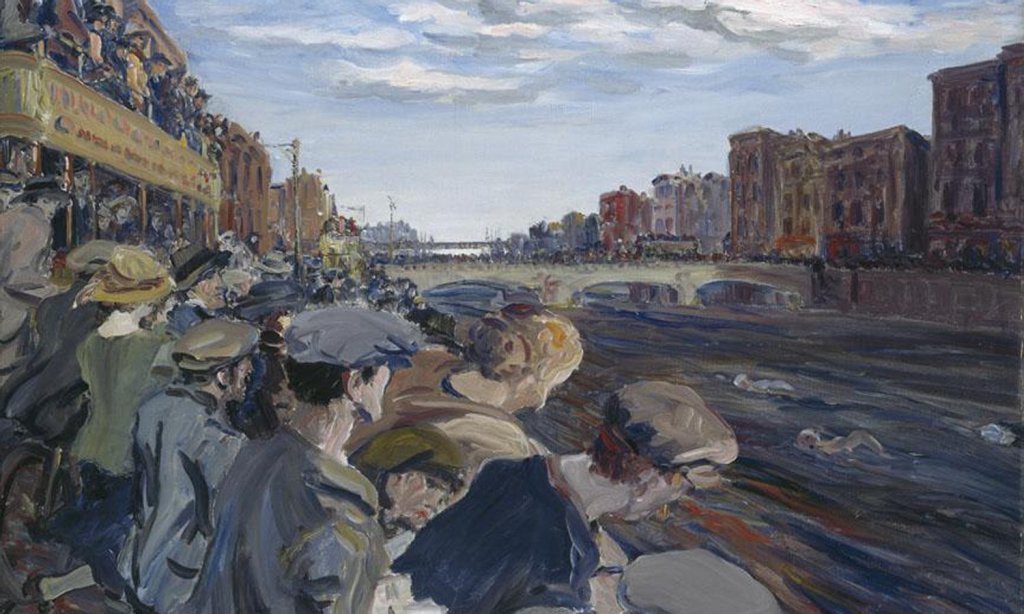
The Liffey Swim, by Jack B. Yeats (1923, 61cm x 91cm, oil on canvas)

I posted the above painting because I was reminded that today is the 150th anniversary of the birth of Jack Butler Yeats, brother of the poet William Butler Yeats. That in turn reminded me that a major exhibition of art by Jack B. Yeats opens at the National Gallery of Ireland on Saturday 4th September. I hope to squeeze in a visit before teaching starts.

Although it was a style he only started to experiment with around 1920, The Liffey Swim is clearly an Expressionist work – the unusual colour palette and texture of the paint are characteristics of that movement- but it also serves as an interesting bit of social history. The Liffey Swim is a regular event in Dublin (or was, in pre-Covid days) but only began in 1920 so it was fairly new when Yeats painted it. He captures the excited atmosphere surrounding the event by placing the viewer in the middle of a huge crowd struggling to get a good view, with the swimmers only shown in cursory detail. You see far more of the spectators than you do of the race!

There’s another interesting thing about this painting. It won a Silver Medal for Ireland in the 1924 Olympic Games in Paris. In fact it was Ireland’s first ever Olympic Medal, coming just a couple of years after independence. It may surprise you to learn that art competitions were a part of the Olympic Games from 1912 until 1948, as were competitions in music and literature. The 1924 Gold Medal for painting was won by an artist from Luxembourg called Jean Jacoby who specialised in sporting themes.

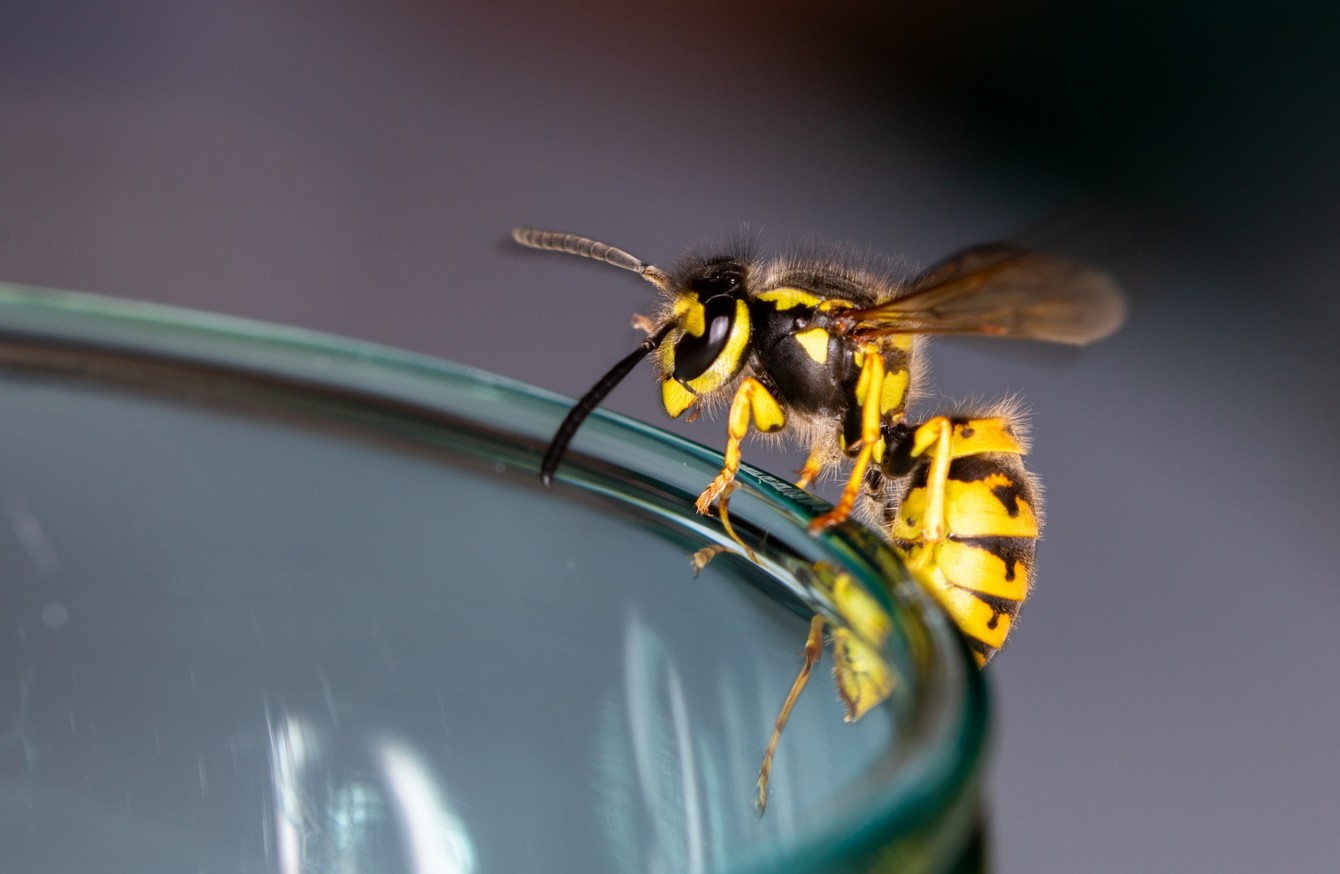
The Wasp, by John Kendall (aka Dum-Dum)

Posted in Poetry on August 29, 2021 by telescoper

Of those uncertain creatures
Who take a simple joy
In swelling up one’s features
On purpose to annoy,
Things void of natural sweetness,
Aggressive and inhosp.
(Pardon the incompleteness)
You are the first, O wasp.

There is no place we visit
In England’s pleasant land
(It isn’t your place, is it?)
But you must take a hand;
You set the nerves a-jangle,
You turn the tan to chalk
Of anglers when they angle,
Of walkers when they walk.

In no uncertain manner
You bid the bather flee;
You foil the caravanner
Who merely wants his tea;
You raid the earnest hopper,
You break upon our sports,
And are, I’m told, improper
To river girls in shorts.

We slap at you and swat you;
We fell you as we may
(The rapture when we’ve got you
Is more than words can say);
One may see great deeds daily
When men unused to strife
Brave you, albeit palely,
For screaming child or wife.

And we have learnt to fashion
A lure that cannot fail,
Born of a lasting passion
That you confess for ale;
An artful jar that cozens
You in and, when you’re tight,
Drowns you in drink by dozens,
A most immoral sight.

But when the day is sinking
And you retire to rest
That, to my private thinking,
Is where man comes out best;
Armed with his apparatus
He tracks you to the comb
Whence you come forth to bait us;
Then, when the last wasp’s home,

Bring forth, O man, your funnel;
With oil and poison come;
Take heed lest haply one’ll
Pass down a warning hum;
Insert with care the former;
Pour down the latter thick;
That should have made things warmer;
That will have done the trick.

Thus with discreet defiance
We tackle you, and yet,
For all the arts of science,
You don’t seem much upset;
Alert and undiminished
You still appear to prosp.;
I leave the word unfinished
To rhyme with you, O wasp.

by John Kaye Kendall (aka Dum-Dum)

The Old Man of Killeaney

Posted in History, Maynooth with tags , , , on August 28, 2021 by telescoper

I stumbled across this remarkable little clip completely by accident and thought I would share it here. It is part of an interview, broadcast in 1965, with a retired farmer by the name of Michael Fitzpatrick who was 107 when the interview was recorded. Mr Fitzpatrick was born in County Clare but moved to Killeaney, a townland just a couple of miles north of Maynooth, in 1940.

He would have been in his eighties in 1940 and moved as a result of a Land Commission scheme. I guess he moved with his family who would have run the farm and looked after him in his retirement.

He talks about the infamous Bodyke Evictions, which took place in the late 1880s, and which he witnessed personally. It’s amazing to imagine what those old eyes had seen in his lifetime, not only the cruelty and brutality of the system of land ownership in Ireland through the latter half of the 19th Century, the War of Independence and the Civil War of the 1920s, but also the dramatic changes in farming he mentions. Michael Fitzpatrick passed away a couple of years after this interview, at the age of 109.

I posted this in the local history Facebook page for Maynooth and it seems there are people who remember Michael Fitzpatrick and that his grandson, also named Michael, passed away recently after a long life of his own.

I am a successful.

Posted in Biographical with tags , on August 27, 2021 by telescoper

The other day a friend of mine pointed out the existence of a website called CelebsAgeWiki.Com which has a page about me. I’m not sure why they considered me worthy of inclusion, although I suspect they just use some sort of bot to trawl through pages on Wikipedia (and I happen to have one of those, although I know not who created it nor who keeps updating it). If that is the case then whoever wrote the software is obviously incompetent.

Anyway you can see from the above grab I took on my phone that my page is full of information about me. For one thing they know that I am a successful. For another they know that I am from. They also know that my “net worth” grew considerably from 2020 to 2021, which is news to me. I won’t comment on their estimate of my “net worth” except to say that I was briefly a millionaire some years ago, but then Italy abolished the Lira.

At least they got my age right.

P.S. I am slightly alarmed that my salary for last year is “under review”. I hope my employer doesn’t expect me to pay it back….

A Year at Home

Posted in Biographical, Covid-19, Maynooth with tags , , on August 26, 2021 by telescoper

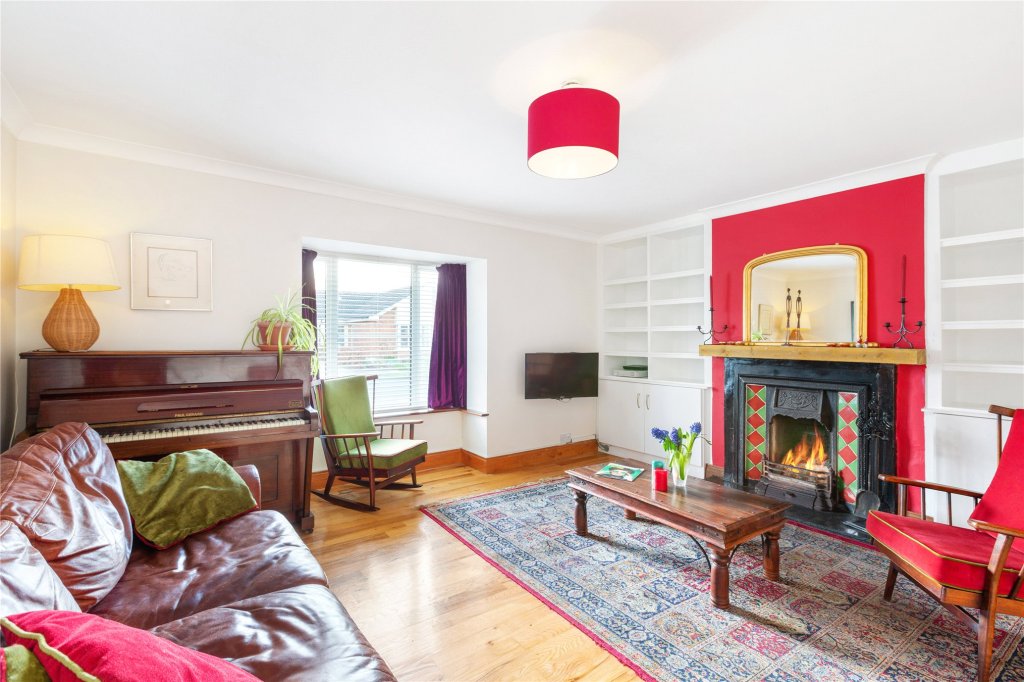
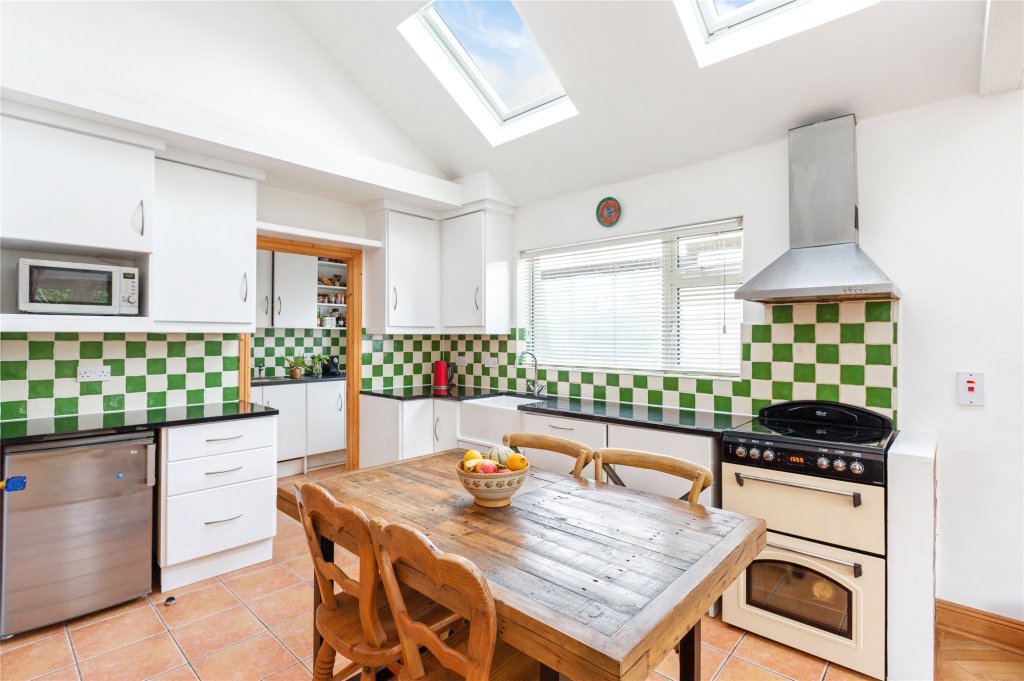
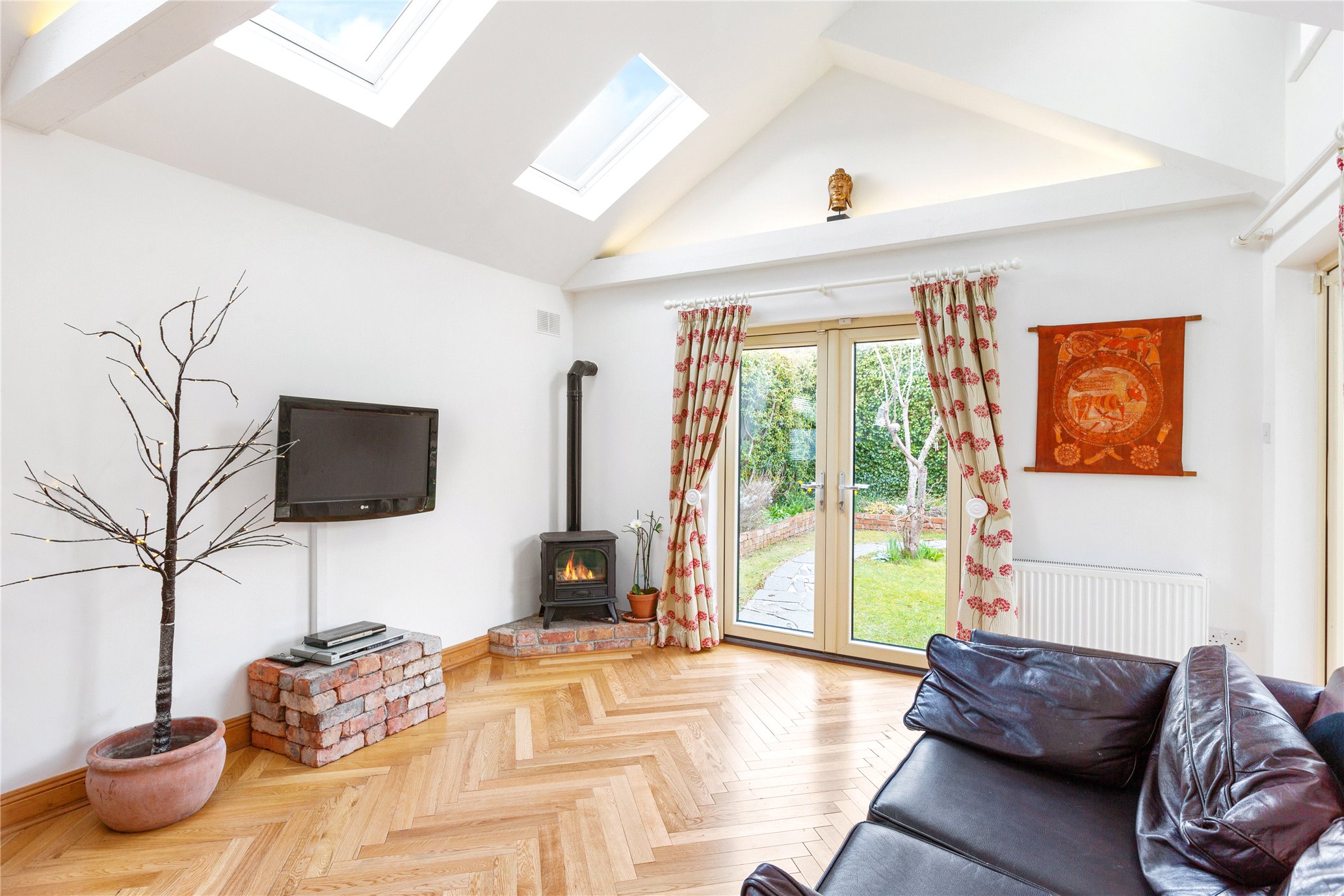
I was reminded this morning that it was a year ago yesterday that I received the keys to my house in Maynooth. I didn’t move in straight away as the house was empty and I had paid the rent on the flat I was living in until the end of August, so I moved my things gradually over the course of a week or so. Looking through all the paperwork this morning I found the pictures that the Estate Agent had used to advertise the property. Here are a few of them:

You’ll see that the bookshelves in the sitting room were empty at the time. They mostly still are. I didn’t think this time last year that I’d still be waiting a year later for my belongings to arrive from Cardiff, but at least they are in transit now. Delivery is pencilled in for next week, as a matter of fact; doing the removal on the cheap as a return load meant waiting a few weeks. I am looking forward to filling the shelves with my books (20-odd boxes of them) and putting up my own artwork. I’ve had enough of bare walls.

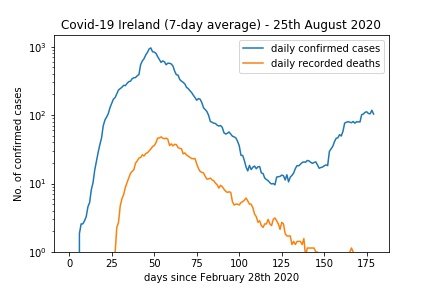
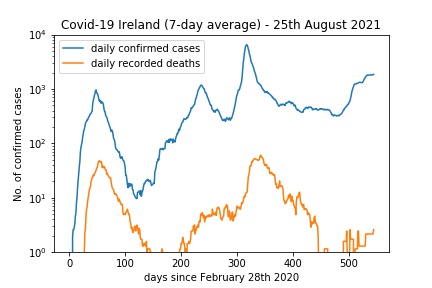
This morning our weekly Faculty Executive meetings resumed, the main topic of discussion – as it was this time last year – being the plans to return to on-campus teaching next month. I thought it would be interesting to show a comparison between the Covid-19 figures in Ireland on August 25th 2020 and August 25th 2021:

You will see that the daily case numbers in Ireland are currently about a factor 20 higher than they were this time last year: yesterday we had 2051 new Covid-19 cases in Ireland; a year ago there were 92. That is significant because the effect of vaccines in suppressing serious illness is at most 95%. Since the number of cases is up by a factor of 20, in some sense the risk level if everyone in the population were vaccinated would be about the same now as it was this time last year. And of course not everyone actually is vaccinated, and not everyone will be by the time teaching starts again on 20th September.

Last year the case numbers increased substantially between August and September meaning that we went back into lockdown in October. We don’t know whether or not case numbers will increase again this year, of course, but from the point of view of resuming teaching we’re really in no better shape now than we were at this time last year. Our optimism then was misplaced and that may well be true now too. This is why so many people in the University system are nervous about the edicts we have been given to return to full lecture theatres with no social distancing, no mandatory masks, and no vaccination certificates. This seems like asking for trouble.

On a personal note, I am pleased to report that the mild symptoms I mentioned on Monday have completely disappeared and, to no surprise at all, my PCR test came back negative. It may or may not be relevant that the weather has improved greatly over the last two or three days. I have now come to the conclusion that what I had was some form of seasonal allergy, possibly connected with crop harvesting in the area spreading pollen or fungal spores. The latter are more prevalent in damp or humid weather, which might be the reason for reduction in effect now. Or it could just be that a nearby farmer has stopped doing whatever he was doing. I don’t know enough about field theory to be certain.

Anyway, all of this means I can now stop self-isolating and start returning to campus again. To be honest, though, it was rather nice self-isolating at home as I spent most of the time working in the garden…

Preprints in Applications – a plea to the ARC!

Posted in Open Access, Science Politics with tags , on August 25, 2021 by telescoper

I was astonished to discover (via this article) that the Australian Research Council has placed a ban on preprints veing cited in funding applications, and that many applicants have had applications rejected solely on the basis that they referred to preprints in them.

It beggars belief that anyone who actually understands modern scientific practice could come up with such a stupid idea. I can only surmise that the people who run the Australian Research Council are so out of touch with actual research that they don’t understand not only the silliness of this rule but also the damage being caused by it.

I have been on grants panels in the UK many times, and have reviewed many applications for other agencies too, and I can’t think of any that didn’t refer to preprints. It can take a year or more for a paper to appear in a traditional journal and in many fields research moves so quickly that citing results ahead of (formal) publication is the only way to present a true picture of ongoing research. Any author who doesn’t cite other authors’ preprints is either out of touch with ongoing research or presented an unbalanced view of the literature. I would further argue that, at least in astrophysics, any applicant who doesn’t have a clutch of preprints on the topic of the application can’t be sufficiently active to justify grant funding.

Results made available in preprints may not have been refereed but that is no reason to ban them altogether. Any experienced reviewer will know how to treat them. And don’t forget there are plenty of wrong results in the refereed literature too. I’d prefer a policy that banned applicants whose papers were not published in an Open Access form…

There is a petition here urging the Australian Research Council to revise its preprint policies. I urge you to sign it (as I have done). Be quick, though, as the deadline is 31st August 2021.

And in case you think this is a matter for Australians only, I disagree. Science is collaborative and many of the collaborations span many different countries. It is in all our interests to ensure that our Australian cousins don’t get held back by inane policies like this.

UPDATE: Nature has now covered this story.

R.I.P. Charlie Watts (1941-2021)

Posted in Jazz with tags , , on August 24, 2021 by telescoper

I’ve just seen the sad news of the death at the age of 80 of the Rolling Stones’ drummer Charlie Watts. Tributes are justifiably pouring in, mainly concentrating on his career as a rock drummer. I’ll just say that while I’ve never seen the Rolling Stones play live, I did go and see Charlie Watts play at Ronnie Scott’s club in London with a jazz group. I thought they were pretty good actually, with Watts on drums not at all trying to hog the show but instead playing very unobtrusively thought still clearly enjoying himself in the more intimate surroundings of a Jazz club rather than a huge rock venue.

In fact Charlie Watts began as a jazz drummer and although he earned his fame and made a fortune after switching to rock and roll, he always kept an interest in jazz. Indeed he recorded an album of performances of Charlie Parker tunes from which I picked the track below. My Dad – himself a Jazz drummer who was never effusive in his praise of other drummers – rated Charlie Watts as technically sound rather than flashy which was the opposite to most rock drummers. At any rate he passed the test of holding the sticks “properly” (i.e. using the trad grip).

Anyway, by way of my own little tribute to an excellent musician and somewhat eccentric gentleman, here is Charlie Watts with his Quintet playing the Charlie Parker composition Bluebird.

Rest in Peace, Charlie Watts (1941-2021).

Self-isolating…

Posted in Biographical, Education, Maynooth with tags , , on August 23, 2021 by telescoper

This time last week I started trying to readjust to working from my office in Maynooth University but I’ve already had to put that on pause (hopefully temporarily).

Over the last several days I’ve been experiencing bouts of sneezing, a frequent runny nose, some sinus pressyre, and uncomfortably dry eyes. These seem to me symptoms of hay-fever (though it is a bit late in the year for that) or some other allergy, rather than Covid-19, but based on what I’ve read about the so-called Delta variant I phoned my GP.

I don’t have the more usual symptoms of Covid-19 (neither cough nor sore throat nor fever) – in fact I don’t really fall unwell at all apart from the sporadic sneezing – so my GP said he thought it was very unlikely to be the Coronavirus. I’m also fully vaccinated, though that doesn’t mean I can be infected. Nevertheless he recommended I self-isolate as a precaution for a few days to see what, if anything, develops. So that is what I am doing.

I’m supposed to be recording video material for orientation week, which I can do just as easily at home. To counter the sneezing I’ll just record everything in small chunks.

As for the symptoms, my money is on some kind of allergy, but I wonder what? I’ve never experienced hay-fever in late August before!

Anyway, I’m glad this has happened before the start of teaching: as we’re supposed to do lectures and tutorials in person from next month, a person who is self-isolating won’t be able to teach and we have so few staff it will be difficult to find cover…

Update: the likeliest explanation seems to be a fungal spore allergy, as the release of fungal spores is triggered by crop harvesting. Maynooth is in an agricultural area and August is harvest time. Allergens of this sort also thrive in humid weather which we certainly have had recently.

The 2021 All-Ireland Senior Hurling Final

Posted in GAA with tags , , , , on August 22, 2021 by telescoper

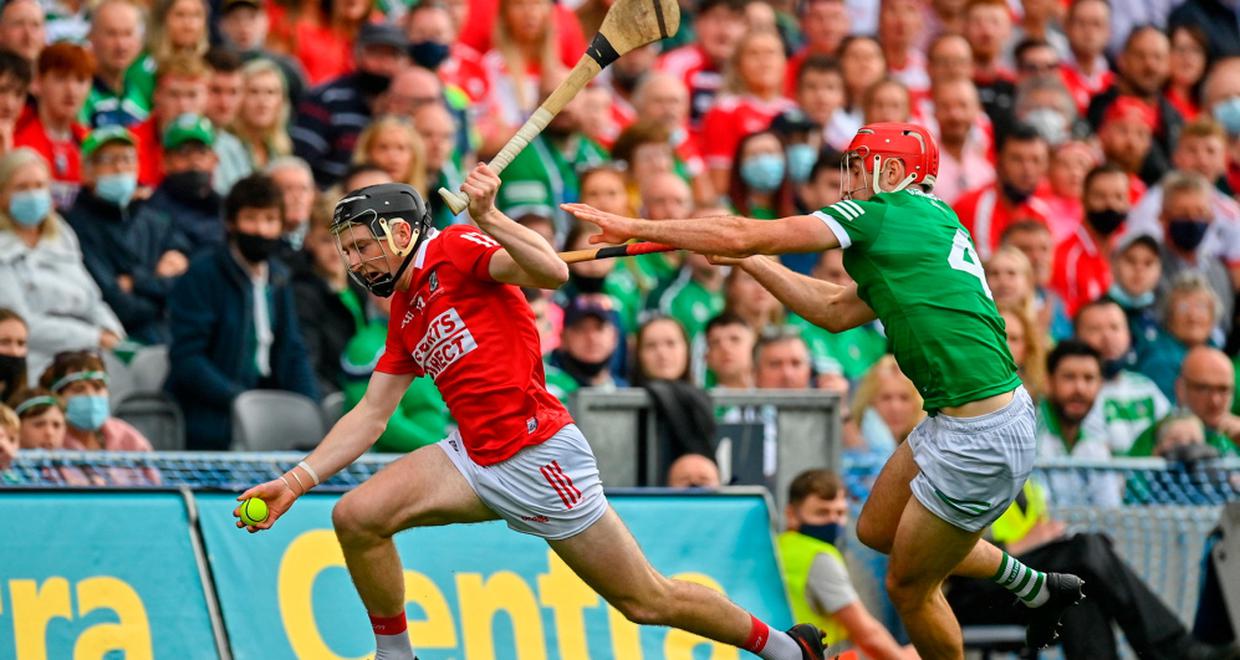
This afternoon’s All-Ireland Senior Hurling Championship Final at Croke Park saw reigning champions Limerick beat Cork by 3-32 to 1-22 at Croke Park. The margin of victory (16 points) reflected Limerick’s dominance; their total of 41 points is one of the largest ever in a final. The Bookies were right in having Limerick odds-on favourites (1-5) before the match and they thoroughly deserved their victory. Congratulations to them!

As a neutral I was hoping for a less one-sided match, and Cork actually started off quite well, responding quickly to Limerick’s opening goal with an impressive goal of their own. The game started at a frantic pace and for about ten minutes it looked a pretty even contest, but once Limerick got into their stride they imposed themselves on all areas of the game. The Limerick team not only looked physically bigger than their opponents but also put in a phenomenal work rate, to such an extent that it frequently seemed they had more players on the pitch than Cork. I know it’s a cliché, but at times it really did look like men against boys.

When not in possession, Limerick harried their opponents into making mistakes and when in possession they ruthlessly exploited errors in the Cork defence. In particular they exerted their trademark dominance of the middle third of the pitch, scoring points from long range like a boxer with a longer reach than his opponent and making it very difficult for Cork to play through them. By half time, when the score was 1-11 to 3-18, Limerick were already 13 points ahead and the game was effectively over as a contest. It was more like an exhibition match or some sort of masterclass.

Credit to the young Cork side for the way they stuck to their task despite being comprehensively outplayed. There’s no disgrace in losing to a team as good as the one they played today. In the end, though, the Championship title goes once again to Limerick, who were magnificent.

Incidentally, Croke Park was about half-full for this showcase event with about 40,000 spectators in the ground. Hopefully next year it will be possible to fill it to capacity. I watched it on TV but it makes a huge difference to the atmosphere if there’s a big crowd watching it in the stadium.

Pronouns for Yous

Posted in Biographical, GAA, Television with tags , , , , , on August 21, 2021 by telescoper

Last night I was watching a very interesting television programme on the Irish language channel TG4. It was about the origins and history of ice hockey, which began as ice hurling as a sport played by Irish immigrants in Canada. The word “puck” comes from the Irish word poc which means to stroke or hit; in hurling the “puck out” is a free hit from the goal area by the goalkeeper much like a goal kick in soccer. The programme was called Poc na nGael, which roughly translates as “The Puck of the Irish”. I think it was repeated last night because this Sunday sees the biggest event of the year in the hurling calendar: the Final of the All-Ireland Senior Hurling Championship at Croke Park, which this year is between Limerick and Cork.

While watching that programme I got thinking about Irish language lessons and whether I will have time to continue them next academic year and then onto wider issues about differences between Irish and English. One thing that struck me was the second person pronoun, so I thought I’d do the following rambling post about it.

In English the personal pronouns I (first person) and he/she (third person) are unusual in that they change depending on their grammatical role. This isn’t unusual in other languages especially Latin where it is the rule rather than the exception. In English we use “I” in the nominative case (“I hit the dog”) but “me” in the accusative case (“the dog bit me”) or when following a preposition (“the dog gave the stick to me”). The same goes with he/him and she/her.

In the example “the dog gave the stick to me”, “me” is really in the dative case but there is no distinct word for that in English; we can only really distinguish between the nominative (subject) and “other” (non-subject) cases. The words “my”, “our”, etc are often called pronouns but they are really of adjectival form, e.g. “this is my cat” and are more correctly called determiners. There are possessive pronouns (“mine”, “ours”, etc) which are in some sense genitive cases of the personal pronouns (meaning “of me”, “of us”, etc) but I digress.

Notice also that the first person and third person plural also have distinct plural forms (we/us and they/them).

The funny one is the second person “you”, which has neither an accusative nor prepositional form nor a distinct plural: “You hit the dog”, “the dog bit you” and “the dog gave the stick to you” all employ the same word although each is in a different grammatical case.

This is by no means the only oddity in modern English, and I have no idea why it developed. In older forms of English there were distinct forms: “thou/thee” in the singular and “ye/you” in the plural. These forms persist in dialects such as Yorkshire.

For some reason, though, as English evolved these four distinct forms merged into one, i.e. “you”. One can usually tell from the context whether “you” is singular or plural or can emphasize it by adding extra words (e.g. in the American “y’all” which is a contraction of “you all”) but there is no single word in standard English that expresses the difference between singular and plural or between subject and non-subject.

Incidentally, in Irish the second person singular is in the nominative case and thú in the non-nominative cases; the second person plural is sibh which is like “ye” in that it has no distinct non-nominative form.

I was brought up on Tyneside and it is a feature of the Geordie dialect that people use the word “yous” to denote the second person plural. It’s definitely a working-class slang, and was very much frowned upon at school, but it was very commonplace when and where I was grew up. I thought it was only in Newcastle that people used this form but when I worked at Sussex a while ago my boss, originally from Glasgow, also on occasion used “yous”. When I asked here about it she explained that it was common usage in Glasgow but didn’t think it was widespread in other parts of Scotland. Geordie and Glaswegian are thus two regional dialects I know that use this form but there may be others. I’d be interested to know so please feel free to comment via the box below!

Anyway the reason for going off on this tangent was that I’d already noticed that a few Irish people use “ye” in Hiberno-English for the second person plural, it was only yesterday that I noticed some using “yous”. I wonder how widespread that is in Ireland and is it regional or more of a class divide?

Would any of yous like to comment?