Old Blue Eyes

Posted in History, Television with tags , , , , , , on April 19, 2021 by telescoper

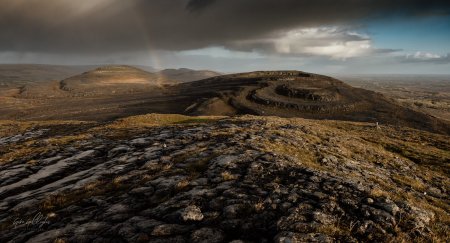
Yesterday I watched the concluding episode of a fascinating two-part documentary series called The Burren: Heart of Stone, an extraordinary region of glaciated limestone klarst in County Clare. The landscape has a distinctly other-worldly look to it, yet humans have lived and farmed on it for at least 8,000 years.

Episode 1 was largely about the geology and ecology of the Burren which explained how the motion of glaciers across the area scraped away upper layers and revealed the limestone deposits formed by the bones and shells of ancient marine creatures who lived there tens of millions of years ago. The present-day Burren is windswept and rainy but is home to a rich ecosystem of plants, insects, birds and animals. Despite the heavy rainfall there are no rivers to be seen, but water flows underground through a complex network of tunnels and caves.

The first programme was interesting enough but Episode 2 was about the history of human habitation in the Burren, incorporating recent genetic discoveries, and that was absolutely fascinating.

The oldest population for which DNA sequencing has been possible were the mesolithic hunter- gatherers who lived in Ireland at least 8,000 years ago. Studies of the available remains show that these people had dark skin and blue eyes.

I only found out recently that the genetic mutation required for blue eyes arose in a single individual about 10,000 years ago; before that happened no humans had blue eyes. Having blue eyes myself, and in light of a recent discovery that I have a different mutation that arose more recently, I find that very intriguing.

Being hunter-gatherers these folk lived on the margins of the forests that covered most of Ireland, fishing and hunting animals as well as gathering nuts and berries. Their settlements were primarily impermanent affairs made of wood, so these people did not leave lasting impression on the landscape. Ireland probably couldn’t sustain a large population of these folk either, but the next people to arrive were the neolithic people who were the first farmers in Ireland. Their genetic profiles suggest they originated somewhere around modern-day Turkey and were also somewhat dark-skinned. They cleared the forests and set up permanent habitations involving stone structures, including the famous megalithic sites such as the tomb at Poulnabrone, which is at least 6,000 years old:

The Burren could have been popular with these people because, with its thin topsoil, it was much easier for them to get rid of the trees and start farming. They built stone walls to divide fields, and it is said that the walls which criss-cross the present-day Burren follow the line of these prehistoric structures.

Genetics reveal that these neolithic people and the mesolithic people intermingled and interbred, though the circumstances that led to this are of course unknown. It is hard to believe that a huge influx of people chopping down trees and clearing the land for farming would have caused no friction with the previous inhabitants. There may well have been violent struggles.

The neolithic culture survived and flourished in relative isolation until the arrival of Bronze Age settlers somewhere around 4000 years ago. These came originally from the Steppes of Russia, who took over many of the neolithic sites and adapted them for their own use before they were eventually abandoned. Evidence from the Burren suggests that the massive deforestation, combined with a climate downturn, led to catastrophic soil erosion; farming became impossible and the culture collapsed.

Incidentally, DNA studies of the Bronze Age people of Ireland are heavily mixed with neolithic genes but show no relic of the mesolithic population. Presumably these were diluted too much, as the neolithic culture sustained a much bigger population, probably around 200,000 in number.

All this was centuries before any Celtic people arrived in these shores, which was around 500 BC.

A fascinating programme, well worth watching if you can get to see it. There was a twist in the tail too: recent discoveries of apparent human activity on animal bones dated back to around 30,000 years ago, show evidence of a population of people in Ireland before the most recent Ice Age began.

Fascinating stuff!

R.I.P. Cousin Itt

Posted in Covid-19, Television with tags , , on April 19, 2021 by telescoper

I was sorry to hear of the recent death at the age of 84 of actor Felix Silla, best known for his role as Cousin Itt in the 1964 TV series The Addams Family in which he pioneered the lockdown hairstyle that is proving so popular these days.

Devastating news from Cape Town

Posted in Biographical with tags , , , on April 18, 2021 by telescoper

(Pictures from here.)

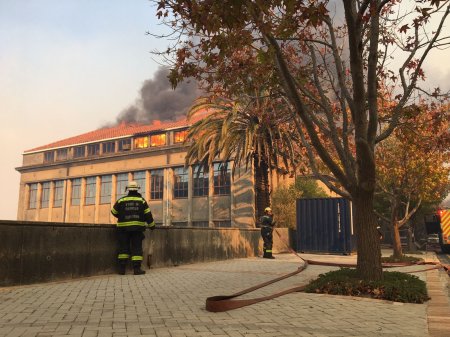
A devastating fire that seems to have started somewhere on Table Mountain has swept onto the upper campus of the University of Cape Town, even engulfing the splendid library (last picture; that’s the special collections part in flames).

It’s terrible to see a place you know go up in flames but at least the campus was evacuated before the fire reached it.

I’ve been to UCT several times, including a long visit in 1995 when I wrote a book with George Ellis. The last time was in 2012; see here. During those visits I was based in the Department of Applied Mathematics, which is on the Upper Campus. From what I’ve seen that building has been completely destroyed by the fire, which seems to be out of control.

I’ve not heard any reports of casualties – thank goodness – but it’s still devastating.

UPDATE: Here is an update on the situation in the Library

UPDATE: I’ve heard from George Ellis that the fires are now out: the Maths and Physics & Astronomy buildings have survived.

Gardener’s Question Time

Posted in Biographical, Maynooth on April 18, 2021 by telescoper

A spell of good weather last week meant that I was able at last to get out and mow the lawns to front and rear of my house. I had tried to do that a while ago but just as I was about to start a hailstorm came down and I abandoned the plan.

By the time I got round to actually mowing it the grass was quite long and still a bit damp which, combined with the poor quality of the old lawnmower I have, meant that I had to do a rough cut followed a couple of dry days later by a closer trim. The lawnmower, incidentally, was left behind in the shed by the previous owner of the house. I was slightly surprised to find that it works at all but I should get myself a new one.

I was joined on the first mow by a little robin who was no doubt on the lookout for bugs disturbed by the grass cutting. I was a bit worried I might accidentally hit the bird with the mower, but he (or she) was fearless, at one point jumping on my foot and pecking at my shoe laces, presumably thinking they were worms.

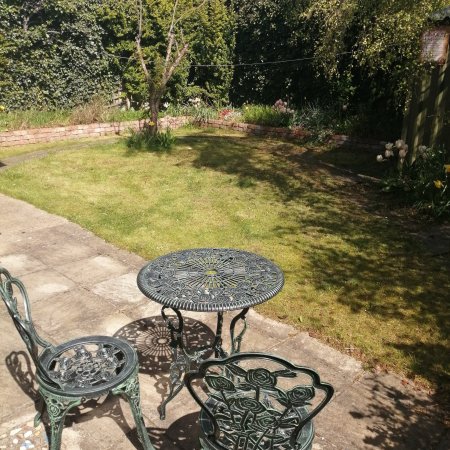
The rear garden is now looking a bit tidier.

This is a very secluded and quiet space, nice for having lunch al fresco which I did yesterday. The sound of the birdsong around was really delightful. I couldn’t see many birds but they were making a lot of noise wherever they were hiding!

Come to think of it they were probably warning each other about the human weirdo invading their territory. They will have eggs and/or chicks in their nests right now.

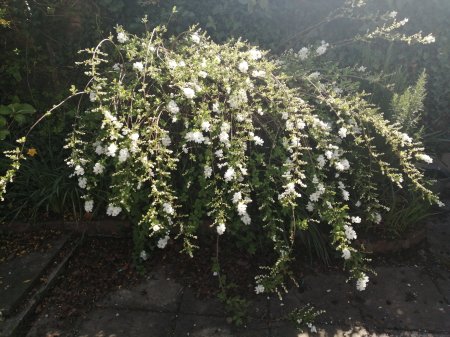
Anyway the above bush is in my rear garden, beside the wall next to the, seating area. Does anyone know what it is?

Answers through the comments box please!

Will we return to on-campus teaching next academic year?

Posted in Biographical, Covid-19, Education, Maynooth on April 17, 2021 by telescoper

As we approach the end of the 20/21 academic year during which most of our teaching has been online rather than face-to-face, a number of students have been asking me whether we will “get back to normal” next September for the start of next teaching year.

The answer I give to this is that I don’t know. It depends entirely on the progress of the battle against the Covid-19 pandemic and that has so far proved to be difficult to predict.

Over the last week, however, the news has made me lean very strongly towards a negative answer. I am now quite confident that there will be no (or at most minimal) in-person teaching at Irish universities in September 2021.

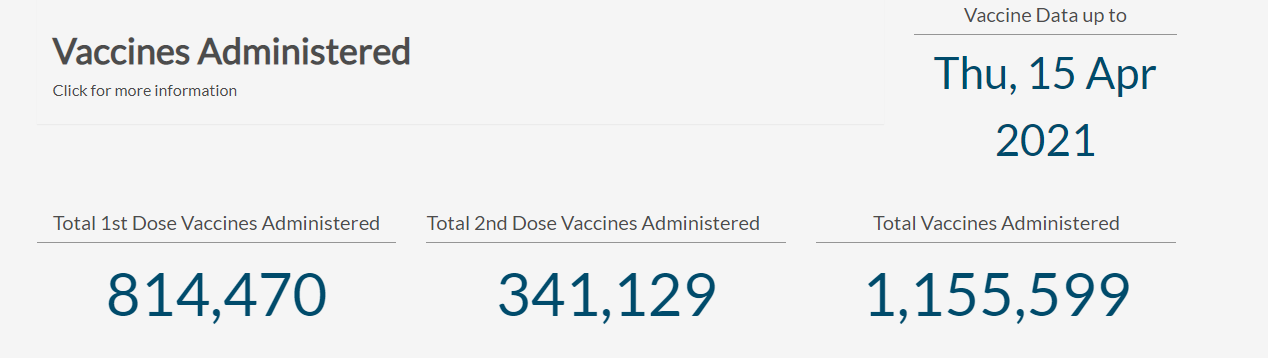
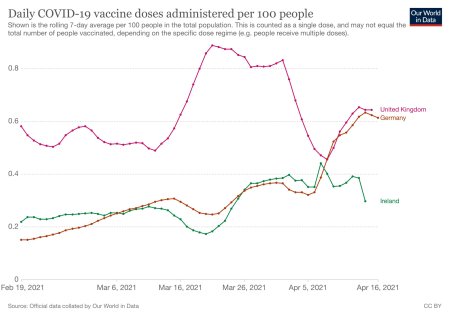
The reason I feel this is the shambolic state of Ireland’s vaccination programme. According to the updates page, as of 15th April, Ireland has administered 1,155,599 vaccine doses, including 814,470 first doses and 341,129 second doses. The figure for total doses on 1st April was 893,375. That means in the first two weeks of April just 262,224 doses have been given. The HSE’s target for April is 800,000 doses; to reach that the daily rate of dishing out vaccinations has to more than double in the second half of the month.

The slowness of the rollout is partly due to a pause in use of the AstraZeneca vaccine because of concerns about blood clots and a decision by Johnson & Johnson not to deliver its promised doses for similar reasons, leaving a shortfall in supply. But that’s not the only reason. If it were then the vaccination programme in Ireland would not be stalling at the same time as Germany’s has been accelerating.

There has been an absurd amount of dithering and disorganization in the Health Service Executive and at Ministerial level which, together with incoherent messaging, has led to administrative chaos.

The AstraZeneca vaccine will in future only be offered to those over the age of 60, with an impact on the timetable for other age cohorts. Last week the HSE announced that Irish people in the general population under the age of 60 will not get their first jab (presumably either Pfizer or Moderna) until June “at the earliest”. It seems – to say the least – unlikely that 80% of the population will receive a vaccine dose by the end of June (the official target) if they’re not going to start on the under-60s until the beginning of that month.

More recently it has been announced that the HSE is also considering changing the correct rollout programme yet again, this time moving people aged 18-30 up the batting order. (Currently the scheme for the general population is organized by age; those in the 65-69 cohort are currently registering.)

I can see the argument for doing that. Younger people tend to have a bigger cross-section for interaction, as it were, and therefore contribute more to the spread of the virus. Prioritizing them would therefore lower the rate of community transmission. On the other hand, moving younger people to a higher priority will have the effect of moving older people down it. But surely this should have been considered long before now?

If the decision is taken to do this people aged 30-50 will not get even their first dose until much later than they would under the current programme, possibly not until the autumn. The vaccination programme plays two roles: one is to protect individuals from serious illness and the other is to slow the transmission of the virus. The former approach means to prioritize the older cohorts while the second pushes in the opposite direction. It’s a difficult question and I think it’s sensible to consider moving younger adults up, though it’s not obvious to me that on balance it would be advantageous.

All of which brings me to the reason I think we won’t be doing on-campus teaching next year, at least for the first Semester. If students (who are mainly aged 18-30) are vaccinated first then most academic staff will probably not be vaccinated by September. If most academic staff are vaccinated by September then probably most students won’t be. Either way it doesn’t look good for a return to campus. I know for a fact that some Irish Universities are already planning for online teaching at the start of the 21/22 academic year. I don’t know what the plans are at my own institution.

I can’t speak for anyone other than myself, but there is I am not going to support a return to face-to-face teaching on campus unless and until a majority of staff and students have been vaccinated. And I am certainly not going to return to campus until I have had both jabs. I am in the 55-60 cohort and may therefore get my first shot in June and second doses by September (although, to be honest, I wouldn’t bet on either of those possibilities).

Of course there are much wider issues to be taken into consideration than what happens in third-level institutions so I’m not saying that this should be a main policy driver, but it’s important to be aware of the ramifications. In previous manifestations of the rollout programme, those involved in delivering education where in a high priority group, but they are no longer. In lowering the priority for vaccination teaching staff, the Government has to accept that it is lowering the priority for a return to campus in September.

Oh Larmor! Energy in Electromagnetic Waves

Posted in Cute Problems, The Universe and Stuff with tags , , , on April 16, 2021 by telescoper

This week I started the bit of my Advanced Electromagnetism module that deals with electromagnetic radiation, including deriving the famous Larmor Formula. It reminded me of this little physics riddle, which I thought I’d share again here.

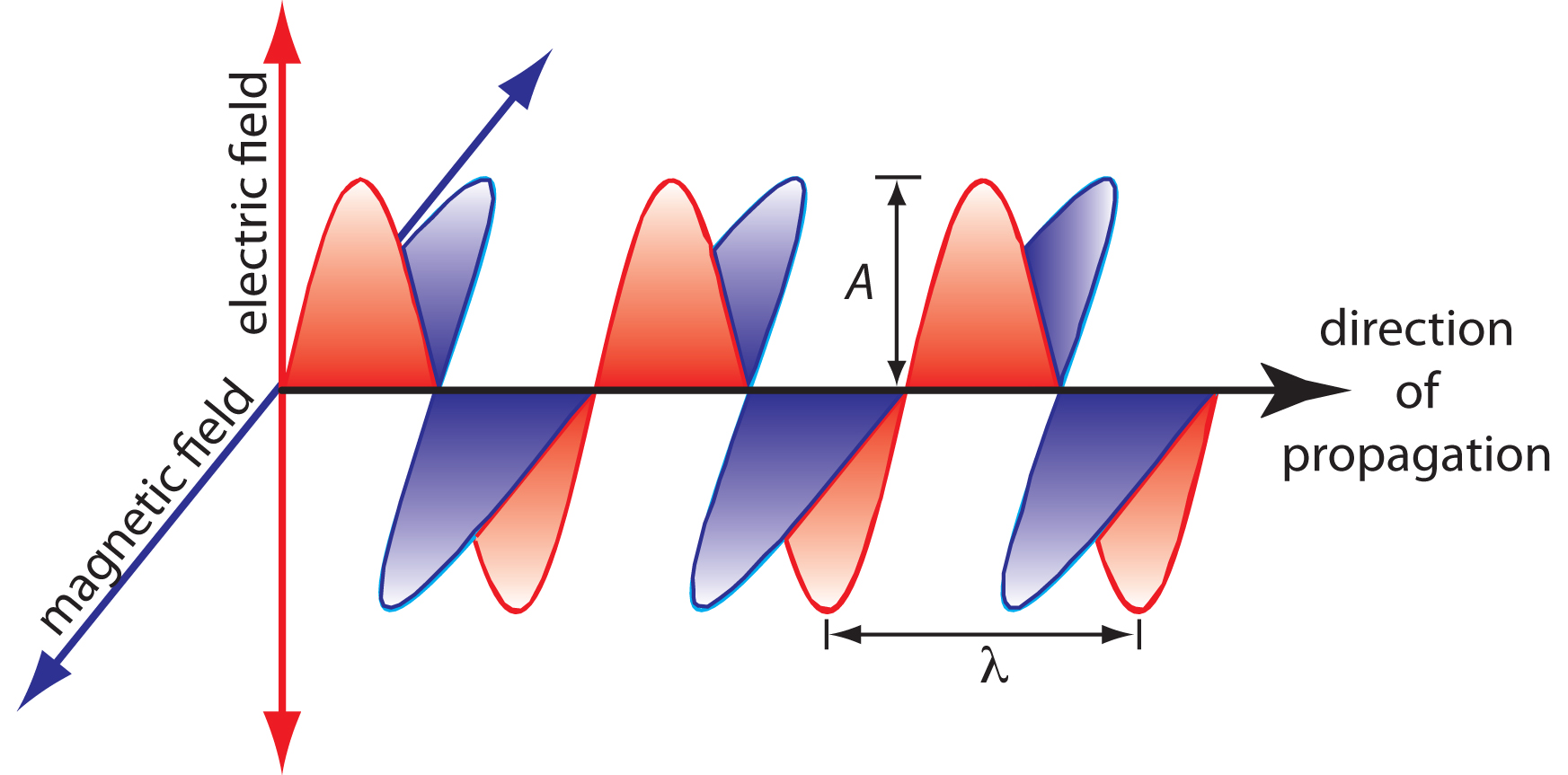
As you all know, electromagnetic radiation consists of oscillating electric and magnetic fields rather like this:

Figure10.1

(Graphic stolen from here.) The polarization state of the wave is defined by the direction of the Electric field, in this case vertically upwards.

Now the energy carried by an electromagnetic wave of a given wavelength is proportional to the square of its amplitude, denoted in the Figure by A, so the energy is of the form kA2 in this case with k constant. Two separate electromagnetic waves with the same amplitude and wavelength would thus carry an energy = 2kA2.

But now consider what happens if you superpose two waves in phase, each having the same wavelength, polarization and amplitude to generate a single wave with amplitude 2A. The energy carried now is k(2A)2 = 4kA2, which is twice the value obtained for two separate waves.

Where does the extra energy come from?

Answers through the Comments Box please!

April is the cruellest month

Posted in Poetry with tags , , , , on April 15, 2021 by telescoper
April is the cruellest month, breeding
Lilacs out of the dead land, mixing
Memory and desire, stirring
Dull roots with spring rain.
Winter kept us warm, covering
Earth in forgetful snow, feeding
A little life with dried tubers.

So begins Part I, The Burial of the Dead from The Waste Land by T.S. Eliot. I thought of it yesterday when I was working in the garden, though I have no lilacs.

The poem is rightly regarded as one of the most important poems of the 20th Century and Eliot one of the most important poets but in my opinion one thing he wasn’t good at was reading his own work. I always found his readings of his own work rather flat and dreary. He’s not the only poet I think that of either, but perhaps that’s just me.

Anyway, here is T.S. Eliot reading all of The Waste Land so you can make your own mind up:

A New Horizon

Posted in Covid-19, Maynooth on April 14, 2021 by telescoper

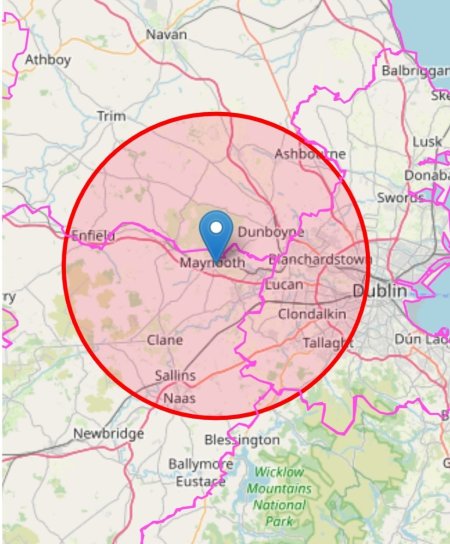
With the (very slight) relaxation in Covid-19 restrictions in Ireland starting this week my horizon had increased from the previous 5km to a new 20km radius:

In fact the new rule says “You can travel within your county or up to 20 km from your home”. I could therefore travel even beyond Naas* remaining within County Kildare, and almost to Dublin City Centre or up to Ashbourne in County Dublin and County Meath respectively. The excitement of it all!

*Naas is the location of the hospital where I get my knee treatment, but they’re not doing routine procedures right now so I’ve got no reason to go there.

The Moon and Blackrock Castle

Posted in Art, The Universe and Stuff with tags , on April 14, 2021 by telescoper

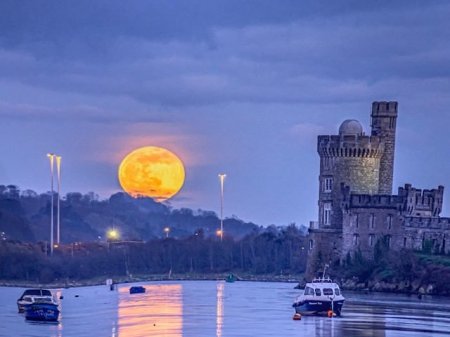
Picture Credit: Cian O’Regan

This image of February’s Full Moon (the “Snow Moon”) by Blackrock Castle Observatory in Cork is by Cian O’Regan. Prints of this and other beautiful images can be bought from his website here.

Testing Cosmological Reciprocity

Posted in The Universe and Stuff with tags , , on April 13, 2021 by telescoper

I have posted a few times about Etherington’s Reciprocity Theorem in cosmology, largely in connection with the Hubble constant tension – see, e.g., here.

The point is that if the Universe is described by a space-time with the Robertson-Walker Metric (which is the case if the Cosmological Principle applies in the framework of General Relativity) then angular diameter distances and luminosity distances can differ only by a factor of (1+z)2 where z is the redshift: DL=DA(1+z)2.

I’ve included here some slides from undergraduate course notes to add more detail to this if you’re interested:

The result DL=DA(1+z)2 is an example of Etherington’s Reciprocity Theorem and it does not depend on a particular energy-momentum tensor; the redshift of a source just depends on the scale factor when light is emitted and the scale factor when it is received, not how it evolves in between.

Etherington’s theorem requires light rays to be described by null geodesics which would not be the case if photons had mass, so introducing massive photons would violate the theorem. It also requires photon numbers to be conserved, so some mysterious way of making photons disappear might do the trick, so adding some exotic field that interacts with light in a peculiar way is another possibility, as is the possibility of having a space-time with torsion, i.e. a non-Riemannian space-time.

Another possibility you might think of is to abandon the Robertson-Walker metric. We know that the Universe is not exactly homogeneous and isotropic, so one could appeal to the gravitational lensing effect of lumpiness to provide a departure from the simple relationship given above. In fact a inhomogeneous cosmological model based on GR does not in itself violate Etherington’s theorem, but it means that the relation DL=DA(1+z)2 is no longer global. In such models there is no way of defining a global scale factor a(t) so the reciprocity relation applies only locally, in a different form for each source and observer. In order to test this idea one would have to have luminosity distances and angular diameter distances for each source. The most distant objects for which we have luminosity distance measures are supernovae, and we don’t usually have angular-diameter distances for them.

Anyway, these thoughts popped back into my head when I saw a new paper on the arXiv by Holanda et al, the abstract of which is here:

Here we have an example of a set of sources (galaxy clusters) for which we can estimate both luminosity and angular-diameter distances (the latter using gravitational lensing) and thus test the reciprocity relation (called the cosmic distance duality relation in the paper). The statistics aren’t great but the result is consistent with the standard theory, as are previous studies mentioned in the paper. So there’s no need yet to turn the Hubble tension into torsion!