The Return of Sherlock Holmes

Posted in Maynooth, Television with tags , , , , , on April 5, 2021 by telescoper

Regular readers of this blog – both of them – will know that I am a huge fan of Jeremy Brett‘s portrayal of Sherlock Holmes in the Granada TV productions of the classic detective stories by Sir Arthur Conan-Doyle first broadcast during the 1980s.

It turns out that Virgin Media in Ireland is now broadcasting the series The Return of Sherlock Holmes, the first episode of which, The Empty House, was on last night (Easter Sunday). I watched it with all the pleasure of meeting an old friend I hadn’t seen for years. It’s hard to believe that episode was first broadcast way back in 1986.

For those of you not up with the canon, this story (based on the original story The Adventure of the Empty House) is set three years after Holmes apparently fell to his death, along with his arch enemy Moriarty, at the Reichenbach Falls.

Holmes’s body was never found, for the very good reason that he didn’t die! It turns out he escaped and spent three years on the run exploring the world and evading Moriarty’s confederates. Much of the first episode is taken up with an account of these goings on, and the case that brings Holmes back to London is fairly slight, really just providing an excuse for his return. A murder in London provides Holmes with an opportunity to trap the last of his erstwhile opponent’s associates.

I did however experience a little frisson of surprise when I heard the identity of the victim of the murder at the heart of the story, namely the Honourable Ronald Adair, the second son of the Earl of Maynooth*…

*The title is fictional, there was a title Earl of Kildare but never an Earl of Maynooth.

Now, for bonus marks, and without using the internet, can anyone tell me the connection between Sherlock Holmes and the field of astronomical spectroscopy?

To see the answer, click below
Continue reading

Easter Hymn, by A.E. Housman

Posted in Poetry with tags , , , , on April 4, 2021 by telescoper

If in that Syrian garden, ages slain,
You sleep, and know not you are dead in vain,
Nor even in dreams behold how dark and bright
Ascends in smoke and fire by day and night
The hate you died to quench and could but fan,
Sleep well and see no morning, son of man.

But if, the grave rent and the stone rolled by,
At the right hand of majesty on high
You sit, and sitting so remember yet
Your tears, your agony and bloody sweat,
Your cross and passion and the life you gave,
Bow hither out of heaven and see and save.

by A.E. Housman (1859-1936)

Housman was an atheist. This poem was not published in his lifetime, but is the first poem in More Poems which was published shortly after his death.


The Dead Christ

Posted in Art, Literature with tags , , , on April 3, 2021 by telescoper

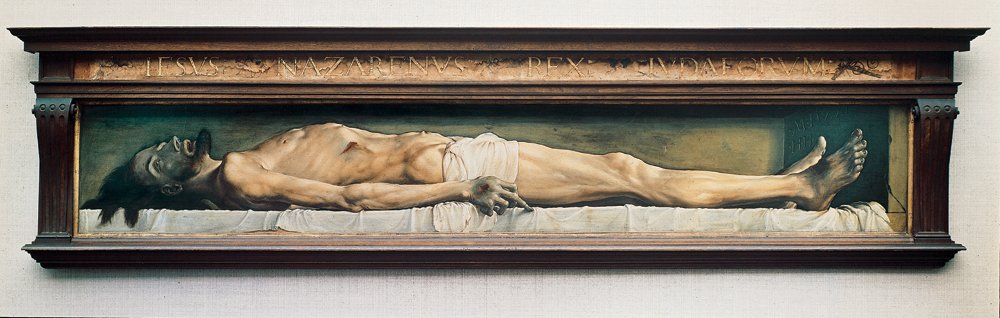
The Dead Christ, 1521 (oil on limewood) by Hans Holbein the Younger (1497/8-1543)

Twitter reminded me this evening of this extraordinary painting by Hans Holbein the Younger and I thought I’d share it here because I realize it was painted in 1521, which means it is 500 years old this year. Despite its age this work still has the power to shock, not least because it is so different from so many works of religious art of its period. The depiction of the dead Christ is 2m long, life-size (so to speak). His eyes and mouth are open, the clear signs of putrefaction appearing in the colouring of his face, hands and feet, the body marked by wounds, is brutal in its frankness and shocking in its authenticity.

But what is the message of this work? Was Holbein questioning the reality of Christ’s bodily resurrection? Or was he emphasizing how miraculous it must have been? And where was a painting of this enormous size and peculiar shape supposed to be displayed? What purpose was it meant to serve? And what’s the reason for the extended middle finger?

I’m not the only one to have asked these questions. The author Fyodor Dostoevsky was famously moved by this work, so much so that in his novel The Idiot he has a character remark “Why, a man’s faith might be ruined by looking at that picture!”.

I don’t expect we’ll ever know what Holbein was trying to say, but perhaps that doesn’t matter. Great art should make you think, but should not necessarily tell you what you should think…

Cá bhfuil tú i do chónaí?

Posted in Biographical, Irish Language, Maynooth with tags , , , on April 3, 2021 by telescoper

I had another Irish language class on Thursday, in between various other things. I’m finding it a struggle since I don’t get much time in between the classes to revise or practice and also because there is quite a lot to learn that is very different from languages with which I am familiar. I spent a lot of time at school learning Latin and tend to filter new languages through that experience, which works reasonably well for French, Spanish and Italian but isn’t very good for Irish.

Some things in Irish are simpler than Latin: there are effectively only four cases for nouns in Irish as there is no real distinction between nominative and accusative. I mean the two cases are grammatically distinct but there is no difference in the word depending on whether it is subject or object of a verb. The other three cases are vocative (preceded by the particle a), genitive and dative. There is no ablative case; the dative is used instead.

Other things are more complicated. Last week we discovered that there are two versions of the verb “to be”. One is bí (which, as in most other European languages, is irregular in declination); the other is called the copula (“an chopail”)  which is used in limited (but quite common) circumstances such as linking a noun with a predicate clause. Confusingly, the form of the copula used in the present tense is “is” but it’s not part of the verb “to be”.

We learnt about these things when talking discussing the question

Cá bhfuil tú i do chónaí?

which is “where do you live?”, literally “Where are you in your habitation?”.  The way to answer this is something like

Tá mé i mo chónaí i Maigh Nuad. 

these sentences both involve the verb to be in the second person and first person respectively. Instead of Tá mé you could use Táim which is the equivalent of using “I’m” for “I am” in English.

It’s more complicated than that though because some place names have to be modified in this construction using an urú (eclipsis):

Maigh Nuad (Maynooth) begins with an M which is not modified but Doire (Derry) becomes nDoire, etc. The mutation from c to g after the preposition i also happens in Welsh, e.g. in the phrase Croeso i Gymru but in Irish you add the changed letter in front of the original rather than replacing it. For example, if I were living in Cork I would say

Tá mé i mo chónaí i gChorchai. 

The g is understood to replace the C for pronunciation purposes.

That brings us on to Irish place names, which are often very different from their anglicized versions. Here are a few examples:

  • Maigh Nuad (Maynooth)
  • Corcaigh (Cork)
  • Port Láirge (Waterford)
  • Doire (Derry)
  • Tir Eoghain (Tyrone)
  • Aontroim (Antrim)
  • Fear Manach (Fermanagh)
  • Béal Feirste (Belfast)
  • Gaillimh (Galway)
  • Thiobraid Árann (Tipperary)

The last one is not actually a long way from where I am. You can guess most of them but it’s a little confusing that the English versions are often conflations of two Irish words.

Obituary of John Barrow

Posted in Biographical, The Universe and Stuff with tags on April 2, 2021 by telescoper

Just a quick word to let you know that my obituary of John Barrow (partly based on my blog post here) has now been published in The Observatory Vol. 141 No. 1281 (2021 April) pp. 93-96. The Observatory Magazine isn’t available online so, with the permission of the Editors, I’ve included a link to a PDF of the published version here:

John Barrow Obituary in Observatory by Peter Coles

Good Friday Break

Posted in Biographical, Maynooth, Poetry with tags , , on April 2, 2021 by telescoper

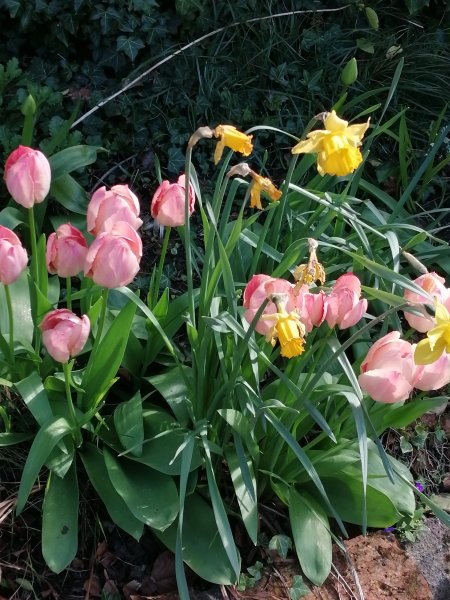
Garden Update: the daffodils are done but the tulips are still going…

Well, here we are. It’s Good Friday, the start of an extra-long weekend (Friday to Monday inclusive). I’m making it a bit longer by taking a few days off next week too. It’s officially Easter break so there are no lectures next week anyway.

I need a break. This term has been exhausting, and the busiest bit is yet to come. We return for four weeks of teaching then, after a short hiatus, we’re into the examination period followed by marking, Exam Boards and all the rest. Oh and there’s the small matter of yet another virtual Open Day at the end of this month.

I’ve put out-of-office replies on my work email and won’t be attending to messages there until I get back to work at the end of next week. Part of me feels a bit guilty for doing that, but only a very small part.

As it’s a nice day, I spent a couple of hours this morning doing some remedial work in the garden. I may have a late lunch out there too as the weather is nice and I recently invested in a garden table and chairs which I have yet to use properly. If the weather holds I might get the mower out and give the lawn a trim. Judging by the constant noise this morning it seems that everyone in the neighbourhood is doing that too. Some people seem to enjoy the sound of their own lawn mowers.

Talking of which I also trimmed my beard this morning, for the first time since Christmas. I have also acquired some clippers and may actually cut the hair on my head at some point over the weekend too.

That’s enough inconsequential rambling for today. Here is a poem on the subject of Good Friday by Christina Rossetti:

Am I a stone, and not a sheep,
That I can stand, O Christ, beneath Thy cross,
To number drop by drop Thy blood’s slow loss,
And yet not weep?

Not so those women loved
Who with exceeding grief lamented Thee;
Not so fallen Peter, weeping bitterly;
Not so the thief was moved;

Not so the Sun and Moon
Which hid their faces in a starless sky,
A horror of great darkness at broad noon –
I, only I.

Yet give not o’er,
But seek Thy sheep, true Shepherd of the flock;
Greater than Moses, turn and look once more
And smite a rock.

Relativity and Electromagnetism

Posted in Biographical, Maynooth, The Universe and Stuff on April 1, 2021 by telescoper

As a service to the public I thought I’d share one of my lectures. This is one I did yesterday, Lecture 16 in my module MP465 Advanced Electromagnetism:

I don’t know how I managed to pad this out to a whole hour.

On Vaccination in Ireland

Posted in Covid-19 with tags , , , on March 31, 2021 by telescoper

Following from my weekend post about issues with Covid19 vaccination, which seems to have ruffled a few feathers, I thought I’d just mention a couple of recent developments.

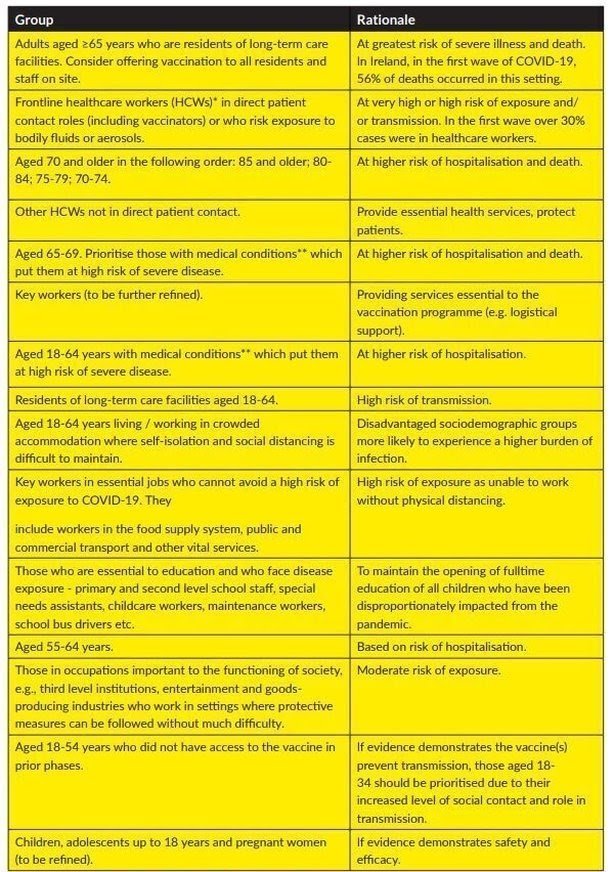
The first is that on Tuesday (yesterday) the Irish Government decided to change the way it vaccinates the rest of the population. The previous plan was rather complicated with a number of groups to be vaccinated in order of priority:

That plan has now been scrapped and after the current groups 1-3 are completed it will revert to a simpler scheme with priority determined only by age. As an oldie I will benefit from this, moving up several steps in the pecking order as a consequence of the decision.

Frontline workers such as teachers and Gardaí are dismayed by this decision. On the news just now various folk were trying to argue that the change is for health policy reasons, stating that the prime factor in risk for Covid-19 is age. Actually, it isn’t. The prime factor is exposure to the virus.

What I mean is that the probability of dying from Covid-19 if you haven’t been infected is zero: 100% of those suffering death or serious illness from Covid-19 have been in contact with the virus. Someone who is 60 years old but able to work effectively at home at far lower risk of exposure than a 35 year old schoolteacher.

The real reason for the change is that Ireland does not possess a system that can be used identify groups by occupation in an efficient way. Doing it by age is far simpler and would lead to a much more rapid rise in the fraction of the population immunized. Sometimes decisions have to be made for such practical reasons, but I do wish certain people were more honest.

The slow rollout of the vaccine in Ireland should have provided the Government to work out how to implement their original strategy. Obviously they decided that they couldn’t.

Anyway, for myself, I am pleased that it now looks quite likely that I’ll get at least one jab by May. Assuming the vaccine supply holds up, of course.

I thought I’d end with a thought following on from my earlier post. Some people will ask whether I would have the AstraZeneca vaccine given my views about the company’s behaviour and the lower efficacy of the vaccine as compared to others available.

I think there are two motivations for getting vaccinated. One is self-preservation. I want to protect myself as much as possible. If I had the choice of vaccine for this reason I would pick Moderna or Pfizer-BioNtech but would accept AZ if that was the only one available. As things stand, over 75% of doses administered in Ireland have been Pfizer-BioNtech,

The other motivation is to help reduce the transmission of the disease. For that even a low efficacy vaccine would play a part. If the only shot available offered just 50% protection I would still take it, as if everyone did so the population dynamics would still be significantly slowed.

It’s a similar thing with face masks, actually. Their role is only partly to protect the wearer. The other part is to protect everyone else.

So on both grounds, yes I would take the AZ vaccine if that was the only one on offer, but if I had the choice I would pick a better one. I feel the same way about the Johnson & Johnson vaccine, which will start to become available in Ireland very soon.

Thought for the Day

Posted in Literature, Politics on March 30, 2021 by telescoper

I don’t have time for a full post today but let me just say that I think that the move from a structuralist account in which capital is understood to structure social relations in relatively homologous ways to a view of hegemony in which power relations are subject to repetition, convergence, and rearticulation brought the question of temporality into the thinking of structure, and marked a shift from a form of Althusserian theory that takes structural totalities as theoretical objects to one in which the insights into the contingent possibility of structure inaugurate a renewed conception of hegemony is bound up with the contingent sites and strategies of the rearticulation of power.

Comments welcome.

Yesterday was nearly Easter

Posted in History, The Universe and Stuff with tags , , , on March 29, 2021 by telescoper

As as Astronomist I am often asked “How do they calculate the date of Easter?”, to which my answer is usually “Look it up on Wikipedia!“.

The simple answer is that Easter Sunday is on the first Sunday after the first full Moon on or after the Vernal equinox. The Vernal Equinox took place this year on March 20th and the more observant among you will have noticed that yesterday was (a) Sunday and (b) a Full Moon. Yesterday was not Easter Sunday because the rule says Easter is on the first Sunday after the first full Moon on or after the Vernal equinox, which does not include a Full Moon on the first Sunday on or after the vernal equinox. Accordingly Easter 2021 is next Sunday 4th April. If the Full Moon had happened on Saturday, yesterday would have been Easter Sunday.

That is just as well really because next weekend is when the holidays and sporting events have been arranged.

I say “simple” answer above because it isn’t quite how the date of Easter is reckoned for purposes of the liturgical calendar.

For a start the ecclesiastical calculation of the date for Easter – the computus – assumes that the Vernal Equinox is always on March 21st, while in reality it can be a day or two either side of that. This year it was on March 20th.

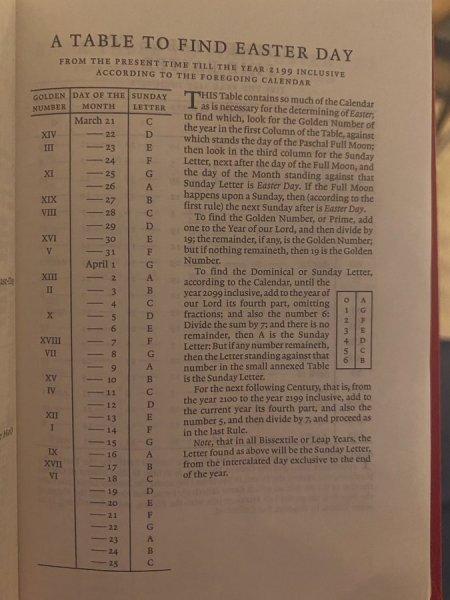
On top of that there’s the issue of what reference time and date to use. The equinox is a precisely timed astronomical event but it occurs at different times and possibly on different days in different time zones. Likewise the full Moon. In the ecclesiastical calculation the “full moon” does not currently correspond directly to any astronomical event, but is instead the 14th day of a lunar month, as determined from tables (see below). It may differ from the date of the actual full moon by up to two days.

There have been years (1974, for example) where the official date of Easter does not coincide with the date determined by the simple rule given above. The actual rule is a complicated business involving Golden Numbers and Metonic cycles and whatnot.

I’m grateful to Graham Pointer on Twitter for sending this excerpt from the Book of Common Prayer that sheweth how to determine the date of Easter for any year up to 2199:

I don’t care what happens after that as I’ll be retired by then. If you apply this method to 2021 you will find it is an 8C. Next year will be a 9B. Further calculations are left as an exercise to the reader.