Last Day Off

Posted in Biographical, Covid-19, Education, Maynooth on January 3, 2021 by telescoper

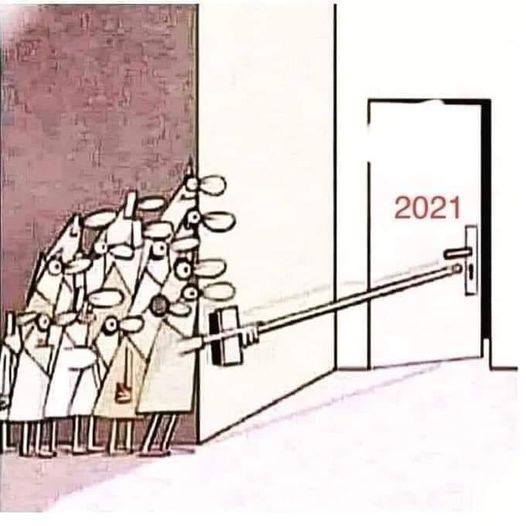
Tomorrow is officially my first day back at work after the Christmas break. Not that I’ll be going back to my office on campus in the morning. Thanks to the state of the Covid-19 pandemic I will be working from home for the foreseeable future. It’s looking pretty grim at the moment, and I think it’s going to get a lot worse before it gets better:
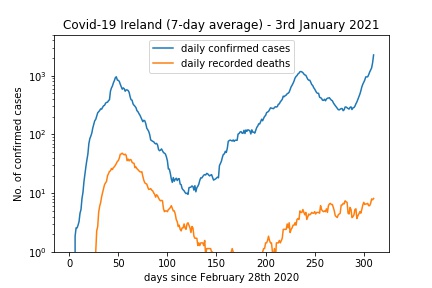
 

I know I’m not alone in thinking that it was a big mistake to relax the Covid-19 restrictions so soon before Christmas with cases at such a high level. What has happened since then in terms of new cases and hospitalizations is even worse than the experts predicted; today almost 5000 cases were reported, taking the total past 100,000. I hope the current Government is properly held to account for the way it bowed to pressure from vested interests (especially the so-called “hospitality industry”) the way it did.

I haven’t read my work emails since the end of last term (December 18th 2020). I do hope I don’t have to work through a mountain of them when I finally open my inbox tomorrow morning. No doubt as  we get back to work there will be detailed instructions on what we can and can’t do. Semester Two of teaching in Maynooth doesn’t start until February 1st so we have a bit of time to see how things progress, but I honestly can’t see any prospect of a return to on-campus classes for the rest of the academic year. I do hope we’re not going to be required to make yet another set of elaborate plans that will never be put into practice…

At least this term I will be “working from home” in better conditions than previously, in my own house with a good internet connection and a proper study that I can close the door on when I need a break. I’ll be teaching three modules next Semester, including one (Advanced Electromagnetism) that I’ve never taught before. Teaching isn’t the only thing, but the other important matters to be dealt with this month are not things I can really write anything about at this stage.

The January examination period starts on Friday (8th) and ends two weeks later (Friday 22nd) so getting through that and getting the examinations marked is going to be the first priority. As in May all these examinations will be in the form of online assessments. We have done this sort of examination before, which makes it a bit easier than last year, but they still cause a lot of stress for staff and students alike. I will have about 100 scripts to mark and will have to do all of them on screen. I’m not looking forward to that at all, but it has to be done. In between those we will be running our first Astrophysics & Cosmology Master Class, which I am looking forward to enormously. It seems to have generated a lot of interest, but we won’t know precisely how many will tune in until the day arrives. It might be a lot if the Schools are closed, which they may be.

I was tempted at this point to make a list of all the things I have to do tomorrow, but that would be breaking my resolution to take a complete break so I will leave that until the morning and instead go and have a nap.

The Day of Perihelion

Posted in The Universe and Stuff with tags , , , , , , , , on January 2, 2021 by telescoper

Earth’s elliptical orbit viewed at an angle (which makes it look more eccentric than it is – in reality is very nearly circular).

Today (Saturday 2nd January 2021) at approximately 13:50 GMT the Earth reaches at the point on its orbit, which which it is at its closest to the Sun, i.e. at its perihelion. At this time the distance from the Sun’s centre to Earth’s centre will be 147,093,163 km. This year, aphelion (the furthest distance from the Sun) is at 23.57 GMT on July 5th 2021 at which point the centre of the Earth will be 152,100,527 km from the centre of the Sun. You can find a list of times and dates of perihelion and aphelion for future years here.

At perihelion the speed of the Earth in its orbit around the Sun is greater than at aphelion (about 30.287 km/s versus 29.291 km/s). This difference, caused by the Earth’s orbital eccentricity, contributes to the difference between mean time and solar time I blogged about when discussing the Winter Solstice a couple of weeks ago.

It surprises me how many people think that the existence of the seasons has something to do with the variation of the Earth’s distance from the Sun as it moves in its orbit. The fact that perihelion occurs in the depth of winter should convince anyone living in the Northern hemisphere that this just can’t be the case, as should the fact that it’s summer in the Southern hemisphere while it is winter in the North.

The real reason for the existence of seasons is the tilt of the Earth’s axis of rotation. I used to do a little demonstration with a torch (flashlight to American readers) to illustrate this when I taught first-year astrophysics. If you shine a torch horizontally at a piece of card it will illuminate a patch of the card. Keep the torch at the same distance but tilt the card and you will see the illuminated patch increase in size. The torch is radiating the same amount of energy but in the second case that energy is spread over a larger area than in the first. This means that the energy per unit area incident on the card is decreases when the card is tilted. It is that which is responsible for winter being colder than summer. In the summer the sun is higher in the sky (on average) than in winter. From this argument you can infer that the winter solstice not the perihelion, is the relevant astronomical indicator of winter.

That is not to say that the shape of the Earth’s orbit has no effect on temperatures. It may, for example, contribute to the summer in the Southern hemisphere being hotter than in the North, although it is not the only effect. The Earth’s surface possesses a significant North-South asymmetry: there is a much larger fraction of ocean in the Southern hemisphere, for example, which could be responsible for moderating any differences in temperature due to insolation. The climate is a non-linear system that involves circulating air and ocean currents that respond in complicated ways and on different timescales not just to insolation but to many other parameters, including atmospheric composition (especially the amount of water vapour).

The dates when Earth reaches the extreme points on its orbit (apsides) are not fixed because of the variations in its orbital eccentricity so, in the short-term, the dates can vary up to 2 days from one year to another. The perihelion distance varies slightly from year to year too.

There is however a long-term trend for perihelion to occur later in the year. For example, in 1246, the December Solstice (Winter Solstice for the Northern Hemisphere) was on the same day as the Earth’s perihelion. Since then, the perihelion and aphelion dates have drifted by an average of one day every 58 years and this trend will continue. This means that by the year 6430 the timing of the perihelion and the March Equinox will coincide, although I will probably have retired by then…

The New Year’s Old Year Blog Statistics

Posted in Biographical on January 1, 2021 by telescoper

Here we are then, in 2021. Good riddance to 2020. I thought I’d see in the New Year by following the tradition of doing a quick blog about this blog.

Once upon a time, in the good old days, in the dim and distant past, WordPress used to publish an annual statistical summary page for its bloggers, but it has discontinued that practice so now I’ll just write my own brief summary based on the data available via the usual dashboard.

For those interested this blog got 350,765 hits last year, an average of just under a 960 a day. That’s up by 10,732 (or about 3.2%) on last year. Interest in this blog is way down from the dizzy heights of 2012 when I got 464,221 page views. Interestingly, 2020 was the first year ever in which there were more hits on this blog from the USA (113,596) than the UK (101,981). Germany and Ireland take third and fourth place in the blog hits table.

Incidentally, there are 1659 current followers of In The Dark on WordPress itself. These are fellow bloggers who use the built-in reader to access posts. I don’t know whether or not these are counted in the above web traffic statistics.

In 2020 there were 2487 comments, also up on last year and in the same era posts received 1898 ‘likes’; that’s a big increase on last year’s figure. The most liked category, incidentally, was Poetry. In case you’re interested the most popular post published in 2020 was this one, on Clifford’s Space-Theory of Matter.

Altogether, since this blog started in 2008 to the end of 2020, it has been viewed about 4,486,045 times by about 1.65 million unique visitors (though, obviously, all my visitors are unique).

P. S. As of today, January 1st 2021, readers in the United Kingdom wishing to view this blog are required to use Netscape.

End of Year Thoughts

Posted in Biographical, Covid-19, Maynooth, Poetry on December 31, 2020 by telescoper

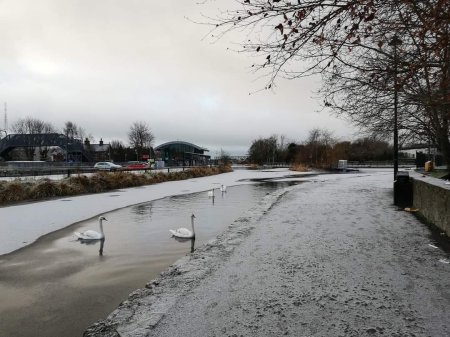
The Royal Canal, Maynooth, looking towards the Railway Station; the harbour is on the right.

The last morning of 2020 found Maynooth covered in a light dusting of snow. Since then the snow has turned to sleet and rain and the town looks a bit less picturesque as a consequence, not least because we haven’t really seen any proper daylight. My trip out this morning was a rare excursion from my house, but I’m glad I was able to get a bit of fresh (though freezing) air without there being lots of people around. I’ll be sitting cosily at home for the rest of the day (and, probability, tomorrow).

It’s extraordinary to think that this time last year there wasn’t an inkling of what was to come in terms of the Coronavirus pandemic. The first cases had been detected in China in December 2019 but I don’t think anyone seriously thought it would go global in the way it did. A year on and we’re still not out of it. Not by a long way. I think this are going to get a lot worse before they get better, but at least there are vaccines on the way.

Looking back over some of my posts from early in the year I’m reminded of two  events in particular- the 200th Anniversary Dinner of the RAS Club in January and the Irish General Election in February, both of which seem now to have happened at least a decade ago. I went to London again in mid-February, but had to cancel my planned trip back to the UK in March because FlyBe went bust. After that I made a couple of trips to Dublin (including a performance of Fidelio)  but since then I haven’t left Maynooth. It’s extremely likely that by March 2021 I will have spent an entire year without leaving the boundaries of Maynooth.

It’s almost a whole year since I posted a list of things I wanted to do in 2020. The first three were:

    1. Go to more live concerts.
    2. See more of Ireland.
    3. No more working weekends

That went well then! I don’t think I’ll bother making a list for next year, or perhaps I’ll just carry over this year’s. Obviously the Covid-19 restrictions and vastly increased workload involved in switching teaching to online put paid to most of my plans for 2020. Although I did manage to buy a house in Maynooth, I will have to wait until the Third Wave is over before I can retrieve the rest of my belongings from Wales and relocate fully.

Although I didn’t make an impact in this year’s Beard of the Year (finishing in last place in the final poll), at least I have the honour of being St Patrick’s Day Beard of Ireland for 2020.

You have to take what positives you can but I’m sure I’m not the only person to think, on balance, this has been a spectacularly awful year. I haven’t myself had Covid-19 but I know people who have and some of them are still struggling with the after-effects. I know many have also lost loved ones to the Coronavirus; condolences to everyone so affected. Although nothing to do with Covid-19, I still feel a very deep sadness that my former thesis supervisor John Barrow is no more. I hope after the pandemic there can be some form of proper tribute to him.

Anyway, to end with, here are a few verses from In Memoriam, by Alfred Lord Tennyson:

Ring out the old, ring in the new,
Ring, happy bells, across the snow:
The year is going, let him go;
Ring out the false, ring in the true.

Ring out the grief that saps the mind,
For those that here we see no more;
Ring out the feud of rich and poor,
Ring in redress to all mankind.

Ring out false pride in place and blood,
The civic slander and the spite;
Ring in the love of truth and right,
Ring in the common love of good.

Ring out old shapes of foul disease;
Ring out the narrowing lust of gold;
Ring out the thousand wars of old,
Ring in the thousand years of peace.

Level 5 New Year

Posted in Biographical, Covid-19, Maynooth with tags , on December 30, 2020 by telescoper

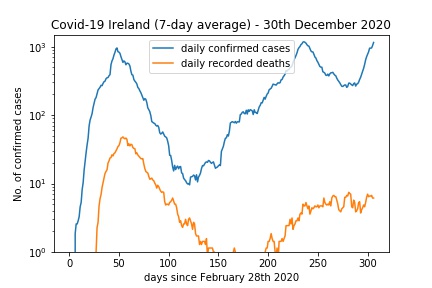
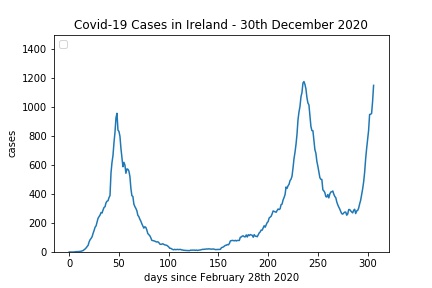
To nobody’s surprise the Taioseach this evening announced that the whole of Ireland would go immediately into full Level 5 Covid-19 restrictions. Officially these will apply until January 31st, but nobody thinks they will end then. Nor should they. The past few days have seen the number of cases and hospitalizations skyrocket and the current positivity rate of tests is 10.5% (7-day average) with a figure of 18% recorded yesterday.

Here are the latest plots of 7-day averages. First, logarithmic:

Second, linear:

I’m not alone in thinking that it was a very big mistake to relax the restrictions in early December, but that’s done now and we have to deal with the situation as it is now. Unfortunately the Christmas wave hasn’t really hit these figures yet so I think thinks are going to get a lot worse before they get better. The current exponential phase with a R number of around 1.6-1.8 means the cases will probably double by this time next week.

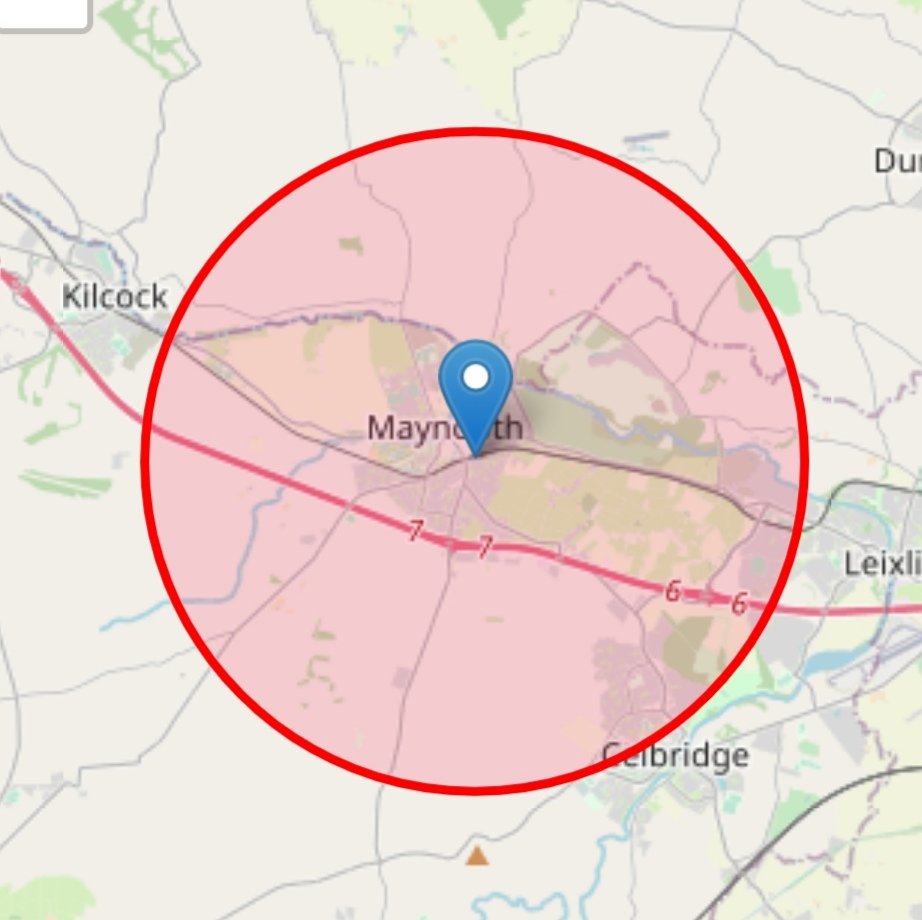
Anyway, looks like a quiet night in for New Year’s Eve (not that I mind that) and my horizon for January is back down to a 5km radius, although its centre has shifted a little as I have moved house since last time!

The Mechanics of Nursery Rhymes

Posted in Cute Problems, The Universe and Stuff with tags , , , , on December 30, 2020 by telescoper

I’ve always been fascinated by Nursery Rhymes. Some people think these are little more than nonsense but in fact they are full of interesting historical insights and offer important advice for the time in which they were written. One such story, for example, delivers a stern warning against the consequences of placing sleeping babies in the upper branches of trees during windy weather.

Another important role for nursery rhymes arises in physics education. Here are some examples that students of elementary mechanics may find useful in preparation for their forthcoming examinations.

1. The Grand Old Duke of York marched 10,000 men up to the top of a hill and marched them down again. The average mass of his men is 65 kg and the height of the hill is 500m.

(a) Estimate the total work done in marching the Duke of York’s men up to the top of the hill.

(b) If, instead of marching down again, the men take turns sliding down a frictionless slide back to where they started, estimate the average speed of a man when he reaches the bottom of the hill.

(You may assume without proof that when they were up they were up, and when they were down they were down and, moreover, when they were only half way up they were neither up nor down.)

2. By calculating the combined rest-mass energy of half a pound of tuppenny rice and half a pound of treacle, and assuming a conversion efficiency of 10%, estimate the energy released when the weasel goes pop. (Give your answer in SI units.)

3. The Moon’s orbit around the Earth can be assumed to be a circle of radius r. A cow of mass m is standing on the Earth (which has mass M, and radius R). Derive a formula in terms of r, R, M, m and Newton’s Gravitational Constant G for the energy the cow needs in order to jump over the Moon.

(The Earth, Moon and cow may be assumed spherical. You may neglect air resistance and udder frictional effects. )

Feel free to contribute similar problems through the Comments Box.

Drogheda and its Surroundings – by William Topaz McGonagall

Posted in Literature with tags , on December 29, 2020 by telescoper

I’ve recently been criticized for not posting enough poetry about Ireland nor by Irish poets, hence this truly remarkable poem by the inimitable William Topaz McGonagall (who was Scottish, but of Irish descent). Let this be a lesson to you.

The town of Drogheda is situated on the river Boyne, a few miles from the sea,
And is its head-quarters for the exploration of its scenery;
And portions of its ancient walls and two gate towers remain,
And one of them is quite perfect – St. Laurence by name.

The west gate is in a good state of preservation,
And is well worth the tourist’s observation,
Because it will stir in him great admiration,
And raise his spirits to a great elevation.

The ruined Church of St. Mary I must mention,
The tower of which is very fine and worthy of attention,
A structure dating from the fourteenth century,
And deserves special notice, because it is wonderful to see.

Then there’s King William’s Glen and the Boyne valley to be seen,
The spot where King William’s troops charged across the stream;
And an imposing obelisk is there, which marks the spot
Where the Battle of the Boyne was fought, which will never be forgot.

And as the tourist for beautiful spots there doth range
I advise him to view the chambered Tumulus of New Grange,
And there he will see remarkable caves, wonderful to be seen,
And in the summer-time the entrance is beautiful with shrubberies green.

The Monastery of Mellifont is most wonderful to see,
And will repay the tourist who visits the locality,
For within the enclosure is a tower standing 110 feet high,
Which arrests the attention of strangers while passing by.

Then there’s the celebrated Hill of Slane,
Which is a very great height and of historical fame,
Because on Easter Eve St. Patrick lighted the paschal fire
And worshipped God there to his heart’s desire.

Then the tourist should visit the Castle of Dunmoe,
And the scene there will drive from him all woe;
And spend a day or two in visiting Tara and Bective Abbey,
For around there is some great curiosities to see.

Then there’s Lough Erne, most beautiful to be seen,
And dotted with beautifully wooded isles, charming and green,
And freely thrown open for public inspection
For the visitor’s amusement, and to which the proprietor has no objection.

There the tourist will find comfortable accommodation,
And nothing short of pleasant recreation;
For there’s boating and fishing if the tourist wishes,
Which will be excellent sport while catching the big and little fishes.

Then ye lovers of beautiful scenery away! away!
To Drogheda, in Ireland, and have a holiday,
And view the romantic scenery and inhale pure air,
Emanating from the sea and wild flowers and woodlands there.

written in 1902 by William Topaz McGonagall. I think the “Church of St Mary” referred to is the Church of Ireland church of that name built between 1805 and 1810 on the site of an older (14th Century) Parish Church, and beside a ruined 13th Century Cistercian abbey, but it may also be the Roman Catholic Church of the same name built during 1881 and 1889 (which has the more impressive “tower”)

The Innocents’ Day

Posted in Music with tags , , , , on December 28, 2020 by telescoper

I am reliably informed that today, 28th December, is The Innocents’ Day, so the least I can do is post a track from the album. This is Chains of Love.

Do you remember?
Once upon a time
When there were open doors
An invitation to the world


Erasmus Minus

Posted in Covid-19, Education, Politics with tags , , on December 27, 2020 by telescoper

The news that the UK is to leave the Erasmus+ scheme for student exchanges shouldn’t have come as a surprise. After all, the Prime Minister Boris Johnson explicitly promised in the House of Commons in January 2020 that it wouldn’t happen and what he says is virtually guaranteed to be the opposite of the truth.

I quote:

There is no threat to the Erasmus scheme. We will continue to participate. UK students will continue to be able to enjoy the benefits of exchanges with our European friends and partners, just as they will continue to be able to come to this country.

In a similar vein, the stated reason for this decision (“financial considerations”) is also untrue. (Contrary to popular myth the United Kingdom is not the most popular destination for Erasmus students; that is Spain.) The cost of participating in Erasmus is modest and the benefits huge for both incoming and outgoing students and indeed the relevant home and host institutions. The real reason for this act of vandalism is demonstrated by the announcement of a new £100 million Turing scheme that is one-way only. Evidently the UK doesn’t want any nasty foreign students coming here. Equally evidently the UK Government believes that other countries will gleefully accept thousands of UK students in their universities while not having the mutual benefit of an exchange programme. Above all, most young people in the United Kingdom did not vote for Brexit in the referendum and remain strongly pro-EU. To the Brexit Government that means they must be punished. Come to think of it, the Erasmus slogan (“Enriching Lives, Opening Minds”) is pretty much the antithesis of the UK Government’s isolationist stance.

It’s “interesting” (and, to me, sickening) that the name of Alan Turing has been appropriated for this new programme. Turing, I’ll remind you, was a man whose life was destroyed by the British authorities despite everything he did for the United Kingdom during World War 2. The (perhaps unintentional) symbolism is obvious. If any of the institutions to which participating students are sent via this scheme are in countries where homosexuality is still illegal, the irony will be complete.

According to the UK Government’s own numbers, the £100 million cost of the Turing scheme will support 35,000 students to study or work internationally. That works out at less than £3000 per student. How much will that pay for? In the absence of a mutual fee waiver (which is how Erasmus+ works) it seems it will cover only a small fraction of the cost of a year abroad. Not to mention the need to acquire a visa which was not the case for movement within the EU. Still, that probably doesn’t matter, as it is only the rich who are meant to benefit.

There are a number of interesting points about UK participation in Erasmus+ which may not have been fully thought through by the Johnson government. I know it’s astonishing to think that a Cabinet full of such stellar intellects might have missed something important, but in fact Higher Education is a devolved responsibility in the United Kingdom. What the Government says about Education policy therefore only really applies to England. Scotland and Wales could in principle decide to continue as members. Moreover, if the Turing scheme is administered through the Department of Education, appropriate funding should be passed to the devolved nations by the Barnett formula which they can spend on continuing Erasmus+ participation if they wish. There’ll be legal arguments of course, but on the face of it that seems to be the situation.

Students in Northern Ireland won’t have to worry, however, as the Republic has already offered to fund the participation of NI students, a decision as generous and politically astute as the English decision is petty and mean-spirited.

The decision to withdraw from Erasmus+ will make life very difficult for many UK Higher Education institutions as many run degree programmes that include a year abroad facilitated by the scheme. As of January 1st 2021 they will no longer be able to offer these programme. I know from my own past experience how long it takes to set exchange programmes, how much work is involved in keeping it going, but how rewarding the participating students find it. Tragically, all that will disappear in the New Year.

But there may be silver lining for Ireland. Students from the EU wishing to study in an English-speaking country are likely to be looking at Irish universities in increasing numbers. We already have quite a few at Maynooth (though not this year because of Covid-19 travel restrictions); for information see here. I think there’s a strong case to exploit the British mistake and boost the involvement in Erasmus+ across the Republic.

I would very much like to do this in the Department of Theoretical Physics at Maynooth University. Though a small Department, we are in a good position to develop more international partnerships because of our collaborative networks. Indeed, although it is the Christmas break, I today received two emails from colleagues abroad wondering if we would be interested in replacing UK institutions. I think we could offer a very nice option for students from Spain and Italy. The problem is that to balance the books we really need to encourage more of our own students to venture abroad. That is difficult because, in Ireland (as in the UK), only a small number of students studying Physics at third level institutions have proficiency in a European language (other than Irish). That may not effect the teaching too much, as many European universities do teach science courses in English, but for life in general it is more difficult if you can’t speak the local language to any real extent. For this reason, it may be better for us to target postgraduate rather than undergraduate students for such an arrangement.

That’s another job to add to my list for the New Year!

Wren Day

Posted in History with tags , , , on December 26, 2020 by telescoper

Yesterday afternoon I checked up and refilled the bird feeders in my garden and a bit later on sat down in the kitchen to see what visited. The usual suspects turned up: starlings, house sparrows, blackbirds, blue tits, great tits, dunnocks, a robin, and a couple of jackdaws. I think I’m going to have to replenish the feeders pretty soon the rate they are guzzling food.

Anyway, during a lull in the proceedings I saw something moving around in the raised beds. At first I couldn’t see it and could only tell from the moving leaves. Then it emerged briefly before darting back under cover. It was a wren. That’s the first time I’ve ever seen one in my garden. From time to time I could hear its very loud song – it’s another small bird with a very big voice! – but it remained quite difficult to see. I tracked the wren’s progress across the garden for quite a while before it finally flew off. It didn’t try to use the feeders but, as I found out later, the wren feeds exclusively on insects rather than seeds and nuts.

I wasn’t sure whether wrens spends the winter here in Ireland but in the process of googling that I found out about a strange and disturbing Irish Christmas tradition. Another name for St Stephen’s Day is Wren Day or Wren’s Day or The Hunt of the Wren Day (Irish: Lá an Dreoilín). This is because of an ancient tradition of hunting wrens at this time of year, the origins of which are lost in history but it is worth remarking that birds play an important role in Celtic and Norse mythology. Originally this was probably connected with the Winter Solstice, but moved to St Stephen’s Day when the season was coopted by the Christian Church. Many so-called “Christmas” traditions are in fact entirely pagan in origin.

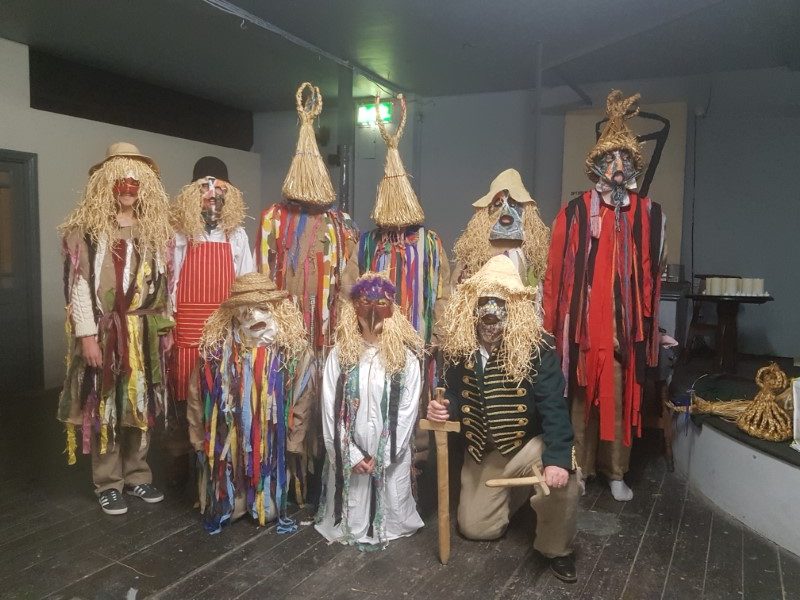
Nowadays Wren Day does not involve hunting any actual birds, though the celebrations can include a fake wren as a sort of effigy. It seems to involve people dressing up like this:

The people dressed like Boris Johnson in that photograph are mummers (or wrenboys, or strawboys) and they take part in parades, sing songs and generally carry on. There are Mummers parades elsewhere in the world too, although probably not this year because of Coronavirus restrictions. This year groups of mummers have been taking the opportunity to visit the homes of people isolated by Covid-19 restrictions, although I’m not sure I’d want a group of people dressed like that turning up at my doorstep. It’s all a bit Wicker Man for my taste.

I checked the garden this morning and there was no sign of the wren. Perhaps it knows what used to happen on this day!