Standing Up for Online Lectures

Posted in Covid-19, Education, mathematics, Maynooth with tags , , , , on November 3, 2020 by telescoper

I have a break of an hour between my last lecture on Vector Calculus (during which I introduced and did some applications of Green’s Theorem) and my next one on Mechanics & Special Relativity (during which I’m doing projectile motion), so I thought I’d share a couple of thoughts about online teaching.

I started the term by doing my lectures in the form of webcasts live from lecture theatres but since we returned from the Study Break on Monday I’ve been doing them remotely from the comfort of my office at home, which is equipped with a blackboard (installed, I might add, at my own expense….)

I still do these teaching sessions “live”, though, rather than recording them all offline. I toyed with the idea of doing the latter but decided that the former works better for me. Not surprisingly I don’t get full attendance at the live sessions, but I do get around half the registered students. The others can watch the recordings at their own convenience. Perhaps those who do take the live webcasts appreciate the structure that a regular time gives to their study. Even if that’s not the reason for them, I certainly prefer working around a stable framework of teaching sessions.

“Why am I still using a blackboard?” I hear you ask. It’s not just because I’m an old fogey (although I am that). It’s because I’m used to pacing myself that way, using the physical effort of writing on the blackboard to slow myself down. I know some lecturers are delivering material on slides using, e.g., Powerpoint, but I have never felt comfortable using that medium for mathematical work. Aside from the temptation to go too fast, I think it encourages students to see the subject as a finished thing to be memorized rather than a process happening in front of them.

I did acquire some drawing tablets for staff to enable them to write mathematical work out, which is useful for short things like tutorial questions, but frankly they aren’t very good and I wouldn’t want to use them to give an hour long lecture.

In addition to these considerations, my decision to record videos in front of a blackboard was informed by something I’ve learnt about myself, namely that I find I am much more comfortable talking in this way when I’m standing up than sitting down. In particular, I find it far easier to communicate enthusiasm, make gestures, and generally produce a reasonable performance if I’m standing up. I know several colleagues who do theirs sitting down talking to a laptop camera, but I find that very difficult. Maybe I’m just weird. Who else prefers to do it standing up?

Track and Trace & Ligatures

Posted in Covid-19, History with tags , , , , on November 2, 2020 by telescoper

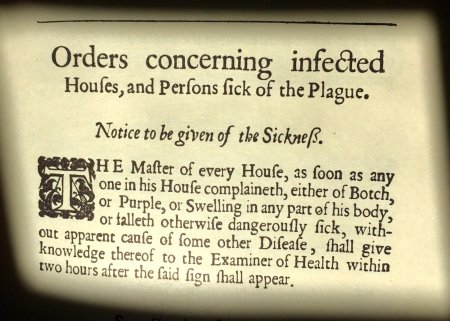
I was interested to see (on Twitter) the above example of track-and-trace from 1665, at the height of the Great Plague of London. I’m not sure how effective this notice was…

Other than its historical context, looking at this piece of text reveals some interesting things about how it was printed.

Note the liberal use of the symbol “ſ’”, for example. This character is sometimes called the “long s”*. There’s a full Wikipedia article on this and I have posted about it before which means there’s no point in repeating here, but I will just mention that the long s was used widely in manuscripts after the distinction arose better upper case and lower-case letters (which was around about the end of the 8th Century) wherein the lower-case form, the “short s” (i.e. s),  was used exclusively at the end of words or before an elision, and the long s everywhere else. It survived into the era of printing, not just in English but also in other languages including German. In fact “ſ” forms the left-hand element of the ligature “Eszett”, written  “ß”, of which the other part is “z”.

Note the use of a ligature that looks like the Eszett at the end of the word “Sickness”. This is not actually an Eszett but is instead a ligature formed from the long s and the short s. I haven’t seen many examples of this in old printed books but I’m by no means an expert in 17th Century orthography but I’m given to  understand this was used in fonts based on the Antiqua class of typefaces, typically used for printing Latin text. I suppose the piece above was produced by a printer used to that form of material. That doesn’t narrow it down much, though, as many scholarly works were published in Latin at that time.

The number of esses (both long and short, as well as capital “S” in “Sickness” and “Swelling”) is quite considerable given its brevity. The last sentence contains quite a tongue-twister too: “said sign shall”!

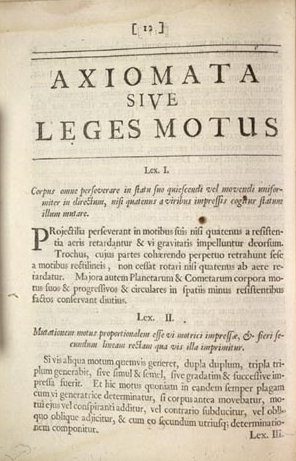
There is another ligature “ct” in the word “infected” in the heading. This is quite common in old printed works, especially in Latin.  Here is an example from Newton’s Principia; see the word “rectam” in the statement of the Second Law of Motion:

The combination “ct” is quite common in Latin, as is “ss”, as are many other digraphs, including “et” (the ligature for which gives the symbol &; “et” means “and” in Latin).

Ligatures were introduced in handwriting, partly to embellish the script and partly to save time. Joining two letters together is a way of eliminating a duplicate stroke of the pen and avoiding having to lift it from the paper. When printing presses were introduced, ligatures were found to make typesetting with movable type easier because one block would replace frequent combinations of letters. It also allows the compositor to reduce the spacing between the characters, saving paper and also making the text easier to read.

*Incidentally, for the mathematically inclined, the long s is also the original form of the integral sign, introduced to mathematics by Leibniz to stand for “summa” (sum), which he wrote “ſumma”.


Domestic Post

Posted in Biographical, Maynooth, Politics with tags , , , on November 1, 2020 by telescoper

O wild West Wind, thou breath of Autumn’s being.
Thou, from whose unseen presence the leaves dead
Are driven, like ghosts from an enchanter fleeing.

Those lines from Ode to the West Wind by Percy Bysshe Shelley came to my mind this morning not only because it’s blowing a gale outside but also because it is just after Halloween Samhain which was a noisy night because of all the fireworks, but at least I wasn’t disturbed by trick-or-treaters. I guess none of them made it past the barbed wire and electric fence…

Anyway, being confined to quarters for the day has allowed me to catch up on some domestic matters, including dealing with my first ever demand for payment of Local Property Tax (LPT) which arrived on Friday: before I bought my own home, my landlord paid the LPT on the flat I was living in. Coincidentally, along with the bill for the Local Property Tax came a letter from the Department of Employment Affairs and Social Protection (DEASP) confirming that they had changed my address on their records. I told them two months ago.

The Local Property Tax plays a similar role in Ireland to that of the Council Tax in the United Kingdom, and is also based on some notional estimate of the value of your home, but it’s quite a lot lower than in the UK. Although my house in Maynooth is worth considerably more than my Pontcanna residence the property tax is less than a third here than it is in Cardiff. You might think that’s a good thing, but the consequence is that there is a much poorer provision of local services here. In fact Local Government as a whole is a much lesser thing here than it is on the other side of the Irish Sea. Although there are elections to the local councils (in my case Kildare County Council) as there are in the UK, the ability of the councils to do anything useful is very limited.

One particular aspect of this is that householders in Ireland have to arrange their own refuse collection via a private company; in Cardiff the refuse collection service was provided by the Council. When I took over the house I asked the previous owner about refuse collections and, since I had no experience of any of the companies listed as offering this service, I simply carried on with the company she had used.

And so it came to pass that my weekly refuse and recycling collection is carried out by Bord na Móna (literally “The Turf Board”), a company set up in 1946 to supply peat as a form of fuel. Although you can still buy peat around these parts to burn on the fire, it is a very dirty fuel and harvesting it causes damage to the peat bogs in the Irish Midlands that provide a unique habitat for wildlife and plants of various kinds. Bord na Móna has therefore been diversifying into more sustainable lines of business with the intention of withdrawing entirely from peat production in the next decade or so. Among these new activities are renewable energy generation and recycling, the latter being relevant to this post.

The refuse collection, carried out through a subsidiary called AES, is quite a sophisticated operation. I have four wheelie bins (one for recycling, one for organic & food waste, one for glass, and one for general waste). Each of these bins is microchipped and the amount of general waste collected recorded at each collection. I am of frugal habits and don’t usually produce very much waste, especially general waste, though I have had a number of things delivered to the house since I moved in which always requires disposal of a considerable amount of packaging. Happily they also send a free SMS reminder of what bin to put out when.

Anyway to return to the opening theme of this post, I’ve discovered a “feature” of my new house. Being situated at the end of a row of similar properties with a wall to one side to mark the end of the row, it seems that leaves which have been blown along the road collect in great heaps on the path leading to my front door. I have to go out quite regularly with a shovel to clear them away. At present I put them in the organic refuse bin, but I’m thinking of getting a compost bin for the garden. It seems I am becoming quite domesticated in my old age.

Postscript: no sooner did I finish this post than all the power went off in the house.

Postscript to the postscript. It came on again after about 2½ hours in my area, but as I write it is still off in parts of Maynooth.

R.I.P. Sean Connery (1930-2020)

Posted in Film with tags , on October 31, 2020 by telescoper

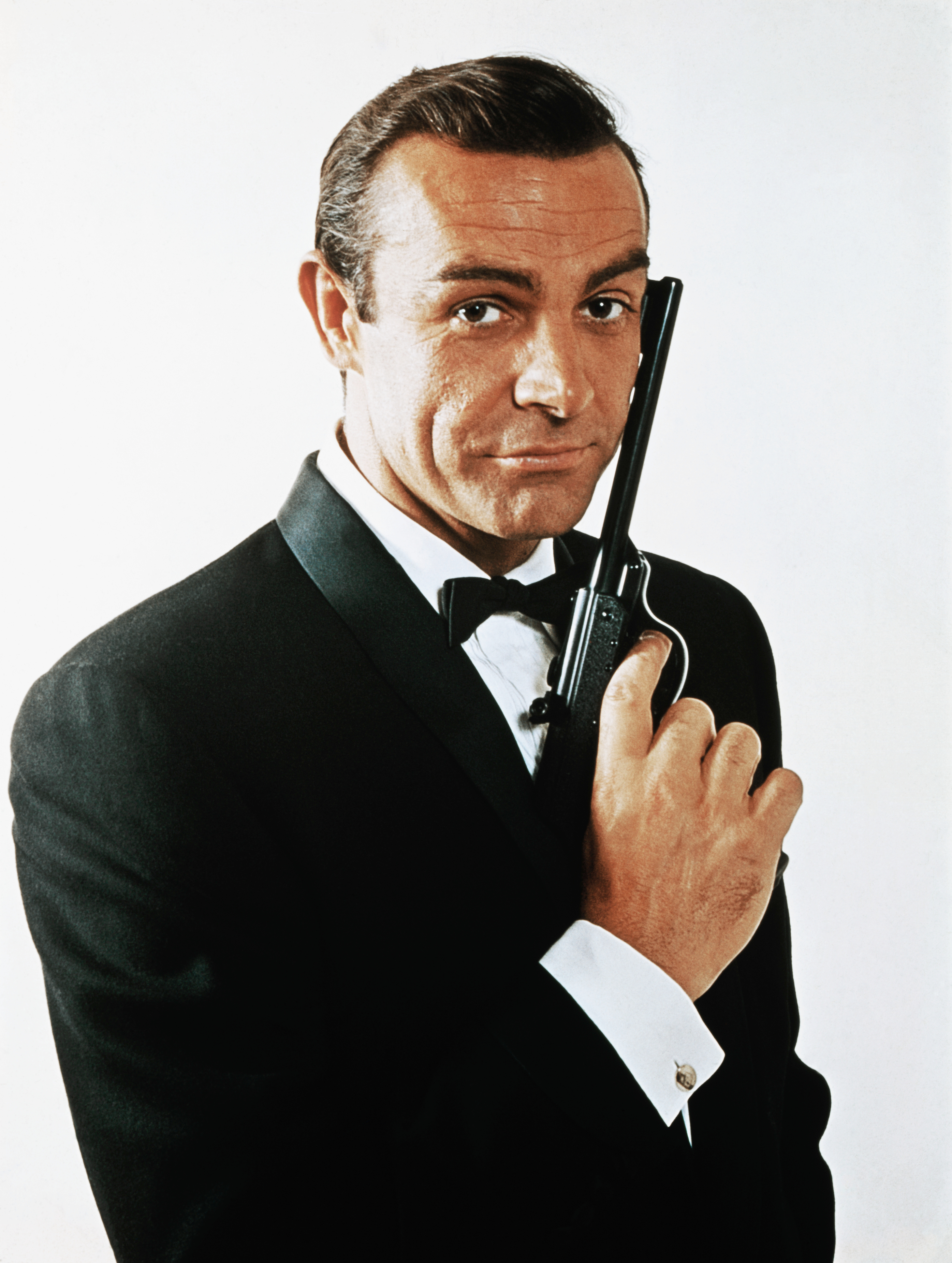
Rest in Peace, Sean Connery, a very fine actor in many roles, but above all The One True James Bond..

Stormy Samhain Super Saturday

Posted in Biographical, Covid-19, Irish Language, Maynooth, Rugby with tags , , on October 31, 2020 by telescoper

So we have arrived at October 31st, Hallowe’en or, in pagan terms, Samhain. This, a cross-quarter day – roughly halfway between the Autumnal Equinox and the Winter Solstice represents the start of winter (“the dark half of the year“) in the Celtic calendar.

Incidentally, Samhain is pronounced something like “sawin”. The h after the m denotes lenition of the consonant (which in older forms of Irish would have been denoted by a dot on top of the m) so when followed by a broad vowel the m is pronounced like the English “w”; when followed by a slender vowel or none “mh” is pronounced “v” or in other words like the German “w” (which makes it easier to remember). I only mention this because I hope to be starting Irish language lessons soon, something I always wish I’d done with Welsh when I lived in Cardiff.

Anyway, it’s a wild blustery day with the wind howling down the chimney of my house in Maynooth sounding like a ghost. At least thanks to the present Level 5 restrictions I won’t have to endure trick-or-treaters this evening. Or will I? Should I sit quietly at home with the lights off again?

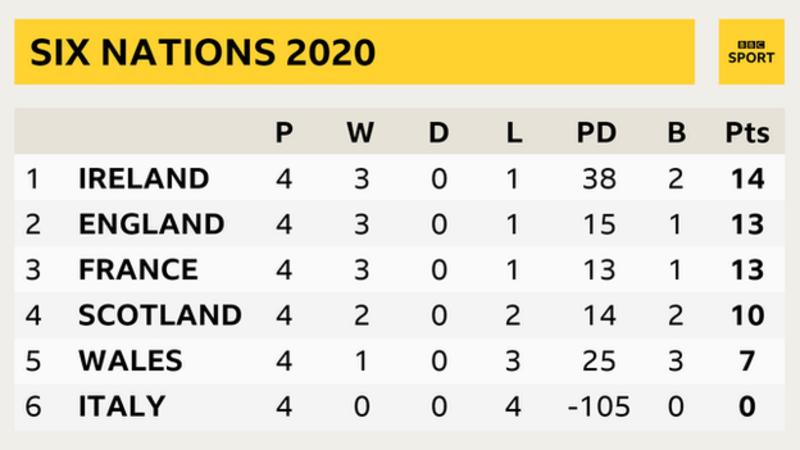
Today’s schedule will revolve around the final round of matches in this year’s Six Nations championship. The settled order of nature having been disturbed by Covid-19 back in March it has only just become possible to finish the competition with three games today. Ireland travel to France for the last game this evening, after England play Italy and Wales play Scotland. Ireland currently head the table, but they have a difficult task in Paris: they need not only to win to secure the Championship but to do so by a bonus point because England will almost certainly get a bonus point against a poor Italian side. The Irish press are talking up the national team’s chances of winning handsomely, but it seems to me rather unlikely especially because France too have a chance of the title if they beat Ireland and get a bonus point. Both sides clearly have to attack, which should make for a good contest.

For what it’s worth, my predictions are: Wales to beat Scotland, England to beat Italy (with a bonus point) and France to beat Ireland (but no bonus point). That combination would make England the champions, with France second and Ireland third.

Update: 16.05. Wales 10 Scotland 14. My predictions are not off to a good start. Scrappy, error-strewn game with Scotland’s try from a maul that shredded the Welsh defence the highlight of the game. Bad result for Wales but it is good to see Scotland back as a force to be reckoned with.

Update: 18.45. England improved dramatically after a poor first half, and eventually ran out winners by 34 points to 5. That means their points difference is +44 compared to Ireland’s +38. Ireland need a win by 7 or more points (or with a bonus point) to win the Championship.

Update: 21.00. Half-time France 17 Ireland 13. France leading without having played particularly well, thanks to two big Irish errors. Ireland need to score 10 points more than France in the 2nd half.

Update 22.00. Final score France 35 Ireland 27. France won with a bonus point but not by a sufficient margin to win the Championship, which goes to England, with France second and Ireland third. It didn’t go exactly as I predicted but I wasn’t far off!

El Espectro

Posted in Biographical with tags , , on October 30, 2020 by telescoper

I have quite a friendly name for anagrams, with mixture of fairly common vowels and consonants that can give not only `telescoper’, but such gems as ‘closet peer’, `elect prose’, ‘poles erect’ and ‘tesco leper’. It is only recently however that I have discovered that this also extends to foreign languages, specifically Spanish. The character `El Espectro‘ (un Antihéroe ficticio publicado por la editorial estadounidense DC Comics) is a seasonal example:

It is a shame that Mr Espectro does not look much like me. Admittedly we do have similar physiques but he alas has no beard.

Odds on Trump

Posted in Politics with tags , , , on October 29, 2020 by telescoper

I’ve been busy all day on a secret mission (from the safety of my own home) which left me no time to do a proper post, so I’ll just do a quickie to mention the state of play as the US presidential election approaches.

Although Joe Biden seems to be comfortably ahead in terms of the popular vote, the vagaries of the American voting system do not easily translate into the probability of a win. After all, Hillary Clinton won the popular vote in 2016, and look what good that did her!

I looked at odds checker just now and saw the best Bookies odds are Biden 11/20 on and Trump 15/8 against. That’s uncomfortably close given what an appallingly terrible man the incumbent is, but at least 40% of the American electoral don’t seem to mind having a such an item for a president so there’s a significant chance that he’ll win, especially since his campaign has been deploying extensive spoiling tactics to tilt the vote in his favour.

Yesterday I decided that I would follow my usual betting practice and place a wager on the outcome that I don’t want to happen. I did this in 2016. Then Hunting the best odds I could find were 18-5 against Donald Trump. I put a monkey* on, and walked away with £2300 (being £1800 plus my stake) when Trump won.

I followed the same strategy on the Brexit Referendum Day as I felt it in my bones that Vote Leave was going to win. I ended up depressed but compensated to the tune of £1000.

I’m afraid to say I feel the same way now about the likelihood of a Trump victory. Not very scientific, I know, but there you go. This year the odds are a lot shorter and I think I’ll bet a bit less, but I’ll still go for the compensation strategy.

I have never paid much attention to American politics in the past. It is as incomprehensible to me as British politics must be to them. Gore Vidal summed it up for me:

There is only one party in the United States, the Property Party … and it has two right wings: Republican and Democrat. Republicans are a bit stupider, more rigid, more doctrinaire in their laissez-faire capitalism than the Democrats, who are cuter, prettier, a bit more corrupt — until recently … and more willing than the Republicans to make small adjustments when the poor, the black, the anti-imperialists get out of hand. But, essentially, there is no difference between the two parties.

Although both parties still represent the moneyed classes more than anyone else, but this time the Republican contender is a corrupt narcissist who has already done untold damage to his country. Americans are free to vote for whomever they wish, of course. I don’t have a say, as I’m a foreigner.

Although I find it deeply depressing that this race is even close, I won’t lose any sleep over the election night. I’ll do what I did on the day of the EU referendum: drink some wine, listen to music and then go to sleep. There’s no point in worrying about things that are out of your hands.

(*monkey = £500)

Phosphine on Venus, Water on the Moon, and Hype Everywhere

Posted in Astrohype, The Universe and Stuff with tags , , on October 28, 2020 by telescoper

To continue the ongoing saga of Phosphine in the atmosphere of Venus there’s a very strongly worded paper on the arXiv with the following abstract:

It’s one thing to question or refute another group’s result, but there’s no need to be so aggressive about it. The last sentence of the abstract is particularly unnecessary and reprehensible.

Update: the abstract has now been changed.

There has been a lot of reaction on social media from astronomers and others to the perceived “hype” of the initial discovery by the authors. I watched the press conference at the time and I think the authors spoke very sensibly about their work. Of course just because scientists are sensible that’s no reason to suppose the press will also be sensible and there was undoubtedly a great deal of hype about that result. In my experience hype is more likely to be a result of journalists wanting a sensational story and/or institutional press offices wanting to promote their institution that scientists over-egging their own puddings (though that does happen too).

I don’t mind individual scientists or groups of scientists making fools of themselves. It’s the damage to public trust in science that is the real danger here.

The hostile reaction we see in the above paper is an inevitable manifestation of an environment which encourages runaway self-publicity. This is not the only area in which this sort of toxic behaviour happens. I suppose it is mildly reassuring that it’s not only cosmologists that behave in such a way, but is this really what we want astrophysics to be like? I think we’d be better off leaving the petty point-scoring to the politicians.

Another example of hype this week – also involving a paper in Nature Astronomy – was the discovery of water on the Moon (again). The NASA publicity machine pulled out all the stops in advance of this announcement, only for the actual result to be a damp squib. Water is one of the most abundant molecules in space and I’ve lost track of how many times it has been detected on the Moon already. I suppose it is moderately reassuring that hasn’t suddenly disappeared, but from a scientific point of view it’s not all that interesting. I was particularly disappointed when the result turned out to be water, as I had bet on phosphine…

Could it be that the Stratospheric Observatory for Infrared Astronomy (SOFIA) is up for a funding review?

Eye on Burlington House

Posted in The Universe and Stuff with tags , , on October 27, 2020 by telescoper

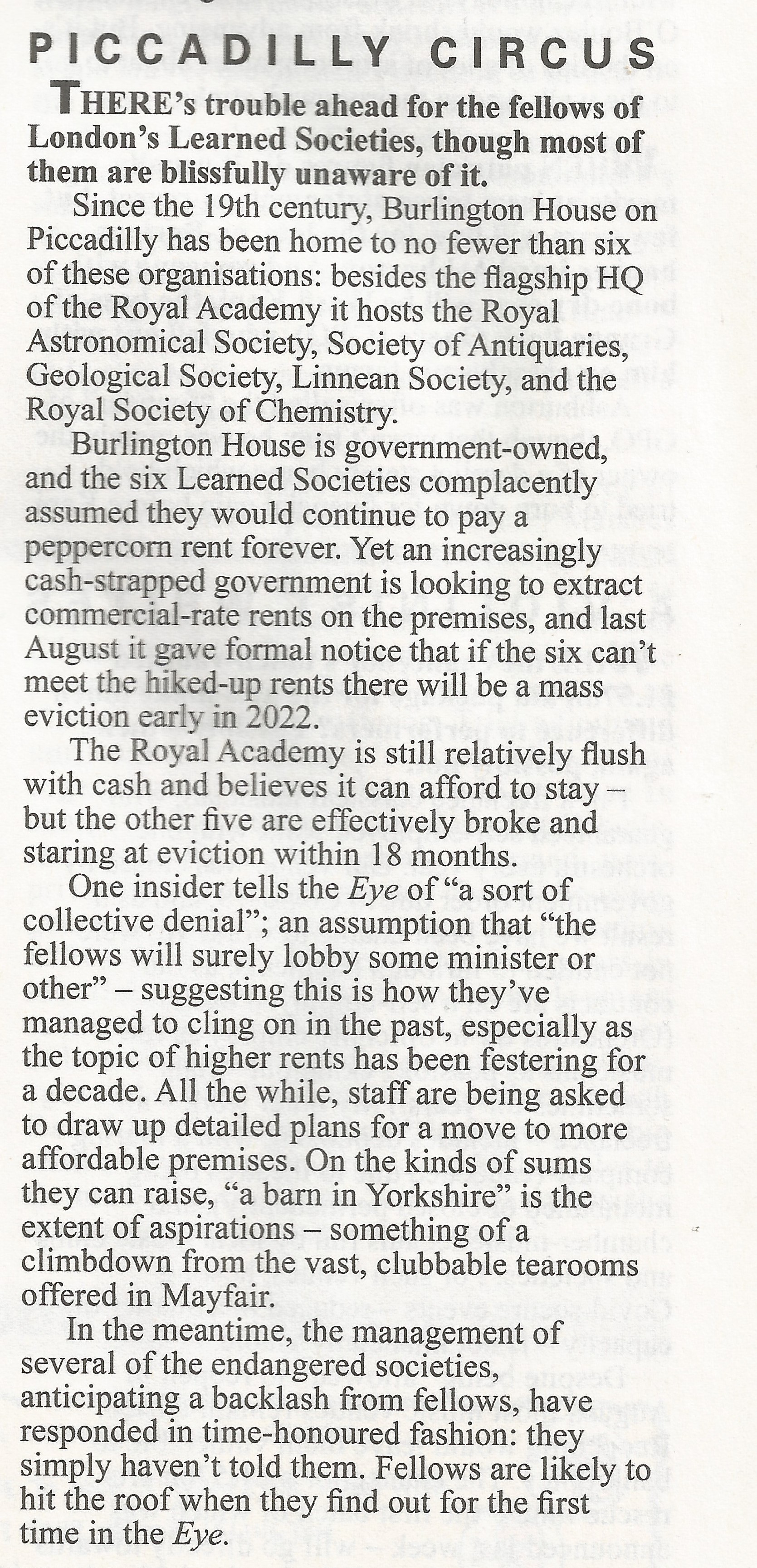
Having been forewarned of this story as soon as my copy of Private Eye arrived (this morning, owing to the Bank Holiday weekend) I headed straight to this:

It sounds rather alarming for the Royal Astronomical Society, which is currently accommodated in Burlington House in Piccadilly, but I do remember something similar being in the air not too long ago when I was a Member of RAS Council. The Government of the time threatened to increased rents and everyone involved with the RAS, including its Fellows, was a bit worried but an agreement was struck. Presumably now the leases are up for negotiation again?

It’s worth pointing out a few inaccuracies in the Eye piece.

  1.  “..the six Learned Societies complacently assumed they would continue to pay a peppercorn rent forever”. This is untrue as the rents have been renegotiated before (see above).
  2.  “The Royal Academy is still relatively flush….but the other five are effectively broke”. I don’t know anything about the others but I’d be very surprised if the Royal Society of Chemistry is “effectively broke” given the income from its academic publishing wing. It also has sizeable industrial income, as does the Geological Society. The Royal Astronomical Society has sizeable reserves in the form of a portfolio of long-term investments built up over the 200 years of its existence but it tends not to use them to fund expenditure; its main cash flow is provided again by academic publishing, especially Monthly Notices of the Royal Astronomical Society. This year – the bicentenary of its foundation – is a bit of an exception because it has dipped into reserves to fund a series of celebratory outreach activities.
  3. The description of “vast clubbable tearooms” is inaccurate too. The RAS occupies rather cramped accommodation in one corner of Burlington house. There is a Fellows’ Room but it is rather small. There are staff offices, a (small) lecture theatre and an important historical library. There are also the President’s Apartments (which I have of course never seen).

I wouldn’t put it past this particular Government to kick out the Learned Societies and outsource Burlington House to Serco but even if this does happen, it wouldn’t be the end of the world.  In my view the RAS needs to shake off the fusty image that its current accommodation in what looks like an old museum tends to perpetuate.  It has always been the case that most of the regulars at the monthly Open Meetings in Burlington House are based in or near London, which means many Fellows don’t get the chance to be involved. Would it really be all that bad for the Royal Astronomical Society had to move? They may have to overhaul their finances anyway if their publishing revenues dry up…

Why not use the opportunity to move the Society out of London altogether to a place with a strong astronomical connection, Bath for example, although that would admittedly make it difficult to get to the Athenaeum in time for dinner…

And if “commercial rates” are going to be the thing for Government-owned buildings, shouldn’t the occupant of 10 Downing Street be charged for his accommodation?


How Mozart Became a Bad Composer, by Glenn Gould

Posted in Music with tags , , on October 26, 2020 by telescoper

I’m not sure how many readers will agree with Glenn Gould’s analysis of Mozart’s piano compositions, especially his later ones, but I think it’s well worth watching and listening to, not least because the presenter is obviously relishing the opportunity to say what he really thinks in the full knowledge that in the process he is winding up a great many of his audience! It’s also interesting how he delivers his pieces to camera: it doesn’t look like he’s using an autocue but he’s a very precise and coherent speaker.