Storm Scenes

Posted in Film with tags , , , on August 19, 2020 by telescoper

Ireland, especially the South and West thereof, is bracing itself tonight for the arrival of Storm Ellen. It seems likely to reach Maynooth in the early hours of tomorrow morning but will probably have dissipated a bit by then.

Anyway, the thought of a storm battering the Irish coast reminded me of the memorable storm scenes in David Lean’s 1970 film Ryan’s Daughter. The film crew had to wait almost a year near the coast at Dingle for a sufficiently violent storm but when one arrived they caught its elemental power superbly. No CGI in these shots!

I love the long shots of the people scurrying like ants on top of the cliff. Their movement makes them look terrified. I suspect they weren’t acting.

Update: it was indeed a very stormy night. I was woken up a few times by the gales, and there are lots of reports on the radio of fallen trees and debris, but I don’t know of any serious damage here in Maynooth.

Covid-19 in Ireland: No End in Sight

Posted in Covid-19, Maynooth with tags , , , on August 19, 2020 by telescoper

Yesterday the Irish Government put the brakes on the relaxation of the restrictions imposed because of the Covid-19 pandemic and tightened up some existing rules. The reason for this move is obvious when you look at the data:

After dropping to very low numbers of new cases a couple of months ago, the curve has been steadily rising. On Saturday 200 new cases were reported and yesterday the figure was 190. The average number of cases per day over the last 7 days is now over a hundred. The last time it was that high was in early May.

So what has gone wrong?

A large fraction of the cases appearing in the latest outbreaks is associated with either meat (or other food) processing plants and with direct provision centres. These are particularly vulnerable to outbreaks because of the difficulty of maintaining social distancing. Most of the people involved however are under the age of 40, so these outbreaks are not (yet) associated with a significant increase in mortality. Until recently it was hoped these localised `events’ could be contained by testing, contact-tracing and isolation.

Unfortunately these outbreaks are happening at a time when public adherence to Covid-19 restrictions has also been declining. I have noticed over the past few weeks that many people in Maynooth are congregating outside, especially in Courthouse Square, without any attempt at social distancing and with nobody wearing a face masks. Pubs in the area are serving drinks to take away and people are just taking them outside and treating the public areas as a big beer garden. The law it seems can do nothing about this, and pub landlords are doing nothing to discourage it.

The problem in this respect started back in June when the (then) Taoiseach Leo Varadkar decided to accelerate the stages of the Roadmap. I didn’t understand this at the time. The plan was carefully thought out and was working. Why change it? The answer is of course intensive lobbying from vested interests worried about the impact on their own finances.

Anyway, the effect of this change was immediately noticeable in that a sizeable contingent of the public clearly thought it was a signal that the Covid-19 outbreak was over and became complacent about the continuing risk of community transmission.

I think of the outbreaks in factories and direct provision centres as sparks that can hopefully be snuffed out quickly. The real risk to the public however is from these sparks spreading the conflagration into the general population. Social distancing acts like a sort of fire break – that’s what the new restrictions are trying to achieve.

What this means for the next month or so I can’t say, but I wouldn’t rule out a full lockdown being imposed again.I hope that doesn’t happen because I am looking forward to getting back to teaching, but it’s looking touch-and-go at the moment.


The U-turn and After …

Posted in Education, Politics with tags , , , on August 18, 2020 by telescoper

One of the many things that Winston Churchill never said (referring to Americans) is that they “…will always do the right thing – after exhausting all the alternatives”. Yesterday the UK Government performed a U-turn on its approach to A-level results but only after extensive protests and after causing immense stress to a great many students. All of this could have been avoided had the Secretary of State for Education bothered to look at the results of the downgrading algorithm. This morning he said that he “wasn’t aware” of what the outcomes would be and tried to put the blame on OfQual. Well, it’s actually his job to be aware of these things and that statement shows he’s not doing his job.

While many students will be mighty relieved that their official A-level grades will go up, that won’t be the end of this fiasco. Many students will find that their places have been already been filled through last week’s clearing process. The Government has lifted the number cap on places in imposed earlier this year, but that won’t help many departments, especially those in the sciences, who have severe constraints on, e.g., laboratory capacity (more so with social distancing in place).

I feel very sorry for friends and former colleagues in UK universities having to deal with this shambles. The Government will be quite happy that it has managed to throw this particularly hot potato into the hands of admissions tutors across the land. Ministers will be hoping that whatever blame now accrues will be attributed to universities being “inflexible” when it is entirely down to incompetence elsewhere. As always it’s the front-line staff who will have to deal with it, as if their job was not stressful enough having to deal with Covid-19.

Meanwhile, here in Ireland, the Government’s plan for “standardisation” of this year’s Leaving Certificate results looks alarmingly similar to the failed approach tried – and subsequently abandoned – in the United Kingdom. Minister for Education Norma Foley has been making statements about the accuracy and reliability of her Department’s plans that sound eerily similar to those issued by officials across the Irish Sea. I hope that I’m wrong about this – and that there’s some frantic activity going on behind the scenes to change the approach ahead of the release of this year’s Leaving Certificate grades (due on September 7th) – but I have a feeling that we’re going to see yet another slow-motion car crash. It wouldn’t be the first time that, having observed something truly shambolic happening in the UK Education system, an Irish Government then proceeds to do exactly the same thing…

Forgotten Fires at Maynooth

Posted in History, Maynooth with tags , , on August 17, 2020 by telescoper

I’m taking the liberty of reblogging this fascinating bit of local Maynooth history. I did know about the 1878 fire on South Campus, having read about it here, but for some reason I had imagined it happened elsewhere in the College. St Mary’s Square, which was designed by Augustus Pugin,  is actually behind St Patrick’s House as you look at it from the larger St Joseph’s Square.


The college chapel was not completed until 1891 so can’t be seen on the picture of the aftermath of the fire shown in the blog post; the spire wasn’t built until 1895. St Mary’s is part of the national seminary, as opposed to Maynooth University.

New House, site of the later fire in  1940 , forms the North side of the quadrangle enclosing St Joseph’s Square which is to your right as you look towards St Patrick’s House. It is home to the Law Department of Maynooth University.

Special Collections's avatarMU Library Treasures

by Sarah Larkin, Archivist, St Patrick’s College Maynooth

Dublin fire brigade attending the fire at New House, 29 March 1940.

This yearSt Patrick’s College, Maynooth celebrates 225years since its foundation in 1795. This blog post is the second in a series highlighting some of the interesting and lesser known events and facts of the College’s history. This postlooks attwo occasions when fire broke out in the College, and how tragedy was avoided.

On 1 November 1878, at 8am in the morning, fire broke out in St Mary’s inMaynooth College. The College fire engine proved to be inadequate. An attempt to summon help from the Dublin fire brigade failed, as the local telegraph failed to work and a message had to be sent from Celbridge. A special train was immediately laid on in Dublin to bring the fire engine to Maynooth. It was thendrawn to the College…

View original post 423 more words

To Fool the Faeries

Posted in History, Maynooth with tags , on August 16, 2020 by telescoper

I follow a fascinating little Facebook group which features old pictures of Maynooth. The above picture is not from there – it’s a private group – but I found it on the net after seeing one of the posts there on the same subject.

The point is that the little kids wearing skirts and dresses in that old photograph are all boys.

Apparently it was a tradition in some parts of rural Ireland until relatively recently (at least until the 1930s) to dress young boys (up to the age of about 12) as girls. The reason for this is both strange and sad.

In poorer communities infant mortality was high. The tragic and otherwise inexplicable deaths of young children were attributed to the malicious actions of the faeries – aos sí – supernatural beings believed in Gaelic tradition to be descendants of the people who built the burial mounds, tumuli and other prehistoric structures found all around Ireland. According to the tradition, the faeries prefer to make off with the souls of male rather than female children. Dressing boys as girls was an arrempt to protect them by fooling the faeries.

The sad fact behind this is that boys are significantly more likely to die young than girls, even in affluent societies where infant mortality is generally low, though it is probably more noticeable where infant mortality is high. The belief in faeries preferring to take boys reflects a kind of folk knowledge of this statistical fact. The reasons why boys are more likely than girls to die in infancy are complex and, as far as I know, not fully understood.

I find these traditional beliefs fascinating because they are not simply quaint superstitions – they are attempts to understand real phenomena.

The world of Gaelic mythology itself is, at least partly, built on folk memory of very ancient history. There were, after all, people in Ireland who built places like Newgrange, long before the arrival of Celtic people from somewhere in Iberia, and nobody really knows what happened to them. In mythology they turned into the little people and went underground, but are still here. Which, in a sense, they are…

R. I. P. Julian Bream – Homenaje

Posted in Music with tags , , , on August 15, 2020 by telescoper

More very sad news arrived yesterday with the death at the age of 87 of the brilliant guitarist and lute player Julian Bream. His influence on the classical guitar, through both playing and teaching, was enormous and he leaves a rich legacy of recordings covering a vast repertoire. I remember seeing and hearing him play and talk about music many times on TV when I was younger, and have quite a few recordings.

It’s difficult to pick an appropriate piece to pay homage to him, but I settled on this wonderful work Homenaje by Manuel de Falla. The full title of this, de Falla’s only piece for guitar, is Homenaje pour Le Tombeau de Claude Debussy and it was a tribute to Debussy. It also provided Benjamin Britten, when he heard Bream play it, with the inspiration to write a much longer piece for Bream, called Nocturnal, which uses a theme from Elizabethan composer John Dowland. Given these connections I thought it would be a nice tribute.

Anyway this is an older Bream playing Homenaje very beautifully and it’s beautifully filmed too!

R. I. P. Julian Bream (1933-2020)

The Great A-level Scandal

Posted in Education, Politics with tags , , on August 14, 2020 by telescoper

The full scale of the scandal of this year’s A-level results is now becoming clear and it is bad enough to bring down a Government. Unfortunately there are so many scandals surrounding the UK Government (e.g. corrupt procurement deals, collapsing economy, terrible Covid-19 mortality figures, fiddled Covid-19 testing statistics, not to mention Boris Johnson himself) that nobody seems to care about that one more probably won’t make much difference.

Yesterday Qfqual released its report on this year’s A-level results which reveals that in arriving at the final grades, the algorithm deployed was based on past performance of pupils at the candidate’s school. in many cases this has resulted in students being downgraded by several grades in a manner that is both arbitrary and cruel.

Update: I’ve just heard from a physics, in an institute in which I once worked, that a student with original grade A* in Physics A-level has been assigned a final grade E. Unbelievable.

That starting point of the Ofqual approach is indefensible. A student’s examination grade should be determined by the student’s own performance, not by the performance of previous generations of students who happened to go to the same school at some time in the past.

Not surprisingly, the Ofqual approach has benefited students who went to private schools and severely disadvantaged students at less privileged establishments. The rightwing media are justifying this on the grounds that teachers at some state schools have inflated their students’ estimated grades. The attitude is that working class kids can’t possibly deserve an A* so their teachers must have cheated! I can’t believe this bias is unintentional. The Tory message to the less privileged is that they need to know their place. You needn’t ask who is behind this deliberate demographic* profiling. It stinks of the unofficial Prime Minister Dominic Cummings

But even within its own flawed terms the Ofqual algorithm is garbage. Table E8 in the report shows that when applied to last year’s input data (mock exams and centre-based assessments), even in the best case subject (History) the prediction was only accurate for 67% of students; the figure falls to less than 50% for, e.g., Further Mathematics. When the Ofqual panel saw that they should have abandoned their algorithm immediately. The fact that they pursued it knowing how deeply problematic means that they are more interested in serving their political masters than the students whose prospects they have deliberately blighted.

In my view a system should be introduced that gives the student the benefit of the doubt. Grades should be awarded based on what the student has achieved. If that ends up being too generous to a few students then that’s surely better than the opposite? Whenever I’ve been involved in University examinations processes when emergency changes were required we have always implemented a `no detriment to the students’ policy. It’s the obvious fair thing to do.

Oh, and you might ask why universities don’t show some humanity and accept students whose grades have been reduced. The answer to that is simple. If they do, they will go down in the league tables. And for many senior managers that’s all that matters.

*which means, of course, (indirect) racial profiling too.

Disturbing Admissions

Posted in Education, Maynooth with tags , , , on August 13, 2020 by telescoper

So, as the second day of Repeat Examinations at Maynooth University gets under way, students in the United Kingdom are receiving their A-level results. I’ve already heard a number of stories from friends and colleagues flabbergasted by the way some marks have been treated, so it all looks likely to be quite a mess. I have great sympathy for the students, for whom this has been an extraordinarily difficult year, and I hope the A-level fiasco doesn’t affect too many too badly.

My experience of over 30 years teaching in UK universities has convinced me that A-levels are not a very good preparation for higher education anyway and the obsession with them is rather unhealthy. Some of the best students I’ve ever had the pleasure of teaching came to University with poor A-level grades (for a variety of reasons).

In fact I’d go as far as to say that the entire system of University admissions in the United Kingdom needs to be overhauled. As I said in a post almost a decade ago:

…if we had the opportunity to design a process for university admissions from scratch, there is no way on Earth we would end up with a system like the current one.

Of course I longer work in the UK so there’s no longer a “we”, but the system in Ireland is not that much different, with the Leaving Certificate playing the role of A-levels for the vast majority of students.

As things stand in the UK, students apply for university places through UCAS before they have their final A-level results (which don’t come out until August). Most applications are in by January of the year of intended admission, in fact. The business of selecting candidates and making offers therefore usually makes use of interim results or “predicted grades” as supplied by teachers of the applicant.

In my (limited) experience most teachers systematically overestimate the grades of their pupils, which is presumably why so many of this year’s A-level results are being downgraded, but there are lots of unconscious biases at play here and I accept that some teachers may be unduly pessimistic about their students likely performance.

But the inaccuracy of predicted A-level grades is not the only absurdity in the current system. Universities have to engage in enormous amounts of guesswork during the admissions process. Suppose a department has a quota of 100, defining the target number students to take in. They might reasonably get a minimum of 500 applications for these 100 places, depending on the popularity of university and course.

Each student is allowed to apply to 5 different institutions. If a decision is made to make an offer of a place, it would normally be conditional on particular A-level grades (e.g. AAB). At the end of the process the student is expected to pick a first choice (CF) and an insurance choice (CI) out of the offers they receive. They will be expected to go to their first choice if they get the required grades, to the insurance choice if they don’t make it into the first choice but get grades sufficient for the reserve. If they don’t make either grade they have to go into the clearing system and take pot luck among those universities that have places free after all the CFs and CIs have been settled.

Each university department has to decide how many offers to make. This will always be larger than the number of places, because not all applicants will make an offer their CF. They have to honour all offers made, but there may be penalties if they under or over recruit. How many offers to make then? What fraction of students with an offer will put you first? What fraction of them will actually get the required grade?

The answers to these questions are not at all obvious, so the whole system runs on huge levels of uncertainty. I’m amazed that each year any institution manages to get anywhere close to the correct number, and we usually get very close indeed by the end.

It’s a very skilled job being an admissions tutor, but there’s no question it would all be fairer on both applicants and departments to remove most of the guesswork by which I mean allowing students to apply to University after they have got their results. But there is the rub. There are two ways I can see of changing the timetable to allow this:

  1. Have the final A-level examinations earlier
  2. Start the university academic year later

The unavoidable consequence of the first option would be the removal of large quantities of material from the A-level syllabus so the exams could be held several months earlier, which would be a disaster in terms of preparing students for university.

The second option would mean starting the academic year in, say, January instead of September. This would in my opinion be preferable to 1, but would still be difficult because it would interfere with all the other things a university does as well as teaching, especially research. The summer recess (July-September), wherein much research is currently done, could be changed to an autumn one (September-December) but there would be a great deal of resistance, especially from the older establishments; I can’t see Oxbridge being willing to abandon its definitions of teaching term! And what would the students do between July and January?

Either of these options would cause enormous disruption in the short-term, which is presumably why they have never been implemented. However, this year everything is disrupted anyway so there’s an opportunity to redesign the whole process. Delaying the start of the academic year until January 2021 would make a great deal of sense this year in particularly, though I think it’s a bit late to be doing it now.

I don’t really imagine the Government is thinking of doing this but here are some suggestions of elements of a new admissions system:

  • Students to apply after receiving A-level* grades (i.e. implement 1 or, preferably, 2 above)
  • All university applications to be anonymous to prevent discrimination.
  • The identity of the applicant’s school to be withheld to prevent undue influence.
  • Teachers to play no part in the process.

*I don’t think A-levels are fit for purpose so here I mean grades of whatever examination replaces them.

Marginalia

Posted in Cute Problems, Education, The Universe and Stuff with tags , , , , , on August 12, 2020 by telescoper

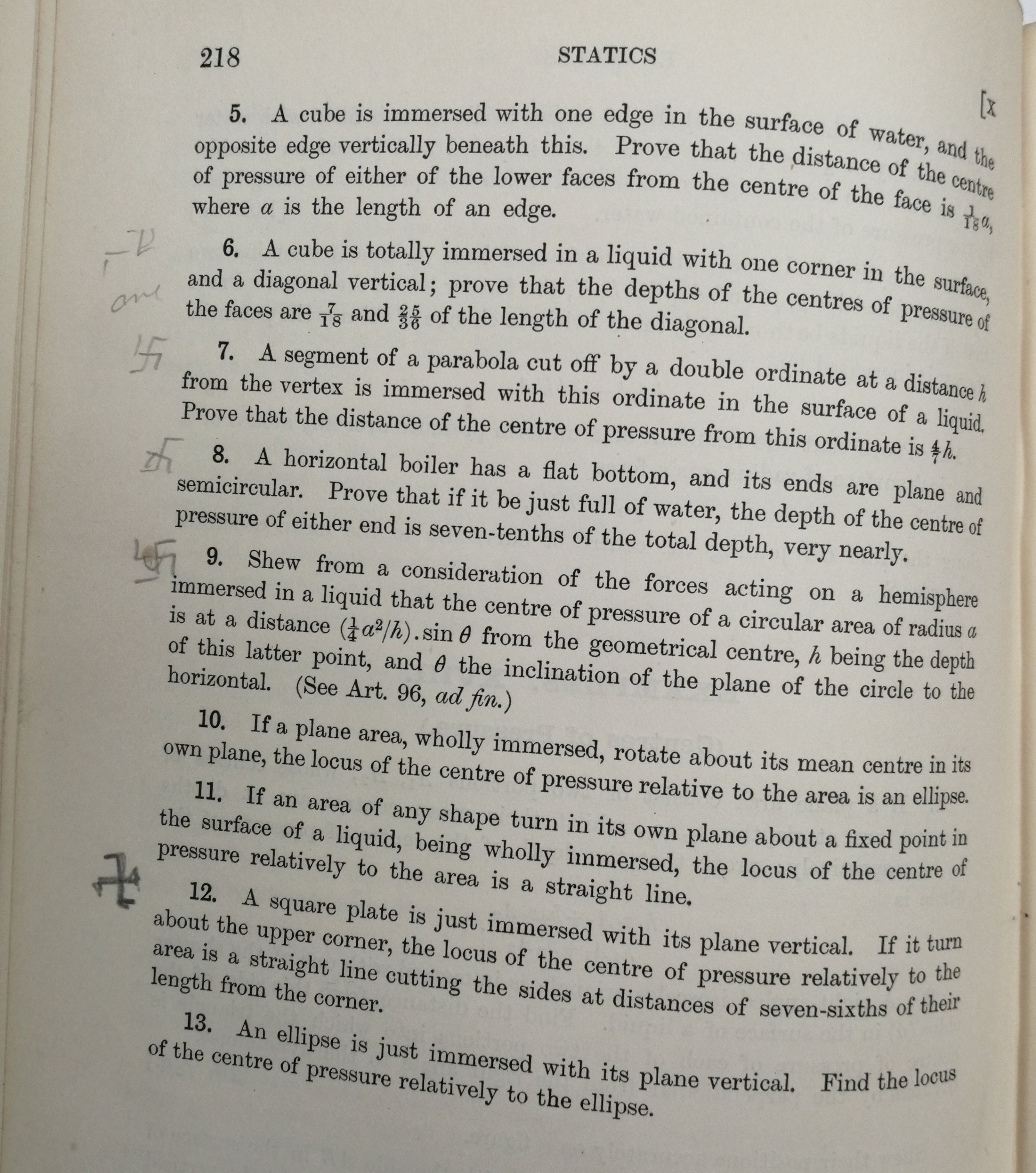
While this morning’s repeat exams were going on I was leafing through an old second-hand text book, one of many I have acquired over the years looking for nice problems and worked examples. The good thing about old books is that solutions to the problems are usually not available on the internet, unlike modern ones. The book concerned this morning is a classic: Statics by Horace Lamb, which you can still get via Cambridge University Press. I have the first edition, published in 1912.

Looking through I was somewhat alarmed to see what had been pencilled in some of the margins:

Of course anyone who has been to India knows that the swastika isn’t necessarily a Nazi symbol: you find it all over the place in the Indian sub-continent, where it is used as a symbol for good luck. I remember being given a very nice conference bag in Pune many years ago with a swastika on it. I didn’t use it back home, of course.

The first owner of the copy of Statics that I have was acquired in 1913 by a J.H.C (or G) Lindesay of Sidney Sussex College, Cambridge. I know because he/she inscribed their name in the front. That doesn’t look to me like an Indian name, but I think it’s a fair bet that the book passed through many hands before reaching me and that one of the past owners was Indian. I haven’t tried any of the problems marked with the swastika, but perhaps they are difficult – hence the `good luck’ symbol? I notice though that the symbol at the bottom of the page has a chirality different from the others. Is this significant, I wonder?

All of which irrelevance reminded me of an discussion I’ve had with a number of people about whether they like to scribble in the margins of their books, or whether they believe this practice to be a form of sacrilege.

I’ll put my cards on the table  straightaway. I like to annotate my books – especially the technical ones – and some of them have extensive commentaries written in them. I also like to mark up poems that I read; that helps me greatly to understand the structure. I don’t have a problem with scribbling in margins because I think that’s what margins are for. Why else would they be there?

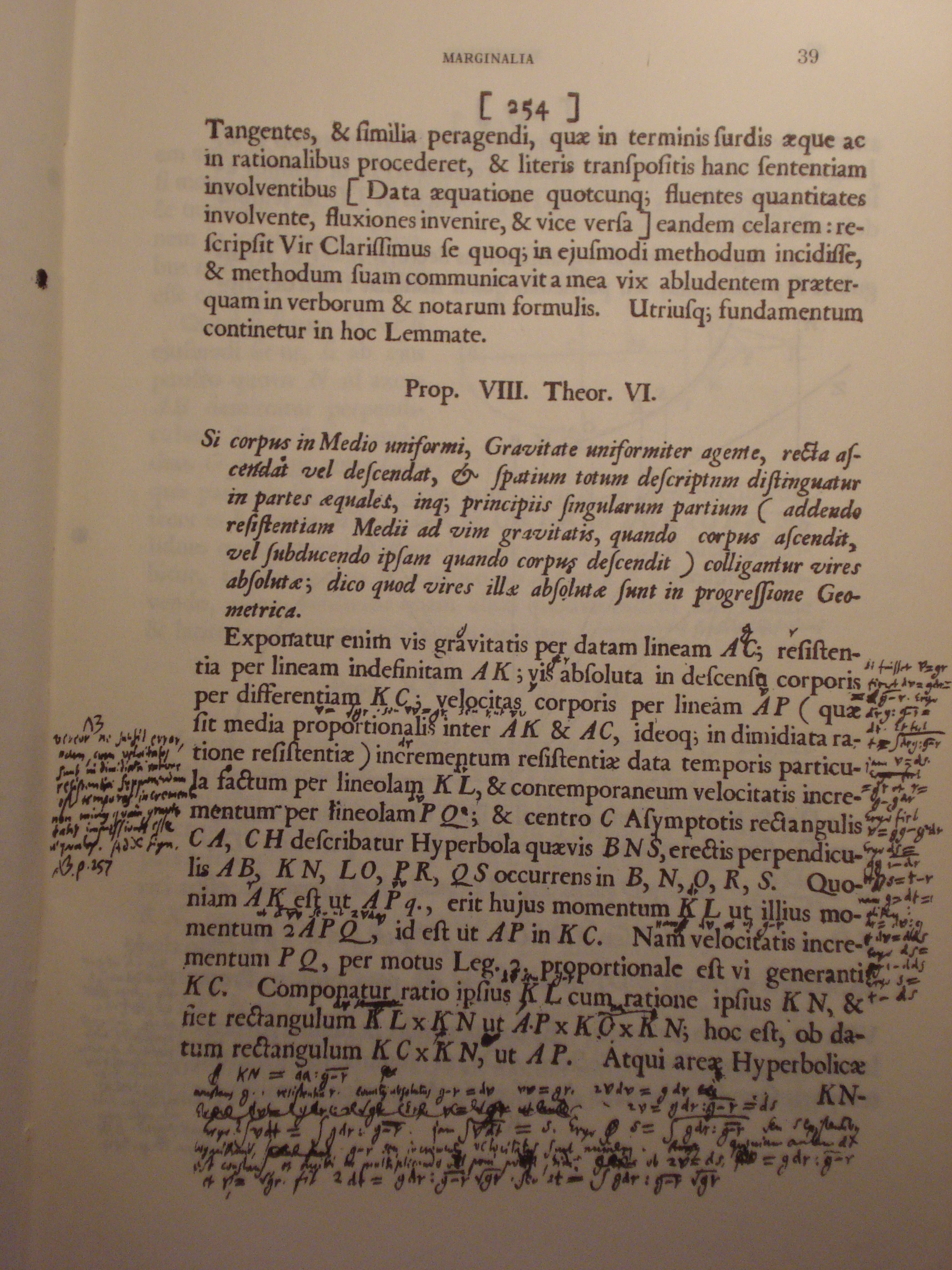
This is a famous example – a page from Newton’s Principia, annotated by Leibniz:

dsc00469

Some of my friends and fellow academics, however, regard such actions as scandalous and seem to think books should be venerated in their pristine state.  Others probably find little use for printed books given the plethora of digitial resources now available online or via Kindles etc so this is not an issue..

I’m interested to see what the divergence of opinions is in with regard to the practice of writing in books, so here’s a poll for you to express your opinion:

Examination Shenanigans

Posted in Covid-19, Education, Maynooth with tags , , , on August 12, 2020 by telescoper

So here I am in my office while the first batch of our repeat examinations gets under way here in Maynooth. They seem to have started correctly so I’ve taken a break to have a cup of coffee and catch up on the news.

I find that examinations seem to be making headlines in the United Kingdom. First there was a to-do and a hoo-ha in Scotland that resulted in school examination results that had been downgraded being upgraded again. The downgrading involved using some sort of statistical model to `correct’ teacher-assigned grades and coursework but this model apparently generated significant anomalies.

Then, not to be outdone by the Scots, the English government has announced that estimated A-level grades, presumably obtained by a similar process to that deployed in Scotland, were to be upgraded too. Or not. It seems they will get the original grades but be able to appeal the results.

Writing in today’s Daily Telegraph, presumably without irony, Gavin Williamson explains the decision not to upgrade A-level results automatically:

Increasing the A Level grades will mean a whole generation could end up promoted beyond their abilities.

Gavin Williamson wrote that. Gavin Williamson.

Universities in the UK receive A-level results a few days before the students in order to make admissions decisions, but this year the results students eventually receive may differ from those the universities got. I can imagine the chaos this is causing behind the scenes.

If I understand correctly the new `Triple Lock’ on A-level results means that a student’s grade will be whichever is the highest of:

  • their mock exam result;
  • the grade estimated by their teacher;
  • an A*.

(OK, I made up that last bit.)

Some people think this approach might lead to grade inflation, but I imagine the authorities are less concerned about that than they are by the prospect of getting sued.

Another issue with the downgrading/upgrading situation is that students who took the International Baccalaureate (IB) and have received algorithmic grades have not had their grades increased, which seems to put them at a disadvantage with respect to students who took A-levels and may cause them to miss out on UK university places.

Meanwhile, here in Ireland, we await the School Leaving Certificate results. These are not due until 7th September but I think the plan is to moderate them as in the United Kingdom. Delaying these results gives Ireland the chance to learn from the UK but whether the process will end up being any fairer here is anyone’s guess!