A Nocturnal upon St Lucy’s Day, Being the Shortest Day – John Donne

Posted in Uncategorized with tags , , , on December 22, 2019 by telescoper

‘Tis the year’s midnight, and it is the day’s,
Lucy’s, who scarce seven hours herself unmasks;
The sun is spent, and now his flasks
Send forth light squibs, no constant rays;
The world’s whole sap is sunk;
The general balm th’ hydroptic earth hath drunk,
Whither, as to the bed’s-feet, life is shrunk,
Dead and interr’d; yet all these seem to laugh,
Compared with me, who am their epitaph.

Study me then, you who shall lovers be
At the next world, that is, at the next spring;
For I am every dead thing,
In whom Love wrought new alchemy.
For his art did express
A quintessence even from nothingness,
From dull privations, and lean emptiness;
He ruin’d me, and I am re-begot
Of absence, darkness, death—things which are not.

All others, from all things, draw all that’s good,
Life, soul, form, spirit, whence they being have;
I, by Love’s limbec, am the grave
Of all, that’s nothing. Oft a flood
Have we two wept, and so
Drown’d the whole world, us two; oft did we grow,
To be two chaoses, when we did show
Care to aught else; and often absences
Withdrew our souls, and made us carcasses.

But I am by her death—which word wrongs her—
Of the first nothing the elixir grown;
Were I a man, that I were one
I needs must know; I should prefer,
If I were any beast,
Some ends, some means ; yea plants, yea stones detest,
And love; all, all some properties invest.
If I an ordinary nothing were,
As shadow, a light, and body must be here.

But I am none; nor will my sun renew.
You lovers, for whose sake the lesser sun
At this time to the Goat is run
To fetch new lust, and give it you,
Enjoy your summer all,
Since she enjoys her long night’s festival.
Let me prepare towards her, and let me call
This hour her vigil, and her eve, since this
Both the year’s and the day’s deep midnight is.

by John Donne (1572-1631).

P. S. St Lucy’s Day (13th December) used to coincide with the shortest day of the year before adoption of the Gregorian Calendar. Donne’s poem was published posthumously in 1633, but is thought to have been written in 1627 the year in which both his patron Lucy Countess of Bedford and his fifth child, Lucy, then aged 18, died.

The Winter Solstice 2019

Posted in The Universe and Stuff with tags , , , , , , on December 21, 2019 by telescoper

The winter solstice in the Northern hemisphere happens tomorrow, Sunday 22nd December 2019, at 04.19 Irish Time (04.19 UTC). Among other things, this means that tomorrow is the shortest day of the year in the Northern hemisphere. Days will get steadily longer from now until the Summer Solstice next June.  In fact, the interval between sunrise and sunset tomorrow will be a whole second longer tomorrow than it is today. Yippee!

This does not mean that sunrise will happen earlier tomorrow than it did this morning, however. Actually, sunrise will carry on getting later until the new year. This is because there is a difference between mean solar time (measured by clocks) and apparent solar time (defined by the position of the Sun in the sky), so that a solar day does not always last exactly 24 hours. A description of apparent and mean time was given by Nevil Maskelyne in the Nautical Almanac for 1767:

Apparent Time is that deduced immediately from the Sun, whether from the Observation of his passing the Meridian, or from his observed Rising or Setting. This Time is different from that shewn by Clocks and Watches well regulated at Land, which is called equated or mean Time.

The discrepancy between mean time and apparent time arises because of the Earth’s axial tilt and the fact that it travels around the Sun in an elliptical orbit in which its orbital speed varies with time of year (being faster at perihelion than at aphelion).

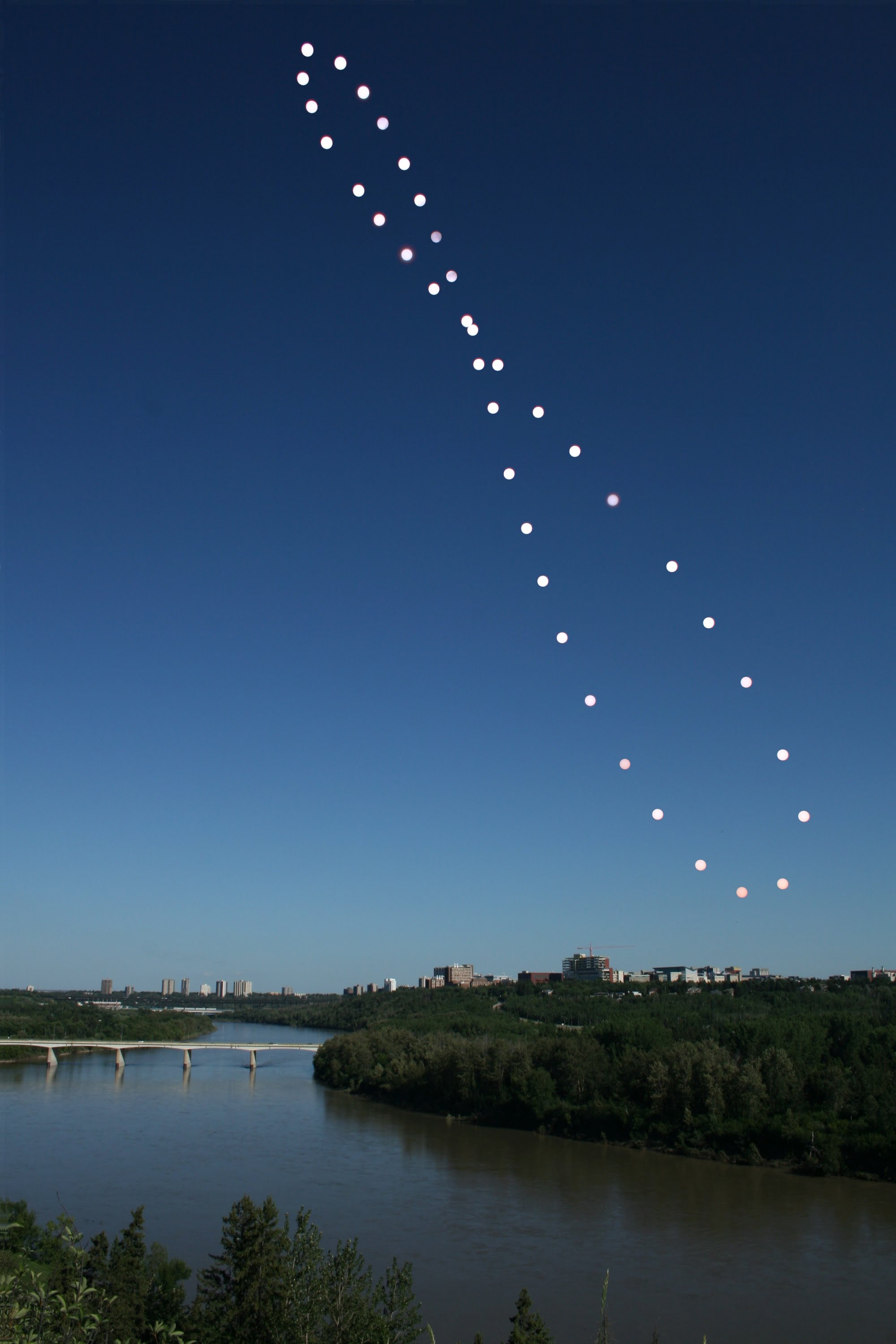
In fact if you plot the position of the Sun in the sky at a fixed time each day from a fixed location on the Earth you get a thing called an analemma, which is a sort of figure-of-eight shape whose shape depends on the observer’s latitude. Here’s a photographic version taken in Edmonton, with photographs of the Sun’s position taken from the same position at the same time on different days over the course of a year:

maxresdefault

The winter solstice is the lowermost point on this curve and the summer solstice is at the top. The north–south component of the analemma is the Sun’s declination, and the east–west component is the so-called equation of time which quantifies the difference between mean solar time and apparent solar time. This curve can be used to calculate the earliest and/or latest sunrise and/or sunset.

Using a more rapid calculational tool (Google), I found a table of the local mean times of sunrise and sunset for Dublin around the 2019 winter solstice. This shows that tomorrow is indeed the shortest day (with a time between sunrise and sunset of 7 hours 29 minutes and 58 seconds).  The table also shows that sunset already started occurring later in the day before the winter solstice, and sunrise will continue to happen later for a few days after the solstice, notwithstanding the fact that the interval between sunrise and sunset gets longer from today onwards.

I hope this clarifies the situation.

2019: A Summary of the Year

Posted in Politics on December 20, 2019 by telescoper

Nollaig Shona

Posted in Maynooth on December 19, 2019 by telescoper

Well, workwise, that’s me just about done for the year 2019.

I received the `official’ Christmas card shown above from the President of the Maynooth University, Professor Philip Nolan, earlier this week so I thought I’d share the picture as a Christmas card to my readers (both of them). The phrase on the card means `Happy Christmas’ (though, as the Welsh `Nadolig Llawen’, the Happy comes after the Christmas). Sometimes you find the phrase Nollaig Shona Duit which means `Happy Christmas to you’.

There’s quite a similarity between the Irish word for Christmas, Nollaig, and the Welsh word Nadolig. That’s not surprising because we are talking about two Celtic languages. But are both related in some way to Noel?

End of Teaching for 2019

Posted in Biographical, Education, Maynooth on December 18, 2019 by telescoper

So it’s 6pm on Wednesday 18th December and I’ve just given my 24th and last Astrophysics & Cosmology lecture for the term at Maynooth University. Earlier this afternoon I gave my 36th and last first-year Mechanics & Special Relativity module so that’s over for the year too. That makes 60 lectures for the semester.

I find these twelve week semesters very tiring (even with a week-long break in the middle). I assume the students do too. Numbers in class certainly dropped off this week, but overall I’ve been very happy with the level of engagement of the students, especially the first years. Although it’s a lot of work putting on a big course for the first time, I do enjoy teaching very much indeed. I have found few things in life more rewarding than teaching students who want to learn and physics students here in Maynooth do seem to be highly motivated. The exams for both modules are in January so I’ll find out in the New Year if anyone actually learnt anything!

This morning somebody suggested that would be my last teaching for the decade. Of course that is incorrect. The current decade ends on 31st December 2020, not 31st December 2019, just as the millennium started on 1st January 2001 not 1st January 2000. I’m glad a fellow blogger has taken the trouble to point the reason: there is no Year Zero.

Earlier today we had presentations from our final-year project students, which were very good. As usual on such occasions I find myself thinking how much better current generations of students are at that than mine was!

I don’t mind admitting that I’m not inconsiderably knackered at this moment and will be heading home for a bite to eat and a glass or several of wine. Tomorrow I have a few things to do before heading off for the Christmas break, after which regular blogging will be suspended for a time.


The ties that bind..

Posted in Uncategorized with tags , , , , , on December 17, 2019 by telescoper

The other day I saw a post on Facebook from an American friend which referred to the wearing of a `necktie’. I’ve always been confused by this word, largely because I’m not aware of many other examples of words combining an item of clothing with where it is worn on the body. As far as I am aware neither `headhat’ nor `footsock’ nor `legtrousers’ is a word. Presumably the prefix `neck-‘ is added to `tie’ in order to specify where the tie is to be worn, either because the wearer might not otherwise know or because there are different kinds of tie to be worn elsewhere on the body as is the case, for example, with `cockring’.

But where else would one wear a tie other than around one’s neck?

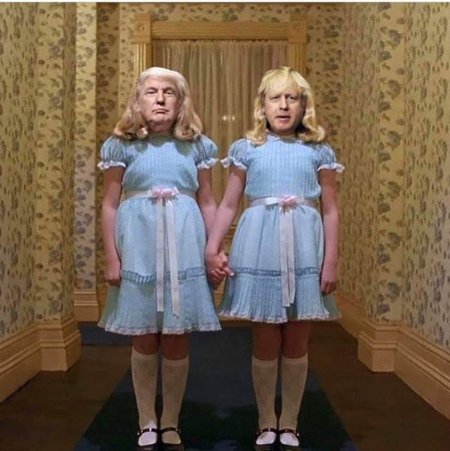
Thinking about this problem led me to the related issue of why (hopefully) soon-to-be-former President of the United States of America, Donald Trump wears such long (neck)ties:

I believe I have an answer to both puzzles. Trump wears an extra-long tie because it’s actually a bellytie, meant to be worn around the waist to keep the legtrousers from falling down. It needs to be extra long because Donald Trump is excessively corpulent. Obviously he only puts his bellytie around his neck when in public, and has some other arrangement to keep his legtrousers up in that situation. I suspect he might wear suspenders.

You may find this all a bit trivial but I post it here for the benefit of British readers whose country will soon be forced to grovel at Trump’s feet for the luxury of being allowed to import chlorinated chicken from America and to be charged higher prices for prescription medicine. You will need to learn the proper vocabulary pronto if you want to fit in with the new order of things.

Change in Northern Ireland

Posted in History, Politics with tags , , on December 17, 2019 by telescoper

One of the potentially most significant outcomes of the 2019 General Election, but one barely mentioned in the English media, was what happened in Northern Ireland. For the first time ever, a majority of the MPs elected in the six counties were nationalist. The Social Democratic and Labour Party (SDLP) gained two seats to add to the seven of Sinn Féin (including a significant gain in Belfast North) while the Democratic Unionist Party (DUP) lost two to finish with eight. The remaining seat went to the Alliance, originally a moderate unionist party but now basically a liberal centrist (and anti-Brexit) party.

Here’s how the electoral map of Northern Ireland changed:

Sinn Féin seats are dark green, DUP orange, SDLP light green and Alliance yellow.

In terms of the popular vote, the DUP+UUP got 42.3% whereas SDLP+ Sinn Féin got 37.7. Both SF and DUP lost vote share compared to 2017 (by 6.7% and 5.4% respectively) at the expense of the Alliance (up 8.8%) and SDLP (up 3.1%).

Incremental differences, perhaps, but significant nonetheless – especially as Brexit hasn’t yet happened. After Brexit there will be a border in the Irish Sea, which will bring the end of partition one step closer. The probability of seeing a United Ireland in my lifetime has definitely increased.

It was no surprise to see the hashtag `#UnityPlan’ trending on Twitter immediately after the election. Irish unification will only happen if there is a public vote and a majority on both sides of the border agree. For that vote to be fair it is vital that there is a definite plan on how to proceed in the event that the vote is in favour, so the public know what they are voting for. The Irish should not make the mistake that Britain did over Brexit.

For many unionists religion was the primary reason for wanting to remain in the United Kingdom at the time of partition in 1921: Protestants felt that their identity would be threatened if they were made to join the Catholic South. Maybe they were right to feel nervous, as the original constitution of the Irish Free State enshrined “the special position of the Holy Catholic Apostolic and Roman Church”.  But the section including that phrase was deltd from the Constitution way back in 1973 and the Roman Church has far less influence in the Republic than it did. Ireland is now an open and progressive country, so I hope those fears have receded.

Just to confuse matters even further I should mention that my Grandfather, the one born in Belfast, to whom I owe my Irish citizenship,  was a protestant republican…

Those in the North who wish to keep their British passports should be able to do so in a United Ireland, just as those of us who were born in Britain but now live in Ireland can keep ours. I’ll be keeping mine, at least until it expires…

P.S. It is worth mentioning (primarily for British friends) that there are three counties in Ireland that belong to the province of Ulster but are not part of Northern Ireland as it was formed after partition: these are Monaghan, Cavan and Donegal. The northernmost point of Donegal, Malin Head, is actually the northernmost point on the island of Ireland.

There are bad times just around the corner – Noel Coward

Posted in Music, Politics with tags , on December 16, 2019 by telescoper

Those `Former Mining Communities’

Posted in Biographical, History, Politics with tags , , , , , , , on December 15, 2019 by telescoper

I’ve generally avoided the UK media over the last few days but couldn’t resist commenting on a phrase that has appeared again in the context of constituencies in the North and Midlands of England that voted in Tory Members of Parliament in the 2019 General Election.

The first of these to declare a result was Blyth Valley, in Northumberland, a place that I know reasonably well as I grew up in the North-East. This constituency was created in 1955 and had a Labour MP continuously from then until December 12th 2019.

(Incidentally, the winning candidate in Blyth Valley, Ian Levy, presented himself as an NHS nurse, which he has never been. I doubt anyone cares, though. Bare-faced lying seems to be completely acceptable these days.)

(Left) Bates Colliery in Blyth in 1986 when it closed; (Right) the scene in 2014. Picture Credit Newcastle Evening Chronicle.

I should state for the record that I was born in Walker, to the East of Newcastle upon Tyne, but grew up in Benwell, to the West. When I was a child all the pits in the immediate vicinity, such as the Montague Main Colliery in Denton Burn, had already closed because the inland coal seams had been exhausted. Those remaining open were deep mines in which the coal faces were out under the North Sea.

Anyway, Blyth Valley was described in the media after the election result as a `Former Mining Community’. The town of Blyth is a port and was at one time a major centre for shipbuilding as well as coal mining, but the coal industry –especially Bates colliery – was indeed an extremely important factor in the town’s economy.

But Bates Colliery closed in 1986. A bit further inland the larger, and probably more famous, Ashington Colliery closed in 1988. The last mine in the North West Durham coalfield closed in 1994. Further South, Bolsover Colliery (in the Derbyshire constituency by Dennis Skinner for 49 years, until December 12th 2019) closed in 1993. And so on. All these places, and many others. decided to return Conservative MPs in 2019.

None of these places has had a working coal pit for 25 years or more, yet they are still consistently described in the media as `former mining communities’. I find that very telling, when there hasn’t been any mining there for a generation.

Coal mining forged the identity of these places. Almost everything revolved around the pits. Many of the houses were specifically by colliery owners to house the miners and their families. In the North-East, miners even had their own dialect, Pitmatic (distinct from Geordie). It wasn’t by any means an easy life being a miner but to be a miner at least meant having a distinct and proud identity,

The foundations of these communities were taken away during the Thatcher years. It’s not just about the local economic devastation, though that was bad enough, it was that the entire raison d’être disappeared. Over the subsequent decades little effort has been made by any Government of any complexion to stimulate the towns and villages so they remain `former mining communities’. Their past is well-defined, their future not.

After a decade of particularly severe austerity it’s hardly surprising that people in such areas expressed their anger at a political system that has failed them so badly, first in the 2016 referendum and then in this year’s General Election.

What’s less comprehensible (at least to me) is why anyone would think that their situation is likely to improve under the same Tories that have ignored them so consistently for so long. All I can guess is that it’s something to do with finding a sense of identity in a mining community that’s no longer a mining community. I suppose that, for some, this entails adopting increasingly nationalistic attitudes, such as were encouraged by the Conservative Party’s consistently xenophobic and anti-immigrant rhetoric.

For myself I don’t see what identity has to do with nationality at all. We can identify ourselves in all kinds of ways without having to rely on the geographical accident of our birthplace.

I have no idea what the next five years will bring for places like Blyth Valley and Bolsover. But the wider question is whether by the time of the next General Election we will will be talking about the former United Kingdom.

Britain’s Potential Explained

Posted in Politics, The Universe and Stuff with tags , , , on December 14, 2019 by telescoper

As a physicist I was intrigued by the recent use by Tory election campaigners of the slogan “Unleash Britain’s Potential”, so I decided to study the matter in more detail. I am pleased to say I am now ready to report on my conclusions.

First here is a sketch of Britain’s potential, which I denote V(r):

How do we interpret this potential?

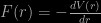
Recall that the force F(r) derived from V(r) is given by

F(r) = - \frac{dV(r)}{dr}.

The gradient of this potential being negative the force is directed towards increasing values of r. By Newton’s Second Law this means accelerated motion to the right (i.e. in the direction of increasing isolation), accompanied by steady and irreversible decline.

Note also that the form of this potential implies that there is something completely repulsive at its origin.

I hope this clarifies the situation.