Sosban Fach

Posted in Music, Rugby with tags , , , , on February 2, 2019 by telescoper

Well, this year’s Six Nations competition certainly got off to a great start for Wales last night with a memorable victory against France in Paris. That reminded me to post this, a song often heard at rugby matches in Wales. It’s particularly associated with Llanelli RFC and, more recently, the  Scarlets regional side.

The title Sosban Fach means (`Little Saucepan’) and I decided to post this version by Cerys Matthews in particular because of the beautiful clarity of her Welsh diction that makes it very easy to follow the lyrics (even for a foreigner like me).

Here are the words in Welsh:

Mae bys Meri-Ann wedi brifo,
A Dafydd y gwas ddim yn iach.
Mae’r baban yn y crud yn crio,
A’r gath wedi sgramo Joni bach.

Sosban fach yn berwi ar y tân
Sosban fawr yn berwi ar y llawr,
A’r gath wedi sgramo Joni bach.

Dai bach y sowldiwr,
A chwt ei grys e mas.

Mae bys Meri-Ann wedi gwella,
A Dafydd y gwas yn ei fedd;
Mae’r baban yn y crud wedi tyfu,
A’r gath wedi huno yn ei hedd.

Sosban fach yn berwi ar y tân
Sosban fawr yn berwi ar y llawr
A’r gath wedi sgramo Joni bach.

Shwd grys oedd ganddo?
Un wen â streipen las.

A’r gath wedi sgramo Joni bach.

O hwp e mewn, Dai,
O hwp e mewn, Dai,
O hwp e mewn, Dai,
Mae’n gas ei weld o mas.

Now feel free to sing along!


The Cost of the Open Journal of Astrophysics

Posted in Open Access with tags , , , on February 1, 2019 by telescoper

Our recent publication of a paper in the Open Journal of Astrophysics caused a flurry of interest in social media and a number of people have independently asked me for information about the cost of this kind of publication.

I see no reason not to be fully `open’ about the running costs of the Open Journal, but it’s not quite as simple as a cost per paper.

The Scholastica platform we use (which is very nice, simple and easy to use) costs $99 per month. That includes professional website hosting with a custom domain, a built-in website editor (so the site itself can be easily customized), integrated PDF viewer, indexing through e.g. Google scholar, fully searchable metadata, and readership analytics. That amounts to $1188 per annum, regardless of how many submissions we receive or how many articles get published.

On top of that we pay for the Peer Review service, which amounts to $10 for each submission (subject to an annual minimum of $250). We pay that whether or not a submission is published. So far we have rejected significantly more than we have accepted. This system provides automated emails, deadline reminders, an interface for searching sorting and assigning submissions to editors, file versioning & blindness control, a reviewer database, metrics to track performance, etc.

The final charge is only for papers that are accepted: we pay a fee to Crossref to register the Digital Object Identifier (DOI). That costs a princely $1.

There are no* other charges, as editors and referees give their services for free. Since all papers are typset by authors we do not use the Scholastica typesetting service (which is $5 per 500 words). If you’re thinking of setting up a non-overlay journal you might want to pay for that.

The actual cost per paper therefore depends on how many papers we publish. If we had 25 papers submitted in a year and published 10 the net cost per published paper would be ($250+$1188+$10)/10= $144.80, but that reduces as the number of published papers increases. For 50 submissions with 20 published it would be ($500+$1188+$20)/20=$85.40, and so on.

Some publishers argue that Open Access publication justifies an Article Processing Charge of several thousands of dollars. I think I’ve demonstrated that it doesn’t. Any charge over a hundred dollars or so is pure profiteering, bearing in mind the huge economies of scale inherent in large organizations.

In reality we have a combination of sources of funding that will be able to pay the annual fee for the foreseeable future. Ignoring this element, the marginal cost per published paper is just $11…

I hope this clarifies the situation.

*As has been pointed out in the comments, there is of course the cost of running the arXiv. The current funding model for that involves a membership program according to which institutes pay a fee depending on how heavily they use the arXiv. The top fee is $4400 per annum, for an entire institution. Some OA journals charge that much as an APC for a single paper!

25 Years of Python!

Posted in History with tags , , on February 1, 2019 by telescoper

Not a lot of people know* that it is 25 years to the day since Guido van Rossum announced the release of Python 1.0.0:

The latest version of Python is 3.7.2.

It’s not quite correct to say that Python is 25 years old today, though. There were versions available before the official Version 1. For a full history see here.

*H/T to Tom Crick, whose tweet alerted me to this.

A Problem of Sons

Posted in Cute Problems with tags , , on January 31, 2019 by telescoper

I’m posting this in the Cute Problems folder, but I’m mainly putting it up here as a sort of experiment. This little puzzle was posted on Twitter by someone I follow and it got a huge number of responses (>25,000). I was fascinated by the replies, and I’m really interested to see whether the distribution of responses from readers of this blog is different.

Anyway, here it is, exactly as posted on Twitter:

Assume there is a 50:50 chance of any child being male or female.

Now assume four generations, all other things being equal.

What are the odds of a son being a son of a son of a son?

Please choose an answer from those below:


UPDATE: The answer is below:


Continue reading

On Barry John

Posted in Biographical, Cardiff, Rugby with tags , , on January 30, 2019 by telescoper

I was browsing a few rugby sites yesterday evening, ahead of this year’s Six Nations competition (which starts on Saturday) when I stumbled across this little clip featuring legendary Welsh standoff Barry John.

The opening part of this clip really caught my attention because it was filmed near the bus stop just outside The Halfway, a pub on Cathedral Road just a few yards from my house in Cardiff; in the background you can see Llandaff Fields.

I’ve often wondered what became of Barry John. He’s 74 now and no longer the slim young prodigy who was quite simply the best rugby player I ever saw. Since he played in a great Welsh side that included Gareth Edwards, J.P.R. Williams, Gerald Davies et al, that really says something. As a sort of rugby equivalent of George Best, he was incredibly famous during his career. Budding rugby players – even those not born in Wales – all wanted to play like Barry John. But suddenly, at the age of just 27, after playing just 25 internationals, he turned his back on all the publicity and adulation and retired from rugby. He found the pressure of being such a star in the amateur era too difficult to cope with.

Anyway, was Barry John really that good? Absolutely yes, he was. Slight of build but with superb balance, he had an extraordinary, almost magical, ability to find his way through a crowd of potential tacklers as if they weren’t there at all. In the memorable words of that great commentator Bill McLaren “he flits like a little phantom”. But you don’t need to take my word for it. Just look at him – and some other giants of the time – in these highlights of the classic Scotland-Wales tie in the Five Nations of 1971. Watch about 30 seconds in, where he wrong-foots half the Scottish three-quarter line before ghosting through three more before releasing the ball to his forwards. Will there ever be another Barry John? I doubt it..

I doubt if Barry John will ever get to read this, but I’m sure there are many of us who remember the excitement of watching him play and feel enriched by what he gave us.

New Publication at the Open Journal of Astrophysics!

Posted in OJAp Papers, Open Access, The Universe and Stuff with tags , , , , , on January 29, 2019 by telescoper

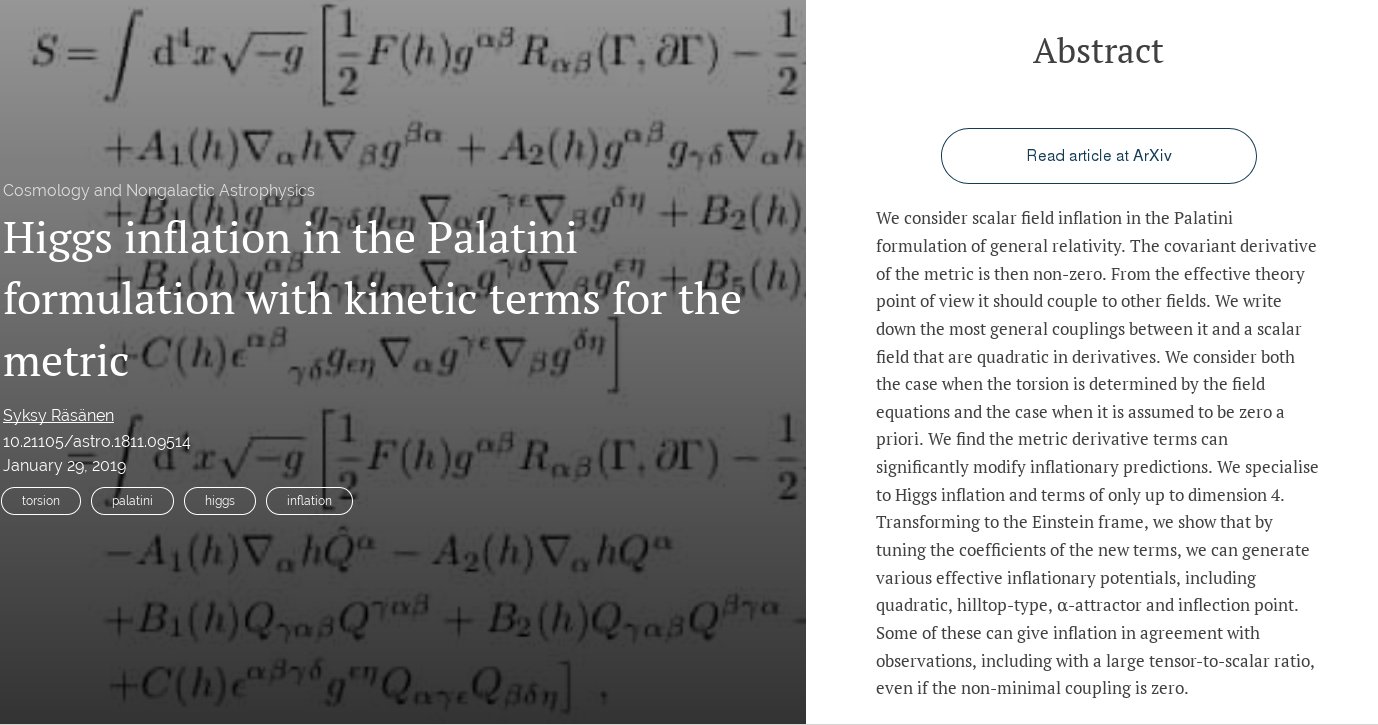
Well, it’s time at last to announce the first paper to be published by the new incarnation of the Open Journal of Astrophysics, which we just published this morning. Here it is!

It’s by Syksy Räsänen of the University of Helsinki. You can find the full article on the arXiv here.

This is the first published paper to have been submitted to the Open Journal of Astrophysics since its re-launch last October; the others on the OJA site were published on the old platform and imported into the new site after publication. This new paper has gone all the way through submission, refereeing, revision and publication on the new platform.

It’s been quite exciting for the last couple of months, as various papers have been working their way through the Editorial pipeline, to see which would win the race and get published first. Some submissions have been slowed down by folk reluctant to accept reviewing requests, presumably because the journal is not so well known and some are suspicious that it might not be bona fide. Hopefully that will pass with time. Moreover, after internal discussions, the Editorial Board have decided to ask for two referees for each paper by default and that has probably also slowed us down a bit.

We have a few other papers coming up for publication soon, and some have been sent back to authors for revise and resubmit. I think I know which one will be published next, but I’ll keep that to myself for now!

Sad about Everyman

Posted in Crosswords with tags , , , , on January 28, 2019 by telescoper

As if the world weren’t crazy enough, yesterday the Observer served up this as its Everyman Crossword puzzle No. 3772:

The Everyman crossword boasts a long tradition of good cryptic puzzles, going back as far as 1945. It has been set by various people over the years, including none other than the great D.S. MacNutt whose book The Art of the Crossword is a must-read for all cruciverbalists.

Most recently the setter of the Everyman Crossword has been Colin Gumbrell whose puzzles have been consistently enjoyable and well-constructed. They’re not as challenging as Azed, but I always like to tackle the Everyman puzzle as a sort of warm-up exercise before doing that one. Sadly I hear that Colin has been forced by ill health to stop composing crossword puzzles. I’m told that the 20th January puzzle (No. 3771) is to be his last. I send my very best wishes to Colin Gumbrell at this time, as I’m sure do crossword enthusiasts everywhere.

Incidentally, Colin Gumbrell also sets the Antico puzzle in The Oldie, a very enjoyable thematic puzzle that I do every month. I’ve won the prize for that one  a couple of times, though not recently. The Oldie has two crosswords, of differing levels of difficulty, labelled `Genius’ and `Moron’, respectively.

It seems the Observer had to find a crossword setter at short notice, which is some kind of excuse for the offering above, but it’s still the worst crossword puzzle I’ve ever seen in a supposedly quality newspaper.

Why?

As an example of the duff clues, take a look at 1 Across:

Loses hope as spa dries. (8)

The answer is DESPAIRS (defined by `loses hope’) and an anagram of SPA DRIES. But where is the anagram indicator?

Now look at 1 Down:

Adorn a device for measuring up to 11 yards? (10)

The answer to this is DECAMETRE (defined by `11 yards’) and clearly intended to be a soundalike (homophone) for DECK A METER (Adorn a device for measuring…). But where is the corresponding homophone indicator?

The clue to 14 down is

Foreign Miss by design or inadvertently (9)

The solution is SIGNORINA (`Foreign Miss’) and a hidden word, but no indicator thereof.

I could go on. The whole puzzle is littered with such deficiencies. D.S. MacNutt – who was a stickler for fairness and precision in his clues – must be turning in his grave.

And who puts a full stop at the end of a crossword clue? I’ve never seen that before!

If this is the way the Everyman puzzle is going to be from now on, I won’t be wasting any more time on it.


BBC Broadcaster John Humphrys: Ireland Should Join With The UK Outside The EU

Posted in Uncategorized on January 27, 2019 by telescoper

There’s been a lot of comment about this performance from John Humphrys. Let’s just say that I’ve got nothing against his family but I think he should retire and spend more time with them.

UPDATE: I think Mr Humphrys has got the message!

An Sionnach Fionn's avatarAN SIONNACH FIONN

The British journalist John Humphrys has a reputation for occasionally allowing his right-wing instincts to filter into his broadcasting but never has this been truer than in this fact-free interview with a remarkably patient Helen McEntee, our own Minister of State for European Affairs, when the BBC Today presenter puts forward the claim that there is an argument for Ireland to leave the European Union and “throw in their lot” with the United Kingdom.

View original post

Slugs for Salt!

Posted in Politics on January 26, 2019 by telescoper

This little cartoon has been doing the rounds on social media recently. It appears to have caused some controversy, so naturally I decided to share it here.

I’m posting it without further comment, though of course any persons wishing to identify as slugs are free to do so.

Travels and Travails

Posted in Biographical, Cardiff with tags , , , on January 25, 2019 by telescoper

This morning I headed back to Cardiff for a few days. It’s my last opportunity to sort out a few things here before teaching starts.

I’m not having much luck with travelling this week. This morning there was a last-minute change of gate at Dublin Airport, then a delay boarding due to ‘technical issues with the aircraft’, then a lengthy queue of other planes on the way to the runway.

Then, just as it seemed to be our turn to take off, we started to taxi back in the direction we had come from. The pilot muttered something about ‘a discrepancy with the paperwork’. I really though we were going back to the Terminal and would all have to disembark.

Fortunately that didn’t happen. We parked in a remote part of the airfield while the alleged discrepancy was resolved. We eventually took off about an hour late.

When we got to Cardiff we were delayed still further by having to get a bus from the plane to the Arrivals area, although the usual gates within walking distance were unoccupied.

Finally I was surprised to see full passport control in place inside the Terminal. Normally there are no passport checks on passengers flying from Dublin to the UK because of the Common Travel Area. I suppose that arrangement will be yet another casualty of Brexit.

On the other hand perhaps all these curious incidents with paperwork, passport checks, etc were related? A suspicious individual on the plane perhaps?

A large contingent of rugby fans were on the plane for tomorrow’s match between Cardiff Blues and Connacht at Cardiff Arms Park, but they were a friendly crowd and unlikely to be the cause of security concerns.

Anyway, I got back to Pontcanna a full 90 minutes late and not entirely gruntled.

Here’s another picture of Maynooth University Library Cat from earlier this week. I wonder what he would have made of today’s shenanigans?