Glamorgan versus Somerset: Vitality Blast Twenty20

Posted in Cardiff, Cricket, Uncategorized on July 20, 2018 by telescoper

After a little drinks reception in the School of Physics and Astronomy (at which I was given a very nice gift of wine) I joined the staff outing to Sophia Gardens to watch this evening’s Twenty20 cruise cricket between Glamorgan and Somerset.

The start was delayed by rain so we lingered in a pub on the way only to be caught on the hop when play actually started and missing the first few overs. Somerset batted well to reach 190 off their 20 overs, with Anderson hitting four big sixes in his 59.

Without Shaun Marsh, who will miss the rest of the season, the Glamorgan batting lineup seemed to have a very long tail and a lot rested on Khawaja and Ingram. Both scored runs quickly while they were in but neither could build a big score. Once those two were out, the Glamorgan innings faltered and they never looked like reaching Somerset’s total. The finished on 160 for 9, losing by 30 runs.

After Graduation

Posted in Biographical with tags , on July 20, 2018 by telescoper

I didn’t get time to blog yesterday as I was involved with various festivities to with the graduation of students from the School of Physics & Astronomy at Cardiff University who, for some reason, shared a ceremony with students from the School of History, Archaeology and Religion. The ceremony was more-or-less my last official duty here at Cardiff. This morning I backed up my computer, returned my keys and removed my boxes of books and other stuff from the office of the Data Innovation Research Institute back to my house. This afternoon I gather there’ll be a small event to celebrate my departure, after which there’s a staff trip to see the cricket at Sophia Gardens (Glamorgan versus Somerset in the Vitality Blast).

Yesterday’s ceremony started at 12 noon and, as usual, was in St David’s Hall in Cardiff. When it was over we adjourned to the Main Building for a reception at which we were informed there would be `unlimited Prosecco’. This turned out to be untrue, as the Prosecco ran out by about 5pm, at which point we moved to a local pub and thence for a late-night curry. It was all a bit excessive and I had a not inconsiderable hangover this morning. I suspect that was the case for many of the graduands too!

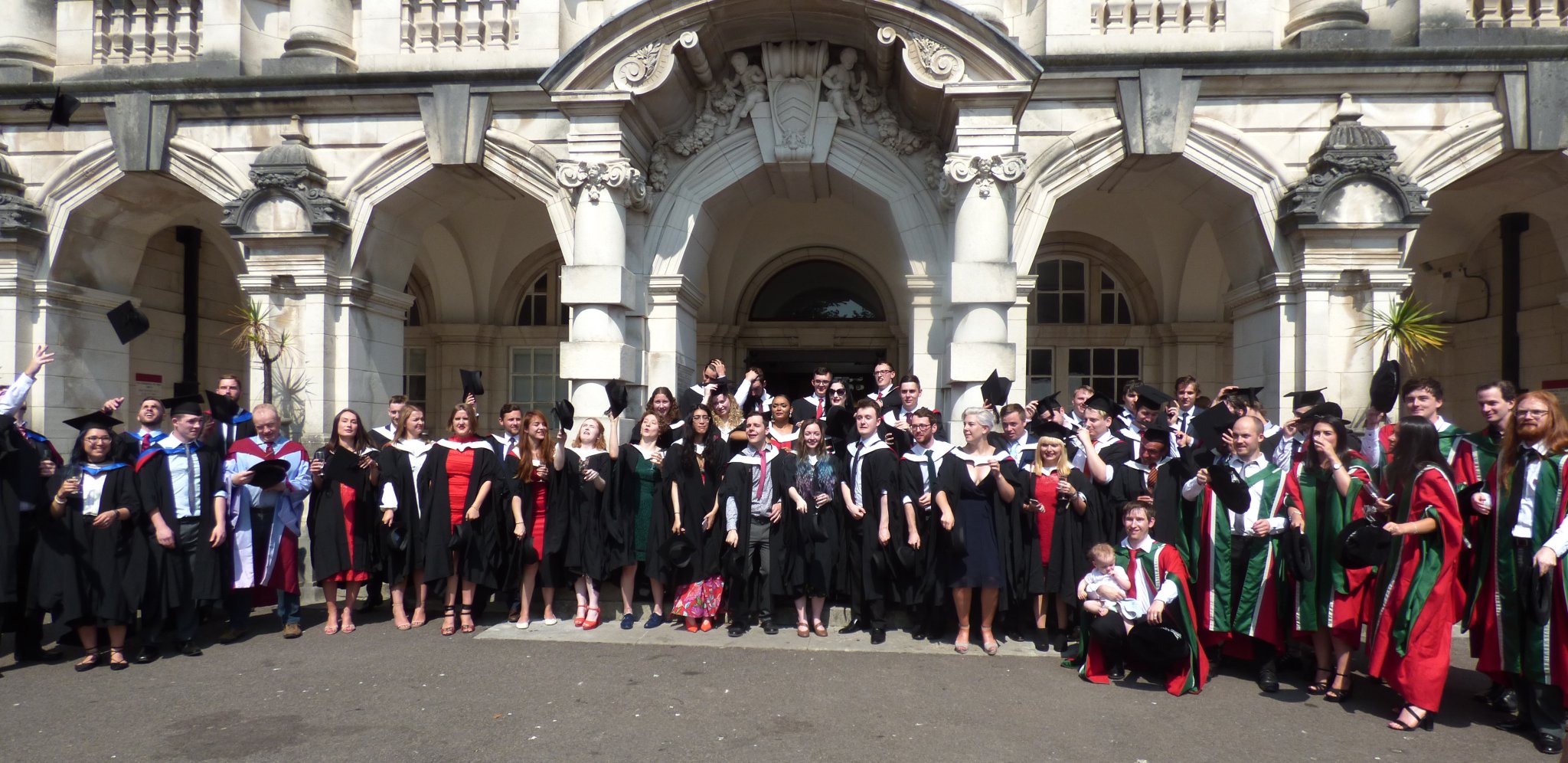
It was a very hot with all the graduation clobber, which is no doubt why such a large volume of liquid refreshment was consumed. The drinks were dispensed in a marquee which was sweltering inside. Anyway, here’s a pic of some of those students who received their degrees yesterday. I was actually there, but just out of shot to the right.

Graduation ceremonies are funny things. With all their costumes and weird traditions, they even seem a bit absurd. On the other hand, even in these modern times, we live with all kinds of rituals and I don’t see why we shouldn’t celebrate academic achievement in this way. I love graduation ceremonies, actually. As the graduands go across the stage you realize that every one of them has a unique story to tell and a whole universe of possibilities in front of them. How their lives will unfold no-one can tell, but it’s a privilege to be there for one important milestone on their journey.

I always find graduation a bittersweet occasion. There’s joy and celebration, of course, but tempered by the realisation that many of the young people who you’ve seen around for three or for years, and whose faces you have grown accustomed to, will disappear into the big wide world never to be seen again.

Graduation of course isn’t just about dressing up. Nor is it only about recognising academic achievement. It’s also a rite of passage on the way to adulthood and independence, so the presence of the parents at the ceremony adds another emotional dimension to the goings-on. Although everyone is rightly proud of the achievement – either their own in the case of the graduands or that of others in the case of the guests – there’s also a bit of sadness to go with the goodbyes. It always seems that as a lecturer you are only just getting to know students by the time they graduate, but that’s enough to miss them when they go.

Anyway, all this is a roundabout way of saying congratulations once more to everyone who graduated yesterday, and I wish you all the very best for the future!

Ongoing Hubble Constant Poll

Posted in The Universe and Stuff with tags , , , , on July 18, 2018 by telescoper

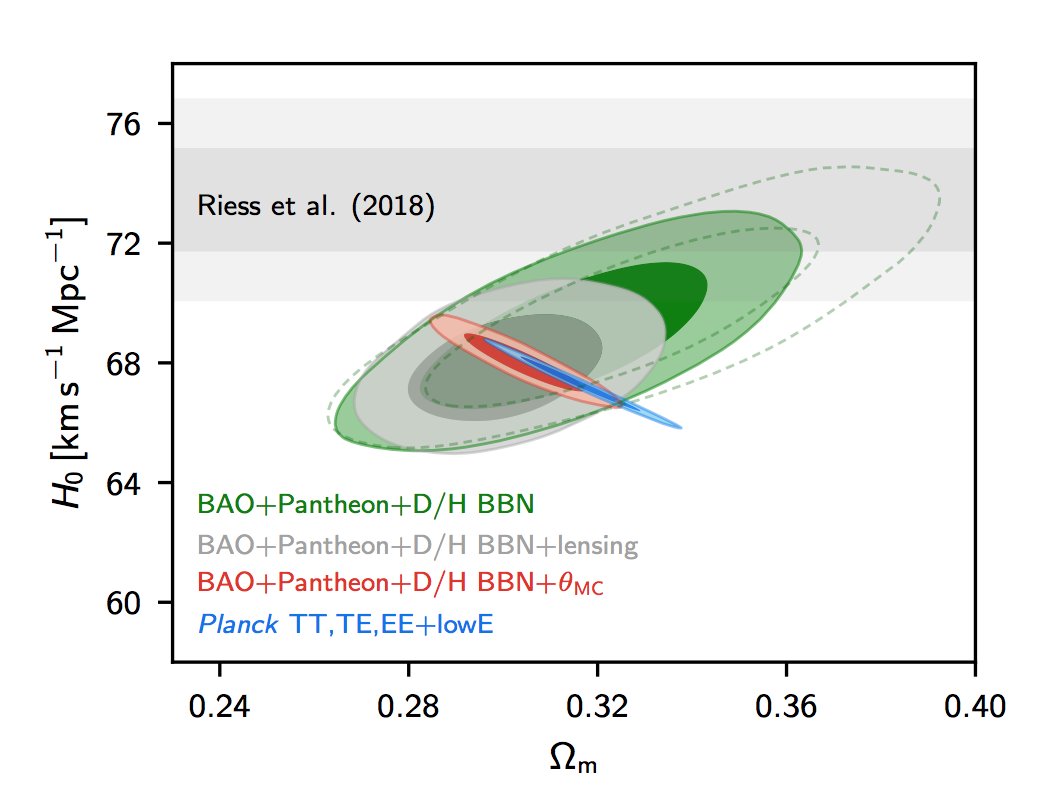
Here are two interesting plots that I got via Renée Hložek on Twitter from the recent swathe of papers from Planck The first shows the `tension’ between Planck’s parameter estimates `direct’ measurements of the Hubble Constant (as exemplified by Riess et al. 2018); see my recent post for a discussion of the latter. Planck actually produces joint estimates for a set of half-a-dozen basic parameters from which estimates of others, including the Hubble constant, can be derived. The plot  below shows the two-dimensional region that is allowed by Planck if both the Hubble constant (H0) and the matter density parameter (ΩM) are allowed to vary within the limits allowed by various observations. The tightest contours come from Planck but other cosmological probes provide useful constraints that are looser but consistent; `BAO’ refers to `Baryon Acoustic Oscillations‘, and `Pantheon’ is a sample of Type Ia supernovae.

You can see that the Planck measurements (blue) mean that a high value of the Hubble constant requires a low matter density but the allowed contour does not really overlap with the grey shaded horizontal regions. For those of you who like such things, the discrepancy is about 3.5σ..

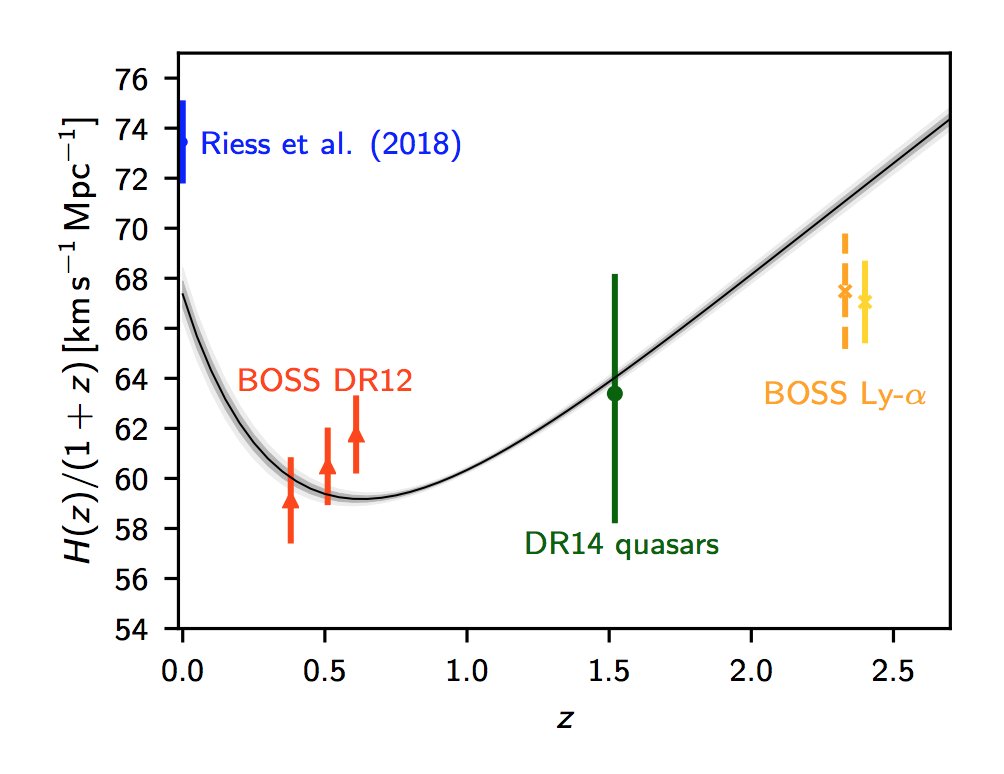
Another plot you might find interesting is this one:

The solid line shows how the Hubble `constant’ varies with redshift in the standard cosmological model; H0 is the present value of a redshift-dependent parameter H(z) that measures the rate at which the Universe is expanding. You will see that the Hubble parameter is larger at high redshift, but decreases as the expansion of the Universe slows down, until a redshift of around 0.5 and then it increases, indicating that the expansion of the Universe is accelerating.  Direct determinations of the expansion rate at high redshift are difficult, hence the large error bars, but the important feature is the gap between the direct determination at z=0 and what the standard model predicts. If the Riess et al. 2018 measurements are right, the expansion of the Universe seems to have been accelerating more rapidly than the standard model predicts.

So after that little update here’s a little poll I’ve been running for a while on whether people think this apparent discrepancy is serious or not. I’m interested to see whether these latest findings change the voting!

Ireland And The Roman Empire. Modern Politics Shaping The Ancient Past?

Posted in History with tags , , , on July 18, 2018 by telescoper

I’m here in Dublin Airport, not far from Drumanagh, the site discussed in the following post. I’m on my way back to Wales for, among other things, tomorrow’s graduation ceremony for students from the School of Physics & Astronomy at Cardiff University.

I thought I’d reblog the post here because it’s very interesting and it follows on from a comment thread relating to my post a few days ago about the current drought in Ireland which has revealed many previously unknown features of archaeological interest, and the (unrelated but also recent) discovery of a 5500 year-old passage tomb in County Lowth.

The site at Drumanagh is not related to either of those new discoveries, but it is fascinating because of the controversy about whether or not it is evidence of a Roman invasion of Ireland in the first century AD. I think the idea that no Romans ever set foot in Ireland during the occupation of Britain is hard to accept given the extensive trading links of the time, but there’s no evidence of a full-scale military invasion or lengthy period of occupation. The only unambiguously Roman finds at Drumanagh are coins and other artefacts which do not really indicate a military presence and there is no evidence there or anywhere else in Ireland of the buildings, roads or other infrastructure that one finds in Roman Britain.

My own opinion is that the Drumanagh site is more likely to have been some sort of trading post than a military fort, and it may even be entirely Celtic in origin. The position and overall character of the site seems more similar to Iron Age promontory forts than Roman military camps. I am, however, by no means an expert.

You can find a description of the Drumanagh site in its historical context here.

An Sionnach Fionn's avatarAN SIONNACH FIONN

Way back in 1996, the Sunday Times newspaper in Britain ran an enthusiastic if awkwardly-phrased banner headline proclaiming that a “Fort discovery proves Romans invaded Ireland”. The “fort” in question was an archaeological site in north County Dublin known as Drumanagh, situated on a wave-eroded headland near the coastal village of Loughshinny. Nearly 900 metres long and 190 metres wide, the monument consists of a trio of parallel ditches protecting an oblong thumb of land jutting out into the ocean, the seaward sides of the irregular protrusion relying on the waters of the Irish Sea for defence. The location is fairly typical of a large number of Iron Age promontory settlements found in isolated spots throughout the country. However what made the area at Drumanagh of particular interest was the significant number of Roman artefacts found within its fields.

Unfortunately a comprehensive archaeological survey of the site has yet to be published due to questions over property rights and compensatory payments for finds, meaning most discoveries from the location have come through agricultural work or destructive raids by…

View original post 1,387 more words

Planck’s Last Papers

Posted in The Universe and Stuff with tags , , , , on July 17, 2018 by telescoper

Well, they’ve been a little while coming but just today I heard that the final set of a dozen papers from the European Space Agency’s Planck mission are now available. You can find the latest ones, along with the all the others, here.

This final `Legacy’ set of papers is sure to be a vital resource for many years to come and I can hear in my mind’s ear the sound of cosmologists all around the globe scurrying to download them!

I’m not sure when I’ll get time to read these papers, so if anyone finds any interesting nuggets therein please feel free to comment below!

Georges Lemaître: Google Doodle Poll

Posted in History, The Universe and Stuff with tags , , , , on July 17, 2018 by telescoper


I noticed this morning that today’s Google Doodle (above) features none other than Georges Lemaître. That reminded me that a while ago I stumbled across a post on the Physics World Blog concerning a radio broadcast about Georges Lemaître.

Here’s a description of said programme:

Few theories could claim to have a more fundamental status than Big Bang Theory. This is now humanity’s best attempt at explaining how we got here: A Theory of Everything. This much is widely known and Big Bang Theory is now one of the most recognisable scientific brands in the world. What’s less well known is that the man who first proposed the theory was not only an accomplished physicist, he was also a Catholic priest. Father Georges Lemaître wore his clerical collar while teaching physics, and not at Oxford, Cambridge or MIT but at the Catholic University of Leuven in Belgium. It was this unassuming Catholic priest in an academic backwater who has changed the way we look at the origins of the universe. His story also challenges the assumption that science and religion are always in conflict. William Crawley introduces us to the “Father” of the Big Bang.

The question is whether the word “Father” in the last sentence should be taken as anything more than a play on the title he’d be given as a Catholic priest?

Lemaître’s work was indeed highly original and it undoubtedly played an important role in the development of the Big Bang theory, especially in Western Europe and in the United States. However, a far stronger claim to the title of progenitor of this theory belongs to Alexander Alexandrovich Friedman, who obtained the cosmological solutions of Einstein’s general theory of relativity, on which the Big Bang model is based, independently of and shortly before Lemaître did. Unfortunately the Russian Friedman died in 1925 and it was many years before his work became widely known in the West. At least in my book, he’s the real “father” of the Big Bang, but I’m well aware that this is the source of a great deal of argument at cosmology conferences (especially when Russian cosmologists are present), which makes it an apt topic for a quick poll:

P.S. I prefer to spell Friedman with one “n” rather than two. His name in his own language is Алекса́ндр Алекса́ндрович Фри́дман and the spelling “Friedmann” only arose because of later translations into German.

Hair pursued by two planets

Posted in Art with tags , , on July 16, 2018 by telescoper

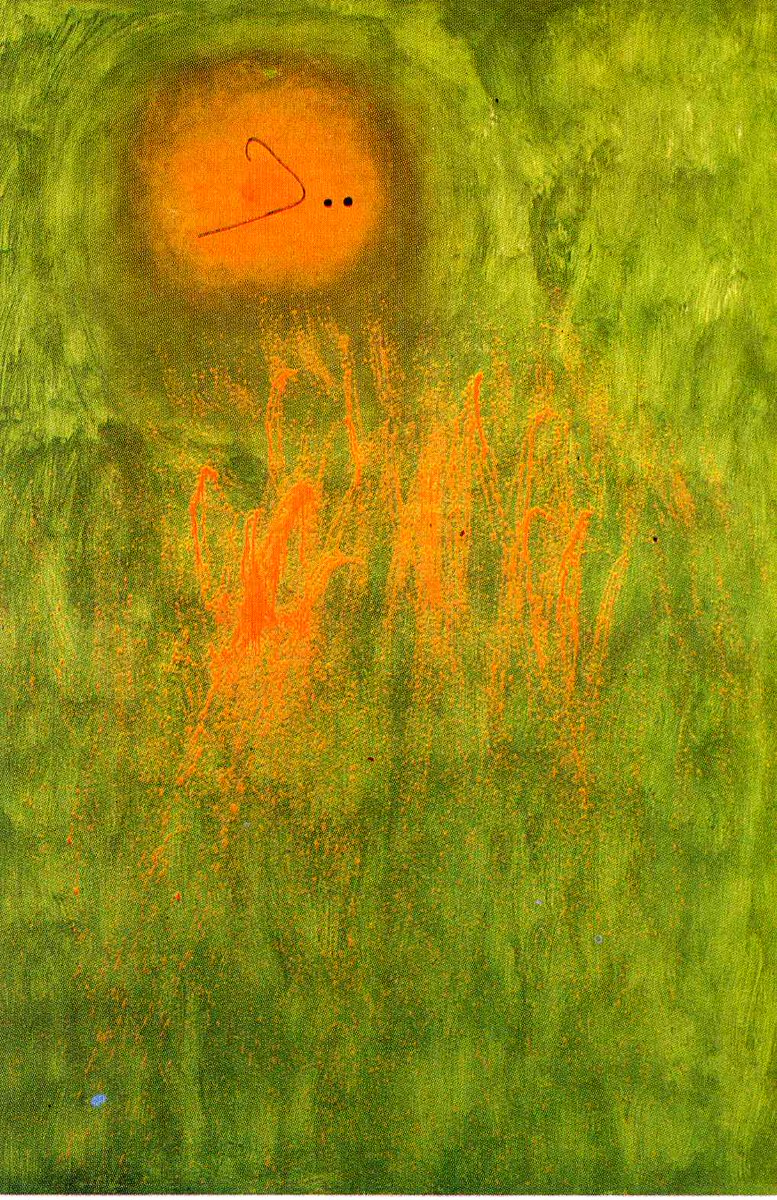
Joan Miró (1893-1993), painted in 1968. Oil and acrylic on canvas, 195 X 130 cm (Fundació Joan Miró, Barcelona). Original title: Cabell perseguit per dos planetes.

World Cup Félicitations!

Posted in Football on July 15, 2018 by telescoper

French President Emmanuel Macron seemed rather excited at the end of this afternoon’s World Cup Final, and why not? France are worthy winners of what has been a fascinating competition after a very exciting final, which I watched in a pub in Maynooth. Most of the crowd there were rooting for underdogs Croatia, actually.

Incidentally, before the match, the bookies were offering odds of 4-1 against Croatia, which I reckoned was quite generous. Although I thought France would win, I didn’t think there was all much between the two sides. I didn’t place a bet though…

As it turned out I thought Croatia were a bit unlucky, actually, and for long periods they looked the better organised and more composed team; they were certainly better at keeping the ball in midfield: overall Croatia had 66% possession, which is an amazing statistic for a team that lost 4-2!

France’s prodigiously talented forward Kylian Mbappé was particularly wasteful, giving the ball away frequently in the first half. It was only when Croatia fell 3-1 behind and had to throw men forward that Mbappe started to find space and from then on he was a constant threat.

Much of the reaction to the result focussed on the penalty for handball, which didn’t look intentional to me. That may have been vital but I think Croatia’s goalkeeper should have done better with the two second-half goals that really killed off the game.

Anyway all credit to Croatia for playing their part in an exciting final, and for keeping going right to the end. They definitely had chances to get back into the game, but it just wasn’t to be.

Croatia were a little unlucky this afternoon, but over the whole competition I think France were the most consistently impressive team and deserved to win the World Cup.

Le football rentre à la maison!

P.S.

P. P. S. We had a bit of rain today, which was nice!

Drought in Greater Dublin

Posted in Maynooth on July 14, 2018 by telescoper

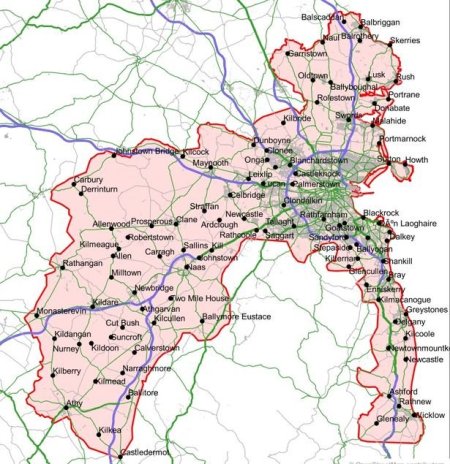
The prolonged period of dry weather we’ve been having in Ireland has led to a water shortage in Greater Dublin and some surrounding districts, including Maynooth in County Kildare (where I live). A hosepipe ban has been in place for some time and now there are restrictions on overnight water usage in Dublin, although not yet in Maynooth.

The map above shows the area affected by the hosepipe ban, which doesn’t affect me because I haven’t got a garden, but I’ve included it because it shows Maynooth and some of the neighbouring towns, in one of which I might well find myself living permanently.

The bus route from Maynooth to Dublin Airport passes through Leixlip and Lucan Village. My current residence is on Straffan Road, which leads south from Maynooth to Straffan. Other notable places are Kilcock, Celbridge, and… er…. Newcastle.

My Time Out in Astrophysics

Posted in Biographical, Brighton, LGBTQ+, Mental Health with tags , , , , , on July 13, 2018 by telescoper

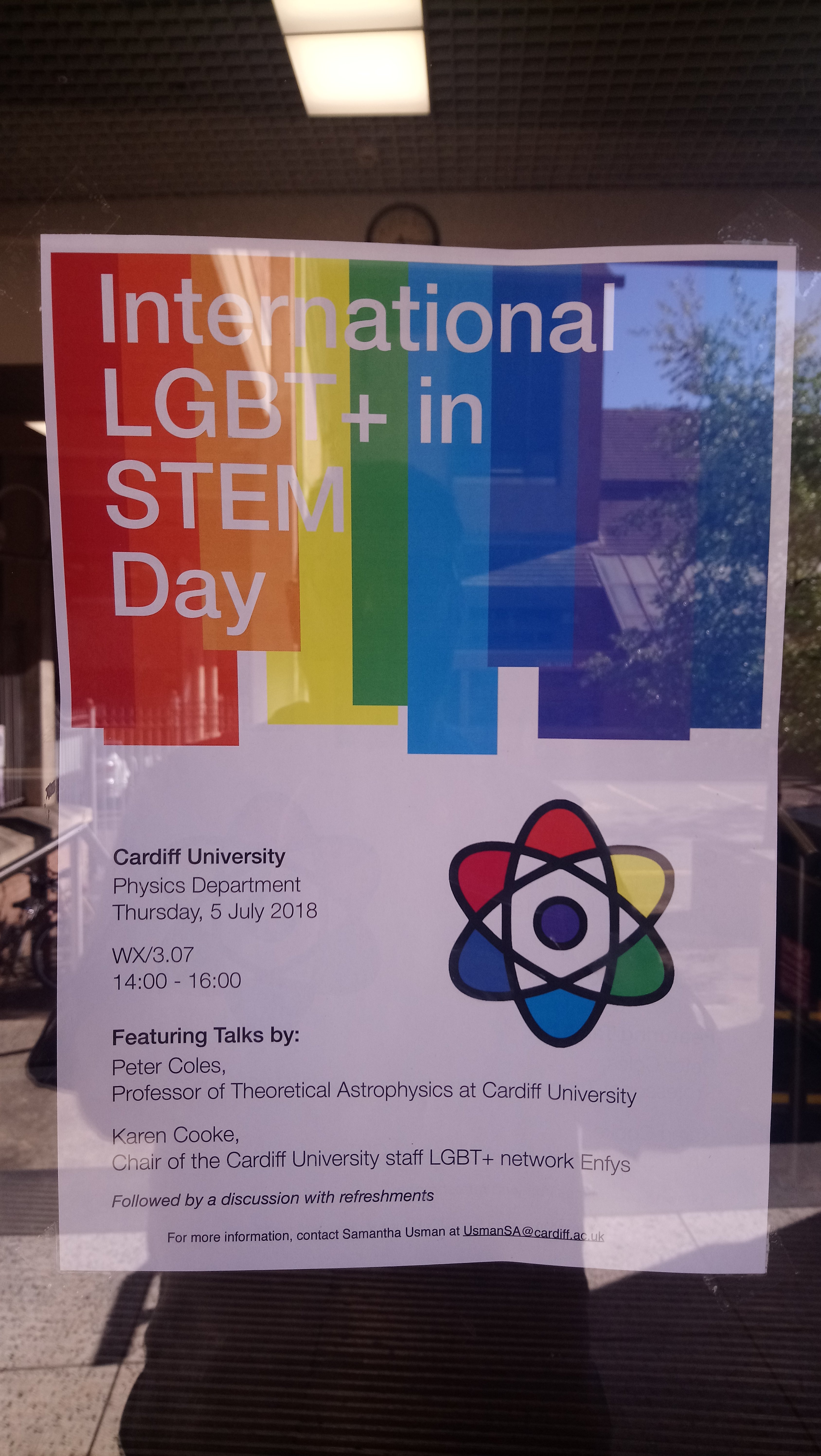
Last week I did a little talk in Cardiff for LGBT Stem Day, which was similar to another I gave earlier this year at the IOP in London at the launch of the LGBT Physical Sciences Climate Survey. I intended to post a summary of the earlier presentation but somehow never got round to it. Doing the more recent one reminded me that I’d forgotten to write up my notes, so here goes.

What I was trying to do in these talks was to explain why I thought (a) the Climate Survey and (b) LGBT STEM day were so important, from the perspective of someone who has been `out’ for over thirty years while pursuing a career in astrophysics. I thought it might be useful to include some personal reminiscences along the way as in both cases most of the audience members were too young to remember what things were like over thirty years ago.

Although I knew I was gay when I was an undergraduate at Cambridge, I wasn’t very open about it except to my closest friends. I also didn’t do much about it either, apart from developing a number of crushes that were doomed to be unrequited. In my final year I decided that I would try to get a place to do a PhD (or, as it turned out, a DPhil). I applied to a few places around the country, and was very happy to get an offer from Sussex and started my postgraduate studies there in 1985. The reputation of Brighton as being a very `gay’ place to live was definitely part of that decision although it was really the topic of my research project that was the decisive factor.

One of the first things I did during `Freshers Week’ at Sussex was join the GaySoc (as it was called) and I gradually became more involved in it as time went on. Initially, though, I kept that part of my life separate from my academic life and wasn’t really all that open in the Department in which I worked. My decision to change that was largely because of things going on in the outside world that convinced me that there was a need to stand up and be counted.

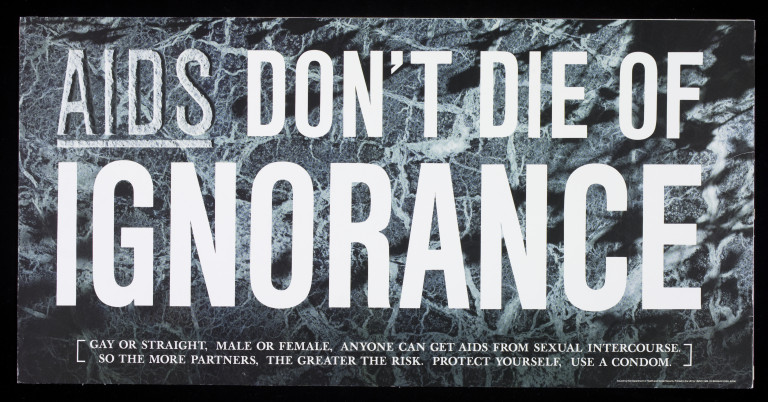
One of these was the AIDS `panic’ exacerbated by the Thatcher Government’s awful advertising campaign, an example of which you can see above. It was a very frightening time to be gay, not only because of the fear of contracting AIDS oneself  but also because of the hostility that arose as a reaction to the `gay plague’.

Although I wasn’t really sexually active as an undergraduate at Cambridge, I had been while I was at school in Newcastle up until 1982. At this time gay sex was illegal with a person under the age of 21, but I had no difficulty finding partners when I was a teenager. I assumed that, as a result of this period of my life,  I would be found HIV+. When I eventually did have a test in 1986 I was quite shocked to find I was negative, so much so that I had another test to make sure. I was lucky, countless others were not.

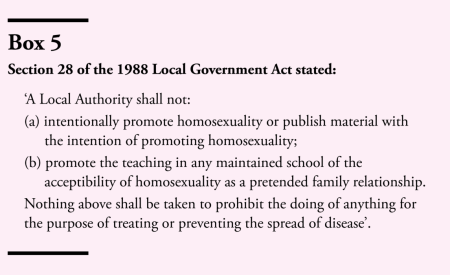
The second thing that made me want to come out was the Local Government Act (1988), which included the now infamous Section 28 (above). This was the subject of the first political demonstrations I ever attended, but we failed to stop it becoming law.

Anyway, I just got fed up of hearing people making ill-informed generalisations during this time. Rather than make a big public statement about being gay, I just resolved to not let such comments pass. I think it only took a few intercessions in the tea room or Falmer Bar for it to become widely known in the Department that I was gay. That was how I came out in astrophysics, and thereafter almost everyone just seemed to know.

I have to say that for quite a long time in this period my general presumption was that a majority of heterosexual people were actively hostile to LGBT+ people, and that would always remain the case. There were quite a few gay people in Brighton who felt the same and their reaction was to become separatists. The logic was that straight people were always going to be horrible, so to hell with them. You could drink in gay bars, eat in gay restaurants, live in a gay part of the town, etc, and thereby minimise interaction with the hostile majority. This seemed an attractive lifestyle to me for some time, but I gradually began to feel that if there was ever going to be a chance of things changing for the better, LGBT+ people had to engage and form alliances. That strategy seems to have worked for the wider community, and I applaud the many straight people who have become allies.

It hadn’t been fear that my sexuality would have a negative impact on my academic career that had held me back – I never really thought I was going to have an academic career until near the end of my time as a research student – it was more fear of confrontation with colleagues who would be hostile. That never really happened. Over the past thirty-odd years, the vast majority of people I’ve known through astrophysics have been friendly and welcoming. There have been exceptions of course, but I won’t waste my time on them here.

Now fast forward to 2018. Not only has Section 28 gone (it was repealed first in Scotland in 2000,  and then nin England & Wales in 2003), but since 2003 the Age of Consent is now equal for everyone and more recently we now have Equal Marriage. If you had asked me back in 1985 whether I thought there was any chance of this happening even on a thirty year timescale, I would have laughed at you.

But although many things have changed for the better, the fact remains that LGBT+ people still face widespread hostility and violence. Bullying is rife in schools, many people are still afraid to come out in their workplace, and in many situations there is still a threat of violence. I know what impact the latter can have, as I have experienced it myself and is has caused me mental health problems throughout my life. In fact, I have found it much harder to be open about my mental health problems than I ever did about being gay!

There are increasing signs of a backlash against LGBT+ people, most obviously in Trump’s America. The rights we have won over the years could so easily be taken away and my fear is that if we are complacent and pretend that everything is fixed because we have equal marriage then we will soon see those rights being eroded. We have to remain active and visible, and keep pushing against all forms of discrimination, harassment and bullying wherever it happens. And the first step in doing that is to raise awareness among everyone that it is still a problem.

Now to some specific points about working in STEM.

First, my own experiences caused me not to perceive science being a difficult environment to be gay, but I am aware that many people have quite different perceptions, often with good reasons. One thing that feeds negative perceptions is simply the lack of positive statements. I remember, over a decade ago, being asked by representative of a major STEM organisation if I could think of anything they could do to make them appear more inclusive to LGBT+ people. I looked at the `equal opportunities’ bit on their website and found that it mentioned gender, race, disability, etc but entirely omitted sexual orientation. What message does that send to an LGBT+ person? The omission was not deliberate, but the perception might well be otherwise. Many institutions display posters about LGBT+ matters, and some staff (either LGBT+ or `allies’) wear rainbow lanyards to carry their ID cards. But what if you’re a student who sees these everywhere else other than your own department? Has nobody bothered to put posters up, or has some arsehole torn them all down?

Another important issue is visibility. Students and early career researchers may be deterred from continuing a career in STEM simply because they don’t see other LGBT+ people doing likewise. I know of at least one student who was on the verge of dropping out of a physics degree because `there are no gay people in physics’. Fortunately he said that to a member of staff who knew he was wrong, as her office was next door to mine, but this does illustrate another problem of perception in STEM fields. In Arts and Humanities subjects it’s much easier to be visible as LGBT+ through your work. You even research matters related to gender or sexuality in literature, for example. It’s rather harder when you do theoretical astrophysics. But what’s wrong with having a rainbow icon on your powerpoint?

When giving my talk at the IOP I got into a discussion about `role models’. I am horrified at the thought that anyone would think of me as a `role model’. I don’t like using that term because it seems to me to imply some sort of ideal to which others should aspire, which seems to me rather arrogant. What I do think is important is for as imany LGBT+ people as possible to say `I’m LGBT+ and I’m in STEM: if I can do it and be like me, warts and all, then you can do it and be like you!’

A comment that I’ve heard about LGBT+ people in STEM goes along the lines of `We don’t need all this political stuff in science. You should just concentrate on your research’. Another version I heard from a senior scientist recently was effectively `I’m not prejudiced at all. I don’t care about your sexuality. I’m only interested in your research!’. I think this kind of stance is not uncommon, actually, but I couldn’t disagree more with it.

Science is, above all, a human activity. It’s not done by robots or calculating machines. It’s done by people. And I don’t think you will get the best science out of your research time unless you create a working environment in which everyone feels comfortable and happy being themselves. Just a few small gestures can go a long way towards creating a department or research group that’s genuinely inclusive for all the people in it.

Of course some STEM subjects have other diversity and inclusivity issues to address. For example, there is a persistent gender imbalance in UK Physics that has resisted many initiatives to encourage more women to enter the field. I’m not arguing that LGBT+ matters more than this or indeed more than race or disability or anything else. It is, however, my firm belief that taking measures to make workplace as inclusive as possible actually benefits everyone  in it. That’s partly because it’s the way to build the best team, and partly the way to get the best out of the team once you have assembled it, but it’s also a good thing to do for its own sake.

Another comment I got on Twitter a few weeks ago `When is it Straight STEM Day?’ Well, perhaps when 69% of heterosexual people feel uncomfortable in the workplace because of their sexuality, or when students are bullied at school for being straight, then perhaps there’ll be a need for it. In the meantime, you just need to recognise that despite the undeniable progress there has been over the past decades, there still isn’t anything like full symmetry between straight and gay.

Finally, and I think this brings me more-or-less back to where I started, events like the LGBT+ STEM Day and initiatives like the LGBT+ Climate Survey are vital because they acknowledge that we’re involved in a  process, not a fixed state and we have to recognise that this process could easily be pushed into reverse. All that’s needed for that to happen is for people to assume that everything is fine now and close their eyes to the overwhelming evidence that it really isn’t.

POSTSCRIPT: A thought that occurred to me while I was writing this relates to inclusivity within the LGBT+ community itself. When I arrived at Sussex in 1985, I joined `GaySoc’. A few years later that became `Lesbian & Gay Soc’. It took a lot longer for Bisexuals to be acknowledged, and even longer for Trans people. Only last week the annual Gay Pride March in London was disrupted by anti-transgender campaigners. Some of us still have a lot to learn about what it means to be inclusive.