I thought I’d share this cute video from the European Space Agency about the Gaia mission I blogged about last week. It shows the effect of parallax, as measured by Gaia, on the positions of stars on the sky. As the Earth orbits the Sun stars do a dance in the sky; the shift in their position greater for closer stars rather than distant ones. To make the video, parallaxes measured by Gaia have been exaggerated by a factor 100,000 and proper motions have been speeded up by one trillion (1012). The effect is rather hypnotic, and gives a sense of the three-dimensional nature of the distribution of stars. At the end of the video you can see the effect of proper motions too, i.e. the change in position of a star due to its actual motion rather than that of the observer.
Follow @telescoperStars Dance to the Music of Parallax
Posted in The Universe and Stuff with tags GAIA, Gaia DR2, parallax on May 3, 2018 by telescoperMidweek Flight to Dublin
Posted in Biographical, Cardiff, Maynooth on May 2, 2018 by telescoper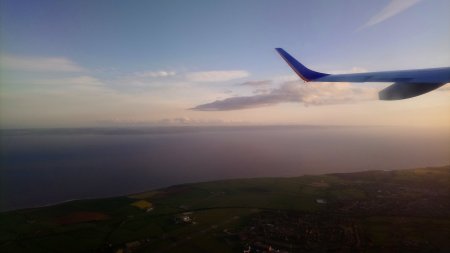
I’ve just arrived in Dublin after the last regular mid-week flight I’ll have to make from Cardiff because of teaching commitments. Last lecture of term in Maynooth tomorrow, and after that I can be more flexible about the travel.
I’ve generally avoided evening flights since the introduction of the summer schedules. Budget airlines such as FlyBe work on very tight schedules and delays tend to accumulate throughout the day, meaning that incoming planes needed to make evening flights are frequently very late. Sometimes they get so late the plane can’t fly because of restrictions on night flights, in which case they are cancelled. This is much less likely with an earlier flight in my experience.
So I took a chance this evening but as it happened there were no delays I got safely on the bus to Maynooth and got to my flight at a reasonable hour. The plane, by the way, was only about a quarter full.
The picture was taken shortly after takeoff from Cardiff Airport, with South Wales underneath and Devon in the distance.
Follow @telescoperHubble Constant Catch-Up
Posted in Bad Statistics, The Universe and Stuff with tags arXiv:1803.04470, arXiv:1804.10655, Bayesian probability, cosmological distance scale, Hubble constant on May 2, 2018 by telescoperLast week when I wrote about the 2nd Data Release from Gaia, somebody emailed me to ask whether the new results said anything about the cosmological distance ladder and hence the Hubble Constant. As far as I could see, no scientific papers were released on this topic at the time and I thought there probably wasn’t anything definitive at this stage. However, it turns out that there is a paper now, by Riess et al., which focuses on the likely impact of Gaia on the Cepheid distance scale. Here is the abstract:
We present HST photometry of a selected sample of 50 long-period, low-extinction Milky Way Cepheids measured on the same WFC3 F555W, F814W, and F160W-band photometric system as extragalactic Cepheids in SN Ia hosts. These bright Cepheids were observed with the WFC3 spatial scanning mode in the optical and near-infrared to mitigate saturation and reduce pixel-to-pixel calibration errors to reach a mean photometric error of 5 millimags per observation. We use the new Gaia DR2 parallaxes and HST photometry to simultaneously constrain the cosmic distance scale and to measure the DR2 parallax zeropoint offset appropriate for Cepheids. We find a value for the zeropoint offset of -46 +/- 13 muas or +/- 6 muas for a fixed distance scale, higher than found from quasars, as expected, for these brighter and redder sources. The precision of the distance scale from DR2 has been reduced by a factor of 2.5 due to the need to independently determine the parallax offset. The best fit distance scale is 1.006 +/- 0.033, relative to the scale from Riess et al 2016 with H0=73.24 km/s/Mpc used to predict the parallaxes photometrically, and is inconsistent with the scale needed to match the Planck 2016 CMB data combined with LCDM at the 2.9 sigma confidence level (99.6%). At 96.5% confidence we find that the formal DR2 errors may be underestimated as indicated. We identify additional error associated with the use of augmented Cepheid samples utilizing ground-based photometry and discuss their likely origins. Including the DR2 parallaxes with all prior distance ladder data raises the current tension between the late and early Universe route to the Hubble constant to 3.8 sigma (99.99 %). With the final expected precision from Gaia, the sample of 50 Cepheids with HST photometry will limit to 0.5% the contribution of the first rung of the distance ladder to the uncertainty in the Hubble constant.
So, nothing definitive yet but potentially very interesting in the future and this group, led by Adam Riess, is now claiming a 3.8σ tension between measurements of the Hubble constant from cosmic microwave background measurements and from traditional `distance ladder’ approaches, though to my mind this is based on some rather subjective judgements.
The appearance of that paper reminded me that I forgot to post about a paper by Bernal & Peacock that appeared a couple of months ago. Here is the abstract of that one:
When combining data sets to perform parameter inference, the results will be unreliable if there are unknown systematics in data or models. Here we introduce a flexible methodology, BACCUS: BAyesian Conservative Constraints and Unknown Systematics, which deals in a conservative way with the problem of data combination, for any degree of tension between experiments. We introduce hyperparameters that describe a bias in each model parameter for each class of experiments. A conservative posterior for the model parameters is then obtained by marginalization both over these unknown shifts and over the width of their prior. We contrast this approach with an existing hyperparameter method in which each individual likelihood is scaled, comparing the performance of each approach and their combination in application to some idealized models. Using only these rescaling hyperparameters is not a suitable approach for the current observational situation, in which internal null tests of the errors are passed, and yet different experiments prefer models that are in poor agreement. The possible existence of large shift systematics cannot be constrained with a small number of data sets, leading to extended tails on the conservative posterior distributions. We illustrate our method with the case of the H0 tension between results from the cosmic distance ladder and physical measurements that rely on the standard cosmological model.
This paper addresses the long-running issue of apparent tension in different measurements of the Hubble constant that I’ve blogged about before (e.g. here) by putting the treatment of possible systematic errors into a more rigorus and consistent (i.e. Bayesian) form. It says what I think most people in the community privately think about this issue, i.e. that it’s probably down to some sort of unidentified systematic rather than exotic physics.
The title of the paper includes the phrase `Conservative Cosmology’, but I think that’s a bit of a misnomer. I think `Sensible Cosmology’. Current events suggest `conservative’ and `sensible’ have opposite meanings. You can find a popular account of it here, from which I have stolen this illustration of the tension:
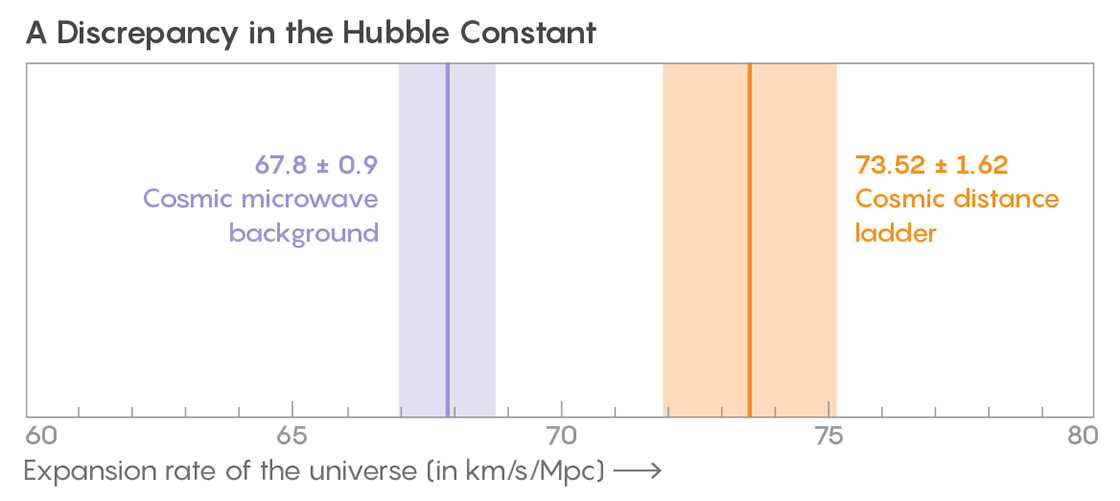
A chart showing the two differing results for the Hubble constant – The expansion rate of the universe (in km/s/Mpc)
Result 1: 67.8 ± 0.9 Cosmic microwave background
Result 2: 73.52 ± 1.62 Cosmic distance ladder
Anyway, I have a poll that has been going on for some time about whether this tension is anything to be excited about, so why not use this opportunity cast your vote?
Follow @telescoperIn Praise of Research Software Engineers
Posted in Cardiff with tags Cardiff University, Data Innovation Research Institute, research, Research Software Engineers on May 1, 2018 by telescoper
Yesterday in the Data Innovation Research Institute we held a special event, our first ever Conference for Research Software Engineers. Sadly I was too busy yesterday to attend in person, but I did turn up at the end for the drinks reception at the end.
In case you weren’t aware, the term Research Software Engineer (RSE) is applied to the growing number of people in universities and other research organisations who combine expertise in programming with an intricate understanding of research. Although this combination of skills is extremely valuable, these people lack a formal place in the academic system. Without a name, it is difficult for people to rally around a cause, hence the creation of the term Research Software Engineer and the Research Software Engineer Association.
We have quite a few RSEs associated with the Data Innovation Research Institute in Cardiff – as you can see here. These are quite different from system administrators or other computing support staff as they are involved directly in research, working in teams alongside academics and other specialists.
One of the biggest problems facing RSEs in the UK university system is there isn’t a well-established promotions route for them. For researchers in an academic environment, performance is usually judged through publications, PhD students supervised, grants awarded and so so. Although RSEs play a vital role, especially (but not exclusively) in large collaborations, they do not usually end up as lead authors on papers and generally do not apply for grants in their own name. That means that if they are judged by these criteria they struggle to get promotion and often leave academia to work for higher pay and better terms and conditions elsewhere.
In my opinion, one of the important things that must be done to improve the lot of Research Software Engineers is to construct a career structure in parallel with the academic route and other grades (such as laboratory technician) but judged by more appropriate criteria tailored to the reality of the job. Writing the necessary grade profiles and getting them agreed by the relevant university committees will take some time, but I think it will pay dividends in terms of better retention and job satisfaction for these highly talented people.
I hope Cardiff can take some sort of a lead in defining the role of an RSE, but this is really a national need. There are pretty uniform grade descriptions for academic and research staff across the United Kingdom so I don’t see any reason why this can’t be the case for Research Software Engineers. They are vital to many research fields already, and their importance can only grow in the future.
Follow @telescoper
May Day, by Phillis Levin
Posted in Poetry with tags May Day, Phillis Levin, Poem on May 1, 2018 by telescoperI’ve decided to waste my life again,
Like I used to: get drunk on
The light in the leaves, find a wall
Against which something can happen,
Whatever may have happened
Long ago—let a bullet hole echoing
The will of an executioner, a crevice
In which a love note was hidden,
Be a cell where a struggling tendril
Utters a few spare syllables at dawn.
I’ve decided to waste my life
In a new way, to forget whoever
Touched a hair on my head, because
It doesn’t matter what came to pass,
Only that it passed, because we repeat
Ourselves, we repeat ourselves.
I’ve decided to walk a long way
Out of the way, to allow something
Dreaded to waken for no good reason,
Let it go without saying,
Let it go as it will to the place
It will go without saying: a wall
Against which a body was pressed
For no good reason, other than this.
Follow @telescoper
Welcome Back To Sophia Gardens
Posted in Cardiff, Cricket with tags Glamorgan County Cricket Club, Sophia Gardens Cardiff, SSE Swalec Stadium on April 30, 2018 by telescoperAs a member of Glamorgan County Cricket Club I today received some important news by email.
It seems that at the end of this month (ie today), the sponsorship deal with an electricity company that involved the cricket ground in Cardiff being called the SSE SWALEC Stadium lapses.
From tomorrow, the First of May, therefore, the ground will be known by the far more attractive name of Sophia Gardens Cardiff. That also happens to be the name by which it was known from 1967 to 2007…
I have to admit that I always struggled to bring myself to call it the SSE SWALEC Stadium, so I’m glad that I no longer have to try!
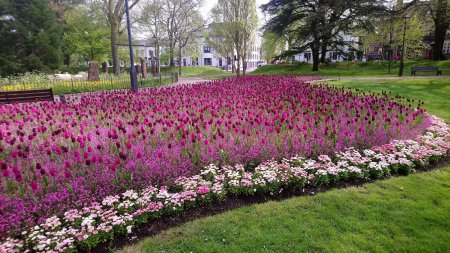
And while we’re on about gardens here is a picture of some flowers I saw in Cathays Park on my way to work this morning.
The Arithmetic of Relegation
Posted in Biographical, Sport with tags Betting, Football, Newcastle United, Sport on April 30, 2018 by telescoperWhen I got back home after yesterday’s concert, I ate some dinner and settled down to have a look through the Sunday papers. Most of the news was as grim as expected, especially the ongoing fiasco of Brexit, and the scandal engulfing Home Secretary former Home Secretary Amber Rudd who obviously lied to Parliament on at least one occasion. Anyway, turning my attention to the Sports pages there was a write-up of Saturday’s disappointing home defeat for Newcastle United against bottom club West Bromwich Albion. I was gloomy enough to wonder whether Newcastle might actually still get relegated, so looked at the Premiership Table:

Neither West Brom (28 points) nor Stoke (30) can catch Newcastle with only two games to play, but Southampton can in principle get 41 points from here if they win all three games. It’s true that they have a worse goal difference but if Newcastle lost all their three remaining games, and Southampton won all theirs that would change. It therefore looks mathematically possible for Newcastle to be relegated.
However, I then glanced at the fixture list and found that Southampton have to play Swansea in one of their remaining matches. If Southampton win that fixture then the maximum number of points Swansea can get by the end of the competition is 39, so Newcastle can’t be relegated. If Southampton lose or it’s a draw then they can’t catch Newcastle.
I conclude, therefore, that Newcastle United are mathematically safe from relegation. Hooray!
But who will go down? I think West Brom and Stoke will probably get relegated, but I’m not sure about the third team. Huddersfield must be very nervous because their recent form has been poor and they have a very bad goal difference. The betting odds are interesting: BetFred are offering 200/1 on West Brom not being relegated and most bookies are about 8/1 on Stoke to stay up. PaddyPower are quoting 4/9 on Huddersfield and even money on Southampton to go down. If you want to bet on Brighton to get relegated your best odds are with BetVictor who are offering 50-1. Few bookies are quoting odds on West Brom to get relegated, so they obviously think that’s the likely outcome.
I expect these odds to change a lot after the next round of matches.
Follow @telescoperProkofiev, Grieg and Beethoven at St David’s Hall
Posted in Music with tags Beethoven Symphony No. 7, Cinderella Suite, Edward Grieg, Ludwig van Beethoven, Orchestra of Welsh National Opera, Peter Donohoe, Sergei Prokofiev, St David's Hall, Tomáš Hanus on April 29, 2018 by telescoperThis afternoon found me once again at St David’s Hall, Cardiff, waiting for a concert to start.
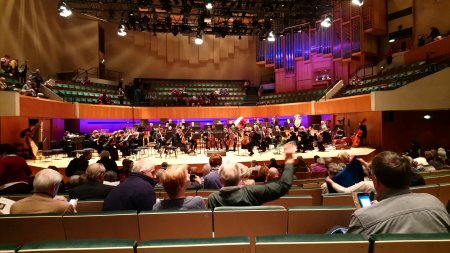
This time it was the Orchestra of Welsh National Opera under the direction of Tomáš Hanus. And very enjoyable it was.
The first number was a bit of a taster for the forthcoming WNO season, which includes Prokofiev’s War and Peace and Rossini’s Lá Cenerentola. The latter being the story of Cinderella, it made sense to include Prokofiev’s Cinderella Suite from the ballet he wrote in the 1940s.
After that we had the evergreen Grieg’s Piano Concerto, by Grieg, played by the excellent Peter Donohoe, exactly how I like it: with all the right notes in the right order, and the Orchestra not too heavy on the banjoes.
Following the wine break we had Beethoven’s Symphony No. 7, a work which has to be one of his most uplifting pieces. Beethoven was very good at ‘uplifting’ so that means it is very special indeed.
A lovely concert, warmly received by the audience and a very pleasant way to spend a Sunday afternoon.
Judgement Day
Posted in Cardiff, Rugby with tags Judgement Day, Principality Stadium, Pro 14, Rugby on April 28, 2018 by telescoper
I’m up early again on a Saturday, travelling back to Cardiff this weekend for the above event later today. It’s actually a School social event for members of the School of Physics & Astronomy that involves two rugby matches at the Principality Stadium in Cardiff, featuring all four Welsh teams in the Guinness Pro 14 tournament: the Blues (from Cardiff); Ospreys (from Neath/Swansea); Scarlets (from Llanelli); and Dragons (from Newport). Tickets for the whole event cost just £10 each…
Should be a good day out! I may post a few pictures from the Stadium, so watch this space.
The scene about 20 minutes before Scarlets v Dragons..
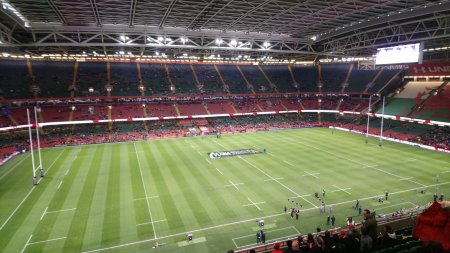
It did fill up: the overall attendance was over 65,000.
The Scarlets versus Dragons match was rather one-sided, ending 33-8 to the team from Llanelli. The thing that struck me most about the game was the dire state of the scrummaging. I think only one scrum completely properly in the whole match! The Dragons also conceded a penalty try after repeated infringements at scrums under their own posts.
After a break we had the Ospreys versus Cardiff Blues. Here is the scene shortly after kick off with the Blues (right) immediately under pressure from the Ospreys (left, in white).
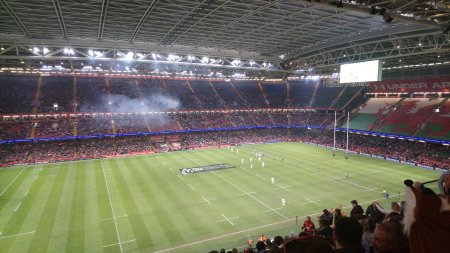
After the first 10 minutes I thought the Ospreys were going to run away with the game but it turned out to be an excellent close-fought contest, of much higher quality than the first. Cardiff were actually ahead for much of the game, despite their atrocious performance at the line out. The match ended 26-23 to the Ospreys, with the winning points coming from a drop goal 2 minutes from the end…
Follow @telescoperThe LGBT+ Physical Sciences Climate Survey – Final Reminder!
Posted in LGBTQ+ with tags Institute of Physics, LGBT+ Physical Sciences Survey, Royal Astronomical Society, Royal Society of Chemistry on April 27, 2018 by telescoper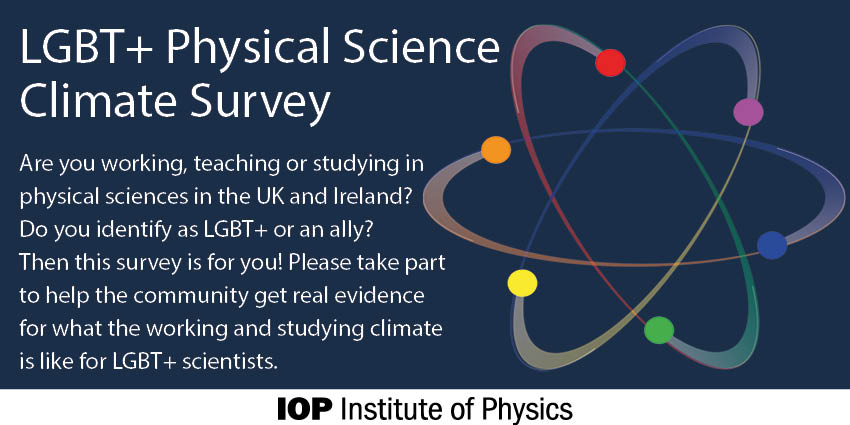
This morning, a tweet from the Institute of Physics containing the above image reminded me to remind you all to participate (if you are so minded) in the LGBT+ Physical Sciences climate survey, which was launched amid the snows of 1st March this year. The deadline is coming up so if you want to complete the survey form and haven’t yet done so, please get on with it!
The survey is open to anyone (whether a member of a professional organisations or not) who identifies as LGBT+ or an ally and who may be working, teaching or studying in a physical sciences field. Respondents will need to be at least 16 years of age and above. The Institute of Physics (IOP), Royal Astronomical Society (RAS) and Royal Society of Chemistry (RSC) are managing this survey on behalf of the LGBT+ Physical Sciences Network. Its aim is to collect evidence for what the working and studying climate is like for LGBT+ physical scientists in the UK and Ireland.
You can complete the survey here.
The survey is open until Monday 30th April, which is very close so why not do it right away?

 In the Dark