Fake Authors in Physics

Posted in The Universe and Stuff with tags , , , on May 30, 2017 by telescoper

Back to work – and exam business – after the Bank Holiday weekend (during most of which I was a bit under the weather), I thought I’d try to get back into the swing of blogging with a brief post about fake authorship.

What provoked me to write this was a strange news item about a Caltech professor who apparently created a fictitious female collaborator called `Ursula C. T. Gamma’ and got her name added as author on scientific papers as well as official email lists on the Caltech website; she also appears in an acknowledgement:

Finally, we thank Ursula C. T. Gamma for continued inspiration.

The professor responsible for all this was none other than Christian Ott, whom I’ve mentioned in a blog post before, because he was placed on unpaid leave by Caltech for harassing two female colleagues.

I don’t know what Ott hoped to gain by inventing a female co-worker. Was it just for a joke, or was there some ulterior motive? I’m not going to speculate here.

If you’ll excuse a bit of frivolity this episode reminded me that a few years ago I toyed with the idea of adding my cat, Columbo, under the pseudonym `Felix Columbo’, as a co-author on a paper I was writing. That would have been for my own amusement – and also because I thought Felix Columbo was a cool name for a physicist, but in the end I didn’t do it largely because I heard about F.D.C. Willard:

The American physicist and mathematician Jack H. Hetherington, Michigan State University, in 1975 wanted to publish some of his research results in the field of low–temperature physics in the scientific journal Physical Review Letters. A colleague, to whom he had given his paper for review, pointed out that Hetherington had used the first person plural in his text, and that the journal would reject this form on submissions with a sole author. Rather than take the time to retype the article to use the singular tense, or to bring in a co-author, Hetherington decided to invent one.

The co-author he invented was his cat, whose name was Chester. The cat’s father was called Willard and the letters F.D.’ stand for `Felis Domesticus’ (the species name for a a house cat).

Other physicists have done similar things. For example, Nobel laureate Andre Geim has written a paper with a hamster as a co-author.

More famously, George Gamow added the name of Hans Bethe to a paper he was writing with his PhD student Ralph Alpher, simply so its authors would be Alpher, Bethe and Gamow. Bethe did subsequently work on the topic discussed in the paper – nucleosynthesis – but hadn’t significantly to the paper. It is reported that Alpher was upset by Gamow’s actions. The paper was published in the Physical Review in 1948 and is a classic in the field of physical cosmology.

As well as being an outstanding physicist, George Gamow was a very colourful and amusing fellow. I’m sure his decision to add Bethe to this paper was just meant as a bit of fun. Likewise with the cat and the hamster. These days, however, authorship of scientific papers is taken far more seriously than it was, as a means to assess research activity and distribute resources. You could argue that this emphasis on authorship is an unhealthy development, but nevertheless that’s the way things. A responsible senior scientist should know that. Adding a phoney author – even if intended as a joke – could well be construed by some institutions as a form of research misconduct.

And how are your real co-workers (especially students and postdocs) supposed to feel if you decide they haven’t contributed enough to merit authorship of a collaborative paper, when they see you adding names of people who don’t even exist?

A Black Rain Frog

Posted in Uncategorized on May 27, 2017 by telescoper

No time for a post today so here’s a picture of a Black Rain Frog…

Summertime – Albert Ayler

Posted in Jazz with tags , , on May 26, 2017 by telescoper

George Gershwin’s beautiful song Summertime has been recorded countless times in countless ways by countless artists, but if you’re expecting it to be performed as a restful lullaby, as it is normally played, you’ll probably be shocked. This version is a heartbreaking expression of pain and anguish performed by the great Albert Ayler, and it was recorded in Copenhagen in 1963.

P.S. The painting shown in the video is by Matisse….

The Sundial of Trevithick 

Posted in The Universe and Stuff with tags , , on May 26, 2017 by telescoper

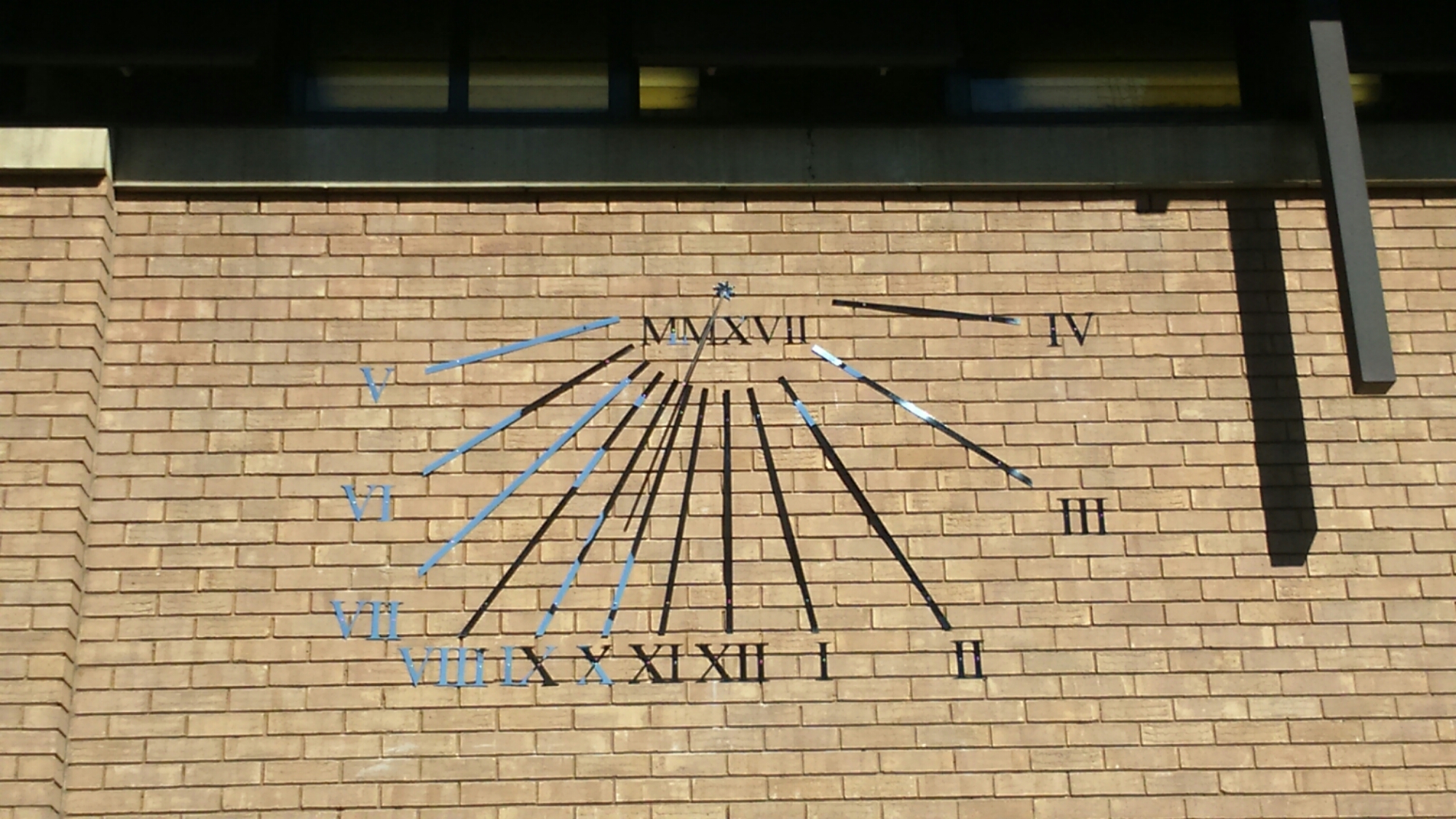
Since it’s a lovely sunny day in Cardiff – and already very warm – I thought I’d step outside the office of the Cardiff University Data Innovation Research Institute which is situated in the Trevithick Building and take a picture of our new sundial:

This flat sundial was installed by a company called Border Sundials and is designed very carefully to be as accurate as possible for the particular wall on which it is place. It’s also corrected for longitude.

However, I took the photograph at about 10.30am, and you’ll notice that it’s showing about 9.30. That’s because it hasn’t been corrected for British Summer Time so it’s offset by an hour. Moreover, a sundial always shows the local solar time rather than mean time which is shown on clocks. These differ because of (a) the inclination of the Earth’s orbit around the Sun relative to the equator and (b) the eccentricity of the Earth’s orbit around the Sun, which means that it does not move at a constant speed. The difference between mean time and solar time can be reconciled using the equation of time. The maximum correction is about 15 minutes, which is large enough to be seen on a sundial of this type. Often a graph of the equation of time is placed next to a sundial so one can do the correct oneself, but for some reason there isn’t one here.

The sundial adds quite a lot of interest to what otherwise is a featureless brick wall and we often notice people looking at it outside our office.

The Art of Jupiter

Posted in Art, The Universe and Stuff with tags , on May 25, 2017 by telescoper

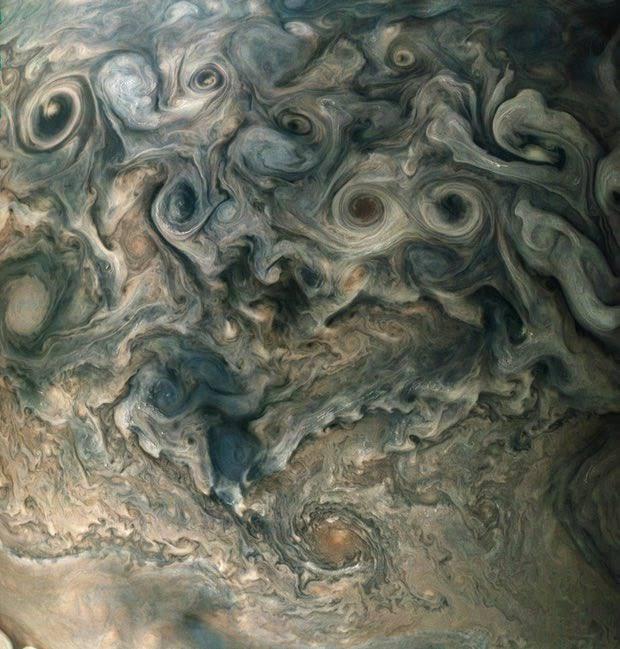
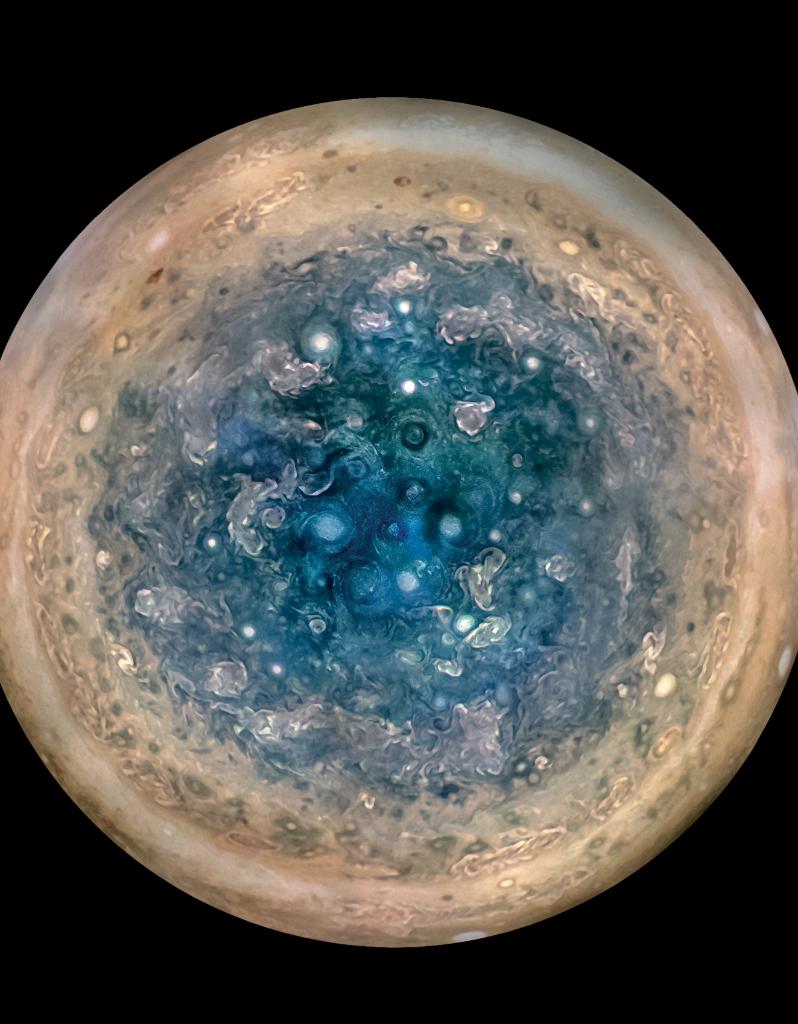
This amazing closeup image is of the North polar region of Jupiter. It was taken by NASA’s Juno spacecraft. Here’s a wider view:


I think it will take scientists quite some time to figure out what is going on in all those complex vortex structures!

In the meantime, though, I think these picture and the others that have been released can be enjoyed as a work of art! As a matter of fact reminds me of van Gogh’s Starry Night...

Yellow Stars, Red Stars and Bayesian Inference

Posted in Bad Statistics, The Universe and Stuff with tags , , , , , , on May 25, 2017 by telescoper

I came across a paper on the arXiv yesterday with the title `Why do we find ourselves around a yellow star instead of a red star?’.  Here’s the abstract:

M-dwarf stars are more abundant than G-dwarf stars, so our position as observers on a planet orbiting a G-dwarf raises questions about the suitability of other stellar types for supporting life. If we consider ourselves as typical, in the anthropic sense that our environment is probably a typical one for conscious observers, then we are led to the conclusion that planets orbiting in the habitable zone of G-dwarf stars should be the best place for conscious life to develop. But such a conclusion neglects the possibility that K-dwarfs or M-dwarfs could provide more numerous sites for life to develop, both now and in the future. In this paper we analyze this problem through Bayesian inference to demonstrate that our occurrence around a G-dwarf might be a slight statistical anomaly, but only the sort of chance event that we expect to occur regularly. Even if M-dwarfs provide more numerous habitable planets today and in the future, we still expect mid G- to early K-dwarfs stars to be the most likely place for observers like ourselves. This suggests that observers with similar cognitive capabilities as us are most likely to be found at the present time and place, rather than in the future or around much smaller stars.

Athough astrobiology is not really my province,  I was intrigued enough to read on, until I came to the following paragraph in which the authors attempt to explain how Bayesian Inference works:

We approach this problem through the framework of Bayesian inference. As an example, consider a fair coin that is tossed three times in a row. Suppose that all three tosses turn up Heads. Can we conclude from this experiment that the coin must be weighted? In fact, we can still maintain our hypothesis that the coin is fair because the chances of getting three Heads in a row is 1/8. Many events with a probability of 1/8 occur every day, and so we should not be concerned about an event like this indicating that our initial assumptions are flawed. However, if we were to flip the same coin 70 times in a row with all 70 turning up Heads, we would readily conclude that the experiment is fixed. This is because the probability of flipping 70 Heads in a row is about 10-22, which is an exceedingly unlikely event that has probably never happened in the history of the universe. This
informal description of Bayesian inference provides a way to assess the probability of a hypothesis in light of new evidence.

Obviously I agree with the statement right at the end that `Bayesian inference provides a way to assess the probability of a hypothesis in light of new evidence’. That’s certainly what Bayesian inference does, but this `informal description’ is really a frequentist rather than a Bayesian argument, in that it only mentions the probability of given outcomes not the probability of different hypotheses…

Anyway, I was so unconvinced by this description’ that I stopped reading at that point and went and did something else. Since I didn’t finish the paper I won’t comment on the conclusions, although I am more than usually sceptical. You might disagree of course, so read the paper yourself and form your own opinion! For me, it goes in the file marked Bad Statistics!

The Beautiful Sun, by William McGonagall

Posted in Poetry with tags , , , on May 24, 2017 by telescoper

Beautiful Sun! with thy golden rays,
To God, the wise Creator, be all praise;
For thou nourisheth all the creation,
Wherever there is found to be animation.

Without thy heat we could not live,
Then praise to God we ought to give;
For thou makest the fruits and provisions to grow,
To nourish all creatures on earth below.

Thou makest the hearts of the old feel glad,
Likewise the young child and the lad,
And the face of Nature to look green and gay,
And the little children to sport and play.

Thou also givest light unto the Moon,
Which certainly is a very great boon
To all God’s creatures here below,
Throughout the world where’er they go.

How beautiful thou look’st on a summer morn,
When thou sheddest thy effulgence among the yellow corn,
Also upon lake, and river, and the mountain tops,
Whilst thou leavest behind the most lovely dewdrops!

How beautiful thou seem’st in the firmament above,
As I gaze upon thee, my heart fills with love
To God, the great Creator, Who has placed thee there,
Who watches all His creatures with an eye of care!

Thou makest the birds to sing on the tree,
Also by meadow, mountain, and lea;
And the lark high poised up in air,
Carolling its little song with its heart free from care.

Thou makest the heart of the shepherd feel gay
As he watches the little lambkins at their innocent play;
While he tends them on the hillside all day,
Taking care that none of them shall go astray.

Thou cheerest the weary traveller while on his way
During the livelong summer day,
As he admires the beautiful scenery while passing along,
And singing to himself a stave of a song.

Thou cheerest the tourist while amongst the Highland hills,
As he views their beautiful sparkling rills
Glittering like diamonds by the golden rays,
While the hills seem to offer up to God their praise.

While the bee from flower to flower does roam
To gather honey, and carry it home;
While it hums its little song in the beautiful sunshine,
And seemingly to thank the Creator divine —

For the honey it hath gathered during the day,
In the merry month of May,
When the flowers are in full bloom,
Also the sweet honeysuckle and the broom.

How beautiful thy appearance while setting in the west,
Whilst encircled with red and azure, ’tis then thou look’st best!
Then let us all thank God for thy golden light
In our prayers every morning and night!

by Wiliam Topaz McGonagall (1825-1902)


Wave Mechanics and Large-scale Structure

Posted in Books, Talks and Reviews, The Universe and Stuff with tags , , , on May 24, 2017 by telescoper

I thought I’d share the slides I used for the short talk I gave last Thursday at the Osservatorio Astronomico di Bologna, on the topic of Wave Mechanics and Large-scale Structure. I’ve posted about the general idea underpinning this workhere, and here are some links to references with more details of the cosmological setting, including a couple of papers by myself and Chris Short on some of whose old slides I based the talk.

http://adsabs.harvard.edu/abs/1993ApJ…416L..71W
http://adsabs.harvard.edu/abs/1997PhRvD..55.5997W
http://adsabs.harvard.edu/abs/2002MNRAS.330..421C
http://adsabs.harvard.edu/abs/2003MNRAS.342..176C
http://adsabs.harvard.edu/abs/2006JCAP…12..012S
http://adsabs.harvard.edu/abs/2006JCAP…12..016S
http://adsabs.harvard.edu/abs/2010MNRAS.402.2491J

I had a few problems with the movies during the actual talk, and they probably don’t work in this embedded version. There are a few formatting errors in the slideshare version too, but hopefully you can figure out what’s going on!

The Shaw Prize goes to Simon White

Posted in The Universe and Stuff with tags , , , on May 23, 2017 by telescoper

MPI Astro Physik – Prof .Simon White

To happier things. I was delighted to see just now that Simon White (above) has won this year’s Shaw Prize for Astronomy. The prize was awarded..

for his contributions to understanding structure formation in the Universe. With powerful numerical simulations he has shown how small density fluctuations in the early Universe develop into galaxies and other nonlinear structures, strongly supporting a cosmology with a flat geometry, and dominated by dark matter and a cosmological constant.

The citation seems a bit strange to me because Simon’s contributions to astronomy and cosmology are many and varied, but it’s in any case an extremely well-justified award. In a field filled with very many very clever people, Simon is definitely one of the cleverest!

The announcement of this awarded reminded me that I was one of the co-authors of a paper with Simon White, but looking it up I realized that was way back in 1993! Where does the time go?

Anyway, hearty congratulations to Simon! I think it’s his round…

Manchester Thoughts

Posted in Poetry with tags , , on May 23, 2017 by telescoper

I went to bed early last night after a long day, so I only found out about the terrible events in Manchester when I woke up this morning. The lives of 22 people ended last night, and many of those who survived will never be the same again because of their physical injuries or because of the awful things they witnessed.

I know it’s a feeble response, but I send my deepest condolences to the bereaved and wish a speedy recovery to all those injured or in any other way affected.

Words fail in situations like this. Comprehension fails too. How someone purportedly of the same species as me can sit down and systematically plan to murder children and teenagers is quite beyond my ability to fathom. The choice of target was as callous as it was deliberate: an audience of young girls. The murderer blew himself up in the course of this attack, which means he has evaded justice. I just hope the police will identify the remains and wrap up whatever network helped him plan and execute this attack.

There’s enough information in the news to make a reasonably informed guess as to what kind of explosive device was used. It’s not difficult to make a bomb of that type, but it’s a step up in sophistication from the event on Westminster Bridge. Let’s hope it’s not the start of a new wave of terror attacks, but even if it is they will not win.

It’s difficult to concentrate on work when something like this happens, but I think it’s important to force oneself to do so. If we allow ourselves to become distracted, then the bastards have won. I won’t write much more, but I will refer you to a poem by Dylan Thomas, arguably his greatest, which came into my mind this morning as it has done (sadly) many times before.

A Refusal to Mourn the Death by Fire of a Child in London was first published just after the end of the Second World War and was written after Thomas heard news of a young girl who had burned to death when the house she was in was set on fire during an air raid.

The idea behind the poem is complex, and its message double-edged, but Thomas finds a perfect balance between horror and sadness, and between indignation and heartbreak. Children shouldn’t have to die, and neither should anyone else whose life is cut short by another’s hand, but we have to live with the fact that they can and do. There’s no consolation to be found in mourning and in any case it’s hypocritical to favour one death with elegies, when suffering is so widespread. The best we can do is allow the dead some dignity and the bereaved some time to heal.

Here is a short extract from the poem, which sums up my thoughts.

I shall not murder
The mankind of her going with a grave truth
Nor blaspheme down the stations of the breath
With any further
Elegy of innocence and youth.

I won’t post the full poem here, but you can find it elsewhere on this blog.