Unsquare Dance

Posted in Jazz with tags , , on May 4, 2017 by telescoper

By way of a small postscript to last week’s post about the great Joe Morello, here’s a piece that shows he was such a great drummer he didn’t even need a drum!

Dave Brubeck’s tune Unsquare Dance is basically a blues built around a single bass figure and played in 7/4 time, making it not inconsiderably difficult to dance to. Difficult, but not impossible! On top of that the tempo actually speeds up during this performance. It’s normally a cardinal sin for a rhythm section in jazz to speed up – the beat has to stay rock steady while the soloists push ahead or lag behind. That’s what generates the sort of dynamic tension that characterizes as swinging performance. In this tune Dave Brubeck was just playing a little joke on the `foot-tappers and finger-snappers’ so he can be forgiven for his trangression.

Listen out, though, for Joe Morello’s contribution. His solo consists entirely of rim shots (made by striking the rim rather than the skin of a snare drum). I believe it is Joe Morello who laughs out loud at the end, partly with relief that they managed to get through this tricky little piece without screwing up!

As you can see, this was released as a 45rpm single and it became quite a hit (by the standards of Jazz records), reaching No. 14 in the UK charts back in 1962.

Widening Participation Matters

Posted in Education with tags , , , , , on May 3, 2017 by telescoper

Time for a mini-rant about the failure of many universities to make any real attempt to make higher education more accessible to students from diverse backgrounds, especially those from underrepresented social groups.

I found this item on Twitter the other day. It’s from a local newspaper in York, and it was accompanied by an article that applauded the University of York (rightly) for being in the top three Russell Group universities for widening participation.
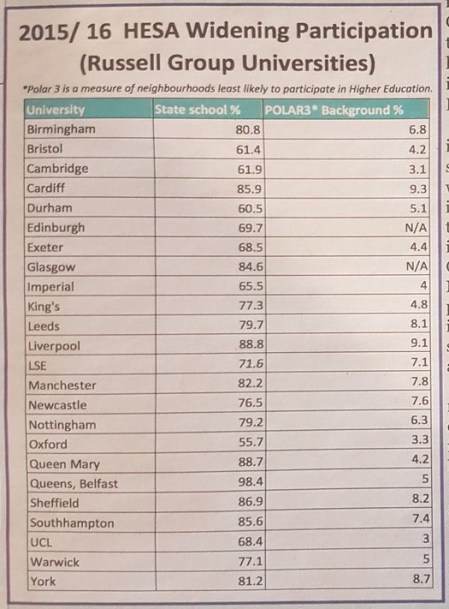
The list shows all 24 universities in the Russell Group, along with the fraction of their students that come from state schools and the fraction that come from geographical areas where participation in higher education is low; ‘POLAR3’ is the latest iteration of the Participation of Local Areas survey carried out by the Higher Education Funding Council for England (HEFCE).

I’m very pleased that my current employer, Cardiff University, leads the Russell Group by this measure, followed by the Universities of Liverpool and York, respectively.

What doesn’t please me is that so many of these institutions have such low participation rates from this group, and also such a small fraction of students who were educated at state schools. Over 90% of the total number of students at UK universities were educated at state schools, but the only Russell Group member to exceed 90% is Queens University, Belfast. However, the school system in Northern Ireland is very different from the rest of the UK, with relatively few private schools, so the situation there is not really comparable.

When tuition fees were increased in 2012, Universities were only allowed the charge the maximum (£9K per annum) if they produced an `Access Agreement‘  outlining measures to be introduced that would `improve access, student success and progression among people from under-represented and disadvantaged groups‘. The evidence of the last five years is that participation rates at many of the Russell Group institutions listed above have not changed at all. The reason for this is simple: the members of senior management at these institutions simply do not careabout widening participation.

I emphasize that it’s the members of senior management who don’t care because I honestly believe that the majority of academic staff in these institutions (and indeed the rest of the higher education sector) do care a very great deal. Nowadays however the gulf between academics and managers is greater than ever

Some time ago I was interviewed for a job in senior management at one of the institutions in the table above. During the course of the interview I was asked, among many other things, what I thought the University needed to do better. Without hesitation I said `widening participation’. The members of the panel stared at me as if I’d taken leave of my senses. The institution concerned was doing in well in league tables and recruiting students and saw no reason to try to make itself more open. When asked why I thought it was so important, I said I thought it was a moral responsibility. What I meant was that I think universities should be run for the public good, not just for the good of people who went to a posh school. That received even more uncomprehending stares than my original statement.

I didn’t get that job. I’m not saying it was because of the way I answered that question. I’m sure there were plenty of other reasons not to employ me, but that is the part of the interview I remember most vividly. I had prepared a list of ideas (including foundation programmes, measures to boost graduate employability, work placements, schools liaison, etc), some of which I’d borrowed from my (then) employer, the University of Sussex (which was – and is – very good at widening participation), but I had wasted my time. They weren’t interested.

The current system of ‘Access Agreements’ clearly isn’t working for these institutions and there is no effective sanction to force them even to try to broaden participation. Until there is, they will continue not to care.

Parliament has recently enacted the Higher Education and Research Act (2017). This presented a great chance to tackle the failures described above but, as far as I can see, none of the new arrangements is likely to do anything to widen participation in the so-called `elite’ universities, so it’s been a wasted opportunity.



Building Momentum Towards Inclusive Teaching and Learning

Posted in Education with tags , , on May 2, 2017 by telescoper

I’ve had a very full day back after the Bank Holiday (Long) Weekend so I only have time for a brief post today.

I was giving a revision lecture this morning so I wasn’t able to attend an event in London organized by the Institute of Physics to launch a new report with the title Building Momentum Towards Inclusive Teaching and Learning. It was a shame I couldn’t go, as I’m a member of the IOP Diversity and Inclusion Committee which oversaw this report, but the exam period is coming up and I couldn’t reschedule the lecture.

Anyway, to quote the IOP web page:

There are particular challenges in providing an inclusive learning environment in all the physical sciences and especially in physics, due to the wide range of activities involved, such as lab sessions, problem classes and fieldwork, and the use of mathematical and scientific notation. General good practice guidance on inclusive curricula do not normally contain specialist information on the particular accessibility challenges of courses with substantial mathematical content given its non-linear nature (ie the relative positioning of letters, symbols and numbers and their relative sizes) and the limitations of assistive technology in manipulating this content.

The Equalities Act (2010) requires HEIs to make `reasonable adjustments’ to make their courses accessible to disabled students, but there’s often no reason why these `adjustments’ should not simply be standard provision for all students. That’s what `inclusive’ means. If, for example, lecture recordings and/or printed notes are made available for students who have difficulty taking notes, then why not make them available for everyone? That’s what `inclusive’ actually means.

To quote again:

By moving towards a more inclusive learning environment many organisational, structural and cultural barriers to disabled students can be removed. The focus on inclusivity means that “individual interventions is the exception, not the rule” as set out in the Department for Education’s report Inclusive Teaching and Learning in Higher Education as a Route to Excellence. This requires all staff in higher education – academics, support staff and senior institutional managers – to consider the needs of disabled students in all that they do – including the design, delivery and assessment of all academic teaching and learning.

I therefore encourage anyone who’s involved in teaching physics to read this report, which you can download as a PDF file here, and think about its recommendations when you start to plan teaching activities, whatever form they take.

 When Things Could Only Get Better..

Posted in Biographical on May 1, 2017 by telescoper

Twitter reminded me this morning that it’s twenty years to the day since the Labour Party under Tony Blair swept to a landslide victory in a General Election. ‘Things can only get better’ was the anthem of the times.

How things have changed.

Twenty years on Labour is in disarray, the United Kingdom is more divided than ever, and we’re about to crash out of the European Union. From where I’m standing things can only get worse. And a lot worse, at that.

Anyway, going back to 1997, I remember that the election happened while I was in America; I had cast  postal vote before going on the trip. On the day, I went to a party at the house of a British colleague. Because of the time difference the results came in during the evening there, rather than the early hours of the morning as they would have done at home.

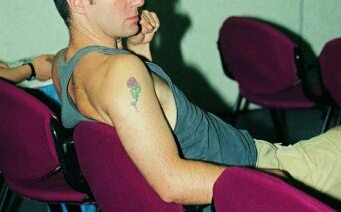
When it became clear that Labour had won, I was already a bit tipsy and decided to celebrate by going to a tattoo parlour to be commemoratively inked. I left with this.

The ‘New Labour’ symbol was a red rose..

The photograph was taken some years after the event, at a conference in Italy. I still have the tattoo, of course, although it has faded a bit (like the rest of me). Among other things,  it reminds me of a time – not too far in the past – when there seemed to be a future.

One-day Cricket: Glamorgan versus Surrey

Posted in Football on April 30, 2017 by telescoper

This morning I headed down to Sophia Gardens to watch a limited-overs match between Glamorgan and Surrey, the first game I’ve ever seen in the Royal London One-day Cup, a 50-overs a side competition.

The weather forecast for today wasn’t encouraging and I almost didn’t go as I thought there wouldn’t be much play. I did, and am glad I did so as there was a full session despite the murky weather.

As it turned out, most of the thick cloud passed over on the rather stiff breeze without dropping any rain. Even this lot didn’t produce a drop:

As I settled into my seat I noticed a gentleman nearby who was wearing a thick overcoat, scarf and gloves. His ensemble was completed, somewhat incongruously, by a white sun hat.

Anyway, having lost the toss and been put into bat, Glamorgan were all out for 239 in the 48th over.  The highlight of the innings was a belligerent 72 from Colin Ingram, who hit two enormous sixes on the way. That aside, it wasn’t a great batting performance, and 240 to win does not seem to be a particularly challenging performance.

Rain had actually arrived by the last few overs of the Glamorgan innings. but it wasn’t heavy enough to stop play. It was,  however, enough to persuade me to go home for a late lunch and to warm up a bit.

If it stops raining and I decide to return to Sophia Gardens I’ll post an update, but it’s possible that there won’t be any more play as the rain is getting heavier and Surrey haven’t even started  their innings yet…

Glamorgan’s next game in this competition is on Tuesday 2nd May against Sussex at Hove. I would have liked to go to that, but unfortunately I’ve got work commitments on Tuesday so I can’t. The next game in Cardiff is on Friday 5th against Somerset. I will go to that, weather permitting..

UPDATE: after a lengthy delay, Surrey were set a target of 182 to win off 29 overs (by the Duckworth-Lewis method). They rattled off the runs with 5 overs to spare.

Championship Update

Posted in Football on April 29, 2017 by telescoper

Well, the plot thickens.

The penultimate round of matches this weekend has seen another twist in the story of this  year’s Championship.

Last night Newcastle United played Cardiff City here in Cardiff, beating the home side 2-0. I didn’t go to the match, but there seem to have been plenty of Newcastle fans in town last night.

That result meant that Newcastle United were still 2nd, but only one point behind leaders Brighton and Hove Albion.

A win for them this afternoon at home against lowly Bristol City would have given them the Championship. Surprisingly, however, they lost 1-0.

The title race, somewhat unexpectedly, therefore goes to the last round of matches next Sunday. If Brighton win, they are Champions. If they don’t, and Newcastle win or draw, then Newcastle United are champions (the latter courtesy of goal difference). If Newcastle lose then Brighton are champions whatever their result.

Given the way this season has gone it seems rather fitting that it will be decided in the final round of matches. May the best team finish top (as long as it’s Newcastle)!

And in other news, to crown an excellent weekend for Newcastle supporters, Sunderland got relegated from the Premiership.

Precision Cosmology!

Posted in Books, The Universe and Stuff with tags , , on April 28, 2017 by telescoper

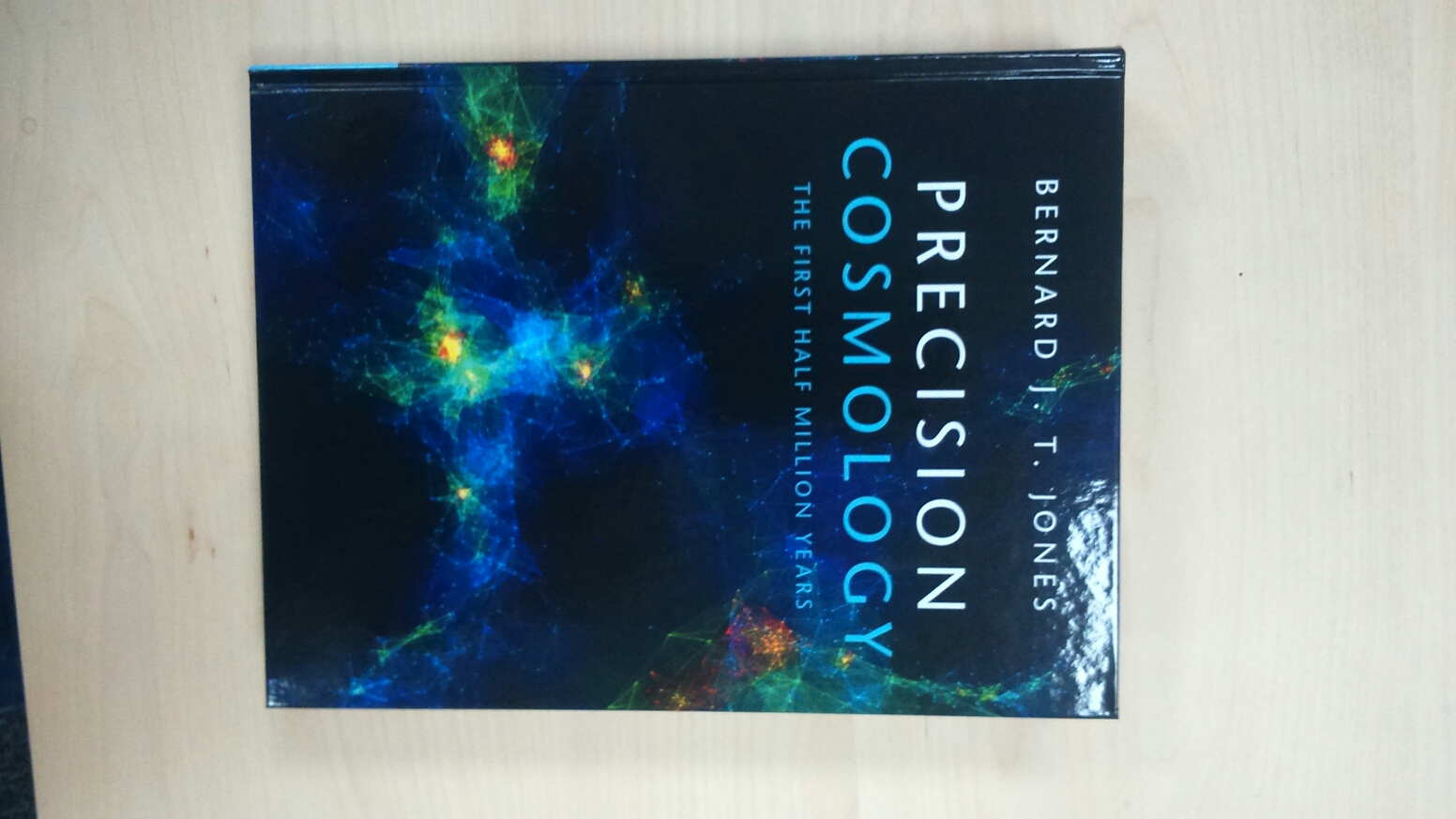
Well, look what the postman brought me today!

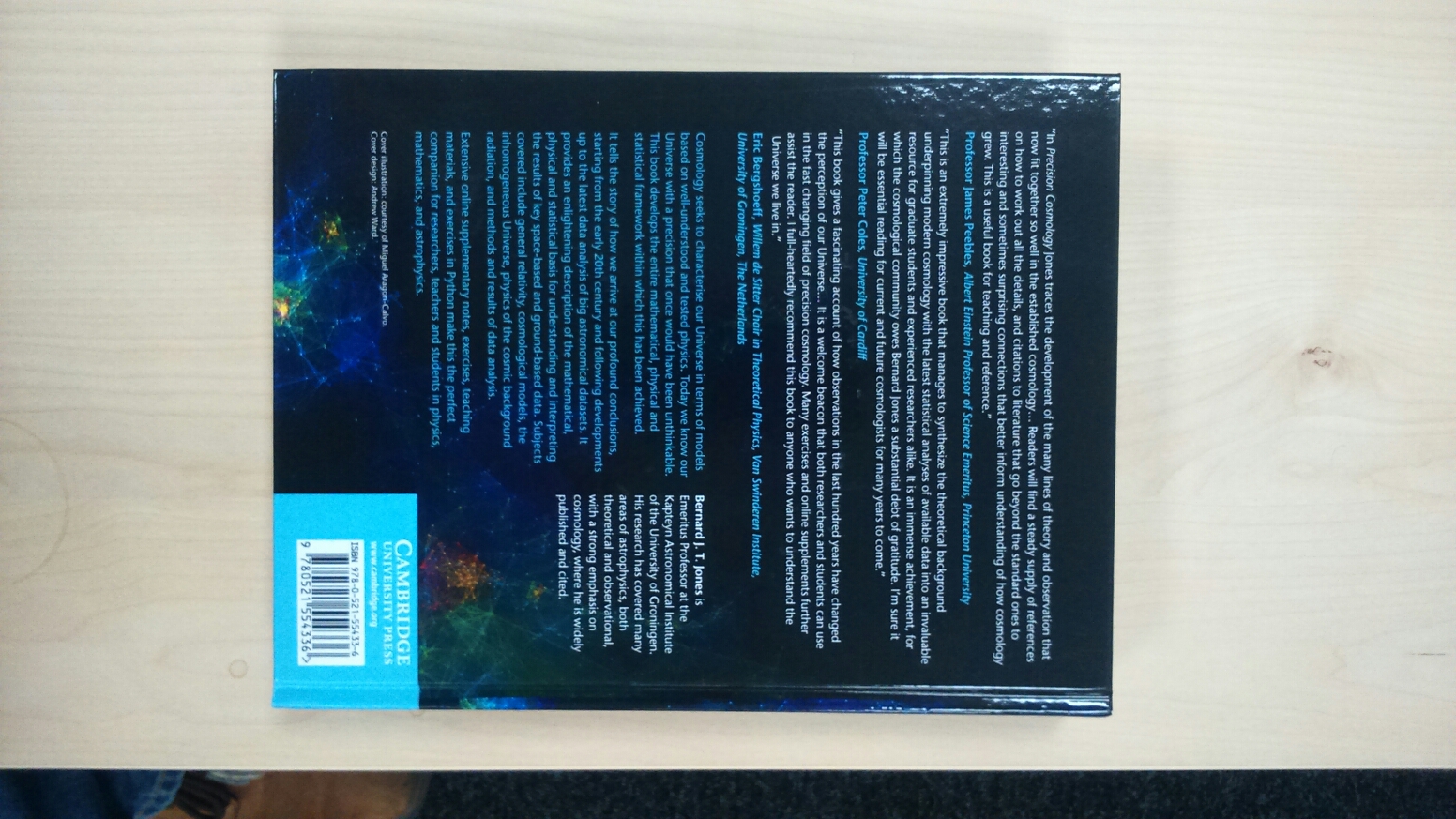
Hot off the press, here is a textbook by my friend and erstwhile collaborator Bernard Jones. As you will see, it even has an endorsement by me on the back cover. I think its a very fine book indeed and it will be immensely useful for cosmologists young and old alike!

A Joe Morello Drum Master Class

Posted in Jazz with tags , , , , on April 28, 2017 by telescoper

After a busy morning, I reckon it’s time for a pause and a quick blog post. I stumbled across this clip of a great drum solo a while ago and immediately bookmarked it for future posting. As happens most times I do that I then forgot about it, only finding it again right now so I thought I’d post it before I forget again.

This is the great Joe Morello at the very peak of his prowess in 1964, with the Dave Brubeck Quartet with whom he recorded over 60 albums. That band pioneered the use of unusual time signatures in jazz, such as 3/4, 7/4, 13/4, 9/8 and most famously in their big hit Take Five which is in 5/4 time throughout; they recorded a number of other tracks in which the time signature shifts backwards and forwards between, e.g., 7/4 and the standard 4/4.

A few points struck me watching this clip. The first is that it’s a great example of the use of the ‘trad’ grip which is with the left hand under the stick, passing between the thumb and index finger and between the second and third fingers, thusly:

The right stick is usually held with an overhand grip. Most jazz drummers (whether they play ‘trad’ jazz or not) use this grip. Most rock drummers on the other hand use a ‘balanced’ grip in which both sticks are held with an overhand grip. You might think holding the left-hand and right-hand sticks the same way is the obvious thing to do, but do bear in mind that people aren’t left-right symmetric and neither are drum kits so it’s really not obvious at all!

The trad grip looks a bit unnatural when you first see it, but it does have an advantage for many of the patterns often used  in jazz. Once you’ve mastered the skill, a slight rotation of the wrist and subtle use of the fingers makes some difficult techniques (e.g. rolls) much easier to do rapidly with this grip than with the balanced grip. I’m not claiming to be a drummer when I say all this, but my Dad was and he did teach me the rudiments. In fact, he thought that drummers who used the balanced grip weren’t proper drummers at all!

(I’ll no doubt get a bunch of angry comments from rock drummers now, but what the hell…)

Anyway you can see Joe Morello using the trad grip to great effect in this clip, in which he displays astonishing speed, accuracy and control. The way he builds that single-stroke roll from about 2:28 is absolutely astonishing. In fact he’s so much in command throughout his solo, that he even has time to adjust his spectacles and move his bass drum a bit closer! Jazz musicians used to joke that atomic clocks could be set to Joe Morello, as he kept time so accurately, but as you can see in this clip he did so much more than beat out a rhythm. It’s only about 3 minutes long but this solo really is a master class.

Joe Morello was never a ‘showy’ musician. He never adopted the popular image of the drummer as the madman who sat at the back of the band that was cultivated by the likes of Gene Krupa in the jazz world and later spread into rock’n’roll. Bespectacled and wearing a suit and tie he looks a bit like a bank clerk, but boy could he play! The expression on Dave Brubeck’s face tells you that he knew he was very lucky to have Joe Morello in his band.


WikiLeeks

Posted in Uncategorized on April 27, 2017 by telescoper

I’ve had today off to work on the launch of my new project, called WikiLeeks.

I’m thrilled now to be able to publish our first findings.

The STFC ‘Breadth of Programme’ Exercise

Posted in Science Politics with tags , , , , , on April 26, 2017 by telescoper

I suddenly realized this morning that I there was a bit of community service I meant to do when I got back from vacations, namely to pass on to astronomers and particle physicists a link to the results of the latest Programmatic Review (actually ‘Breadth of Programme’ Exercise) produced by the Science and Technology Facilities Council.

It’s a lengthy document, running to 89 pages, but it’s a must-read if you’re in the UK and work in area of science under the remit of STFC. There was considerable uncertainty about the science funding situation anyway because of BrExit, and that has increased dramatically because of the impending General Election which will probably kick quite a few things into the long grass, quite possibly delaying the planned reorganization of the research councils. Nevertheless, this document is well worth reading as it will almost certainly inform key decisions that will have to be made whatever happens in the broader landscape. With `flat cash’ being the most optimistic scenario, increasing inflation means that some savings will have to be found so belts will inevitable have to be tightened. Moreover, there are strong strategic arguments that some areas should grow, rather than remain static, which means that others will have to shrink to compensate.

There are 29 detailed recommendations and I can’t discuss them all here, but here are a couple of tasters:

The E-ELT is the European Extremely Large Telescope, in case you didn’t know.

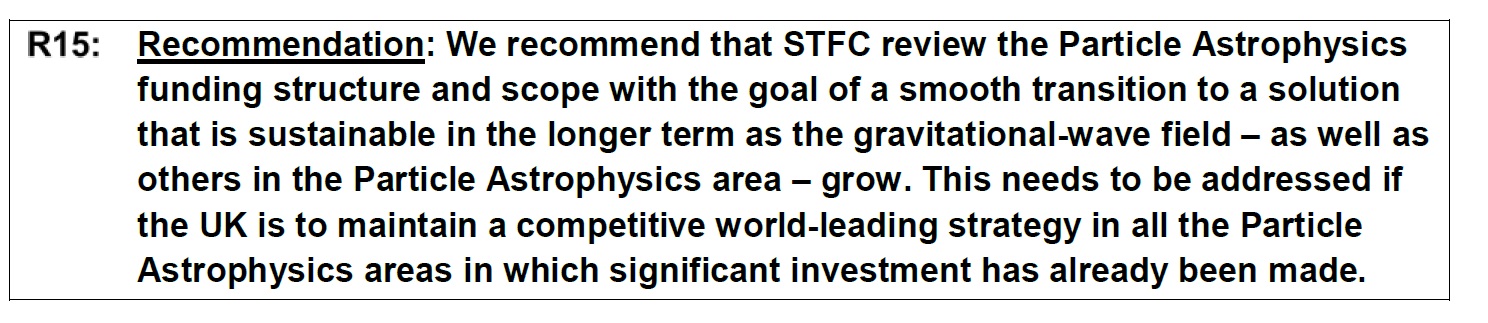
Another one that caught my eye is this:

I’ve never really understood why gravitational-wave research came under ‘Particle Astrophysics’ anyway, but given their recent discovery by Advanced LIGO there is a clear case for further investment in future developments, especially because the UK community is currently rather small.

Anyway, do read the document and, should you be minded to do so, please feel free to comment on it below through the comments box.