I couldn’t resist sharing this charming video about neutrino physics. I don’t know who this Samantha is, but I think she’s a star!
Follow @telescoperA Young Person’s Guide to Neutrino Physics
Posted in The Universe and Stuff with tags Neutrino Flavour, Neutrino Physics, Samantha on October 28, 2015 by telescoperCommercially-driven research should be funded by loans, not grants
Posted in Politics, Science Politics with tags Grants, Loans, research, Science funding on October 27, 2015 by telescoperI couldn’t resist a very quick comment on an item in yesterday’s Financial Times. The article may be behind a paywall, so here’s a short extract giving the essential point:
Ministers are considering proposals to replace research grants to industry with loans, in a move that business leaders fear would damage Britain’s ability to innovate.
The reason for mentioning this is that I suggested the very same idea on this blog about five years ago. My general point was the logical inconsistency in swapping grants for loans in the case of university students on the grounds that they are the beneficiaries of education and should be able to pay back the investment through earnings, when the same argument is not applied to businesses that profit from university-based research. I wonder if BIS have been reading this blog again?
For what it’s worth I’ll repeat here my personal opinion view that “commercially useful” research should not be funded by the taxpayer through research grants. If it’s going to pay off in the short term it should be funded by private investors or venture capitalists of some sort. Dragon’s Den, even. When the public purse is so heavily constrained, it should only be asked to fund those things that can’t in practice be funded any other way. That means long-term, speculative, curiosity driven, scientific research.
This is pretty much the opposite of what the Treasury seems to have been thinking for the last five years. It wants to concentrate public funds in projects that can demonstrate immediate commercial potential. Taxpayer’s money used in this way ends up in the pockets of entrepreneurs if the research succeeds and, if it doesn’t, the grant has effectively been wasted. My proposal, therefore, is to phase out research grants for groups (either in universities or in business) that want to concentrate on commercially motivated research and replace them with research loans. If the claims they make to secure the advance are justified they should have no problem repaying it from the profits they make from patent income or other forms of exploitation. If not, then they will have to pay back the loan from their own funds (as well as being exposed as bullshit merchants). In the current economic situation the loans could be made at very low interest rates and still save a huge amount of the current research budget for higher education. Indeed after a few years – suggest the loans should be repayable in 3-5 years, it would be self-financing. I think a large fraction of research in the Applied Sciences and Engineering should be funded in this way.
The money saved by replacing grants to commercially driven research groups with loans could be re-invested in those areas where public investment is really needed, such as pure science and medicine. Here grants are needed because the motivation for the research is different. Much of it does, in fact, lead to commercial spin-offs, but that is accidental and likely to appear only in the very long term. The real motivation of doing this kind of research is to enrich the knowledge base of the UK and the world in general. In other words, it’s for the public good. Remember that?
Most of you probably think that this is a crazy idea, but if you do I’ll ask you to now think about how the government funds teaching in universities and ask yourself why research is handled in such a different way.
Follow @telescoperScience is Vital at the Conway Hall
Posted in Politics, Science Politics with tags Conway Hall, Science funding, Science is Vital on October 27, 2015 by telescoperYesterday, as promised, I went up to London to attend the Science is Vital event at the Conway Hall.I was a bit worried that I might not make it in time for the 7 o’clock kick-off, but it turned out that a meeting I was attending finished earlier than expected and I got to the venue in good time.
It was a fun evening, but you don’t need to take my word for it. Here is a video of the whole thing, which is basically a recording of the live webstream. I learned a lot, especially from Andrew Steele (who appears early on); check out his website here. Did you know for example that the average expenditure per person per year in the UK on alcohol is £600, while the average expenditure per person per year in the UK on cancer research is a paltry £2.80?
P.S. There’s a nice discussion of wider issues raised by the Science is Vital campaign in today’s Guardian.
Follow @telescoperR.I.P. Lisa Jardine
Posted in History with tags Jacob Bronowski, Lisa Jardine on October 26, 2015 by telescoper

As soon as I got home from Oxford yesterday I heard the very sad news of the death of writer, scholar and broadcaster Lisa Jardine, who has passed away at the age of 71.
Today’s newspapers are filled with tributes from people who are fair better qualified than me to discuss her career as a historian (e.g. here and here). I can’t leave her death unmarked, but I’ll restrict myself to some personal recollections. Lisa Jardine worked at Queen Mary College when I was employed there (from 1990-1998) . I won’t claim to have known her well but I did meet her quite a few times, usually in the Senior Common Room bar. She seemed to me to be a rarity: a historian who was genuinely interested in, and knowledgeable about, science. In fact she knew an enormous amount about a huge range of different subjects, but was also extremely engaging and approachable, though she didn’t suffer fools gladly (if at all). She was a delight to talk to; conversations with Lisa were always both entertaining and educational. What I’ll remember most, however, is her deliciously cheeky sense of humour and the marvellous twinkle in her eye. It’s hard to believe that she has gone.
Rest in Peace, Lisa Jardine (1944-2015).
P.S. In case you weren’t aware, Lisa Jardine was the daughter of famous polymath Jacob Bronowski who was of Polish-Jewish origin. I mention that not to detract from Lisa’s own achievements as an academic, but to draw attention to yet another family of “migrants” that has enriched our nation’s culture.
Follow @telescoper
The Open Journal cometh..
Posted in Biographical, Open Access on October 25, 2015 by telescoperI have been at a meeting in Oxford with a group of conspirators this afternoon to plot the final downfall of the academic publishing industry..

All systems are go and we have agreed a schedule for the official launch of the long-awaited Open Journal of Astrophysics.
More details will come out over the next few weeks. Watch this space!
Follow @telescoperFracking, Gender, and the need for Open Science
Posted in Open Access, Politics, Science Politics, The Universe and Stuff with tags Averil MacDonald, Beddington Report, hydraulic fracturing, Science, shale gas, Sir John Beddington, UK Onshore Oil and Gas on October 24, 2015 by telescoperI can’t resist commenting on some of the issues raised by Professor Averil MacDonald’s recent pronouncements about hydraulic fracturing (“fracking” for short). I know Averil MacDonald a little bit through SEPNet and through her work on gender issues in physics with the Institute of Physics and I therefore found some of her comments – e.g. that women “don’t understand fracking, which is why they don’t support it” – both surprising and disappointing. I was at first prepared to accept that she might have been misquoted or her words taken out of context. However she has subsequently said much the same thing in the Guardian and, worse, in an excruciating car crash of an interview on Channel 4 News. It seems that having lots of experience in gender equality matters is no barrier to indulging in simplistic generalisations; for a discussion of the poll which inspired the gender comments, and what one might or might not infer from it, see here. For the record, Professor MacDonald is Chair of UK Onshore Oil and Gas, an organization that represents and lobbies on behalf of the United Kingdom’s onshore oil and gas industry.
Before I go on I’ll briefly state my own position on fracking, which is basically agnostic. Of course, burning shale gas produces carbon dioxide, a greenhouse agent. I’m not agnostic about that. What I mean is that I don’t know whether fracking is associated with an increased risk of earthquakes or with water contamination. I don’t think there is enough reliable scientific literature in the public domain to form a rational conclusion on those questions. On the separate matter of whether there is enough shale gas to make a meaningful contribution to the UK’s energy needs I am rather less ambivalent – the balance of probability seems to me to suggest that fracking will never provide more than a sticking-plaster solution (if that) to a problem that which reach critical proportions very soon. Fracking seems to me to be a distraction; a long-term solution will have to be found elsewhere.
The central issue in the context of Averil MacDonald’s comments seems to me however to be the perception of the various risks associated with fracking that I have mentioned before, i.e. earth tremors, contaminated water supplies and other environmental dangers. I think it’s a perfectly rational point of view for a scientifically literate person to take to be concerned about such things and to oppose fracking unless and until evidence is supplied to allay those fears. Moreover, it may be true that most women don’t understand science but neither do most men. I suspect that goes for most of our politicians too. I’ve commented many times on what a danger it is to our democracy that science is so poorly understood among the general population but my point here is that the important thing about fracking is not whether men understand the science better than women, but that there’s too little real scientific evidence out there for anyone – male or female, scientifically literate or not – to come to a rational conclusion about it.
I’ve yet to see any meaningful attempt in the mainstream media on the actual science evidence involved when surely that’s the key to whether we should “get behind” fracking or not? It struck me that quite a few readers might also be interested in this issue to, so for them I’d recommend reading the Beddington Report. The problem with this report, however, is that it’s a high-level summary with no detailed scientific discussion. In my opinion it’s a very big problem that geologists and geophysics (and climate scientists for that matter) have not adopted the ideals of the growing open science movement. In particular, it is very difficult to find any proper scientific papers on fracking and issues associated with fracking that aren’t hidden behind a paywall. If working scientists find it difficult to access the literature how can we expect non-scientists to come to an informed conclusion?
Here’s an exception: a rare, peer-reviewed scientific article about hydraulic fracturing. The abstract of the paper reads:
The widespread use of hydraulic fracturing (HF) has raised concerns about potential upward migration of HF fluid and brine via induced fractures and faults. We developed a relationship that predicts maximum fracture height as a function of HF fluid volume. These predictions generally bound the vertical extent of microseismicity from over 12,000 HF stimulations across North America. All microseismic events were less than 600 m above well perforations, although most were much closer. Areas of shear displacement (including faults) estimated from microseismic data were comparatively small (radii on the order of 10 m or less). These findings suggest that fracture heights are limited by HF fluid volume regardless of whether the fluid interacts with faults. Direct hydraulic communication between tight formations and shallow groundwater via induced fractures and faults is not a realistic expectation based on the limitations on fracture height growth and potential fault slip.
However, it is important to realise that, as noted in the acknowledgements, the work on which this paper is based was funded by “Halliburton Energy Services, Inc., a company that is active in the hydraulic fracturing industry in sedimentary basins around the world”. And therein lies the rub. In the interest of balance here is a link to a blog post on fracking in the USA, the first paragraph of which reads:
For some time now, proponents of the controversial practice of hydraulic fracturing or “fracking” have claimed there was little or no evidence of real risk to groundwater. But as the classic saying goes: “the absence of evidence is not evidence of absence” of a problem. And the evidence that fracking can contaminate groundwater and drinking water wells is growing stronger with every new study.
I encourage you to read it, but if you do please carry on to the comments where you will see detailed counter-arguments. My point is not to say that one side is right and the other is wrong, but that there are scientists on both sides of the argument.
What I would like to see is a proper independent scientific study of the geological and geophysical risks related of hydraulic fracturing, subjected to proper peer review and publish on an open access platform along with all related data; by “independent”, I mean not funded by the shale gas industry. I’m not accusing any scientists of being in the pockets of the fracking lobby, but it may look like that to the general public. If there is to be public trust such studies then they will have to be seen to be unbiased.
Anyway, in an attempt to gauge the attitude to fracking of my totally unrepresentative readership, I thought I’d relaunch the little poll I tried a while ago:
And if you have strong opinions, please feel free to use the comments box.
Follow @telescoperMathematical Cake
Posted in Uncategorized with tags Cake on October 23, 2015 by telescoperThis afternoon in the School of Mathematical and Physical Sciences we had one of our occasional thematic cake events:
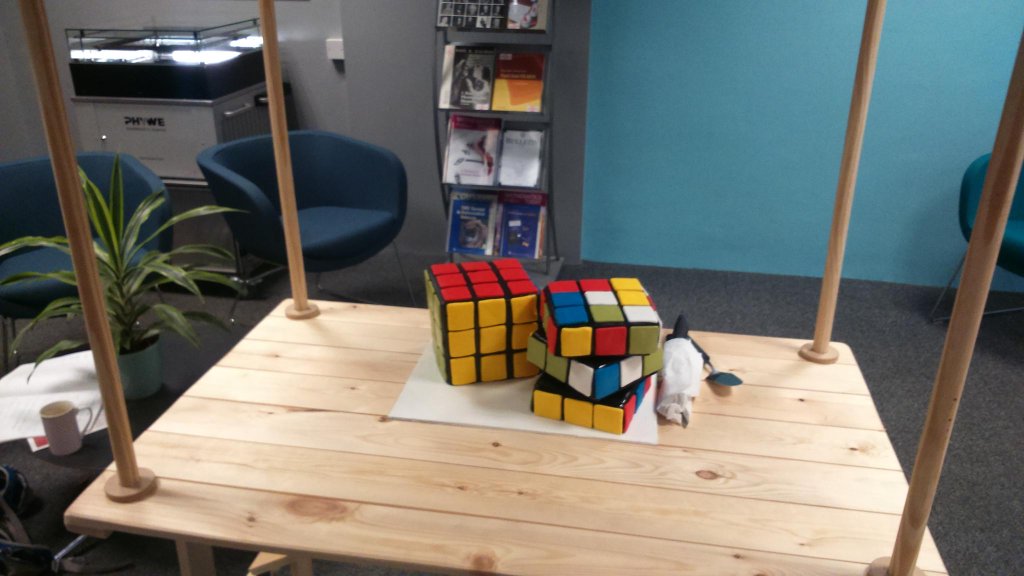
As you can see, today’s cakes were inspired by Rubik’s Cube. One reason for this choice is that we were thanking the former Head of Department of Mathematics, Miro Chlebik who stood down this summer, for his service in that role. The other is that we felt that a Mattematical theme (Geddit?) would be appropriate to mark the departure of one of our office staff, Matt Tiernan, who leaves us today for a job elsewhere in the University. I’ll just add a “goodbye” and “good luck” message to the heartfelt thanks offered by our School Administrator Oonagh in her speech this afternoon!
Follow @telescoperThe Applicant
Posted in Poetry with tags Sylvia Plath, The Applicant on October 23, 2015 by telescoperFirst, are you our sort of a person?
Do you wear
A glass eye, false teeth or a crutch,
A brace or a hook,
Rubber breasts or a rubber crotch,
Stitches to show something’s missing? No, no? Then
How can we give you a thing?
Stop crying.
Open your hand.
Empty? Empty. Here is a hand
To fill it and willing
To bring teacups and roll away headaches
And do whatever you tell it.
Will you marry it?
It is guaranteed
To thumb shut your eyes at the end
And dissolve of sorrow.
We make new stock from the salt.
I notice you are stark naked.
How about this suit——
Black and stiff, but not a bad fit.
Will you marry it?
It is waterproof, shatterproof, proof
Against fire and bombs through the roof.
Believe me, they’ll bury you in it.
Now your head, excuse me, is empty.
I have the ticket for that.
Come here, sweetie, out of the closet.
Well, what do you think of that?
Naked as paper to start
But in twenty-five years she’ll be silver,
In fifty, gold.
A living doll, everywhere you look.
It can sew, it can cook,
It can talk, talk, talk.
It works, there is nothing wrong with it.
You have a hole, it’s a poultice.
You have an eye, it’s an image.
My boy, it’s your last resort.
Will you marry it, marry it, marry it.
by Sylvia Plath (1932-1963)
Science is (still) Vital
Posted in Biographical, Politics, Science Politics with tags cuts, Science is Vital on October 22, 2015 by telescoperI’ve been on an interview panel all day and have only just emerged, blinking, into the daylight. I thought I’d take the opportunity to remind readers that there is a very important meeting/rally scheduled for Monday evening (26th October) at the Conway Hall in London organised by Science is Vital to campaign against proposed cuts in UK science funding. I got my ticket some time ago, but I think there are a few places left. If you can’t make the meeting then you can still write a postcard to George Osborne. I have done a couple myself. Being in Brighton I was tempted to send one demonstrating the subtle humour characteristic of British seaside postcards, such as this one
 but I decided not to.
Anyway, it’s almost five years since I last participated in a rally in London to protest against proposed cuts to the UK science budget. Since then research funding has been heavily squeezed by a “flat cash” settlement that threatens the survival our science base, with consequent damaging effects on the long-term future of the economy. This graphic, from a post by Stephen Curry, says it all:

Back in 2010, most of us were relieved that the outcome of the Chancellor’s spending review was a level funding in cash terms, although the decline in real terms funding since then has been enormously challenging across the board. The forthcoming spending review puts us in an even more dangerous situation. After the 2010 election the Coalition government announced a “ring fence” that protected science spending from cash cuts for the duration of the last Parliament (although this has, as the graphic above demonstrates) translated into real-terms cuts year on year. This time any commitment to a ring-fence from the Conservative government has been conspicuous by its absence. Indeed, its decision to claw back funding of STEM subjects through HEFCE has demonstrated its intention to remove even this modest protection. The government has signalled its desire to cut overall spending massively this time, and there are few places left for the axe to fall other than in research. Now the UK’s research councils are being told to budget for cuts of 20% and 40% to their core funding. This will lead to the abandonment of many international research projects and lead to large-scale redundancies across the sector, driving the best of our scientists abroad. These plans are bad not only for science, but for the economy as a whole because it is only through growth triggered by research and innovation that this country can hope to recover from the mess that it is currently in.
Follow @telescoper
Do Primordial Fluctuations have a Quantum Origin?
Posted in The Universe and Stuff with tags Cosmology, Inflation, Perturbations, Primordial Density Fluctuations, Quantum Mechanics, quantum theory, the early Universe on October 21, 2015 by telescoperA quick lunchtime post containing a confession and a question, both inspired by an interesting paper I found recently on the arXiv with the abstract:
We investigate the quantumness of primordial cosmological fluctuations and its detectability. The quantum discord of inflationary perturbations is calculated for an arbitrary splitting of the system, and shown to be very large on super-Hubble scales. This entails the presence of large quantum correlations, due to the entangled production of particles with opposite momentums during inflation. To determine how this is reflected at the observational level, we study whether quantum correlators can be reproduced by a non-discordant state, i.e. a state with vanishing discord that contains classical correlations only. We demonstrate that this can be done for the power spectrum, the price to pay being twofold: first, large errors in other two-point correlation functions, that cannot however be detected since hidden in the decaying mode; second, the presence of intrinsic non-Gaussianity the detectability of which remains to be determined but which could possibly rule out a non-discordant description of the Cosmic Microwave Background. If one abandons the idea that perturbations should be modeled by Quantum Mechanics and wants to use a classical stochastic formalism instead, we show that any two-point correlators on super-Hubble scales can exactly be reproduced regardless of the squeezing of the system. The later becomes important only for higher order correlation functions, that can be accurately reproduced only in the strong squeezing regime.
I won’t comment on the use of the word “quantumness” nor the plural “momentums”….
My confession is that I’ve never really followed the logic that connects the appearance of classical fluctuations to the quantum description of fields in models of the early Universe. People have pointed me to papers that claim to spell this out, but they all seem to miss the important business of what it means to “become classical” in the cosmological setting. My question, therefore, is can anyone please point me to a book or a paper that addresses this issue rigorously?
Please let me know through the comments box, which you can also use to comment on the paper itself…
Follow @telescoper
 In the Dark