Here’s a little mathematical exercise with a Valentines theme:
Sketch the curve in the x-y plane described by the equation

for

Geddit?
Answer: the equation is that of a cardioid:

Here’s a little mathematical exercise with a Valentines theme:
Sketch the curve in the x-y plane described by the equation
for
Geddit?
Answer: the equation is that of a cardioid:
Just a few months ahead of the 2015 General Election (and some council elections, including here in Brighton) there’s something very worrying going on with the whole electoral process. For the 2014 European Parliament Elections last year I was on the electoral roll and used my vote as normal. However, last last year I discovered to my horror that I had been removed from the register here in Brighton. When I asked why, I was told by Brighton and Hove City Council (local councils oversee the election process) that I had to register afresh if I wanted to vote this May and that to do this I would have to supply personal details such as my National Insurance Number. This despite the fact that I have been resident at the same address in Brighton and have paid Council Tax at that address for two years. I had received no communication from anyone to warn me that I was being removed from the elctoral roll and, as far as I’m aware, had I not asked I simply would not have been able to vote in the forthcoming elections.
I assumed that this was just some sort of administrative error, but I have since heard from many other people who have similarly been summarily kicked off the electoral roll for no obvious reason. One has to be wary of anecdotal evidence about things like this, but the issue seems to be a national one, related to a botched attempt to move to individual voter registration, as opposed to registration associated with a residential address. People move around much more than houses do, so there is much more information to track. The new system has been rushed through without the resources needed to support the vastly increased complexity of keeping track of individuals. For the 2015 elections over a million people who should be eligible to vote will will be absent from the electoral register, and this will mostly be the young and mobile (including students) and those in private rented accommodation in urban areas. The potential inlfluence of this effective disenfranchisement on the election result is obvious.
The more I read about this the more alarmed I have become. I am really starting to believe that this is a cynical attempt by vested interests to manipulate the outcome of the General Election, which will hinge on a relatively small number of key marginal seats where the votes of students and other young people could be crucial. It looks very sinister.
Anyone else had trouble getting on the Electoral Register? Please let me know through the Comments Box.
Follow @telescoperI’ve been running this blog for over six years now and although I’ve posted quite a lot of music in that time I’ve never included anything by the Beatles. I decided to post it this morning just because I was listening to it last night and it struck me again how clever it is as a composition. Ostensibly in a major key (F Major) established by the opening chord, it almost immediately shifts into a minor tonality through a series of chord changes taking it to the relative minor (D Minor). The opening chord is therefore a bit of a decoy but it’s certainly a very effective hook to switch so rapidly from major to minor. It’s also (I think) the first Beatles track to be performed by Paul McCartney on his own (with strings on the original single). Paul McCartney actually wrote the tune and the lyrics. In my opinion it’s a true classic.
Follow @telescoper
I saw a news item the other day about a report produced by the Royal Society, the British Academy, the Royal Academy of Engineering and the Academy of Sciences calling for a big uplift in research spending. Specifically,
A target for investment in R&D and innovation of 3% of GDP for the UK as a whole – 1% from the government and 2% from industry and charities – in line with the top 10 OECD research investors. The government currently invests 0.5% of GDP; with 1.23% from the private sector.
For reference here is the UK’s overall R&D spending as a fraction of GDP since from 2000 to 2012 as a fraction of GDP:

Some people felt that scientific research funding has done relatively well over the past few years in an environment of deep cuts in government funding in other areas. Iit has been protected against a steep decline in funding by a “ring fence” which has kept spending level in cash terms. Although inflation as measured by the RPI has been relatively low in recent years, the real costs of scientific research have been much faster than these measures. Here is a figure that shows the effective level of funding since the last general election that shows the danger to the UK’s research base:
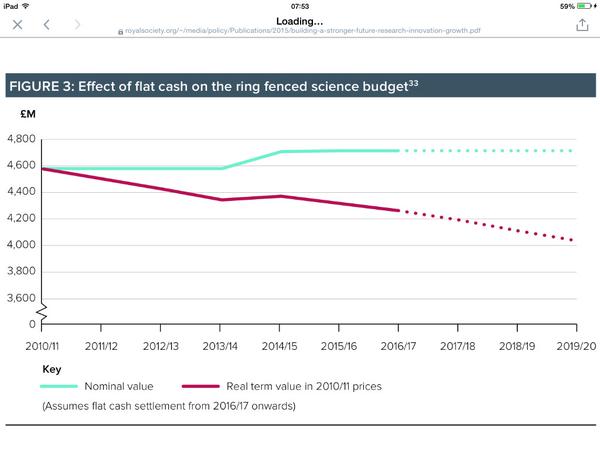
As a nation we already spend far less than we should on research and development, and this figure makes it plain that we are heading in the wrong direction. It’s not just a question of government funding either. UK businesses invest far too little in developing products and services based on innovations in science and technology. Because of this historic underfunding, UK based research has evolved into a lean and efficient machine but even such a machine needs fuel to make it work and the fuel is clearly running out…
Follow @telescoperMy recent post about postgraduate scholarships at the University of Sussex has generated quite a lot of interest so I thought I’d spend a few moments today trying to answer some of the questions I’ve been asked recently, by current and prospective students (or parents thereof).
I’ll start by explaining what the difference is between the different forms of Masters degrees in science that you can get in the United Kingdom, chiefly the distinction between an MSc and one of the variations on the MPhys or MMath we have here in the School of Mathematical and Physical Sciences here at the University of Sussex. I have to admit that it’s all very confusing so here’s my attempt to explain.
The main distinction is that the MSc “Master of Science” is a (taught) postgraduate (PG) degree, usually of one (calendar) year’s duration, whereas the MPhys etc are undergraduate (UG) degrees usually lasting 4 years. This means that students wanting to do an MSc must already have completed a degree programme (and usually have been awarded at least Second Class Honours) before starting an MSc whereas those doing the MPhys do not.
Undergraduate students wanting to do Physics in the Department of Physics & Astronomy at the University of Sussex, for example, can opt for either the 3-year BSc or the 4-year MPhys programmes. However, choosing the 4-year option does not lead to the award of a BSc degree and then a subsequent Masters qualification; graduating students get a single qualification usually termed an “integrated Masters”.
It is possible for a student to take a BSc and then do a taught MSc programme afterwards, perhaps at a different university, but there are relatively few MSC programmes for Physics in the UK because the vast majority of students who are interested in postgraduate study will already have registered for 4-year undergraduate programmes. That’s not to say there are none, however. There are notable MSc programmes dotted around, but they tend to be rather specialist; examples related to my own area include Astronomy and Cosmology at Sussex and Astrophysics at Queen Mary. Our own MSc in Frontiers in Quantum Technology is the only such course in the United Kingdom.
To a large extent these courses survive by recruiting students from outside the UK because the market from home students is so small. No department can afford to put on an entire MSc programme for the benefit of just one or two students. Often these stand-alone courses share modules with the final year of the undergraduate Masters, which also helps keep them afloat.
So why does it matter whether one Masters is PG while the other is UG? One difference is that the MSc lasts a calendar year (rather than an academic year). In terms of material covered, this means it contains 180 credits compared to the 120 credits of an undergraduate programme. Typically the MSc will have 120 credits of taught courses, examined in June as with UG programmes, followed by 60 credits worth of project work over the summer, handed in in September, though at Sussex some of our programmes are split 90 credits coursework and 90 credits of project.
The reason why this question comes up so frequently nowadays is that the current generation of applicants to university (and their parents) are facing fees of £9K per annum. The cost of doing a 3-year BSc is then about £27K compared to £36K for an MPhys. When rushing through the legislation to allow universities to charge this amount, the Powers That Be completely forgot about PG programmes, which have accordingly maintained their fees at a relatively low level, despite the fact that these are not controlled by government. For example, the MSc Astronomy at Sussex attracts a fee of about £6K for home students and £17K for overseas students. These levels are roughly consistent with the UG fees paid by home students on the previous fee regime (approx £3.5K per annum, bearing in mind that you get 1.5 times as much teaching on an MSc compared to a year of an MPhys).
Being intelligent people, prospective physicists look at the extra £9K they have to pay for the 4th year of an MPhys and compare it with the current rate for an entire MSc and come to the conclusion that they should just do a BSc then switch. This seems to be not an unreasonable calculation to make.
However, there are some important things to bear in mind. Firstly, unlike UG programmes, the fee for PG programmes is basically unregulated. Universities can charge whatever they like and can increase them in the future if they decide to. See, for example, the list at Sussex University which shows that MSc fees already vary by more than a factor of four from one school to another. Incidentally, that in itself shows the absurdity of charging the same fee for UG degrees regardless of subject…
Now the point is that if one academic year of UG teaching costs £9K for future students, there is no way any department can justify putting on an entire calendar of advanced courses (i.e. at least 50% more teaching at an extremely specialist level) for less than half the income per student. Moreover undergraduate courses in laboratory-based sciences attract an additional contribution of around £1.4K (“the unit of resource”) paid by the government to the University concerned via HEFCE. The logical fee level for MSc programmes is mininum of about 1.5 times the UG fee, plus the unit of resource applied to full calendar year, which is a whopping £15.6K (similar to the current whopping amount already paid by overseas students for these programmes). It’s therefore clear that you cannot take the current MSc fee levels as a guide to what they will be in three years’ time, when you will qualify to enter a taught PG programme. Prices will certainly have risen by then. I doubt if there will be a sudden step-change, but they will rise.
The picture has changed significantly since the Chancellor of the Exchequer announced in the Autumn Statement last year that loans of up to £10,000 would be made available to students on postgraduate (Masters) courses from 2016/17 onwards. Welcome though this scheme may be it does not apply to students wanting to start a Masters programme this September (i.e. for Academic Year 2015/16).
I’d say that, contrary to what many people seem to think, if you take into the full up-front fee and the lack of student loans etc, the cost of a BSc + MSc is already significantly greater than doing an MPhys, and in future the cost of the former route will inevitably increase. I therefore don’t think this is a wise path for most Physics undergraduates to take, assuming that they want their MSc to qualify them for a career in Physics research, either in a university or a commercial organization, perhaps via the PhD degree, and they’re not so immensely rich that money is no consideration.
The exception to this conclusion is for the student who wishes to switch to another field at Masters level, to do a specialist MSc in a more applied discipline such as medical physics or engineering. Then it might make sense, as long as you can find a way to deal with the need to pay up-front for such courses.
Now comes the plug for Sussex. Last week the University of Sussex unveiled a huge boost to the University’s flagship Chancellor’s Masters Scholarships means that 100 students graduating this summer with a first-class degree from any UK university will be eligible to receive a £10,000 package (non-repayable) to study for a Masters degree at Sussex. There are also specific schemes to support students who are already at Sussex; see here.
I’m drawing this to the attention of readers of this blog primarily to point out that the Department of Physics & Astronomy at the University of Sussex is one of relatively few UK universities to have a significant and well-established programme of Masters (MSc) courses, including courses in Physics, Particle Physics, Cosmology, and Astronomy. In particular, as I mentioned above, we are the only Department in the United Kingdom to have an MSc in Quantum Technology, an area which has just benefitted from a substantial cash investment from the UK government.
Wisely, the University of Sussex has introduced special measures to encourage current Integrated Masters students to stay on their degree rather than bailing out into a BSc and taking a Masters. However, this scheme is a great opportunity for high-flying physics graduates from other universities to get a funded place on any of our MSc programmes to start later this year. Indeed, the deal that is being offered is so good that I would recommend students who are currently in the third year of 4-year MPhys or MSci integrated Masters programmes, perhaps at a dreary University in the Midlands, to consider ditching your current course, switching to a BSc and graduating in June in order to take up this opportunity. The last year of an integrated Masters consists of 120 credits of material for which you will have to be a further £9K of fees; a standalone Masters at Sussex would involve 180 credits and be essentially free if you get a scholarship.
Think about it, especially if you are interested in specializing in Quantum Technology. Sussex is the only university in the UK where you can take an MSc in this subject! This is a one-off opportunity, since (a) this scheme will be replaced by loans from 2016/17 and (b) the fees will almost certainly have risen by next year for the reasons I outlined above.
In conclusion, though, I have to say that, like many other aspects of Higher Education in the Disunited Kingdom, this system is a mess. I’d prefer to see the unified system of 3 year UG Bachelor degrees, 2-year Masters, and 3-year PhD that pertains throughout most of continental Europe.
P.S. In the interest of full disclosure, I should point out an even worse anomaly. I did a 3-year Honours degree in Natural Science at Cambridge University for which I was awarded not a BSc but a BA (Bachelor of Arts). A year or so later this – miraculously and with no effort on my part – turned into an MA. Work that one out if you can.
Follow @telescoperI have done it again.
One year in every ten
I manage it–
A sort of walking miracle, my skin
Bright as a Nazi lampshade,
My right foot
A paperweight,
My face a featureless, fine
Jew linen.
Peel off the napkin
O my enemy.
Do I terrify?–
The nose, the eye pits, the full set of teeth?
The sour breath
Will vanish in a day.
Soon, soon the flesh
The grave cave ate will be
At home on me
And I a smiling woman.
I am only thirty.
And like the cat I have nine times to die.
This is Number Three.
What a trash
To annihilate each decade.
What a million filaments.
The peanut-crunching crowd
Shoves in to see
Them unwrap me hand and foot–
The big strip tease.
Gentlemen, ladies
These are my hands
My knees.
I may be skin and bone,
Nevertheless, I am the same, identical woman.
The first time it happened I was ten.
It was an accident.
The second time I meant
To last it out and not come back at all.
I rocked shut
As a seashell.
They had to call and call
And pick the worms off me like sticky pearls.
Dying
Is an art, like everything else.
I do it exceptionally well.
I do it so it feels like hell.
I do it so it feels real.
I guess you could say I’ve a call.
It’s easy enough to do it in a cell.
It’s easy enough to do it and stay put.
It’s the theatrical
Comeback in broad day
To the same place, the same face, the same brute
Amused shout:
‘A miracle!’
That knocks me out.
There is a charge
For the eyeing of my scars, there is a charge
For the hearing of my heart–
It really goes.
And there is a charge, a very large charge
For a word or a touch
Or a bit of blood
Or a piece of my hair or my clothes.
So, so, Herr Doktor.
So, Herr Enemy.
I am your opus,
I am your valuable,
The pure gold baby
That melts to a shriek.
I turn and burn.
Do not think I underestimate your great concern.
Ash, ash–
You poke and stir.
Flesh, bone, there is nothing there–
A cake of soap,
A wedding ring,
A gold filling.
Herr God, Herr Lucifer
Beware
Beware.
Out of the ash
I rise with my red hair
And I eat men like air.
by Sylvia Plath (October 27, 1932 – February 11, 1963)
Follow @telescoper
I’ve posted this before but I thought I would do so again, just because it’s so marvellous.
I wonder what you felt as you watched it? What went through your mind? Amusement? Fascination? I’ll tell you how it was for me when I first saw it. I marvelled.
Seeing the extraordinary behaviour of this incredible creature filled me with a sense of wonder. But I also began to wonder in another sense too. How did the Lyre Bird evolve its bizarre strategy? How does it learn to be such an accurate mimic? How does it produce such a fascinating variety of sounds? How can there be an evolutionary advantage in luring a potential mate to the sound of foresters and a chainsaw?
The Lyre Bird deploys its resources in such an elaborate and expensive way that you might be inclined to mock it, if all it does is draw females to “look at its plumes”. I can think of quite a few blokes who adopt not-too-dissimilar strategies, if truth be told. But if you could ask a Lyre Bird it would probably answer that it does this because that’s what it does. The song defines the bird. That’s its nature.
I was moved to post the clip some time ago in response to a characteristically snide and ill-informed piece by Simon Jenkins in the Guardian. Jenkins indulges in an anti-science rant every now and again. Sometimes he has a point, in fact. But that article was just puerile. Perhaps he had a bad experience of science at school and never got over it.
I suppose I can understand why some people are cynical about scientists stepping into the public eye to proselytise about science. After all, it’s also quite easy to come up with examples of scientists who have made mistakes. Sadly, there are also cases of outright dishonesty. The inference is that science is no good because scientists are fallible. But scientists are people, no better and no worse than the rest. To err is human and all that. We shouldn’t expect scientists to be superhuman any more than we should believe the occasional megalomaniac who says they are.
To many people fundamental physics is a just a load of incomprehensible gibberish, the Large Hadron Collider a monstrous waste of money, and astronomy of no greater value to the world than astrology. Any scientist trying to communicate science to the public must be trying to hoodwink them, to rob them of the schools and hospitals that their taxes should be building and sacrifice their hard-earned income on the altar of yet another phoney religion.
And now the BBC is participating in this con-trick by actually broadcasting popular programmes about science that have generated huge and appreciative audiences. Simon Jenkins obviously feels threatened by it. He’s probably not alone.
I don’t have anything like the public profile of the target of Jenkins’ vitriol, Lord Rees, but I try to do my share of science communication. I give public lectures from time to time and write popular articles, whenever I’m asked. I also answer science questions by email from the general public, and some of the pieces I post on here receive a reasonably wide distribution too.
Why do I (and most of my colleagues) do all this sort of stuff? Is it because we’re after your money? Actually, no it isn’t. Not directly, anyway.
I do all this stuff because, after 25 years as a scientist, I still have a sense of wonder about the universe. I want to share that as much as I can with others. Moreover, I’ve been lucky enough to find a career that allows me to get paid for indulging my scientific curiosity and I’m fully aware that it’s Joe Public that pays for me to do it. I’m happy they do so, and happier still that people will turn up on a rainy night to hear me talk about cosmology or astrophysics. I do this because I love doing science, and want other people to love it too.
Scientists are wont to play the utilitarian card when asked about why the public should fund fundamental research. Lord Rees did this in his Reith Lectures, in fact. Physics has given us countless spin-offs – TV sets, digital computers, the internet, you name it – that have created wealth for UK plc out of all proportion to the modest investment it has received. If you think the British government spends too much on science, then perhaps you could try to find the excessive sum on this picture.
Yes, the LHC is expensive but the cost was shared by a large number of countries and was spread over a long time. The financial burden to the UK now amounts to the cost of a cup of coffee per year for each taxpayer in the country. I’d compare this wonderful exercise in friendly international cooperation with the billions we’re about to waste on the Trident nuclear weapons programme which is being built on the assumption that international relations must involve mutual hatred.
This is the sort of argument that gets politicians interested, but scientists must be wary of it. If particle physics is good because it has spin-offs that can be applied in, e.g. medicine, then why not just give the money to medical research?
I’m not often put in situations where I have to answer questions like why we should spend money on astronomy or particle physics but, when I am, I always feel uncomfortable wheeling out the economic impact argument. Not because I don’t believe it’s true, but because I don’t think it’s the real reason for doing science. I know the following argument won’t cut any ice in the Treasury, but it’s what I really think as a scientist (and a human being).
What makes humans different from other animals? What defines us? I don’t know what the full answer to that is, or even if it has a single answer, but I’d say one of the things that we do is ask questions and try to answer them. Science isn’t the only way we do this. There are many complementary modes of enquiry of which the scientific method is just one. Generally speaking, though, we’re curious creatures.
I think the state should support science but I also think it should support the fine arts, literature, humanities and the rest, for their own sake. Because they’re things we do. They make us human. Without them we’re just like any other animal that consumes and reproduces.
So the real reason why the government should support science is the song of the Lyre Bird. No, I don’t mean as an elaborate mating ritual. I don’t think physics will help you pull the birds. What I mean is that even in this materialistic, money-obsessed world we still haven’t lost the need to wonder, for the joy it brings and for the way it stimulates our minds; science doesn’t inhibit wonder, as Jenkins argues, it sparks it.
Now, anyone want to see my plumes?
Follow @telescoperI was intrigued by an article I found at the weekend which reports on a (no doubt rigorous) scientific study that claims a connection between the relative lengths of index and ring fingers and the propensity to be promiscuous. The assertion is that people whose ring finger is longer than their index finger like to play around, while those whose index finger is longer than their ring finger are inclined to fidelity. Obviously, since the study involves the University of Oxford’s Department of Experimental Psychology, there can be do doubt whatsoever about its reliablity or scientific credibility, just like the dozens of other things supposed to be correlated with digit ratio. Ahem.
I do remember a similar study some time ago that claimed that men with with a longer index finger (2D) than ring finger (4D) (i.e. with a 2D:4D digit ratio greater than one) were much more likely to be gay than those with a digit ratio lower than one. Taken with this new finding it proves what we all knew all along: that heterosexuals are far more likely to be promiscuous than homosexuals.
For the record, here is a photograph of my left hand (which, on reflection, is similar to my right, and which clearly shows a 2D:4D ratio greater than unity):

Inspired by the stunning application of the scientific method described in the report, I have decided to carry out a rigorous study of my own. I have heard that, at least among males, it is much more common to have digit ratio less than one than greater than one but I can’t say I’ve noticed it myself. Furthermore previously unanswered question in the literature is whether there is a connection between digit ratio and the propensity to read blogs. I will know subject this to rigorous scientific scrutiny by inviting readers of this blog to complete the following simply survey. I look forward to publishing my findings in due course in the Journal of Irreproducible Results.
PS. The actual paper on which the report was based is by
Follow @telescoperTaking a short break from this weekend’s task of preparing notes and problem sets for the Theoretical Physics module I’m teaching this term. In the course of putting this stuff together I remembered an old post I did some time ago about lecture notes.
I won’t repeat the entire content of my earlier discussion, but one of the main points I made in that was about how inefficient many students are at taking notes during lectures, so much so that the effort of copying things onto paper must surely prevent them absorbing the intellectual content of the lecture (assuming that there is any).
I dealt with this problem when I was an undergraduate by learning to write very quickly without looking at the paper as I did so. That way I didn’t waste time moving my head to and fro between paper and screen or blackboard. Of course, the notes I produced using this method weren’t exactly aesthetically pleasing, but my handwriting is awful at the best of times so that didn’t make much difference to me. I always wrote my notes up more neatly after the lecture anyway. But the great advantage was that I could write down everything in real time without this interfering with my ability to listen to what the lecturer was saying.
An alternative to this approach is to learn shorthand, or invent your own form of abbreviated language. This approach is, however, unlikely to help you take down mathematical equations quickly.
My experience nowadays is that students simply aren’t used to taking notes like this – I suppose because they get given so many powerpoint presentations or other kinds of handout – so they struggle to cope with the old-fashioned chalk-and-talk style of teaching that some lecturers still prefer. That’s probably because they get much less practice at school than my generation. Most of my school education was done via the blackboard..
Nowadays, most lecturers use more “modern” methods than this. Many lecturers using powerpoint, and often they give copies of the slides to students. Others give out complete sets of printed notes before, during, or after lectures. That’s all very well, I think, but what are the students supposed to be doing during the lecture if you do that? Listen, of course, but if there is to be a long-term benefit they should take notes too.
Even if I hand out copies of slides or other notes, I always encourage my students to make their own independent set of notes, as complete as possible. I don’t mean copying down what they see on the screen and what they may have on paper already, but trying to write down what I say as I say it. I don’t think many take that advice, which means much of the spoken illustrations and explanations I give don’t find their way into any long term record of the lecture.
And if the lecturer just reads out the printed notes, adding nothing by way of illustration or explanation, then the audience is bound to get bored very quickly.
My argument, then, is that regardless of what technology the lecturer uses, whether he/she gives out printed notes or not, then if the students can’t take notes accurately and efficiently then lecturing is a complete waste of time. In fact for the Theoretical Physics module I’m doing now I don’t hand out lecture notes at all during the lectures, although I do post lecture summaries and answers to the exercises online after they’ve been done.
As a further study aid, most lectures at Sussex University are recorded and made available to students to view shortly after the event. In most cases this is video as well as audio but in some smaller rooms only audio capture is available. I checked the attendance at my lecture last week (the third week of Term) and found over 95% of those enrolled were at the lectures. There’s no evidence that availability of recorded lectures has lowered the attendance. It appears that students use the recordings for revision and/or to clarify points raised in the notes they have taken.
I would actually like to put my lectures online, e.g. on YouTube, so they could be viewed freely by anyone who wanted but I am told this is against University policy as the campus trade union, UCU, had objected to the suggestion. I don’t know why.
I do like lecturing, because I like talking about physics and astronomy, but as I’ve got older I’ve become less convinced that lectures play a useful role in actually teaching anything. I think we should use lectures more sparingly, relying more on problem-based learning to instil proper understanding. When we do give lectures, they should focus much more on stimulating interest by being entertaining and thought-provoking. They should not be for the routine transmission of information, which is far too often the default.
I’m not saying we should scrap lectures altogether. At the very least they have the advantage of giving the students a shared experience, which is good for networking and building a group identity. Some students probably get a lot out of lectures anyway, perhaps more than I did when I was their age. But different people benefit from different styles of teaching, so we need to move away from lecturing as the default option and ensure that a range of teaching methods is available.
I don’t think I ever learned very much about physics from lectures – I found problem-based learning far more effective – but I’m nevertheless glad I learned out how to take notes the way I did because I find it useful in all kinds of situations. Effective note-taking is definitely a transferable skill, but it’s also in danger of becoming a dying art. If we’re going to carry on using lectures, we old fogeys need to stop assuming that students learnt it the way we did and start teaching it as a skill.
Follow @telescoperI looked for this quotation last week when I heard a reference to it on Radio 3 in connection with some incidental music written by Dmitry Shostakovich for a film of King Lear. Reading the full text it struck me that academic life has many of the advantages of being in prison…
No, no, no, no! Come, let’s away to prison:
We two alone will sing like birds i’ the cage:
When thou dost ask me blessing, I’ll kneel down,
And ask of thee forgiveness: so we’ll live,
And pray, and sing, and tell old tales, and laugh
At gilded butterflies, and hear poor rogues
Talk of court news; and we’ll talk with them too,
Who loses and who wins; who’s in, who’s out;
And take upon’s the mystery of things,
As if we were God’s spies: and we’ll wear out,
In a wall’d prison, packs and sects of great ones,
That ebb and flow by the moon.
(King Lear, Act V Scene 3)
Follow @telescoper
 In the Dark