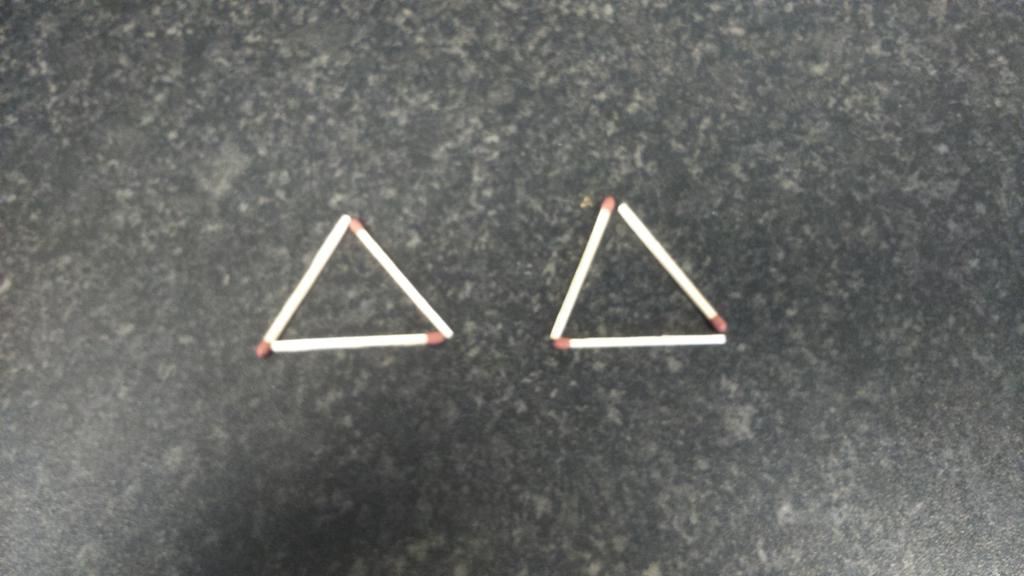
 Puzzle time! Move three (and only three) matches and position them to create just four, i.e four and only four, (identical) triangles. No cutting the matches, either!
Click on to see the answer…
Puzzle time! Move three (and only three) matches and position them to create just four, i.e four and only four, (identical) triangles. No cutting the matches, either!
Click on to see the answer…
It’s certainly a wet start to 2014 here in Brighton, but did you know that 2014 was the warmest year in the UK since records began as well as one of the wettest?
 Colour-coded Map of UK showing how each region of the UK exceeded the 1981-2010 average temperature. Crown Copyright
2014 was the warmest year in the UK ‘since records began’ – and most probably the warmest since at least 1659. You can read the Met Office Summary here
The World Meteorological Organisation (WMO) also report that 2014 is likely to have been the warmest year in Europe and indeed over the entire Earth for at least 100 years.
This was briefly ‘news‘ but somehow this astonishing statistic seems to have disappeared almost without trace.
In fact there are three astonishing things about the statistic
This article is about why
View original post 519 more words
The following clip comes from a broadcast on Fox News:
The fact that Steve Emerson’s statement was laughably exaggerated and based entirely on ignorance (in this case of the city of Birmingham) comes as no surprise. After all, this was Fox News – a channel whose drivel-mongering is often beyond parody. It did however provoke two things that were surprising, at least to me.
One was something that is a rare commodity these days: a full and unreserved apology:

It’s better not to say stupid things in the first place, but credit to him at least for doing the right thing. I gather he has made a donation to a children’s hospital in Birmingham. So there’s that.
The other surprising thing was what happened on Twitter. Some genius had the idea of setting up a hashtag called #FoxNewsFacts. The consequences were hilarious, as hundreds of people contributed tweets lampooning Fox News for its ignorance of the United Kingdom and of Islam. You can find some of the funniest ones here.
I even contributed a few myself. This one proved a particular hit:
Sharia Law is the wife of retired footballer Denis Law. #foxnewsfacts
— Peter Coles (@telescoper) January 11, 2015
There was also this:
The UK’s largest mosque is in #Brighton It also doubles as a venue for same-sex weddings. #FoxNewsFacts pic.twitter.com/rnw9ZgZH9C
— Peter Coles (@telescoper) January 12, 2015
and this
Trains are so nervous about entering Birmingham that they often wait hours outside New St Station before plucking up courage #FoxNewsFacts
— Peter Coles (@telescoper) January 12, 2015
But my favourite was this:
In Britain the weather switches between Sunni and Shi’ite #foxnewsfacts — 가빈 (@blueliberal1) January 11, 2015
I thought it was wonderful how Twitter users responded in such an imaginative, light-heartedly humorous, and sometimes downright surreal, way to something which could instead have produced pure bile. Twitter isn’t always like that, but yesterday it was a delight on a dark and stormy evening and a welcome change of mood after the depressing events of the last week. And I’m glad to say #FoxNewsFacts is still trending…so it’s not too late to have a go yourself!
Follow @telescoperChristmas Eve saw the passing of another great Jazz artist, the clarinettist Buddy DeFranco , at the grand old age of 91. Not surprisingly, glowing tributes to him have appeared in all the mainstream media as well as in specialist jazz sources as he was an absolutely superb musician as well as a distinctive stylist. Alongside countless other measures of his greatness and popularity, he won no less than twenty Downbeat Magazine Awards and nine Metronome Magazine Awards as the number one jazz clarinettist in the world.
It’s an interesting facet of jazz history that the clarinet, a mainstay of jazz styles from the New Orleans roots through to the Swing Era, fell into disfavour in the post-war era with the advent of bebop when it was largely eclipsed by the saxophone. Very few musicians persisted with the clarinet into the era of modern jazz, but Buddy DeFranco was one who did. That’s not to say that he disliked swing music though. In fact he began his career playing with big bands of that era, such as those led by Gene Krupa and Tommy Dorsey. One of the most famous bands of that era, the Glenn Miller Orchestra, formed in 1935 and saw its greatest popularity during the Second World War. It was disbanded in 1944 on the death of its leader, but it started again in 1956 and, although it has had a number of changes of personnel, it is still going strong. So strong that there’s a minimum two year waiting list if you want to book the Glenn Miller Orchestra for a gig! With the 70th anniversary of the end of World War Two coming up this year, I’ve no doubt that there’ll be a great deal of nostalgia evoked by renditions of Moonlight Serenade..
The distinctive sound of the original Glenn Miller Orchestra largely derived from the unusual arrangement of its reed section: usually four saxophones playing in harmony, topped by a high clarinet lead. Many jazz fans found that blend a bit too honeyed compared with the likes of, e.g., the Count Basie Orchestra but there’s no question that it gave the band an immediately recognisable sound. Despite his predilection for more modern jazz idioms, especially bebop, Buddy DeFranco obviously very much liked the idea of a big band with a clarinet playing such a prominent part and, in fact, he was the leader and musical director of the revived Glenn Miller Orchestra from 1966 until 1974, and also guested with them on a number of occasions after that.
Anyway, Buddy DeFranco was one of the most technically accomplished clarinettists in all of jazz. Very few have ever been able to match his control, particularly in the upper register. But what I admired most about him was his willingness to take on material not usually associated with his instrument. Here’s a great example, of him playing the John Coltrane classic Giant Steps together with Terry Gibbs on vibraphone. When I saw the relatively low quality reproduction of the film I assumed the sound quality would be similarly poor, but some superb remastering work has been done and this sounds terrific.
Rest In Peace, Buddy DeFranco (1923-2014).
Follow @telescoperIn an attempt to get away from the horrors of the last few days I thought I’d offer this video I just found on Youtube. It features majestic, life-affirming music from the 2nd Movement of Beethoven’s Symphony No. 7 in A Major along with some wonderful astronomical images from the Hubble Space Telescope. Science and art for all humanity. How pathetic our petty squabbles appear when we think about the Universe or listen to great music.
Follow @telescoperOn Wednesday afternoon, after an important meeting that took up most of the morning, I headed off my train to Durham. Unusually by the standards of my recent experiences of railways, the trip went smoothly and I arrived on time. The cathedral was looking rather spectral when I arrived:

The occasion of my vist was the Young Experimentalists and Theorists Institute (YETI for short), a gathering of early career particle physicists, mainly graduate students. I was scheduled to give a 90-minute lecture on Cosmic Microwave Background Theory to the 40-50 folks attending the workshop. It was nice to get the chance to get away from budgets and spreadsheets for a time and talk about cosmology, and it was an interesting audience different from the usual more specialist crowd I get to talk to at graduate workshops. It’s good, especially for beginning research students, to find out about subjects outside their immediate research topic and I’m glad the YETI organizers appreciate that. On the other hand, CMB theory is a huge topic so it was difficult to decide what to put in and what to leave out.
Incidentally, 2015 sees the 50th anniversary of the discovery of the Cosmic Microwave Background, and with yet more exciting results due out soon I’m sure the CMB will be in the news a lot this year.
I spent Wednesday night at Collingwood College, where the conference delegates were accommodated, and gave my 90-minute talk, starting at 9am yesterday morning, paused for quick cup of coffee and then legged it back to Durham station for the return journey back to Brighton. It’s a pity I didn’t get the chance to stay longer, especially because the second speaker of the morning, on CMB Observations, was Jo Dunkley of Oxford University who this afternoon is giving a talk at the Royal Astronomical Society because she has just been awarded the Society’s Fowler Prize. I can’t attend that meeting because of work commitments either. Sigh.
The train journey back to Brighton went smoothly and on time too. Wonders never cease!
Anyway, thanks to the organizers of YETI for inviting me. I hope the talk was reasonably comprehensible. Apologies to my other friends at Durham for not hanging around, but I really didn’t have time to stop for a natter or, more importantly, a beer or several.
Follow @telescoperI’ve been very busy today, mainly travelling, so haven’t had timetable do a proper post, but I saw this earlier and thought I would pass it on to my avid readers. I don’t manage as many of these as I should, but hopefully you will do better!
I turn 40 in tomorrow and I’ve more or less been 100% devoted to physics since I was 20 (2nd year uni). It’s been a journey with some highs and a couple of very serious lows. Motivated by this recent excellent post on self-care & overwork in academia, I spent some time looking back and thinking about what would I go back and tell my 20 year old self (aside from get your B.Sc. and then go get a real job, one with good prospects & good money) or others at the same stage, e.g., the 2nd year lab students I taught this year. Some are things I’ve learned and managed to incorporate, some are things that I still fail at despite repeated attempts…
1. Put up walls: Despite having an excellent role model for this over much of my career, I still haven’t learned to put up walls to keep…
View original post 1,485 more words
Laugh, and the world laughs with you;
Weep, and you weep alone.
For the sad old earth must borrow its mirth,
But has trouble enough of its own.
Sing, and the hills will answer;
Sigh, it is lost on the air.
The echoes bound to a joyful sound,
But shrink from voicing care.
Rejoice, and men will seek you;
Grieve, and they turn and go.
They want full measure of all your pleasure,
But they do not need your woe.
Be glad, and your friends are many;
Be sad, and you lose them all.
There are none to decline your nectared wine,
But alone you must drink life’s gall.
Feast, and your halls are crowded;
Fast, and the world goes by.
Succeed and give, and it helps you live,
But no man can help you die.
There is room in the halls of pleasure
For a long and lordly train,
But one by one we must all file on
Through the narrow aisles of pain.
by Ella Wheeler Wilcox (1850-1919)
Follow @telescoper





 In the Dark